
Market Overview
| Study Period | 2021 - 2031 |
|---|---|
| Forecast Data Period | 2026 - 2031 |
| Base Year Market Size (2025) | USD 43.10 Billion |
| Market Size (2026) | USD 45.01 Billion |
| Market Size (2031) | USD 54.89 Billion |
| Growth Rate (2026 - 2031) | 4.05 % |
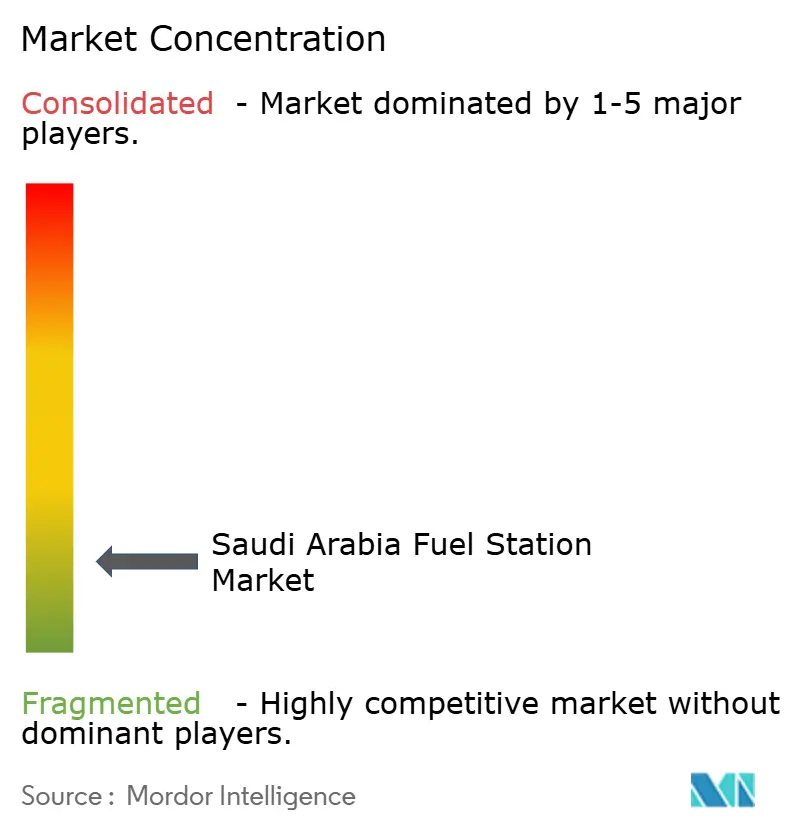
| Market Concentration | Low |
Major Players *Disclaimer: Major Players sorted in no particular order Image © Mordor Intelligence. Reuse requires attribution under CC BY 4.0. | |
Saudi Arabia Fuel Station Market Analysis by Mordor Intelligence
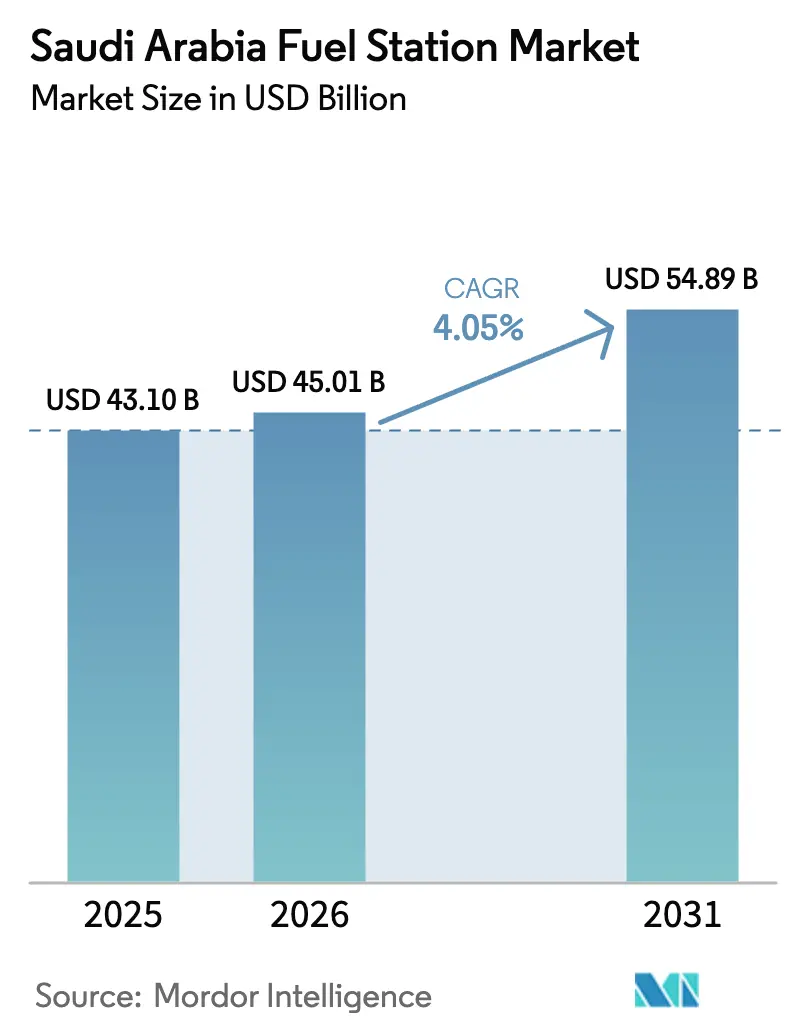
The Saudi Arabia Fuel Station Market size is projected to be USD 43.10 billion in 2025, USD 45.01 billion in 2026, and reach USD 54.89 billion by 2031, growing at a CAGR of 4.05% from 2026 to 2031.
Momentum rests on three parallel forces: a 16.8% surge in 2024 new-vehicle registrations that expanded the national parc to 15.8 million units, the diesel-price doubling that tested price elasticity yet widened retail spreads, and Vision 2030 mandates that funnel private capital into multi-energy forecourts able to dispense gasoline, diesel, electricity, and hydrogen. While gasoline retains transactional primacy, alternative fuels are scaling at a 25.3% growth, providing a hedge against looming efficiency norms and the Saudi Green Initiative. Station operators are racing to re-balance economics as Aramco’s monthly price caps leave only 5–8 halalas per-liter gross margin, tilting profit pools toward convenience retail, quick-service restaurants, and fintech-enabled loyalty programs. Foreign incumbents such as ADNOC Distribution, ENOC, and OOMCO have entered to replicate high-margin non-fuel blueprints honed in the UAE and Oman, intensifying network upgrades and accelerating consolidation across the Saudi Arabia fuel station market.
Key Report Takeaways
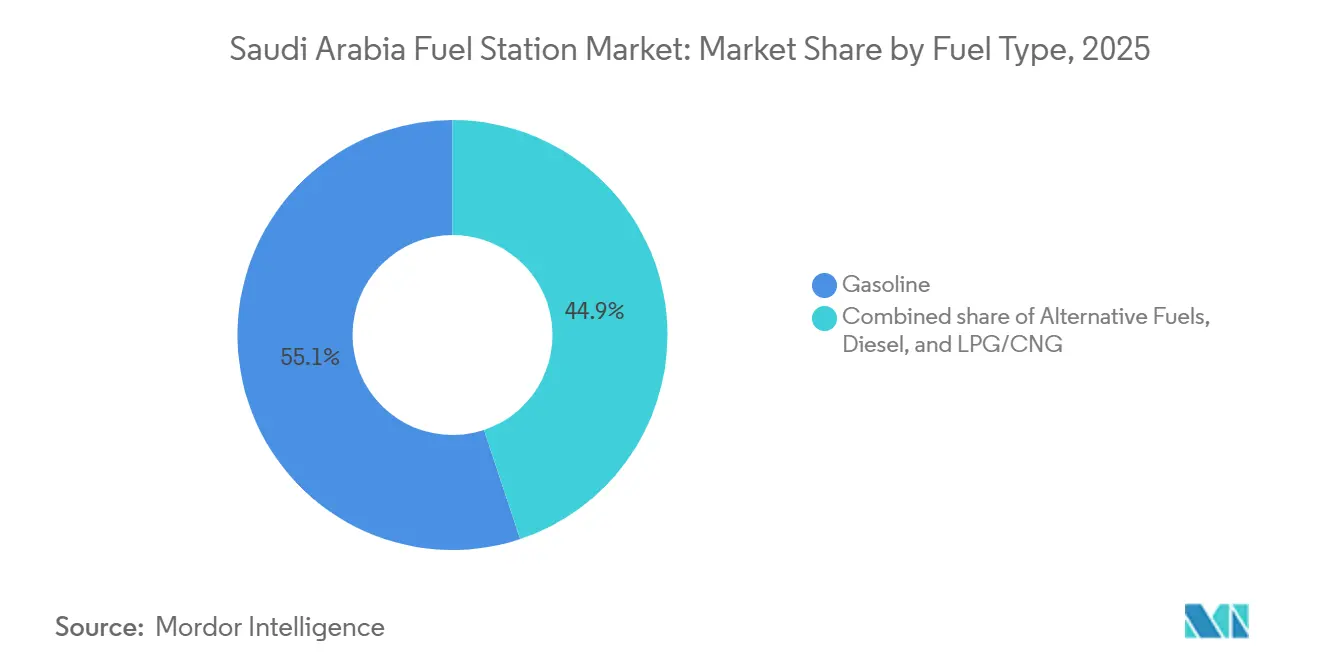
- By fuel type, gasoline led with 55.1% of the Saudi Arabian fuel station market share in 2025, whereas alternative fuels are projected to post a 25.3% CAGR through 2031.
- By service offering, fuel-and-convenience-store formats captured 51.5% revenue in 2025; multi-energy hubs integrating EV and hydrogen dispensing are forecast to grow at a 20.7% CAGR to 2031.
- By station format, traditional full-service sites held a 49.9% share in 2025, while highway service plazas are set to expand at a 6.2% CAGR over 2026-2031.
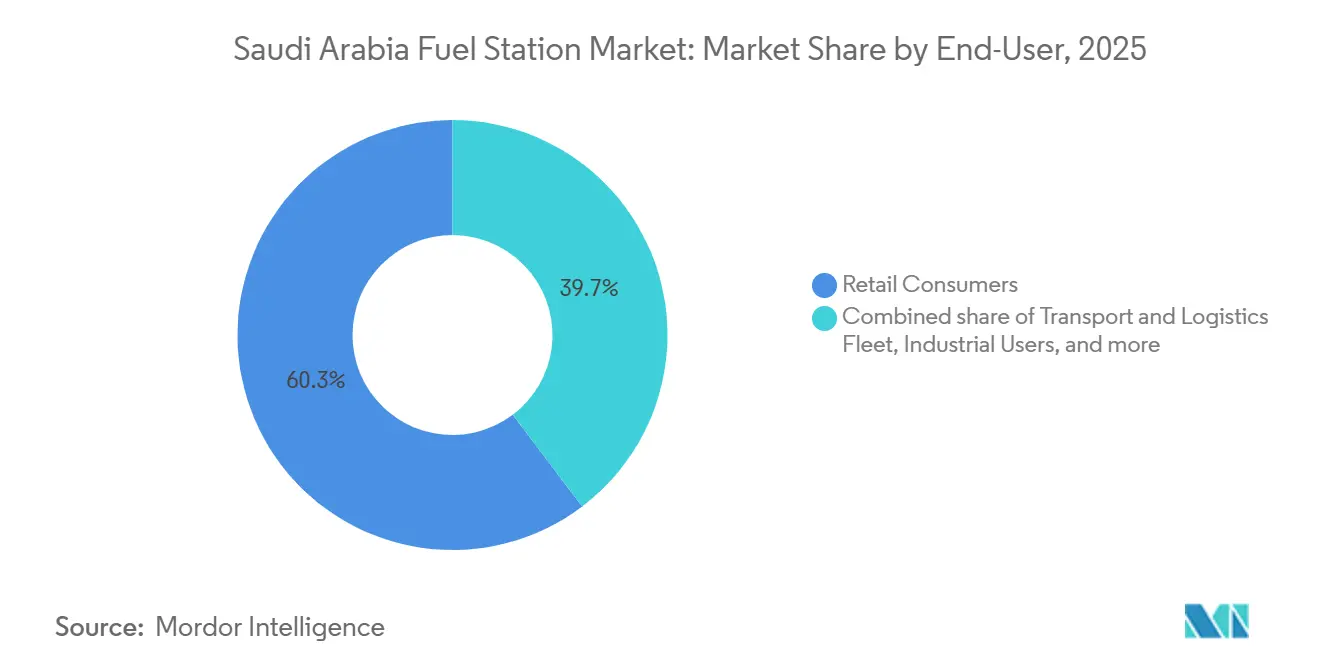
- By end user, retail motorists accounted for 60.3% demand in 2025 and transport-and-logistics fleets represent the fastest-growing cohort at 6.9% CAGR to 2031.
- SASCO, Aldrees, Petromin, the Aramco–TotalEnergies Sahel venture, and NAFT (now folded into SASCO) collectively controlled roughly 25–30% of the Saudi Arabia fuel station market in 2025, underscoring a moderately fragmented competitive field.
Note: Market size and forecast figures in this report are generated using Mordor Intelligence’s proprietary estimation framework, updated with the latest available data and insights as of January 2026.
Market Trends and Insights
Drivers Impact Analysis of Saudi Arabia Fuel Station Market*
| Driver | (~) % Impact on CAGR Forecast | Geographic Relevance | Impact Timeline |
|---|---|---|---|
| Rising light-vehicle parc post-COVID rebound | +0.9% | Riyadh, Jeddah, Dammam metros | Short term (≤ 2 years) |
| Acceleration of giga-projects (NEOM, Qiddiya, Red Sea) | +0.7% | Western & Central corridors | Medium term (2-4 years) |
| Fuel-price liberalization attracting private capex | +0.6% | Nationwide urban nodes | Medium term (2-4 years) |
| Modern convenience-retail formats boosting forecourt revenue | +0.5% | Major cities | Short term (≤ 2 years) |
| RFID / mobile pay fueling experience upgrades | +0.3% | National | Short term (≤ 2 years) |
| Uniform-design mandate forcing network modernization | +0.4% | National | Medium term (2-4 years) |
| Source: Mordor Intelligence | |||
Rising Light-Vehicle Parc Post-COVID Rebound
New-vehicle registrations jumped 16.8% in 2024, lifting the parc to 15.8 million units and directly raising throughput at the average Saudi Arabian fuel station market forecourt.[1] Passenger-car demand rebounded as consumer credit loosened and Vision 2030 construction reopened, prompting chains to retrofit legacy sites with automated dispensers that add 15–20% pump productivity at peak times. SASCO alone automated 292 stations in 2023 and introduced self-fueling at 56 sites, a move that compressed labor cost per liter while pushing volume per nozzle higher.[2] Fleet composition favors SUVs and crossovers that consume 10–15% more fuel per kilometer than sedans, cushioning gasoline demand against forthcoming CAFÉ standards. Higher utilization also enhances the addressable base for ancillary services such as oil-change bays and tire centers that lift non-fuel revenue.
Acceleration of Giga-Projects (NEOM, Qiddiya, Red Sea)
Megaprojects valued above USD 1 trillion are converting previously remote stretches into high-traffic corridors, creating micro-markets within the broader Saudi Arabia fuel station market. NEOM’s USD 8.5 billion green-hydrogen plant goes live in 2026, and Petromin has already opened a prototype site that dispenses gasoline, diesel, electricity, and hydrogen in one forecourt.[3] Highway service plazas such as SASCO’s Al-Jazeera 1 on the Riyadh–Dammam route anchor giga-project logistics, spanning 280,000 square meters and integrating QSRs, prayer halls, and rest areas to extend dwell time beyond 20 minutes. These destination-style formats justify the capex of USD 6.7–10.7 million per site and capture tourism-linked demand that Vision 2030 places at 100 million annual visits by 2030.
Fuel-Price Liberalization Attracting Private Capex
Aramco’s monthly pricing lifted diesel from SAR 0.80 to SAR 1.60 per liter in January 2024 and nudged gasoline 91 to SAR 2.37 by December 2024, eroding the subsidy-era barriers that had deterred private entrants. Gross fuel spreads of 5–8 halalas per liter now suffice when paired with 30–40% margins from convenience retail. Circle K’s alliance with the Alsulaiman Group targets 300 stores within five years, relying on higher price transparency and faster pump payback periods to justify investment. ADNOC Distribution opened 25 Saudi sites by December 2025, transplanting its ADNOC Oasis blueprint that sources up to 50% of gross profit from non-fuel lines.
Modern Convenience-Retail Formats Boosting Forecourt Revenue
As the Saudi Arabia fuel station market transitions toward thinner per-liter economics, c-stores, cafés, and QSRs supply the bulk of incremental profit. SASCO’s Palm network reached 128 outlets in 2023 and plans 60 more in 2026, accounting for 30–40% of station-level profit. The Aramco–TotalEnergies Sahel venture runs 270 mixed-energy sites that leverage Bonjour and Fai café formats to lift average tickets 20–30% above fuel-only peers. PwC research shows 62% of Saudis seek health-forward food and 40% prefer tech such as self-checkout, aligning with Circle K’s introduction of cashier-less kiosks in July 2025.
Restraints Impact Analysis of Saudi Arabia Fuel Station Market*
| Restraint | (~) % Impact on CAGR Forecast | Geographic Relevance | Impact Timeline |
|---|---|---|---|
| EV & hybrid adoption targets for 2030 | -0.5% | Riyadh, Jeddah, NEOM | Long term (≥ 4 years) |
| CAFÉ efficiency standards & ride-sharing penetration | -0.3% | Urban centers | Medium term (2-4 years) |
| Retail margin squeeze from monthly price cap | -0.2% | Nationwide | Short term (≤ 2 years) |
| Rising UST-leak compliance CAPEX | -0.1% | Legacy districts | Medium term (2-4 years) |
| Source: Mordor Intelligence | |||
EV & Hybrid Adoption Targets for 2030
The Saudi Green Initiative mandates 30% of new-vehicle sales be electric or plug-in hybrid by 2030, a policy reinforced by fleet-procurement rules for public agencies. Lucid delivered 6,200 units in 2025, triple its 2024 tally, while Ceer shipped its first 150 vehicles in September 2025, securing government-fleet contracts. Public charging points surpassed 1,000 in 2024, with another 1,000 under tender, yet utilization averages below 15%, raising questions about near-term ROI for chargers that cost SAR 150,000–250,000 each. A typical 50 kWh charge yields only SAR 75 at current tariffs, half the revenue of a gasoline fill, squeezing forecourt economics and lengthening payback periods unless bundled with high-margin retail offers.
CAFÉ Efficiency Standards & Ride-Sharing Penetration
SASO 2864:2022 phases fuel-economy rules to 20 km/L for cars by 2030, implying a 15–20% cut in per-vehicle gasoline demand. Simultaneously, ride-hailing hit USD 2.5 billion in 2023 and is growing 12% annually, with Uber, Careem, and Bolt intensifying urban competition. Higher vehicle utilization reduces the total cars needed, capping parc expansion. Fleet drivers refuel more often yet chase the cheapest pump, diluting brand loyalty and ancillary purchases. Station chains are countering with volume-discount lanes, but per-transaction profit remains 20–30% below retail norms.
*Our forecasts treat driver/restraint impacts as directional, not additive. The impact forecasts reflect baseline growth, mix effects, and variable interactions.
Saudi Arabia Fuel Station Market Segment Analysis
By Fuel Type:
Alternative Fuels Surge Amid Gasoline DominanceGasoline generated 55.1% of the Saudi Arabian fuel station market in 2025, underpinned by the 15.8 million-vehicle parc and persistent internal-combustion reliance. Diesel followed, yet its January 2024 price leap to SAR 1.60 prompted freight operators to upgrade fleets, moderating volume gains. Liquefied and compressed gases stay niche, limited by sparse dispensing points. Alternative fuels, hydrogen, and EV charging will expand at a 25.3% CAGR through 2031, buoyed by the USD 8.5 billion NEOM hydrogen plant and a 30% EV-sales mandate.[4] The Saudi Arabia fuel station market size for alternative fuels is set to outpace overall growth, yet remains a cash-consumer until charger utilization climbs above breakeven mid-decade.
Despite thin margins, operators position infrastructure early to anchor brand equity and capture first-mover data. SASCO’s fast-charger rollout begins in 2024, betting Lucid and Ceer volume will exceed 150,000 units annually by 2028. Hydrogen pumping costs run SAR 2–3 million per station, but giga-project corridors offer captive demand from construction fleets. Gasoline cash flows, therefore, cross-subsidize the transition, keeping the Saudi Arabian fuel station market resilient during the energy mix shift.

By Service Offering:
Multi-Energy Hubs Redefine Forecourt EconomicsFuel-and-c-store designs delivered 51.5% revenue in 2025 and will remain the Saudi Arabia fuel station market workhorse through 2031. Palm, Bonjour, Fai, and ADNOC Oasis concepts have demonstrated 20–30% ticket uplifts over fuel-only peers. Multi-energy hubs that pair liquid fuels with EV and hydrogen dispense points grow fastest at 20.7% CAGR, riding Vision 2030 mandates.
The Saudi Arabia fuel station market size for multi-energy hubs remains small yet strategic. Operators view electrons and hydrogen as traffic magnets that lengthen dwell times and stimulate retail baskets. Circle K’s North American planograms, health-led assortments, and self-checkout serve PwC findings on consumer preference, raising non-fuel gross margins to 35–40%. However, low electricity tariffs cap charging spreads at 10–15%, making cross-selling essential for economic viability.
By Station Format:
Highway Plazas Capture Corridor TrafficTraditional full-service sites retained 49.9% of 2025 volume, but highway plazas will post a 6.2% CAGR out to 2031 as giga-project logistics and domestic tourism scale. The Saudi Arabia fuel station market size allocated to plaza developments is rising because each project funnels USD 6.7–10.7 million into large-format sites every 150–200 km.
Al-Jazeera 1 sets the blueprint: 280,000 square meters, integrated QSRs, prayer halls, and ample truck parking. Average dwell hits 25 minutes, tripling in-store spend relative to city stations. Capex intensity limits competition to well-capitalized chains, accelerating consolidation while offering insurers and regulators uniform-design compliance that reduces operational risk.
By End User:
Transport Fleets Accelerate ElectrificationRetail motorists supplied 60.3% of 2025 demand, but logistics and ride-hailing fleets will expand at a 6.9% CAGR to 2031, propelled by e-commerce and Vision 2030 trade-hub ambitions. The Saudi Arabia fuel station market size for fleet fueling is poised to enlarge as fleet vehicles log 40,000–60,000 km annually, raising per-vehicle throughput.
Government decrees require 30% EV adoption in public fleets, nudging bulk buyers toward electrified vans and sedans starting in 2025. Chains respond with high-amp charging lanes, RFID pumps, and fleet-discount programs to protect share. Yet fleet customers bargain hard on price, yielding margins 20–30% beneath retail averages and pressuring operators to monetize data analytics and ancillary maintenance offers.
Geography Analysis
Riyadh, Jeddah, and Dammam house more than 60% of the country’s vehicle base, siphoning the lion’s share of Saudi Arabia's fuel station market throughput and non-fuel revenue. SASCO concentrates its 540 stations in these metros, where prime sites pump 3–5 million liters monthly. The Western Province’s NEOM and Red Sea tourism corridors show the fastest network build-out; Petromin’s NEOM hub embeds hydrogen and EV lines that regional planners intend to replicate near pilgrimage centers in Mecca and Medina.
Central provinces exploit inter-city highways. SASCO’s Al-Jazeera 1 plaza on the Riyadh–Dammam axis captures both commuter and long-haul freight, illustrating how high-capex formats unlock rural spending previously lost to informal truck stops. Eastern industrial belts centered on Dammam sustain diesel-heavy volumes but trail in EV uptake due to depot-to-port haul lengths that exceed current battery ranges. Northern and southern regions remain underserved; modular stations with two to four pumps and limited retail can carve local monopolies, yet longer payback horizons deter fast expansion.
Uniform-design enforcement intensifies in metros, pressing independents to retrofit or exit. Rural areas experience looser oversight, but subsidy removal equalizes pump prices nationwide, driving urban consumers to price-shop within 1–2 halalas spreads and sharpening competitive pressure in dense catchments.
Regulatory Landscape
Saudi fuel retail licensing and operational oversight are led by the Ministry of Energy (MoE), which issues petroleum product trading licenses and the station management and maintenance qualification certificate (Taheel). The qualification for establishing fuel stations has also moved from the Ministry of Municipalities and Housing to the MoE, tightening the linkage between licensing, technical competence, and ongoing compliance under the Law of Petroleum and Petrochemical Products.
On the technical side, equipment and operations are shaped by Saudi Standards, Metrology and Quality Organization (SASO) requirements covering fuel dispensing and storage infrastructure, including technical regulations for petroleum product tanks and measurement accuracy standards (including OIML-aligned certification requirements). These requirements increase retrofit and compliance capex for legacy sites, while also raising barriers to entry that favor scaled operators able to standardize systems and documentation across multi-station networks.
Competitive Landscape
The Saudi Arabia fuel station industry hosts a moderately fragmented roster: the top five operators control roughly 25–30% of national volume. SASCO leads with about a 5.5% share and a 540-station footprint, followed by Aldrees, Petromin, and the Aramco–TotalEnergies Sahel network. Gulf entrants import playbooks that hinge on diversified revenue: ADNOC Distribution’s Oasis stores, ENOC’s ZOOM outlets, and OOMCO’s Quick Shop formats replicate UAE and Omani success in extracting 50% of gross profit from non-fuel lines.
Circle K’s alliance with the Alsulaiman Group aims for 300 stores by 2030 and employs North American category management to optimize planograms and loyalty analytics. Technology is a decisive wedge: SASCO’s app enables pump reservation and in-car payment, trimming transaction times by 30–40 seconds and capturing purchase data for personalized offers. Aramco’s NFC windshield tags let fleet drivers refuel without PIN entry, feeding real-time analytics that fine-tune promotions.
Compliance costs accelerate consolidation. Uniform-design retrofits run SAR 100,000–300,000 per legacy site, prompting small independents to divest networks rather than invest. Large chains exploit scale economies in procurement, IT, and marketing, pushing the Saudi Arabia fuel station market toward a more structured oligopoly while still leaving room for regional specialists in compact or rural formats.
Saudi Arabia Fuel Station Industry Leaders
-
Aldrees Petroleum & Transport Services Co. (Aldrees)
-
SASCO
-
Petromin Corporation
-
Aramco/Total Sahel JV
-
NAFT Services Co.
- *Disclaimer: Major Players sorted in no particular order
Saudi Arabia Fuel Station Market Companies Covered in this Report
- Aldrees Petroleum & Transport Services Co.
- Saudi Automotive Services Co. (SASCO)
- Petromin Corporation
- Saudi Aramco / TotalEnergies (Sahel JV)
- NAFT Services Co. Ltd.
- Wafi Energy Co.
- ADNOC Distribution
- Emirates National Oil Co. (ENOC)
- Oman Oil Marketing Co. (OOMCO)
- Nanco Petroleum Services
- Tas’helat Marketing Co.
- Sahel Transport Co.
- Al-Manahil Petrol Stations
- Shell Saudi Arabia
- Caltex (KSA licensee)
- Aljomaih & Shell Lubricating Oil Co.
- United Petroleum Co.
- Al-Dhabhi Fuel Stations
- Al-Sadhan Petrol Chain
- Al-Nahdi Fuel Retail
Market Opportunities and Future Outlook
Network consolidation and corridor-format buildouts are creating near-term whitespace, supported by new capital vehicles and PPP pipelines. In April 2026, Shuaa Capital and Gate Capital Financial Services signed a preliminary agreement to launch a fund aimed at building a national fuel retail operator with a network of over 500 service stations, pointing to scaled roll-ups rather than organic, single-site expansion. In parallel, the Roads General Authority and the National Center for Privatization and PPP qualified bidders in February 2026, including Petromin, SASCO, and Aldrees, for a 30-year DBFOM program to develop One-Stop Stations across the Kingdoms 73,600 km intercity road network, which supports a structured deployment of highway service plazas with diversified non-fuel revenue.
A second opportunity area is compliance-led modernization and digitalization, where mandatory instrumentation and connectivity requirements push operators to replace or upgrade legacy forecourt systems. Automatic Tank Gauge (ATG) systems, fuel pump calibration under national metrology programs, and tighter integration with government reporting and receipt systems drive demand for standardized forecourt automation, remote monitoring, and data-led loyalty and fleet propositions. Operators can pair these compliance investments with multi-energy services (EV charging and hydrogen on select corridors) and higher-margin retail formats to counter structurally thin per-liter fuel margins.
Recent Industry Developments in Saudi Arabia Fuel Station Market
- June 2026: Petromin Energy opened an integrated energy and mobility station in King Abdullah Economic City, combining fuel, lubricants, convenience retail, and EV charging. The opening advances the shift from fuel-only forecourts to multi-service destinations intended to monetize longer dwell times and capture early charging traffic on major corridors.
- October 2025: SASCO began operations at a renovated fuel station on the Dammam-Riyadh Highway with a 45,000 square meter footprint. The project reinforces the highway plaza model, where larger sites add QSR and retail alongside fueling to strengthen unit economics under capped fuel margins.
- July 2024: Circle K and the Alsulaiman Group opened their 50th Saudi store, incorporating self-checkout kiosks. The milestone underlines the pace of convenience-led expansion, using in-store automation to lift throughput and non-fuel basket sizes at fuel-linked retail locations.
Saudi Arabia Fuel Station Market Report Scope and Research Methodology
Market Definition and Coverage
This market covers the total revenues generated through fuel stations operating in Saudi Arabia, including fuel sales and the typical on-site retail and service add-ons that are directly tied to the station site.
Scope exclusions: Revenues from upstream refining, bulk fuel distribution outside station retailing, and off-site retail activity that is not attached to the station location are excluded.
Segments Covered in This Report
- By Fuel Type
- Gasoline
- Diesel
- Liquified Petroleum Gas (LPG)/Compressed Natural Gas (CNG)
- Alternative Fuels (Hydrogen, EV Charging)
- By Service Offering
- Fuel Only
- Fuel and Convenience Store
- Fuel, C-Store, and Quick-Serve Restaurant
- Multi-Energy Hubs (Fuel + EV/H₂)
- By Station Format
- Traditional Full-Service
- Compact/Micro-stations
- Highway Service Plazas
- By End-User
- Retail Consumers
- Commercial Fleets
- Industrial Users
- Transport and Logistics Fleets
- Air/Marine Transport
Data Sources, Market Sizing, and Validation
Desk Research
Desk research started with mapping how fuel stations operate in Saudi Arabia and what revenue lines normally sit at the site level, so later assumptions did not float without context. We referred to public and official sources such as national statistics releases, transport and mobility indicators, energy ministry and regulator updates, customs and trade dashboards, and standards or compliance notes that affect station operations.
To strengthen the fact base, we also reviewed operator announcements, reputable press coverage, and public financial disclosures where available, because these often explain station count changes, refurbishment cycles, and the mix of services added at newer sites. A small set of paid subscriptions was used selectively for company financial intelligence, patent lookups related to station equipment and multi-energy concepts, and shipment-level import and export signals for relevant equipment categories. These desk sources are illustrative and not exhaustive, and many other public references were used for data collection, cross-checks, validation, and research clarification.
Primary Interviews and Surveys
Primary work focused on closing gaps that desk sources usually do not spell out clearly, such as how revenue mix varies by station format, how margins move between fuel-only and fuel plus retail setups, and how quickly alternative fuels and charging are being added to existing networks. We spoke with station operators, fuel retail service providers, distributors, and informed ecosystem participants across major demand centers in the country so our assumptions could be tested, refined, and then triangulated back to the model.
Distribution of primary research fieldwork respondents
| Company type | Respondent position |
|---|---|
| Top tier: 34% | CXOs: 13% |
| Mid tier: 52% | Functional/Unit leaders: 40% |
| Smaller Players: 14% | Managers: 47% |
Market-Sizing & Forecasting
Sizing was built using a top-down approach where national mobility and fuel demand signals are reconstructed into a station-level revenue pool, which is then adjusted for the share of spending that actually occurs at retail sites. The totals were corroborated with selective bottom-up approximations, such as sampled station counts by format, typical throughput bands by corridor and urban locations, and realistic price and margin ranges validated through interviews.
Key model inputs included the vehicle parc and usage intensity, retail fuel consumption mix by gasoline and diesel, average retail fuel price movements, station network additions and refurbishments, and the share of sites shifting toward fuel plus convenience or broader multi-energy formats. When data was patchy for smaller station formats, we used conservative gap fills based on comparable urban and highway benchmarks, then rechecked how sensitive the total was to those assumptions. For forecasting, scenario analysis was applied with a base case anchored to expert views on demand growth, pricing direction, and the timing of site upgrades, and then the sensitivities were reviewed so the outlook stayed realistic across the forecast window.
Data Validation & Update Cycle
Validation was handled through multiple passes that compare model outputs against independent signals, then route any unusual variances back into the assumption set for correction. Checks were run for items like unrealistic revenue per station, fuel mix shifts that do not match mobility indicators, and price effects that overstate growth when volumes are flat.
Before sign-off, the numbers and logic are reviewed by another analyst, and any large swings trigger follow-up questions to a few primary contacts. Reports refresh annually, and interim updates are made when material events occur such as policy changes, major retail pricing shifts, or large network expansions. Right before delivery, a final review pass is completed so clients receive the latest updated view available at that time.
Mordor Intelligence's Saudi Arabia Fuel Station Market Estimate Compared With Other Published Estimates
Published market values for fuel stations in Saudi Arabia can look far apart, even when the topic name is similar, because the revenue lines counted inside a station are not consistent across publishers. Differences also come from the year used as the base, the way price effects are handled, and how frequently assumptions are refreshed.
Some external estimates appear to use a tighter definition that resembles limited station services or a narrower revenue pool, which keeps the value materially lower even for the same year. For Mordor Intelligence, the total includes fuel sales plus station-attached offerings like convenience retail where it is directly tied to the site, and it excludes upstream refining and bulk fuel distribution so the number stays aligned to retail station economics.
Benchmark comparison
| Source | Market Size | Gaps in Research Methodology |
|---|---|---|
| Mordor Intelligence | USD 43.10 B (2025) | |
| Industry Publisher A | USD 34.52 B (2025) | Typically reflects a narrower station revenue scope, and the treatment of non-fuel on-site revenue can be inconsistent, which reduces the total even when the country and year match. |
| Industry Publisher B | USD 0.87 B (2025) | The scale suggests a much tighter measurement basis, likely counting only a limited subset of station-related revenues, which makes it not directly comparable to a full retail fuel station revenue pool. |
The main takeaway from the table is that scope and measurement basis drive most of the spread, not small math differences. When the model is tied back to visible demand indicators and then re-checked through operator and ecosystem interviews, the final number becomes easier to trace and repeat during future refreshes.
Key Questions Answered in the Report
What is the current value of the Saudi Arabia fuel station market?
The Saudi Arabia fuel station market size reached USD 45.01 billion in 2026 and is projected to climb to USD 54.89 billion by 2031.
How fast is the Saudi Arabia fuel station market expected to grow?
The market is forecast to register a 4.05% CAGR between 2026 and 2031, supported by vehicle-parc growth and convenience-retail expansion.
Which fuel type is expanding the quickest in Saudi filling stations?
Alternative fuels, namely hydrogen and EV charging, are poised to rise at a 25.3% CAGR through 2031 despite a small starting base.
Who are the leading players in Saudi fuel retail?
SASCO, Aldrees, Petromin, the Aramco-TotalEnergies Sahel venture, and NAFT (now integrated into SASCO) head the operator rankings with roughly 25-30% combined share.
How are convenience stores influencing station profitability?
Non-fuel lines such as cafés and c-stores contribute 30-40% of station-level profit, offsetting thin fuel margins capped at 5-8 halalas per liter.
What role will hydrogen play in Saudi forecourts?
Hydrogen pumps will initially anchor giga-project corridors like NEOM, with infrastructure spending front-loaded ahead of fuel-cell vehicle adoption expected post-2027.