
Saudi Arabia Commercial Roofing Market Size and Share
Market Overview
| Study Period | 2021 - 2032 |
|---|---|
| Forecast Data Period | 2027 - 2032 |
| Base Year Market Size (2026) | USD 0.85 Billion |
| Market Size (2027) | USD 0.91 Billion |
| Market Size (2032) | USD 1.28 Billion |
| Growth Rate (2027 - 2032) | 7.01 % |
| Market Concentration | Low |
Major Players *Disclaimer: Major Players sorted in no particular order Image © Mordor Intelligence. Reuse requires attribution under CC BY 4.0. | |
Saudi Arabia Commercial Roofing Market Analysis by Mordor Intelligence
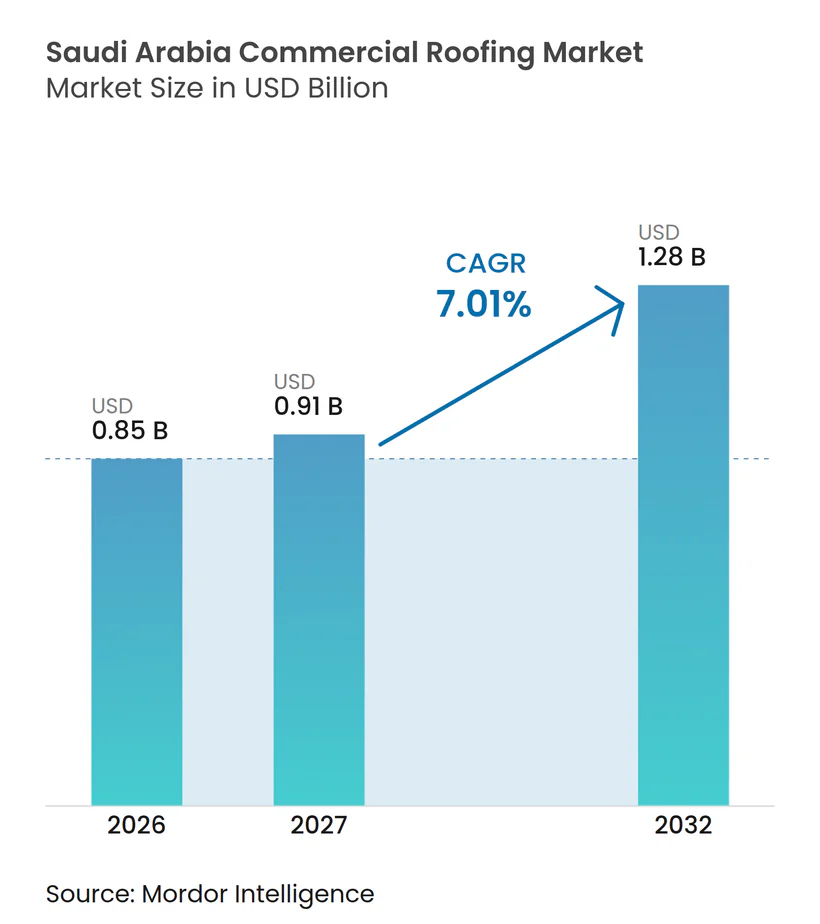
The Saudi Arabia Commercial Roofing Market size is projected to expand from USD 0.85 billion in 2026 and USD 0.91 billion in 2027 to USD 1.28 billion by 2032, registering a CAGR of 7.01% between 2027 and 2032.
The Saudi Arabia commercial roofing market is supported by projects that have moved from planning into contract awards and site work. Logistics centers, factories, tourism facilities, and data centers are creating immediate demand for large commercial roofs. These building types are often low-rise, so their roof area is large relative to the usable floor space. Energy rules are also moving demand toward reflective and insulated systems that can meet thermal requirements. Suppliers that combine proven materials, warranties, local availability, and qualified installation capacity are better placed to serve this project pipeline.
Key Report Takeaways
- By material type, metal roofing held 42.00% of the Saudi Arabia commercial roofing market share in 2026, while single-ply membranes are forecast to expand at a 7.50% CAGR through 2032.
- By construction type, new construction accounted for 78.00% of the Saudi Arabia commercial roofing market size in 2026 and is projected to grow at a 7.60% CAGR through 2032.
- By application, industrial facilities held 38.00% of the commercial roofing sector in 2026 and are forecast to record a 7.80% CAGR through 2032.
- By geography, Riyadh accounted for 34.00% of the Saudi Arabia commercial roofing market size in 2026 and is forecast to advance at an 8.40% CAGR through 2032.
Note: Market numbers in this report are based on Mordor Intelligence's proprietary estimation framework, which combines nine months of actuals with Q4 projections for base year 2026.
Market Trends and Insights
Drivers Impact Analysis of Saudi Arabia Commercial Roofing Market*
| Drivers | (~) % Impact on CAGR Forecast | Geographic Relevance | Impact Timeline |
|---|---|---|---|
| Vision 2030 Logistics, Tourism, and Industrial-Zone Construction | +1.8% | National, concentrated in Riyadh, Jeddah, and Dammam corridors | Long term (≥ 4 years) |
| Airport, Port, and Free-Zone Development | +1.2% | National, primary impact in Riyadh, Jeddah port zone, and Eastern Province | Medium term (2-4 years) |
| Reflective and Insulated Roof Demand in Extreme Heat | +0.9% | National, most acute in Riyadh, Makkah, and Eastern Province | Short term (≤ 2 years) |
| Data-Center and Utility Infrastructure Buildout | +0.8% | National, concentrated in Riyadh and Dammam | Short term (≤ 2 years) |
| Green-Building Requirements in New Urban Districts | +0.7% | National, with early adoption in Riyadh and Red Sea Project corridor | Medium term (2-4 years) |
| Rapid-Build Roof Systems for Large Developments | +0.6% | National, with spillover to Makkah and Madinah logistics zones | Medium term (2-4 years) |
| Source: Mordor Intelligence | |||
Vision 2030 Logistics, Tourism, and Industrial-Zone Construction
Saudi Arabia’s National Transport and Logistics Strategy has a USD 267 billion investment plan, supporting logistics warehouses, hospitality assets, and factory construction[1]. The Saudi Authority for Industrial Cities and Technology Zones operates 40 industrial cities that host more than 12,000 factories. The government is targeting 36,000 factories by 2035, which supports a sustained pipeline for industrial roofing work. In January 2026, MODON launched 17 projects in Jeddah and Makkah, including 160 turnkey factories and infrastructure upgrades[2]. Low-rise factories and logistics buildings require large roof areas, so the Saudi Arabia commercial roofing market benefits directly from this construction mix. Zamil Steel’s April 2025 Masar Mall contract covered 200,000 sqm of structural steel, showing the scale of tourism-led commercial envelope work[3].
Airport, Port, and Free-Zone Development
Airport and seaport projects create concentrated demand because roofed areas are defined early in engineering and procurement packages. King Salman International Airport is expected to require extensive terminal, cargo, service-building, and logistics infrastructure. Such assets require extensive roofing for terminals, cargo facilities, service buildings, and logistics structures. RSGT agreed with CMA CGM in October 2025 to develop a fourth container terminal at Jeddah Islamic Port, adding to covered infrastructure around the port. RSGT also announced investment in four Red Sea ports in June 2025, covering warehouses and operating infrastructure. The Saudi Arabia commercial roofing market gains from airport, port, and free-zone work because these facilities favor durable roofs with reliable drainage and insulation.
Reflective and Insulated Roof Demand in Extreme Heat
High summer heat makes thermal performance a practical requirement for commercial buildings across Saudi Arabia. The Saudi Energy Efficiency Center has introduced 16 building-envelope regulations that raise thermal resistance and solar reflectance requirements for commercial roofs. A December 2025 study in Results in Engineering found that composite systems using polyisocyanurate insulation and reflective membranes delivered strong energy-reduction results under Saudi conditions. These requirements favor reflective single-ply assemblies and insulated panels over lower-performance roof systems. Compliance with Saudi Building Code 601 and energy-efficiency programs requires project teams to demonstrate roof thermal and reflectance performance, and the Saudi Arabia commercial roofing market is responding with stronger demand for tested roof assemblies. The Saudi Arabia commercial roofing market therefore benefits as building owners place more value on insulation, heat control, and warranty-backed energy performance.
Data Center and Utility Infrastructure Buildout
Saudi Arabia’s operational data center capacity increased from 68 megawatts in 2021 to 467 megawatts in the first quarter of 2026. Data centers require large flat roofs that manage heat, vapor, drainage, and equipment loads. This technical profile supports single-ply membranes and insulation systems with consistent installation quality. The Saudi Arabia commercial roofing market also benefits because these projects often establish stricter specifications than conventional warehouses. Data center operators need dependable roof performance to protect server halls and cooling equipment. As these facilities expand in Riyadh and Dammam, their requirements can influence specifications for other industrial buildings.
Restraints Impact Analysis of Saudi Arabia Commercial Roofing Market*
| Restraints | (~) % Impact on CAGR Forecast | Geographic Relevance | Impact Timeline |
|---|---|---|---|
| Extreme Heat and Material-Storage Constraints | -0.8% | National, most acute in Riyadh, Makkah, and Eastern Province | Short term (≤ 2 years) |
| Limited Local Production of Specialty Membranes | -0.6% | National, with partial mitigation in Riyadh and Dammam | Medium term (2-4 years) |
| Developer Concentration and Tendering Volatility | -0.5% | National, most acute in Riyadh and Jeddah megaproject corridors | Medium term (2-4 years) |
| Water Scarcity Limiting Green-Roof Applications | -0.4% | National, most acute in arid interior regions | Long term (≥ 4 years) |
| Shortage of Certified Applicators Outside Principal Cities | -0.3% | National, with mitigation concentrated in Riyadh, Jeddah, and Dammam | Long term (≥ 4 years) |
| Source: Mordor Intelligence | |||
Extreme Heat and Material-Storage Constraints
Rooftop temperatures can exceed 80°C during Saudi summers, creating demanding installation and storage conditions. High heat can degrade polymer-based adhesives and accelerate the aging of materials stored in open areas. Torch-applied systems can also face hot-work restrictions under project safety requirements. Contractors must therefore plan roofing as a weather-sensitive activity, particularly on projects with fixed delivery dates. Delays can affect logistics centers and data centers where roofing is part of the critical construction path. The Saudi Arabia commercial roofing market has room for heat-stable products, but contractors must manage the cost of storage controls and specialized working practices.
Limited Local Production of Specialty Membranes
High-performance thermoplastic polyolefin, ethylene propylene diene monomer, and polyvinyl chloride membranes are largely imported into Saudi Arabia. Shipping disruptions, port variability, and foreign-exchange movements can complicate fixed-price bids. Domestic production is more concentrated in bituminous membranes than in specialty single-ply products. Sika acquired Gulf Seal in November 2025, adding local bituminous waterproofing capacity to its Saudi portfolio. Local production of insulation components is progressing, but specialty membrane supply remains limited. This supply structure can slow the Saudi Arabia commercial roofing market when tender schedules do not allow enough procurement lead time. The Saudi Arabia commercial roofing market also rewards suppliers that can secure inventory before project awards.
*Our forecasts treat driver/restraint impacts as directional, not additive. The impact forecasts reflect baseline growth, mix effects, and variable interactions.
Saudi Arabia Commercial Roofing Market Segment Analysis
By Material Type:
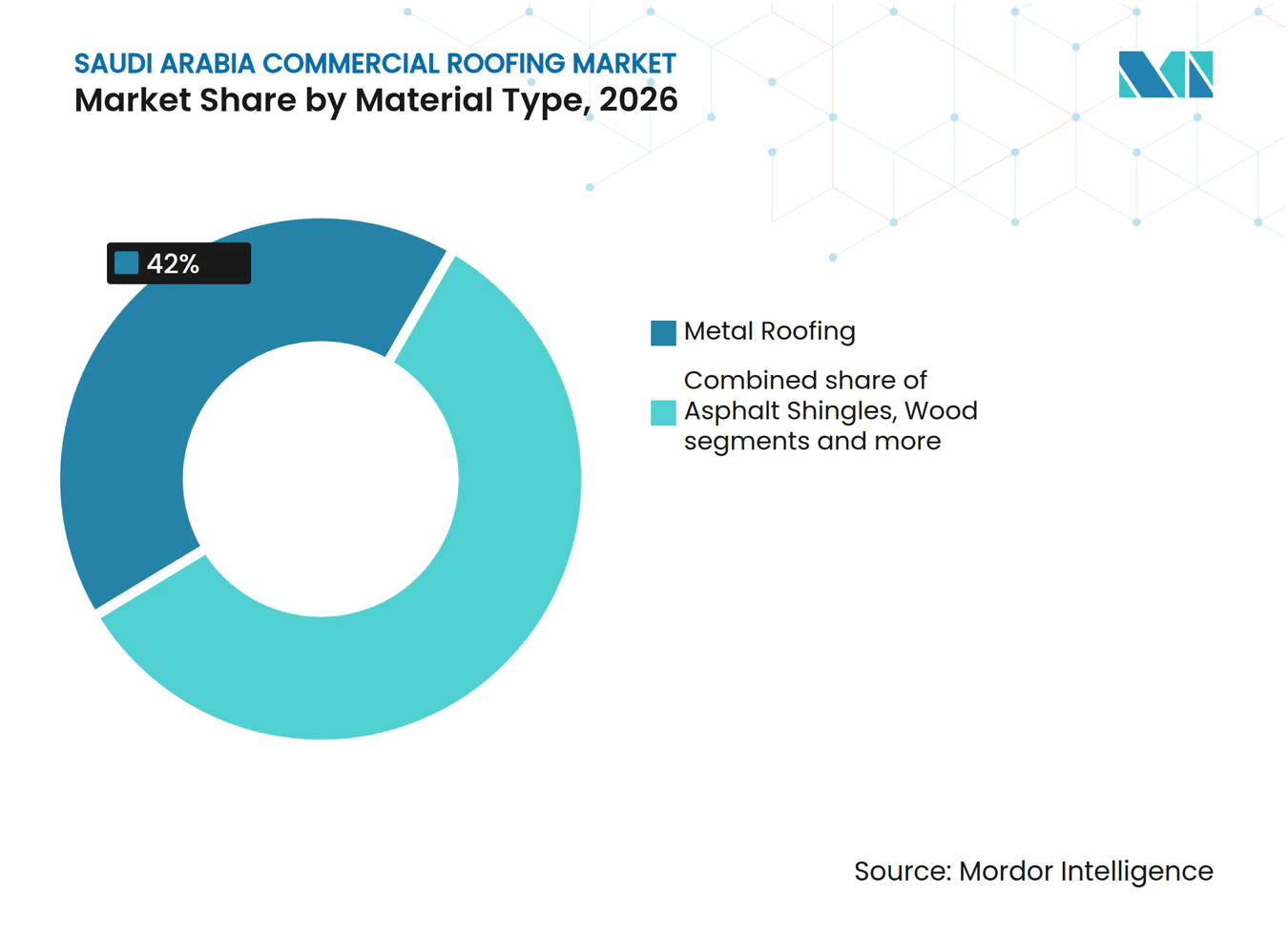
Metal Roofing Leads While Single-Ply Systems Gain GroundMetal roofing held 42.00% of the commercial roofing sector in 2026, making it the leading material category. It fits pre-engineered steel buildings widely used for warehouses, factories, and data centers. In these buildings, roof panels, insulation, and structural purlins are often supplied as an integrated package. This arrangement ties the roofing decision closely to the structural frame selection. Saudi Building Code 301-2018 governs roof loading, wind, and seismic requirements, which supports careful material selection. Lighter insulated metal systems can reduce structural demands on large-span industrial buildings.
Single-ply membranes are projected to record a 7.50% CAGR from 2027 to 2032, the highest rate among material types. Thermoplastic polyolefin, ethylene propylene diene monomer, and polyvinyl chloride systems support solar reflectance and ultraviolet durability requirements. Data center projects also use these systems for large flat roofs that need airtightness and thermal stability. A December 2025 scientific study supported the value of reflective single-ply membranes paired with polyisocyanurate insulation in Saudi climate conditions. Bituminous membranes retain a meaningful role due to established use on flat concrete decks and familiarity with Saudi Standards, Metrology and Quality Organization requirements. Clay and concrete tiles, asphalt shingles, wood, coatings, and liquid-applied systems serve smaller or specialized parts of the Saudi Arabia commercial roofing market.



By Construction Type:
New Construction Sets the Demand BaseNew construction accounted for 78.00% of the commercial roofing sector in 2026. It is also forecast to grow at a 7.60% CAGR from 2027 to 2032. This combination reflects the mainly greenfield nature of commercial development across the Kingdom. Large industrial, logistics, hospitality, airport, and tourism projects are being delivered through government-backed development programs. New assets require complete roof assemblies rather than limited repairs. This gives material suppliers and installation contractors access to larger project values.
Industrial development illustrates the scale of the new-build pipeline. MODON’s January 2026 program covered 17 projects in Jeddah and Makkah, including 160 turnkey factories. Zamil Steel’s 2025 Masar Mall work also demonstrates the commercial envelope demand linked to tourism construction. Reroofing and replacement remain smaller, but they provide steadier work when new tender awards slow. Commercial properties from the 1990s and early 2000s are entering important waterproofing renewal cycles. Building owners use replacement projects to prevent leaks, limit asset damage, and reduce operating disruption.
By Application:
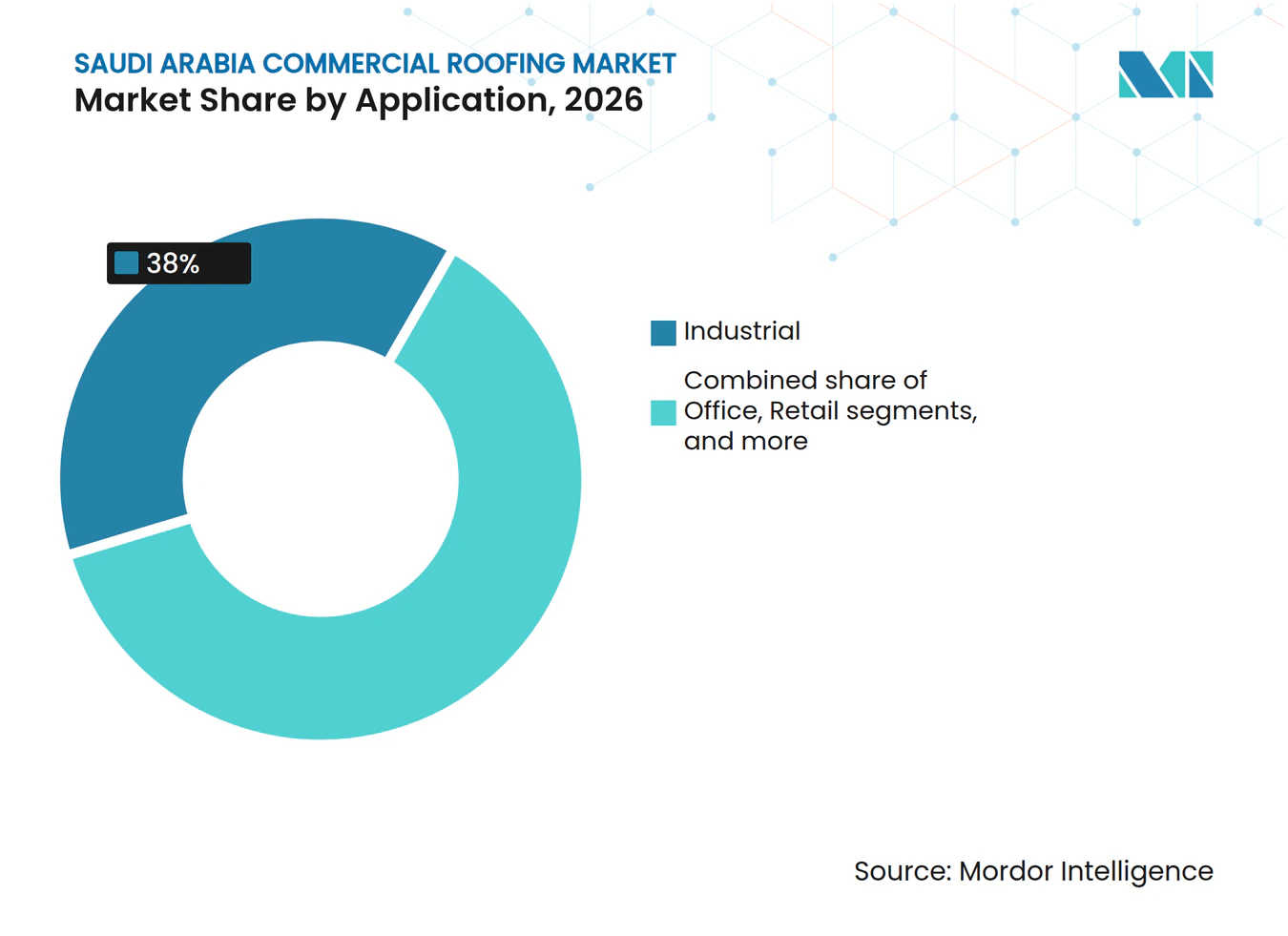
Industrial Facilities Drive Volume and Higher SpecificationsIndustrial facilities held 38.00% of the Saudi Arabia commercial roofing market share in 2026 and represent the leading application segment. The segment is forecast to grow at a 7.80% CAGR from 2027 to 2032, which is also the highest application growth rate. Factories, warehouses, energy-service sites, food-processing facilities, and data centers have large contiguous roof areas. These buildings often use insulated metal panels or reflective single-ply membranes. Their roofing contracts can have a higher average value than small retail or office installations. Industrial growth is therefore central to both material volume and specification quality.
Retail projects require varied solutions across shopping centers, hypermarkets, and mixed-use leisure developments. Their roofs must combine weather protection with architectural integration at visible locations. Office buildings have smaller roof areas per project because they are often multi-story, although photovoltaic-ready systems can raise technical requirements. Hospitality, healthcare, education, and institutional buildings sit within the other application category. These buildings increasingly need efficient envelopes where GSAS or Leadership in Energy and Environmental Design requirements apply. The Saudi Arabia commercial roofing industry is therefore shaped by industrial volume while other applications broaden demand for specialized systems.

Geography Analysis
Riyadh accounted for 34.00% of the commercial roofing sector in 2026 and is forecast to grow at an 8.40% CAGR through 2032. The city combines airport development, data centers, logistics zones, offices, hospitality facilities, and large public projects. King Salman International Airport adds terminal, cargo, and logistics requirements within its development program. Riyadh also benefits from its role as the center for capital-intensive Vision 2030 projects. Its large project base gives local suppliers and contractors a strong reason to maintain technical teams and qualified installers in the city.
Jeddah’s commercial roofing activity is linked to port infrastructure, logistics zones, retail construction, and hospitality development along the Red Sea coast. RSGT’s fourth container-terminal agreement at Jeddah Islamic Port supports new warehousing and operational infrastructure. Coastal humidity and salt-laden air create demand for corrosion-resistant coated metal panels and marine-capable membrane systems. These local conditions favor suppliers that can provide technical support rather than only low-cost materials. The Saudi Arabia commercial roofing market in coastal projects therefore places a premium on proven corrosion resistance. The Saudi Arabia commercial roofing market in Jeddah is also supported by the growing use of reflective and insulated roofs in commercial and mixed-use projects.
The Dammam Metropolitan Area serves as the Eastern Province hub for industrial, petrochemical, logistics, and digital-infrastructure construction. It benefits from port-related warehousing and oil and gas service facilities that need large, durable roof assemblies. Saudi Global Ports began work on an integrated logistics park at King Abdulaziz Port in Dammam in 2025, including modular warehousing, cold chain, and re-export zones. Makkah, Madinah, Tabuk, and other secondary cities are also gaining commercial construction through tourism, pilgrimage, and hospitality development. These areas expand the market footprint, although they need stronger local installation capacity for specialty roofing systems.
Competitive Landscape
Market Concentration
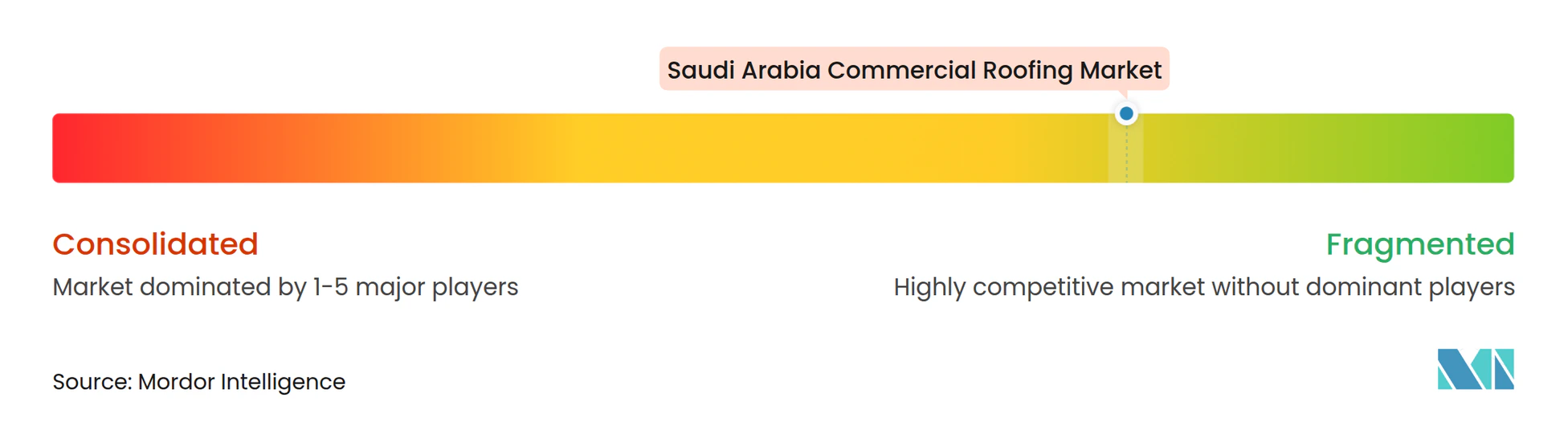
The Saudi Arabia commercial roofing market is fragmented, and no company dominates both material supply and installation. Multinational building-material companies compete through product certifications, technical specifications, and warranty programs. Regional pre-engineered building manufacturers compete by combining structural steel, insulation, and roofing in one package. Local contractors compete on price, relationships, and their ability to mobilize crews across dispersed locations. This structure gives project owners several procurement options, while technical requirements can limit the number of eligible suppliers for specialty systems.
Sika expanded its local waterproofing position by acquiring Gulf Seal in November 2025. The transaction added Riyadh-based bituminous membrane production and established export channels to Sika’s regional portfolio. Saint-Gobain completed the acquisition of Fosroc in February 2025, expanding its construction-chemicals portfolio. Its portfolio approach can support consultants seeking integrated waterproofing, insulation, façade, and interior solutions.
The certified applicator gap outside Riyadh, Jeddah, and Dammam creates a durable advantage for contractors with manufacturer-recognized installation capability. Building information modeling, drone-based thermal inspection, and digital quantity tools can improve roofing design, site accuracy, and warranty management. These practices may reduce rework and help contractors prepare bids more quickly. Suppliers that support training and inspection can strengthen their place in projects with high performance requirements. The competitive field remains fragmented because materials suppliers, integrated building firms, and local installers compete in different parts of the value chain.
Saudi Arabia Commercial Roofing Industry Leaders
-
Kabbani Construction Group
-
BMC
-
Saudi Rock Wool Factory Company
-
Saudi Insulation Manufacturing Company
-
Zamil Industrial Investment Company
- *Disclaimer: Major Players sorted in no particular order
Saudi Arabia Commercial Roofing Market Companies Covered in this Report
- Kabbani Construction Group
- BMC
- Saudi Rock Wool Factory Company
- Saudi Insulation Manufacturing Company
- Zamil Industrial Investment Company
- Al Bawani Company
- Nesma and Partners
- Saudi Binladin Group
- Almabani General Contractors
- El Seif Engineering Contracting Company
- Alfanar Construction
- Shapoorji Pallonji International
- Sika Saudi Arabia
- Saint-Gobain Saudi Arabia
- Kingspan Group plc
- Holcim
- TSSC Group
- Kimmco-Isover
- Danube Building Materials
- Arabian Profiles Co. Ltd.
Recent Industry Developments in Saudi Arabia Commercial Roofing Market
- October 2026: Mawani launches the expression of interest phase for the Khumra Integrated Logistics Zone (KILZ), a 2.4 million sqm facility near Jeddah Islamic Port targeting 1.26 million sqm of warehousing and a 500,000 container annual handling capacity. The USD 800 million minimum financial threshold for applicants signals the scale of building envelope and commercial roofing contracts embedded within this single logistics development.
- July 2026: The King Abdulaziz Center for World Culture achieves Leadership in Energy and Environmental Design Platinum Certification for Operations and Maintenance under the U.S. Green Building Council framework, reinforcing growing institutional adoption of international green building performance standards in Saudi Arabia’s landmark commercial and cultural facilities.
- January 2026: Saudi Authority for Industrial Cities and Technology Zones (MODON) launches 17 development projects totaling USD 667 million in the industrial cities of Jeddah and Makkah, including 160 turnkey factories and major infrastructure networks. Factory construction at this scale generates direct demand for insulated metal roofing systems and PIR sandwich panels across industrial park developments.
Saudi Arabia Commercial Roofing Market Report Scope
Segmentation Overview
| Asphalt Shingles |
| Clay & Concrete Tiles |
| Metal Roofing |
| Bituminous / Modified Bitumen Membranes |
| Single-Ply Membranes (TPO, EPDM, and PVC) |
| Wood |
| Others |
| New Construction |
| Reroofing and Replacement |
| Retail |
| Office |
| Industrial |
| Others |
| Riyadh |
| Jeddah |
| DMA (Dammam Metropolitan Area) |
| Rest of Saudi Arabia |
| By Material Type | Asphalt Shingles |
| Clay & Concrete Tiles | |
| Metal Roofing | |
| Bituminous / Modified Bitumen Membranes | |
| Single-Ply Membranes (TPO, EPDM, and PVC) | |
| Wood | |
| Others | |
| By Construction Type | New Construction |
| Reroofing and Replacement | |
| By Application | Retail |
| Office | |
| Industrial | |
| Others | |
| By Geography | Riyadh |
| Jeddah | |
| DMA (Dammam Metropolitan Area) | |
| Rest of Saudi Arabia |
Key Questions Answered in the Report
What is the projected value of commercial roofing in Saudi Arabia by 2032?
The sector is projected to reach USD 1.28 billion by 2032, growing at a 7.01% CAGR from 2027.
Which roofing material has the largest share in Saudi commercial projects?
Metal roofing leads with 42.00% share in 2026, supported by its fit with pre-engineered industrial and logistics buildings.
Which roofing material is growing fastest in Saudi Arabia?
Single-ply membranes are forecast to grow at a 7.50% CAGR through 2032 as reflective and thermally efficient systems gain wider use.
Why are industrial buildings important for roofing demand in Saudi Arabia?
Industrial facilities held 38.00% share in 2026 and are forecast to grow at a 7.80% CAGR, driven by factories, warehouses, and data centers.
Which city offers the strongest commercial roofing opportunity?
Riyadh led with 34.00% share in 2026 and is forecast to grow at an 8.40% CAGR through 2032.
What are the main challenges for roofing suppliers and contractors?
Extreme heat, specialty-membrane imports, tender volatility, water scarcity, and shortages of certified installers can affect cost, timing, and execution.