
Saudi Arabia Commercial Construction Market Size and Share
Market Overview
| Study Period | 2021 - 2032 |
|---|---|
| Forecast Data Period | 2027 - 2032 |
| Base Year Market Size (2026) | USD 13.97 Billion |
| Market Size (2027) | USD 14.68 Billion |
| Market Size (2032) | USD 18.78 Billion |
| Growth Rate (2027 - 2032) | 5.05 % |
| Market Concentration | Low |
Major Players *Disclaimer: Major Players sorted in no particular order Image © Mordor Intelligence. Reuse requires attribution under CC BY 4.0. | |
Saudi Arabia Commercial Construction Market Analysis by Mordor Intelligence
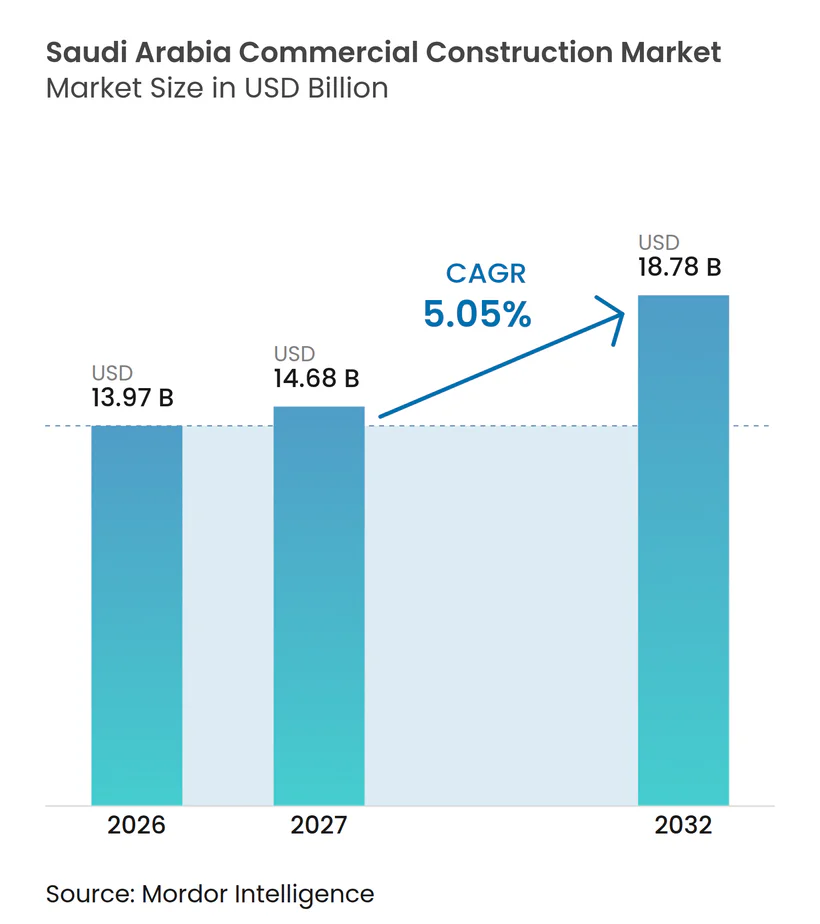
The Saudi Arabia Commercial Construction Market size is projected to be USD 13.97 billion in 2026, USD 14.68 billion in 2027, and reach USD 18.78 billion by 2032, growing at a CAGR of 5.05% from 2027 to 2032.
Demand is supported by Saudi Arabia’s economic diversification agenda and a sizable pipeline of office, logistics, hospitality, retail, and mixed-use developments. Corporate relocations are supporting new office supply, while industrial policies are increasing the need for warehouses and distribution facilities. The Saudi Arabia commercial construction market also benefits from tourism projects, urban redevelopment, and rising private investment in commercial assets. Execution risk remains material because project timing, imported equipment, and specialist labor availability can affect costs and schedules. The Saudi Arabia commercial construction market therefore offers opportunities for contractors with strong delivery capacity, technical design capabilities, and a balanced customer base.
Key Report Takeaways
- By commercial sector type, office construction accounted for 33.3% of the Saudi Arabia commercial construction market share in 2026, while industrial and logistics construction is forecast to expand at a 6.07% CAGR through 2032.
- By construction type, new construction accounted for 82.1% of the Saudi Arabia commercial construction market share in 2026, while renovation is forecast to expand at a 5.95% CAGR through 2032.
- By investment source, the public sector represented 60.1% of the Saudi Arabia commercial construction market size in 2026, while private investment is forecast to expand at a 6.01% CAGR through 2032.
- By city, Riyadh represented 48.6% of the Saudi Arabia commercial construction market size in 2026, while Jeddah is forecast to expand at a 6.44% CAGR through 2032.
Note: Market numbers in this report are based on Mordor Intelligence's proprietary estimation framework, which combines nine months of actuals with Q4 projections for base year 2026.
Market Trends and Insights
Drivers Impact Analysis of Saudi Arabia Commercial Construction Market*
| Drivers | (~) % Impact on CAGR Forecast | Geographic Relevance | Impact Timeline |
|---|---|---|---|
| Regional Headquarters Expansion and Corporate Relocations | +1.6% | Riyadh-led, with Jeddah growing as an alternative hub | Medium term (2-4 years) |
| Industrial Diversification and Logistics Expansion | +1.3% | Riyadh, Jeddah, and Dammam Metropolitan Area | Short term (≤ 2 years) |
| Tourism Diversification and Hotel Investment Programs | +1.0% | Riyadh, Jeddah, Makkah, Madinah, Red Sea coast, and AlUla | Medium term (2-4 years) |
| Large-Scale Urban Regeneration Initiatives | +0.8% | Riyadh, Jeddah, and Makkah | Long term (≥ 4 years) |
| Growing Organized Retail Activity | +0.6% | Riyadh, Jeddah, and Makkah | Medium term (2-4 years) |
| Private Healthcare and Education Investments | +0.4% | National, with early gains in Riyadh, Jeddah, Al Ahsa, and Alkhobar | Medium term (2-4 years) |
| Source: Mordor Intelligence | |||
Regional Headquarters Expansion Driving Grade A Office Construction Demand
The Regional Headquarters program is increasing requirements for high-quality office space in Riyadh. Grade A office occupancy in Riyadh reached 98% in 2025, which has kept demand for new buildings and upgrades to older stock active. The Saudi Arabia commercial construction market is also seeing a broader tenant mix, including technology, financial services, and healthcare businesses. These occupiers need buildings with reliable electrical, mechanical, and digital systems, which can raise the technical scope of office projects. The office supply pipeline is expected to grow, but planned delivery is weighted toward later years. This timing keeps near-term work available for contractors that can meet high design and fit-out standards.
A shortage of prime office space has also improved the case for renovating secondary buildings. Grade B space has become more relevant for tenants seeking central locations at lower costs than premium properties. Building owners can respond by improving cooling, power, layout, and common areas. This supports renovation activity alongside new construction rather than replacing it. The Saudi Arabia commercial construction market can therefore draw work from both new corporate campuses and the upgrade of established business districts. Contractors with experience in occupied buildings have an advantage because tenants need projects completed with limited disruption.
Industrial Diversification and Logistics Expansion Accelerating Warehouse Construction
Industrial diversification is expanding demand for warehouses, distribution centers, and specialized facilities across Saudi Arabia. Industrial and logistics construction is the fastest-growing commercial sector type, with a 6.07% CAGR projected through 2032. New space is increasingly designed for cold storage, e-commerce operations, automated handling, and data-intensive tenants. The Saudi Arabia commercial construction market is consequently moving toward facilities with more complex mechanical, electrical, and plumbing systems. This raises the need for suppliers and contractors that can meet industrial city requirements and deliver specialized building systems. The development of logistics assets also supports national targets for trade, manufacturing, and distribution activity.
In November 2025, Agility Logistics Parks opened its Jeddah facility with six Grade A warehouses across 338,000 square meters of built-up area. The project was designed to support data-center readiness and serves sectors including retail, consumer goods, technology, automotive, energy, and e-commerce[1]. Such projects show how industrial buildings increasingly require systems beyond basic storage functions. They also increase competition for engineers and technicians who can install and commission those systems. The Saudi Arabia commercial construction market has room for firms that combine civil construction, building services, and commissioning expertise. The strongest opportunities are likely to be in facilities that must operate reliably from the first day of use.
Tourism Diversification and Hotel Investment Accelerating Hospitality Construction
Tourism development is increasing construction demand for hotels, retail space, entertainment venues, and visitor services. The national tourism program has encouraged a wide range of accommodation formats, from luxury resorts to properties that serve religious travelers. This creates different design and delivery requirements across locations. The Saudi Arabia commercial construction market benefits when hotel projects also require restaurants, retail units, public areas, and supporting infrastructure. These linked uses can create work for general contractors and specialist suppliers. They also support longer project pipelines in destinations that combine hospitality with cultural or retail activity.
In 2026, the AlUla Development Company began construction of the 250-key NUMAJ hotel, which Marriott International will manage and which is scheduled for delivery in 2027[2]. The project illustrates the role of heritage destinations in the Saudi Arabia commercial construction market. Hotel programs often require careful coordination between construction, landscape, guest services, and energy systems. Contractors who understand these requirements can serve both new hotels and related commercial facilities. Demand will vary by city because the mix of religious tourism, business travel, and leisure travel differs across the Kingdom. This diversity reduces reliance on a single hospitality format.
Large-Scale Urban Regeneration Stimulating Mixed-Use Commercial Development
Large urban redevelopment programs are creating multi-year work across office, retail, hospitality, and leisure construction. These programs differ from single-asset projects because several property types progress within one master-planned area. The Saudi Arabia commercial construction market gains a more continuous pipeline when later phases are tendered as earlier phases move forward. This can help contractors plan labor, equipment, and subcontractor capacity over a longer period. It also creates demand for firms that can coordinate complex interfaces among several buildings and public spaces. Delivery remains dependent on funding discipline and project sequencing.
King Salman Gate in Makkah covers 12 million square meters of gross floor area and combines residential, hospitality, commercial, and cultural uses near Al-Masjid Al-Haram[3]. Its scale shows why integrated developments can influence the Saudi Arabia commercial construction market for many years. The project will require coordinated delivery across multiple building types and a dense urban location. Similar redevelopment activity in Riyadh and Jeddah supports commercial construction beyond traditional office districts. Contractors that maintain specialized project teams can pursue complex packages without relying on one building category. The main challenge is aligning capacity with the timing of phased awards.
Restraints Impact Analysis of Saudi Arabia Commercial Construction Market*
| Restraints | (~) % Impact on CAGR Forecast | Geographic Relevance | Impact Timeline |
|---|---|---|---|
| PIF Investment Reprioritization and Tighter Project Feasibility Assessments | -0.8% | National, with the greatest exposure in Riyadh’s giga-project belt | Short term (≤ 2 years) |
| Regional Geopolitical Tensions Disrupting Supply Chains | -0.5% | Gulf ports and Red Sea routes, with the Jeddah and Dammam Metropolitan Area most exposed | Medium term (2-4 years) |
| Elevated Construction Material and Equipment Costs | -0.4% | National | Medium term (2-4 years) |
| Shortages of Specialized Construction and Mechanical, Electrical, and Plumbing Professionals | -0.3% | National, with the greatest exposure in Riyadh’s concentrated project pipeline | Medium term (2-4 years) |
| Source: Mordor Intelligence | |||
PIF Reprioritization and Tighter Feasibility Assessments Delaying Commitments
The Public Investment Fund, known as PIF, remains important to the timing of large commercial projects. Changes in its investment priorities can delay the release of packages or alter the scale of planned development. Reuters reported in 2025 that PIF was preparing to emphasize artificial intelligence infrastructure and assets with nearer-term returns after delays in some giga-projects. The Saudi Arabia commercial construction market is not dependent on a single funding source, but contractors with concentrated PIF exposure may face uneven order timing. Feasibility reviews can improve capital allocation, yet they can reduce short-term visibility for project teams and suppliers. Firms serving public agencies, private developers, and international operators are better placed to manage this uncertainty.
This restraint affects the pace of work rather than the underlying need for commercial buildings. Private investment, logistics development, and corporate expansion continue to provide other sources of demand. However, a contractor may need to carry overhead for longer when a large package moves to a later phase. The Saudi Arabia commercial construction market will reward companies that manage cash flow, bid selectively, and avoid excessive reliance on any one master developer. Strong relationships with subcontractors are also important when project schedules change. The resulting pressure is greatest for firms that have added capacity solely for mega-project delivery.
Regional Geopolitical Tensions Disrupting Supply Chains and Extending Procurement Timelines
Regional transport disruption can increase the cost and delivery time of imported construction materials and equipment. The exposure is most significant for facade systems, electrical equipment, mechanical systems, and structural steel. The United Nations Conference on Trade and Development stated that Strait of Hormuz disruptions affect global energy and commodity flows beyond the immediate Gulf region. The Saudi Arabia commercial construction market is therefore exposed when shipping changes affect procurement planning. Longer lead times can force contractors to change work sequences and hold more inventory. These adjustments can pressure margins even when a project remains active.
A 2026 study in Scientific Reports identified financial instability and supplier delivery failure among the main risks affecting Saudi construction supply chains. The finding reinforces the need for careful supplier assessment before major equipment is ordered. Contractors can reduce schedule risk by securing critical systems early and allowing more time for testing and delivery. Local sourcing can also reduce some exposure, although specialized equipment may still require imports. The Saudi Arabia commercial construction market will remain sensitive to procurement conditions because its major projects use technically advanced materials and systems. More disciplined purchasing can help firms limit the effect on completion dates.
*Our forecasts treat driver/restraint impacts as directional, not additive. The impact forecasts reflect baseline growth, mix effects, and variable interactions.
Saudi Arabia Commercial Construction Market Segment Analysis
By Commercial Sector Type:
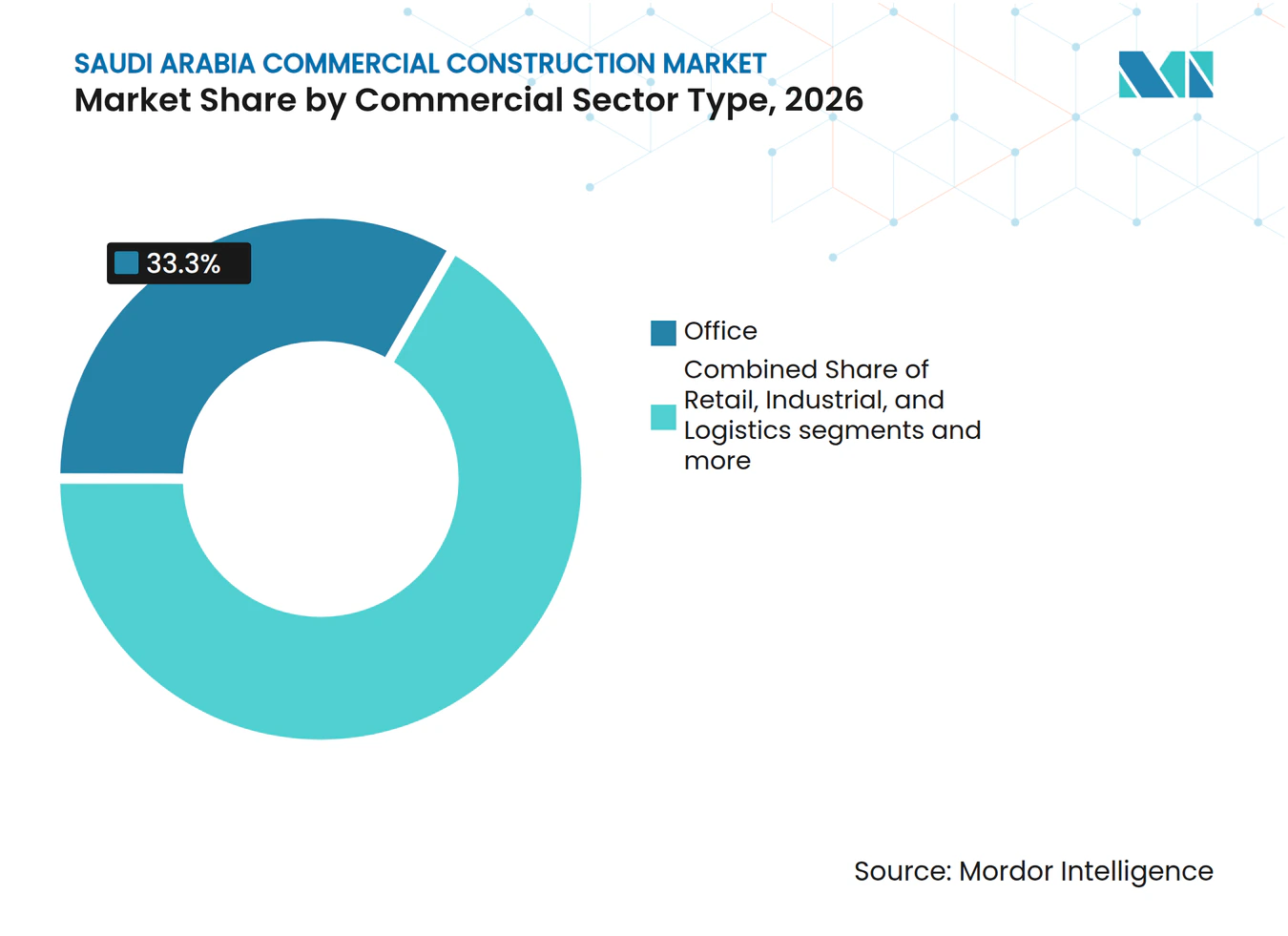
Office Construction Leads While Industrial and Logistics Gain PaceOffice construction held 33.3% of the Saudi Arabia commercial construction market share in 2026, making it the largest commercial sector type. The Regional Headquarters program and a strong need for high-quality corporate space in Riyadh support the segment. Prime office projects often require advanced building services, flexible floor layouts, and high standards for tenant fit-out. This makes them attractive to contractors who can coordinate structural work with mechanical, electrical, plumbing, and digital systems. Office construction also creates renovation opportunities when secondary buildings are upgraded to meet tenant expectations. The Saudi Arabia commercial construction industry is therefore serving both purpose-built headquarters and older properties that need modernization.
Industrial and logistics construction is forecast to grow at a 6.07% CAGR through 2032. Warehouse projects are being shaped by e-commerce, cold-chain distribution, manufacturing, and data-intensive operations. The segment requires more specialized systems than conventional storage facilities. The Jeddah logistics park developed by Agility illustrates the demand for Grade A buildings with data-center-ready design. Retail, hospitality, healthcare, education, and mixed-use facilities form the remaining commercial categories. Each category broadens the Saudi Arabia commercial construction market by creating projects with different tenant requirements and delivery schedules. These requirements also create a need for contractors who can coordinate building systems with the operating needs of tenants.



By Construction Type:
New Construction Holds the Largest Position, While Renovation BroadensNew construction accounted for 82.1% of the Saudi Arabia commercial construction market share in 2026. The large share reflects the greenfield nature of industrial estates, logistics zones, mixed-use districts, and hospitality programs. New sites give developers greater flexibility over building scale, energy systems, tenant layouts, and infrastructure connections. They also allow projects to meet modern technical requirements from the start. This keeps demand strong for general contractors, designers, and specialist subcontractors. The Saudi Arabia commercial construction market size for new construction remains closely linked to the timing of large master-planned developments.
Renovation is forecast to grow at a 5.95% CAGR through 2032. Older office and commercial assets need upgrades when tenants seek better energy performance, building services, and workspace standards. Renovation work can be complex because buildings often remain occupied during construction. Contractors need to manage access, safety, noise, and phased installation without disrupting tenants. This favors firms that can redesign mechanical and electrical systems within existing structures. The Saudi Arabia commercial construction industry can use renovation to extend the useful life of assets in established districts. New construction will remain larger, while refurbishment provides a growing and more specialized source of work. Asset owners can use these upgrades to improve tenant retention and maintain the relevance of established properties.
By Investment Source:
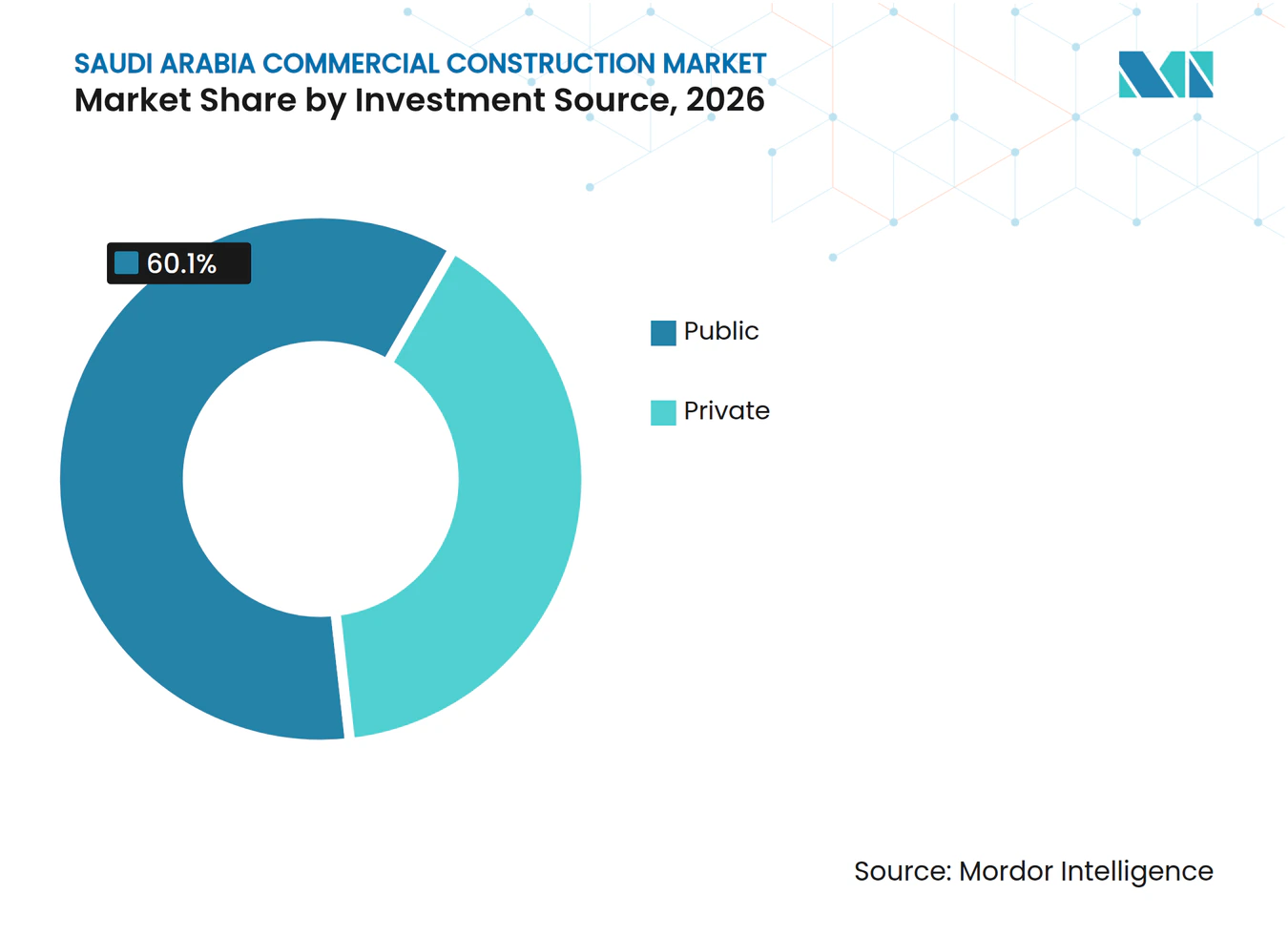
Public-Sector Investment Leads While Private Investment Grows FasterPublic-sector investment held 60.1% of the Saudi Arabia commercial construction market share in 2026. Public entities and related development companies have commissioned many of the country’s largest commercial and mixed-use projects. Their role is particularly visible in major urban regeneration, cultural, tourism, and logistics initiatives. Public investment can support infrastructure and enabling works that make nearby private development more viable. It also gives contractors access to large packages that require substantial technical and financial capacity. The Saudi Arabia commercial construction market has therefore developed around a significant public project base.
Private investment is forecast to expand at a 6.01% CAGR through 2032. Private developers and listed companies are entering commercial assets that benefit from new infrastructure, rising consumer activity, and corporate demand. Private capital may move more selectively than public investment, but it can provide a broader range of smaller and mid-sized projects. This can reduce dependence on a limited number of major programs. Financing discipline and land-use rules will influence how quickly projects progress from planning to construction. The Saudi Arabia commercial construction industry will benefit when private developers combine local market knowledge with reliable financing. The growth of this segment supports a more diverse client base for contractors. It also gives suppliers and specialist subcontractors more opportunities to work across projects of different sizes.

Geography Analysis
Riyadh held 48.6% of the Saudi Arabia commercial construction market share in 2026, making it the country’s largest commercial construction market. The city is the center for regional headquarters, large public developments, and private office, retail, and hospitality investments. Its broad project mix supports demand for contractors with capabilities across several building types. The city also has a large need for premium office space and the modernization of older commercial assets. These conditions sustain both new development and refurbishment work. Riyadh’s depth makes it the main source of commercial construction demand, although project timing can be affected by decisions on large master plans. It remains important for companies that need a local base for coordinating projects across the Kingdom.
Jeddah is forecast to expand at a 6.44% CAGR through 2032, which is the highest city growth rate in the supplied data. The city combines corporate activity with port logistics, waterfront redevelopment, retail, and tourism. Its location supports warehouse and distribution projects as well as commercial construction linked to visitor activity. Jeddah Central is intended to develop a major waterfront district through phased delivery. This makes the city relevant to firms that can work across mixed-use packages and logistics facilities. The Saudi Arabia commercial construction market also draws support from Jeddah’s ability to serve as a second corporate hub.
The Dammam Metropolitan Area has a distinct role in port, industrial, and logistics construction. Its commercial demand is linked to energy-related activity, industrial estates, and goods moving through the Eastern Province. Makkah has a different demand profile because hospitality, retail, and mixed-use development are connected to religious tourism. King Salman Gate is a major example of a long-term mixed-use program in the city. AlUla and other destination locations add heritage and tourism projects to the construction pipeline. Together, these locations give the Saudi Arabia commercial construction market a demand base that is wider than the Riyadh, Jeddah, and Dammam Metropolitan Area corridor. This spread can reduce the effect of a slowdown in one urban area on national construction activity.
Competitive Landscape
Market Concentration
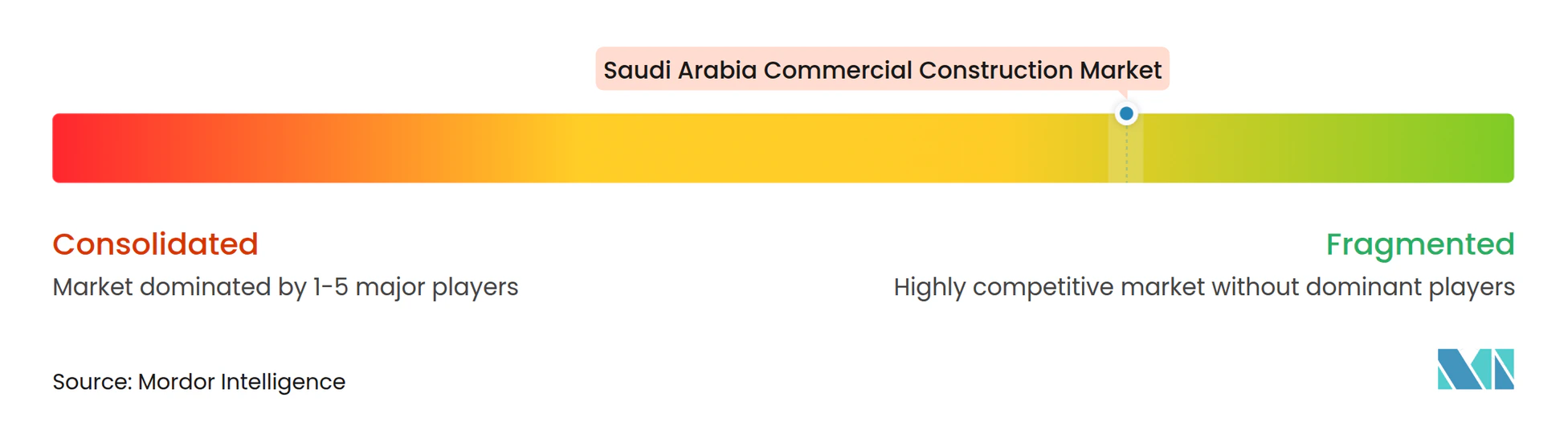
The Saudi Arabia commercial construction market is fragmented in nature and has 3 main groups of competitors. Large Saudi contractors such as Nesma & Partners, El Seif Engineering Contracting, Saudi Binladin Group, AlBawani, Al-Ayuni Investment and Contracting Company, and Almabani compete for major commercial packages. International firms, including Bechtel Corporation and Samsung C&T, tend to participate selectively in the largest or technically complex projects. Smaller specialist firms compete in areas such as building services, project controls, commissioning, and retrofit work. A firm’s ability to secure major contracts depends on its financial strength, licenses, workforce capacity, and record of delivering complex projects.
The technical requirements of each project also shape competition. Office, hospitality, logistics, and mixed-use developments increasingly need reliable cooling, power, building controls, and digital systems. In June 2025, AlBawani and Samsung signed a memorandum of understanding to explore smart building management systems, energy-efficient technologies, and integrated digital platforms. This agreement shows how leading contractors use technology partnerships to strengthen their offerings for complex commercial buildings. This creates an advantage for firms that can install and commission advanced systems, rather than only deliver basic building structures.
Public Investment Fund, or PIF, investment has strengthened the position of contractors that can qualify for sovereign-linked work. PIF acquired a minority shareholding in AlBawani Holding in January 2025, reinforcing AlBawani’s connection to the national project pipeline. Private developments and specialist commercial projects remain open to a wider group of competitors, especially where technical expertise is more important than contractor scale. Saudi Contractors Authority requirements and local workforce rules continue to set important entry requirements for large public tenders.
Saudi Arabia Commercial Construction Industry Leaders
-
Nesma & Partners
-
El Seif Engineering Contracting
-
Al-Ayuni Investment and Contracting Company
-
Almabani
-
Alfanar Projects
- *Disclaimer: Major Players sorted in no particular order
Saudi Arabia Commercial Construction Market Companies Covered in this Report
- Nesma & Partners
- El Seif Engineering Contracting
- Al-Ayuni Investment and Contracting Company
- Almabani
- Alfanar Projects
- IHCC
- AlBawani
- Alkifah Contracting Company
- Construction and Planning Co. (C&P)
- BEC Arabia
- Mofarreh Al-Harbi and Partners
- UNIMAC
- MARCO
- Contracting and Construction Enterprises (CCE)
- Shibh Al Jazira Contracting Company (SAJCO)
- Saudi Binladin Group
- Al-Rashid Trading and Contracting Company (RTCC)
- Saudi Pan Kingdom Company (SAPAC)
- Umm Al Qura for Development and Construction Company
- Saudi Arabian Baytur Construction Company
- Saudi Real Estate Infrastructure Company (Binyah)
- Red Sea International Company
- ABV Rock Group
- Makkah Construction and Development Company
- Bechtel Corporation
Recent Industry Developments in Saudi Arabia Commercial Construction Market
- October 2026: Knowledge Economic City partnered with TGP International to develop and operate a food hall at Multaqa Al-Madinah Mall in Madinah. The venue will bring together local, regional, and international restaurant concepts for residents and visitors.
- September 2026: ROSHN Group and Talaat Moustafa Group Saudi signed a preliminary agreement to explore a residential-led mixed-use community in Riyadh with more than 55,000 homes. The proposal includes retail, commercial, hospitality, entertainment, healthcare, and education facilities, subject to master planning and a final business case.
- July 2026: Mawani, the Saudi Ports Authority, signed 7 contracts valued at USD 267 million to build and expand logistics centers at Jeddah Islamic Port and the Al-Khumra logistics zone. The developments cover more than 384,000 square meters of storage, consolidation, and re-export facilities under an operator-funded concession model.
Saudi Arabia Commercial Construction Market Report Scope
Segmentation Overview
| Office |
| Retail |
| Industrial and Logistics |
| Others |
| New Construction |
| Renovation |
| Public |
| Private |
| Riyadh |
| Jeddah |
| DMA (Dammam Metropolitan Area) |
| Rest of Saudi Arabia |
| By Commercial Sector Type | Office |
| Retail | |
| Industrial and Logistics | |
| Others | |
| By Construction Type | New Construction |
| Renovation | |
| By Investment Source | Public |
| Private | |
| By City | Riyadh |
| Jeddah | |
| DMA (Dammam Metropolitan Area) | |
| Rest of Saudi Arabia |
Key Questions Answered in the Report
What is the projected value of commercial construction in Saudi Arabia by 2032?
The Saudi Arabia commercial construction market is projected to reach USD 18.78 billion by 2032, growing at a 5.05% CAGR from 2027. This outlook reflects demand from corporate, logistics, hospitality, retail, and mixed-use projects across several Saudi cities.
Which commercial sector type is the largest in Saudi Arabia?
Office construction is the largest sector type, holding 33.3% share in 2026. Corporate relocation activity, premium workspace needs, and the modernization of older office stock support this position.
Which commercial construction segment is growing fastest in Saudi Arabia?
Industrial and logistics construction is forecast to grow at a 6.07% CAGR through 2032. Specialized warehouse needs include cold-chain, e-commerce, automated handling, and data-ready facilities.
Why is Riyadh important for commercial construction?
Riyadh held 48.6% share in 2026 and combines regional headquarters demand with public and private mixed-use development. Its broad pipeline includes offices, retail, logistics, hospitality, urban redevelopment, and modernization of established commercial districts.
Why is Jeddah growing faster than other cities?
Jeddah is forecast to grow at a 6.44% CAGR through 2032 because of its tourism, waterfront, corporate, and logistics activity. It also provides an alternative hub for regional businesses that need office and distribution capacity.
What are the main risks affecting project delivery in Saudi Arabia?
PIF project timing and supply-chain disruption can delay procurement, increase costs, and pressure contractor schedules. Strong supplier management, early equipment purchasing, and diversified client exposure can reduce these risks.