
Ruggedized Industrial Imaging Systems Market Size and Share
Market Overview
| Study Period | 2020 - 2031 |
|---|---|
| Market Size (2026) | USD 379.22 Million |
| Market Size (2031) | USD 630.18 Million |
| Growth Rate (2026 - 2031) | 10.69 % |
| Fastest Growing Market | Asia-Pacific |
| Largest Market | Asia-Pacific |
| Market Concentration | Medium |
Major Players *Disclaimer: Major Players sorted in no particular order Image © Mordor Intelligence. Reuse requires attribution under CC BY 4.0. | |
Ruggedized Industrial Imaging Systems Market Analysis by Mordor Intelligence
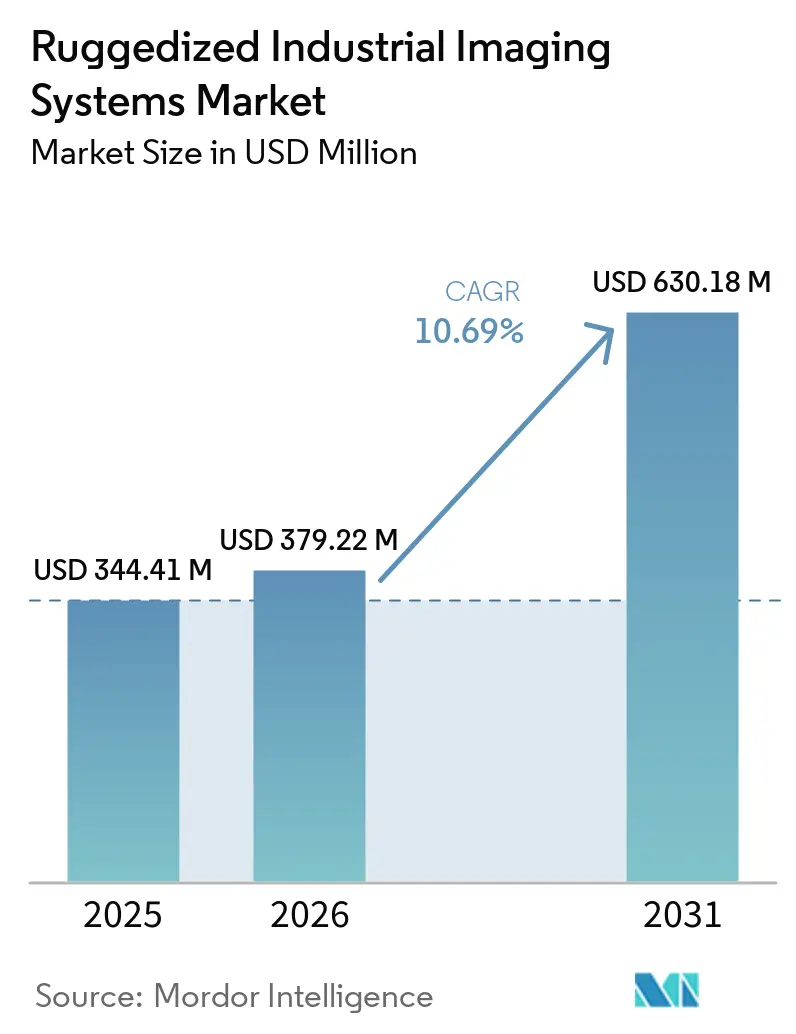
The Ruggedized industrial imaging systems market size was valued at USD 344.41 million in 2025 and estimated to grow from USD 379.22 million in 2026 to reach USD 630.18 million by 2031, at a CAGR of 10.69% during the forecast period (2026-2031). Demand rests on automation-capable, IP-rated vision hardware that can operate in demanding production and field conditions. Investment in factory automation and embedded AI inspection is moving more image processing from centralized server rooms to sealed enclosures near the production line. This shift gives suppliers an opportunity to integrate optics, computing, and software into devices that are easier to install and maintain. Asia-Pacific combines the largest regional position with the fastest projected growth, supported by manufacturing activity in China and rising adoption of automation in India and Southeast Asia. High integration costs and thermal constraints in fanless enclosures will keep product engineering and service capabilities important in the Ruggedized industrial imaging systems market.
Key Report Takeaways
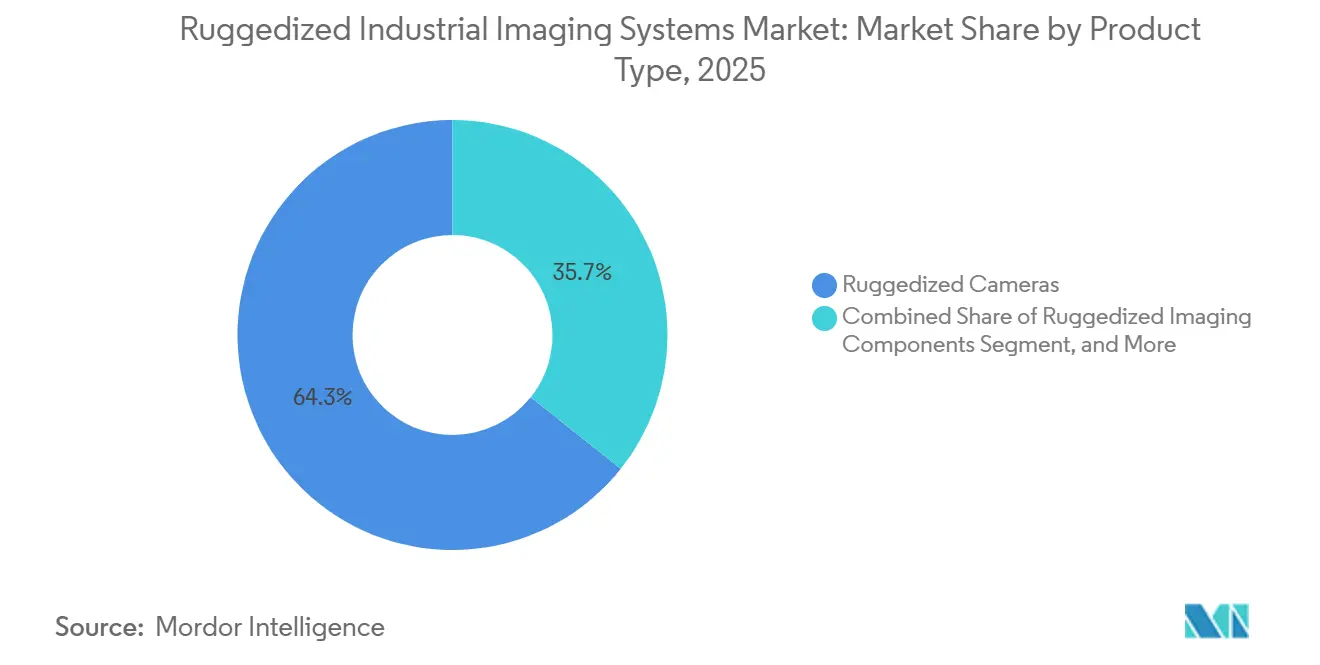
- By product type, ruggedized cameras held 64.31% of the Ruggedized industrial imaging systems market share in 2025, while ruggedized vision systems are projected to expand at a 11.67% CAGR through 2031.
- By imaging type, 2D imaging accounted for 69.19% of the Ruggedized industrial imaging systems market size in 2025, while 3D imaging is projected to grow at a 12.32% CAGR through 2031.
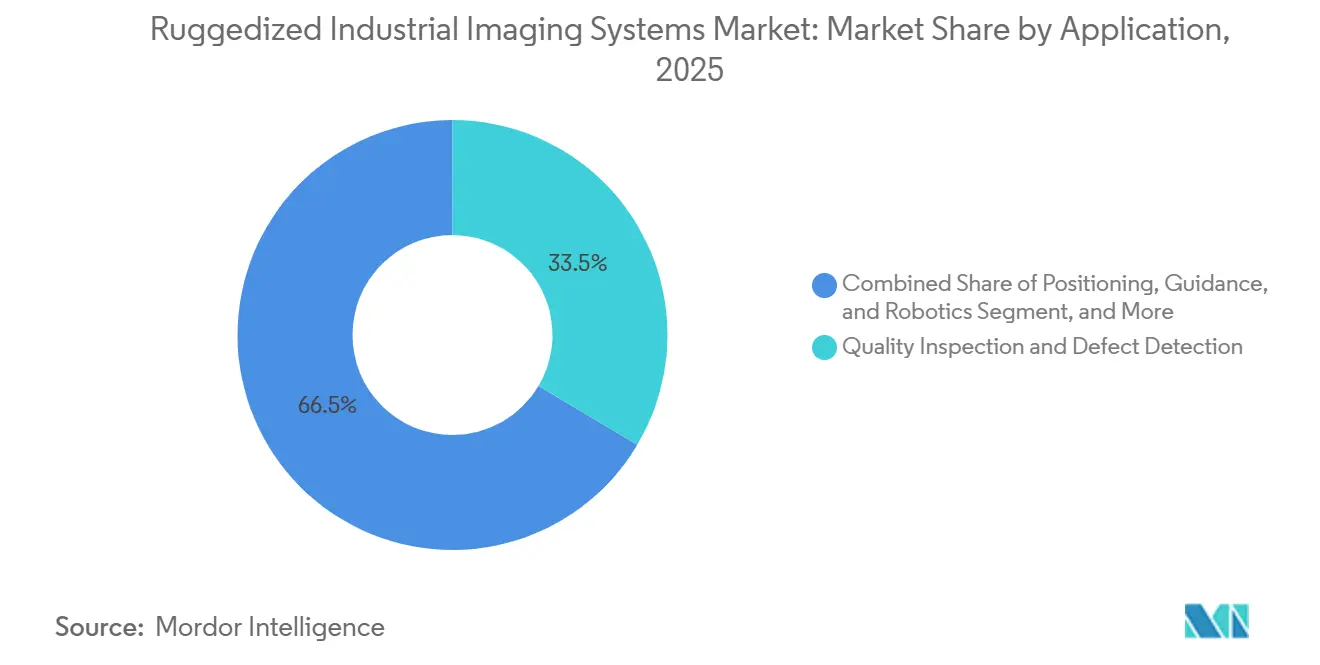
- By application, quality inspection and defect detection accounted for 33.53% in 2025, while positioning, guidance, and robotics are projected to grow at a 11.46% CAGR through 2031.
- By end-user industry, automotive and transportation held 22.13% share in 2025, while logistics and warehousing are projected to expand at a 11.89% CAGR through 2031.
- By geography, Asia-Pacific held 36.78% share in 2025 and is projected to grow at a 11.56% CAGR through 2031.
Note: Market size and forecast figures in this report are generated using Mordor Intelligence’s proprietary estimation framework, updated with the latest available data and insights as of January 2026.
Global Ruggedized Industrial Imaging Systems Market Trends and Insights
Drivers Impact Analysis*
| Driver | (~) % Impact on CAGR Forecast | Geographic Relevance | Impact Timeline |
|---|---|---|---|
| Factory Automation and Inline Quality Control | +3.2% | Global, concentrated in China, South Korea, Germany, and the United States | Short term (≤ 2 years) |
| Edge AI and 3D Vision in Rugged Enclosures | +2.8% | Global, with early gains in North America and East Asia, then Europe | Medium term (2-4 years) |
| Vision-Guided Robotics and Autonomous Mobile Robots | +2.3% | Asia-Pacific, followed by North American and European logistics hubs | Medium term (2-4 years) |
| Harsh-Environment Asset Monitoring | +1.8% | Middle East, North American energy corridors, and Australia | Medium term (2-4 years) |
| Compliance and Traceability Requirements in Food and Pharma | +1.4% | North America and Europe, extending to South America and Asia-Pacific | Medium term (2-4 years) |
| Continuous Non-Contact Thermal and Condition Monitoring | +1.0% | Middle East, North America, and Southeast Asia | Long term (≥ 4 years) |
| Source: Mordor Intelligence | |||
Increasing Adoption of Factory Automation and Inline Quality Control
Advanced plants are moving from sampling-based checks toward 100% inline verification at full production speed. This approach requires vision hardware that can operate continuously in the presence of ordinary factory dust, vibration, and temperature fluctuations. The International Federation of Robotics recorded 542,000 industrial robot installations worldwide in 2024, and its forecast indicated 575,000 installations in 2025 and more than 700,000 by 2028.[1]International Federation of Robotics, “Global Robot Demand in Factories Doubles Over 10 Years,” World Robotics 2025 Report, ifr.org A robot-integrated production line often needs several fixed cameras so that deployment volumes can rise with each new automated line. The Japan Robot Industry Association projected JPY 1.22 trillion in robot orders for 2026 (USD 8.2 billion) in 2025, with AI-related semiconductor investment supporting demand. Semiconductor investment supports demand in cleanroom-adjacent and wafer-handling operations, where protected enclosures are a basic requirement for the Ruggedized industrial imaging systems market.
Rapid Integration of Edge AI and 3D Vision Into Rugged Enclosures
Improved edge computing performance is reducing the need to send industrial image data to a separate server. This makes sealed devices that combine camera, computing, and analysis software more practical for demanding inspection work. Cognex introduced the In-Sight 6900 Vision Controller in April 2026 with up to 157 TOPS of AI performance using NVIDIA Jetson technology for synchronized multi-model inference. A 2026 peer-reviewed study found that event-based machine vision can reduce inference latency for motion-sensitive edge applications while preserving task performance. As more analysis runs on-device, hardware suppliers can bundle software functions that were previously sold separately in the Ruggedized industrial imaging systems market.
Proliferation of Vision-Guided Robotics and Autonomous Mobile Robots
Vision systems provide the environmental perception needed for autonomous mobile robots to navigate changing factory and warehouse settings. The International Federation of Robotics reported 199,000 professional service robot installations in 2024, up 9% from the previous year, including autonomous mobile robots. A mobile robot may use 4 to 8 imaging units to provide full-area perception. Advantech demonstrated an AMR development kit in 2025 that used 4 GMSL 2D cameras and 4 stereo 3D cameras for panoramic, depth-aware sensing. Food, beverage, and pharmaceutical logistics also increase demand for washdown-compatible cameras in the Ruggedized industrial imaging systems market.
Growing Demand for Harsh-Environment Asset Monitoring in Heavy Industries
Oil and gas, mining, metals, and offshore operations use thermal and day-and-night cameras for continuous process monitoring. The equipment can support gas-leak identification, furnace-wall inspection, and conveyor hotspot detection, where missed anomalies carry high operational costs. Explosion-protected systems for hydrocarbon settings are commonly specified for Zone 1 and Zone 2 operations and may need to operate over the temperature range -60°C to 80°C. Current housing specifications include IP66, IP67, or IP68 protection, durable optic windows, and vibration testing for offshore use. Embedded analytics can also identify gas plumes, corrosion patterns, and maintenance needs, thereby reducing the need for manual inspections in hazardous areas. This expands the role of rugged thermal imaging from surveillance to operational risk management in the Ruggedized industrial imaging systems market, especially in asset-intensive facilities.
Restraints Impact Analysis*
| Restraint | (~) % Impact on CAGR Forecast | Geographic Relevance | Impact Timeline |
|---|---|---|---|
| Upfront Capital and System Integration Costs | -1.8% | Global, most acute for small and mid-sized firms in South and Southeast Asia and South America | Short term (≤ 2 years) |
| Thermal Dissipation in Sealed and Fanless Enclosures | -1.1% | Global, especially in high-ambient-temperature settings | Medium term (2-4 years) |
| Legacy Infrastructure Interoperability Challenges | -0.8% | North America and Europe, where older installed bases are extensive | Medium term (2-4 years) |
| Shortage of Calibration and Maintenance Specialists | -0.5% | Global, particularly Asia-Pacific outside China and South America | Long term (≥ 4 years) |
| Source: Mordor Intelligence | |||
High Upfront Capital Costs and System Integration Expenses
An integrated system can include a sealed camera body, industrial optics, lighting, an edge controller, and software links to plant systems. That configuration costs more than an entry-level industrial camera and can limit adoption by manufacturers with constrained budgets. Integration with legacy PLC, SCADA, and ERP platforms can require custom middleware and site-specific calibration. These activities extend deployment schedules and raise total project costs. Buyers in South and Southeast Asia and South America may therefore retain manual inspection practices or choose lower-specification alternatives. Competitive pricing from Chinese suppliers with IP67-rated products increases pressure on established North American and European suppliers in the Ruggedized industrial imaging systems market.
Thermal Dissipation Bottlenecks in Sealed and Fanless Enclosures
Sealed housings eliminate ventilation openings and cooling fans to meet high ingress protection requirements. This design limits the heat that can be released when an edge processor runs continuous AI workloads. Processing capability has moved from below 10 TOPS in earlier smart cameras to more than 100 TOPS in current platforms. Heat management is especially difficult in steel mills, glass furnace lines, and outdoor energy facilities with high ambient temperatures. Compact fanless systems must control junction temperatures to sustain reliable inference performance during industrial duty cycles. The result can be a 12- to 18-month interval between a processor launch and the availability of a viable, fully IP-rated device for the Ruggedized industrial imaging systems market.
*Our forecasts treat driver/restraint impacts as directional, not additive. The impact forecasts reflect baseline growth, mix effects, and variable interactions.
Segment Analysis
By Product Type: Integrated Vision Systems Gain Share Against an Established Camera Base
Ruggedized cameras accounted for 64.31% of the product category in 2025, reflecting long-standing use in automotive welding, pharmaceutical packaging, and electronics inspection. Their installed base rests on a camera-plus-external-PC design that became a standard configuration. Ruggedized vision systems are projected to grow at an 11.67% CAGR through 2031. Their higher growth reflects buyer interest in a single sealed unit that combines optics, computing, and software. The Ruggedized industrial imaging systems market size for integrated systems benefits when customers seek fewer external dependencies. Cognex launched the In-Sight 3900 in May 2026, with processing up to 4 times faster than the prior generation and up to 25-megapixel resolution.
Ruggedized imaging components, including lenses, sensors, and custom lighting assemblies, support both cameras and integrated systems. This category benefits from replacement demand and specialty work such as hyperspectral and ultraviolet inspection. Integrated units can reduce some installation work because their compute and software are already aligned with the camera. This matters where customers want to limit external PC maintenance and reduce system integration risk. The shift also raises the importance of suppliers that can maintain reliable performance inside sealed housings. These conditions support a gradual change in product mix across the Ruggedized industrial imaging systems market.



By Imaging Type: 3D Imaging Challenges a Large 2D Installed Base
2D imaging held 69.19% of the imaging category in 2025, supported by established workflows in automotive, printed circuit board, and food operations. It remains effective for detecting color, contrast, and two-dimensional geometry in stable production tasks. 3D imaging is projected to grow at a 12.32% CAGR through 2031. Structured light, stereovision, and time-of-flight technologies address bin picking, volumetric metrology, and robotic guidance. These tasks require depth information that 2D sensors cannot consistently provide. The 69.19% position held by 2D imaging reflects its broad installed base and established operator knowledge.
SICK launched AI-powered 3D inspection capabilities for its Nova platform in August 2026. The system combines deep learning models with height data analysis and can detect defects without relying on surface color or contrast. Teledyne e2v introduced the Perciva 5D in March 2026, producing 2D and 3D data from a single CMOS sensor in a GigE Vision-compliant housing that weighs 230 grams and draws less than 5 W.[2]Teledyne e2v, “Teledyne e2v Introduces Perciva 5D Camera,” Business Wire, businesswire.com Thermal and infrared systems continue to support condition monitoring and predictive maintenance in harsh environments. Combined long-wave infrared and visible-spectrum products can be used where visible-light cameras need explosion-protected housings.
By Application: Robotics Guidance Becomes the Main Growth Area
Quality inspection and defect detection held 33.53% of the application category in 2025. Its position reflects long-standing use in automotive, semiconductor, and consumer electronics production. Existing users are increasing the number of features inspected per part and are using greater speed and resolution. Positioning, guidance, and robotics are projected to grow at an 11.46% CAGR through 2031. Autonomous mobile robots and vision-guided arms support this demand in logistics, flexible assembly, and bin-picking. This places the Ruggedized industrial imaging systems market size for robotics-related uses on a faster path than established inspection work.
A 2026 study of machine-learning vision for robotic inspection reported detection accuracy above 95% in production settings. The study also found that 77% of implementations remained at the prototype or pilot stage. Process monitoring and control serve steel rolling, glass forming, and chemical production, where cameras run continuously in heat, vibration, and corrosive conditions. Metrology and measurement support precision machining and aerospace inspection, which require sub-millimeter 3D accuracy. Intrinsic’s 3D-Object Perception Transformer demonstrated DIMM insertion with 0.57-millimeter clearance using standard RGB cameras at CVPR 2026. Predictive and condition monitoring uses thermal and multispectral imaging for rotating equipment and infrastructure assessment.
By End-User Industry: Logistics Growth Narrows Automotive’s Lead
Automotive and transportation held 22.13% of end-user demand in 2025. The sector has long used machine vision in body shops, powertrain assembly, and paint-line inspection. Electrification has added checks for battery pouch integrity, electrode coating consistency, and high-voltage connectors. Logistics and warehousing are projected to grow at an 11.89% CAGR through 2031. E-commerce fulfillment automation and the replacement of manual picking with autonomous mobile robots support this growth. The Ruggedized industrial imaging systems industry serves these robots with multiple cameras that must withstand dust, cleaning chemicals, and vibration.
Food and beverage production, pharmaceuticals, and chemicals create demand that is shaped by traceability requirements. The United States Food and Drug Administration began full enforcement of the Drug Supply Chain Security Act against manufacturers and repackagers in May 2025, requiring interoperable electronic product tracing. In August 2025, the agency proposed extending the food traceability compliance date to July 2028, providing additional preparation time for covered businesses. Electronics and semiconductor facilities require cleanroom-compatible equipment. Metals and mining projects can require hazardous-area certification, while aerospace and defense uses non-destructive testing standards. These requirements make entry specifications important across the Ruggedized industrial imaging systems market.
Geography Analysis
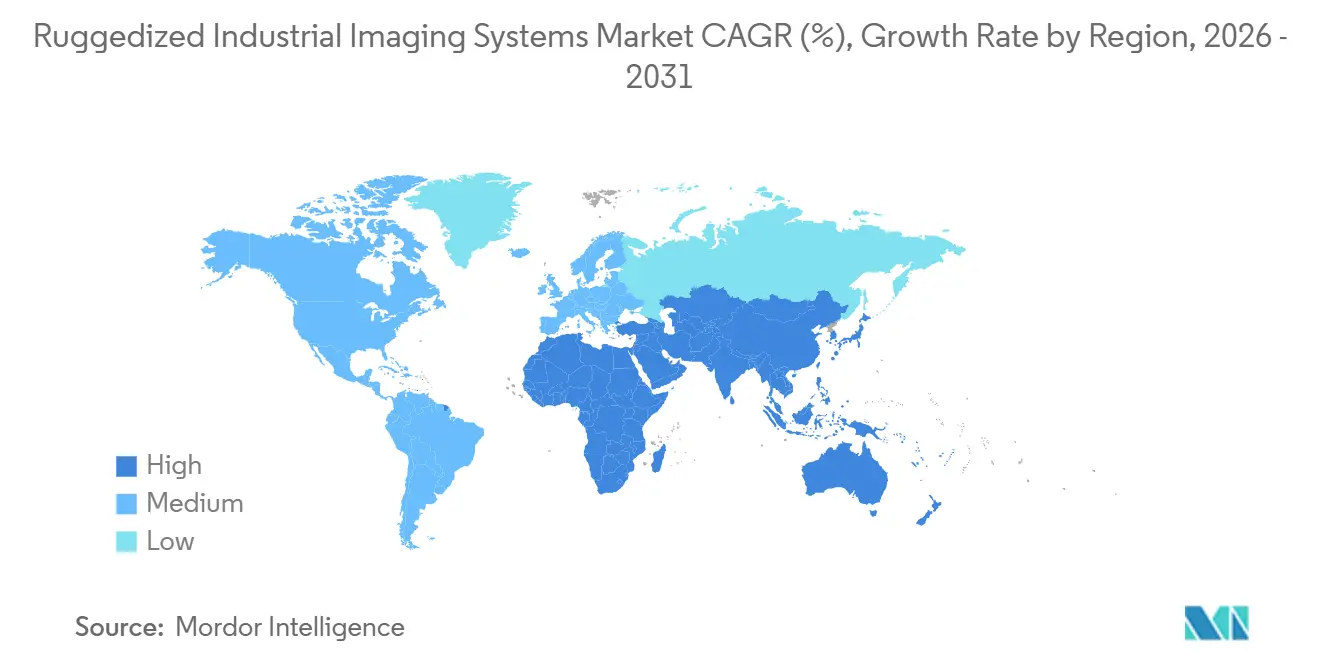
Asia-Pacific held 36.78% of the global market in 2025 and is projected to grow at an 11.56% CAGR through 2031. This gives the region the leading share of the Ruggedized industrial imaging systems market and the fastest regional expansion. China accounted for 295,000 of 542,000 global industrial robot installations in 2024, or 54% of deployments, and had an operational stock of more than 2 million units. Domestic manufacturers reached 57% of China’s machine vision market, compared with 28% a decade earlier. Semiconductor automation in China is increasing demand for high-precision vision in cleanroom and wafer-handling operations.
Japan provides a separate signal of demand in the region. JARA projected 2026 robot orders totaling JPY 1.22 trillion (USD 8.2 billion), supported by AI-related semiconductor investment. India installed a record 9,100 industrial robots in 2024, up 7%, and automotive accounted for 45% of these installations. India ranked sixth globally in installations, creating room for wider adoption of in-line vision. Hikrobot introduced its CI Series infrared LWIR cameras and CT Series area-scan cameras in India in July 2026, signaling supplier interest in emerging Asian automation markets.
North America and Europe had substantial combined demand in 2025 through pharmaceutical serialization, aerospace metrology, and advanced automotive work. The United States installed 34,200 industrial robots in 2024, making it the largest national market outside China.[3]International Federation of Robotics, “World Robotics 2025 Executive Summary, Industrial Robots,” World Robotics 2025, ifr.org European robot installations fell 8% in 2024, while Germany fell 5% to 26,982 units, so upgrades and software integration may matter more than new lines in the near term. Middle East, Africa, and South America remain earlier-stage areas for thermal and explosion-protected systems in energy, mining, food processing, and agriprocessing.

Competitive Landscape
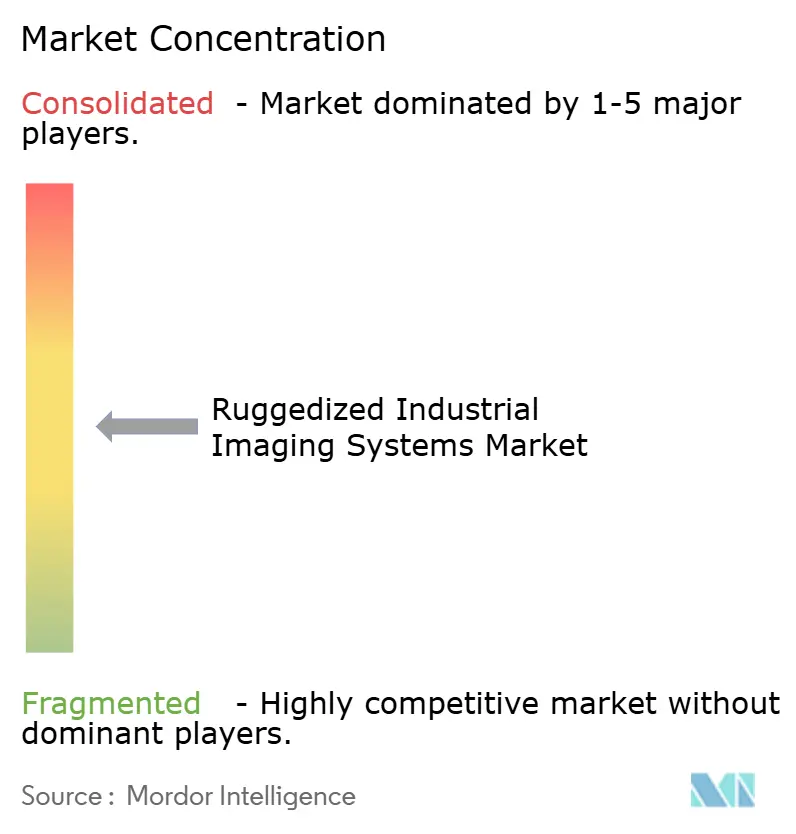
The Ruggedized industrial imaging systems market is moderately concentrated. Cognex, Keyence, Teledyne, SICK, and Basler hold established positions in software, hardware, and services. A second group of regional and specialist suppliers competes through pricing, integration flexibility, and certifications for specific operating conditions. Cognex made its OneVision collaborative AI environment generally available in May 2026 after a 12-month beta with more than 100 customers. The platform lets manufacturers train inspection models centrally and deploy them across multiple sites.
Basler, LUCID Vision Labs, and IDS Imaging Development Systems focus on GigE Vision and GenICam compatibility, as well as higher ingress protection ratings. This makes interoperability a basic competitive requirement, while resolution, thermal performance, and form factor provide differentiation. SICK released its Nova AI-powered 3D inspection platform in August 2026 after validating compatibility with EtherNet/IP, PROFINET, and Modbus-TCP. Such validation can slow market entry, but it is necessary for use in regulated production settings. The Ruggedized industrial imaging systems market favors vendors able to combine reliable devices with standards-based connectivity.
Chinese suppliers led by Hikrobot are expanding internationally with line-scan, infrared, and IP67 camera products. Their cost structures place pressure on mid-range products sold by Western suppliers in price-sensitive regions. LUCID’s Triton2 event-based camera and Teledyne e2v’s Perciva 5D target high-speed motion analysis and robotic guidance, where conventional frame cameras can face motion blur or limited depth data.[4]LUCID Vision Labs, “HDR and Event-Based Cameras at All About Automation 2026,” LUCID Vision Labs, thinklucid.com Suppliers are competing to offer turnkey systems that bring together on-device AI, protected hardware, and fleet-management capabilities. The competitive opportunity lies in meeting demanding ATEX Zone 1, IP68, and -60°C to 85°C requirements without compromising deployment simplicity. These product priorities are defining competition in the Ruggedized industrial imaging systems market.
Ruggedized Industrial Imaging Systems Industry Leaders
Cognex Corporation
Keyence Corporation
Teledyne Technologies Incorporated
Basler AG
Omron Corporation
- *Disclaimer: Major Players sorted in no particular order

Recent Industry Developments
- August 2026: SICK AG launched AI-powered 3D quality inspection capabilities within the Nova machine vision platform, combining deep-learning neural networks with precision pixel-level height-data analysis. The platform enables teach-by-example model training on-device across logistics, automotive, electronics, and battery manufacturing inspection applications. SICK reported group revenue of EUR 1.8 billion (USD 1.99 billion) in fiscal 2025.
- May 2026: Cognex launched the Insight 3900 Vision System, powered by Qualcomm Dragonwing platforms, delivering up to 4 times faster inspection processing at up to 25-megapixel resolution with dual Ethernet for direct PLC and robot integration. The platform enables edge AI, advanced AI, and rule-based vision tools to run simultaneously at full production line speed.
- April 2026: Cognex introduced the modular In-Sight 6900 Vision Controller powered by NVIDIA Jetson technology, delivering up to 157 TOPS of AI performance for real-time multi-model inference at microsecond production synchronization. The modular architecture supports interchangeable cameras, lenses, and lighting, eliminating external PC and distributed architecture dependencies.
- March 2026: Teledyne e2v launched the Perciva 5D camera, generating both 2D and 3D data simultaneously from a single CMOS sensor using Angular Sensitive Pixel technology and an onboard neural processing unit. The factory-calibrated, GigE Vision-compliant device weighs 230 grams, operates at under 5 W, and targets robotic arms, cobots, humanoid robots, and 3D industrial process monitoring.


Global Ruggedized Industrial Imaging Systems Market Report Scope
The ruggedized industrial imaging systems market covers imaging devices, cameras, sensors, and related software designed to operate reliably in harsh industrial environments. These systems withstand extreme temperatures, vibration, dust, moisture, shock, and other demanding operating conditions.
The Ruggedized Industrial Imaging Systems Market Report is Segmented by Product Type (Ruggedized Cameras, Ruggedized Vision Systems, and Ruggedized Imaging Components), Imaging Type (2D Imaging, 3D Imaging, Thermal and Infrared Imaging, and Other Imaging Types), Application (Quality Inspection and Defect Detection, Process Monitoring and Control, Metrology and Measurement, Positioning, Guidance, and Robotics, Predictive and Condition Monitoring, and Other Applications), End-User Industry (Automotive and Transportation, Food and Beverage, Pharmaceuticals and Chemicals, Oil and Gas, Metals and Mining, Electronics and Semiconductor, Aerospace and Defense, Logistics and Warehousing, and Other End-User Industries), and Geography (North America, South America, Europe, Asia-Pacific, Middle East, and Africa). The Market Forecasts are Provided in Terms of Value (USD).
| Ruggedized Cameras |
| Ruggedized Vision Systems |
| Ruggedized Imaging Components |
| 2D Imaging |
| 3D Imaging |
| Thermal and Infrared Imaging |
| Other Imaging Types |
| Quality Inspection and Defect Detection |
| Process Monitoring and Control |
| Metrology and Measurement |
| Positioning, Guidance, and Robotics |
| Predictive and Condition Monitoring |
| Other Applications |
| Automotive and Transportation |
| Food and Beverage |
| Pharmaceuticals and Chemicals |
| Oil and Gas |
| Metals and Mining |
| Electronics and Semiconductor |
| Aerospace and Defense |
| Logistics and Warehousing |
| Other End-User Industries |
| North America | United States |
| Canada | |
| Mexico | |
| South America | Brazil |
| Argentina | |
| Chile | |
| Rest of South America | |
| Europe | Germany |
| United Kingdom | |
| France | |
| Italy | |
| Spain | |
| Rest of Europe | |
| Asia-Pacific | China |
| Japan | |
| India | |
| South Korea | |
| Australia | |
| Rest of Asia-Pacific | |
| Middle East | United Arab Emirates |
| Saudi Arabia | |
| Qatar | |
| Rest of Middle East | |
| Africa | South Africa |
| Egypt | |
| Rest of Africa |
| By Product Type | Ruggedized Cameras | |
| Ruggedized Vision Systems | ||
| Ruggedized Imaging Components | ||
| By Imaging Type | 2D Imaging | |
| 3D Imaging | ||
| Thermal and Infrared Imaging | ||
| Other Imaging Types | ||
| By Application | Quality Inspection and Defect Detection | |
| Process Monitoring and Control | ||
| Metrology and Measurement | ||
| Positioning, Guidance, and Robotics | ||
| Predictive and Condition Monitoring | ||
| Other Applications | ||
| By End-User Industry | Automotive and Transportation | |
| Food and Beverage | ||
| Pharmaceuticals and Chemicals | ||
| Oil and Gas | ||
| Metals and Mining | ||
| Electronics and Semiconductor | ||
| Aerospace and Defense | ||
| Logistics and Warehousing | ||
| Other End-User Industries | ||
| By Geography | North America | United States |
| Canada | ||
| Mexico | ||
| South America | Brazil | |
| Argentina | ||
| Chile | ||
| Rest of South America | ||
| Europe | Germany | |
| United Kingdom | ||
| France | ||
| Italy | ||
| Spain | ||
| Rest of Europe | ||
| Asia-Pacific | China | |
| Japan | ||
| India | ||
| South Korea | ||
| Australia | ||
| Rest of Asia-Pacific | ||
| Middle East | United Arab Emirates | |
| Saudi Arabia | ||
| Qatar | ||
| Rest of Middle East | ||
| Africa | South Africa | |
| Egypt | ||
| Rest of Africa | ||


Key Questions Answered in the Report
What is the size of the ruggedized industrial imaging systems market?
The market was valued at USD 344.41 million in 2025, is estimated at USD 379.22 million in 2026, and is forecast to reach USD 630.18 million by 2031 at a 10.69% CAGR.
What is driving demand for ruggedized industrial imaging systems?
Factory automation, 100% inline quality checks, edge AI, 3D vision, and vision-guided robotics are increasing adoption.
Which product type leads demand?
Ruggedized cameras held 64.31% of the product category in 2025, while integrated ruggedized vision systems are projected to grow faster at 11.67% CAGR.
Why is 3D imaging growing faster than 2D imaging?
3D imaging supports depth-dependent uses such as bin picking, volumetric metrology, and robotic guidance that 2D systems cannot reliably perform.
Which region leads adoption?
Asia-Pacific held 36.78% of global demand in 2025 and is projected to grow at an 11.56% CAGR through 2031.
Page last updated on:





