
Robotic Air Purifier Market Size and Share
Market Overview
| Study Period | 2022 - 2032 |
|---|---|
| Market Size (2027) | USD 0.82 Billion |
| Market Size (2032) | USD 1.29 Billion |
| Growth Rate (2027 - 2032) | 9.52 % |
| Fastest Growing Market | Europe |
| Largest Market | Asia-Pacific |
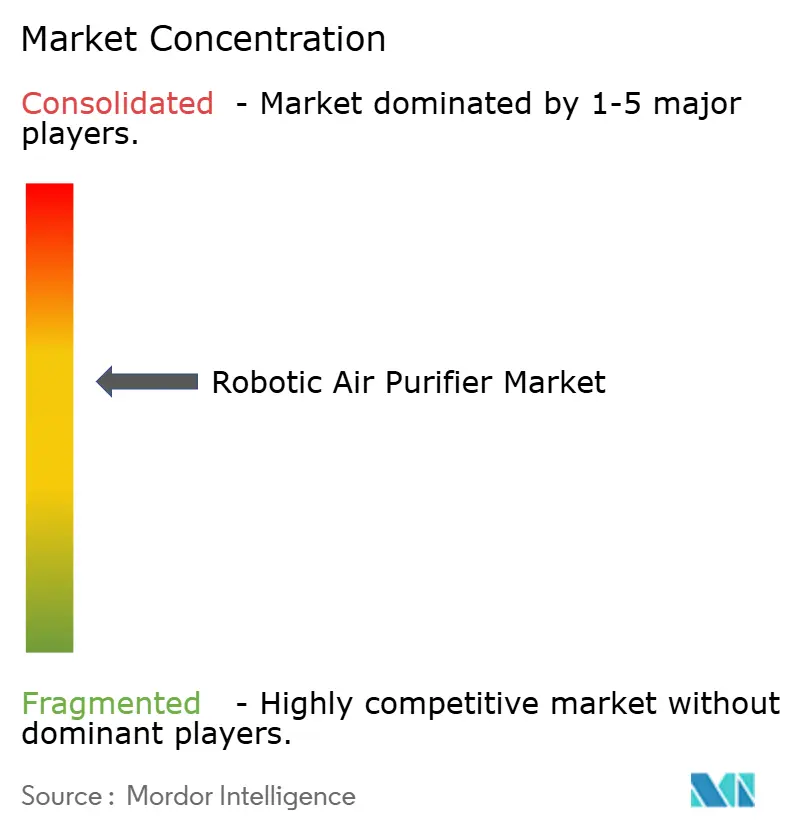
| Market Concentration | Medium |
Major Players *Disclaimer: Major Players sorted in no particular order Image © Mordor Intelligence. Reuse requires attribution under CC BY 4.0. | |
Robotic Air Purifier Market Analysis by Mordor Intelligence
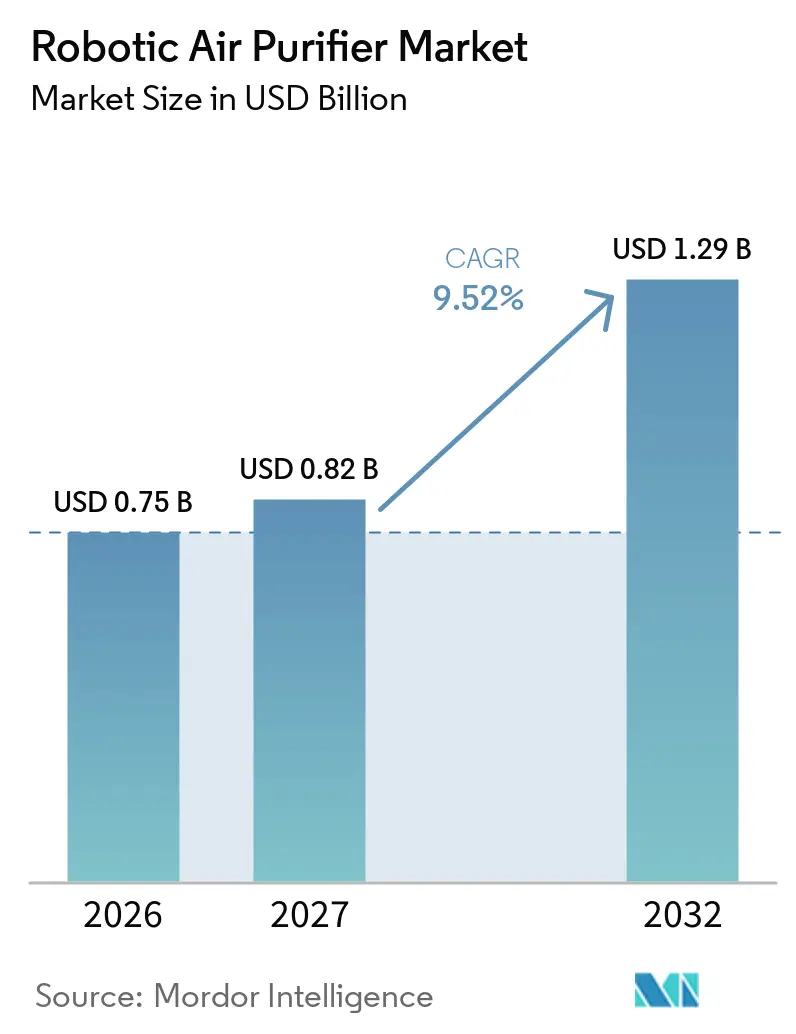
The Robotic Air Purifier Market size was valued at USD 0.75 billion in 2026 and is estimated to grow from USD 0.82 billion in 2027 to reach USD 1.29 billion by 2032, at a CAGR of 9.52% during the forecast period (2027-2032). Demand is moving toward devices that can identify changing pollution conditions within a home or facility and move to where purification is needed. This favors products that combine navigation, sensing, and filtration rather than basic mobile appliances. Connected functions also support filter replacement, operational monitoring, and managed service models, which can make recurring revenue more important for suppliers. East Asian manufacturing ecosystems provide an advantage in sensors, batteries, and robotic components, while European building requirements are raising the value of documented indoor-air-quality performance. Price sensitivity, limited familiarity with the category, and connected-device compliance requirements will still slow broader household adoption in several regions.
Key Report Takeaways
- By product type, standalone robotic air purifiers held 63.4% of the robotic air purifier market share in 2026, while commercial and industrial robotic air purifiers are forecast to grow at a 10.3% CAGR through 2032.
- By filtration technology, High-Efficiency Particulate Air (HEPA) held 43.1% of the robotic air purifier market share in 2026, while UV-C and photocatalytic purification is forecast to grow at a 10.9% CAGR through 2032.
- By navigation technology, LiDAR held 29.6% of the robotic air purifier market share in 2026, while AI-enabled autonomous navigation is forecast to grow at an 11.3% CAGR through 2032.
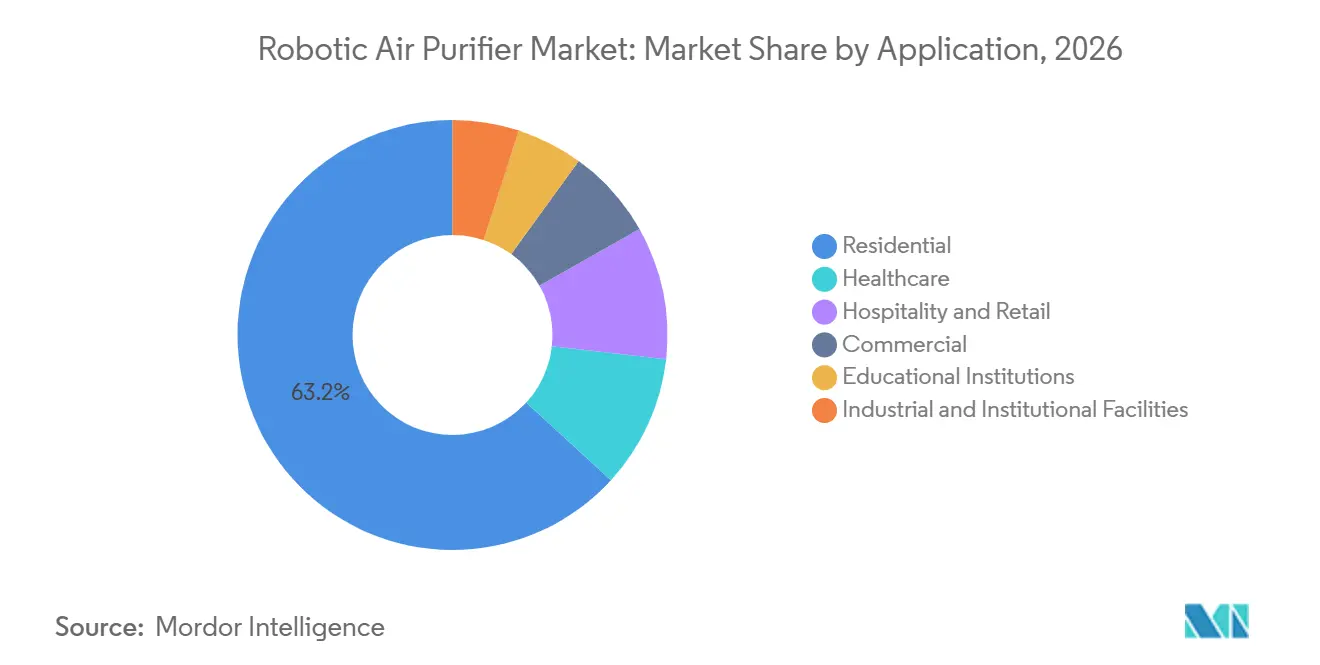
- By application, residential applications accounted for 63.2% of the robotic air purifier market size in 2026, while healthcare is forecast to grow at an 11.6% CAGR through 2032.
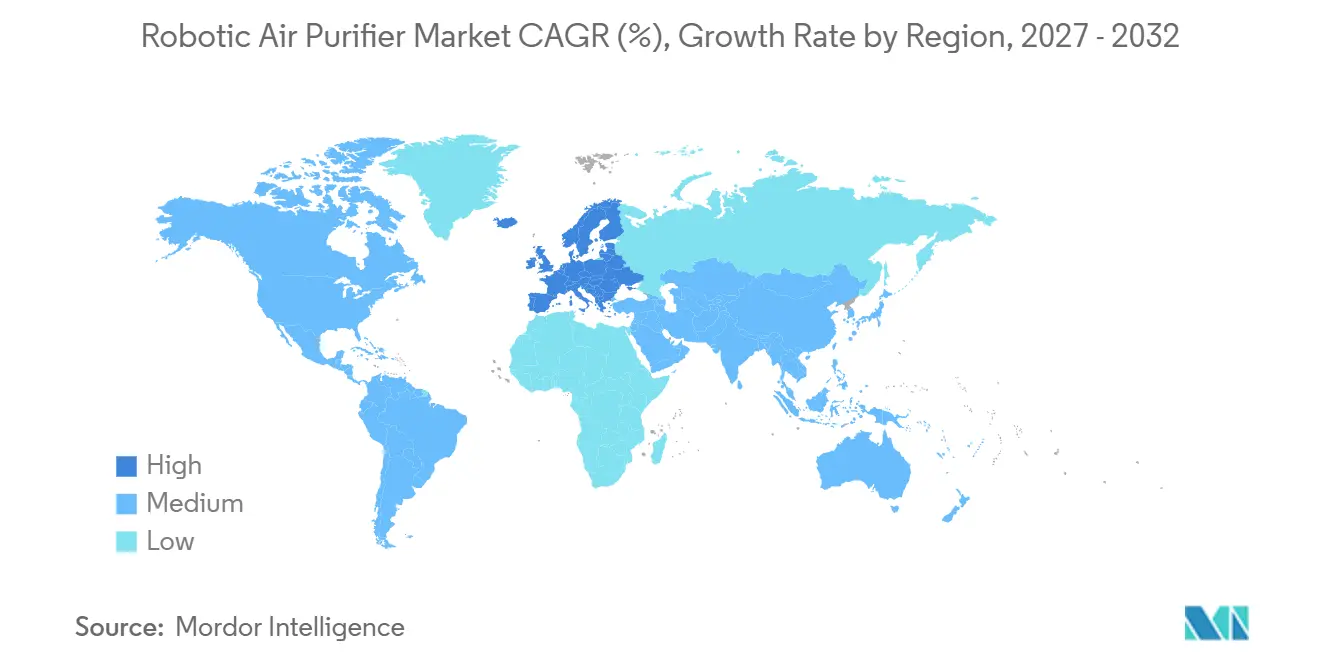
- By geography, Asia-Pacific held 37.6% of revenue in 2026, while Europe is forecast to grow at a 9.9% CAGR through 2032.
Note: Market numbers in this report are based on Mordor Intelligence's proprietary estimation framework, which combines nine months of actuals with Q4 projections for base year 2026.
Global Robotic Air Purifier Market Trends and Insights
Drivers Impact Analysis*
| Driver | (~) % Impact on CAGR Forecast | Geographic Relevance | Impact Timeline |
|---|---|---|---|
| Rising Indoor Air Quality and Health Awareness | +2.8% | Global, with highest relevance in Asia-Pacific cities and Northern Europe | Medium term (2-4 years) |
| Smart Home and Connected Device Adoption | +2.2% | North America, Europe, and East Asia, with early adoption in Southeast Asia | Medium term (2-4 years) |
| AI Navigation, Sensing, and Filtration Advances | +2.0% | Global, led by Asia-Pacific manufacturing hubs and North American research | Long term (≥ 4 years) |
| Commercial Indoor Air Quality Monitoring Requirements | +1.5% | Europe and North America, with early gains in Japan, South Korea, and the GCC | Short term (≤ 2 years) |
| Room-to-Room Coverage Gap in Fixed Purifier Use | +1.3% | Global, especially larger homes in Asia-Pacific | Medium term (2-4 years) |
| Filter Service Automation and Subscription Potential | +0.8% | North America and Europe, with emerging demand in the Middle East and Singapore | Long term (≥ 4 years) |
| Source: Mordor Intelligence | |||
Rising Indoor Air Quality and Health Awareness
The World Health Organization updated its Air Quality Standards database in February 2025 to cover nearly 140 countries, 17% more than the previous edition.[1] The update reinforces that particulate matter, nitrogen dioxide, and ozone remain above guideline levels in many urban areas. The World Health Assembly’s 2025 road map also includes a voluntary objective to halve the health effects of air pollution by 2040.[2] Within homes, pollution can vary between cooking areas, bedrooms, and spaces used by children. A fixed appliance may not address these changing locations as effectively as a mobile unit. This supports demand in the robotic air purifier market for equipment that can direct cleaning activity toward changing indoor conditions. The benefit is not limited to a single room because sources and occupants can change during the day. This makes visible and dependable routing a central part of product credibility for health-conscious buyers.
Smart Home and Connected Device Adoption
Connected homes reduce the practical barriers to introducing an autonomous appliance. A connected purifier can report patterns, help manage filter replacement, and provide operating data to the user. These functions can support recurring service plans alongside equipment sales. They also create a basis for suppliers to improve navigation and filter-management features over time. The room-to-room coverage gap of stationary equipment makes connected autonomous products more relevant where households already use multiple smart devices. This gives the robotic air purifier market an opening to position mobility as a useful part of wider home automation rather than as an isolated feature. A clear app experience can also make maintenance requirements easier for households to understand. Suppliers must still avoid making connected features feel like an unnecessary cost or a complicated setup task.
AI Navigation, Sensing, and Filtration Advances
A U.S. patent granted in July 2025 describes a mobile air-handling robot that adjusts routing, fan speed, and Ultraviolet C (UV-C) settings using readings for particulate matter, carbon dioxide, temperature, and occupancy. Processing sensor information on the device can reduce response delays and limit the need to send operational data to a remote service. The same design direction can help suppliers address privacy expectations for connected equipment. Mobile platforms can also schedule UV-C operation when a room is unoccupied, which can make the technology easier to use in controlled settings. Better sensing, mapping, and filtration combinations are therefore raising the technical threshold for new entries in the robotic air purifier market. The benefit is strongest when suppliers can combine reliable hardware with software that identifies recurring indoor pollution patterns. Hardware alone does not create useful autonomy if the system cannot interpret sensor readings consistently. Suppliers also need controls that let users understand how the device makes routing decisions.
Commercial Indoor Air Quality Monitoring Requirements
Commercial building requirements are creating a nearer-term use case for mobile purification and monitoring. The revised EN 16798-3 standard was updated in May 2025 and sets filtration requirements for non-residential buildings.[3] The recast Energy Performance of Buildings Directive places indoor environmental quality alongside energy performance requirements for European buildings. In the United States, Advanced Research Projects Agency for Health (ARPA-H) awarded Mayo Clinic up to USD 40 million for air-safety research involving robotics, biosensors, and smart filtration in emergency departments.[4] These programs increase the relevance of systems that can provide both purification and operating records. They also make compliance-oriented applications more important to the robotic air purifier market than consumer demand alone. Buyers can use recorded conditions to link equipment use to facility management practices. This encourages suppliers to design reporting functions for nontechnical operators as well as specialists.
Restraints Impact Analysis*
| Restraint | (~) % Impact on CAGR Forecast | Geographic Relevance | Impact Timeline |
|---|---|---|---|
| High Upfront and Total Cost of Ownership | -0.7% | Global, with greatest effect in South America, Southeast Asia, and the Middle East and Africa | Medium term (2-4 years) |
| Limited Awareness and Early Stage Category Penetration | -0.5% | Global, with greatest effect in South America, Africa, and nonurban Asia-Pacific | Short term (≤ 2 years) |
| Battery, Noise, and Clean Air Delivery Trade-Offs | -0.4% | Global | Medium term (2-4 years) |
| Privacy, Cybersecurity, and Evidence Requirements for Connected Devices | -0.3% | North America and the European Union, with effects extending to South Korea and Japan | Long term (≥ 4 years) |
| Source: Mordor Intelligence | |||
High Upfront and Total Cost of Ownership
The category remains premium priced, which limits adoption outside higher-income customer groups. Cost includes the appliance, replacement filters, and potential monitoring or service fees. A 2025 study of 3,400 middle-income households in Dhaka found that consumers valued air purifiers at only 8% to 16% of the retail price, despite high indoor particulate exposure. This indicates that awareness alone may not overcome the affordability barrier. Wider adoption in South America, Southeast Asia, and Sub-Saharan Africa will depend on lower component costs and credible service propositions. Battery capacity, operating noise, and clean-air-delivery performance must also be balanced without pushing prices beyond what mass-market buyers will accept. Cheaper products that compromise too sharply on movement or airflow could weaken consumer confidence in the category. Cost reductions must therefore preserve the core performance that distinguishes a robotic unit from a stationary appliance.
Limited Awareness and Early-Stage Category Penetration
Customers must understand air purification, recognize the limitations of stationary coverage, and trust autonomous movement before considering a robotic model. This creates a more difficult adoption path than for a conventional purifier. Earlier products with limited navigation capability may make buyers cautious about category claims. The robotic air purifier market must therefore show practical coverage benefits rather than rely on automation alone. Connected products also face growing privacy, cybersecurity, and evidence requirements in major markets. Suppliers that cannot substantiate performance or protect device data may find institutional buyers especially difficult to win. Demonstrations that show movement, sensing, and filtration working together can reduce this uncertainty. Independent testing and clear operating guidance will remain important as connected products enter more sensitive settings.
*Our forecasts treat driver/restraint impacts as directional, not additive. The impact forecasts reflect baseline growth, mix effects, and variable interactions.
Segment Analysis
By Product Type: Standalone Platforms Anchor Revenue, Commercial Units Accelerate
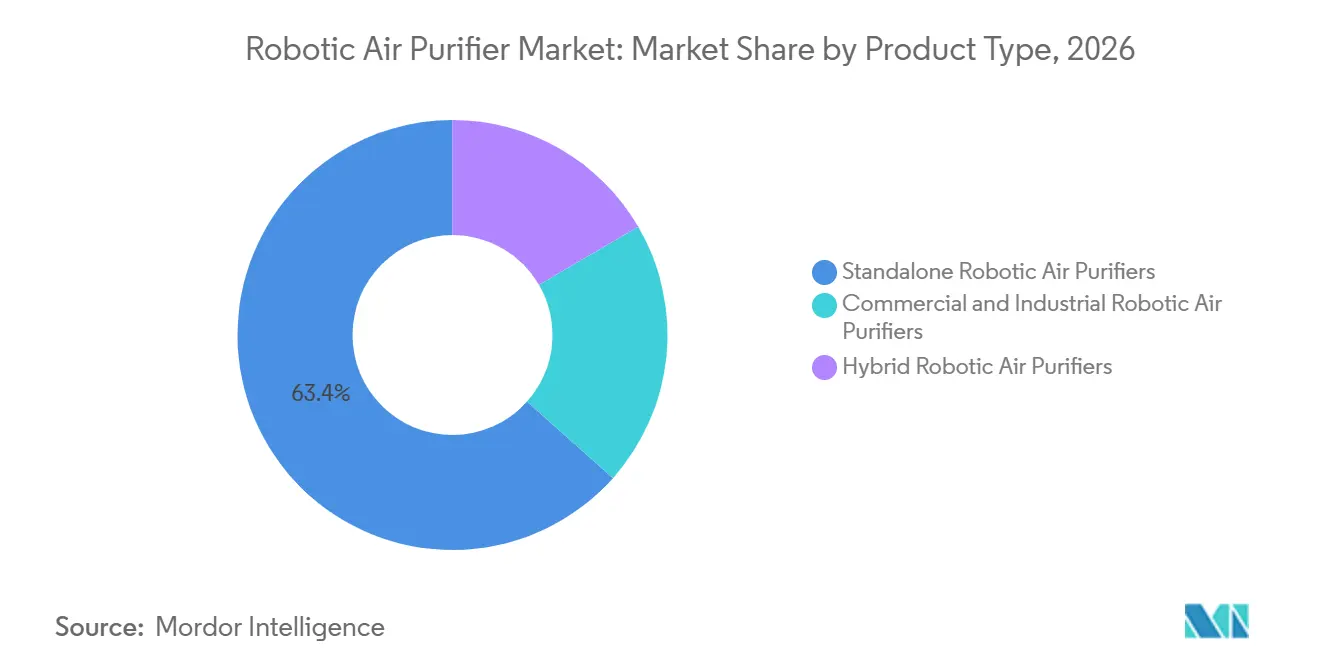
Standalone robotic air purifiers accounted for 63.4% of the robotic air purifier market size in 2026. Their position reflects a first residential approach among early category suppliers. Dedicated units can prioritize airflow design, sensors, and movement without sharing space with a cleaning mechanism. This format is suited to buyers who see air purification as the main function. It can also support room-specific routing when air quality differs across a home. Hybrid products combine purification with vacuuming or mopping and can help justify the purchase to cost-conscious households. However, shared architecture can constrain airflow and clean-air delivery. The product choice depends on whether buyers value dedicated purification performance or multiple household functions. The robotic air purifier industry is likely to keep both formats in the portfolio as the category broadens. Dedicated platforms may also be easier for buyers to evaluate because the purpose and performance requirements are more direct. Hybrid designs need to demonstrate that added functions do not weaken air-cleaning capability.
Commercial and industrial robotic air purifiers are projected to grow at a 10.3% CAGR through 2032. Their momentum comes from healthcare procurement requirements and managed service deployments. GAMA Healthcare deployed nearly 300 Rediair mobile purification units across 2 NHS Midlands trust sites in February 2025 under a 5-year filter-replacement service agreement. This model converts filter management into an ongoing supplier responsibility. It can reduce the operational burden for facilities that do not want to manage equipment internally. Offices, mid-scale healthcare settings, and education facilities offer room for products below the cost of clinical-grade platforms. Suppliers that combine dependable service with clear performance reporting can compete for this part of the robotic air purifier market. Commercial demand also gives manufacturers a way to build recurring revenue beyond initial equipment sales. Facility operators may prefer a service agreement when it gives them predictable support and replacement schedules. This preference makes after-sales capability as important as hardware performance for many institutional suppliers.
By Filtration Technology: HEPA Dominates, UV-C Photocatalytic Gains Ground
HEPA filtration held 43.1% of revenue in 2026. Its leading position is supported by established performance classifications under ISO 29463 and EN 1822. These classifications help healthcare and commercial buyers set minimum filter expectations. Activated carbon and electrostatic technologies can complement HEPA in multi-stage systems. They address gases and volatile organic compounds that mechanical filters do not capture in the same way. This layered approach is becoming more relevant where users expect one device to handle multiple contaminant types. HEPA therefore remains the baseline technology for the robotic air purifier market. The standardization of filter performance also gives institutional buyers a clearer basis for comparison. Suppliers can use familiar HEPA classifications to communicate performance without relying on unfamiliar technical claims. This makes HEPA a useful foundation even when a product includes additional purification stages.
UV-C and photocatalytic purification are forecast to grow at a 10.9% CAGR through 2032. A Scientific Reports study found that a TiO2 photocatalyst reduced airborne microorganism counts in hospital rooms within 2 hours and was linked to a lower incidence of febrile neutropenia in the assessed setting. This type of evidence can be relevant to healthcare procurement decisions. Mobile equipment may add value by applying treatment where and when it is needed. Belgium’s recognition-label framework for virus-reduction claims limits qualifying technologies to H13 or higher HEPA, UV-C from 240 to 280 nm, or high-efficiency electrostatic systems. The framework shows how performance claims may require specific testing and certification. Smaller suppliers may need additional investment to meet these requirements. These conditions support a more regulated competitive environment in the robotic air purifier market. The need for substantiation can protect buyers from unsupported virus-reduction claims. It can also lengthen launch timelines for products using newer purification methods.
By Navigation Technology: LiDAR Sets the Standard, AI Defines the Next Horizon
LiDAR-based navigation held 29.6% of revenue in 2026. It provides detailed room mapping and obstacle avoidance for mobile equipment. This capability is particularly useful in commercial settings with changing layouts and multiple rooms. Sensor and component scale from the broader robotics ecosystem is helping make advanced mapping more accessible. Simultaneous Localization and Mapping (SLAM) navigation provides the underlying mapping architecture on many platforms. Camera and infrared approaches can address lower price points but may offer less detailed navigation. LiDAR remains a practical performance reference for many products in the robotic air purifier market. Reliable movement also improves the value of air-quality data because the device can act on the information it collects. Mapping accuracy matters when a device must navigate furniture without losing access to priority areas. It also supports repeatable cleaning routes that users can observe and adjust.
AI-enabled autonomous navigation is forecast to grow at an 11.3% CAGR through 2032. The approach moves beyond obstacle avoidance toward learning occupancy patterns, cooking activity, and seasonal allergen conditions. SK Intellix launched NAMUHX in South Korea in September 2025 with on-device processing for navigation, spatial hearing, and air-quality prioritization. The company stated that the product received Internet of Things security certification from the Korea Internet and Security Agency. On-device processing can support both responsive operation and cybersecurity compliance. The result is a higher bar for suppliers that rely only on basic movement features. Over time, software performance and sensor integration may matter as much as filtration specifications in the robotic air purifier market. Systems that learn repeated conditions may reduce unnecessary operation when air quality is stable. They must also preserve clear user control to avoid concerns about unpredictable behavior.
By Application: Residential Volume Underpins the Market, Healthcare Sets the Growth Pace
Residential applications accounted for 63.2% of the robotic air purifier market size in 2026. Urban households are the main early users because air-quality concerns, automation interest, and indoor time are often higher in dense cities. Smart-home infrastructure also makes connected products easier to introduce. East Asia has relevance because seasonal particulate events coincide with strong consumer familiarity with automated household devices. Residential buyers may favor standalone units for dedicated purification or hybrid units for wider household utility. In either case, the value proposition depends on whether mobile coverage improves the experience beyond a fixed purifier. Filter replacement and app-based monitoring can support continued user engagement. The residential base gives the robotic air purifier market its present revenue foundation. Household adoption will be stronger where users can see a clear improvement in coverage across daily living spaces. Simple maintenance prompts may be particularly helpful for buyers unfamiliar with filter replacement cycles.
Healthcare is forecast to grow at an 11.6% CAGR through 2032. Research presented at the 2025 IEEE INCSST conference reported that autonomous AI and Internet of Things equipped robots can support air-quality management and sterility maintenance in surgical environments. Healthcare settings need evidence of performance, operating consistency, and safe use around patients and staff. Commercial applications include offices, retail, and hospitality, where air-quality transparency has become more important to tenants and guests. The Netherlands required carbon dioxide meters in primary and secondary school classrooms from July 1, 2025. This monitoring infrastructure can provide a basis for later action when ventilation or purification needs are identified. Hospitality, retail, industrial, and education facilities remain earlier-stage opportunities. Managed-service contracts may provide their most practical entry point into the robotic air purifier market. The same service format can help buyers compare operating costs before they commit to a larger deployment. It also creates a channel for regular filter replacement and performance support.
Geography Analysis
Asia-Pacific held 37.6% of revenue in 2026, the largest share of the robotic air purifier market. The region benefits from integrated supply networks for LiDAR sensors, battery systems, and other robotic components. These supply chains can improve cost control and shorten product-development cycles. China’s robotics ecosystem gives local manufacturers scale across adjacent automated appliance categories. South Korea is also contributing premium product concepts that combine air purification with health-related sensing. This supports a wider product range, from cost-conscious household units to advanced wellness robots.
Indonesia, Malaysia, Thailand, and the Philippines offer longer-term demand potential as seasonal agricultural burning raises public concern about air quality. These countries will remain sensitive to device price and service cost. Product designs that reduce replacement complexity may be more suitable than premium hardware alone. Asia-Pacific suppliers also have an advantage in converting robotic components into consumer products at scale. This may help the region maintain its position in the robotic air purifier market as unit costs decline. The strongest opportunities will depend on whether suppliers can turn technical capability into clearly understood household benefits.
Europe is forecast to grow at a 9.9% CAGR through 2032. The growth rate reflects building and indoor environmental quality requirements that do not have the same direct equivalent in every region. The revised EN 16798-3 standard and the recast Energy Performance of Buildings Directive raise the importance of filtration performance and recorded indoor conditions. Germany, France, and the United Kingdom are the largest individual country markets in the region. North America has a technology-oriented residential base and an expanding healthcare opportunity, reinforced by the Advanced Research Projects Agency for Health (ARPA-H) supported work at Mayo Clinic. South America is still at an early awareness stage, while the Middle East and Africa are emerging through high-income GCC markets with strong smart-home interest and high indoor occupancy. The regional picture creates room for suppliers that can adapt product pricing, service models, and compliance evidence.
Competitive Landscape
The robotic air purifier market is moderately concentrated among the leading suppliers and more fragmented among smaller manufacturers. Chinese original equipment manufacturers compete strongly on specifications and manufacturing cost. However, category leadership increasingly depends on navigation software, sensor fusion, and evidence of performance. Ecovacs has pursued a partnership route through its September 2025 agreement with BSH Home Appliances Group. The collaboration integrates Ecovacs robotics technology into a Bosch branded kitchen-embedded cleaning product. Although the product is not a robotic purifier, the arrangement shows how leading robotics suppliers are seeking built-in appliance distribution channels.
Suppliers are also using on-device intelligence to differentiate their products. SK Intellix’s NAMUHX combines autonomous air purification, spatial hearing, and noncontact vital-sign monitoring in one platform. This type of design links air purification to broader home wellness functions. It also places more emphasis on device security and responsible data handling. GAMA Healthcare’s deployment model shows a different approach based on mobile purification and a 5-year filter-replacement service contract. Such contracts can make the robotic air purifier market more accessible to healthcare buyers that prefer predictable operating costs. The main competitive question is whether suppliers can translate technical features into reliable, lower-burden service for customers.
Open opportunities remain in office buildings, mid-scale healthcare facilities, and education settings that need managed deployments below the cost of clinical-grade systems. After-sales revenue from filters and air-quality monitoring is also less developed than equipment sales. Patent activity suggests that software and sensor integration will become more important sources of differentiation. European claim requirements may also favor suppliers with the resources to fund testing and certification. Honeywell also focuses on stationary residential and commercial air purifiers rather than autonomous mobile purification. The competitive set is therefore shaped by firms that can combine mobile robotics with filtration and operating support.
Robotic Air Purifier Industry Leaders
-
Ecovacs Robotics, Inc.
-
Dyson Limited
-
Partner Robotics Co., Ltd.
-
Xiaomi Corporation
-
Samsung Electronics Co., Ltd.
- *Disclaimer: Major Players sorted in no particular order
Recent Industry Developments
- November 2025: SK Intellix's NAMUHX robotic air purifier receives a CES 2026 Innovation Award in the robotics category, validating its autonomous navigation, 100% voice-control architecture, and non-contact vital-sign monitoring.
- September 2025: BSH Home Appliances Group and Ecovacs Robotics announce a global strategic partnership to co-develop integrated cleaning robots, unveiling a kitchen-furniture-embedded vacuum and mopping robot under the Bosch brand.
- April 2025: SK Networks and SK Magic launch NAMUHX in South Korea, an AI wellness robot combining autonomous air purification, spatial hearing AI, and noncontact vital monitoring powered by an on-device chip with Internet of Things security certification.
- June 2025: Dreame Technology launches the AirPursue PM20 in the United States and Canada with dual-flow airflow modulation, a 6-layer H13 HEPA filtration matrix, radar-based human tracking, and 7 onboard sensors.
Global Robotic Air Purifier Market Report Scope
A robotic air purifier is an autonomous, mobile device that moves through indoor spaces to detect and filter airborne pollutants, allergens, and odors.
The global robotic air purifier market is segmented by product type, filtration technology, navigation technology, application, and geography. By product type, the market is segmented into standalone robotic air purifiers, hybrid robotic air purifiers, and commercial and industrial robotic air purifiers. By filtration technology, the market is segmented into HEPA filtration, activated carbon filtration, electrostatic precipitators, ionization and ozone-based systems, UV-C and photocatalytic purification, and other filtration technologies. By navigation technology, the market is segmented into LiDAR-based navigation, camera and vision-based navigation, infrared and sensor-based navigation, simultaneous localization and mapping (SLAM), and AI-enabled autonomous navigation. By application, the market is segmented into residential, commercial, healthcare, hospitality and retail, educational institutions, and industrial and institutional facilities. The report also covers the market size and forecasts for the global robotic air purifier market across 28 countries in key regions. For each segment, the market sizing and forecasts have been provided on the basis of value (USD).
| Standalone Robotic Air Purifiers |
| Hybrid Robotic Air Purifiers |
| Commercial and Industrial Robotic Air Purifiers |
| HEPA Filtration |
| Activated Carbon Filtration |
| Electrostatic Precipitator |
| Ionization and Ozone-Based Systems |
| UV-C and Photocatalytic Purification |
| Other Filtration Technologies |
| LiDAR-Based Navigation |
| Camera and Vision-Based Navigation |
| Infrared and Sensor-Based Navigation |
| Simultaneous Localization and Mapping (SLAM) |
| AI-Enabled Autonomous Navigation |
| Residential |
| Commercial |
| Healthcare |
| Hospitality and Retail |
| Educational Institutions |
| Industrial and Institutional Facilities |
| North America | United States |
| Canada | |
| Mexico | |
| Europe | Germany |
| France | |
| Italy | |
| Spain | |
| United Kingdom | |
| Poland | |
| Netherlands | |
| Russia | |
| Rest of Europe | |
| Asia-Pacific | China |
| India | |
| Japan | |
| South Korea | |
| Australia | |
| Indonesia | |
| Malaysia | |
| Thailand | |
| Philippines | |
| Rest of Asia-Pacific | |
| South America | Brazil |
| Argentina | |
| Colombia | |
| Rest of South America | |
| Middle East and Africa | Saudi Arabia |
| United Arab Emirates | |
| South Africa | |
| Egypt | |
| Nigeria | |
| Rest of Middle East and Africa |
| By Product Type | Standalone Robotic Air Purifiers | |
| Hybrid Robotic Air Purifiers | ||
| Commercial and Industrial Robotic Air Purifiers | ||
| By Filtration Technology | HEPA Filtration | |
| Activated Carbon Filtration | ||
| Electrostatic Precipitator | ||
| Ionization and Ozone-Based Systems | ||
| UV-C and Photocatalytic Purification | ||
| Other Filtration Technologies | ||
| By Navigation Technology | LiDAR-Based Navigation | |
| Camera and Vision-Based Navigation | ||
| Infrared and Sensor-Based Navigation | ||
| Simultaneous Localization and Mapping (SLAM) | ||
| AI-Enabled Autonomous Navigation | ||
| By Application | Residential | |
| Commercial | ||
| Healthcare | ||
| Hospitality and Retail | ||
| Educational Institutions | ||
| Industrial and Institutional Facilities | ||
| By Geography | North America | United States |
| Canada | ||
| Mexico | ||
| Europe | Germany | |
| France | ||
| Italy | ||
| Spain | ||
| United Kingdom | ||
| Poland | ||
| Netherlands | ||
| Russia | ||
| Rest of Europe | ||
| Asia-Pacific | China | |
| India | ||
| Japan | ||
| South Korea | ||
| Australia | ||
| Indonesia | ||
| Malaysia | ||
| Thailand | ||
| Philippines | ||
| Rest of Asia-Pacific | ||
| South America | Brazil | |
| Argentina | ||
| Colombia | ||
| Rest of South America | ||
| Middle East and Africa | Saudi Arabia | |
| United Arab Emirates | ||
| South Africa | ||
| Egypt | ||
| Nigeria | ||
| Rest of Middle East and Africa | ||
Key Questions Answered in the Report
What is the projected value of robotic air purifiers by 2032?
The category is projected to reach USD 1.29 billion by 2032, growing from USD 0.82 billion in 2027 at a 9.52% CAGR. Growth is supported by demand for equipment that can move toward changing indoor air conditions.
Which product format leads revenue?
Standalone robotic air purifiers lead revenue with a 63.4% share in 2026 because they focus on dedicated airflow, sensing, and mobile purification. This makes their performance proposition easier for household buyers to assess.
Which filtration technology is expanding fastest?
UV-C and photocatalytic purification is forecast to grow at a 10.9% CAGR through 2032, supported by healthcare interest and developing performance requirements. Suppliers will need credible testing to support germicidal and related claims.
Why is healthcare a priority application?
Healthcare is expected to record an 11.6% CAGR through 2032 because facilities value documented air-quality performance, consistent operation, and managed service options. This favors suppliers that can provide support beyond the initial device sale.
Which region has the largest revenue share?
Asia-Pacific holds the largest share at 37.6% in 2026, supported by its robotics supply ecosystem and strong demand for automated household devices. Regional component supply can also help manufacturers control product costs.
What limits wider adoption of robotic air purifiers?
High upfront costs, replacement and service expenses, limited awareness, and cybersecurity or performance-evidence requirements remain the main barriers. A clear service model and dependable operating results can help suppliers address some of these concerns.