
Reticulated Foam Market Size and Share
Market Overview
| Study Period | 2022 - 2032 |
|---|---|
| Market Size (2027) | USD 654.48 Million |
| Market Size (2032) | USD 889.98 Million |
| Growth Rate (2027 - 2032) | 6.34 % |
| Fastest Growing Market | Asia-Pacific |
| Largest Market | North America |
| Market Concentration | Low |
Major Players *Disclaimer: Major Players sorted in no particular order Image © Mordor Intelligence. Reuse requires attribution under CC BY 4.0. | |
Reticulated Foam Market Analysis by Mordor Intelligence
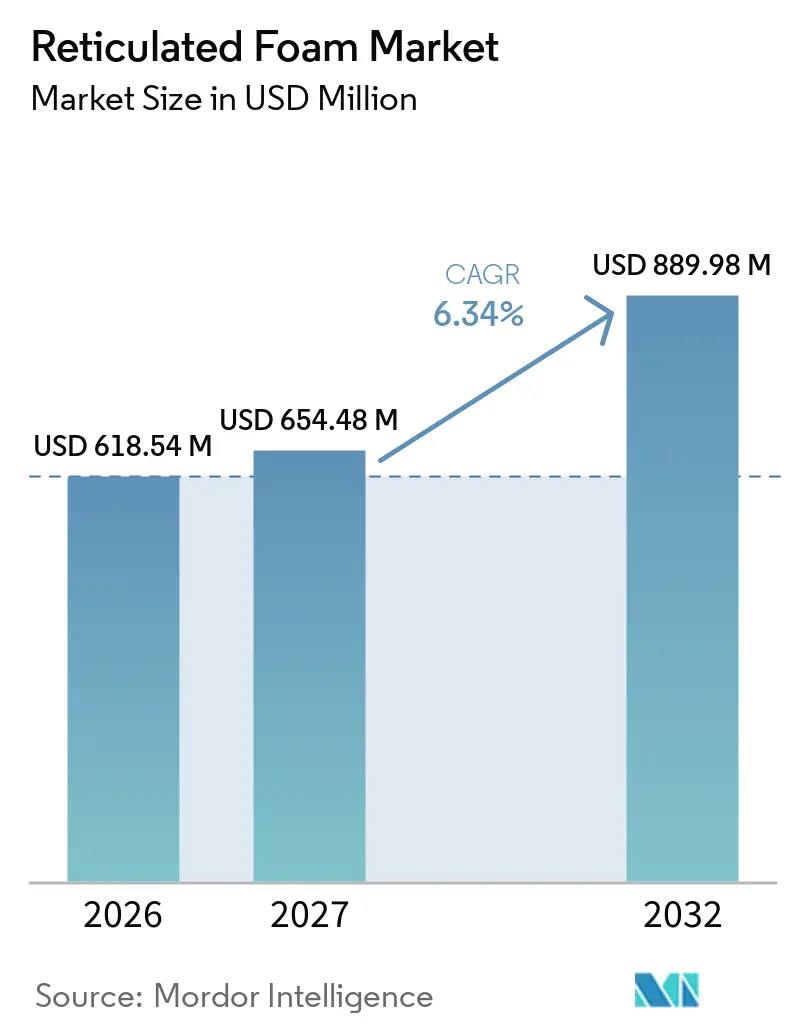
The Reticulated Foam Market size was valued at USD 618.54 million in 2026 and is estimated to grow from USD 654.48 million in 2027 to USD 889.98 million by 2032, at a CAGR of 6.34% during the forecast period (2027-2032). Reticulated foam combines high void space with a connected, open-cell structure that supports air and liquid flow while maintaining physical stability in demanding applications. This characteristic supports its use in filtration, acoustic control, thermal management, and fluid handling, where material performance must be documented. The reticulated foam market is driven by long-cycle changes in vehicle design, industrial air-quality requirements, and increasingly compact electronic assemblies. Suppliers are moving toward flame-retardant, lower-emission, and locally qualified grades, which increases the importance of technical capability over scale alone. The opportunity is strongest where a foam grade is designed into a component and changing materials requires fresh testing or customer approval.
Key Report Takeaways
- By material type, polyurethane held 58.67% of the market share in 2026, while polyether is forecast to grow at a 6.83% CAGR through 2032.
- By pore size, medium-pore foam held 45.12% of the market share in 2026, while large-pore foam is forecast to grow at a 6.91% CAGR through 2032.
- By application, filtration held 52.78% of the market share in 2026 and is forecast to grow at a 7.13% CAGR through 2032.
- By end-user industry, automotive held 37.19% of the market share in 2026, while electronics is forecast to grow at a 7.47% CAGR through 2032.
- By geography, North America held 36.23% of the market share in 2026, while Asia-Pacific is forecast to grow at a 7.14% CAGR through 2032.
Note: Market numbers in this report are based on Mordor Intelligence's proprietary estimation framework, which combines nine months of actuals with Q4 projections for base year 2026.
Market Trends and Insights
Drivers Impact Analysis of Reticulated Foam Market*
| Drivers | (~) % Impact on CAGR Forecast | Geographic Relevance | Impact Timeline |
|---|---|---|---|
| Rising Demand for Air and Liquid Filtration | +2.0% | Global, with Asia-Pacific and North America as core markets | Long term (≥ 4 years) |
| Demand for Durable Outdoor Furnishings | +0.8% | North America, Europe, Asia-Pacific, marine, and hospitality | Medium term (2-4 years) |
| Lightweight Acoustic and Filtration Components in Automotive and Aerospace | +1.2% | Global, with Asia-Pacific as a core market and spillover to the Middle East and Africa through OEM localization | Long term (≥ 4 years) |
| Sustainability and Recyclable-Material Adoption | +0.6% | European Union primary, North America secondary | Medium term (2-4 years) |
| EV Thermal Management and Localized Original Equipment Manufacturer (OEM) Qualification | +1.0% | China and the Asia-Pacific core, with spillover to North America and Europe | Short-term (≤ 2 years) and medium-term (2-4 years) |
| Source: Mordor Intelligence | |||
Rising Demand for Air and Liquid Filtration
Industrial air quality and water treatment requirements drive demand for reticulated foam in filtration systems, particularly where operators need a low-cost first stage that protects higher-cost downstream filters, maintains stable airflow, and provides maintenance teams with a practical way to manage replacement intervals across large equipment fleets. The material can act as a pre-filter, intercepting coarse particles before they reach downstream media and helping manage maintenance requirements. This role is relevant in complete air-handling systems where filter selection and documentation are important. Reticulated foam is also used in Heating, Ventilation, and Air Conditioning (HVAC) systems for electric vehicles, buses, and mobile homes, extending its use beyond conventional industrial filtration. The reticulated foam market benefits when vehicle and industrial customers require traceable media and consistent filtration performance. The U.S. Environmental Protection Agency renewed the information collection requirements for flexible polyurethane foam product facilities under 40 Code of Federal Regulations (CFR) Part 63 in June 2025, maintaining a compliance framework for covered operations.
Demand for Durable Outdoor Furnishings
Outdoor furniture and marine seating require foam that drains quickly after water exposure, as standing moisture can compromise comfort, encourage premature replacement, and reduce the practical value of a premium seating product expected to remain usable through frequent rain, washdown, or saltwater exposure. Large-pore reticulated grades meet this need because their open structure releases water while providing cushioning and shape retention. These attributes are relevant in hospitality seating, boat cushions, and premium outdoor furniture, where replacement cycles can be costly. This demand driver is most relevant in North America, Europe, and parts of Asia-Pacific with established outdoor living and marine markets. It also creates demand for grades that can perform through humidity cycles without losing functionality. The reticulated foam market benefits from applications where drainage, durability, and comfort are evaluated together rather than as separate specifications.
Lightweight Acoustic and Filtration Components in Automotive and Aerospace
Electric vehicles make road, motor, and HVAC sounds more noticeable because there is less engine noise to mask them, requiring vehicle designers to manage several smaller sound sources simultaneously rather than relying on conventional engine noise to cover vibration, airflow, and road-surface noise within the cabin. Open-pore foams dissipate sound through viscous effects in their pore network and are used in vehicle door inserts, pillar fillers, and structural cavities. A 2025 review describes the role of sound packages in controlling vehicle noise and discusses the porous materials used in this application[1]. In aerospace, foam can support cabin-air filtration and anti-slosh functions in fuel systems, where dimensional stability and documented performance are important. The same materials can reduce component weight compared with less efficient alternatives. The reticulated foam market benefits from specifications that combine acoustic control, air movement, and weight management in a single component.
Sustainability and Recyclable-Material Adoption
Procurement teams assess recycled, bio-based, and lower-emission inputs when selecting polymer foam, as material documentation can affect supplier selection, customer reporting, and a component maker's ability to meet a buyer's internal environmental requirements without changing product functionality. NEVEON has reported using certified mass-balance raw materials in foam products, demonstrating that lower-emission feedstock approaches can be incorporated into commercial foam portfolios. Research also continues into chemical and biological routes to recover useful materials from polyurethane foam waste. These developments are relevant for reticulated grades because they can help suppliers address material traceability requirements without changing the foam's intended function. European purchasing practices are particularly influential, as environmental documentation can be included in tender evaluation. The reticulated foam market benefits when producers can pair functional specifications with credible material-origin information.
Restraints Impact Analysis of Reticulated Foam Market*
| Restraints | (~) % Impact on CAGR Forecast | Geographic Relevance | Impact Timeline |
|---|---|---|---|
| Petroleum-Linked Feedstock Volatility | -0.8% | Global, with Europe and North America most exposed to spot pricing | Short-term (≤ 2 years) and medium-term (2-4 years) |
| High Production Costs and Limited Application Awareness | -0.6% | Emerging markets in South America, the Middle East, Africa, and parts of the Asia-Pacific | Medium term (2-4 years) |
| Limited Cross-Market Standardization | -0.4% | Global, with the greatest impact in the Middle East, Africa, and South America | Long term (≥ 4 years) |
| Source: Mordor Intelligence | |||
Petroleum-Linked Feedstock Volatility
Reticulated foam production depends on isocyanates and polyols, the costs of which are tied to petrochemical feedstocks. This exposes producers when supply conditions change faster than negotiated customer prices, and when a specialty grade cannot be reformulated without renewed validation from the customer or application engineer. Processors without long-term supply contracts are particularly vulnerable to rapid cost increases. This exposure is especially difficult for smaller fabricators serving specialized filtration or marine accounts, as their purchase quantities are limited. Such companies may struggle to pass on higher material costs when operating under fixed-price agreements. Supply interruptions can also delay deliveries and disrupt customer scheduling. The reticulated foam market remains exposed to this restraint because material performance often requires a specific chemistry that cannot be quickly replaced with a lower-cost substitute.
High Production Costs and Limited Application Awareness
The reticulation process removes cell membranes from the base foam using controlled chemical or thermal methods. Producers must closely manage the base foam, processing conditions, quality checks, and conversion steps to deliver the pore structure and physical consistency required in a finished component. This process requires specialized equipment and tightly controlled conditions, which raises production costs. As a result, reticulated grades cannot compete on cost alone against conventional open-cell foam in price-sensitive applications. In South America, the Middle East, Africa, and parts of Asia-Pacific, buyers may still select commodity sponge due to limited awareness of performance differences. This choice can result in lower filtration efficiency or shorter service life in applications that require more durable materials. Demand is likely to remain constrained until performance-based specifications and technical education become more widely adopted.
*Our forecasts treat driver/restraint impacts as directional, not additive. The impact forecasts reflect baseline growth, mix effects, and variable interactions.
Reticulated Foam Market Segment Analysis
By Material Type:
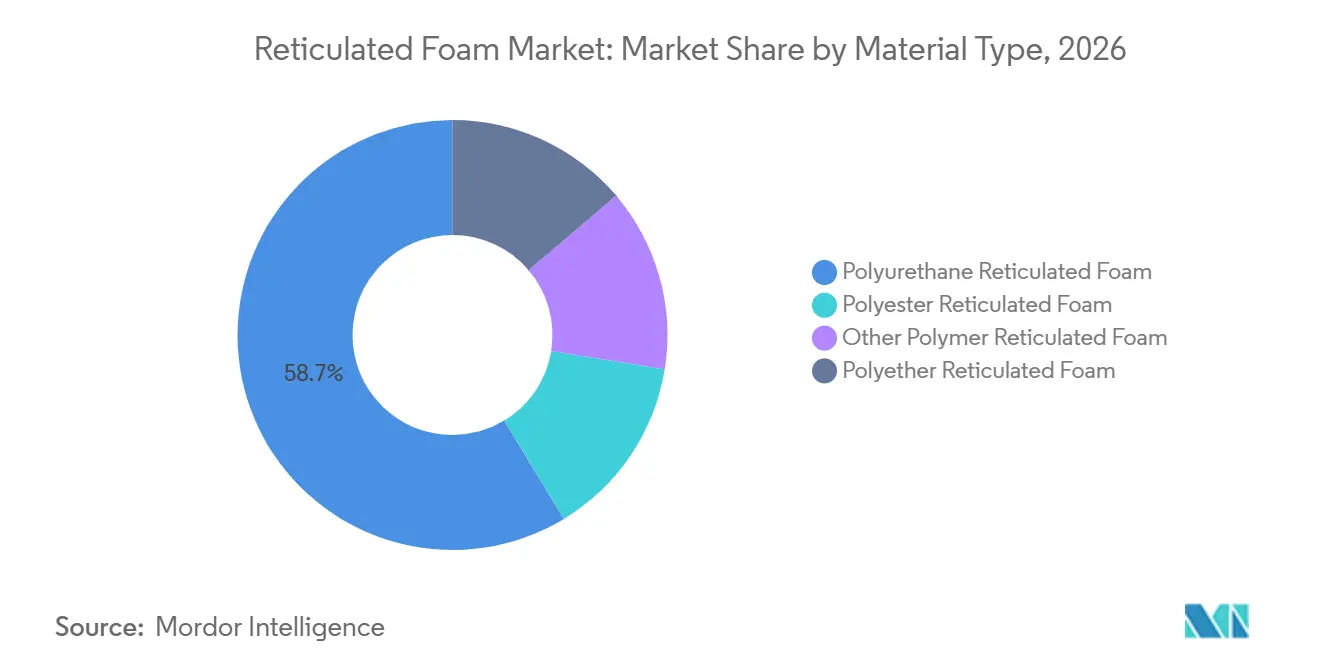
Polyurethane Leads Across Core ApplicationsPolyurethane accounted for 58.67% of the Reticulated Foam Market share in 2026, reflecting its broad use in industrial filtration, vehicle components, and marine applications. Processors can select grades with varying pore structures and physical properties while working within a material platform familiar to converters, component designers, and purchasing teams. Its cost-to-performance balance supports use across a wide range of operating conditions. Polyurethane grades can be tailored to meet requirements for flexibility, pore structure, flame performance, and chemical resistance, making the material suitable for customers who require a consistent product across multiple component designs. The large installed base also gives processors familiarity with polyurethane conversion and fabrication. This position supports sustained demand even as alternative chemistries remain relevant in selected applications, as customers can retain a familiar material platform while adapting density, pore structure, resilience, and conversion methods to the performance requirements of individual finished parts.
Polyether is forecast to expand at a 6.83% CAGR through 2032 due to its performance in wet conditions and in applications involving repeated exposure to humidity. This property supports use in aquatic filtration, medical fluid handling, outdoor seating, and selected thermal management interfaces. A 2025 article on flexible polymer foams discusses their role in thermal management and the material choices used in these systems. Polyester reticulated foam continues to serve petroleum-contact filtration and solvent-handling applications where tensile and tear strength are important. Melamine and hybrid foam variants remain focused on specialized acoustic and aerosp

By Pore Size:
Medium-Pore Grades Support Broad Filtration UseMedium-pore foam held 45.12% of the Reticulated Foam Market share in 2026 because it balances particle capture with airflow, giving system designers a practical option where a filter must provide meaningful coarse-particle control without imposing a pressure drop that would increase energy use or require changes to existing equipment. The 20-45 Pores Per Inch (PPI) range is used in HVAC pre-filtration and other systems that must avoid excessive pressure drop, allowing fans and blowers to operate without unnecessary motor sizing. Medium-pore grades are also familiar to industrial customers who require repeatable filtration behavior. Their versatility supports adoption across commercial and industrial air systems, and the segment's established position reflects the wide range of applications that require both airflow and practical particle retention.
Large-pore foam is projected to grow at a 6.91% CAGR through 2032, driven by applications in outdoor furniture and marine seating. Pore sizes in the 10-20 PPI range favor drainage and physical bulk rather than fine-particle interception, making them appropriate where fast drying is more important than filtration efficiency. Premium outdoor seating and hospitality furnishings drive demand for foam cores that retain comfort after exposure to water. Small-pore grades above 45 PPI remain important for medical devices and electronics where contamination control requirements are more demanding. The Reticulated Foam Market can serve each requirement because pore size can be selected to match the application, rather than treating open-cell foam as a uniform product.
By Application:
Filtration Combines Scale with GrowthFiltration accounted for 52.78% of the Reticulated Foam Market size in 2026 and is projected to grow at a 7.13% CAGR through 2032. The application covers traditional industrial equipment, vehicle cabin air systems, medical ventilation, aquatic systems, and other installations where contamination control and reliable maintenance practices have direct operating value. Industrial HVAC, cabin-air systems, aquatic systems, and medical ventilation create multiple demand channels. Foam's ability to act as a pre-filter helps protect more costly downstream media, and once a foam grade is specified in a system, replacement may require additional validation. These characteristics make filtration an important source of recurring and technically defined demand.
Sound absorption remains a major secondary application, as open-cell structures can dissipate sound energy in vehicle interiors, for speaker protection, and in acoustic panels. The vehicle noise-control literature describes the importance of sound package materials in managing cabin noise. Fluid management also uses reticulated foam to control liquid flow in cosmetic applicators, printer ink systems, and surgical settings. Cleaning products use the structure's durability and ability to retain or release fluids during use. These applications broaden the customer base beyond filtration and reduce dependence on any individual equipment cycle. The same structural features that serve filtration can therefore address diverse functional requirements across the Reticulated Foam Market.
By End-User Industry:
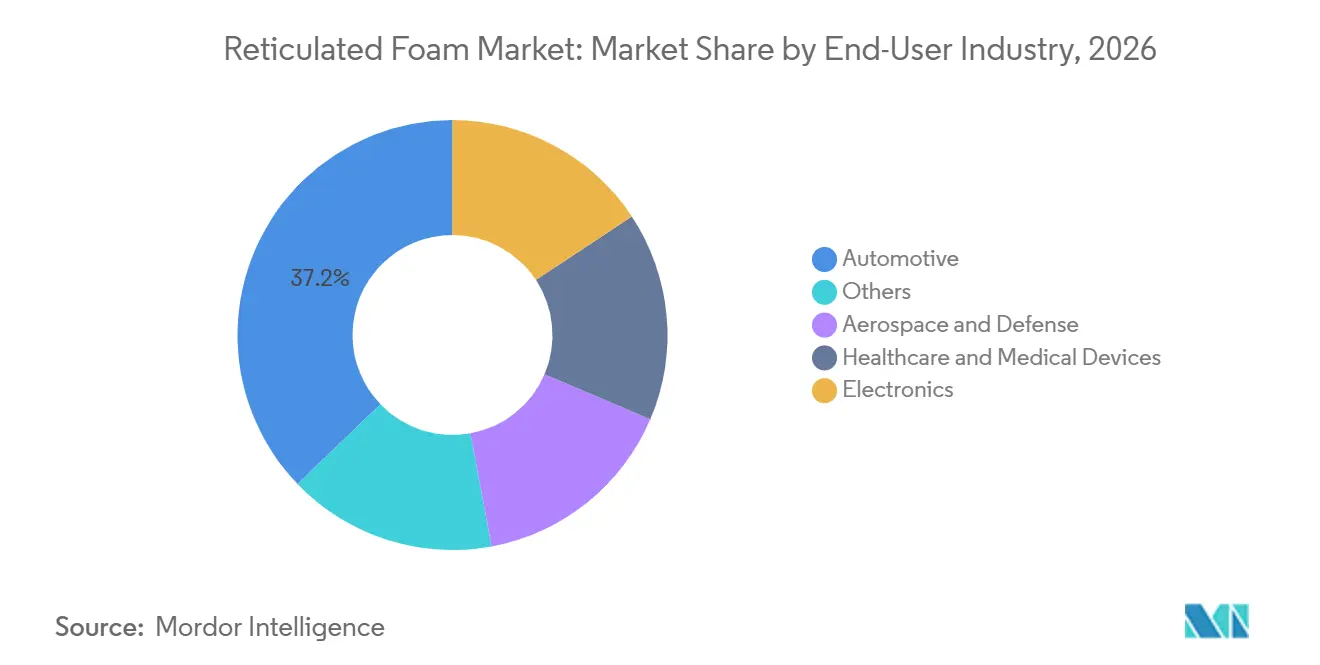
Automotive Provides Scale While Electronics Records Fastest GrowthAutomotive accounted for 37.19% of revenue in 2026, making it the largest end-user segment in the Reticulated Foam Market. Foam components can be integrated into several vehicle systems simultaneously, including air handling, seating comfort, cabin acoustics, vibration management, and protection of selected sensitive assemblies. Electric vehicles retain several of these requirements while adding battery protection and thermal interface opportunities. Reduced powertrain noise in electric vehicles also makes road and airflow sounds more noticeable inside the cabin, increasing the importance of well-designed acoustic components. Automotive demand remains tied to long product-development cycles, which can create a durable business once a material is approved.
Electronics is forecast to grow at a 7.47% CAGR through 2032 as components become more compact and more sensitive to vibration and heat. Relevant uses include gap filling, antenna sealing, server applications, and cushioning for wearable devices. Rogers Corporation launched PORON 40V0 in September 2025 as a halogen-free polyurethane foam for applications requiring fire performance and compressibility. Aerospace and defense demand remains governed by qualification requirements, while healthcare uses include wound care, positioning, and respiratory filtration products. Cleaning, sports equipment, and packaging form a stable additional output base. The Reticulated Foam Market benefits when end users require a material that can manage air, fluids, sound, and mechanical protection within a limited space.
Geography Analysis
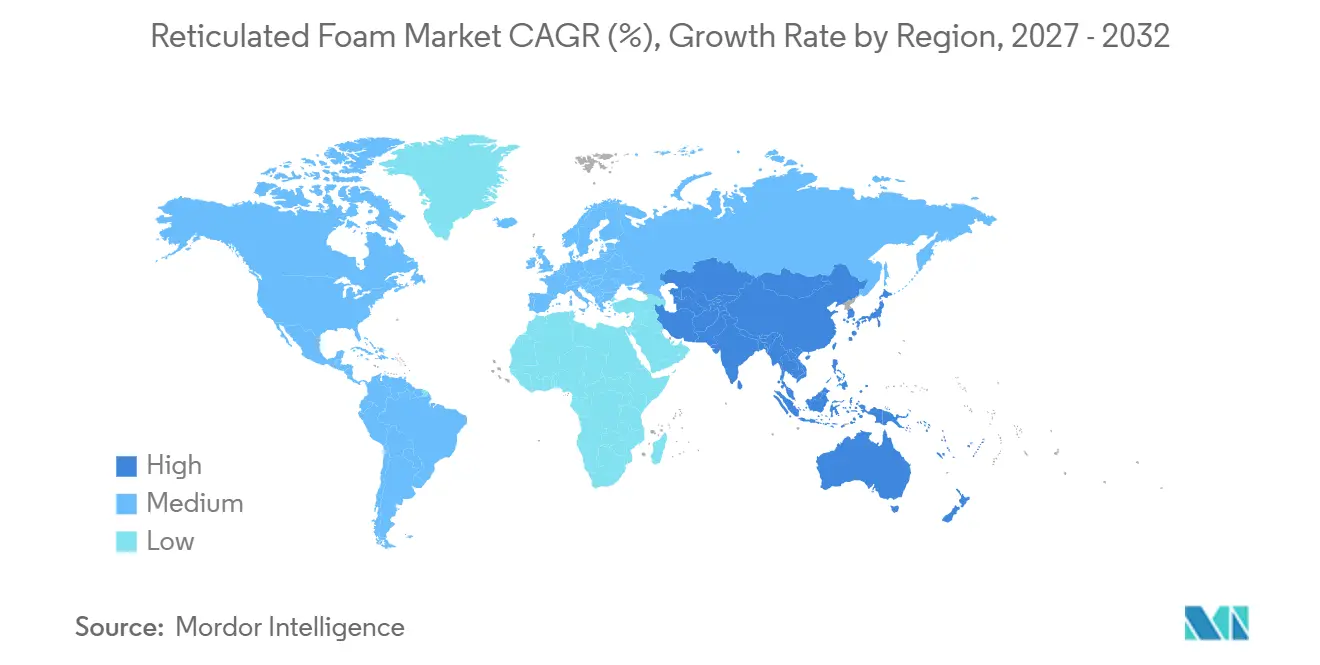
North America accounted for 36.23% of the reticulated foam market share in 2026, supported by mature automotive supply chains, aerospace procurement, and industrial filtration demand. The region's technical customer base favors suppliers that can combine material consistency, local service, and documentation suited to regulated or high-performance applications. Higher-value grades are used in aerospace, medical devices, and electronics, where technical performance supports stronger pricing and where component makers can differentiate through customer-specific fabrication, reliable production controls, and the ability to demonstrate that a foam grade meets agreed functional requirements across repeated production runs. The U.S. regulatory environment also maintains compliance requirements for flexible polyurethane foam product facilities. Canada contributes through Woodbridge's automotive foam operations, while Mexico offers further opportunities through vehicle manufacturing and supplier localization. North American customers tend to value documented fire, filtration, and acoustic performance, which supports specialized foam conversion.
Asia-Pacific is projected to grow at a 7.14% CAGR through 2032, making it the fastest-growing region in the reticulated foam market. Regional manufacturers serve expanding vehicle and electronics production, while customers increasingly prefer suppliers that can respond quickly to local tooling, testing, qualification, and delivery requirements. Vehicle production, electronics assembly, and home furnishings manufacturing support demand across China, India, Japan, South Korea, and Southeast Asia. Local qualification is important in this region because OEMs often require suppliers to support programs without long import lead times, as component changes can affect production scheduling and program costs when vehicle and electronics manufacturers depend on coordinated deliveries from multiple tiers of local and international suppliers. Carpenter's additional reticulation capacity in Changzhou demonstrates our commitment to serving customers closer to their manufacturing bases. In December 2025, WTEC Group signed a sales framework agreement with GuangDong ShiFeng New Materials to distribute polyurethane foam across ASEAN markets, effective from January 2026[2]. These developments indicate a more organized regional supply chain for technical foam.
Europe remains a significant consumption center, with Germany, the United Kingdom, France, and Nordic countries supporting demand for filtration and acoustic foam. Environmental and chemical management requirements make technical documentation, reformulation capability, and credible material-origin information increasingly important to supplier decisions. NEVEON operates filter-foam and reticulation capabilities across a broad European production network. Regional regulatory requirements are pushing suppliers toward reformulated, lower-emission foam grades, requiring producers to balance environmental documentation with durability, processability, and the filtration, acoustic, or safety performance expected by customers who may be reluctant to requalify familiar products. The European Commission adopted restrictions on per- and polyfluoroalkyl substances (PFAS) in firefighting foams in October 2025, with transition periods that vary by use. South America, the Middle East, and Africa remain developing regions for the reticulated foam market, where automotive activity and industrial investment drive demand, but high costs and limited awareness slow wider adoption.
Competitive Landscape
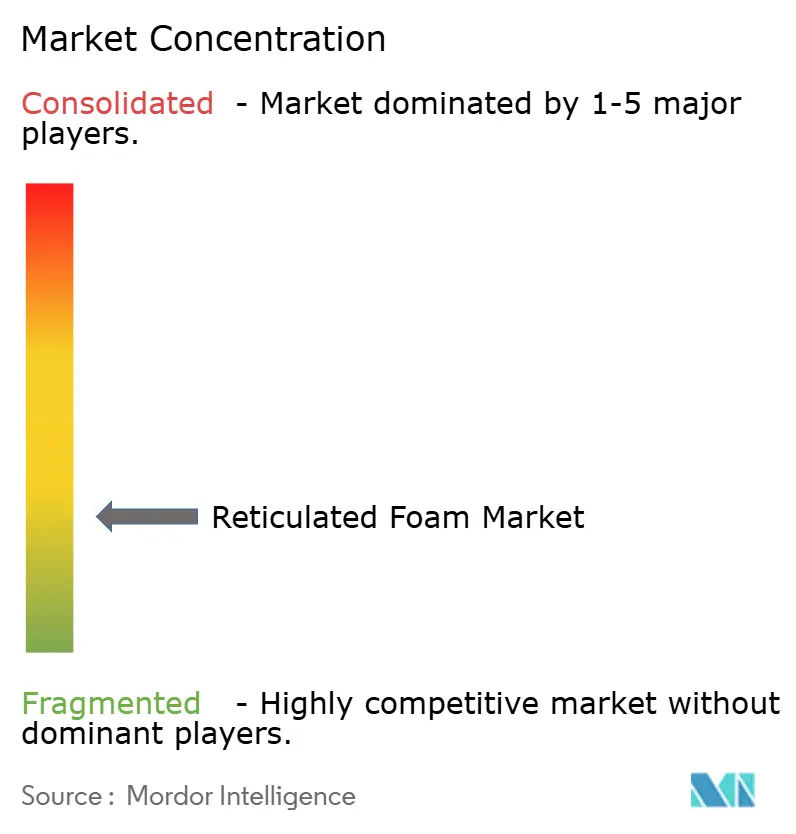
The reticulated foam market is fragmented, with Carpenter Co., NEVEON Holding GmbH, Woodbridge, and Sheela Foam Ltd. competing alongside specialist fabricators such as Rogers Foam Corporation, Polymer Technologies, Inc., and H-O Products. This fragmentation reflects materially different customer requirements across filtration, acoustic treatment, fluid management, battery protection, medical products, and outdoor cushioning. Integrated producers have an advantage in material sourcing, manufacturing reach, and the development of grades for multiple end markets, especially when customers need a single supplier to handle raw-material selection, reticulation, conversion, testing support, and consistent regional delivery. Specialty fabricators compete through application knowledge and customer-specific conversion. No single company is optimized for aerospace filtration, battery protection, medical fluid management, and outdoor cushioning simultaneously, and this diversity of applications limits any one producer's ability to dominate the market.
Our strategic focus is on Asia expansion, fire-retardant chemistry, sustainability, and electric-vehicle qualification. Suppliers are seeking to enter programs where product approval, manufacturing location, and engineering support are more difficult for competitors to replicate than a standard foam-conversion process. Woodbridge opened a joint-venture plant in Pune in February 2025 and announced plans to open two plants in China in June 2025, strengthening its ability to serve automotive customers in those locations. Rogers Corporation's PORON 40V0 launch addresses fire performance and gap-filling requirements for electronics and electric-vehicle applications. Carpenter's capacity investment in Changzhou is another example of local manufacturing used to support customer qualification. These developments indicate that manufacturing location and technical certification are as important as basic foam production capacity, as customers selecting foam for high-value assemblies may evaluate response time, engineer access, local inventory, fire-performance data, and qualification support before considering price.
Battery thermal interfaces represent an opportunity, as customer programs require documented fire and safety performance. This gives suppliers a reason to invest in controlled foam formulations, local application support, and test data to address battery-pack designers' concerns around compression, vibration, propagation resistance, and assembly reliability. Covestro's battery encapsulation foam and BASF's battery-pack work with Welion indicate that major materials companies are investing in this area. The competitive field is therefore extending beyond traditional foam suppliers to companies with broader polyurethane and battery-material expertise. Suppliers that can offer halogen-free grades, local production, and technical support are better positioned to compete for approved programs, particularly where applications must satisfy multiple testing requirements and customers need assurance that changes in formulation or processing will not affect performance during serial production. Smaller fabricators can retain a role in niche applications where custom processing and responsive service are priorities. The reticulated foam market is likely to remain fragmented, as these application niches require different products, testing capabilities, and customer-service approaches.
Reticulated Foam Industry Leaders
-
Carpenter Co.
-
FXI
-
Rogers Foam Corporation
-
NEVEON Holding GmbH
-
Woodbridge
- *Disclaimer: Major Players sorted in no particular order
Reticulated Foam Market Companies Covered in this Report
- American Foam Products
- Arjun Enterprises
- Carpenter Co.
- Devendra Industries
- filsonfilters
- Foamcraft USA, LLC
- Foamtech Wellington Ltd
- FXI
- H-O Products
- NEVEON Holding GmbH
- Polymer Technologies, Inc.
- Rogers Foam Corporation
- Sheela Foam Ltd.
- WinFun Foam
- Woodbridge
Recent Industry Developments in Reticulated Foam Market
- December 2025: Jiangsu ChengFeng New Materials and WTEC Group Sdn Bhd signed a Sales Framework Agreement for the supply and distribution of polyurethane foam, including reticulated grades, across ASEAN markets. The agreement, effective January 2026, targets the automotive, electrical, and electronics segments.
- October 2025: The European Commission adopted new REACH-based measures restricting the use of PFAS in firefighting foams, with sector-specific transition periods ranging from 12 months to 10 years. These measures affected producers of reticulated foam grades with fire-retardant properties, used in industrial fire-suppression applications.
Global Reticulated Foam Market Report Scope
Reticulated foam is a highly porous, open-cell solid foam in which the internal cell walls are completely removed, leaving only a net-like skeleton of interconnected strands. The foam undergoes reticulation, either through chemical treatment or thermal processing, to eliminate the cell membranes while retaining the structural framework.
The reticulated foam market is segmented by material type, pore size, application, end-user industry, and geography. By material type, the market is segmented into polyurethane reticulated foam, polyether reticulated foam, polyester reticulated foam, and other polymer reticulated foam. By pore size, the market is segmented into small-pore, medium-pore, and large-pore. By application, the market is segmented into filtration, sound absorption, fluid management, cleaning products, and others. By end-user industry, the market is segmented into automotive, aerospace and defense, healthcare and medical devices, electronics, and others. The report also covers market sizes and forecasts for the reticulated foam across 15 countries in major regions. The market sizes and forecasts are provided in terms of value (USD).
Segmentation Overview
| Polyurethane Reticulated Foam |
| Polyether Reticulated Foam |
| Polyester Reticulated Foam |
| Other Polymer Reticulated Foam |
| Small-pore |
| Medium-pore |
| Large-pore |
| Filtration |
| Sound Absorption |
| Fluid Management |
| Cleaning Products |
| Others |
| Automotive |
| Aerospace and Defense |
| Healthcare and Medical Devices |
| Electronics |
| Others |
| Asia-Pacific | China |
| India | |
| Japan | |
| South Korea | |
| ASEAN Countries | |
| Rest of Asia-Pacific | |
| North America | United States |
| Canada | |
| Mexico | |
| Europe | Germany |
| United Kingdom | |
| France | |
| Italy | |
| NORDIC Countries | |
| Rest of Europe | |
| South America | Brazil |
| Argentina | |
| Rest of South America | |
| Middle East and Africa | Saudi Arabia |
| South Africa | |
| Rest of Middle East and Africa |
| By Material Type | Polyurethane Reticulated Foam | |
| Polyether Reticulated Foam | ||
| Polyester Reticulated Foam | ||
| Other Polymer Reticulated Foam | ||
| By Pore Size | Small-pore | |
| Medium-pore | ||
| Large-pore | ||
| By Application | Filtration | |
| Sound Absorption | ||
| Fluid Management | ||
| Cleaning Products | ||
| Others | ||
| By End-User Industry | Automotive | |
| Aerospace and Defense | ||
| Healthcare and Medical Devices | ||
| Electronics | ||
| Others | ||
| By Geography | Asia-Pacific | China |
| India | ||
| Japan | ||
| South Korea | ||
| ASEAN Countries | ||
| Rest of Asia-Pacific | ||
| North America | United States | |
| Canada | ||
| Mexico | ||
| Europe | Germany | |
| United Kingdom | ||
| France | ||
| Italy | ||
| NORDIC Countries | ||
| Rest of Europe | ||
| South America | Brazil | |
| Argentina | ||
| Rest of South America | ||
| Middle East and Africa | Saudi Arabia | |
| South Africa | ||
| Rest of Middle East and Africa | ||
Key Questions Answered in the Report
What is current market size of Reticulated Foam Market?
The Reticulated Foam Market size was valued at USD 618.54 million in 2026 and is estimated to grow from USD 654.48 million in 2027 to USD 889.98 million by 2032, at a CAGR of 6.34% during the forecast period (2027-2032).
Why is reticulated foam used in electric vehicles?
It can support cabin-air filtration, acoustic control, gap filling, and battery protection functions where fire performance and local qualification are important. The material can help designers manage several physical requirements in confined vehicle spaces.
Which material type is most widely used?
Polyurethane is the largest material type, holding 58.67% of revenue in 2026, while polyether is projected to grow at a 6.83% CAGR through 2032. Polyether grades are valued in wet or humid operating settings, while other chemistries serve selected, specialized applications.
Which regional market is growing fastest?
Asia-Pacific is forecast to grow at a 7.14% CAGR through 2032, supported by vehicle, electronics, and regional supply-chain activity.