
Retail Enterprise Content Management (ECM) Market Size and Share
Market Overview
| Study Period | 2020 - 2031 |
|---|---|
| Market Size (2026) | USD 3.04 Billion |
| Market Size (2031) | USD 5.67 Billion |
| Growth Rate (2026 - 2031) | 13.28 % |
| Fastest Growing Market | Asia-Pacific |
| Largest Market | North America |
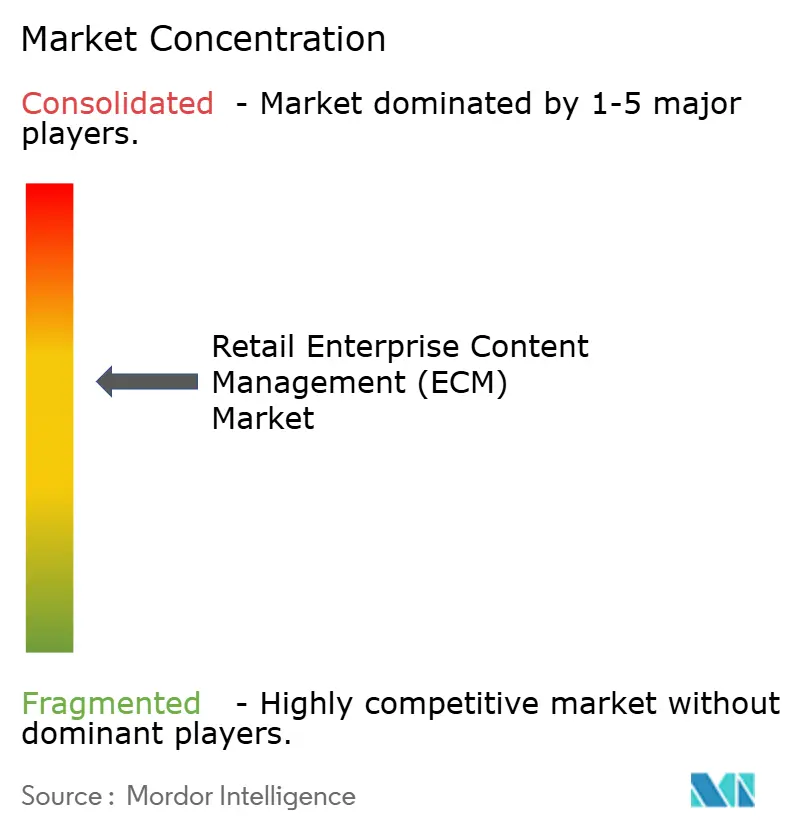
| Market Concentration | Medium |
Major Players *Disclaimer: Major Players sorted in no particular order Image © Mordor Intelligence. Reuse requires attribution under CC BY 4.0. | |
Retail Enterprise Content Management (ECM) Market Analysis by Mordor Intelligence
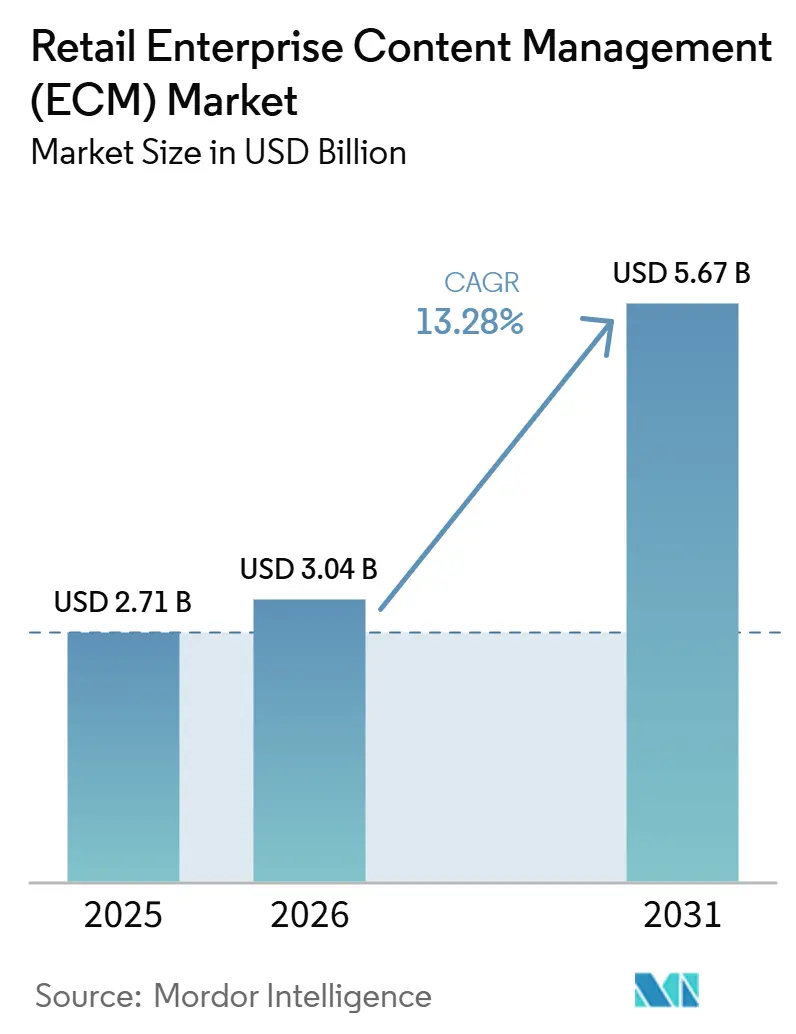
The retail enterprise content management (ECM) market size is projected to expand from USD 2.71 billion in 2025 and USD 3.04 billion in 2026 to USD 5.67 billion by 2031, registering a CAGR of 13.28% between 2026 and 2031. Growth is tied to the rising volume of product records, digital assets, compliance files, and channel-specific content that retailers now manage across stores, marketplaces, webshops, and social commerce environments. Retailers are moving away from isolated repositories and toward unified platforms that combine document governance, digital asset control, and workflow automation in one operating layer. This shift is gaining force as AI-assisted merchandising and personalization tools increase the need for cleaner metadata, controlled approvals, and reliable audit trails. Competition is centered on embedded automation, cloud delivery, and tighter links with product information, publishing, and enterprise resource planning systems. The retail enterprise content management market also faces pressure from integration difficulty and higher ownership costs, yet those same issues are steering buyers toward vendors that can simplify deployment and prove operational value faster.
Key Report Takeaways
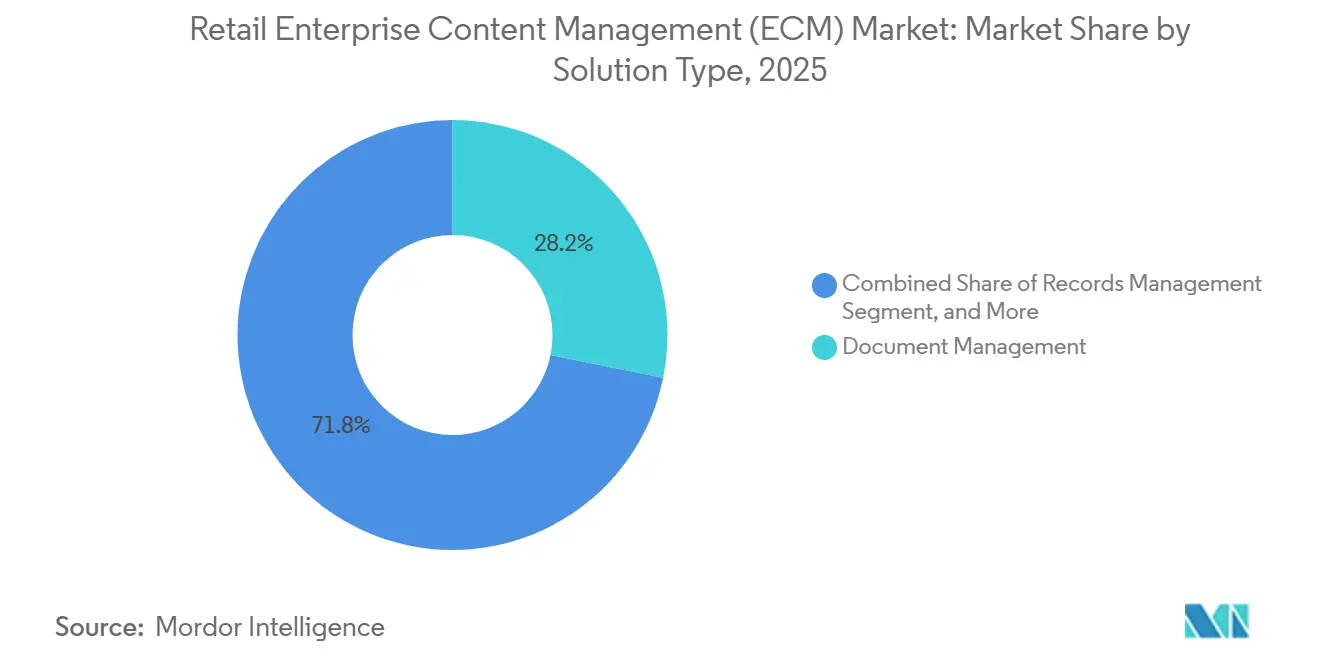
- By solution type, document management held 28.19% of the retail enterprise content management (ECM) market share in 2025, while digital asset management is projected to expand at a 13.96% CAGR through 2031.
- By deployment mode, cloud accounted for 72.83% of the retail enterprise content management market size in 2025 and is projected to advance at a 14.62% CAGR through 2031.
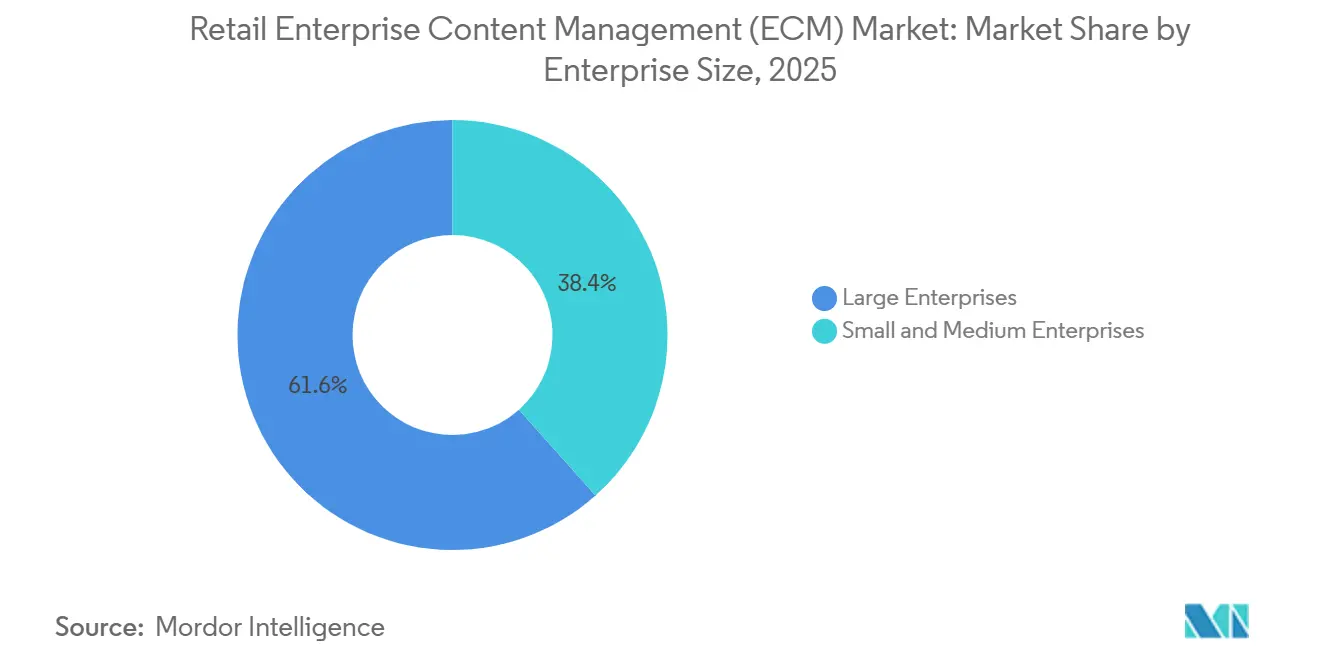
- By enterprise size, large enterprises held 61.59% share in 2025, while SMEs are projected to record the highest CAGR at 14.18% through 2031.
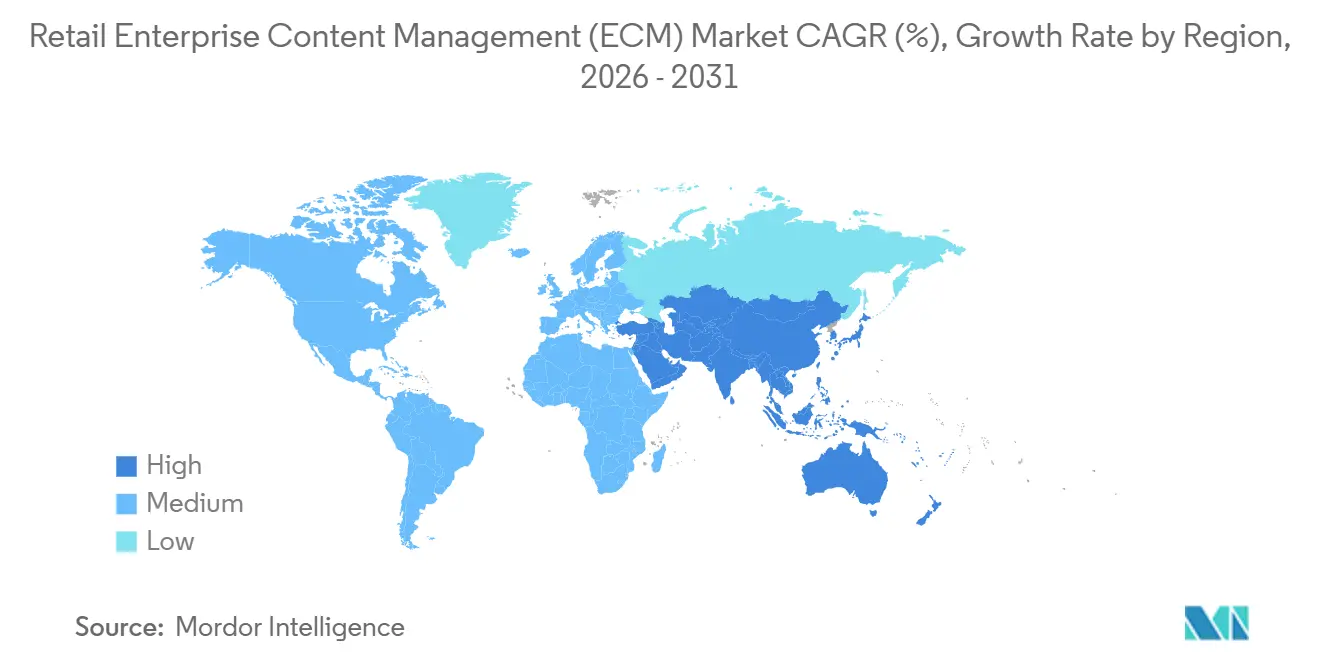
- By geography, North America held 38.73% of the retail enterprise content management market in 2025, while Asia-Pacific remained the fastest-growing regional segment through the forecast period, projected to expand at a 13.51% CAGR through 2031.
Note: Market size and forecast figures in this report are generated using Mordor Intelligence’s proprietary estimation framework, updated with the latest available data and insights as of January 2026.
Market Trends and Insights
Drivers Impact Analysis of Retail Enterprise Content Management (ECM) Market*
| DRIVER | (~) % IMPACT ON CAGR FORECAST | GEOGRAPHIC RELEVANCE | IMPACT TIMELINE |
|---|---|---|---|
| Omnichannel Retail Content Complexity | +3.1% | Global | Short term (≤ 2 years) |
| AI-Assisted Metadata and Tagging Automation | +2.4% | Global, with early gains in North America and China | Medium term (2-4 years) |
| Retail Compliance and Audit Trail Requirements | +1.8% | EU primary, spreading to APAC via PDPA and Southeast Asia | Short term (≤ 2 years) |
| Product Information and Digital Asset Governance Convergence | +1.4% | Global, concentrated in North America and Europe | Medium term (2-4 years) |
| Shift to Cloud-Native Content Operations | +1.3% | North America and EU, with rapid adoption in India and Southeast Asia | Short term (≤ 2 years) |
| Retailer Demand for Faster Campaign Localization | +1.1% | APAC core, spill-over to MEA and South America | Medium term (2-4 years) |
| Source: Mordor Intelligence | |||
Omnichannel Retail Content Complexity
Omnichannel operations remain the strongest demand trigger for the retail enterprise content management (ECM) market because every added channel raises the number of assets, records, approvals, and revisions that teams must control. Retailers are no longer publishing a single product page or a single campaign file, and they are managing many channel-specific versions that must stay accurate across marketplaces, owned commerce sites, stores, and partner networks. This operating model becomes harder when product claims, images, pricing references, and disclosure language must be updated quickly and consistently across regions. The EU AI Act raises the bar further because retailers using AI-supported content systems must maintain stronger control over content provenance and transparency, which directly supports demand for governed repositories and auditable workflows.[1]European Commission, “Regulation (EU) 2024/1689 of the European Parliament and of the Council, Artificial Intelligence Act,” Official Journal of the European Union, eur-lex.europa.eu Amazon also reported more than USD 1 billion of 2024 investment in trust and safety systems tied to its Digital Services Act obligations, which shows that content governance is now treated as a business control issue rather than only a back-office task.
AI-Assisted Metadata and Tagging Automation
AI-based metadata enrichment is improving the economics of the retail enterprise content management (ECM) market because retailers can classify and retrieve high volumes of content with less manual work. This matters in retail environments where product documentation, supplier files, campaign assets, and approval trails arrive in large volumes and in mixed formats. M-Files expanded this area in June 2026 with its Metadata Agent, which suggests document classification, naming, tagging, and description at ingestion and also supports bulk enrichment of legacy content. IBM followed in June 2026 with IBM Content Cortex Essentials Edition, which includes a Navigator Core Agent for automated document analysis and classification, making agentic content workflows easier to deploy inside governed environments.[2]IBM Corporation, “A New Era of Agentic Content Automation Has Arrived With IBM Content Cortex Essentials Edition,” IBM Community Blog, community.ibm.com As these tools mature, the retail enterprise content management (ECM) market is gaining a stronger automation case, especially for retailers that need faster indexing, cleaner retrieval, and more reliable audit support.
Retail Compliance and Audit Trail Requirements
Compliance is creating an independent demand cycle for the retail enterprise content management (ECM) market because retailers must retain controlled records even when broader technology budgets are under pressure. The EU AI Act, entering full legal force in August 2026, requires stronger governance around AI-related content processes, which increases the value of version control, provenance tracking, and role-based access tools. Amazon’s 2025 EU DSA audit implementation report also shows how large digital retail platforms are investing heavily in content control, oversight, and auditability to meet regulatory obligations. Germany’s mandatory e-invoicing regime, effective from January 2025, adds another structured documentation requirement that aligns closely with document management and archival capabilities in ECM platforms. As more regulatory deadlines cluster in the 2025 to 2026 period, retailers have less room to delay decisions on governed content infrastructure.
Product Information and Digital Asset Governance Convergence
The line between product data governance and digital asset governance is narrowing, which is broadening the functional scope of the retail enterprise content management (ECM) market. Retailers want product text, images, documents, approvals, and channel publishing rules to move through one controlled workflow instead of separate systems with repeated handoffs. Adobe stated in May 2024 that organizations using its content supply chain solutions achieved a 30% increase in asset reuse efficiency and a 70% reduction in time spent managing content and digital experiences, which supports the value of more connected content operations. OpenText strengthened this direction in its June 2026 Content Management 26.2 release by adding Copilot validation against governed enterprise content and broader records governance capabilities, which reinforces the shift toward unified control layers. Microsoft also introduced new Dynamics 365 Commerce Model Context Protocol capabilities in June 2026, which shows that content, commerce, and operational data are moving closer together inside retail workflows.
Restraints Impact Analysis of Retail Enterprise Content Management (ECM) Market*
| RESTRAINT | (~) % IMPACT ON CAGR FORECAST | GEOGRAPHIC RELEVANCE | IMPACT TIMELINE |
|---|---|---|---|
| Integration Complexity Across PIM, DAM, CMS, and ERP Stacks | -2.3% | Global, most acute in large and multi-geography retail operations | Long term (≥ 4 years) |
| High Change Management Burden in Store and Field Teams | -1.4% | Global, highest in distributed multi-location retailers | Medium term (2-4 years) |
| Content Security and Brand Leakage Risks in Distributed Retail Networks | -0.9% | Global, elevated exposure in franchise and multi-geography models | Short term (≤ 2 years) |
| Rising Total Cost of Ownership for Multi-Channel Content Governance | -0.7% | Global, higher pressure on mid-market retailers | Medium term (2-4 years) |
| Source: Mordor Intelligence | |||
Integration Complexity Across PIM, DAM, CMS, and ERP Stacks
Integration remains the heaviest brake on the retail enterprise content management (ECM) market because retailers rarely deploy ECM in isolation. Most projects must connect governed content with product information systems, digital asset libraries, commerce platforms, content management tools, and ERP environments that already support live operations. OpenText’s SAP S/4HANA Cloud Public Edition certification in November 2025 shows how important packaged ERP linkage has become for content platform adoption in enterprise accounts. Microsoft’s June 2026 Dynamics 365 Commerce MCP release also reflects the same pressure, because retailers increasingly expect product discovery, inventory availability, pricing logic, and related content to work in connected flows rather than stand-alone modules. When those links are weak, deployment timelines stretch, manual work returns, and the business case for the retail enterprise content management (ECM) market becomes harder to defend.
High Change Management Burden in Store and Field Teams
Change management slows the retail enterprise content management (ECM) market because governed content processes often start at headquarters but must later be adopted by store teams, franchise operators, and field staff. These users need simpler interfaces, clearer permissions, and training that matches their daily tasks instead of enterprise-wide system logic. M-Files highlighted context-first experiences and native Microsoft 365 integration in its January 2026 product update, which shows that vendors are actively trying to lower adoption friction in everyday work settings. Even so, many retailers still need sustained executive backing to shift from informal file handling to versioned, governed workflows that support accountability across locations. Until that transition becomes routine, deployment speed in the retail enterprise content management (ECM) market will remain uneven across smaller and distributed retail networks.
*Our forecasts treat driver/restraint impacts as directional, not additive. The impact forecasts reflect baseline growth, mix effects, and variable interactions.
Retail Enterprise Content Management (ECM) Market Segment Analysis
By Solution Type:
Document Management Anchors Revenue While Digital Asset Management Leads GrowthDocument management held the largest solution type share at 28.19% in 2025, which shows that compliance files, supplier records, product documentation, and legal content still form the core workload of the retail enterprise content management (ECM) market. Retailers continue to depend on document control because labeling records, audit files, invoicing trails, and contract archives must be stored in ways that support retrieval and accountability. This leadership reflects an active operating need rather than legacy inertia, since regulated documentation remains essential across cross-border retail operations. Records Management, Workflow, and Business Process Management also stay relevant because retail approvals, claims checks, and internal reviews still require structured routing and retention.
Digital asset management is projected to grow at a 13.96% CAGR through 2031, which shows how quickly rich media has expanded inside the retail enterprise content management (ECM) market. Retailers now need approved images, video, campaign content, and social commerce assets that can move across channels without repeated manual correction. Adobe reported a 30% increase in asset reuse efficiency and a 70% reduction in time spent managing content and digital experiences for organizations using its content supply chain solutions, which supports the productivity case for stronger asset governance.[3]Adobe Inc., “Organizations Using Adobe Content Supply Chain Solutions Achieve 30% Increase in Asset Reuse Efficiency,” Adobe, adobe.com As DAM capabilities move closer to document governance and publishing workflows, the retail enterprise content management industry is shifting from file storage toward coordinated content operations.



By Deployment Mode:
Cloud Dominance Deepens While Hybrid Adoption Builds Around Governance NeedsCloud accounted for 72.83% of the retail enterprise content management (ECM) market size in 2025 and is projected to advance at a 14.62% CAGR through 2031, confirming that scalable delivery has become the default choice for most new deployments. Retailers prefer cloud models because they support faster onboarding of new channels, new geographies, and new asset types without the provisioning delays that come with self-hosted infrastructure. This model also aligns with the need for real-time collaboration across merchandising, marketing, compliance, and partner teams. On-premises deployment still retains relevance where retailers face stricter data residency rules or maintain sensitive document categories that they do not want in public cloud environments.
Hybrid deployment is gaining traction because many retailers need cloud agility for campaign and asset workflows while keeping selected records in more controlled environments. Statistics Canada reported in June 2025 that 12.2% of Canadian businesses used AI over the prior 12 months, up from 6.1% a year earlier, which supports the view that more organizations are building the digital foundation needed for cloud-based content operations.[4]Statistics Canada, “Businesses Using Artificial Intelligence, Canada, June 2025,” Statistics Canada, statcan.gc.ca Microsoft’s June 2026 Dynamics 365 Commerce MCP release also points to a cloud-first direction in retail operations, since it connects product discovery, pricing, and inventory capabilities inside a modern commerce environment. As a result, the retail enterprise content management (ECM) market is likely to see cloud remain dominant while hybrid becomes a practical governance model rather than a temporary compromise.
By Enterprise Size:
Large Enterprises Lead Spending While SMEs Expand FasterLarge enterprises held 61.59% of the retail enterprise content management (ECM) market in 2025, reflecting their deeper budgets, broader compliance exposure, and higher content volumes across regions and product lines. These retailers manage larger SKU counts, more legal entities, and more channel combinations, which makes governed content infrastructure harder to avoid. Their buying decisions also shape platform roadmaps because vendors still prioritize enterprise-grade workflow, integration, and repository control. This keeps large enterprises at the center of vendor competition in the retail enterprise content management (ECM) market.
SMEs are projected to grow at a 14.18% CAGR through 2031, helped by cloud-native platforms that reduce upfront infrastructure demands and make phased adoption more realistic. Regulatory pressure is also pulling smaller retailers into structured content governance, especially when e-invoicing, record retention, and privacy obligations become harder to manage through ad hoc tools. Germany’s 2025 e-invoicing requirement is one example of a rule change that can push smaller organizations toward better document control and archival systems. Vendors that offer modular pricing, lighter onboarding, and faster time to value are well placed as the retail enterprise content management industry expands further into the SME base.
Geography Analysis
The Americas Retail Enterprise Content Management (ECM) Market
North America held 38.73% of the retail enterprise content management (ECM) market size in 2025, giving the region the largest share of global demand. The United States remains the main regional revenue center because it combines large enterprise retailers, mature cloud adoption, and heavy multichannel content volume. Canada adds momentum through rising enterprise digitization, and Statistics Canada reported in June 2025 that AI use among businesses reached 12.2% over the prior 12 months, up from 6.1% a year earlier. That shift supports demand for content environments that are easier to search, classify, and reuse in AI-supported retail workflows. Mexico and the wider South America region remain smaller in current value terms, but they are benefiting from regional expansion by multinational retailers that want more standardized content governance across markets.
APAC Retail Enterprise Content Management (ECM) Market
Asia‑Pacific enters 2026 as the fastest‑growing region in the retail enterprise content management (ECM) market, with a projected CAGR of 13.51% through 2031. This growth is driven by the region’s combination of large e‑commerce volumes, fast‑moving channel formats, and strong localization needs, positioning Asia‑Pacific at the forefront of ECM adoption globally. Retailers in China, India, Southeast Asia, Japan, South Korea, and Australia are operating in commerce environments where speed of publishing matters as much as accuracy of records. This raises demand for controlled product content, reusable digital assets, and workflow systems that can support market-specific variations without losing governance. The region also benefits from a large base of manufacturers and direct-to-consumer brands that are building more formal content operations as they expand their reach.
EMEA Retail Enterprise Content Management (ECM) Market
Europe is defined by regulatory density, which gives the retail enterprise content management (ECM) market a strong compliance-led demand base. The EU AI Act raises expectations around traceability and transparency for AI-related content processes, which supports stronger interest in governed repositories and auditable workflows. Germany’s mandatory e-invoicing regime from January 2025 adds another document-heavy requirement that aligns well with ECM capabilities. The Middle East is investing through broader digital commerce build-outs, while Africa remains earlier stage, with adoption led by markets that are formalizing retail operations and digital documentation practices.

Competitive Landscape
The retail enterprise content management (ECM) market shows moderate concentration, with Microsoft Corporation, OpenText Corporation, IBM Corporation, and Adobe Inc. holding strong positions in enterprise-tier deployments. These companies benefit from broad product portfolios, established enterprise relationships, and deeper integration paths into productivity, commerce, and business process environments. That advantage is important because large retail accounts often want fewer vendors, stronger security controls, and clearer upgrade roadmaps. The retail enterprise content management (ECM) market is still contested, however, because specialist vendors continue to compete on ease of deployment, AI readiness, and mid-market fit. This keeps the market active even though the top group remains well established.
IBM strengthened its position in June 2026 through IBM Content Cortex Essentials Edition, which packaged agentic document analysis and classification into a governed content automation offer that fits regulated retail use cases. M-Files also moved aggressively in June 2026 with new AI agents that support metadata enrichment, contract review, and role-based intelligence delivery, which gives it a stronger differentiation angle in accounts comparing governance depth with practical AI features.[5]M-Files Corporation, “M-Files Expands Agentic AI Capabilities With New Agents That Deliver Context-Aware Automation,” M-Files Press Release, m-files.com Adobe expanded its agentic ecosystem in April 2026 through partnerships with AWS, Anthropic, Google Cloud, IBM, Microsoft, and NVIDIA, signaling a strategy focused on orchestration across the wider AI stack rather than only core content functions. These moves show that competition in the retail enterprise content management (ECM) market is shifting toward embedded intelligence and ecosystem reach.
OpenText’s June 2026 content management 26.2 release added validation of AI-generated responses against governed enterprise content and expanded records governance features, which reinforces its position with buyers that want stronger control around content accuracy and compliance. The market also continues to leave room for vendors such as Hyland, M-Files, and Zoho in areas where buyers value modular adoption, cloud-native delivery, or simpler user experiences. White-space opportunities remain strongest where product information, digital assets, and governed documents must work together inside retail-specific workflows. As a result, the retail enterprise content management (ECM) market is not defined by a single dominant platform, but by a competitive balance between large suite vendors and focused challengers.
Retail Enterprise Content Management (ECM) Industry Leaders
OpenText Corporation
IBM Corporation
Hyland Software, Inc.
M‑Files Corporation
Box, Inc.
- *Disclaimer: Major Players sorted in no particular order
Retail Enterprise Content Management (ECM) Market Companies Covered in this Report
- OpenText Corporation
- IBM Corporation
- Hyland Software, Inc.
- M-Files Corporation
- Box, Inc.
- DocuWare GmbH
- Laserfiche, Inc.
- Alfresco Software, Inc.
- SER Group
- Fabasoft AG
- KnowledgeLake, Inc.
- Objective Corporation Limited
- Datamatics Global Services Limited
- Microsoft Corporation
- Oracle Corporation
- SAP SE
- Adobe Inc.
- Zoho Corporation Pvt. Ltd.
- Egnyte, Inc.
- Newgen Software Technologies Limited
- Everteam
- iManage
- eFileCabinet

Recent Industry Developments in Retail Enterprise Content Management (ECM) Market
- June 2026: IBM launched IBM Content Cortex Essentials Edition on June 29, 2026, repositioning IBM FileNet Content Manager as a next-generation agentic content automation platform. The launch includes a pre-packaged Navigator Core Agent for document analysis and classification, Intelligent Archiving for processing hundreds of millions of content sections per day, and Business Automation Insights for content KPI visualization, enabling AI-driven content workflows without custom pipeline development. This development materially expands IBM's competitive positioning in regulated retail environments where audit trail governance and AI-readiness are evaluated together.
- June 2026: M-Files launched a new suite of AI agents on June 24, 2026, including the Metadata Agent for intelligent document classification and bulk legacy content enrichment, the Contracts Agent for policy-aligned contract review and automation, the Insights Agent for role-tailored intelligence delivery, and Custom Agents for workflow-embedded automation. All agents are built on M-Files' Enterprise Knowledge Graph and maintain auditable reasoning trails, addressing the governance gap that limits AI adoption in regulated retail organizations.
- June 2026: Hyland and Microsoft announced a strategic partnership on June 1, 2026, to bring the Hyland Content Innovation Cloud to Microsoft Azure. The partnership enables joint go-to-market execution, Microsoft Marketplace availability for simplified enterprise procurement, and expanded geographic reach through Azure's global infrastructure. The collaboration targets content-rich, regulated industries including retail, with particular emphasis on governance, data residency, and compliance-ready AI deployment.
- June 2026: OpenText released Content Management 26.2 in June 2026, introducing AI-to-AI integration with Microsoft Copilot for inline validation of AI-generated responses against governed enterprise content, expanded Guidewire integration, enhanced records governance capabilities, and multi-tenant Microsoft 365 support for distributed retail governance environments.


Global Retail Enterprise Content Management (ECM) Market Report Scope
The retail enterprise content management (ECM) market refers to the platforms and solutions that retail enterprises use to manage, store, organize, and secure digital content across business functions. These systems help retailers centralize documents, product information, marketing assets, compliance records, and customer communications in a scalable environment. The market supports retailers in maintaining omnichannel consistency, meeting regulatory requirements, improving operational efficiency, and using AI-powered automation to streamline workflows, reduce costs, and deliver personalized customer experiences across physical and digital channels.
The Retail Enterprise Content Management (ECM) Market Report is Segmented by Solution Type (Document Management, Records Management, Workflow and Business Process Management, Case Management, Digital Asset Management, Web Content Management, and Other Solutions), Deployment Mode (On-Premises, Cloud, and Hybrid), Enterprise Size (Small and Medium Enterprises (SME), and Large Enterprises), and Geography (North America, South America, Europe, Asia-Pacific, and Middle East and Africa). The Market Forecasts are Provided in Terms of Value (USD).
| Document Management |
| Records Management |
| Workflow and Business Process Management |
| Case Management |
| Digital Asset Management |
| Web Content Management |
| Other Solutions |
| On-Premises |
| Cloud |
| Hybrid |
| Small and Medium Enterprises (SME) |
| Large Enterprises |
| North America | United States | |
| Canada | ||
| Mexico | ||
| South America | Brazil | |
| Argentina | ||
| Rest of South America | ||
| Europe | United Kingdom | |
| Germany | ||
| France | ||
| Rest of Europe | ||
| Asia-Pacific | China | |
| Japan | ||
| India | ||
| South Korea | ||
| Australia | ||
| Rest of Asia-Pacific | ||
| Middle East and Africa | Middle East | United Arab Emirates |
| Saudi Arabia | ||
| Rest of Middle East | ||
| Africa | South Africa | |
| Kenya | ||
| Rest of Africa | ||
| By Solution Type | Document Management | ||
| Records Management | |||
| Workflow and Business Process Management | |||
| Case Management | |||
| Digital Asset Management | |||
| Web Content Management | |||
| Other Solutions | |||
| By Deployment Mode | On-Premises | ||
| Cloud | |||
| Hybrid | |||
| By Enterprise Size | Small and Medium Enterprises (SME) | ||
| Large Enterprises | |||
| By Geography | North America | United States | |
| Canada | |||
| Mexico | |||
| South America | Brazil | ||
| Argentina | |||
| Rest of South America | |||
| Europe | United Kingdom | ||
| Germany | |||
| France | |||
| Rest of Europe | |||
| Asia-Pacific | China | ||
| Japan | |||
| India | |||
| South Korea | |||
| Australia | |||
| Rest of Asia-Pacific | |||
| Middle East and Africa | Middle East | United Arab Emirates | |
| Saudi Arabia | |||
| Rest of Middle East | |||
| Africa | South Africa | ||
| Kenya | |||
| Rest of Africa | |||


Key Questions Answered in the Report
What is the current and forecast value of the retail enterprise content management (ECM) market?
The retail enterprise content management (ECM) market was valued at USD 2.71 billion in 2025, reached USD 3.04 billion in 2026, and is projected to hit USD 5.67 billion by 2031 at a 13.28% CAGR.
Which solution category leads demand in retail enterprise content management?
Document Management led in 2025 with a 28.19% share because retailers still need strong control over compliance records, supplier files, product documentation, and legal content.
Which deployment model is growing fastest in retail content platforms?
Cloud leads both scale and growth, with 72.83% share in 2025 and a projected 14.62% CAGR through 2031, supported by faster rollout across channels and geographies.
Why are retailers investing more in governed content systems?
Retailers need tighter control over product information, digital assets, compliance files, and multichannel publishing as content volumes rise and regulations become more demanding.
Which enterprise segment offers the strongest growth opportunity?
SMEs are the fastest-growing user group with a 14.18% CAGR through 2031, helped by lower-cost cloud-native platforms and rising compliance needs.
Which region leads global demand and which one is expanding fastest?
North America led with 38.73% share in 2025, while Asia-Pacific remained the fastest-growing regional segment expected to register a CAGR of13.51%, owing to large e-commerce volumes and rising localization needs.
Page last updated on:


 Your data is secure and never sold or shared.


