
Renewable Naphtha Market Size and Share
Market Overview
| Study Period | 2022 - 2032 |
|---|---|
| Market Size (2027) | USD 0.94 Billion |
| Market Size (2032) | USD 1.51 Billion |
| Growth Rate (2027 - 2032) | 9.84 % |
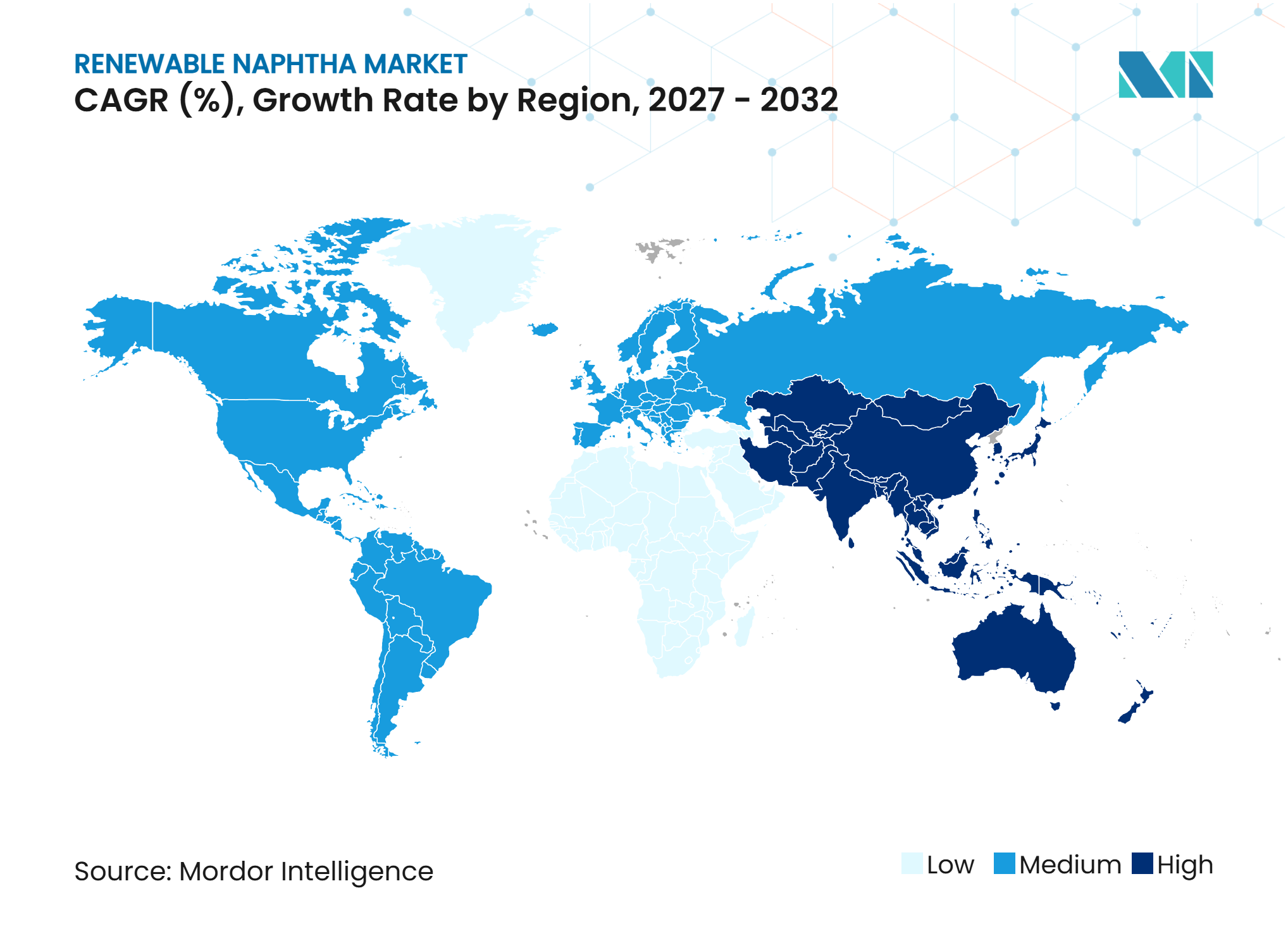
| Fastest Growing Market | Asia-Pacific |
| Largest Market | Europe |
| Market Concentration | Medium |
Major Players *Disclaimer: Major Players sorted in no particular order Image © Mordor Intelligence. Reuse requires attribution under CC BY 4.0. | |
Renewable Naphtha Market Analysis by Mordor Intelligence
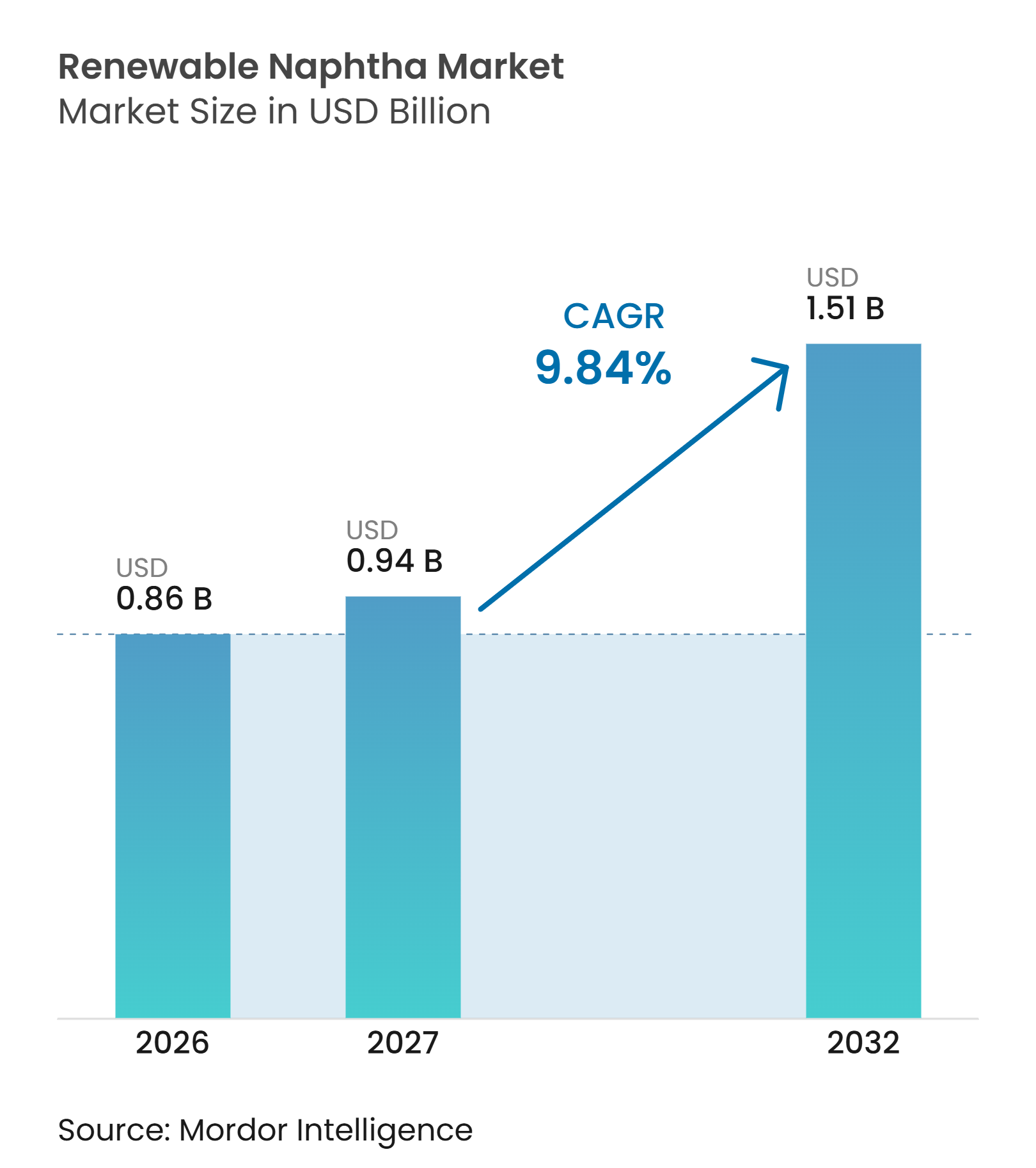
The renewable naphtha market size was valued at USD 0.86 billion in 2026 and is estimated to grow from USD 0.94 billion in 2027 to reach USD 1.51 billion by 2032, at a CAGR of 9.84% during the forecast period (2027-2032). Regulatory requirements for renewable content and lower-carbon materials are shifting bio-based naphtha from a discretionary input to a strategic procurement option, particularly in Europe and North America. The revised EU Renewable Energy Directive establishes a binding 42.5% renewable energy target for 2030, while the US Renewable Fuel Standard supports qualifying renewable fuel pathways. Renewable naphtha supply also increases alongside hydrotreated vegetable oil and sustainable aviation fuel capacity, as it is a co-product of those production routes. This relationship creates an opportunity for chemical producers to integrate certified materials into existing supply chains, although competition for waste oils and animal fats continues to pressure feedstock availability. The renewable naphtha market is shaped by regulatory compliance, refinery capacity, certification systems, and buyers' willingness to pay a premium for verified renewable content.
Key Report Takeaways
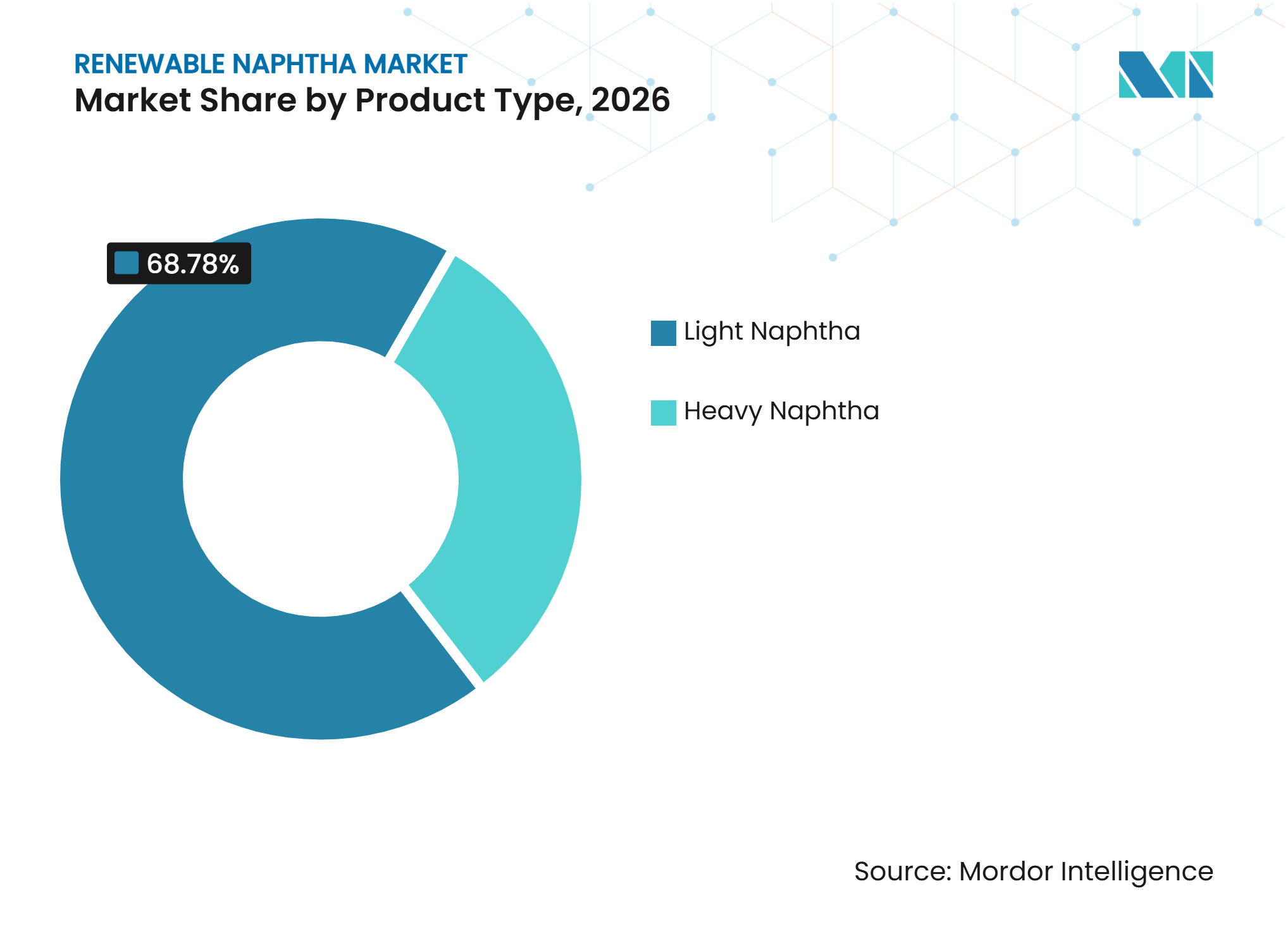
- By product type, light naphtha held 68.78% of global revenue in 2026, while heavy naphtha is projected to grow at an 11.47% CAGR through 2032.
- By application, fuel blending accounted for 33.62% of global revenue in 2026, while petrochemical feedstock is forecast to expand at a 12.64% CAGR through 2032.
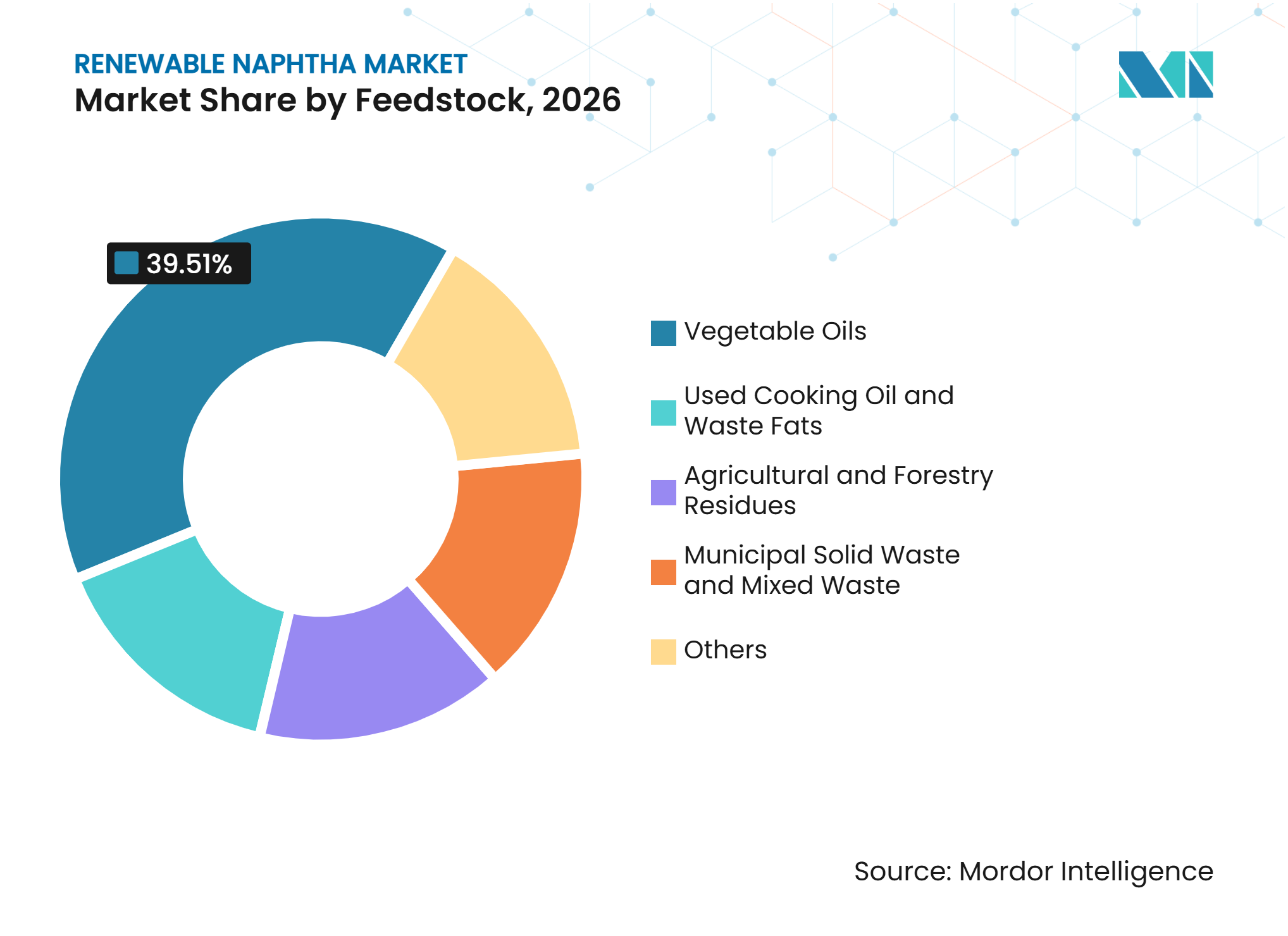
- By feedstock, vegetable oils held 39.51% of global revenue in 2026, while used cooking oil and waste fats are projected to advance at a 12.89% CAGR through 2032.
- By geography, Europe accounted for 43.45% of global revenue in 2026, while Asia-Pacific is forecast to grow at an 11.91% CAGR through 2032.
Note: Market numbers in this report are based on Mordor Intelligence's proprietary estimation framework, which combines nine months of actuals with Q4 projections for base year 2026.
Market Trends and Insights
Drivers Impact Analysis of Renewable Naphtha Market*
| Drivers | (~) % Impact on CAGR Forecast | Geographic Relevance | Impact Timeline |
|---|---|---|---|
| Regulatory Demand for Low-Carbon Petrochemical Feedstocks | +3.2% | Global, with early gains in EU and North America | Medium term (2-4 years) |
| Drop-In Compatibility with Existing Steam Crackers | +1.6% | Global | Short term (≤ 2 years) |
| Expansion of Hydrotreated Vegetable Oil (HVO) and Sustainable Aviation Fuel (SAF) Capacity | +2.3% | North America & EU, spillover to APAC | Medium term (2-4 years) |
| Mass-Balance Demand from Packaging and Consumer-Goods Brands | +1.4% | Global, with intensity in EU and East Asia | Medium term (2-4 years) |
| Waste-Fat and Tall-Oil Valorization | +1.1% | Europe core, spillover to APAC and North America | Long term (≥ 4 years) |
| Source: Mordor Intelligence | |||
Regulatory Demand for Low-Carbon Petrochemical Feedstocks
Petrochemical producers in Europe and North America face stricter requirements to use lower-carbon feedstocks in steam cracker operations. The EU's revised Renewable Energy Directive provides the policy framework for accounting for renewable content and deploying certified bio-based inputs in downstream value chains. International Sustainability and Carbon Certification (ISCC) supports chain-of-custody and mass-balance claims that connect renewable naphtha with polymer and chemical buyers. The EPA's 2026 and 2027 Renewable Fuel Standard rules recognize defined fuel pathways and establish the broader policy framework for renewable fuel credits. Carbon-related requirements affecting imported goods add pressure on chemical supply chains to document material inputs. Together, these factors make renewable naphtha more relevant to procurement decisions where buyers require certified renewable content or lower lifecycle emissions.
Drop-in Compatibility with Existing Steam Crackers
Renewable naphtha derived from hydrotreated vegetable oil (HVO) has a paraffinic composition similar to that of conventional petroleum naphtha. It can be processed in existing steam crackers and refinery units without the capital modifications required for some alternative low-carbon feedstocks. This compatibility reduces the implementation burden for chemical producers operating naphtha-based assets. The material's low aromatic and sulfur content can also support ethylene and propylene yield performance relative to some conventional grades. Technical development remains active across this area as producers seek to improve product quality and expand feedstock flexibility. The practical value of this pathway is that buyers can incorporate certified renewable material while maintaining their existing processing infrastructure.
Expansion of Hydrotreated Vegetable Oil (HVO) and Sustainable Aviation Fuel (SAF) Capacity
The renewable naphtha market benefits from additions to hydrotreated vegetable oil (HVO) and sustainable aviation fuel (SAF) capacity, as both pathways produce renewable naphtha as a co-product. Neste's Rotterdam expansion is expected to increase global renewables production capacity from 5.5 million tons to 6.8 million tons per year by 2027. Galp's Sines project combines investments in renewable hydrogen and biofuels, including production systems that produce bio-naphtha and bio-propane. SAF-focused facilities can generate renewable naphtha output that exceeds immediate demand from the chemical sector in some periods. This can improve material availability for qualified buyers, but it also means renewable naphtha economics remain linked to the broader performance of renewable diesel and SAF assets. Supply response in the renewable naphtha market is therefore driven as much by aviation and diesel policy as by petrochemical demand.
Mass-Balance Demand and Waste-Fat Valorization
Packaging and consumer goods companies are building certified mass-balance chains for renewable and recycled polymers. ISCC PLUS introduced standalone system documents and updated mass-balance guidance in 2025, clarifying the framework participants use in these chains[1]. Renewable naphtha is an upstream input for these polymer chains, and brand commitments can support longer-term procurement arrangements. Waste fats, used cooking oil, and tall oil offer additional routes to lower-carbon feedstock use. UPM uses crude tall oil from pulp production at its Lappeenranta biorefinery, demonstrating a commercial route outside virgin vegetable oils. Long-term contracts for certified renewable naphtha can reduce spot availability and differentiate certified supply from non-certified supply.
Restraints Impact Analysis of Renewable Naphtha Market*
| Restraints | (~) % Impact on CAGR Forecast | Geographic Relevance | Impact Timeline |
|---|---|---|---|
| Feedstock Competition and Variable Feedstock Quality | -2.0% | Global, with APAC implications | Short term (≤ 2 years) |
| Renewable Price Premium to Fossil Naphtha | -1.5% | Global | Medium term (2-4 years) |
| Variable Feedstock Quality and Naphtha Specifications | -0.8% | APAC core, Global implications | Long term (≥ 4 years) |
| Source: Mordor Intelligence | |||
Feedstock Competition and Variable Feedstock Quality
Renewable naphtha, renewable diesel, and sustainable aviation fuel draw on many of the same waste streams, including used cooking oil and animal fats. The International Energy Agency reported that demand was increasing pressure on vegetable-oil and waste-oil supplies as biofuel production expanded. A 2026 peer-reviewed study identified the finite availability of fats, oils, and greases as a key constraint on competing low-carbon fuel pathways. Sustainable aviation fuel producers may be able to support higher feedstock prices because policy requirements directly support their output. Variable feedstock quality also poses challenges for production consistency and for meeting naphtha specifications, particularly where collection systems are less developed. These conditions can raise costs in the renewable naphtha market and require producers to build more flexible feedstock procurement and processing systems.
Renewable Price Premium to Fossil Naphtha
Certified renewable naphtha carries a price premium over conventional fossil naphtha, which can limit adoption among cost-sensitive chemical buyers. The premium is most difficult to absorb when customers do not face renewable-content requirements or when there are no buyers willing to pay for certified bio-circular products. Co-product economics also mean renewable naphtha carries a share of the capital and feedstock costs of the wider hydrotreated vegetable oil facility. As a result, greater production capacity does not automatically close the price gap with fossil naphtha. Demand in the renewable naphtha market is more likely to grow where compliance obligations, customer commitments, or product certification create value beyond the direct feedstock price. Producers must therefore align output with buyers that can use verified renewable content in their own commercial positioning.
*Our forecasts treat driver/restraint impacts as directional, not additive. The impact forecasts reflect baseline growth, mix effects, and variable interactions.
Renewable Naphtha Market Segment Analysis
By Product Type:
Light Naphtha Leads by Share, Heavy Fraction Records Faster GrowthLight naphtha accounted for 68.78% of global revenue in 2026. The C5-C9 fraction matches the boiling range and paraffin specifications used by many steam crackers in Europe and North America. This fit makes light naphtha a common entry point for chemical-sector mass-balance supply chains. The hydrotreated vegetable oil pathway also tends to produce significant light fractions when facilities are configured for downstream olefin output. This production pattern aligns with the requirements of integrated petrochemical buyers. UPM's Lappeenranta biorefinery uses crude tall oil to produce renewable fuels and naphtha that supply packaging, textile, and automotive polymer value chains under certification systems.
Heavy naphtha is projected to grow at an 11.47% CAGR between 2027 and 2032. This growth reflects demand from crackers configured for heavier C10+ feeds and from reformers producing aromatic precursors. The value outlook for heavy naphtha is supported by interest in a broader range of bio-attributed chemical inputs. Research presented at the 33rd European Biomass Conference examined the role that Fischer-Tropsch naphtha could play in meeting European chemical demand through biogenic carbon pathways. Such material could complement the light fraction produced through hydrotreated vegetable oil routes. ISCC PLUS requirements are also extending across specialty chemical and aromatics supply chains, which can widen the available application base for heavier renewable fractions.



By Application:
Fuel Blending Leads, Petrochemical Feedstock Redefines GrowthFuel blending held 33.62% of global revenue in 2026. Renewable fuel policies allow bio-based blending components to contribute to fuel decarbonization objectives where they meet the relevant pathway and sustainability requirements. Fuel blending offers a clear initial outlet, as renewable naphtha can supplement components of the conventional gasoline pool. Solvent production and plastics feedstocks hold smaller positions but are developing as specialty chemical suppliers seek certified product claims. Shell has described upgrades to its Sarnia-area operations, including plans for renewable feedstock processing. These uses link demand to both fuel policy and the commercial value of lower-carbon chemical products.
Petrochemical feedstock is forecast to expand at a 12.64% CAGR from 2027 to 2032. LG Chem's joint venture with Eni is developing a 300,000-ton-per-year hydrotreated vegetable oil facility in Seosan, South Korea, designed to support the production of bio-based materials. The project connects renewable feedstock supply with downstream production of ISCC PLUS-certified Acrylonitrile Butadiene Styrene (ABS), Super Absorbent Polymer (SAP), and Ethylene Vinyl Acetate (EVA) polymers. This approach makes renewable naphtha a core input for selected polymer portfolios rather than a supplementary purchase. The market can benefit where chemical companies integrate feedstock sourcing with certification and product marketing. This model also reduces exposure to short-term spot purchases by tying supply to internal or contracted downstream demand.
By Feedstock:
Vegetable Oils Dominate, Waste-Based Streams Grow FastestVegetable oils held 39.51% of global revenue in 2026. Rapeseed, palm, canola, and soybean oils are supported by established processing infrastructure in hydrotreated vegetable oil refineries. Galp's Sines development illustrates the integration of renewable hydrogen and biofuel capacity within a refinery setting. Vegetable-oil systems are established, but they face scrutiny regarding sustainability and competition from fuel use. Agricultural and forestry residues offer a separate route for the renewable naphtha market. UPM's BioVerno products use crude tall oil and exemplify a forestry-residue pathway for packaging, textiles, and automotive components.
Used cooking oil and waste fats are expected to grow at a 12.89% CAGR from 2027 to 2032. Their appeal comes from lower lifecycle emissions and their role in approved waste-based renewable fuel pathways. The revised Renewable Energy Directive (RED) defines rules for renewable transport fuels and their feedstock treatment. Repsol and Bunge announced a 2025 initiative to develop intermediate crops, such as camelina and safflower, as renewable fuel feedstocks. OMV Petrom is constructing a sustainable-fuels unit at Petrobrazi, designed to adjust its product mix to include sustainable aviation fuel, hydrotreated vegetable oil, bio-naphtha, and bio-liquefied petroleum gas (bio-LPG). Feedstock flexibility is important because it allows producers to respond to input availability and changes in product demand. Municipal solid waste and mixed-waste routes remain earlier-stage options for adding supply over a longer period. Renewable naphtha carries a price premium over conventional fossil naphtha, which can limit adoption among cost-sensitive chemical buyers. The premium is most difficult to absorb when customers do not face renewable-content requirements or when no buyers are willing to pay for certified bio-circular products. Co-product economics also mean renewable naphtha carries a share of the capital and feedstock costs of the wider hydrotreated vegetable oil facility. As a result, greater production capacity does not automatically remove the gap with fossil naphtha. The market is more likely to see demand increase when compliance obligations, customer commitments, or product certification create value beyond the direct feedstock price. Producers should align their output with buyers who can use verified renewable content in their own commercial positioning.

Geography Analysis
Europe
Europe held 43.45% of global revenue in 2026. The region combines a large base of hydrotreated vegetable oil and sustainable aviation fuel refineries with a developed ISCC PLUS certification system. Policy settings that link lower-carbon feedstocks to chemical and packaging value chains support the renewable naphtha market. Germany, France, the United Kingdom, and the Nordic countries are active centers of procurement and production. VARO completed its acquisition of Preem in March 2025, creating VAROPreem and adding scale to renewable fuel production in Europe[2]. Neste's Rotterdam expansion adds another major supply source for the region. Regulatory influence through RED III, certification requirements, and carbon-related trade rules supports demand for certified material. The region's renewable naphtha market advantage lies in the close connection among producers, certified polymer chains, and customers seeking documented renewable content.
Asia-Pacific
Asia-Pacific is projected to grow at an 11.91% CAGR from 2027 to 2032. South Korea is developing renewable fuel capacity to connect biorefinery output to local chemical demand. LG Chem and Eni began construction on their Seosan joint venture in August 2025. The project is intended to supply material for ISCC PLUS-certified specialty polymers, including ABS, SAP, and EVA. Japan is advancing policy measures related to biomass-fuel investment, as its petrochemical sector remains reliant on imported naphtha. Malaysia is also emerging as a regional production location through the PETRONAS, Enilive, and Euglena biorefinery project in Pengerang. The project applies Ecofining and renewable hydrogen technologies and is targeted for commercial operations in the second half of 2028. These investments may strengthen regional supply options for chemical producers that require certified renewable inputs.
North America, South America, and the Middle East and Africa
North America has an established renewable diesel production base that provides renewable naphtha as a co-product. The U.S. Energy Information Administration has reported additions to sustainable aviation fuel capacity, reinforcing the broader expansion of renewable fuel infrastructure. U.S. policy remains influential because qualifying pathways under the Renewable Fuel Standard can support renewable fuel credit generation. South America has substantial availability of vegetable oil and animal fat, but demand for certified renewable naphtha and mass-balance infrastructure remains less developed. This creates potential for export-oriented supply into European buyers that value verified renewable content. The Middle East and Africa are at an earlier stage, with planned facilities for sustainable aviation fuel and hydrotreated vegetable oil indicating a potential shift toward regional production. The regional value outlook will depend on the adoption of certifications, feedstock logistics, and the commercial maturity of new biorefinery projects. Each region's path differs but is influenced by the availability of suitable feedstocks and access to export markets.
Competitive Landscape
Market Concentration
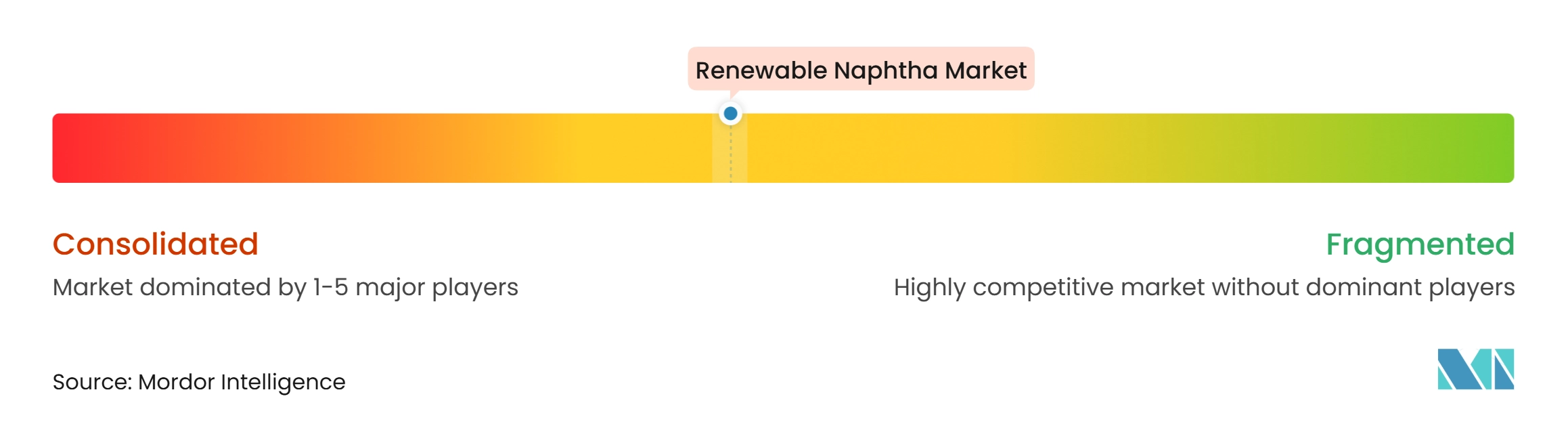
The renewable naphtha market is moderately consolidated. Neste, TotalEnergies, Enilive, and the Valero-Darling Diamond Green Diesel joint venture are among the integrated producers active in the commercial supply of renewable naphtha. Their position reflects the scale required to operate hydrotreated vegetable oil and sustainable aviation fuel assets, where renewable naphtha is a co-product. Neste expanded its Rotterdam refinery to 6.8 million tons of global renewables production capacity by 2027. Enilive secured a EUR 500 million financing agreement in July 2025 to convert its Livorno refinery into a biorefinery. These investments reinforce the role of large integrated producers in the renewable naphtha market.
Large producers generally position renewable naphtha as a co-product that supports the economics of renewable diesel and sustainable aviation fuel plants. This model raises entry barriers because meaningful output requires investment in full-scale hydroprocessing facilities. Shell's September 2025 decision not to restart construction of its Rotterdam biofuels plant demonstrated that large projects remain dependent on access to viable feedstocks and commercial certainty. Eni's Ecofining technology is being deployed through international partnerships, including projects in South Korea and Malaysia. This approach allows technology and operating practices to enter new markets through joint ventures, linking renewable naphtha supply to the expansion of broader renewable fuel networks.
Feedstock pathways are emerging as a clear point of competitive differentiation. Tall oil, municipal solid waste, agricultural residues, and intermediate crops could reduce dependence on supplies of used cooking oil and animal fat. Repsol and Bunge's intermediate-crops initiative illustrates efforts to diversify the renewable feedstock base. Repsol has also continued to develop renewable fuel production in Spain and Portugal. OMV Petrom's flexible Petrobrazi unit offers another example of a refinery designed to adjust output in response to feedstock availability and product demand. Competition in the market will remain centered on reliable access to feedstock, processing flexibility, and the ability to supply certified material to chemical buyers.
Renewable Naphtha Industry Leaders
-
Neste Oil Corporation
-
TotalEnergies
-
Shell plc
-
Eni S.p.A.
-
UPM
- *Disclaimer: Major Players sorted in no particular order
Renewable Naphtha Market Companies Covered in this Report
- Chevron Corporation
- Darling Ingredients
- Diamond Green Diesel LLC
- Eni S.p.A.
- Galp
- Marathon Petroleum Corporation
- Neste Oil Corporation
- OMV Aktiengesellschaft
- Phillips 66 Company
- Repsol
- Shell plc
- TotalEnergies
- UPM
- Valero
- VAROPreem Sverige AB
Recent Industry Developments in Renewable Naphtha Market
- August 2026: The US EPA approved a facility-specific fuel pathway for Chevron's Geismar, Louisiana, plant (formerly Renewable Energy Group), allowing renewable naphtha produced from CoverCress oil, a winter cover-crop oilseed, to generate advanced biofuel (D5) RINs under the Renewable Fuel Standard (RFS). This expanded the domestic oilseed feedstock base for renewable naphtha eligible for regulatory credit incentives and provided commercial certainty for growers ahead of CoverCress's first commercial crush in early 2027.
- July 2026: Valero Energy's Diamond Green Diesel joint venture reported a renewable diesel segment operating income of USD 717 million for Q2 2026, reversing a Q2 2025 operating loss of USD 79 million. Improved regulatory credit values and higher output of renewable naphtha and diesel co-production at DGD's combined facilities, with a capacity of 1.595 billion gallons per year, drove this recovery.
Global Renewable Naphtha Market Report Scope
Renewable naphtha is a sustainable hydrocarbon liquid produced as a co-product or alternative to petroleum-based naphtha during the production of renewable diesel or sustainable aviation fuel (SAF), or through waste plastic pyrolysis and CO2 hydrogenation.
The renewable naphtha market is segmented by product type, application, feedstock, and geography. By product type, the market is segmented into light naphtha and heavy naphtha. By application, the market is segmented into fuel blending, petrochemical feedstock, solvent production, plastics and polymer feedstock, and others. By feedstock, the market is segmented into used cooking oil and waste fats, vegetable oils, agricultural and forestry residues, municipal solid waste and mixed waste, and others. The report also covers market sizes and forecasts for renewable naphtha across 15 countries in major regions. The market sizes and forecasts are provided in terms of value (USD).
Segmentation Overview
| Light Naphtha |
| Heavy Naphtha |
| Fuel Blending |
| Petrochemical Feedstock |
| Solvent Production |
| Plastics and Polymer Feedstock |
| Others |
| Used Cooking Oil and Waste Fats |
| Vegetable Oils |
| Agricultural and Forestry Residues |
| Municipal Solid Waste and Mixed Waste |
| Others |
| Asia-Pacific | China |
| India | |
| Japan | |
| South Korea | |
| ASEAN Countries | |
| Rest of Asia-Pacific | |
| North America | United States |
| Canada | |
| Mexico | |
| Europe | Germany |
| United Kingdom | |
| France | |
| Italy | |
| NORDIC Countries | |
| Rest of Europe | |
| South America | Brazil |
| Argentina | |
| Rest of South America | |
| Middle East and Africa | Saudi Arabia |
| South Africa | |
| Rest of Middle East and Africa |
| By Product Type | Light Naphtha | |
| Heavy Naphtha | ||
| By Application | Fuel Blending | |
| Petrochemical Feedstock | ||
| Solvent Production | ||
| Plastics and Polymer Feedstock | ||
| Others | ||
| By Feedstock | Used Cooking Oil and Waste Fats | |
| Vegetable Oils | ||
| Agricultural and Forestry Residues | ||
| Municipal Solid Waste and Mixed Waste | ||
| Others | ||
| By Geography | Asia-Pacific | China |
| India | ||
| Japan | ||
| South Korea | ||
| ASEAN Countries | ||
| Rest of Asia-Pacific | ||
| North America | United States | |
| Canada | ||
| Mexico | ||
| Europe | Germany | |
| United Kingdom | ||
| France | ||
| Italy | ||
| NORDIC Countries | ||
| Rest of Europe | ||
| South America | Brazil | |
| Argentina | ||
| Rest of South America | ||
| Middle East and Africa | Saudi Arabia | |
| South Africa | ||
| Rest of Middle East and Africa | ||
Key Questions Answered in the Report
What is current market size of Renewable Naphtha Market?
The renewable naphtha market size was valued at USD 0.86 billion in 2026 and is estimated to grow from USD 0.94 billion in 2027 to reach USD 1.51 billion by 2032, at a CAGR of 9.84% during the forecast period (2027-2032).
Which application is expected to grow the fastest?
Petrochemical feedstock is forecast to grow at a 12.64% CAGR through 2032 as chemical producers add certified renewable inputs.
Which feedstock category is growing fastest?
Used cooking oil and waste fats are projected to grow at a 12.89% CAGR through 2032, supported by their emissions profile and approved pathways.
Which region leads renewable naphtha demand?
Europe leads with a 43.45% share in 2026, supported by refinery capacity, certification infrastructure, and regulatory demand.