
Recycled Terephthalic Acid (rTPA) Market Size and Share
Market Overview
| Study Period | 2022 - 2032 |
|---|---|
| Market Size (2027) | USD 2.58 Billion |
| Market Size (2032) | USD 3.22 Billion |
| Growth Rate (2027 - 2032) | 4.56 % |
| Fastest Growing Market | Asia-Pacific |
| Largest Market | Asia-Pacific |
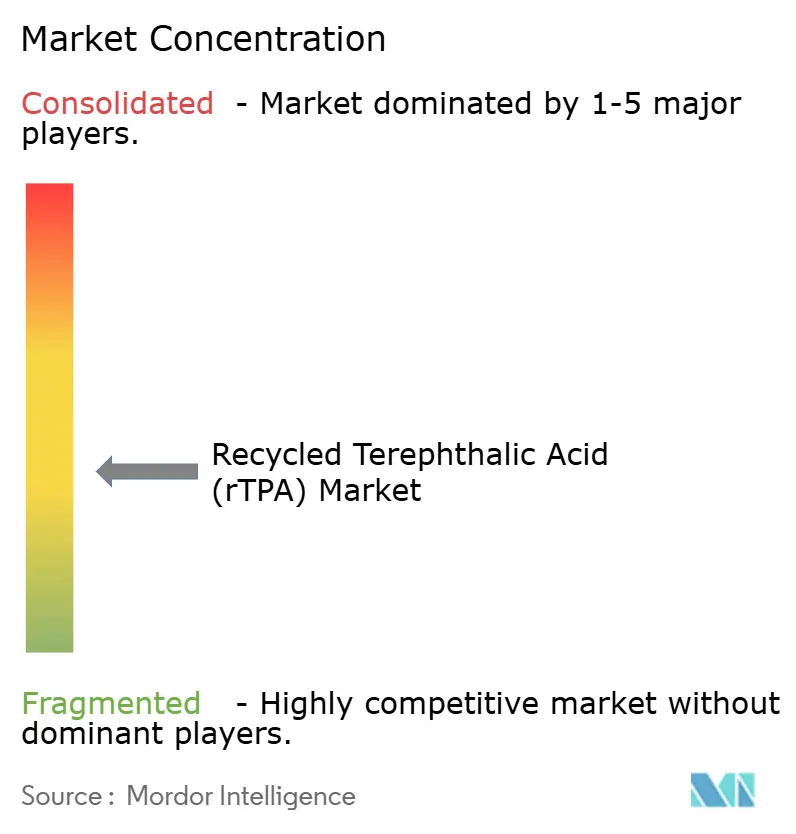
| Market Concentration | Medium |
Major Players *Disclaimer: Major Players sorted in no particular order Image © Mordor Intelligence. Reuse requires attribution under CC BY 4.0. | |
Recycled Terephthalic Acid (rTPA) Market Analysis by Mordor Intelligence
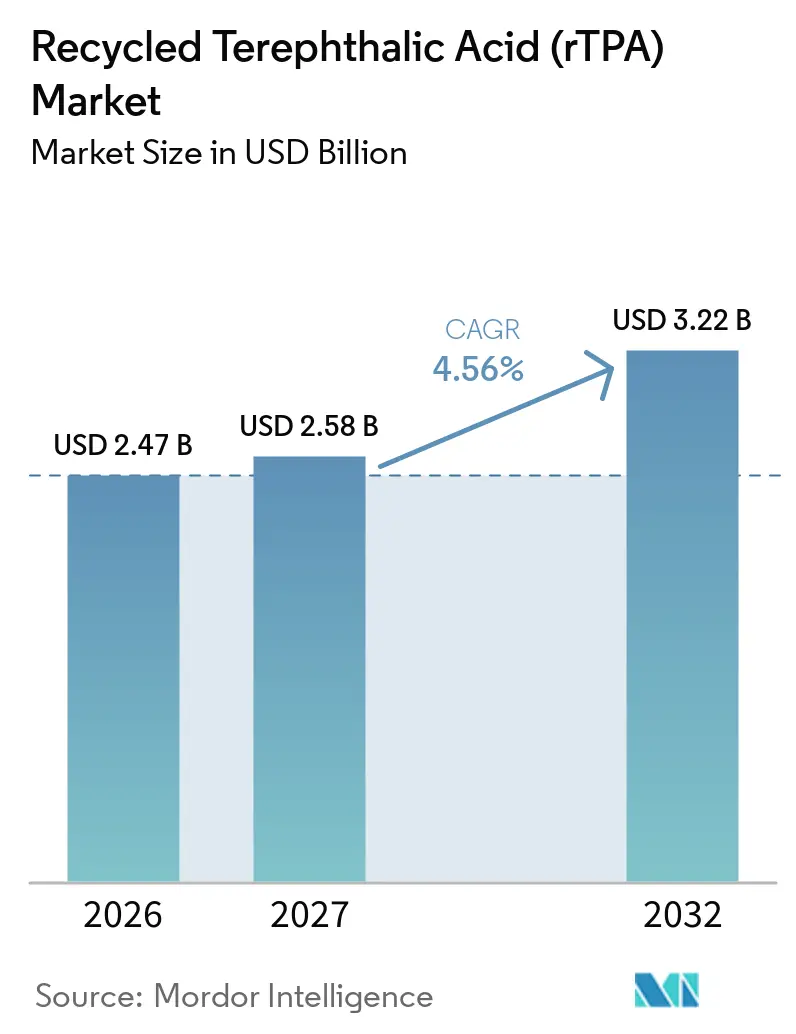
The recycled terephthalic acid market size was valued at USD 2.47 billion in 2026 and is estimated to grow from USD 2.58 billion in 2027 to USD 3.22 billion by 2032, at a CAGR of 4.56% during the forecast period (2027-2032). The recycled terephthalic acid market is supported by recycled-content requirements, corporate material commitments, and chemical recycling methods that recover monomers from post-consumer polyethylene terephthalate (PET). These conditions are influencing procurement decisions as buyers require a reliable supply that meets quality and traceability standards. Producers that combine feedstock access, proven purification methods, and long-term customer agreements are better positioned as capacity expands. The market also depends on whether recycling facilities can reduce energy use and achieve consistent material quality at a commercial scale. Price pressure from virgin purified terephthalic acid (PTA) and mechanically recycled PET remains a key factor in markets where recycled-content rules are not consistently enforced.
Key Report Takeaways
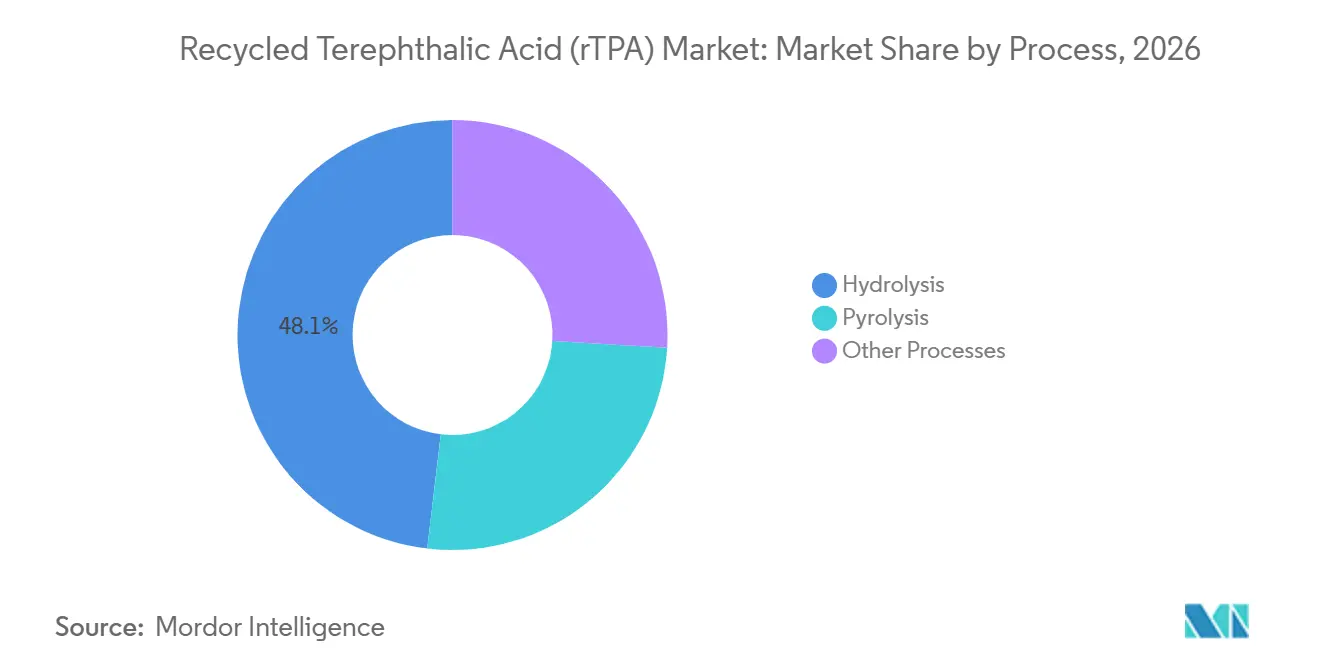
- By process, hydrolysis held 48.12% of the recycled terephthalic acid market share in 2026, while pyrolysis is forecast to expand at a CAGR of 5.05% through 2032.
- By application, fibers accounted for 43.64% of segment revenue in 2026 and are forecast to expand at a 5.17% CAGR through 2032.
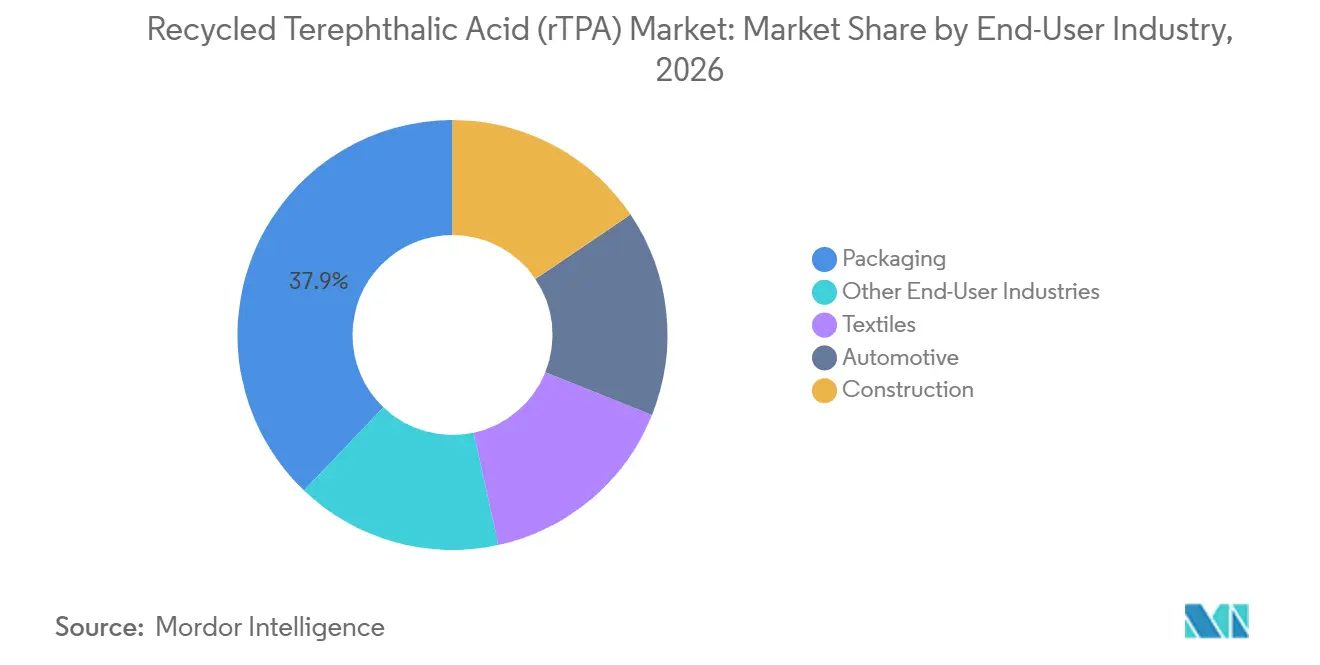
- By end-user industry, packaging accounted for 37.87% of the recycled terephthalic acid market share in 2026 and is forecast to expand at a 5.71% CAGR through 2032.
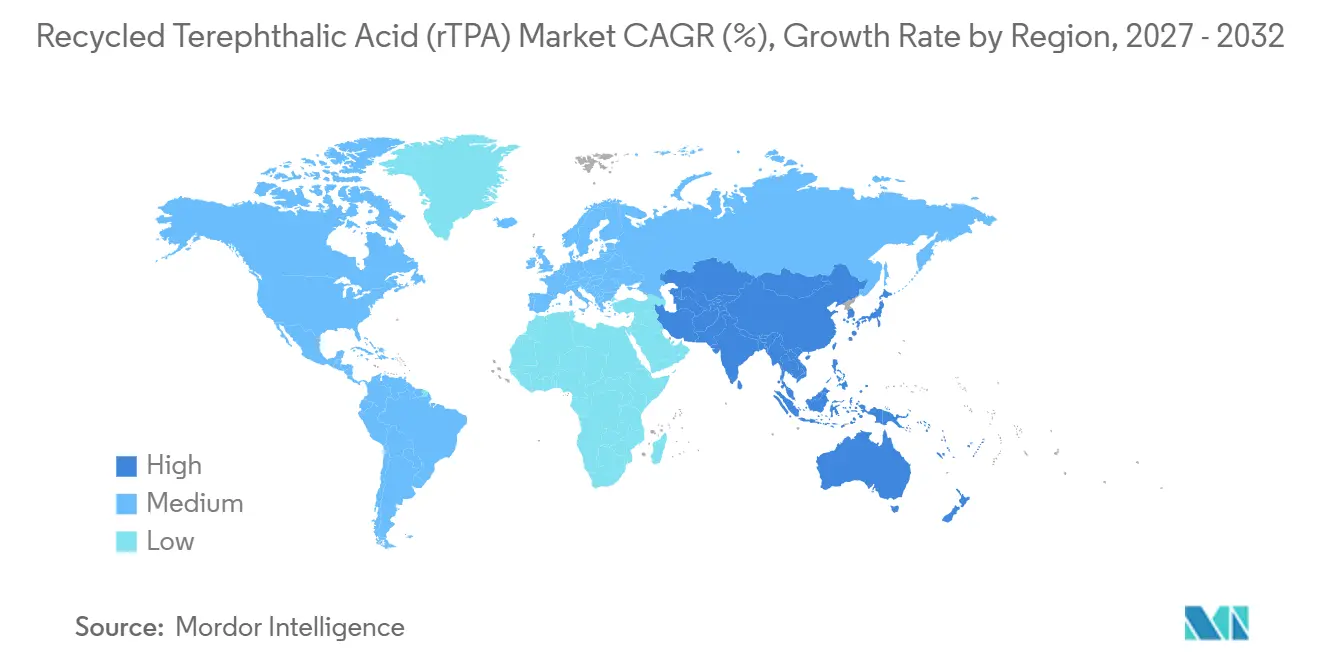
- By geography, Asia-Pacific accounted for 44.51% of revenue in 2026 and is projected to grow at 5.62% CAGR through 2032.
Note: Market numbers in this report are based on Mordor Intelligence's proprietary estimation framework, which combines nine months of actuals with Q4 projections for base year 2026.
Market Trends and Insights
Drivers Impact Analysis of Recycled Terephthalic Acid (rTPA) Market*
| Drivers | (~) % Impact on CAGR Forecast | Geographic Relevance | Impact Timeline |
|---|---|---|---|
| Recycled-Content Mandates and Extended Producer Responsibility | +1.3% | Global, with the EU and North America as primary enforcement regions | Short term (≤ 2 years) |
| Brand Commitments to Circular Polyester and Packaging | +1.0% | Global, concentrated in North America, Europe, and East Asia | Medium term (2-4 years) |
| Demand for Virgin-Equivalent Recycled Polyester Inputs | +0.8% | Global, with Asia-Pacific at the core and spillover to North America and Europe | Medium term (2-4 years) |
| Textile-to-Textile Recycling of Hard-to-Recycle Polyester Waste | +0.6% | Asia-Pacific at the core, with early adoption in North America and Europe | Long term (≥ 4 years) |
| Source: Mordor Intelligence | |||
Recycled-Content Mandates and Extended Producer Responsibility
The recycled terephthalic acid market benefits when statutory recycled-content requirements convert voluntary purchasing targets into planned procurement. Regulation (EU) 2025/40 entered into force in January 2025 and sets recycled-content targets for plastic packaging that rise to 30% by 2030 and 65% by 2040, while requiring packaging to be designed for recyclability from 2030. The regulation gives packaging buyers a clearer basis for selecting recycled material with documented origin and verified performance. In July 2025, the European Commission consulted on calculation and verification rules for chemically recycled content in polyethylene terephthalate (PET) beverage bottles under the Single-Use Plastics Directive. Its fuel-use-excluded approach means that material used for energy recovery does not count toward recycled-content claims, which supports demand for material recovery routes. The recycled terephthalic acid market stands to benefit from these rules when producers supply traceable material and brands secure supply ahead of the 2030 deadlines.
Brand Commitments to Circular Polyester and Packaging
Brand commitments are giving chemical recyclers clearer demand signals and helping convert pilot activity into contracted supply. In June 2025, Lululemon and Samsara Eco announced a 10-year agreement for recycled polyester and nylon, with the materials potentially supplying 20% of Lululemon's overall fiber portfolio. Gap Inc. also joined Syre as a launch partner, committing to use 10,000 metric tons of textile-to-textile circular polyester annually. H&M Group reported in June 2025 that all of its polyester use was certified as recycled under the Recycled Content Standard. PUMA and RE&UP signed a multi-year letter of intent in March 2025 to advance a circular textile solution that converts textile waste into recycled polyester chips. The recycled terephthalic acid market benefits when these commitments reduce exposure to short-term virgin purified terephthalic acid (PTA) price movements, as suppliers have identifiable buyers and agreed-upon quantity pathways.
Demand for Virgin-Equivalent Recycled Polyester Inputs
High-specification applications in food-contact packaging, technical fibers, and automotive components require recycled inputs with consistent quality. A 2025 review of PET hydrolysis found that carefully controlled temperature, pressure, and catalyst conditions can support high-purity monomer recovery with efficiencies above 90%. That quality profile makes chemical depolymerization relevant where repeated mechanical recycling cannot maintain the required molecular properties. Japan's National Institute of Advanced Industrial Science and Technology described a room-temperature method in July 2025 that uses dimethyl carbonate to recover dimethyl terephthalate, a direct precursor to terephthalic acid[1]. The process indicates a route that could reduce the energy burden of conventional high-temperature recycling, although commercial scaling remains necessary. The recycled terephthalic acid market, therefore, presents an opportunity for buyers seeking recycled feedstocks that perform comparably to virgin material and meet demanding compliance requirements.
Textile-to-Textile Recycling of Hard-to-Recycle Polyester Waste
The recycled terephthalic acid market has a significant feedstock opportunity in textile waste, as blended fabrics, dyed yarns, and complex garments are difficult to recycle mechanically. A 2025 academic review found that less than 0.1% of polyester textile fibers are recycled in a closed loop into new textiles. Chemical depolymerization can separate and recover monomers from material that conventional sorting and mechanical processes struggle to handle. In September 2025, Ester Loop Infinite Technologies acquired land in Dahej, Gujarat, for an Infinite Loop chemical recycling facility designed for polyester textile waste. The planned facility is intended to have an initial capacity of 70,000 metric tons per year and is expected to be commissioned by the end of 2027. Feedstock collection, sorting, and traceability are practical, competitive requirements, as they determine whether facilities can operate reliably.
Restraints Impact Analysis of Recycled Terephthalic Acid (rTPA) Market*
| Restraints | (~) % Impact on CAGR Forecast | Geographic Relevance | Impact Timeline |
|---|---|---|---|
| High Capital and Energy Intensity of Chemical Recycling | -1.2% | Global, most acute in markets without policy-backed financing | Short term (≤ 2 years) |
| Competition From Virgin Purified Terephthalic Acid (PTA) and Mechanically Recycled Polyethylene Terephthalate (PET) | -0.9% | Global, most pronounced in Asia-Pacific amid virgin PET oversupply | Short term (≤ 2 years) |
| Inconsistent Feedstock Quality and Traceability in Blended Textile Waste | -0.5% | Asia-Pacific at the core, South Asia, with spillover to the Middle East and Africa | Medium term (2-4 years) |
| Source: Mordor Intelligence | |||
High Capital and Energy Intensity of Chemical Recycling
Chemical recycling plants require specialized reactors, purification equipment, distillation systems, and process controls, which increase capital requirements. Carbios reported that its planned Longlaville enzymatic PET biorecycling plant involved estimated construction costs of EUR 230 million (~USD 258.21 million), with EUR 42.5 million (~USD 47.71 million) in confirmed public funding. The company's financing structure illustrates how project development depends on public support, customer commitments, and private capital. High-temperature hydrolysis may require operating conditions of 200°C or higher, increasing energy demand and operating costs. Eastman has planned a Texas methanolysis facility with groundbreaking targeted for the fourth quarter of 2026 and mechanical completion in 2028, reflecting the multi-year commitment required for large facilities. These requirements favor well-financed companies and can limit smaller operators to partnerships, licensing arrangements, or pilot projects in the recycled terephthalic acid market.
Competition From Virgin PTA and Mechanically Recycled PET
Virgin PTA and mechanically recycled PET remain lower-cost alternatives, with buyers not required to use chemically recycled inputs. This pressure is strongest in price-sensitive applications where food-contact approval, high purity, or fiber performance is not essential. Mechanically recycled PET can meet some non-food packaging and fiber requirements at a lower conversion cost, even though its material properties may vary more than chemically recovered monomers. Feedstock inconsistency poses another limitation, as blended textiles and poorly sorted waste require additional sorting, pretreatment, and verification before processing. International Sustainability and Carbon Certification (ISCC) PLUS mass-balance certification and food-contact frameworks, including Regulation (EU) 2022/1616, raise the standard for material traceability and process control[2]. The recycled terephthalic acid market remains sensitive to virgin material pricing and the pace at which collection systems provide clean, documented feedstock.
*Our forecasts treat driver/restraint impacts as directional, not additive. The impact forecasts reflect baseline growth, mix effects, and variable interactions.
Recycled Terephthalic Acid (rTPA) Market Segment Analysis
By Process:
Hydrolysis Holds the Largest Position While Pyrolysis Broadens Feedstock OptionsHydrolysis held 48.12% of revenue in 2026, making it the largest process segment in the recycled terephthalic acid market. The process is preferred where high monomer purity is important, particularly for food-contact packaging and demanding fiber applications. Hydrolysis can be optimized by adjusting temperature, pressure, and catalyst selection to improve yields and product quality. A 2025 review of PET hydrolysis described autocatalytic behavior, in which carboxyl end groups can accelerate the reaction as depolymerization progresses. Enzymatic routes broaden the available feedstock pool by processing colored and contaminated PET that is difficult to use in conventional routes. Carbios and Samsara Eco are among the companies developing commercial applications for enzymatic depolymerization. The process plays a significant role in the recycled terephthalic acid market by enabling products that require controlled purity. Its performance depends on reliable feedstock preparation and the cost of operating the required equipment.
Pyrolysis is forecast to grow at a CAGR of 5.05% from 2027 to 2032, the highest rate among process routes. It can accept mixed and contaminated PET streams that would require extensive sorting before many hydrolysis processes. This flexibility can increase the usable supply of post-consumer material in locations with mixed-waste collection systems. However, the thermal environment can produce complex output streams that require further upgrading before achieving monomer-equivalent purity. A 2025 review of polyester-containing textile recycling identified chemical recycling as relevant for materials that cannot be effectively processed through conventional recycling routes. Glycolysis produces bis(2-hydroxyethyl) terephthalate (BHET) for polyester repolymerization, while methanolysis produces dimethyl terephthalate that can be used in high-purity material pathways. Pyrolysis is therefore a complementary option for difficult feedstocks rather than a direct replacement for hydrolysis across all end uses. Its progress in the recycled terephthalic acid market will depend on catalysts, upgrading methods, and the economics of treating heterogeneous waste.

By Application:
Fibers Combine the Largest Revenue Base with the Highest Growth RateFibers accounted for 43.64% of segment revenue in 2026 and are forecast to grow at a CAGR of 5.17% through 2032. This position reflects the apparel sector's shift from bottle-derived recycled polyester toward textile-to-textile recycling. Chemical depolymerization is relevant because it can convert polyester waste into monomers suitable for new fiber production. The recycled terephthalic acid market is supported by brands establishing supply relationships for circular polyester. Gap Inc.'s stated 10,000-metric-ton annual commitment with Syre illustrates the type of long-term demand arrangement that supports the construction of new processing capacity. H&M Group's reported use of certified recycled polyester also points to established demand for verified recycled materials. The very low closed-loop recycling rate for polyester textiles leaves substantial room for new collection and processing systems. Fiber producers require feedstock that consistently meets quality specifications, which favors the use of controlled chemical processes.
Films and sheets are an adjacent application where high-purity recycled material may be suitable for food-contact products. Regulation (EU) 2022/1616 sets the framework for recycled plastic materials and articles intended to come into contact with food. Resins serve automotive and electronics applications where dimensional stability and chemical resistance are key material requirements. Other uses include packaging strapping, industrial textiles, and specialty coatings. These uses can absorb materials with different performance profiles and help facilities direct outputs to appropriate outlets. Fibers remain distinct because apparel brands are directly linking the use of recycled materials to public circularity commitments. The recycled terephthalic acid market can benefit when fiber applications create stable demand for virgin-equivalent recycled inputs. Expansion in films, sheets, and resins can diversify revenue and reduce reliance on a single customer group.
By End-User Industry:
Packaging Leads Current Demand, and Textile Recycling Extends the OpportunityPackaging accounted for 37.87% of segment demand in 2026 and is projected to grow at a 5.71% CAGR through 2032. Packaging demand is linked to recycled-content requirements that set future compliance milestones for brand owners. Regulation (EU) 2025/40 establishes recycled-content targets for plastic packaging, providing a policy basis for buyers to plan material procurement. The Single-Use Plastics Directive also requires 25% recycled content in PET beverage bottles by 2025 and 30% in all plastic bottles by 2030. The recycled terephthalic acid market requires packaging customers that can meet food-contact, quality, and traceability expectations. Indorama Ventures reported recycling 150 billion PET bottles in August 2025, underscoring the scale of its PET collection and recycling operations. Its 2025 verification statement also documented 837,000 metric tons of installed global recycled PET (rPET) bale input capacity and 458,500 metric tons processed.
Textiles are the second-largest end-user segment and have a longer development cycle because they require dedicated systems for collection, sorting, and processing. The recycled terephthalic acid market is relevant to textiles because monomer recovery can address dyed, blended, and contaminated material that mechanical methods struggle to recycle. Automotive demand is growing as recycled polyester is used in seat upholstery, interior trim, and under-hood components. Construction uses, including geotextiles, insulation batting, and bonded fibers, can provide outlets for material that does not require food-contact quality. These different end uses allow processors to direct output according to purity and performance requirements. Global Recycled Standard (GRS) and ISCC PLUS certification can influence purchasing decisions in textiles and packaging by documenting recycled content and chain-of-custody practices. Producers that manage these requirements can offer customers a clearer record of compliance. Packaging drives near-term regulatory demand, while textile recycling builds the feedstock and demand systems needed to support future growth.
Geography Analysis
APAC Recycled Terephthalic Acid (rTPA) Market
Asia-Pacific accounted for 44.51% of regional revenue in 2026 and is projected to grow at a 5.62% CAGR through 2032. The recycled terephthalic acid market in the region encompasses PET production, polyester textile manufacturing, and the development of recycling capacity across China, India, Japan, and Southeast Asia. In India, the planned ELITe facility in Gujarat is intended to process polyester textile waste into virgin-quality recycled material at 70,000 metric tons per year after commissioning by the end of 2027. This development indicates that textile waste is becoming an organized feedstock source rather than solely a disposal issue. Japan also has active company collaboration in chemical recycling, including a 2025 initiative led by Kao to expand non-food PET recycling into beverage-grade bottles. China's large PTA base can create price competition for recycled materials, particularly when virgin materials are readily available. This makes feedstock security, low-energy processes, and compliance-driven demand important regional factors.
Europe Recycled Terephthalic Acid (rTPA) Market
Europe is the second-largest regional market and has a relatively stable policy basis for demand. Regulation (EU) 2025/40 requires plastic packaging to contain increasing amounts of post-consumer recycled content, with targets reaching 30% in 2030. The region also has food-contact rules and calculation methods that make traceability important for chemically recycled materials. These standards can favor producers that maintain detailed records of material origin, processing, and allocation. Deposit return systems in Germany and Nordic countries provide clean PET bales that serve as useful inputs for high-quality recycling. France is also developing chemical recycling capacity through projects such as Carbios' planned Longlaville facility. Europe's growth opportunity depends on the consistent implementation of regulations and on producers' ability to finance commercial plants.
The Americas and MEA Recycled Terephthalic Acid (rTPA) Market
North America is positioned for steady growth as state and federal producer responsibility frameworks continue to develop. Eastman's planned Texas methanolysis facility is a significant addition to the regional project pipeline, with groundbreaking targeted for the fourth quarter of 2026 and completion targeted in 2028. Brand agreements in the region can also support demand for chemically recycled polyester, as demonstrated by the Lululemon and Samsara Eco agreement. South America, the Middle East, and Africa hold smaller market positions, as collection systems and formal recycling infrastructure are less developed in these regions. Brazil and Mexico have relatively more established collection and recycling systems within their respective regions. Saudi Arabia and South Africa are at an earlier stage in developing producer responsibility frameworks. The recycled terephthalic acid market in these regions will grow more substantially when collection, feedstock quality, and compliance systems improve.
Competitive Landscape
The recycled terephthalic acid market is moderately fragmented and includes technology-focused chemical recyclers as well as integrated polyethylene terephthalate (PET) and petrochemical producers. Carbios, Loop Industries, DePoly, and JEPLAN focus on depolymerization technologies, while Indorama Ventures, Eastman Chemical, and Far Eastern New Century have established capabilities in resins, customer relationships, and distribution. Pure-play companies can develop specialized enzymatic or catalytic methods but often depend on external financing and customer commitments to build commercial facilities. Integrated companies can leverage existing operational networks but may move more slowly in reallocating capital from mechanical to chemical recycling. Loop Industries and Ester Industries formed ELITe to combine Infinite Loop technology with local manufacturing and access to feedstocks in India. This model demonstrates how technology providers can work with local industrial partners rather than building each part of the value chain independently. Competitive positions are also shaped by access to textile collection, preprocessing, and material traceability, and these capabilities may become more important as textile-to-textile production expands.
Companies are using offtake agreements and projects to reduce uncertainty around new chemical recycling capacity. Lululemon's 10-year agreement with Samsara Eco creates a pathway for recycled polyester and nylon within a major apparel company's fiber portfolio. Gap Inc.'s annual commitment to Syre provides another example of a customer relationship that supports textile-to-textile supply development. Kao's cross-industry collaboration in Japan extends the use of chemical recycling feedstocks beyond food PET bottles. These arrangements address different parts of the recycled terephthalic acid market, including demand, feedstock, and technology validation. International Sustainability and Carbon Certification (ISCC) PLUS certification and food-contact compliance are becoming necessary commercial requirements for companies making recycled-content claims. Companies that cannot document the origin and allocation of materials may face commercial barriers, even if their processes perform well technically.
Production is dispersed among several developers and established groups, while larger packaging and fiber buyers can account for a substantial share of contracted quantities. This dynamic gives major buyers leverage in commercial negotiations and makes customer diversification important for recyclers. Companies with public financing, long-term offtake agreements, and reliable access to feedstock are better positioned to move from pilot operations to larger-scale plants. Cost reduction remains important, as the recycled terephthalic acid market must compete with both virgin material and mechanical recycling. Developments that reduce energy use, such as the National Institute of Advanced Industrial Science and Technology (AIST) room-temperature research, can improve economics if they progress beyond research-scale results. Commercial execution, regulatory compliance, and access to quality feedstock will be more important to the market's development than technology claims alone.
Recycled Terephthalic Acid (rTPA) Industry Leaders
-
Indorama Ventures Public Company Limited
-
Eastman Chemical Company
-
Alpek S.A.B. de C.V.
-
Far Eastern New Century Corporation
-
INEOS
- *Disclaimer: Major Players sorted in no particular order
Recycled Terephthalic Acid (rTPA) Market Companies Covered in this Report
- Alpek S.A.B. de C.V.
- ALPLA
- Biffa
- Carbios
- DePoly
- Eastman Chemical Company
- Far Eastern New Century Corporation
- Indorama Ventures Public Company Limited
- INEOS
- JEPLAN, INC.
- Loop Industries
- Lotte Chemical Corporation
- Plastipak Holdings, Inc.
- Reliance Industries Limited
- SABIC
- SUEZ
Recent Industry Developments in Recycled Terephthalic Acid (rTPA) Market
- September 2025: Ester Loop Infinite Technologies (ELITe), a 50:50 joint venture between Ester Industries and Loop Industries, entered an agreement to acquire 90 acres of land at Dahej, Gujarat, for India's first Infinite Loop chemical recycling facility. The project targeted an initial capacity of 70,000 metric tons per year, with commissioning expected by end of 2027.
- June 2025: Lululemon and Samsara Eco announced a 10-year agreement for enzymatically recycled polyester and nylon. Under the agreement, Samsara Eco's materials could supply 20% of Lululemon's total fiber portfolio.
Global Recycled Terephthalic Acid (rTPA) Market Report Scope
Recycled Terephthalic Acid (rTPA) is a chemical compound recovered through the chemical recycling of post-consumer or post-industrial polyethylene terephthalate (PET) waste, such as plastic bottles and discarded textiles. The recycling process involves breaking down PET waste into its core chemical components, including rTPA and ethylene glycol, which are then used as raw materials to produce new PET or other chemical products.
The recycled terephthalic acid (rTPA) market is segmented by process, application, end-user industry, and geography. By process, the market is segmented into hydrolysis, pyrolysis, and other processes. By application, the market is segmented into fibers, films and sheets, resins, and other applications. By end-user industry, the market is segmented into packaging, textiles, automotive, construction, and other end-user industries. The report also covers market sizes and forecasts for the global recycled terephthalic acid (rTPA) across 15 countries in major regions. The market sizes and forecasts are provided in terms of value (USD).
Segmentation Overview
| Hydrolysis |
| Pyrolysis |
| Other Processes |
| Fibers |
| Films and Sheets |
| Resins |
| Other Applications |
| Packaging |
| Textiles |
| Automotive |
| Construction |
| Other End-User Industries |
| Asia-Pacific | China |
| India | |
| Japan | |
| South Korea | |
| ASEAN Countries | |
| Rest of Asia-Pacific | |
| North America | United States |
| Canada | |
| Mexico | |
| Europe | Germany |
| United Kingdom | |
| France | |
| Italy | |
| NORDIC Countries | |
| Rest of Europe | |
| South America | Brazil |
| Argentina | |
| Rest of South America | |
| Middle East and Africa | Saudi Arabia |
| South Africa | |
| Rest of Middle East and Africa |
| By Process | Hydrolysis | |
| Pyrolysis | ||
| Other Processes | ||
| By Application | Fibers | |
| Films and Sheets | ||
| Resins | ||
| Other Applications | ||
| By End-User Industry | Packaging | |
| Textiles | ||
| Automotive | ||
| Construction | ||
| Other End-User Industries | ||
| By Geography | Asia-Pacific | China |
| India | ||
| Japan | ||
| South Korea | ||
| ASEAN Countries | ||
| Rest of Asia-Pacific | ||
| North America | United States | |
| Canada | ||
| Mexico | ||
| Europe | Germany | |
| United Kingdom | ||
| France | ||
| Italy | ||
| NORDIC Countries | ||
| Rest of Europe | ||
| South America | Brazil | |
| Argentina | ||
| Rest of South America | ||
| Middle East and Africa | Saudi Arabia | |
| South Africa | ||
| Rest of Middle East and Africa | ||
Key Questions Answered in the Report
What is current market size of Recycled Terephthalic Acid (rTPA) Market?
The recycled terephthalic acid market size was valued at USD 2.47 billion in 2026 and is estimated to grow from USD 2.58 billion in 2027 to USD 3.22 billion by 2032, at a CAGR of 4.56% during the forecast period (2027-2032).
Why is packaging important for rTPA demand?
Packaging accounts for 37.87% of demand in 2026 and has the highest end-user CAGR at 5.71%, supported by recycled-content requirements.
Which region leads recycled terephthalic acid demand?
Asia-Pacific leads with 44.51% of revenue in 2026 and is projected to grow at a 5.62% CAGR through 2032.
What limits the adoption of chemically recycled terephthalic acid?
High capital and energy requirements, competition from virgin purified terephthalic acid (PTA) and mechanically recycled PET, and inconsistent textile feedstock quality limit wider adoption.