
Recycled Pharmaceutical Solvents Market Size and Share
Market Overview
| Study Period | 2021 - 2031 |
|---|---|
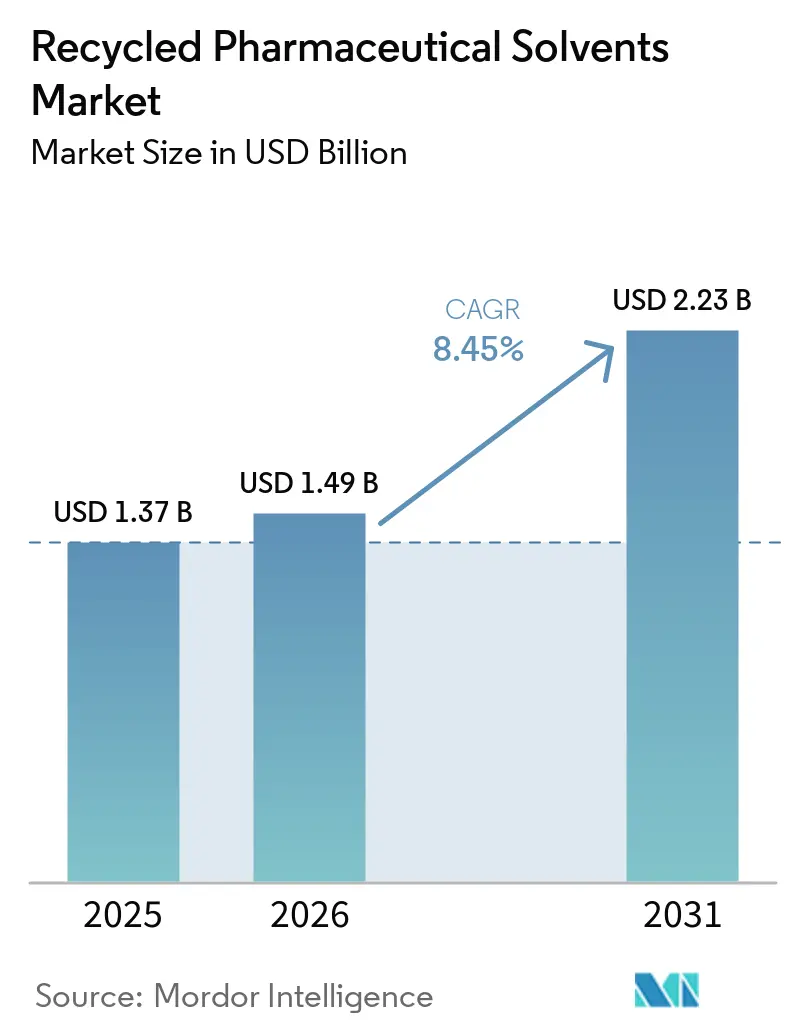
| Market Size (2026) | USD 1.49 Billion |
| Market Size (2031) | USD 2.23 Billion |
| Growth Rate (2026 - 2031) | 8.45 % |
| Fastest Growing Market | Asia-Pacific |
| Largest Market | Asia-Pacific |
| Market Concentration | Medium |
Major Players *Disclaimer: Major Players sorted in no particular order Image © Mordor Intelligence. Reuse requires attribution under CC BY 4.0. | |
Recycled Pharmaceutical Solvents Market Analysis by Mordor Intelligence
The Recycled Pharmaceutical Solvents Market size was valued at USD 1.37 billion in 2025 and is estimated to grow from USD 1.49 billion in 2026 to reach USD 2.23 billion by 2031, at a CAGR of 8.45% during the forecast period (2026-2031). The recycled pharmaceutical solvents market is supported by a wide gap between solvent volumes that can be recovered and the volumes currently recycled in pharmaceutical manufacturing. Solvents account for 60% to 70% of the waste stream from active pharmaceutical ingredient (API) production, while only 35% of pharmaceutical solvent waste is recycled, leaving much of the balance for incineration. Higher disposal costs, tighter emissions controls, and supply risks are making recovery programs more relevant to procurement teams. Expanding active pharmaceutical ingredient and contract development and manufacturing organization capacity in Asia-Pacific and North America is also creating more regular waste streams that can support dedicated recovery systems. The recycled pharmaceutical solvents market benefits when recovery providers can meet purity requirements, document traceability, and offer facilities a dependable alternative to virgin solvent purchases.
Key Report Takeaways
- By solvent type, alcohols held 33.56% of the recycled pharmaceutical solvents market share in 2025 and are projected to advance at a 9.23% CAGR through 2031.
- By purity grade, pharmaceutical grade held 41.34% of the recycled pharmaceutical solvents market share in 2025, while high-purity grade is projected to advance at a 10.45% CAGR through 2031.
- By recovery method, membrane separation held 52.49% of the recycled pharmaceutical solvents market share in 2025, while molecular-sieve drying is projected to advance at a 10.38% CAGR through 2031.
- By end-use, active pharmaceutical ingredient manufacturing held 35.13% of the recycled pharmaceutical solvents market share in 2025, while pharmaceutical manufacturing is projected to advance at a 10.94% CAGR through 2031.
- By geography, Asia-Pacific held 38.87% of the recycled pharmaceutical solvents market share in 2025 and is projected to advance at a 10.77% CAGR through 2031.
Note: Market size and forecast figures in this report are generated using Mordor Intelligence’s proprietary estimation framework, updated with the latest available data and insights as of January 2026.
Global Recycled Pharmaceutical Solvents Market Trends and Insights
Drivers Impact Analysis*
| Driver | (~) % Impact on CAGR Forecast | Geographic Relevance | Impact Timeline |
|---|---|---|---|
| Expansion of API and CDMO solvent-intensive production | +2.5% | Global; concentrated in Asia-Pacific (China, India) and North America | Long term (≥ 4 years) |
| Stricter hazardous-solvent disposal and VOC controls | +2.0% | Global; led by EU (IED, REACH) and North America (EPA NESHAP); extending to China and India | Medium term (2–4 years) |
| Corporate solvent circularity and waste-reduction targets | +1.4% | Global; primary movers in EU and North America among listed pharma multinationals | Medium term (2–4 years) |
| Higher virgin-solvent procurement and disposal costs | +1.0% | Global; amplified in Asia-Pacific and South America where import dependency is high | Short term (≤ 2 years) |
| Closed-loop recovery for segregated, recurring solvent streams | +0.7% | Global; strongest adoption in large-volume API and CDMO facilities with stable feed profiles | Long term (≥ 4 years) |
| Source: Mordor Intelligence | |||
Expansion of API and CDMO Solvent-Intensive Production
Active pharmaceutical ingredient synthesis and contract development and manufacturing organization campaigns create concentrated solvent streams that are more practical to recover than mixed or intermittent streams. Production of 1 kg of finished active pharmaceutical ingredient can generate up to 180 kg of solvent waste, which gives large sites a substantial potential feedstock for recovery systems. This operating profile supports the recycled pharmaceutical solvents market because consistent streams simplify separation, testing, and reuse documentation. In January 2026, Hybio Pharmaceutical's Wuhan subsidiary partnered with GenTech on an integrated waste-liquid recovery system for glucagon-like peptide-1 synthesis waste using distillation and adsorption. Once a recovery program is qualified, recurring campaigns can support longer service agreements and stable volumes. Closed-loop recovery is particularly suited to segregated, recurring streams because recovery providers can establish repeatable controls around a known feed profile.
Stricter Hazardous-Solvent Disposal and VOC Controls
Hazardous-waste rules and volatile organic compound controls are increasing the cost of sending usable solvent to disposal. The European Union Industrial Emissions Directive and the United States National Emission Standards for Hazardous Air Pollutants form important compliance reference points for pharmaceutical operations. The recycled pharmaceutical solvents market can benefit when enforcement turns incineration from a routine operating choice into a documented compliance exposure. Commission Regulation (EU) 2023/1768 restricted the use of dimethylacetamide and 1-ethylpyrrolidin-2-one under specified conditions, adding pressure to review solvent choices and handling practices[1]. More formal controls in China and India can also encourage pharmaceutical manufacturers to authorize and track solvent recovery operations. These rules make traceable recovery arrangements more important in locations with established pharmaceutical production clusters.
Corporate Solvent Circularity and Waste-Reduction Targets
Corporate waste-reduction programs are placing solvent management closer to finance, procurement, and environmental reporting processes. Published corporate recovery programs show that structured solvent management can support reuse at large manufacturing operations. The German Circular Economy Act also establishes a policy basis for waste prevention and recycling. The recycled pharmaceutical solvents market gains support when corporate targets are translated into supplier requirements and operating metrics. Such requirements can preserve demand for recovery services even when the immediate unit-cost advantage is limited.
Higher Virgin-Solvent Procurement and Disposal Costs
Volatile virgin-solvent prices and rising hazardous-waste costs can improve the business case for recovered material. Sulzer Ltd stated that advanced separation systems can reduce energy use by up to 50% compared with conventional thermal recovery in relevant applications. On-site systems can convert a variable purchasing expense into a more controlled processing cost when feed streams are stable. Maratek reported in February 2026 that an Omega RS installation reduced a client's waste volume by 90% and generated annual savings of USD 75,000 to USD 80,000. These economics can matter most for contract manufacturers and smaller active pharmaceutical ingredient producers with limited room to absorb input-price changes. The recycled pharmaceutical solvents market, therefore, has an immediate opening where solvent purchases and disposal charges are both material operating costs.
Restraints Impact Analysis*
| Restraint | (~) % Impact on CAGR Forecast | Geographic Relevance | Impact Timeline |
|---|---|---|---|
| Long GMP validation and requalification cycles | -1.2% | Global; most pronounced in FDA- and EMA-regulated markets (North America, EU) | Long term (≥ 4 years) |
| Mixed-feed contamination and azeotrope complexity | -0.8% | Global; most acute in multi-product API and CDMO environments | Medium term (2–4 years) |
| High energy and capital intensity of advanced recovery | -0.5% | Global; disproportionately constraining in emerging markets with high cost of capital | Long term (≥ 4 years) |
| Source: Mordor Intelligence | |||
Long GMP Validation and Requalification Cycles
Good Manufacturing Practice (GMP) requalification can slow adoption because recovered solvent must be documented, controlled, and tested for its intended use. The International Council for Harmonisation Q7 guideline requires appropriate controls for recovered solvents used in active pharmaceutical ingredient manufacturing[2]. A change in source stream, recovery supplier, or fraction cut can require additional qualification work. The Active Pharmaceutical Ingredients Committee's March 2026 position paper called for a risk-based framework for recycled solvents in active pharmaceutical ingredient production. This issue is especially relevant to multi-product contract development and manufacturing organizations that manage streams for many clients. The recycled pharmaceutical solvents market grows more slowly when the validation burden outweighs the benefit of recovery for smaller or less predictable campaigns.
Mixed-Feed Contamination and Azeotrope Complexity
Multi-product facilities often generate mixed streams containing alcohols, ketones, water, trace reaction by-products, and cleaning residues. The ethanol-water azeotrope requires additional separation measures, such as entrainer-assisted distillation, pervaporation, or molecular-sieve drying. These measures add equipment, energy use, analytical testing, and validation work. Seqens described a recovery case in which a persistent water-solvent azeotrope needed a tailored drying-agent pretreatment after earlier attempts had failed. Advanced systems can also require meaningful capital investment and can be difficult to justify when feed volumes are small or irregular. As a result, the recycled pharmaceutical solvents market remains less accessible for streams with unstable composition or difficult contaminants.
*Our forecasts treat driver/restraint impacts as directional, not additive. The impact forecasts reflect baseline growth, mix effects, and variable interactions.
Segment Analysis
By Solvent Type: Alcohols Support Established Recovery Demand
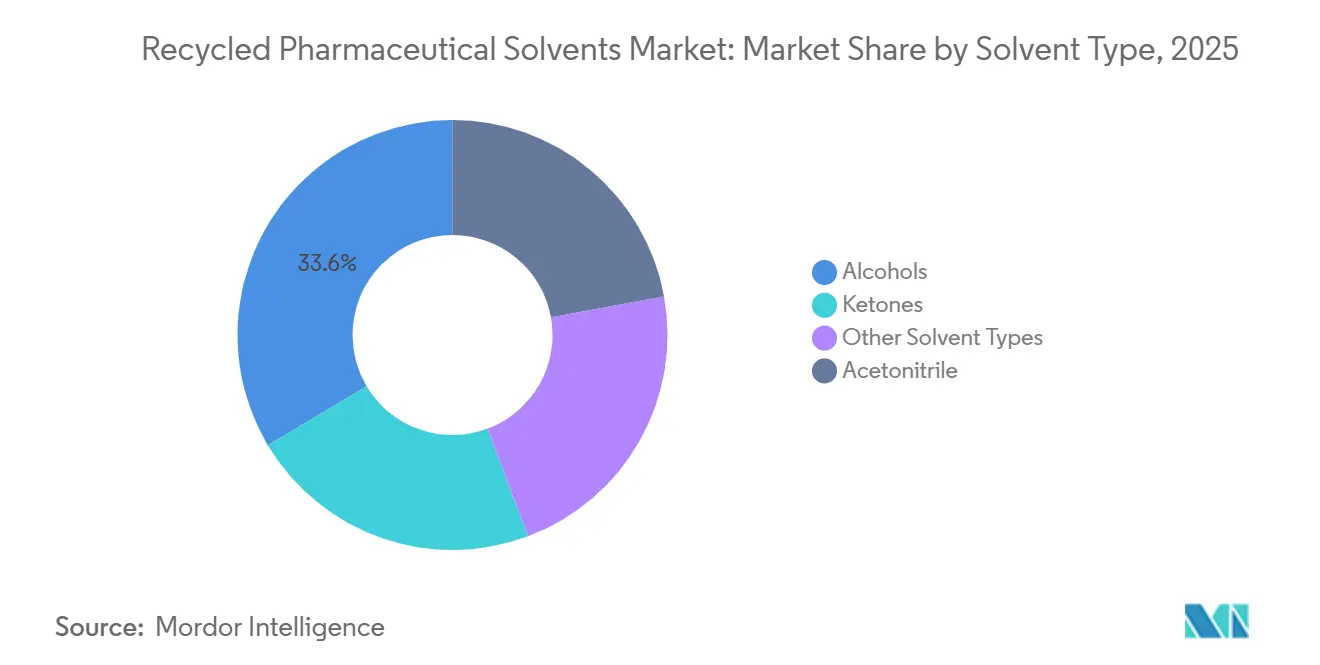
Alcohols held 33.56% of the recycled pharmaceutical solvents market share in 2025 and are projected to advance at a 9.23% CAGR through 2031. These solvents are used across synthesis, crystallization, purification, and final-product washing. Their broad use creates substantial recovery volumes at active pharmaceutical ingredient and formulation sites. Dedicated alcohol streams are generally easier to process because their composition is more consistent than that of mixed waste. This makes them suitable for distillation-based recovery and same-process reuse where qualification requirements are met.
Nitriles, principally acetonitrile, are widely used in oligonucleotide synthesis and downstream purification processes. In January 2026, a Chinese small nucleic acid pharmaceutical enterprise commissioned an acetonitrile recovery system with a 650 kg/h capacity. The project reported water content below 40 ppm and organic impurities below 1 ppm for each component. Acetonitrile recovery is, therefore, becoming more relevant in oligonucleotide production, where stringent impurity control is needed.

By Purity Grade: Pharmaceutical Grade Leads While High-Purity Grade Advances
Pharmaceutical grade held 41.34% of the recycled pharmaceutical solvents market share in 2025. It is the core quality tier for recovered solvents used in active pharmaceutical ingredient synthesis and formulation under current Good Manufacturing Practice frameworks. Established programs rely on defined release methods and supplier audits to verify quality standards. This tier is most common at high-volume recovery programs where manufacturers have already qualified their process controls. It gives recovery suppliers a route to recurring demand when they can provide consistent documentation and lot quality.
High-purity grade is projected to advance at a 10.45% CAGR through 2031 within the recycled pharmaceutical solvents market. Biopharmaceutical laboratories, oligonucleotide producers, and cell therapy facilities need recovered solvents with impurity profiles close to virgin-material specifications. High assay levels of at least 99.5% and testing for trace impurities may be needed before release. Providers that can produce this material may secure premium contracts in applications with demanding quality controls. Technical grade and industrial grade solvents serve more cost-sensitive uses, including cleaning validation and equipment washing, while other grades are often arranged for a specific campaign.
By Recovery Method: Membrane Separation Holds the Lead, While Molecular-Sieve Drying Expands
Membrane separation held 52.49% share of the recycled pharmaceutical solvents market in 2025. The method benefits from advances in organic solvent nanofiltration that can reduce the energy required for selected separations. A 2024 Nature Communications study reported that crown ether-based polyamide membranes had 23% to 90% higher selectivity than commercial benchmarks and 93% higher acetonitrile permeance. These results support membrane systems where pharmaceutical streams are heat-sensitive or include several solvent components. The method can complement, rather than fully replace, distillation in recovery programs that need flexible process design.
Molecular-sieve drying is projected to advance at a 10.38% CAGR through 2031 in the recycled pharmaceutical solvents market. Demand is tied to the removal of trace moisture from alcohol and acetonitrile streams used in biopharmaceutical and nucleic acid manufacturing. Water content below 100 ppm can be a requirement for reuse in some sensitive production settings. Fractional distillation remains widely used because it can manage a broad range of feed compositions. Seqens reported recovering 100 metric tons of trial batches through high-capacity vacuum distillation columns. Adsorption and pervaporation remain relevant for selected capture and azeotrope-breaking applications.
By End-Use: Active Pharmaceutical Ingredient Manufacturing Leads, While Pharmaceutical Manufacturing Expands
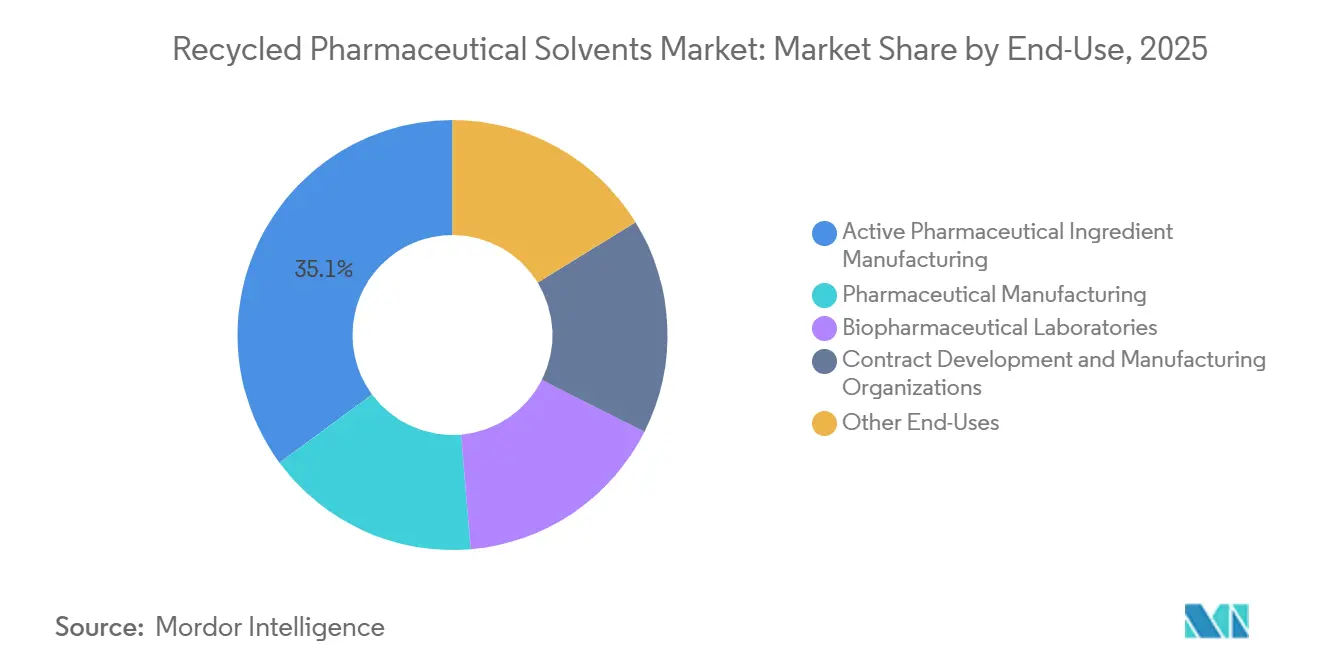
Active pharmaceutical ingredient manufacturing held 35.13% share of the recycled pharmaceutical solvents market in 2025. It is the most solvent-intensive production stage, with batch processes generating substantial solvent waste relative to finished product output. A typical process can generate up to 180 kg of solvent waste for each kilogram of finished active pharmaceutical ingredient. Mature recovery programs at large facilities are supported by stable volumes and established qualification routines. These attributes make active pharmaceutical ingredient manufacturing a central source of demand for recovery providers.
Pharmaceutical manufacturing is projected to advance at a 10.94% CAGR through 2031 in the recycled pharmaceutical solvents market. The expansion of amorphous solid dispersion spray drying is increasing solvent use in formulation and dosage-form operations. Codis CDMO purchased a GEA Pharma-SD PSD-4 solvent-capable spray dryer in March 2026 for its Haverhill facility, with 30,000 kg/year amorphous solid dispersion capacity. Biopharmaceutical laboratories also require high-purity recovery for peptide, messenger ribonucleic acid, and oligonucleotide production. Contract development and manufacturing organizations can be valuable customers because they consolidate multiple client programs within one qualified service relationship.
Geography Analysis
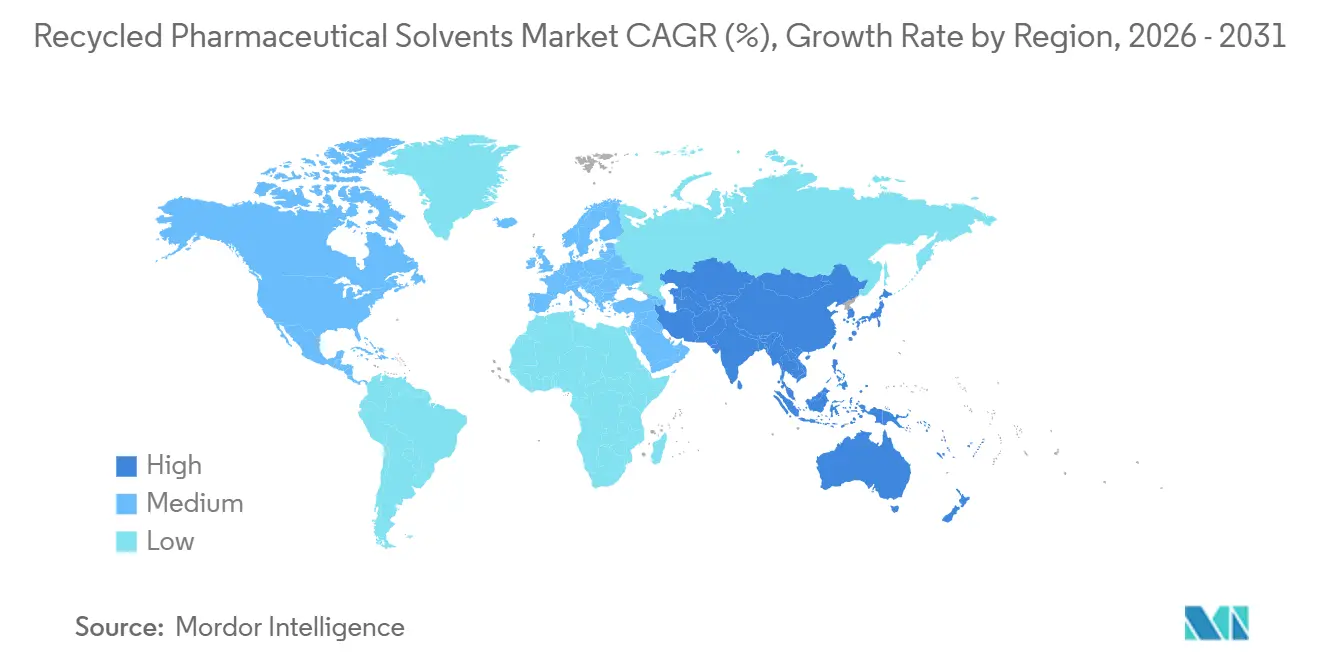
Asia-Pacific held 38.87% share of the recycled pharmaceutical solvents market in 2025 and is projected to advance at a 10.77% CAGR through 2031. China, India, South Korea, and Japan have large active pharmaceutical ingredient and pharmaceutical manufacturing bases. India's bulk drug exports reached USD 4,869.98 million during fiscal 2024-2025. This production base creates a clear operating case for collection, treatment, and reuse systems.
Environmental enforcement is encouraging manufacturers to formalize waste handling and recovery programs. South Korean facilities have a demand for advanced recovery equipment that supports export-oriented quality requirements. Japan's pharmaceutical and chemical manufacturing base produces complex multi-solvent streams that often need specialized separation. In May 2026, OFRU Recycling and its Thai distribution partner TOPCO SCIENTIFIC (TSC) held a technical seminar for representatives of Thailand’s process industries, supporting the company’s presence in Southeast Asia.
North America maintains a major position in the recycled pharmaceutical solvents market through premium recovery programs at pharmaceutical companies and contract development and manufacturing organizations. CLEAN HARBORS, INC. operates 9 recycling centers and recycles more than 16 million gallons of solvent annually through Safety-Kleen. Europe benefits from a compliance-led demand base that includes Germany, the United Kingdom, France, and Italy. Tradebe's facility at BASF's Schwarzheide site recovered 19,000 metric tons of products annually from 2024, with 70% reintegrated into BASF manufacturing cycles. South America and Middle East and Africa remain earlier-stage regions where adoption is often tied to multinational pharmaceutical companies and limited local recovery infrastructure.
Competitive Landscape
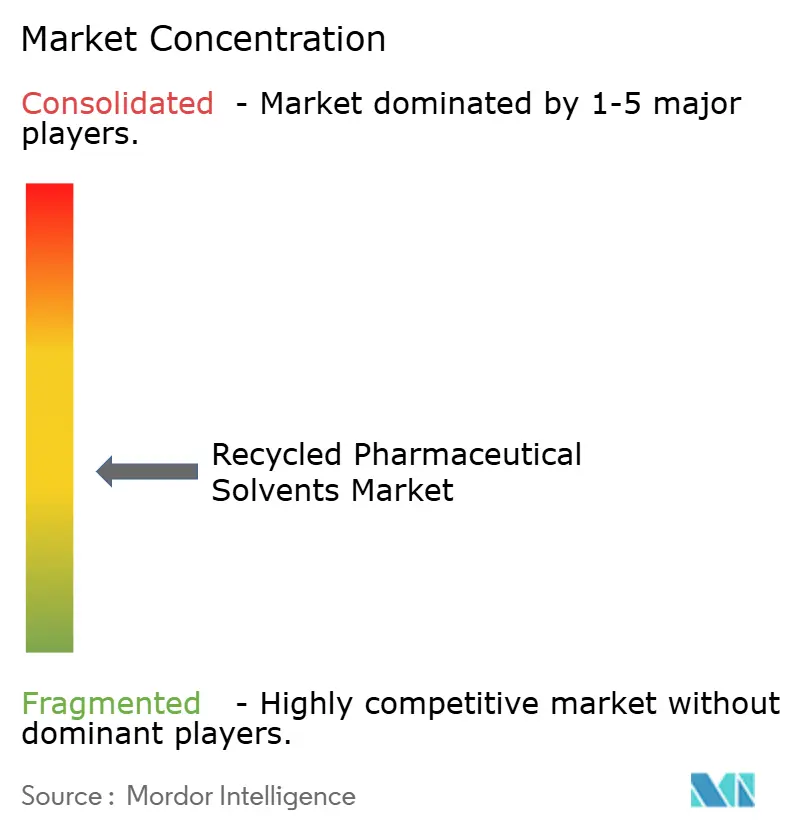
The recycled pharmaceutical solvents market is moderately concentrated, with the top five players including Veolia, CLEAN HARBORS, INC., Tradebe, SUEZ, and Maratek. Veolia, CLEAN HARBORS, INC., SUEZ, and Tradebe use multi-site logistics, compliance capabilities, and established pharmaceutical customer relationships to compete for large contracts. Tradebe's Purification division serves 8 of the top 10 global pharmaceutical companies and operates capacities of 30,000 metric tons per year in Spain and 20,000 metric tons per year in Italy. Veolia regenerates more than 20,000 metric tons of solvents annually at Novartis sites across 15 European locations. For pharmaceutical customers, this combined service model can reduce the need to manage multiple waste and material suppliers. It can also make established providers more attractive when compliance documentation must remain consistent across sites.
Seqens offers toll recovery services that purify customer waste streams and return qualified recovered solvent. Sulzer Ltd and Koch Separation Solutions compete through membrane, separation, and modular recovery technologies. Sulzer Ltd's platform combines DistilCare, EXCELOT, OptimEXT liquid-liquid extraction, and VoltaSplit distillation. The company reported recovery of up to 99% of target solvents and energy reductions of up to 50% against conventional thermal recovery in relevant cases. Such technologies can lower the volume threshold needed for on-site or modular systems. This can broaden access for mid-size contract development and manufacturing organizations that cannot fully support managed programs.
In June 2026, Tradebe acquired a majority stake in Soltec (Ireland) Ltd, a specialist in transfer-station operations and solvent distillation recycling. In May 2026, SUEZ began an organic solvent recycling project in Chongqing under a 30-year service agreement, with a 30,000 metric tons annual treatment capacity in Phase 1. OFRU Recycling's International Electrotechnical Commission System for Certification to Standards Relating to Equipment for Use in Explosive Atmospheres certification supports deployment in facilities with strict electrical safety requirements. The competitive opportunity remains strongest in high-purity recovery for oligonucleotide and biologic solvents and in modular systems for mid-size sites. These areas depend on proof of purity, validation support, and dependable local service. It also keeps the focus on operating reliability rather than on recovery capacity alone.
Recycled Pharmaceutical Solvents Industry Leaders
-
Veolia
-
CLEAN HARBORS, INC.
-
Tradebe
-
SUEZ
-
Maratek
- *Disclaimer: Major Players sorted in no particular order
Recent Industry Developments
- May 2026: Tradebe acquired a majority stake in Soltec (Ireland) Ltd., a specialist transfer station and solvent recycling business in Mullingar, Ireland. The acquisition strengthens Tradebe’s solvent recovery and recycling capabilities, supporting the recycled pharmaceutical solvents market by expanding infrastructure for recovering and reprocessing industrial solvents.
- April 2026: ChemTechPro Global completed a current Good Manufacturing Practice (cGMP)-compliant continuous fractional distillation system for an API manufacturer, delivering 99.8% recovered-solvent purity and an 85% solvent recovery rate. The project demonstrated growing adoption of advanced distillation systems for recovering pharmaceutical-grade solvents and reducing fresh-solvent consumption in API manufacturing.
Global Recycled Pharmaceutical Solvents Market Report Scope
Recycled pharmaceutical solvents are recovered solvent streams that are purified and processed for reuse in pharmaceutical and biopharmaceutical manufacturing activities. They help reduce fresh solvent consumption, waste generation, and resource use while supporting more efficient chemical processing.
The Recycled Pharmaceutical Solvents Market is segmented by solvent type, purity grade, recovery method, end-use, and geography. By solvent type, the market is segmented into alcohols, ketones, acetonitrile, and other solvent types. By purity grade, the market is segmented into technical grade, industrial grade, pharmaceutical grade, high-purity grade, and other grades. By recovery method, the market is segmented into fractional distillation, molecular-sieve drying, adsorption, membrane separation, and other recovery methods. By end-use, the market is segmented into active pharmaceutical ingredient manufacturing, pharmaceutical manufacturing, biopharmaceutical laboratories, contract development and manufacturing organizations, and other end-uses. The report also covers the market size and forecasts for recycled pharmaceutical solvents across 15 countries. For each segment, the market sizing and forecasts have been done on the basis of value (USD).
| Alcohols |
| Ketones |
| Acetonitrile |
| Other Solvent Types |
| Technical Grade |
| Industrial Grade |
| Pharmaceutical Grade |
| High-Purity Grade |
| Other Grades |
| Fractional Distillation |
| Molecular-Sieve Drying |
| Adsorption |
| Membrane Separation |
| Other Recovery Methods |
| Active Pharmaceutical Ingredient Manufacturing |
| Pharmaceutical Manufacturing |
| Biopharmaceutical Laboratories |
| Contract Development and Manufacturing Organizations |
| Other End-Uses |
| Asia-Pacific | China |
| India | |
| Japan | |
| South Korea | |
| ASEAN Countries | |
| Rest of Asia-Pacific | |
| North America | United States |
| Canada | |
| Mexico | |
| Europe | Germany |
| United Kingdom | |
| France | |
| Italy | |
| NORDIC Countries | |
| Rest of Europe | |
| South America | Brazil |
| Argentina | |
| Rest of South America | |
| Middle East and Africa | Saudi Arabia |
| South Africa | |
| Rest of Middle East and Africa |
| By Solvent Type | Alcohols | |
| Ketones | ||
| Acetonitrile | ||
| Other Solvent Types | ||
| By Purity Grade | Technical Grade | |
| Industrial Grade | ||
| Pharmaceutical Grade | ||
| High-Purity Grade | ||
| Other Grades | ||
| By Recovery Method | Fractional Distillation | |
| Molecular-Sieve Drying | ||
| Adsorption | ||
| Membrane Separation | ||
| Other Recovery Methods | ||
| By End-Use | Active Pharmaceutical Ingredient Manufacturing | |
| Pharmaceutical Manufacturing | ||
| Biopharmaceutical Laboratories | ||
| Contract Development and Manufacturing Organizations | ||
| Other End-Uses | ||
| By Geography | Asia-Pacific | China |
| India | ||
| Japan | ||
| South Korea | ||
| ASEAN Countries | ||
| Rest of Asia-Pacific | ||
| North America | United States | |
| Canada | ||
| Mexico | ||
| Europe | Germany | |
| United Kingdom | ||
| France | ||
| Italy | ||
| NORDIC Countries | ||
| Rest of Europe | ||
| South America | Brazil | |
| Argentina | ||
| Rest of South America | ||
| Middle East and Africa | Saudi Arabia | |
| South Africa | ||
| Rest of Middle East and Africa | ||
Key Questions Answered in the Report
What is the size of the recycled pharmaceutical solvents market?
The recycled pharmaceutical solvents market stands at USD 1.49 billion in 2026 and is projected to reach USD 2.23 billion by 2031.
What is driving demand for recycled pharmaceutical solvents?
Active pharmaceutical ingredient and contract development and manufacturing organization expansion, disposal controls, corporate circularity goals, and solvent cost pressures are supporting demand.
Which solvent type held the largest share in 2025?
Alcohols held 33.56% of the market revenue in 2025, supported by the extensive use of ethanol and isopropanol in synthesis, purification, and cleaning.
Which recovery method is expected to grow fastest through 2031?
Molecular-sieve drying is projected to advance at a 10.38% CAGR through 2031, reflecting demand for low-moisture alcohol and acetonitrile streams.