
Ready-to-Eat Popcorn Market Size and Share
Market Overview
| Study Period | 2027 - 2032 |
|---|---|
| Market Size (2027) | USD 6.83 Billion |
| Market Size (2032) | USD 11.49 Billion |
| Growth Rate (2027 - 2032) | 10.95 % |
| Fastest Growing Market | Asia-Pacific |
| Largest Market | North America |
| Market Concentration | Medium |
Major Players *Disclaimer: Major Players sorted in no particular order Image © Mordor Intelligence. Reuse requires attribution under CC BY 4.0. | |
Ready-to-Eat Popcorn Market Analysis by Mordor Intelligence
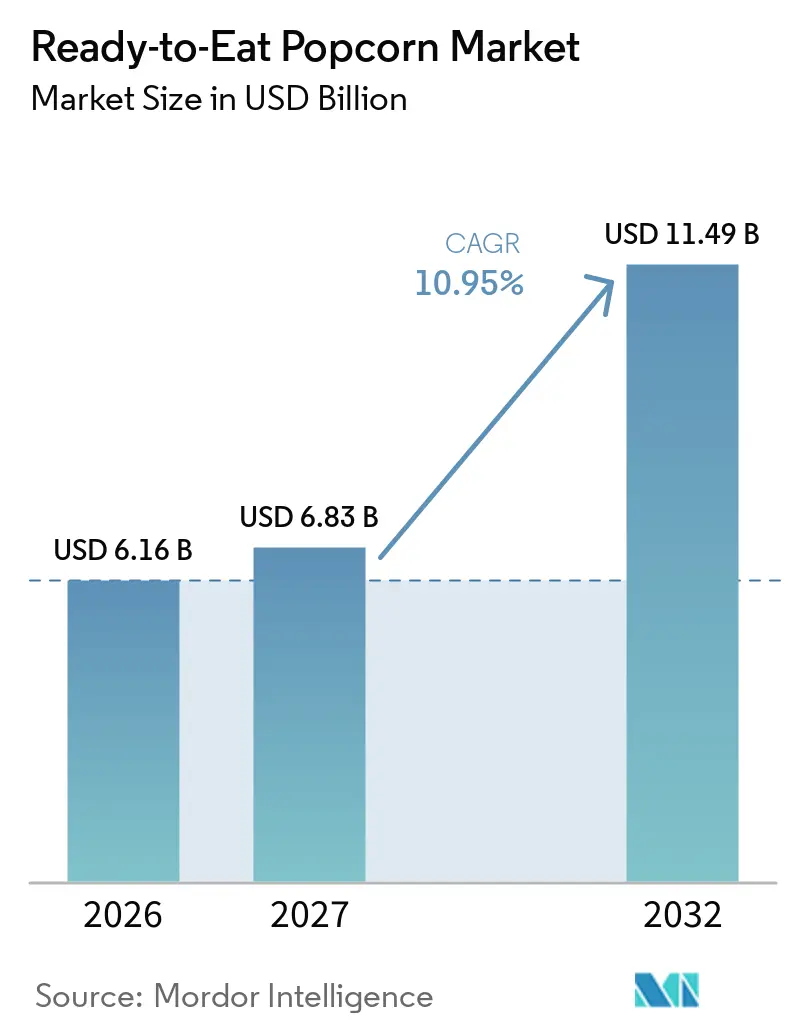
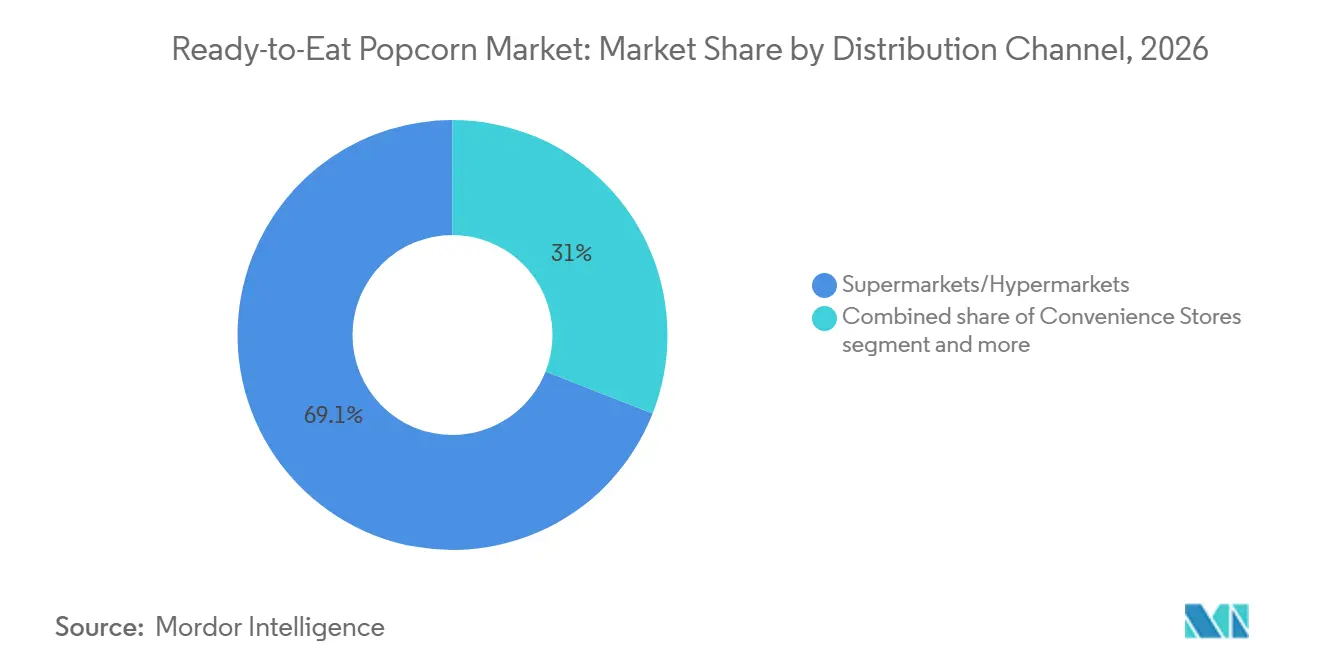
In 2026, the ready-to-eat popcorn market is estimated at USD 6.16 billion. The market is expected to grow from USD 6.83 billion in 2027 to USD 11.49 billion by 2032, registering a CAGR of 10.95% during 2027–2032. This growth is supported by increasing demand for convenient snacks, product innovation across sweet and savory flavors, premiumization, and the expansion of online retail channels. Conventional popcorn leads the market by nature, accounting for an estimated 85.67% share in 2026, while organic popcorn is projected to grow at a CAGR of 11.55% during 2027–2032. Salted and traditional flavors hold the largest flavor share at 53.34%, while cheese-flavored popcorn is expected to be among the fastest-growing flavor categories. Multi-serve packs account for an estimated 47.65% share, supported by household consumption, while single-serve packs benefit from demand for portion-controlled and on-the-go snacks. Supermarkets and hypermarkets remain the leading distribution channel, representing an estimated 69.05% share in 2026, whereas online retail is expected to expand as e-commerce adoption increases. North America leads the market with an estimated 31.35% share, while Asia-Pacific is projected to record the fastest growth, creating opportunities for manufacturers to expand distribution and tailor products to regional preferences.
Key Report Takeaways
- Conventional popcorn accounted for 85.67% of the ready-to-eat popcorn market size in 2026, while organic variants are projected to grow at a CAGR of 11.55% during 2027–2032.
- Salted and traditional flavors held 53.34% of the ready-to-eat popcorn market share in 2026, while cheese-flavored popcorn is projected to grow at a CAGR of 12.20% through 2032.
- Multi-serve packs represented 47.65% of the ready-to-eat popcorn market share in 2026, while single-serve packs are projected to expand at a CAGR of 12.95% during 2027–2032.
- Supermarkets and hypermarkets accounted for 69.05% of the ready-to-eat popcorn market size in 2026, whereas online retail stores are projected to grow at a CAGR of 11.45% through 2032.
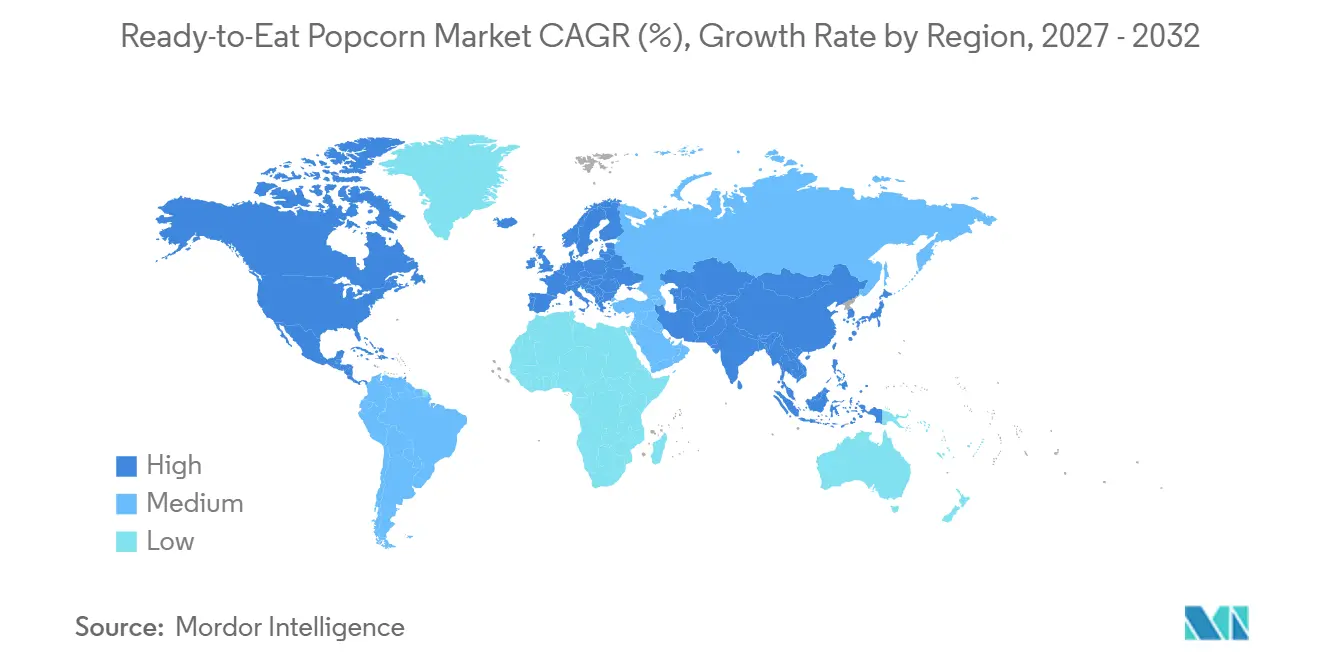
- North America held 31.35% of the ready-to-eat popcorn market share in 2026, while Asia-Pacific is projected to record the fastest growth, with a CAGR of 12.25% during 2027–2032.
Note: Market numbers in this report are based on Mordor Intelligence's proprietary estimation framework, which combines nine months of actuals with Q4 projections for base year 2026.
Market Trends and Insights
Drivers Impact Analysis of Ready-to-Eat Popcorn Market*
| DRIVERS | (~) % IMPACT ON CAGR FORECAST | GEOGRAPHIC RELEVANCE | IMPACT TIMELINE |
|---|---|---|---|
| Rising demand for convenient, ready-to-eat snack options | +1.2% | Global, particularly North America and urban markets across Asia-Pacific | Short term (Less than 2 years) |
| Growing consumer preference for organic and health-positioned popcorn | +0.9% | Global, particularly North America and Europe | Medium term (2–4 years) |
| Increasing demand for innovative flavors, including cheese and specialty varieties | +0.8% | Global, with established demand in North America and growing opportunities in Asia-Pacific | Medium term (2–4 years) |
| Expanding availability through supermarkets, hypermarkets, and online retail | +0.7% | Global, with online-channel opportunities across Asia-Pacific and other emerging markets | Short term (Less than 2 years) |
| Product innovation in single-serve packs and convenient on-the-go formats | +0.6% | Global, particularly urban markets and convenience-oriented retail channels | Medium term (2–4 years) |
| Source: Mordor Intelligence | |||
Growing Demand for Convenient, Ready-to-Eat Snacks
Consumer demand for convenient snack options is supporting the appeal of ready-to-eat popcorn, which can be consumed without preparation and fits between-meal occasions. In August 2024, the International Food Information Council reported that nearly 9 in 10 US consumers described what they ate or drank between meals as a snack, while two-thirds said their snacking was more likely to be spontaneous than planned [1]. These findings highlight the importance of accessible, easy-to-consume products, although they do not measure ready-to-eat popcorn demand directly. For popcorn manufacturers, ready-to-eat formats can serve consumers seeking quick snacks at work, during travel, or at home. Portable packaging, consistent texture, and familiar flavors can help brands compete with other packaged snacks. However, purchase decisions remain influenced by price, taste, pack size, and product availability.
Product Innovation in Flavors, Ingredients, and Formats
Product innovation enables ready-to-eat popcorn manufacturers to differentiate their offerings through new flavor combinations, ingredient choices, and packaging formats. SNAC International’s 2025 State of the Industry Report highlights consumer interest in spicy and globally inspired snack flavors, reflecting broader innovation across the snack industry [2]. Although these findings are not specific to popcorn, they indicate opportunities for manufacturers to extend beyond traditional salted varieties through cheese, spicy, sweet, and regionally inspired flavors. Ingredient innovation can also support products positioned around simpler ingredient lists or particular dietary preferences, provided the claims are accurate and substantiated. New formats and flavor launches may encourage trial and refresh consumer interest in an established snack category. However, manufacturers must balance novelty with familiar preferences, production costs, and the ability to maintain product quality and shelf life.
Rising Demand for Premium and Health-Conscious Snacking Options
Consumer interest in ingredient quality, nutritional value, and differentiated snack experiences is creating opportunities for ready-to-eat popcorn products positioned around premium and health-conscious preferences. In 2024, the US Department of Agriculture’s Agricultural Research Service highlighted popcorn as a whole-grain food that provides dietary fiber, noting that its nutritional profile depends partly on preparation and toppings [3]. This provides a basis for manufacturers to offer air-popped products, simpler ingredient formulations, and varieties with controlled amounts of salt, sugar, or added fats. Premium positioning can also be supported through distinctive flavors, product quality, and differentiated packaging. However, ready-to-eat popcorn is not automatically a healthier choice simply because it is made from whole-grain corn; added ingredients and portion sizes influence its nutritional profile. Manufacturers therefore need to substantiate nutrition claims and balance health-oriented attributes with taste and affordability.
Expansion of E-Commerce and Organized Retail Distribution
The expansion of online shopping and established retail networks can improve the accessibility and visibility of ready-to-eat popcorn across consumer markets. The US Census Bureau reported that US retail e-commerce sales reached USD 316.1 billion in the fourth quarter of 2025, increasing by 5.3% compared with the fourth quarter of 2024; e-commerce accounted for 16.6% of total retail sales during the quarter [4]. Although these figures cover all retail categories, they illustrate the scale of online purchasing and the potential reach of digital distribution. For popcorn manufacturers, supermarkets and hypermarkets provide opportunities for prominent shelf placement, promotional displays, and multipack sales, while e-commerce platforms can support product discovery, assortment expansion, and repeat purchases. Online channels can also help niche brands reach consumers beyond their immediate retail footprint. However, growth opportunities depend on distribution costs, retailer access, competitive pricing, and packaging that protects product freshness during storage and delivery.
Growth of At-Home Entertainment and On-the-Go Consumption
Ready-to-eat popcorn can serve both at-home leisure occasions and consumption outside the home because it requires no preparation and is available in individual and sharing formats. The US Bureau of Labor Statistics reported that Americans aged 15 and older spent an average of 2.6 hours per day watching television in 2024, making it the largest individual leisure activity measured in its American Time Use Survey. This finding provides context for at-home viewing occasions but does not establish a direct relationship between television viewing and popcorn purchases. For manufacturers, family-size packs can be positioned for shared consumption during movie nights and other leisure activities, while smaller packs can address workplace, travel, and other on-the-go occasions. Offering multiple pack sizes can help brands serve different consumption needs and price points. Nevertheless, demand will depend on competition from other snacks, household spending, product availability, and consumers’ preferences for particular flavors and formats.
Restraints of Ready-to-Eat Popcorn Market*
| RESTRAINT | (~) % IMPACT ON CAGR FORECAST | GEOGRAPHIC RELEVANCE | IMPACT TIMELINE |
|---|---|---|---|
| Fluctuations in corn, edible oil, and packaging material prices | −0.9% | Global, particularly markets exposed to agricultural commodity price volatility and packaging cost increases | Short term (Less than 2 years) |
| Competition from alternative ready-to-eat snacks | −0.7% | Global, particularly North America, Europe, and urban markets across Asia-Pacific | Medium term (2–4 years) |
| Concerns over salt, sugar, fat, and artificial additives | −0.5% | Global, particularly markets with health-conscious consumers and stricter food-labeling requirements | Medium term (2–4 years) |
| Product freshness, shelf life, and packaging challenges | −0.4% | Global, particularly regions with high temperatures or less-developed storage and distribution infrastructure | Short term (Less than 2 years) |
| Source: Mordor Intelligence | |||
Fluctuations in Corn, Edible Oil, and Packaging Material Prices
Ready-to-eat popcorn manufacturers face cost pressures when prices of key raw materials, including corn, edible oils, seasonings, and packaging materials, fluctuate. Changes in agricultural commodity prices can increase procurement costs, while higher prices for packaging films, paperboard, and other materials can raise production and distribution expenses. These fluctuations can be particularly challenging for smaller manufacturers with limited purchasing power or less flexibility to negotiate long-term supply agreements. Passing higher costs on to retailers and consumers may weaken price competitiveness, whereas absorbing them can reduce profit margins. Manufacturers can mitigate some of these pressures through supplier diversification, procurement planning, operational efficiency, and packaging optimization. However, their ability to manage cost increases depends on supplier conditions, production scale, and the extent to which consumers accept retail price changes.
Competition from Alternative Ready-to-Eat Snacks
Ready-to-eat popcorn competes with a wide range of packaged snacks, including potato chips, pretzels, crackers, nuts, extruded snacks, and snack bars. These alternatives offer different combinations of flavor, texture, convenience, and price, giving consumers multiple options for between-meal consumption. For popcorn manufacturers, this competition can make it difficult to maintain consumer attention and differentiate products, particularly when competing brands offer frequent flavor launches, promotional pricing, or convenient multipacks. Manufacturers can respond through product differentiation, consistent quality, and pack sizes suited to different consumption occasions. However, competing snacks may limit pricing flexibility and repeat purchases when consumers perceive alternatives as offering better value or a more appealing eating experience.
*Our forecasts treat driver/restraint impacts as directional, not additive. The impact forecasts reflect baseline growth, mix effects, and variable interactions.
Ready-to-Eat Popcorn Market Segment Analysis
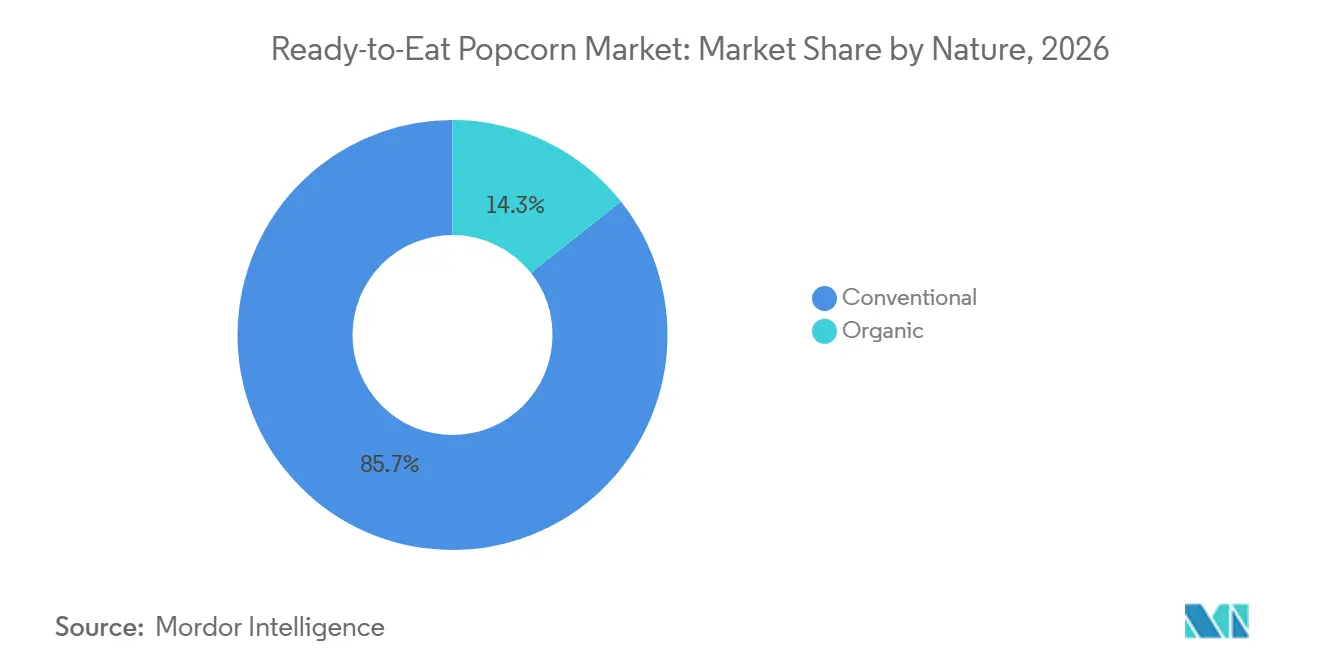
Conventional popcorn accounts for the largest share of the Ready-to-Eat Popcorn Market, representing 85.67% of the market in 2026. Its established consumer familiarity, broad retail availability, and suitability for traditional salted and flavored products support its leading position. Meanwhile, the organic segment is projected to grow at a CAGR of 11.55% during 2027–2032, reflecting an opportunity for manufacturers to target consumers seeking products made with certified organic ingredients. Organic ready-to-eat popcorn can differentiate itself through transparent ingredient information and verified organic claims, although certification and ingredient costs may affect retail pricing. The segment’s future growth will depend on consumer acceptance, product availability, and manufacturers’ ability to balance organic positioning with affordability.
Conventional and organic products therefore serve different positioning strategies within the market. Conventional popcorn benefits from its broad appeal and established distribution, while organic varieties provide an avenue for product differentiation. Manufacturers can address both segments through varied flavors, pack sizes, and price points. However, the reported segment shares and forecast growth rates are based on the market data supplied for this analysis.

By Flavor:
Salted and Traditional Varieties Lead as Cheese Flavor Gains MomentumSalted and traditional flavors account for the largest share of the Ready-to-Eat Popcorn Market, representing 53.34% in 2026. Their established consumer appeal and familiar taste profiles support their position across supermarkets, hypermarkets, and other retail channels. Meanwhile, cheese-flavored popcorn is projected to record the fastest growth, with a CAGR of 12.20% during 2027–2032. Cheese varieties provide manufacturers with an opportunity to diversify flavor portfolios and attract consumers seeking alternatives to conventional salted popcorn. Continued growth will depend on flavor acceptance, competitive pricing, and the ability to maintain consistent taste and product quality.
Flavor segmentation allows manufacturers to serve consumers with different taste preferences and purchasing occasions. Traditional varieties provide an established product offering, while cheese-flavored products create opportunities for flavor-led differentiation. Companies can also use product launches and varied seasoning profiles to refresh their portfolios. However, the commercial success of new flavors depends on repeat purchases, ingredient costs, and competition from other savory snacks.
By Packaging Type:
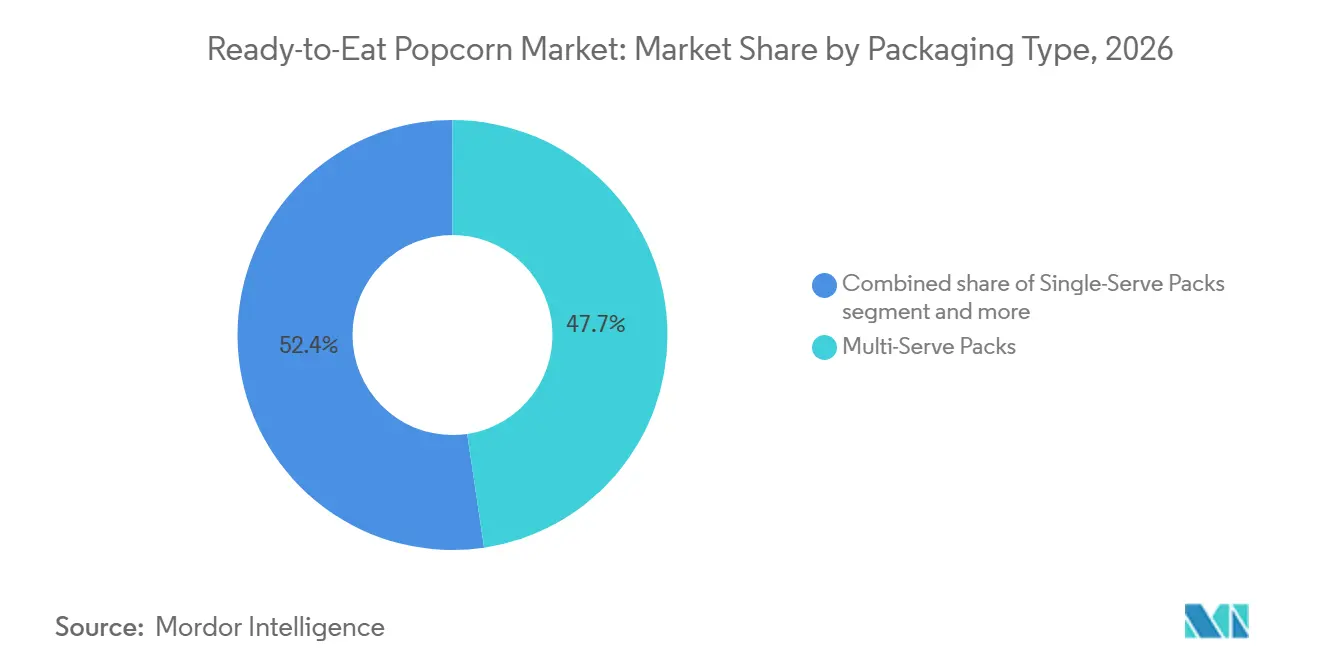
Multi-Serve Packs Lead as Single-Serve Formats GrowMulti-serve packs account for the largest share of the Ready-to-Eat Popcorn Market, representing 47.65% in 2026. These packs cater to household consumption, sharing occasions, and consumers seeking larger quantities in a single purchase. In contrast, single-serve packs are projected to grow at a CAGR of 12.95% during 2027–2032, making them the fastest-growing packaging segment. Their portability and portion-defined quantities can appeal to consumers purchasing snacks for work, travel, lunchboxes, and individual consumption. However, manufacturers must balance convenience and pack-size flexibility against packaging costs and retail price expectations.
The packaging landscape reflects the different occasions for which ready-to-eat popcorn is purchased. Multi-serve formats support household and group consumption, while single-serve formats offer greater portability and convenience. Manufacturers can serve both needs through differentiated pack sizes and packaging designs that help preserve crispness and product quality. The growth of single-serve formats will depend on consumer acceptance, distribution availability, and the economics of smaller packaging units.
By Distribution Channel:
Supermarkets and Hypermarkets Lead as Online Retail ExpandsSupermarkets and hypermarkets account for the largest share of the Ready-to-Eat Popcorn Market, representing 69.05% in 2026. Their broad product assortments, physical shelf visibility, and capacity to offer multiple flavors and pack sizes support their role in product discovery and routine snack purchases. Meanwhile, online retail stores are projected to grow at a CAGR of 11.45% during 2027–2032. Online channels can provide consumers with access to a wider range of products, support repeat purchases, and enable smaller brands to reach customers beyond their immediate physical distribution networks. However, online sales may be affected by delivery costs, product protection requirements, and competition for visibility on digital platforms.
Distribution-channel segmentation highlights the continued importance of physical retail alongside opportunities in e-commerce. Supermarkets and hypermarkets provide opportunities for in-store promotions and multipack purchases, while online platforms can support convenient ordering and product comparisons. Manufacturers can expand their reach by combining established retail relationships with digital distribution strategies. The relative performance of each channel will depend on retail access, promotional activity, pricing, and consumer purchasing preferences.
Geography Analysis
North America Ready-to-Eat Popcorn Market
North America accounted for 31.35% of the Ready-to-Eat Popcorn Market in 2026, making it the largest regional market according to the supplied estimates. The region’s established packaged-snack consumption and broad availability of ready-to-eat products across supermarkets, hypermarkets, and other retail channels support its market position. Multi-serve packs can cater to household consumption and at-home entertainment, while single-serve formats address individual snacking occasions. Product differentiation through traditional, cheese, and other flavored varieties can help manufacturers serve diverse consumer preferences. Going forward, competition from alternative snacks, price sensitivity, and demand for convenient packaging will influence the region’s market development.
Asia-Pacific Ready-to-Eat Popcorn Market
Asia-Pacific is projected to be the fastest-growing regional market, with a CAGR of 12.25% during 2027–2032. The region presents opportunities for ready-to-eat popcorn manufacturers to expand distribution, introduce locally relevant flavors, and develop pack sizes suited to different consumer preferences. Growth in organized retail and online distribution can improve product accessibility, while single-serve packaging can support individual and on-the-go consumption. Manufacturers may also explore organic and differentiated flavor offerings as they seek to reach new consumer groups. However, growth will depend on local purchasing power, consumer familiarity with packaged popcorn, distribution infrastructure, and competition from established regional snack products.
Europe Ready-to-Eat Popcorn Market
Europe represents an opportunity for ready-to-eat popcorn manufacturers to serve consumers through established retail channels and differentiated product offerings. Supermarkets and hypermarkets can support product visibility, while online retail provides an additional route for product discovery and repeat purchases. Conventional varieties can appeal to consumers seeking familiar snack options, while organic products and distinctive flavors offer opportunities for differentiation. Packaging innovation that protects freshness and supports convenient consumption may also help manufacturers address changing retail and consumer requirements.
Competitive Landscape
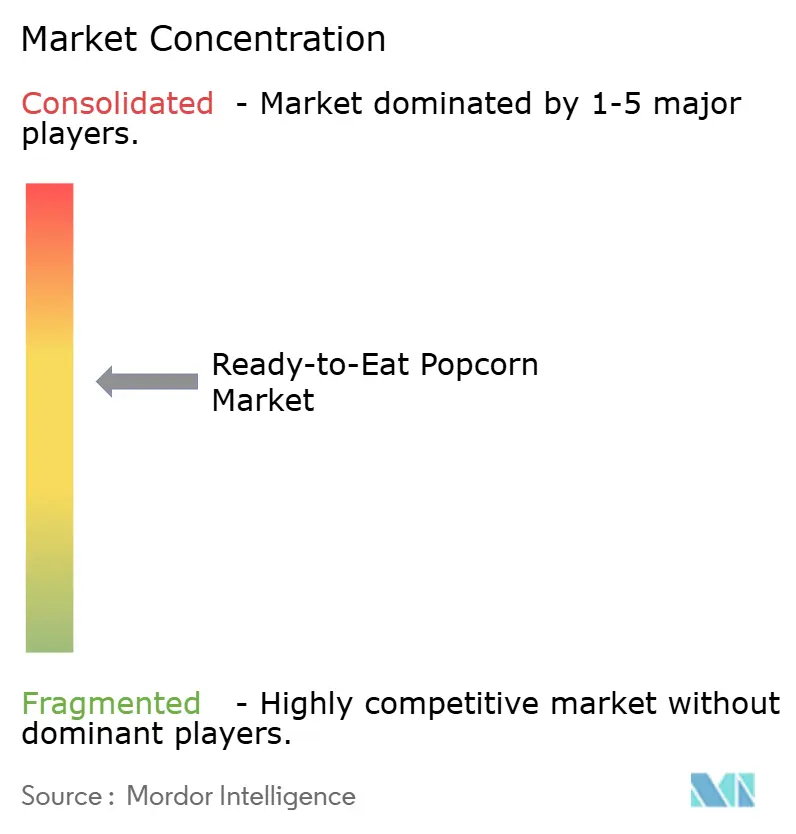
The Ready-to-Eat Popcorn Market features established snack-food companies alongside specialist popcorn brands, with competition centered on brand recognition, flavor variety, product positioning, packaging, and retail distribution. The market concentration score is moderately concentrated structure for this analysis; this score should be treated as your working assessment rather than an independently verified industry statistic. Key players with relevant ready-to-eat popcorn offerings include The Hershey Company through SkinnyPop, PepsiCo through Smartfood, and Conagra Brands through Angie’s BOOMCHICKAPOP. Their product portfolios span traditional, cheese, sweet-and-salty, and other flavored varieties, allowing them to address different consumer preferences.
Product differentiation is an important competitive lever. SkinnyPop offers products such as original, white cheddar, sea salt and pepper, and sweet-and-salty kettle corn, while Smartfood markets white cheddar, movie-theater butter, and other flavored popcorn varieties. Conagra’s Angie’s BOOMCHICKAPOP offers options including sea salt, cheddar, and sweet-and-salty kettle corn. These portfolios illustrate how established brands use flavor extensions and varied pack sizes to address different snacking occasions.
Specialist and regional brands also contribute to competition. Relevant companies and brands to consider in the competitive landscape include Garrett Popcorn Shops, Proper Snacks, Quinn Foods, 4700BC, Popcornopolis (associated with Utz Brands), and Weaver Popcorn. Their relevance varies by geography and product format, so the final company list should prioritize businesses with verified ready-to-eat popcorn products rather than companies focused mainly on unpopped kernels or microwave popcorn.
Ready-to-Eat Popcorn Industry Leaders
-
The Hershey Company (SkinnyPop)
-
PepsiCo (Smartfood)
-
Conagra Brands (Angie’s BOOMCHICKAPOP)
-
Our Home (Pop Secret)
-
Weaver Popcorn Manufacturing
- *Disclaimer: Major Players sorted in no particular order
Ready-to-Eat Popcorn Market Companies Covered in this Report
- Conagra Brands
- PepsiCo (Smartfood)
- The Hershey Company (SkinnyPop)
- Campbell Soup Company (Pop Secret)
- Weaver Popcorn Manufacturing
- Quinn Foods
- Intersnack Group (Proper Snacks)
- Eagle Foods
- Herr Foods
- Garrett Popcorn Shops
- American Pop Corn Company (JOLLY TIME)
- Utz Brands (Popcornopolis)
- Joe & Seph's
- General Mills
- Zea Maize Private Limited (4700BC)
- Newman's Own
- Our Home (Popcorn Indiana)
- The Hain Celestial Group (LesserEvil)
- Corporativo Bimbo (Barcel)
- The J.M. Smucker Company
Recent Industry Developments in Ready-to-Eat Popcorn Market
- October 2026: Our Home’s Pop Secret partnered with Marvel Studios on an Avengers: Doomsday promotional campaign featuring limited-edition packaging, retail displays, a Fandango Movie Rewards promotion, and a sweepstakes. The collaboration covers selected microwave and ready-to-eat popcorn products, including ready-to-eat Movie Theater Butter and Double Cheddar varieties.
- May 2026: Conagra Brands announced new ready-to-eat flavors for Angie’s BOOMCHICKAPOP, including Mango Habanero and Cinnamon Churro, at the 2026 Sweets & Snacks Expo. The flavors combine sweet and spicy or dessert-inspired profiles, extending the brand’s existing popcorn range.
- April 2026: Garrett Popcorn Shops partnered with Mike’s Hot Honey to introduce a ready-to-eat popcorn offering combining Garrett’s sweet-and-savory popcorn mix with chili heat. The launch extends flavor innovation into sweet-and-spicy combinations and illustrates how brand collaborations can introduce differentiated products without relying solely on internally developed flavor concepts.
- January 2026: Marico announced an agreement to acquire a 93.27% stake in Zea Maize Private Limited, the company behind the 4700BC gourmet snacking brand, from PVR INOX Limited. The brand’s portfolio includes ready-to-eat, instant, and microwave popcorn, alongside other snack products. Marico identified opportunities to use its food-business capabilities and distribution network to expand 4700BC’s presence across offline, online, and institutional channels.
Global Ready-to-Eat Popcorn Market Report Scope
For this study, the Ready-to-Eat Popcorn Market is defined as the sales value of commercially produced popcorn that is popped, seasoned or flavored, packaged, distributed, and sold for direct consumption without further preparation. The market covers conventional and organic popcorn, segmented by flavor, including salted/traditional, cheese, caramel and sweet, savory and spiced, and other flavors; packaging type, including single-serve packs, multi-serve packs, and family and bulk packs; and distribution channel, including supermarkets and hypermarkets, convenience stores, specialty stores, and online retail stores. The market is analyzed across North America, Europe, Asia-Pacific, South America, and the Middle East and Africa, with country-level coverage as specified in the report. Market sizing and forecasts are presented in value terms (USD) across the defined segments and geographies.
Segmentation Overview
| Conventional |
| Organic |
| Salted/Traditional |
| Butter |
| Cheese |
| Caramel |
| Barbecue |
| Sweet and Savory |
| Other Flavors |
| Single-Serve Packs |
| Multi-Serve Packs |
| Family-Size Packs |
| Supermarkets/Hypermarkets |
| Convenience and Grocery Stores |
| Online Retail Stores |
| Other Distribution Channels |
| North America | United States |
| Canada | |
| Mexico | |
| Rest of North America | |
| Europe | United Kingdom |
| Germany | |
| France | |
| Italy | |
| Spain | |
| Sweden | |
| Belgium | |
| Poland | |
| Netherlands | |
| Rest of Europe | |
| Asia-Pacific | China |
| Japan | |
| India | |
| Thailand | |
| Singapore | |
| Indonesia | |
| South Korea | |
| Australia | |
| Rest of Asia-Pacific | |
| South America | Brazil |
| Argentina | |
| Colombia | |
| Peru | |
| Chile | |
| Rest of South America | |
| Middle East and Africa | South Africa |
| Saudi Arabia | |
| United Arab Emirates | |
| Nigeria | |
| Egypt | |
| Morocco | |
| Turkey | |
| Rest of Middle East and Africa |
| By Nature | Conventional | |
| Organic | ||
| By Flavor | Salted/Traditional | |
| Butter | ||
| Cheese | ||
| Caramel | ||
| Barbecue | ||
| Sweet and Savory | ||
| Other Flavors | ||
| By Packaging Type | Single-Serve Packs | |
| Multi-Serve Packs | ||
| Family-Size Packs | ||
| By Distribution Channel | Supermarkets/Hypermarkets | |
| Convenience and Grocery Stores | ||
| Online Retail Stores | ||
| Other Distribution Channels | ||
| By Geography | North America | United States |
| Canada | ||
| Mexico | ||
| Rest of North America | ||
| Europe | United Kingdom | |
| Germany | ||
| France | ||
| Italy | ||
| Spain | ||
| Sweden | ||
| Belgium | ||
| Poland | ||
| Netherlands | ||
| Rest of Europe | ||
| Asia-Pacific | China | |
| Japan | ||
| India | ||
| Thailand | ||
| Singapore | ||
| Indonesia | ||
| South Korea | ||
| Australia | ||
| Rest of Asia-Pacific | ||
| South America | Brazil | |
| Argentina | ||
| Colombia | ||
| Peru | ||
| Chile | ||
| Rest of South America | ||
| Middle East and Africa | South Africa | |
| Saudi Arabia | ||
| United Arab Emirates | ||
| Nigeria | ||
| Egypt | ||
| Morocco | ||
| Turkey | ||
| Rest of Middle East and Africa | ||
Key Questions Answered in the Report
What is the size of the Ready-to-Eat Popcorn Market?
The Ready-to-Eat Popcorn Market is valued at USD 6.16 billion in 2026 and is projected to reach USD 11.49 billion by 2032.
What is the expected growth rate of the Ready-to-Eat Popcorn Market?
The Ready-to-Eat Popcorn Market is projected to grow at a CAGR of 10.95% from 2027 to 2032.
Which segment holds the largest share of the Ready-to-Eat Popcorn Market?
The conventional segment holds the largest share by nature, accounting for 85.67% of the Ready-to-Eat Popcorn Market in 2026.
Which region is expected to grow fastest in the Ready-to-Eat Popcorn Market?
Asia-Pacific is projected to be the fastest-growing region in the Ready-to-Eat Popcorn Market, registering a CAGR of 12.25% from 2027 to 2032.