
Reactive Diluents Market Size and Share
Market Overview
| Study Period | 2020 - 2031 |
|---|---|
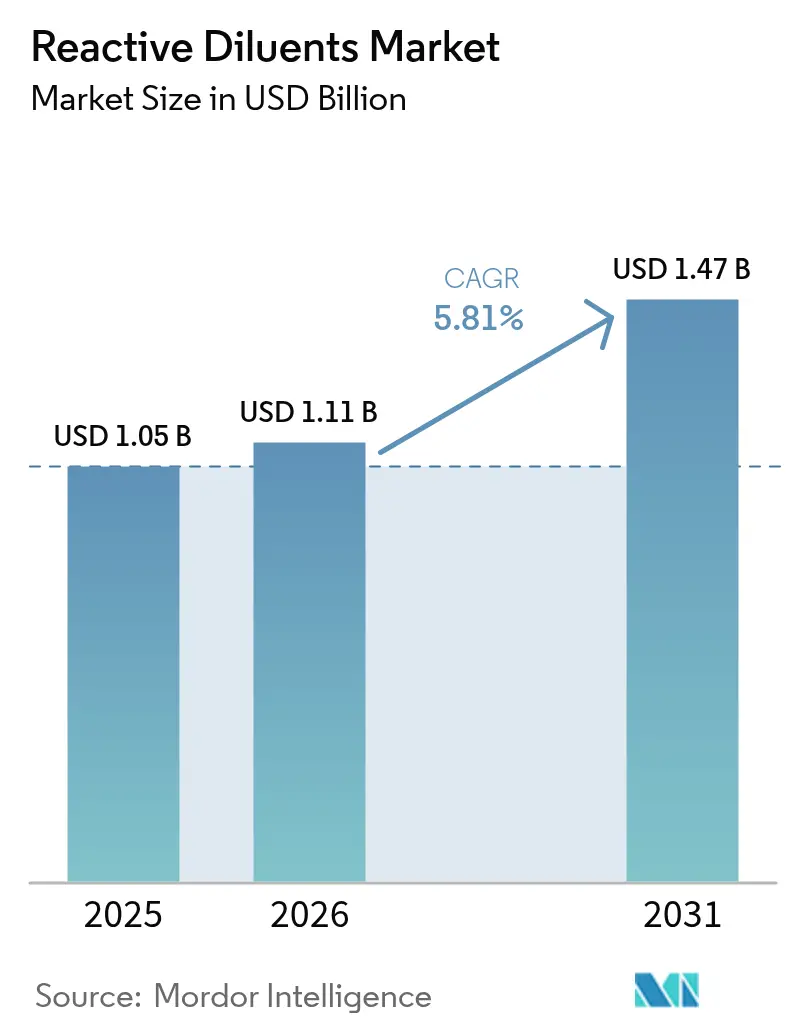
| Market Size (2026) | USD 1.11 Billion |
| Market Size (2031) | USD 1.47 Billion |
| Growth Rate (2026 - 2031) | 5.81 % |
| Fastest Growing Market | Asia Pacific |
| Largest Market | Asia Pacific |
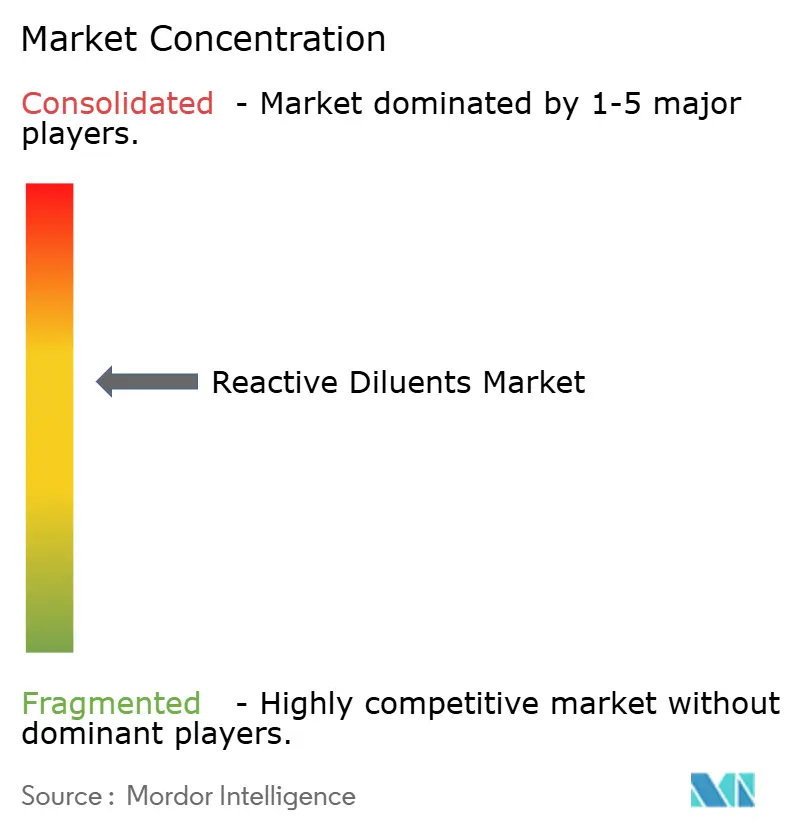
| Market Concentration | Medium |
Major Players *Disclaimer: Major Players sorted in no particular order Image © Mordor Intelligence. Reuse requires attribution under CC BY 4.0. | |
Reactive Diluents Market Analysis by Mordor Intelligence
The Reactive Diluents Market size is expected to grow from USD 1.05 billion in 2025 to USD 1.11 billion in 2026 and is forecast to reach USD 1.47 billion by 2031 at 5.81% CAGR over 2026-2031. Growing demand for low-viscosity epoxy systems that comply with tightening VOC rules anchors this steady advance. Increased wind-energy investments, wider uptake of UV-curable printing resins, and continuous infrastructure upgrades provide strong volume pull, while formulators benefit from the dual function of reactive diluents as both processing aids and performance modifiers. Cost pressure from volatile bisphenol-A and epichlorohydrin feedstocks accelerates the search for bio-based glycidyl ethers that match incumbent performance. Producers able to balance compliant chemistry with supply security are winning contracts in aerospace coatings, industrial composites, and 3-D printing photopolymers.
Key Report Takeaways
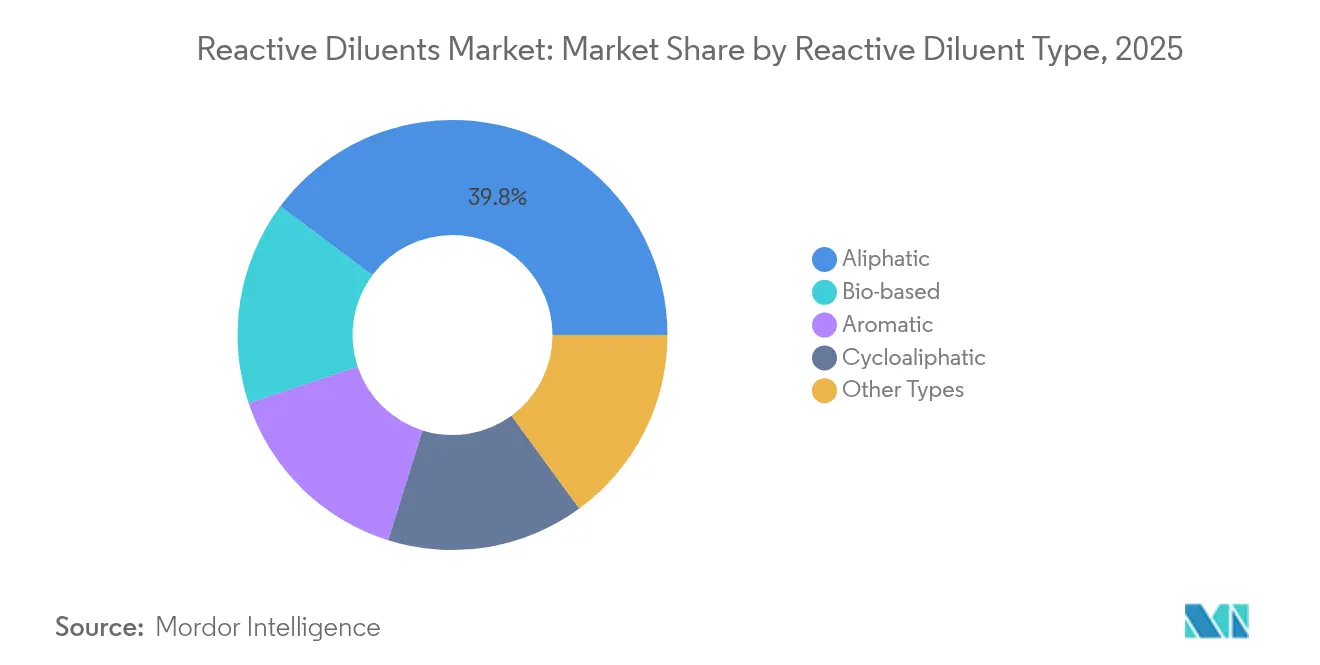
- By diluent type, aliphatic grades led with 39.79% of reactive diluents market share in 2025; bio-based grades are poised for the fastest 6.54% CAGR to 2031.
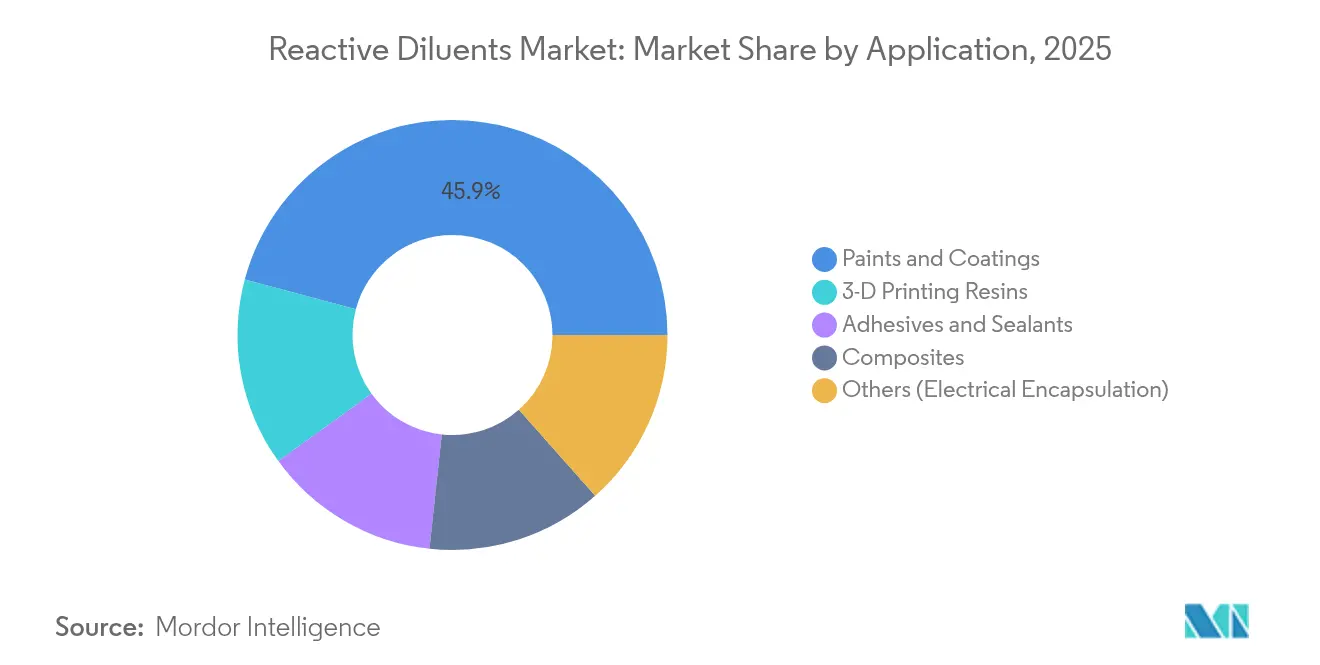
- By application, paints and coatings accounted for 45.85% of the reactive diluents market size in 2025, whereas 3-D printing resins are on track for a 6.26% CAGR through 2031.
- By geography, Asia Pacific captured 45.10% revenue share in 2025, and the region is forecast to expand at a 6.9% CAGR to 2031.
Note: Market size and forecast figures in this report are generated using Mordor Intelligence’s proprietary estimation framework, updated with the latest available data and insights as of 2026.
Market Trends and Insights
Drivers Impact Analysis of Reactive Diluents Market*
| Driver | (~) % Impact on CAGR Forecast | Geographic Relevance | Impact Timeline |
|---|---|---|---|
| Shift to low-VOC industrial coatings | +1.2% | Global, with strongest impact in North America & EU | Medium term (2-4 years) |
| Rapid expansion of wind-blade composites | +0.9% | APAC core, spill-over to North America & EU | Long term (≥ 4 years) |
| Infrastructure rehabilitation epoxy flooring | +0.7% | Global, concentrated in developed markets | Medium term (2-4 years) |
| Adoption of UV-curable 3-D printing resins | +0.8% | North America & EU, expanding to APAC | Short term (≤ 2 years) |
| Emergence of bio-based glycerol/glycidyl ethers | +0.6% | EU leading, followed by North America | Long term (≥ 4 years) |
| Source: Mordor Intelligence | |||
Shift to Low-VOC Industrial Coatings
EPA amendments that took effect in January 2025 cap allowable VOCs in aerosol and industrial coatings, compelling formulators to adopt high-solids epoxy blends enabled by low-viscosity reactive diluents[1]Environmental Protection Agency, “National VOC Emission Standards for Aerosol Coatings: Final Rule,” epa.gov . South Coast AQMD limits in California already require VOC levels under 250 g/l for clear topcoats, and many multinational paint makers now standardize the same formulations globally to streamline compliance[2]South Coast Air Quality Management District, “Rule 1151: Motor Vehicle and Mobile Equipment Non-Assembly Line Coating Operations,” aqmd.gov . Bis-oxazolidine diluents let producers meet those thresholds without sacrificing dry-film hardness. European producers apply similar reformulation tactics to remain within the 420 g/l ceiling of Directive 2004/42/EC. As regulations ratchet up through 2030, supply contracts increasingly specify maximum application viscosity, putting specialty diluent suppliers in a favorable negotiating position.
Infrastructure Rehabilitation Epoxy Flooring
Aging bridges, port terminals, and airport runways increasingly receive thin-film epoxy overlays formulated with reactive diluents that penetrate micro-cracks. Laboratory work with 1,6-hexanediol diglycidyl ether shows viscosity below 40 mPa·s while maintaining LD50 values above 5,000 mg/kg, satisfying performance and safety screens. Studies published in 2024 demonstrated that warm-mix epoxy asphalt with 10% diluent improves rutting resistance by 18% compared with SBS-modified control samples. Such data drive municipal engineering departments to specify reactive-diluent-rich binders in maintenance tenders from 2025 onward.
Adoption of UV-Curable 3-D Printing Resins
Photopolymer printers for dental models and aerospace ducts rely on low-viscosity di-functional diluents like HDDMA to cut layer time and maintain dimensional accuracy within ±0.05 mm. Bio-derived itaconic-acid diluents further improve cure speed without styrene emissions, an advantage when printing in enclosed shop floors. Royal Society of Chemistry findings highlight thiol-ene diluent systems that shrink 40% less during light exposure, improving optical device fabrication. Printer OEMs now benchmark resin kits against these metrics, making diluent chemistry a differentiator in service contracts.
Emergence of Bio-Based Glycerol/Glycidyl Ethers
European climate policy favors renewable monomers, prompting scale-up of glycidyl ethers sourced from epoxidized soybean oil. Academic trials confirm that substituting 30 wt% of conventional DGEBA with cardanol glycidyl ether maintains Tg within 2 °C of baseline while cutting global-warming potential by 35%. Automotive OEMs evaluate these resins for interior trim where odor thresholds are strict. Supply chains remain nascent, yet vertical collaboration between oilseed processors and epoxy formulators signals accelerating commercialization after 2026.
Restraints Impact Analysis of Reactive Diluents Market*
| Restraint | (~) % Impact on CAGR Forecast | Geographic Relevance | Impact Timeline |
|---|---|---|---|
| Tightening EU REACH/US EPA regulations | -0.8% | EU & North America, cascading globally | Medium term (2-4 years) |
| Volatile bisphenol-A & epichlorohydrin costs | -0.6% | Global, most acute in import-dependent regions | Short term (≤ 2 years) |
| Scale-up hurdles for bio-based alternatives | -0.4% | Global, particularly affecting emerging bio-based suppliers | Long term (≥ 4 years) |
| Source: Mordor Intelligence | |||
Tightening EU REACH / US EPA Regulations
Expanded substance evaluations oblige reactive-diluent suppliers to invest in toxicology dossiers that can exceed USD 2 million per substance. The European Commission’s proposed duties on Asian epoxy intermediates further complicate compliance costs by reshaping trade flows, forcing processors to re-qualify new sources. Small and mid-size formulators often lack the capital to file registration updates, leading to market exits and supply tightening.
Volatile Bisphenol-A & Epichlorohydrin Costs
Spot epichlorohydrin prices rose 17% in the first half of 2025 as energy tariffs increased and labor strikes disrupted European chlor-alkali plants. The U.S. Department of Commerce confirmed anti-dumping margins on South Korean epoxy imports, increasing landed costs for North American purchasers. Integrated players absorb some volatility, but independents frequently pass surcharges downstream, pressuring coating makers’ margins and dampening substitution rates for newer diluents.
*Our forecasts treat driver/restraint impacts as directional, not additive. The impact forecasts reflect baseline growth, mix effects, and variable interactions.
Reactive Diluents Market Segment Analysis
By Reactive Diluent Type:
Balancing Aliphatic Dominance with Bio-Based InnovationAliphatic grades secured 39.79% of reactive diluents market share in 2025, reflecting entrenched supply chains and low toxicity profiles attractive to flooring and marine coatings. Their share is expected to slip modestly as bio-based entrants grow at a 6.54% CAGR. Aromatic diluents, though higher priced, remain essential in electronics over-molding where elevated Tg offsets solder-reflow stress. Cycloaliphatic variants cater to aerospace and under-the-hood automotive parts that require flexibility at sub-zero temperatures.
The reactive diluents market size for aliphatic grades is set to reach USD 0.59 billion by 2031, expanding 4.03% per year, while bio-based grades could cross USD 0.22 billion by 2031 at the aforementioned 6.54% CAGR. Cardanol-based diluents illustrate the ecological appeal: they lower resin viscosity by 35% yet improve flame-retardancy indexes by 18 units. Research also highlights that dosing 5 phr of carvacrol glycidyl ether can cut VOC output by 22% without altering pot life. Aromatic benzyl glycidyl ether commands price premiums of up to 35% because it lifts heat-deflection temperature by 12 °C in printed-circuit encapsulants. Such property trade-offs shape procurement strategies as OEMs weigh unit cost against lifetime reliability.



By Application:
3-D Printing Resins Challenge Coating SupremacyPaints and coatings retained a 45.85% revenue slice in 2025, though their growth moderates to 4.83% annually as legislative ceilings on VOCs encourage waterborne technologies. Additive-manufactured photopolymers, in contrast, show a brisk 6.26% CAGR through 2031 driven by aerospace bracketry, personalized dental aligners, and lightweight UAV components. The reactive diluents market size for 3-D printing is forecast to surpass USD 0.15 billion by 2031, up from USD 0.10 billion in 2025, with di-functional acrylate diluents sustaining layer-on-layer fusion accuracy within ±0.03 mm.
In adhesives and sealants, diluent innovations enable lower-temperature cure cycles that cut energy usage by 12%, a decisive factor in assembly plants targeting carbon neutrality. Epoxy composites for wind blades maintain robust offtake levels, with diluent-enabled RTM resins capturing 33% of new installations in Asia Pacific during 2025. Electrical encapsulation consumes a niche 5% volume but pays premium pricing for high-purity cycloaliphatics that block ionic contamination pathways. Cross-segment synergies arise as UV-curable diluents developed for 3-D printers migrate into PCB solder masks, illustrating technology transfer across industries.
Geography Analysis
APAC Reactive Diluents Market
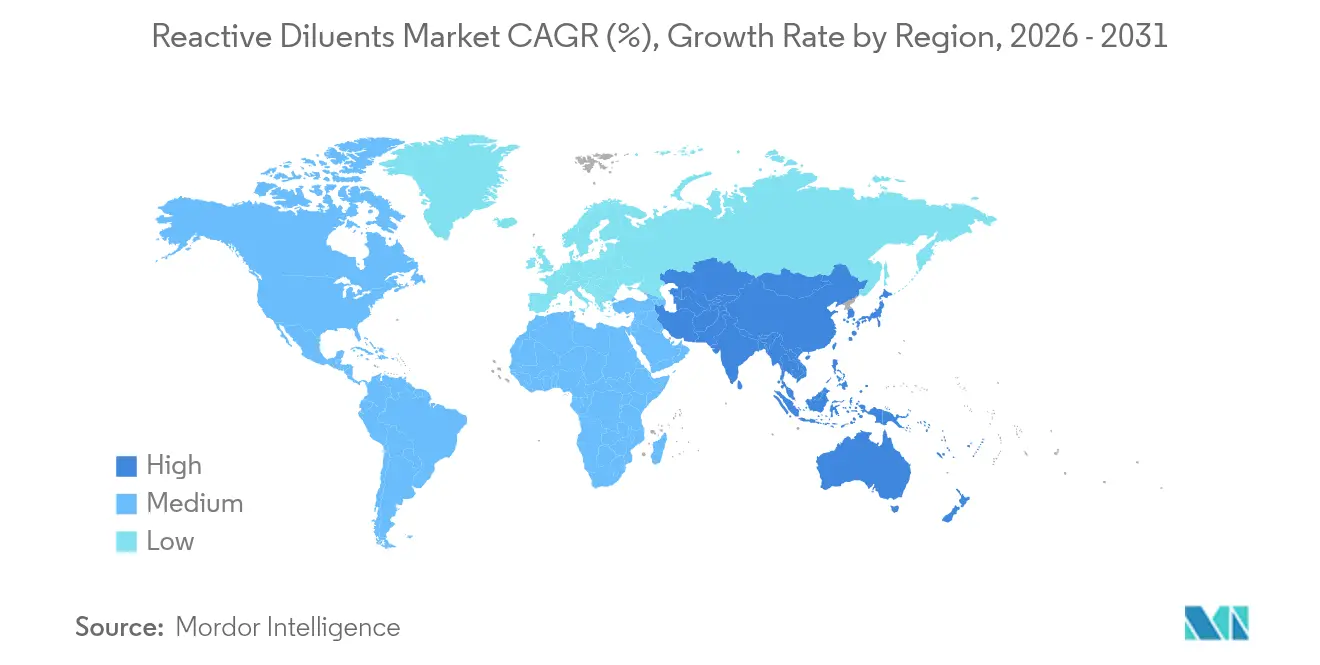
Asia Pacific holds 45.10% of global revenue thanks to expansive chemical production hubs in China, India, and Southeast Asia. Mainland China’s caustic-soda capacity, exceeding 50,000 ktpa in 2024, ensures steady epichlorohydrin supply, letting epoxy formulators price competitively in export markets. India’s specialty-chemicals turnover is projected to reach USD 50 billion in 2025, enlarging the local customer base for reactive diluents in high-growth sectors like wind-energy nacelles and electronic finishes. South Korea and Singapore host regional application labs where multinational suppliers customize low-VOC solutions for tropical climates.
North America Reactive Diluents Market
North America, shaped by strict EPA oversight and high adoption of UV-cured paints in automotive refinish shops. Investments in offshore wind along the Atlantic seaboard drive procurement of diluent-tuned infusion resins that withstand cyclic humidity. Federal incentives for advanced manufacturing expand the footprint of resin 3-D printing service bureaus, pushing local consumption of high-purity acrylate diluents.
EMEA and South America Reactive Diluents Market
Europe commands a significant share, yet growth stays below the global mean as REACH compliance costs deter smaller formulators. Nonetheless, EU Green Deal funding supports bio-based chemistry pilots in Germany and the Netherlands. Regulatory stringency positions the region as a testbed for glycerol-derived diluents that surpass 60 % biocarbon content. The Middle East and Africa contribute a modest 6%, but petrochemical diversification programs in Saudi Arabia and the United Arab Emirates include epoxy intermediates that will lift regional self-sufficiency from 2027. South America edges toward 5% market share on the back of Brazilian infrastructure upgrades and wind-farm rollouts in the Patagonia corridor.

Regulatory Landscape
Regulation in reactive diluents is led by chemical safety and emissions frameworks that directly influence monomer selection, labeling, and formulation VOC profiles. In the United States, TSCA actions shape new-chemical reviews and use-designations, with Significant New Use Rules (SNURs) issuing additional checks on new or changed uses of regulated diluents and related intermediates after May 2026.
In Europe, REACH and CLP drive substance evaluation and classification, with the REACH Candidate List reaching 253 entries in February 2026, increasing compliance workload for suppliers managing portfolios that include evaluated solvents and epoxy-related intermediates. The EU Deforestation Regulation (EU 2023/1115) applies from December 30, 2026, requiring deforestation-free proof for relevant bio-based inputs and traceability across the supply chain.
Value Chain Analysis
The reactive diluents value chain starts with upstream feedstocks such as epichlorohydrin and propylene derivatives for conventional glycidyl ethers, and vegetable-oil or biomass-derived intermediates (for example, cardanol and other renewable phenolic streams) for bio-based grades. These inputs flow to specialty chemical producers that synthesize epoxy and acrylate reactive diluents, followed by formulation into end-use systems for paints and coatings, adhesives and sealants, composites (including wind-blade resins), and UV-curable/3-D printing photopolymers.
Distribution typically runs through a mix of direct sales to large formulators and regional distributors that support smaller coating and composite customers with blending, technical service, and regulatory documentation. Value creation concentrates in process know-how (purity, low-viscosity performance, and low-VOC enabling behavior) and in compliance capabilities tied to REACH/TSCA dossiers and product stewardship. IP and process intensification are also part of the chain, illustrated by a US patent granted in January 2026 to Korea Kumho Petrochemical Co., Ltd. for an eco-friendly method for epoxy reactive diluents using cardanol and epichlorohydrin that avoids additional organic solvents and washing steps. Logistics and sourcing resilience remain important because key intermediates and bio-based oils face supply variability and traceability requirements, including EU deforestation-free evidence obligations from late 2026 for relevant bio-based inputs.
Competitive Landscape
The reactive diluents market exhibits moderate concentration. Evonik has redirected capital toward high-growth segments by divesting non-core businesses that generated EUR 350 million in sales in 2024, freeing resources for specialty amine expansions that integrate upstream with its diluents portfolio. Huntsman announced a USD 75 million impairment linked to shutting its Italian maleic-anhydride facility, a step that underscores renewed focus on resin modifiers rather than commodity intermediates.
Arkema leverages its reactive polyamide know-how to supply blade-repair kits that slash downtime by 20% for European wind operators. Emerging firms centered on bio-based chemistry, such as companies commercializing itaconic-acid acrylates, target niche volumes but command 15% price premiums. Established suppliers counter by co-marketing lifecycle-assessment data that prove petro-based grades can still meet stringent ESG criteria when manufactured in energy-efficient plants.
Reactive Diluents Industry Leaders
Evonik Industries AG
Cargill Inc.
Hexion Inc.
Huntsman Corporation
KUKDO Chemical Co., Ltd.
- *Disclaimer: Major Players sorted in no particular order
Reactive Diluents Market Companies Covered in this Report
- Adeka Corporation
- Aditya Birla Chemicals
- Arkema
- Bodo Möller Chemie GmbH
- Cardolite Corporation
- Cargill Inc.
- Evonik Industries AG
- Hexion Inc.
- Huntsman Corporation
- KUKDO Chemical Co., Ltd.
- Mitsubishi Chemical Corporation
- Nan Ya Plastics Corporation
- Olin Corporation
- Royce International
- SACHEM, Inc.
- Westlake Epoxy

Market Opportunities and Future Outlook
A major opportunity is the accelerated substitution of higher-VOC, solvent-borne viscosity reducers with reactive diluents that enable high-solids epoxy and UV-curable systems while maintaining mechanical performance, especially in industrial coatings, infrastructure rehabilitation epoxies, and composite infusion resins. In the United States, EPA VOC-related compliance pressure referenced in industry adoption trends, combined with TSCA amendments finalized in December 2024 and SNUR activity in May 2026, increases the premium on established, well-documented diluent chemistries and on suppliers that can provide robust stewardship packages and consistent quality for global paint makers that standardize formulations.
Bio-based and lower-hazard reactive diluents represent a second whitespace, driven by European REACH/CLP pressures and supply-security goals, while new traceability requirements (EU Deforestation Regulation applying from December 30, 2026) push the market toward documented renewable sourcing and auditable chain-of-custody for bio-based feedstocks. Market participants are also building regional manufacturing positions to serve demand centers and shorten lead times; for example, Aditya Birla Group’s June 2025 acquisition of Cargill’s specialty chemicals facility in Dalton, Georgia anchors a North American footprint and includes a stated plan to expand capacity at the site within two years. On the innovation side, published research on bio-based epoxy diluents (including furfural-derived epoxies) supports performance-driven entry points in structural adhesives and advanced composites where viscosity reduction and cured-network integrity must be optimized together.
Recent Industry Developments in Reactive Diluents Market
- May 2026: The U.S. Environmental Protection Agency issued Significant New Use Rules (SNURs) under TSCA for certain chemical substances. This adds procedural checkpoints for manufacturers and downstream users when introducing new uses, reinforcing demand for well-documented reactive diluent chemistries and tighter supply chain communication for compliant formulations.
- September 2025: Huntsman commenced commercial availability in Europe of a new range of ARALDITE epoxy adhesives free from intentionally added Bisphenol A (BPA) and CMR-classified substances. The launch supports reformulation pathways for adhesives and coatings that rely on reactive diluents to manage viscosity while meeting tightening substance and labeling requirements.
- June 2024: The European Commission continued implementation of its Chemicals Strategy for Sustainability under the European Green Deal framework, keeping focus on safer chemicals, substitution of substances of concern, and improved hazard communication across supply chains. For reactive diluents used in coatings and UV-curable systems, this strengthens the business case for lower-hazard portfolios and investment in dossier readiness for EU compliance.


Reactive Diluents Market Report Scope and Research Methodology
Market Definition and Coverage
For this study, the reactive diluents market covers specialty additives that are intentionally added to reduce formulation viscosity and then react into the final polymer network during curing, so they become part of the finished material.
Scope exclusions: Non-reactive thinners and conventional solvents that mainly evaporate during drying are excluded from this market sizing.
Segments Covered in This Report
- By Reactive Diluent Type
- Aliphatic
- Aromatic
- Cycloaliphatic
- Bio-based
- Other Types
- By Application
- Paints and Coatings
- Adhesives and Sealants
- Composites
- 3-D Printing Resins
- Others (Electrical Encapsulation)
- By Geography
- Asia-Pacific
- China
- India
- Japan
- South Korea
- Rest of Asia-Pacific
- North America
- United States
- Canada
- Mexico
- Europe
- Germany
- United Kingdom
- France
- Italy
- Rest of Europe
- South America
- Brazil
- Argentina
- Rest of South America
- Rest of Asia-Pacific
- Middle East and Africa
- Saudi Arabia
- South Africa
- Rest of Middle East and Africa
- Asia-Pacific
Data Sources, Market Sizing, and Validation
Desk Research
Desk research was used to set the market boundary and to build the first round of volume and pricing assumptions that can be defended using public signals. We referenced sources such as USGS mineral and chemical statistics, US International Trade Commission trade data, UN Comtrade, Eurostat industrial indicators, and EPA or ECHA chemical regulation notes to understand upstream feedstocks, trade flows, and compliance-driven shifts.
We also reviewed company annual reports, investor presentations, technical datasheets, and reputable press coverage to map typical end uses and to check how product families are described in the market. Paid subscriptions for company financials and intelligence, patent databases, and shipment-level import/export data were selectively used to confirm capacity announcements, product positioning, and cross-border movement patterns. The desk sources mentioned here are illustrative and not exhaustive, and other public references were used for data collection, validation, and clarification.
Primary Interviews and Surveys
Primary work focused on validating the demand pool across coatings, adhesives and sealants, composites, and emerging resin systems like 3-D printing, along with how mix shifts change average pricing. Discussions with manufacturers, formulators, distributors, and downstream users in APAC, EMEA, and the Americas helped close gaps from public data and stress-test assumptions before finalizing the model.
Distribution of primary research fieldwork respondents
| Company type | Respondent position | Region |
|---|---|---|
| Top tier: 31% | CXOs: 17% | APAC: 43% |
| Mid tier: 51% | Functional/Unit leaders: 28% | EMEA: 33% |
| Smaller Players: 18% | Managers: 55% | Americas: 24% |
Market-Sizing & Forecasting
The core model uses a top-down build that reconstructs reactive diluents demand by linking resin and formulation output to typical diluent loading rates, and then converting implied volumes into value using region-adjusted pricing. To keep the totals realistic, selective bottom-up checks were used, such as sampled supplier roll-ups in key regions and channel checks on typical price bands, which are then used to tune the headline number.
Key inputs included coatings and composites production trends, construction and automotive output indicators (as demand proxies for major coating systems), trade movement for relevant chemical intermediates, environmental rule changes that affect solvent replacement behavior, and mix shares across aliphatic, aromatic, cycloaliphatic, and bio-based grades. Forecasts relied mainly on scenario analysis supported by expert views on downstream activity and substitution pace, followed by a smoothing step so short-term shocks do not distort the long-range trajectory. Where bottom-up coverage was thin for smaller applications, the gap was handled through conservative penetration assumptions tied back to the same end-market indicators.
Data Validation & Update Cycle
Outputs were checked against independent signals such as regional coatings activity, trade direction, and reported capacity additions, and large variances were reworked until the drivers were clearly explained. A second analyst review was completed to verify arithmetic, units, currency conversions, and the consistency of assumptions across regions and applications.
The report is refreshed annually, and interim updates are triggered when material events occur, such as major plant expansions, abrupt feedstock price moves, or regulatory changes that alter formulation choices. Before delivery, the analyst runs a final update pass so the numbers reflect the most recent market information available.
Mordor Intelligence's Reactive Diluents Market Size Measured Against Other Published Estimates
Published market numbers for reactive diluents often differ because each publisher draws the market boundary in its own way, and then uses different volume proxies and pricing logic to turn that boundary into a single value. Timing also matters because base years, currency conversion dates, and the refresh cadence for assumptions can shift the reported figure.
Demand-side checks like coatings and composites output indicators, plus trade-flow direction for relevant chemical intermediates, are used to tie Mordor Intelligence's estimate to a defined consumption pool rather than to broad chemical revenues. Differences usually come from whether a study counts only reactive diluents that chemically bond into the cured system, how it treats bio-based variants and adjacent additives, and whether ASPs are progressed using grade mix changes versus a flat inflation uplift.
Benchmark comparison
| Source | Market Size | Gaps in Research Methodology |
|---|---|---|
| Mordor Intelligence | USD 1.11 B (2026) | |
| Global Consultancy A | USD 1.27 B (2026) | Uses a broader market envelope in some summaries, which can pull in adjacent formulation additives alongside reactive diluents, and it applies a longer forecast window that can change price and mix expectations versus near-term checks. |
| Industry Publisher B | USD 1.30 B (2025) | Reports a different base year and typically emphasizes a growth-led view where pricing progression is less clearly tied to grade mix and end-use intensity, which can lift the starting market value when compared across years. |
Overall, the spread is mainly explained by base-year alignment and how tightly each estimate separates true reactive diluents from nearby additive categories. By keeping inputs traceable to end-market activity and to realistic pricing bands, the final number stays practical to replicate and easier to defend in planning discussions.


Key Questions Answered in the Report
What is the current Reactive Diluents Market size?
The market is valued at USD 1.11 billion in 2026 and is forecast to reach USD 1.47 billion by 2031.
Which region leads the reactive diluents market?
Asia Pacific holds 45.10% of global revenue and is expanding at a 6.9% CAGR to 2031.
What application segment is growing fastest within the reactive diluents market?
3-D printing resins are set to rise at a 6.26% CAGR, outpacing traditional paints and coatings.
How are regulations influencing reactive diluent demand?
Tighter VOC limits in the United States and Europe drive adoption of low-viscosity, high-solids formulations that rely on specialty diluents.
Page last updated on:


 Your data is secure and never sold or shared.


