
Rare Earth Magnets Market Size and Share
Market Overview
| Study Period | 2022 - 2032 |
|---|---|
| Market Size (2027) | USD 23.80 Billion |
| Market Size (2032) | USD 32.42 Billion |
| Growth Rate (2027 - 2032) | 6.38 % |
| Fastest Growing Market | Asia-Pacific |
| Largest Market | Asia-Pacific |
| Market Concentration | Low |
Major Players *Disclaimer: Major Players sorted in no particular order Image © Mordor Intelligence. Reuse requires attribution under CC BY 4.0. | |
Rare Earth Magnets Market Analysis by Mordor Intelligence
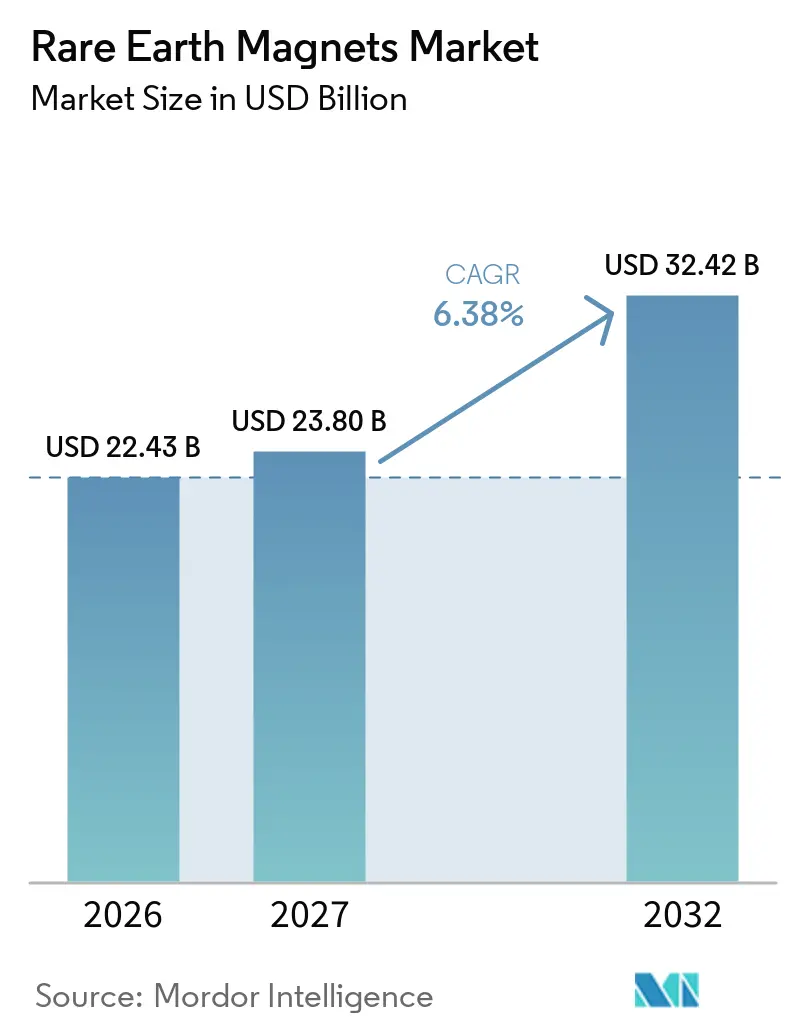
The Rare Earth Magnets Market size was valued at USD 22.43 billion in 2026 and is estimated to grow from USD 23.80 billion in 2027 to reach USD 32.42 billion by 2032, at a CAGR of 6.38% during the forecast period (2027-2032). Permanent magnets, accounting mainly for 95% of rare earth consumption by value, remain essential to electrified drivetrains, wind conversion systems, and precision industrial equipment. Neodymium, praseodymium, dysprosium, and terbium remain central inputs in the rare earth magnets market, particularly in applications that require high magnetic performance. Government-backed investment in North America, Europe, and Japan is creating new supply routes outside China, particularly after China introduced export controls in April 2025 and expanded them in October 2025. The rare earth magnets market is, therefore, being shaped by both electrification demand and the need for resilient sourcing. Companies are pursuing capacity expansion, long-term customer agreements, recycling, and heavy-rare-earth-free materials to protect access to critical inputs.
Key Report Takeaways
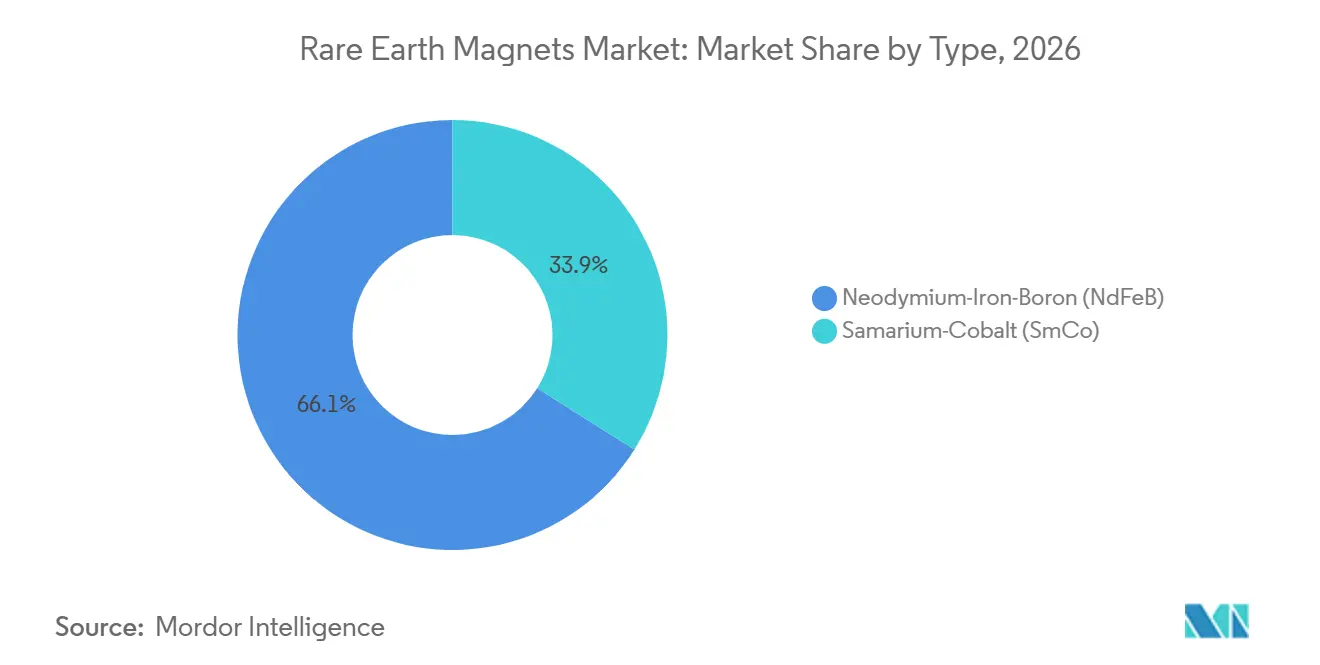
- By type, neodymium-iron-boron (NdFeB) held 66.06% of the rare earth magnets market share in 2026, while samarium-cobalt (SmCo) is forecast to advance at a 6.94% CAGR through 2032.
- By manufacturing process, sintered held 70.14% of the rare earth magnets market share in 2026, while bonded is forecast to advance at a 7.13% CAGR through 2032.
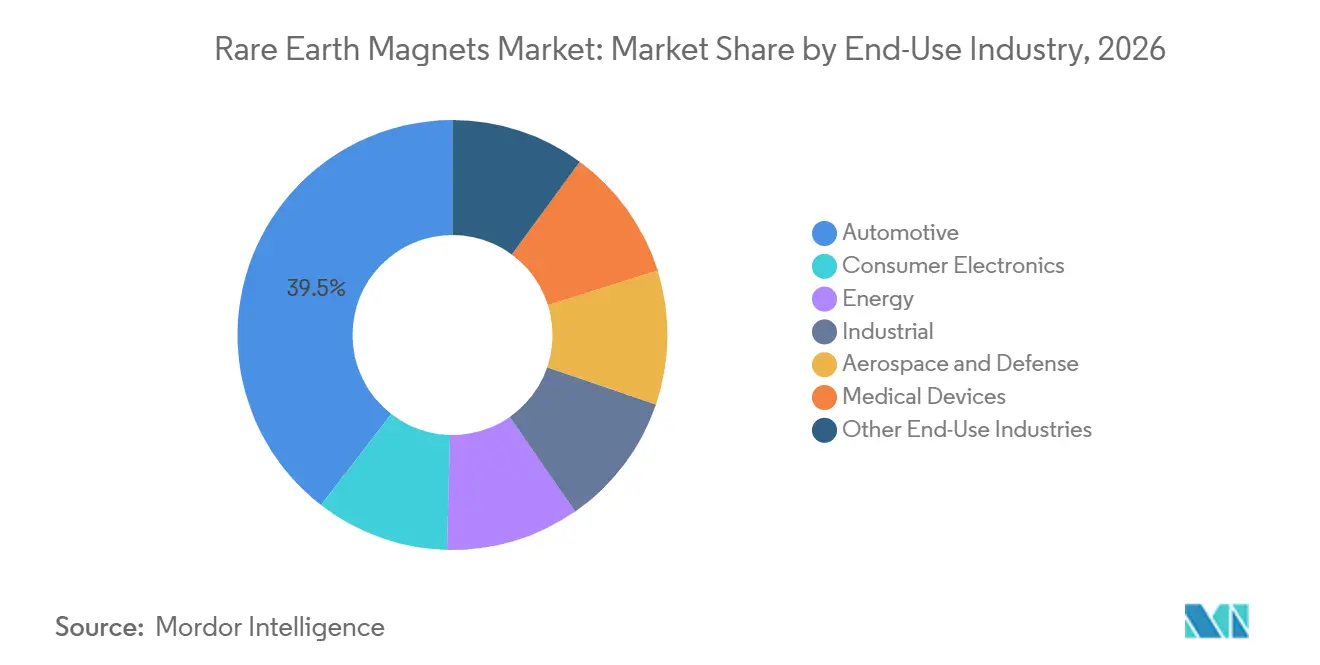
- By end-use industry, automotive held 39.52% of the rare earth magnets market share in 2026, while energy is forecast to advance at a 7.61% CAGR through 2032.
- By geography, Asia-Pacific held 46.63% of the rare earth magnets market share in 2026 and is forecast to advance at a 7.24% CAGR through 2032.
Note: Market numbers in this report are based on Mordor Intelligence's proprietary estimation framework, which combines nine months of actuals with Q4 projections for base year 2026.
Global Rare Earth Magnets Market Trends and Insights
Drivers Impact Analysis*
| Driver | (~) % Impact on CAGR Forecast | Geographic Relevance | Impact Timeline |
|---|---|---|---|
| Electric Vehicle Traction-Motor Adoption | +2.5% | Global; peak intensity in China, Europe, and North America | Short term (≤ 2 years) |
| Direct-Drive Wind Turbine Deployment | +1.5% | APAC & Europe core, spillover to North America and MEA | Medium term (2–4 years) |
| High-Performance Miniaturization in Electronics and Robotics | +0.9% | Global; APAC dominates volume, North America leads high-value tiers | Short term (≤ 2 years) |
| Industrial Automation and High-Efficiency Motor Retrofitting | +0.7% | Global; Germany, Japan, China, and United States leading | Medium term (2–4 years) |
| Heavy-Rare-Earth-Free Grade Commercialization | +0.4% | Global; early adoption in Japan and Western Europe | Medium term (2–4 years) |
| Source: Mordor Intelligence | |||
Electric Vehicle Traction-Motor Adoption
Electric vehicle traction motors are the largest source of additional demand for rare earth magnets. The supply chain impact became clear in May 2025, when Chinese export controls contributed to Ford idling its Chicago facility and German automakers warning of possible production stoppages. Rare earth permanent magnet motors remain important because they provide the performance needed for electric drive systems. This position has made magnet availability a procurement issue for automakers rather than a routine materials purchase. The rare earth magnets market benefits as vehicle manufacturers seek dependable supplies for current and planned electric models. It also encourages Tier 1 suppliers to qualify sources outside China for critical motor components.
Direct-Drive Wind Turbine Deployment
Direct-drive permanent magnet synchronous generators use 2.7 to 3.2 metric tons of neodymium-iron-boron material for each megawatt of rated capacity. This makes offshore wind construction an important demand source for the rare earth magnets market. WindEurope’s August 2025 roadmap calls for at least 30% of permanent magnets used in European wind turbines to come from resilient non-China sources by 2030 and 50% by 2035[1]. The roadmap expects the first resilient wind projects to begin construction in 2028. Semi-direct-drive turbines use 25% less neodymium-iron-boron than full direct-drive designs, so offshore capacity additions do not translate directly into magnet volumes. A 2025 scientific paper also identified generator manufacturing and assembly scale-up as the main operational constraint for direct-drive offshore wind equipment.
High-Performance Miniaturization in Electronics and Robotics
Humanoid robots add demand for rare earth magnets that is separate from the electric vehicle and wind cycles. Rare earth permanent magnets are used in more than 95% of humanoid robot motors, and each robot contains 40 motors on average. This supports the rare earth magnets market as robotics moves from development programs toward broader production. Demand from robotics is distinct from the consumer electronics category because magnets in consumer devices are becoming smaller. The resulting decline in magnet intensity per electronic device partly offsets higher unit volumes in that application. Manufacturers, therefore, need to assess robotics separately when tracking equipment demand and capacity needs.
Industrial Automation and High-Efficiency Motor Retrofitting
Industrial electric motors account for 45% of global electricity consumption, supporting the need for more efficient motor systems. European Union Ecodesign requirements for IE3 and IE4 efficiency classes favor motor designs that commonly use rare earth magnets. This creates a replacement cycle for older induction motors and supports the rare earth magnets market beyond vehicle demand. Replacement cycles of 15 to 25 years provide a steadier demand base when electric vehicle adoption varies.
Restraints Impact Analysis*
| Restraint | (~) % Impact on CAGR Forecast | Geographic Relevance | Impact Timeline |
|---|---|---|---|
| Neodymium, Dysprosium, and Terbium Price Volatility | -0.8% | Global; most acute in North America, Europe, Japan, and South Korea | Short term (≤ 2 years) |
| Concentrated China-Centric Processing and Manufacturing Capacity | -0.6% | Global ex-China; most exposed in North America and Europe | Long term (≥ 4 years) |
| High Scrap Loss and Qualification Cost for Closed-Loop Recycling | -0.3% | Europe and North America primarily | Long term (≥ 4 years) |
| Source: Mordor Intelligence | |||
Neodymium, Dysprosium, and Terbium Price Volatility
Rare earth magnet prices became less predictable in 2025 as China’s export measures fragmented regional supply conditions. The International Energy Agency documented sharp regional price differences for elements included in the April 2025 export controls[2]. This condition increases the risk for contracts that use Chinese spot prices as their reference. It also creates a larger cost gap between Chinese and non-Chinese materials. The rare earth magnets market faces a procurement challenge because supply disruptions can alter prices faster than long procurement cycles can adjust. Buyers are responding by placing more value on regional supply options and terms that limit exposure to sudden disruptions.
High Scrap Loss and Qualification Cost for Closed-Loop Recycling
Closed-loop recycling can support a more secure magnet supply, but it requires consistent scrap recovery and strict quality control. Production scrap and end-of-life magnets need to meet demanding material specifications before they can return to high-performance applications. Qualification costs are especially important in automotive, wind, defense, and other applications where customers require documented performance and traceability. These conditions make it difficult to expand recycling capacity quickly in Europe and North America. VACUUMSCHMELZE GmbH and Co. KG’s recycling agreement with Cyclic Materials illustrates how manufacturers are building circularity into new production facilities. The approach can reduce waste, but it does not remove the near-term cost and qualification barriers facing recycled feedstock.
*Our forecasts treat driver/restraint impacts as directional, not additive. The impact forecasts reflect baseline growth, mix effects, and variable interactions.
Segment Analysis
By Type: NdFeB Sustains Revenue Leadership, SmCo Gains Ground in High-Temperature Niches
Neodymium-iron-boron (NdFeB) held 66.06% of the market share in 2026. Its leadership reflects high energy-product density and cost effectiveness across traction motors, wind generation, and industrial motor applications. China’s scale in neodymium-iron-boron manufacturing reinforces Asia-Pacific’s production advantage in the rare earth magnets market. Proterial, Ltd. announced NMX-F1SH-HF, which delivers coercive force of at least 1,671 kA/m and residual magnetic flux density of 1.40 T without dysprosium or terbium. These characteristics are intended for electric vehicle driving motors, power steering, and compressors. Proterial, Ltd. holds more than 600 worldwide patents in neodymium sintered magnets, including a dedicated heavy-rare-earth-free portfolio.
Samarium-cobalt (SmCo) is projected to advance at a 6.94% CAGR through 2032. Its stable magnetic performance above 300 °C and in corrosive conditions supports use in applications where neodymium-iron-boron may not meet operating requirements. Defense, aerospace, and medical original equipment manufacturers use samarium-cobalt in missile guidance, aircraft actuators, satellite ion thrusters, and surgical instruments. Permag announced a capacity expansion in August 2025 to address defense demand and target compliance with Defense Federal Acquisition Regulation Supplement 252.225-7052 by mid-2026. The compliance target precedes the January 1, 2027, statutory deadline. International Traffic in Arms Regulations registration and Defense Federal Acquisition Regulation Supplement compliance are separating United States domestic supply chains from international supply chains.
By Manufacturing Process: Sintered Process Retains Primacy, Bonded Process Gains on Form-Factor Flexibility
The sintered process held 70.14% of the market share in 2026. Electric vehicle traction motors, direct-drive wind generators, and high-efficiency industrial motors require the high energy-product performance that sintered processing provides. This maintains the position of sintered products within the rare earth magnets market. VACUUMSCHMELZE GmbH and Co. KG is commissioning a sintered neodymium-iron-boron plant in Sumter, South Carolina, at the end of 2025. The company also signed a 10-year exclusive agreement with Cyclic Materials for swarf recycling from the plant. China’s GB/T 45756-2025 technical standard sets adhesive bonding requirements for spliced sintered rare earth permanent magnets. These standards show that quality assurance and traceability remain important for automotive supply chains.
The bonded process is projected to advance at a 7.13% CAGR through 2032. Net-shape forming supports complex designs that are difficult to make through sintering and are useful in small robotic actuators and consumer electronics. Neo Performance Materials Inc. commercialized heavy-rare-earth-free magnetic powder for bonded electric vehicle motor applications. Its Narva, Estonia, facility was co-funded by the European Union Just Transition Fund and targets 2,000 metric tons of annual Phase 1A capacity. A September 2025 memorandum of understanding reserves substantial annual capacity for Robert Bosch GmbH. Lower scrap generation can improve material efficiency for bonded magnet production when rare earth prices are unstable.
By End-Use Industry: Automotive Anchors Revenue, Energy Drive Incremental Growth
Automotive accounted for 39.52% of the market share in 2026. Electric and hybrid vehicles use rare earth magnets in traction motors, power steering, braking systems, and accessory equipment. The April and May 2025 disruption showed the segment’s sensitivity to supply constraints. It prompted Tier 1 suppliers to pursue dual qualification of non-China magnet sources. However, lower magnet intensity per device is offset only partly by higher volumes and growing robotics demand.
Energy is projected to advance at a 7.61% CAGR through 2032. Direct-drive offshore wind installations are the main driver of this growth. WindEurope’s roadmap sets a 30% resilient permanent magnet procurement target for European wind by 2030. The European Union Net-Zero Industry Act requires resilience criteria in public tenders for certain components beginning in 2026. Industrial equipment benefits from IE3 and IE4 motor efficiency requirements. Aerospace, defense, and medical devices favor secure sources because their performance needs are demanding. HVAC, appliances, and low-altitude aviation in China add further applications as robots and electric vertical takeoff and landing platforms progress toward wider production.

Geography Analysis
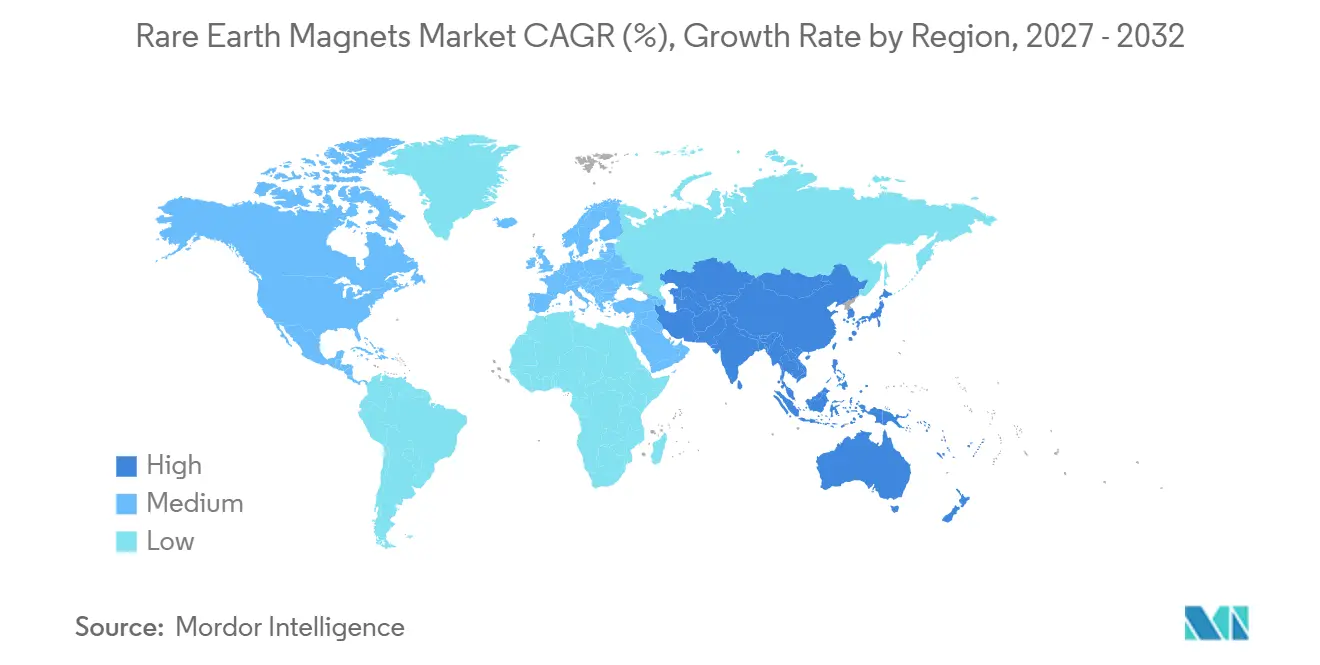
Asia-Pacific accounted for 46.63% of the market share in 2026 and is projected to advance at a 7.24% CAGR through 2032. The regional position in the rare earth magnets market reflects China’s dominant sintered magnet production, Japan’s strength in high-performance neodymium-iron-boron and samarium-cobalt grades, and South Korea’s role in precision components and electric vehicle motors. China’s domestic new energy vehicle growth, India’s developing electric vehicle sector, and Southeast Asian manufacturing expansion support regional demand. Japan’s neodymium and didymium demand rose 18.2% year over year to 6,500 metric tons in 2025, driven by automotive and artificial intelligence server demand. Japan’s Ministry of Economy, Trade and Industry is supporting heavy-rare-earth-free motors and magnets with a goal of reducing heavy rare earth use by 50%. India is also developing rare-earth-free and reduced-rare-earth motors to reduce import dependence.
North America is building capacity from a limited installed base through mine-to-magnet projects that began production in 2025. MP Materials started commercial neodymium-praseodymium metal production and trial sintered neodymium-iron-boron magnet production at its Independence facility in Fort Worth, Texas, in January 2025. The facility is the first integrated United States site for rare earth metal, alloy, and magnet manufacturing and plans to have a finished magnet capacity of 1,000 metric tons per year for General Motors and other manufacturers. Noveon Magnetics Inc. signed a November 2025 memorandum of understanding with Kangwon Energy Co., Ltd. for a 2,000-metric-ton annual facility in South Korea that is planned to begin production in 2027. Lynas Rare Earths Ltd also partnered with Noveon Magnetics Inc. in October 2025 for light and heavy rare earth materials and finished magnets for United States defense and commercial customers. The United States Department of Defense provides a demand base for North American samarium-cobalt and neodymium-iron-boron producers that face higher manufacturing costs than Chinese producers.
Europe is adding magnet capacity from a limited manufacturing base. Neo Performance Materials Inc. opened its Narva, Estonia, facility in September 2025, and the site targets 2,000 metric tons of annual Phase 1A capacity. The European Union Critical Raw Materials Act and Net-Zero Industry Act provide policy support for longer-term capacity investment. These rules also introduce resilience criteria for public procurement of critical components beginning in 2026. South America has rare earth reserves, particularly in Brazil, that may support upstream supply beyond the forecast period. Middle East and Africa investors are directing capital toward critical minerals infrastructure as part of broader economic diversification. These developments could create future options for mining and processing capacity outside Asia-Pacific and broaden the rare earth magnets market supply base.
Competitive Landscape
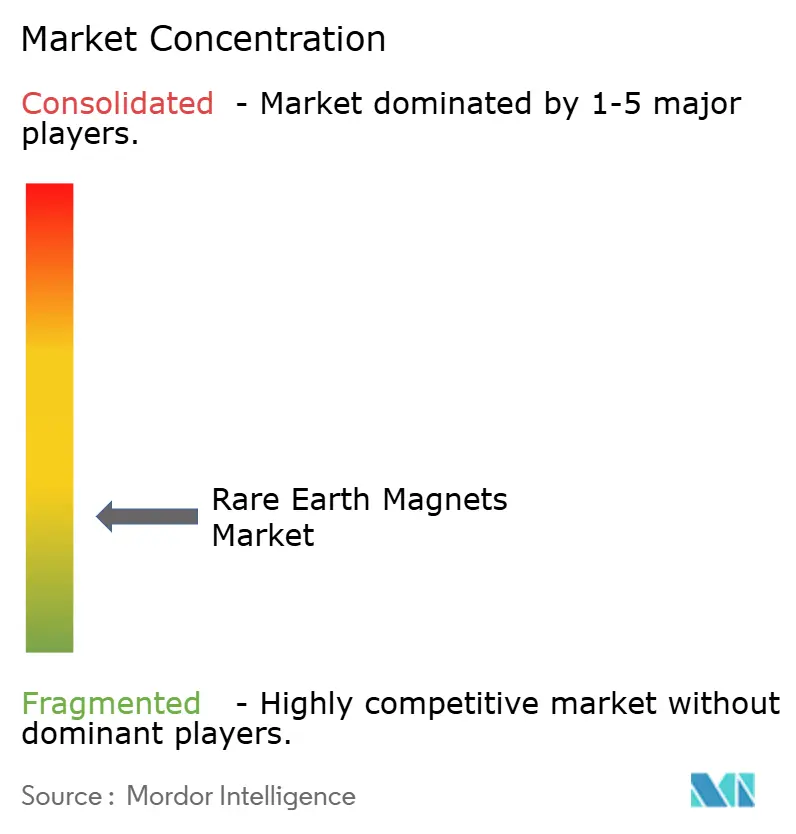
The rare earth magnets market is highly fragmented, with the top five players including Beijing Zhong Ke San Huan Hi-Tech Co., Ltd., Proterial, Ltd., Yantai Zhenghai Magnetic Material Co., Ltd., JL MAG Rare-Earth Co., Ltd., and Ningbo Yunsheng Co., Ltd. Daido Electronics Co., Ltd., Proterial, Ltd., Shin-Etsu Chemical Co., Ltd., and TDK Corporation have established positions in Japanese high-performance applications. MP Materials, Neo Performance Materials Inc., Noveon Magnetics Inc., and VACUUMSCHMELZE GmbH and Co. KG are expanding non-China supply options. This company mix creates a market where scale, technology, traceability, and customer qualification all matter. The rare earth magnets market is not defined by a single competitive model because commodity supply and specialized materials have different cost and performance requirements.
JL MAG Rare-Earth Co., Ltd. reported CNY 7.72 billion in 2025 revenue (approximately USD 1.06 billion) with neodymium-iron-boron magnet revenue rising 19.00% year over year. The company broke ground on Phase III of its Baotou complex in July 2025, with a CNY 1.05 billion investment (approximately USD 146 million) to add 20,000 metric tons of annual high-performance neodymium-iron-boron capacity. The project supports a target of 60,000 metric tons of annual capacity by 2027. VACUUMSCHMELZE GmbH and Co. KG expanded its Cyclic Materials partnership into a 10-year exclusive agreement covering all production by-products from its South Carolina facility. Neo Performance Materials Inc. reserved Narva capacity for Robert Bosch GmbH through a multi-year memorandum of understanding. These actions use scale, circular supply, and long-term offtake agreements to strengthen commercial positions in the rare earth magnets market.
Growth opportunities include samarium-cobalt for defense and space equipment, heavy-rare-earth-free neodymium-iron-boron for automotive suppliers, and recycling services that document material provenance. Proterial, Ltd.’s patent portfolio of more than 600 worldwide neodymium sintered magnet patents supports its position in heavy-rare-earth-free materials. Noveon Magnetics Inc. is pursuing a hydrogen-based recycling process that converts end-of-life neodymium-iron-boron magnets into new sintered magnets. This approach combines primary and secondary production routes in the rare earth magnets market. Chinese producers and non-China specialty producers increasingly operate in separate strategic areas. Chinese companies manage export licensing exposure, while Western entrants manage scale and production-cost pressures. The rare earth magnets market remains competitive because customer qualification and supply assurance can be as important as production volume for high-value applications.
Rare Earth Magnets Industry Leaders
-
Beijing Zhong Ke San Huan Hi-Tech Co., Ltd.
-
Proterial, Ltd.
-
Yantai Zhenghai Magnetic Material Co., Ltd.
-
JL MAG Rare-Earth Co., Ltd.
-
Ningbo Yunsheng Co., Ltd.
- *Disclaimer: Major Players sorted in no particular order
Recent Industry Developments
- August 2026: India’s Ministry of Heavy Industries received 20 bids under its scheme to establish integrated sintered rare earth permanent magnet manufacturing facilities, targeting a combined capacity of 6,000 metric tons per annum. The initiative supports the rare earth magnets market by encouraging domestic manufacturing, reducing import dependence, and strengthening supply chains for electric vehicles, wind turbines, and defense systems.
- June 2026: The U.S. Department of Commerce finalized an agreement providing USA Rare Earth with up to USD 1.6 billion in federal incentives and loans to develop mining, processing, metal alloy, and neodymium-iron-boron (NdFeB) magnet production capabilities. The project supports the rare earth magnets market by expanding U.S. production capacity and strengthening an integrated domestic supply chain for permanent magnets.
Global Rare Earth Magnets Market Report Scope
Rare earth magnets are high-performance permanent magnets made from rare earth elements and other metals to deliver strong magnetic fields in compact designs. They provide high magnetic strength and energy density, making them suitable for applications requiring efficient motion control, power conversion, and precise magnetic performance.
The Rare Earth Magnets Market is segmented by type, manufacturing process, end-use industry, and geography. By type, the market is segmented into neodymium-iron-boron (NdFeB) and samarium-cobalt (SmCo). By manufacturing process, the market is segmented into sintered and bonded. By end-use industry, the market is segmented into automotive, consumer electronics, energy, industrial, aerospace and defense, medical devices, and other end-use industries. The report also covers the market size and forecasts for rare earth magnets across 15 countries. For each segment, the market sizing and forecasts have been done on the basis of value (USD).
| Neodymium-Iron-Boron (NdFeB) |
| Samarium-Cobalt (SmCo) |
| Sintered |
| Bonded |
| Automotive |
| Consumer Electronics |
| Energy |
| Industrial |
| Aerospace and Defense |
| Medical Devices |
| Other End-Use Industries |
| Asia-Pacific | China |
| India | |
| Japan | |
| South Korea | |
| ASEAN Countries | |
| Rest of Asia-Pacific | |
| North America | United States |
| Canada | |
| Mexico | |
| Europe | Germany |
| United Kingdom | |
| France | |
| Italy | |
| NORDIC Countries | |
| Rest of Europe | |
| South America | Brazil |
| Argentina | |
| Rest of South America | |
| Middle East and Africa | Saudi Arabia |
| South Africa | |
| Rest of Middle East and Africa |
| By Type | Neodymium-Iron-Boron (NdFeB) | |
| Samarium-Cobalt (SmCo) | ||
| By Manufacturing Process | Sintered | |
| Bonded | ||
| By End-Use Industry | Automotive | |
| Consumer Electronics | ||
| Energy | ||
| Industrial | ||
| Aerospace and Defense | ||
| Medical Devices | ||
| Other End-Use Industries | ||
| By Geography | Asia-Pacific | China |
| India | ||
| Japan | ||
| South Korea | ||
| ASEAN Countries | ||
| Rest of Asia-Pacific | ||
| North America | United States | |
| Canada | ||
| Mexico | ||
| Europe | Germany | |
| United Kingdom | ||
| France | ||
| Italy | ||
| NORDIC Countries | ||
| Rest of Europe | ||
| South America | Brazil | |
| Argentina | ||
| Rest of South America | ||
| Middle East and Africa | Saudi Arabia | |
| South Africa | ||
| Rest of Middle East and Africa | ||
Key Questions Answered in the Report
What is the size of the rare earth magnets market?
The rare earth magnets market was valued at USD 22.43 billion in 2026 and is estimated to grow from USD 23.80 billion in 2027 to reach USD 32.42 billion by 2032, at a CAGR of 6.38% during the forecast period (2027-2032).
What is driving demand for rare earth magnets?
Electric vehicle traction motors, direct-drive wind systems, industrial efficiency upgrades, and robotics are key demand sources.
Which type held the largest share in 2026?
Neodymium-iron-boron (NdFeB) held 66.06% of the market share in 2026 because it supports traction motors, wind systems, and industrial equipment.
Which manufacturing process held the largest share in 2026?
Sintered held 70.14% of the market share in 2026 because high-performance motors and generators require their energy-product performance.