
Quantum Software For Supply Chain Optimization Market Size and Share
Market Overview
| Study Period | 2020 - 2031 |
|---|---|
| Market Size (2026) | USD 0.52 Billion |
| Market Size (2031) | USD 2.17 Billion |
| Growth Rate (2026 - 2031) | 33.07 % |
| Fastest Growing Market | Asia-Pacific |
| Largest Market | North America |
| Market Concentration | Medium |
Major Players *Disclaimer: Major Players sorted in no particular order Image © Mordor Intelligence. Reuse requires attribution under CC BY 4.0. | |
Quantum Software For Supply Chain Optimization Market Analysis by Mordor Intelligence
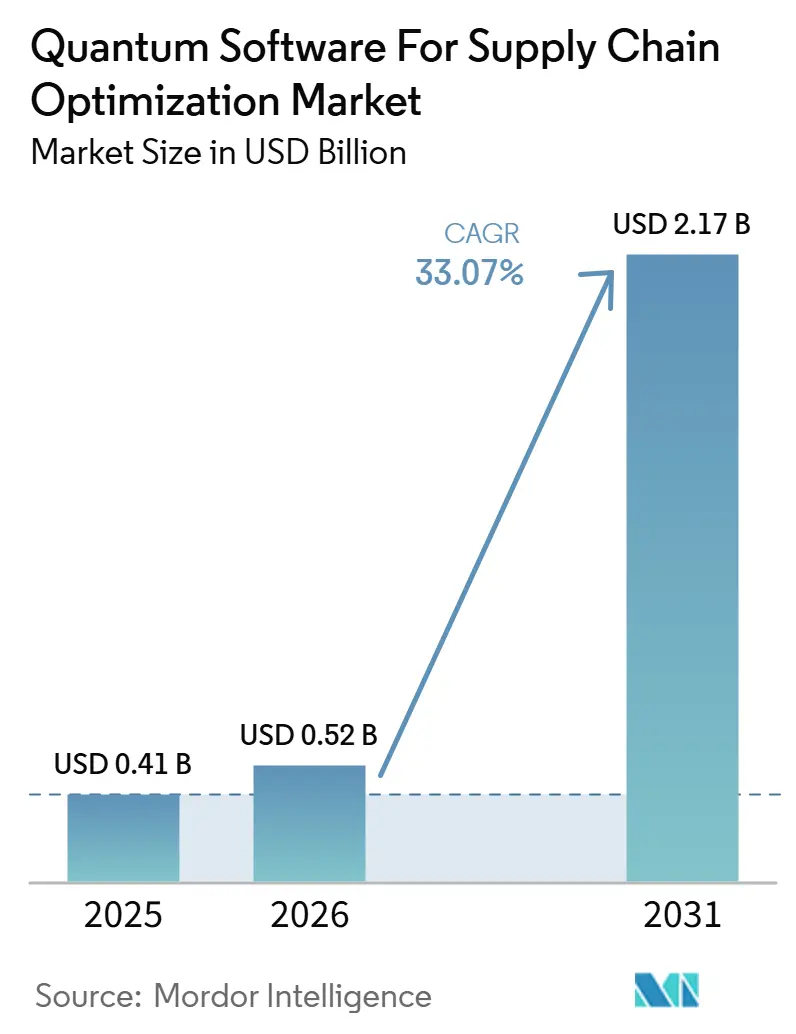
The quantum software for supply chain optimization market size was USD 0.41 billion in 2025, USD 0.52 billion in 2026, and is forecast to reach USD 2.17 billion by 2031 at a CAGR of 33.07% over 2026-2031. Growth is being shaped by the rising difficulty of solving large routing, production, and inventory problems with classical tools alone, along with broader enterprise access to quantum and hybrid computing through cloud delivery. The market is also moving forward because large technology vendors have begun treating quantum computing as a funded business priority rather than a distant research effort, while early commercial contracts show that some enterprise use cases now run in daily production. Another important shift is that software vendors and enterprise planning providers are embedding quantum-ready features into existing supply chain and ERP environments, lowering adoption barriers for buyers who prefer gradual deployment. At the same time, the strongest commercial positions are forming around vendors that can translate real supply chain problems into workable hybrid models, because hardware access alone does not solve the implementation gap. Vendor lock-in across different quantum approaches still slows conversion from pilot to full deployment, but that same friction is opening room for middleware, integration, and managed-service providers.
Key Report Takeaways
- By solution, software held 64.81% of the quantum software for supply chain optimization market share in 2025, while services are projected to expand at a 36.42% CAGR through 2031.
- By deployment, cloud-based delivery accounted for 71.24% of the quantum software for supply chain optimization market size in 2025, while hybrid deployment is projected to expand at a 35.18% CAGR through 2031.
- By application, transportation and route optimization held 28.36% share in 2025, while supply chain risk and resilience planning is projected to expand at a 38.74% CAGR through 2031.
- By end user, industrial manufacturing held 24.19% share in 2025, while retail and e-commerce are projected to expand at a 37.62% CAGR through 2031.
- By geography, North America held 34.82% of the quantum software for supply chain optimization market share in 2025, while Asia-Pacific is projected to expand at a 36.93% CAGR through 2031.
Note: Market size and forecast figures in this report are generated using Mordor Intelligence’s proprietary estimation framework, updated with the latest available data and insights as of January 2026.
Market Trends and Insights
Drivers Impact Analysis of Quantum Software For Supply Chain Optimization Market*
| Driver | (~) % Impact on CAGR Forecast | Geographic Relevance | Impact Timeline |
|---|---|---|---|
| Rising Demand for Complex Network Optimization in Logistics | +6.5% | Global | Short term (≤ 2 years) |
| Faster ROI from Hybrid Quantum-Classical Workflows in High Variability Planning | +5.8% | North America and Europe | Short term (≤ 2 years) |
| Cloud Delivery Lowers Trial Barriers for Enterprise Optimization Teams | +5.2% | Global | Short term (≤ 2 years) |
| Growing Need for Scenario-Rich Resilience Planning After Supply Chain Shocks | +4.6% | Global | Medium term (2-4 years) |
| Integration With Existing ERP, TMS, and APS Stacks Accelerates Adoption | +4.1% | North America and Europe | Medium term (2-4 years) |
| Early Compliance and Sustainability Use Cases Expand Budget Justification | +3.2% | Europe and North America | Long term (≥ 4 years) |
| Source: Mordor Intelligence | |||
Rising Demand for Complex Network Optimization In Logistics
The quantum software for supply chain optimization market is gaining from the fact that modern logistics networks now involve very large delivery maps, mixed fleets, strict time windows, and real-time disruption triggers. These conditions create a problem scale that often pushes classical solvers outside practical planning windows, especially when enterprises need frequent reruns under changing operating conditions. A 2025 peer-reviewed study documented fuel consumption reductions of 12% and delivery time improvements of 18% from quantum-assisted route optimization, providing buyers a clear operational benchmark rather than a theoretical promise.[1] Research published in 2026 also showed that a hybrid quantum tabu-search approach outperformed comparable classical heuristics across vehicle routing benchmarks with dense constraints. The practical effect is that companies with denser stop patterns and tighter planning windows can see value sooner than operators that only manage simple route structures. Fraunhofer SCS is also advancing NISQ-compatible scheduling and forecasting work for logistics, production, and retail, which supports a near-term path from research programs to commercial adoption in the quantum software for supply chain optimization market.
Faster ROI from Hybrid Quantum-Classical Workflows in High Variability Planning
The quantum software for supply chain optimization market is also advancing rapidly, as hybrid quantum-classical workflows deliver value before fully fault-tolerant machines are available. This shortens the payback discussion for finance teams that had previously viewed quantum computing as a very long-term commitment with limited near-term business use. BASF and D-Wave reported in November 2025 that a hybrid application reduced production scheduling time from 10 hours to 5 seconds, while cutting scheduling lateness by 14%, setup times by 9%, and tank unloading duration by up to 18%.[2] A February 2026 study by NTT Data Germany and NTT Research showed that hybrid QUBO formulations could jointly optimize cost, emissions, and delivery time across Airbus logistics constraints on IonQ hardware. This matters because even modest gains in plan quality can yield meaningful savings when a manufacturer or logistics operator reruns the same planning cycle multiple times throughout the year. Research published in Logistics also pointed to faster integration of hybrid quantum optimization with ERP and APS systems between 2026 and 2032, which strengthens the medium-term commercial case for the quantum software market for supply chain optimization.[3]
Cloud Delivery Lowers Trial Barriers for Enterprise Optimization Teams
Cloud delivery is helping the quantum software for supply chain optimization market by separating software trials from the need to buy specialized hardware. Enterprise teams can now access optimization environments through platform ecosystems such as D-Wave Leap, AWS Braket, Azure Quantum, and IBM quantum services, which reduces the initial technical and budget burden for pilots. This is especially useful for manufacturers and logistics operators whose heaviest optimization workloads appear during seasonal peaks, network redesign cycles, or disruption recovery windows rather than every day. The operating model also fits buyers who want to test several use cases before making a larger platform commitment, because usage-based access is easier to align with a narrow budget line than permanent infrastructure investment. Research on hybrid frameworks indicates that cloud-connected architectures will remain central while vendors standardize the link between quantum solvers and ERP, WMS, and APS environments. As a result, cloud delivery is not only reducing entry barriers but also shaping how revenue is recognized across the quantum software for supply chain optimization market, with more spending tied to usage, integration, and recurring platform access.
Growing Need for Scenario-Rich Resilience Planning After Supply Chain Shocks
The quantum software for supply chain optimization market is also benefiting from a broader shift in how enterprises fund resilience planning, a pattern that remained visible through 2024. Many companies now want planning systems that can test a wider range of supplier, weather, transport, and inventory scenarios than traditional models can handle at a practical speed. A 2026 paper on Quantum Supply Chain Risk Optimization reported a 23.7% cost reduction in multi-tier logistics compared to classical heuristics, along with 18-21% improvements in recovery time and service resilience through weather-aware risk modeling. Another 2026 study in EPJ Quantum Technology introduced a Quantum Criticality Index framework for scoring supply chain exposure across critical materials, export-control conditions, and allied-nation concentration risk. This extends the addressable use case beyond route and inventory optimization into risk scoring and contingency planning, broadening the buyer base within the quantum software for supply chain optimization market. It also means resilience budgets are becoming part of ongoing operating plans instead of one-time responses to a single disruption event.[4]
Restraints Impact Analysis of Quantum Software For Supply Chain Optimization Market*
| Restraint | (~) % Impact on CAGR Forecast | Geographic Relevance | Impact Timeline |
|---|---|---|---|
| Limited Quantum Advantage for Many Real-World Supply Chain Problem Sizes | -4.8% | Global | Short term (≤ 2 years) |
| Scarcity Of Quantum-Literate Optimization Talent and Implementation Partners | -4.2% | Global | Medium term (2-4 years) |
| Data Quality and Model Formulation Gaps Weaken Production Deployment Outcomes | -3.5% | Global, concentrated in Asia-Pacific and South America | Medium term (2-4 years) |
| Vendor Lock-In Concerns Across Proprietary Quantum Toolchains And Cloud Stacks | -3.1% | North America and Europe | Long term (≥ 4 years) |
| Source: Mordor Intelligence | |||
Limited Quantum Advantage for Many Real-World Supply Chain Problem Sizes
A core restraint on the quantum software for supply chain optimization market is that many real-world enterprise planning problems still exceed the practical capacity of near-term hardware when encoded directly. Supply chain networks often involve hundreds of nodes and thousands of constraints, and current NISQ systems still require decomposition before those problems can be handled in a workable form. A 2025 review noted that commercially available systems remain limited in scale for industrial vehicle routing and related optimization tasks when direct encoding is attempted. Fraunhofer SCS similarly describes current leading hardware as experimental for enterprise-scale supply chain problems, which keeps many deployments in the pilot stage rather than full production. This creates buyer fatigue because some companies fund pilots expecting immediate operational deployment, only to discover that substantial problem decomposition and redesign remain required. The result is a slower conversion from proof of concept to scaled rollout across the quantum software for supply chain optimization market.
Scarcity of Quantum-Literate Optimization Talent And Implementation Partners
The quantum software for supply chain optimization market also faces a significant talent gap, as adoption requires skills in quantum methods, optimization mathematics, and supply chain operations. That mix is much harder to source than a normal enterprise software team, even for buyers with strong budgets and existing analytics capabilities. A 2025 review identified the shortage of skilled professionals as one of the most important barriers to wider adoption, alongside hardware immaturity, implementation cost, and cybersecurity risk. Research published in 2025 on quantum-AI hybrid e-commerce logistics also noted that companies need combined expertise in quantum algorithms and AI-enabled logistics workflows, further widening the staffing challenge. This shortage is one reason services are projected to outgrow software, because enterprises often need external help to define use cases, prepare data, tune models, and connect outputs to planning systems. Until training capacity expands through university programs and corporate development pipelines, the talent bottleneck will continue to slow the quantum software market for supply chain optimization.
*Our forecasts treat driver/restraint impacts as directional, not additive. The impact forecasts reflect baseline growth, mix effects, and variable interactions.
Quantum Software For Supply Chain Optimization Market Segment Analysis
By Solution:
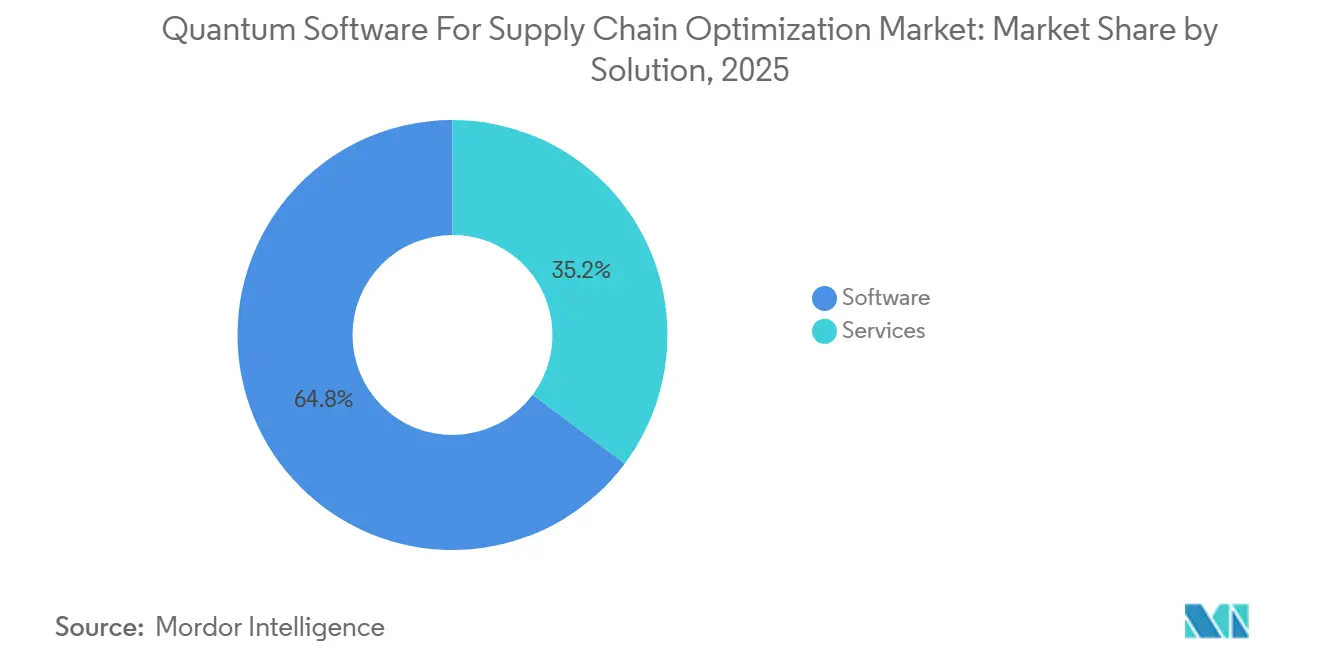
Software Platforms Lead Revenue While Services Gains SpeedSoftware held 64.81% share in 2025, while services are projected to expand at a 36.42% CAGR through 2031. The software lead reflects stronger adoption of platform-based offerings such as algorithm libraries, QUBO tools, optimization engines, and connectors that sit closer to existing enterprise planning systems. Buyers often prefer these products at the start because a software license gives them a defined operating model, a clearer procurement path, and easier internal ownership than a fully open-ended consulting engagement. This keeps platform revenue high even when enterprises begin with a narrow pilot or one planning workflow rather than a broad supply chain rollout. At the same time, the quantum software for supply chain optimization market shows that software demand alone does not eliminate the need for implementation support.
Services is projected to grow at 36.42% because many enterprises still struggle to turn theoretical use cases into deployable planning tools. The strongest vendors increasingly combine proprietary software with integration, tuning, and workflow support, helping them capture a larger share of the account budget and creating switching costs through custom problem formulations. This is drawing both specialist providers and larger implementation firms into the same sales motion, especially where a buyer wants direct links into ERP, TMS, and APS environments. A 2025 review tied wider adoption barriers to the shortage of specialized professionals, which supports the idea that service demand will remain elevated even as software tools improve. Within the quantum software for supply chain optimization industry, the split between software leadership and faster service growth indicates a market that is commercializing but still needs hands-on operational support.
By Deployment:
Cloud Leads Today While Hybrid Builds The Long-Term Enterprise ModelCloud-based deployment held 71.24% share in 2025, while hybrid deployment is projected to grow at a 35.18% CAGR through 2031. Cloud leads because enterprises can reach quantum resources without paying for dedicated infrastructure, which is especially useful when optimization demand is uneven across the year. This structure also supports pilot programs, because buyers can pay for access during a test phase and expand later if the use case proves useful. The result is a faster path into the quantum software for supply chain optimization market for companies that want to evaluate multiple workflows before making a long-term architecture decision. It also favors platform providers that can make access simple through developer tools, APIs, and managed environments.
Hybrid deployment is growing faster because many enterprises still want classical workloads and sensitive data to remain close to internal systems while quantum processing is accessed externally. That mix is important in regulated industries, defense-adjacent operations, and sovereign-data environments where full cloud offloading is difficult. Research published in Logistics stated that hybrid solvers connected to ERP, WMS, and APS systems are expected to be the dominant deployment pattern through the medium term. On-premises deployment remains a small part of the quantum software for supply chain optimization market, but it still has a place in organizations with security, classification, or sovereignty restrictions. The broader direction is clear: cloud drives access today, while hybrid design appears more likely to anchor enterprise-scale operations over time.
By Application:
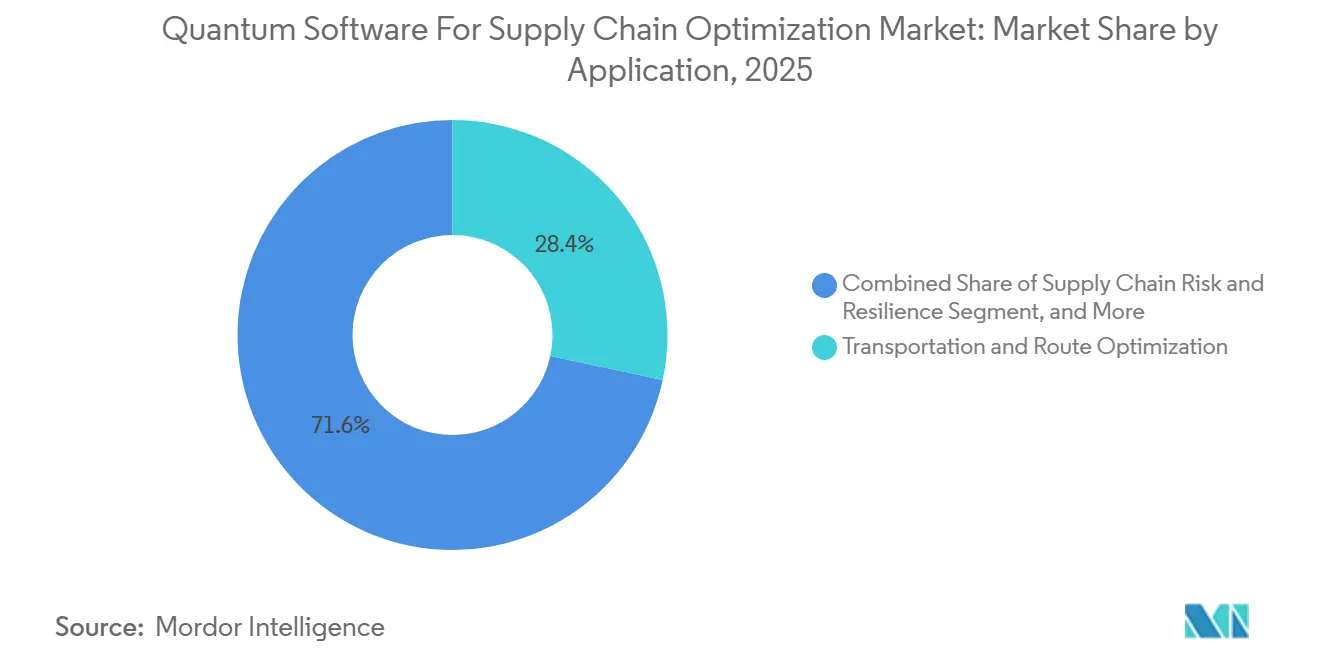
Route Optimization Holds Scale While Risk Planning Accelerates FastestTransportation and route optimization held 28.36% share in 2025, while supply chain risk and resilience planning is projected to expand at a 38.74% CAGR through 2031. Route optimization leads because it already has commercially visible pilots and because the underlying problem structure aligns well with quantum annealing and hybrid search methods. A 2025 peer-reviewed study reported 12% lower fuel consumption and 18% shorter delivery times in quantum-assisted routing use cases, providing the quantum software for supply chain optimization market with one of its clearest operational proof points. This application also benefits from repetition, since routing decisions are made frequently and small improvements can be multiplied across large fleets and delivery networks. That recurring planning cycle helps buyers justify the effort needed to test new optimization methods.
Risk and resilience planning is growing faster because companies want broader scenario coverage for supplier exposure, transport disruption, and recovery planning. A 2026 study on Quantum Supply Chain Risk Optimization reported a 23.7% cost reduction compared to classical heuristics in multi-tier logistics, along with stronger recovery and resilience outcomes, supporting expansion in this use case. Inventory optimization and production planning also remain important, with a 2025 review noting a 30% reduction in production lead times and a 15% improvement in demand forecast accuracy in the related research base. Supply chain network design is a smaller but emerging part of the quantum software for supply chain optimization market, particularly for companies that need to redesign multi-echelon networks under cost and emissions constraints. Overall, the application mix shows that the market is no longer limited to routing alone and is expanding into higher-strategic-value planning layers.

By End User:
Manufacturing Anchors Adoption While Retail And E-Commerce Expands FastestIndustrial manufacturing held 24.19% share in 2025, while retail and e-commerce are projected to expand at a 37.62% CAGR through 2031. Manufacturing leads because it involves dense production scheduling, bill-of-material balancing, and multi-line capacity decisions that naturally translate into optimization formulations. This gives the segment a practical fit with early hybrid quantum workflows, especially where a plant needs faster scheduling under many operating constraints. BASF and D-Wave provided one of the clearest examples in 2025 when they cut production scheduling time from 10 hours to 5 seconds in a liquid-filling environment and also improved lateness, setup time, and tank unloading performance. That kind of operational evidence helps explain why industrial users still anchor revenue in the quantum software for supply chain optimization industry.
Retail and e-commerce are growing faster because omnichannel fulfillment creates a much larger volume of SKU-location, routing, batching, and inventory decisions across each planning cycle. A 2025 study in The Journal of Supercomputing found that AI-quantum hybrid models can improve logistics efficiency and sustainability in e-commerce beyond what classical AI can deliver on several combinatorial tasks. Transportation and logistics, energy and utilities, and food and beverage remain active middle-tier demand pockets, with pilot programs moving toward managed production use. Aerospace and defense, IT and telecom, and construction and infrastructure are earlier in adoption, but their operating complexity makes them relevant once platform maturity, compliance, and internal skills improve. The end-user mix in the quantum software for supply chain optimization market therefore combines current volume from manufacturing with a stronger forward growth signal from digital commerce operations.
Geography Analysis
North America Quantum Software for Supply Chain Optimization Market
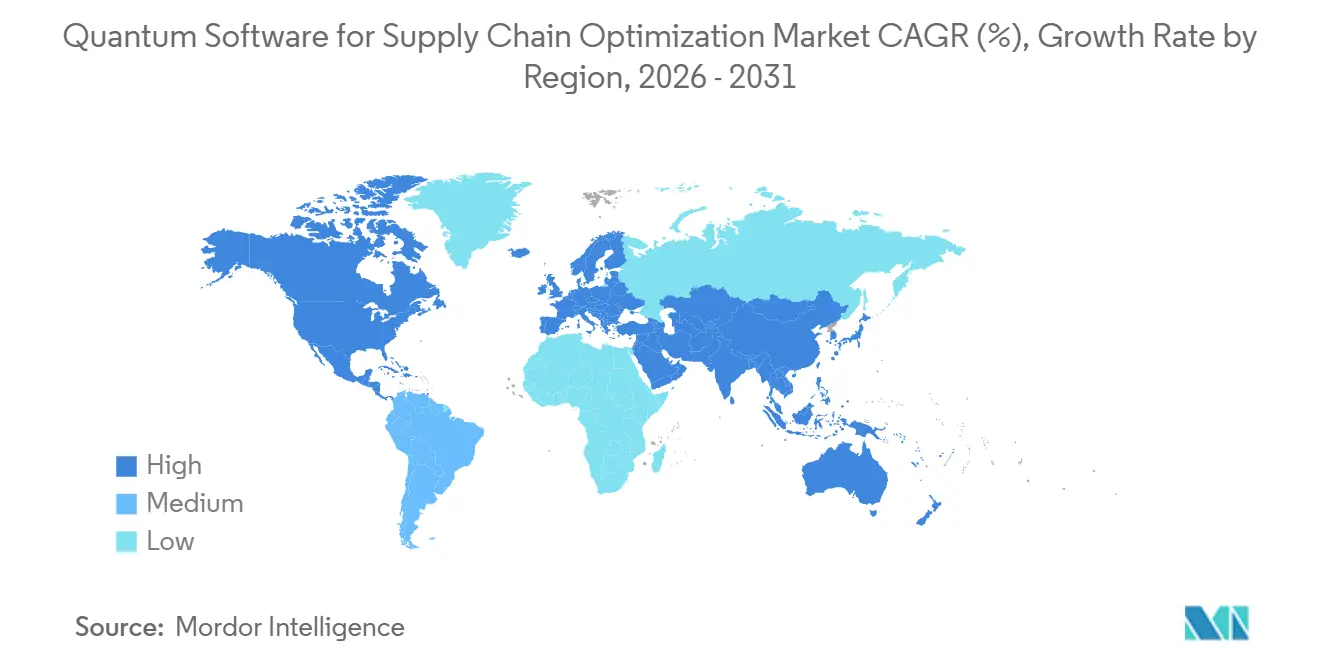
North America held 34.82% of the quantum software for supply chain optimization market share in 2025. The region leads because it combines enterprise buyer demand with the geographic concentration of major platform vendors, including IBM, D-Wave, IonQ, Google, AWS, and Microsoft. A 2025 review also noted the United States commitment of USD 675 million in annual quantum information science investment through 2028, which supports both research depth and ecosystem continuity. In May 2026, IBM and the U.S. Department of Commerce signed a Letter of Intent to establish Anderon, America’s first purpose-built quantum wafer foundry, backed by a proposed USD 1 billion CHIPS Act award and USD 1 billion in IBM cash investment. Canada also adds depth through the IBM and Polytechnique Montréal initiative launched in November 2025 for AI and quantum-enabled forestry supply chain decision support, while Mexico is emerging as a demand pocket as nearshoring raises the complexity of manufacturing logistics across North American corridors.
APAC Quantum Software for Supply Chain Optimization Market
Asia-Pacific is projected to record the fastest growth in the quantum software for supply chain optimization market, with a 36.93% CAGR through 2031. The region is supported by China’s state-backed programs, Japan’s government-industry efforts in automotive and semiconductor supply chains, and India’s National Quantum Mission, which has allocated INR 6,000 crore (USD 718 million) for indigenous capability development. Dense electronics and industrial supply chains also help the regional outlook in South Korea and Southeast Asia, where route, inventory, and production optimization already matter at very high transaction volumes. In April 2026, Horizon Quantum Holdings in Singapore signed a strategic agreement with IonQ to purchase one of IonQ’s first 6th-generation, chip-based 256-qubit trapped-ion systems, indicating deeper regional software and infrastructure readiness. China’s work in quantum communications, including the Beijing-Shanghai quantum key distribution network highlighted in the 2025 review, also signals adjacent demand for secure and advanced digital supply chain environments.
EMEA and South America Quantum Software for Supply Chain Optimization Market
Europe remains a credible third center in the quantum software for supply chain optimization market, supported by Germany’s DLR Quantum Computing Initiative and the EU Quantum Flagship program. Germany’s QuTeNet project is one visible example, with support for tensor-network optimization in maritime logistics through BearingPoint, Multiverse Computing, and Fraunhofer CML. The United Kingdom also strengthened its role in 2026 through the University of Cambridge's partnership with IonQ, described as the country’s largest corporate quantum research collaboration. South America, the Middle East, and Africa remain earlier-stage regions where activity is still concentrated in pilots, research partnerships, and selective enterprise exploration rather than broad commercial adoption.
Competitive Landscape
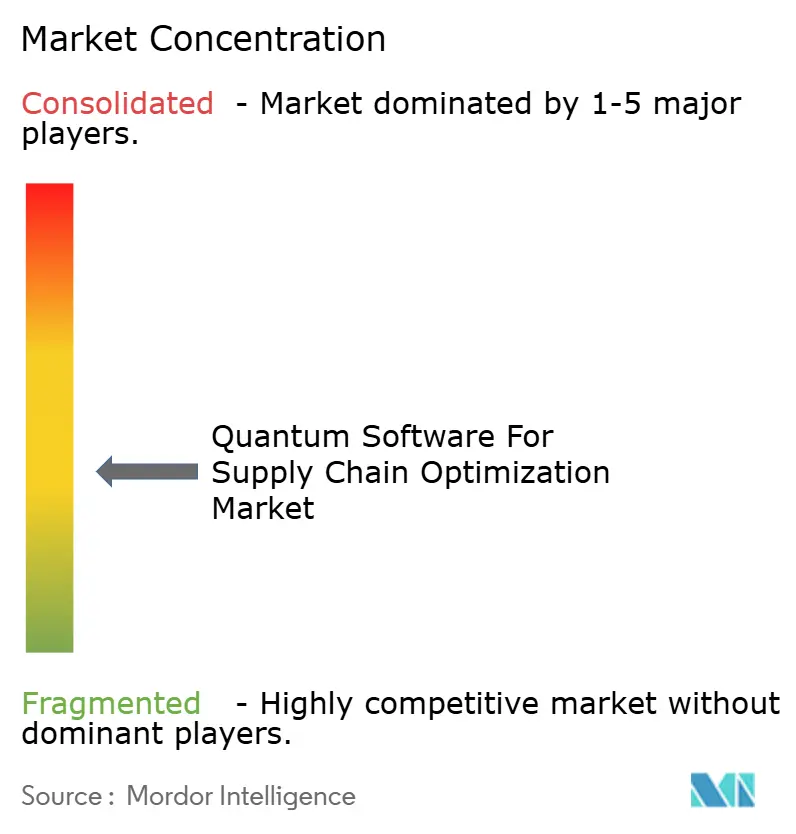
The quantum software for supply chain optimization market is moderately concentrated at the platform layer and more fragmented at the application layer. IBM, Microsoft, Google, and Amazon Web Services anchor the cloud platform tier, where access to hardware and developer environments shape the broader software ecosystem. D-Wave holds a distinct position because annealing-based optimization is already in active, production-oriented supply chain workflows rather than only in lab or pilot settings. Pure-play vendors such as Classiq, QC Ware, Xanadu Quantum Technologies, and Pasqal compete through algorithm design, workflow tools, and more specialized optimization capabilities. SAP and Oracle are also tightening the competition by embedding quantum-ready functionality into broader ERP and supply chain planning portfolios, narrowing the gap between core software and advanced optimization overlays.
Several strategic moves since late 2025 show how fast competitive positions are being built. IBM committed more than USD 10 billion in June 2026 across R&D, manufacturing, ecosystem partnerships, capital expenditure, and M&A, which strengthened its long-term platform position and ecosystem pull. IonQ announced its planned USD 1.8 billion acquisition of SkyWater Technology in January 2026, creating a vertically integrated domestic quantum stack in the United States from chip design through deployment and service upgrades. D-Wave also announced a USD 10 million, two-year QCaaS agreement with a Fortune 100 company in January 2026, and said the customer already had a first quantum-powered application running daily in production. In October 2025, Swiss Quantum Technology SA signed a EUR 10 million (USD 10.9 million) agreement with D-Wave to deploy an Advantage2 annealing quantum computer in Europe, which expanded D-Wave’s hardware-plus-services reach for industrial users.
Competitive space remains open in areas where buyers want less lock-in and more domain-specific value. One of the clearest gaps is middleware that can sit across annealing, gate-model, and quantum-inspired stacks, because many enterprises do not want to redesign workflows each time they test a different platform. Another gap lies in specialized solvers for areas such as cold-chain optimization and construction materials logistics, where planning complexity is high but vendor coverage remains limited. Joint development models are also becoming more common, as shown by the Airbus-related multi-objective logistics work from NTT Data Germany and NTT Research on IonQ hardware. This pattern spreads revenue across cloud providers, software specialists, and implementation partners, which is why the broader quantum software for supply chain optimization market still looks fragmented despite visible leadership at the platform tier.
Quantum Software For Supply Chain Optimization Industry Leaders
-
IBM Corporation
-
Microsoft Corporation
-
D-Wave Quantum Inc.
-
Quantinuum Ltd.
-
IonQ, Inc.
- *Disclaimer: Major Players sorted in no particular order
Quantum Software For Supply Chain Optimization Market Companies Covered in this Report
- IBM Corporation
- Microsoft Corporation
- D-Wave Quantum Inc.
- Quantinuum Ltd.
- IonQ, Inc.
- Amazon Web Services, Inc.
- Google LLC
- SAP SE
- Oracle Corporation
- Accenture plc
- Atos SE
- Fujitsu Limited
- Classiq Technologies Ltd.
- QC Ware Corp.
- 1QBit
- Xanadu Quantum Technologies Inc.
- Rigetti Computing, Inc.
- Pasqal SAS
- Toshiba Digital Solutions Corporation
- Multiverse Computing
Recent Industry Developments in Quantum Software For Supply Chain Optimization Market
- January 2026: IBM committed more than USD 10 billion to quantum computing over five years, covering R&D, capital expenditure, manufacturing, ecosystem partnerships, and M&A. The investment directly reinforces the supply chain optimization software ecosystem that depends on IBM's Qiskit platform and IBM Quantum Network, and it establishes quantum compute as a multi-decade infrastructure commitment.
- May 2026: IBM and the US Department of Commerce signed a Letter of Intent to establish Anderon, America's first pure-play quantum wafer foundry, backed by a proposed USD 1 billion CHIPS Act incentive and USD 1 billion in IBM cash investment based in Albany, New York. The facility secures domestic production capacity for quantum hardware that underpins supply chain optimization software deployments across defense and commercial sectors.
- May 2026: Quantinuum entered into a Letter of Intent with the US Department of Commerce for funding to accelerate fault-tolerant trapped-ion quantum computing, partnering with GlobalFoundries and Monarch Quantum to onshore critical photonics and semiconductor manufacturing. The collaboration targets bottlenecks in fault-tolerant system development with supply chain resilience implications for the quantum hardware ecosystem itself.
- April 2026: Horizon Quantum Holdings (Singapore) and IonQ signed a strategic agreement under which Horizon Quantum will purchase one of IonQ's first 6th-generation, chip-based 256-qubit trapped-ion systems. The deployment advances quantum software infrastructure for broad quantum advantage in Asian industrial and logistics applications.
Global Quantum Software For Supply Chain Optimization Market Report Scope
The quantum software for supply chain optimization market refers to the specialized ecosystem of software solutions and associated services that leverage quantum computing algorithms to solve highly complex, large-scale optimization problems within supply chain and logistics operations. This market includes platforms designed to tackle specific supply chain challenges such as transportation and route optimization, inventory management, production scheduling, network design, and risk resilience planning. Deployed across cloud-based, hybrid, and on-premises environments, these quantum solutions cater to a wide range of industries, including manufacturing, retail, transportation, and aerospace. By utilizing quantum capabilities, such as evaluating a vast number of variables and constraints simultaneously, this software enables organizations to overcome the computational limitations of classical computers. This allows businesses to discover truly optimal logistics routes, drastically reduce operational costs, minimize inventory bottlenecks, and build highly agile, resilient supply chains that can rapidly adapt to real-time disruptions and dynamic market conditions.
The Quantum Software for Supply Chain Optimization Market Report is Segmented by Solution (Software and Services), Deployment (Cloud-Based, Hybrid, and On-Premises), Application (Transportation and Route Optimization, Inventory Optimization, Production Planning and Scheduling, Supply Chain Network Design, and Supply Chain Risk and Resilience Planning), End User (Industrial Manufacturing, Retail and E-Commerce, Transportation and Logistics, Energy and Utilities, Food and Beverage, IT and Telecom, Construction and Infrastructure, Aerospace and Defense, and Other End-user Industries), and Geography (North America, South America, Europe, Asia-Pacific, and Middle East and Africa). The Market Forecasts are Provided in Terms of Value (USD).
Segmentation Overview
| Software |
| Services |
| Cloud-Based |
| Hybrid |
| On-Premises |
| Transportation and Route Optimization |
| Inventory Optimization |
| Production Planning and Scheduling |
| Supply Chain Network Design |
| Supply Chain Risk and Resilience Planning |
| Industrial Manufacturing |
| Retail and E-Commerce |
| Transportation and Logistics |
| Energy and Utilities |
| Food and Beverage |
| IT and Telecom |
| Construction and Infrastructure |
| Aerospace and Defense |
| Other End-user Industries |
| North America | United States | |
| Canada | ||
| Mexico | ||
| South America | Brazil | |
| Argentina | ||
| Rest of South America | ||
| Europe | Germany | |
| United Kingdom | ||
| France | ||
| Russia | ||
| Spain | ||
| Rest of Europe | ||
| Asia-Pacific | China | |
| Japan | ||
| India | ||
| South Korea | ||
| Southeast Asia | ||
| Rest of Asia-Pacific | ||
| Middle East and Africa | Middle East | Saudi Arabia |
| United Arab Emirates | ||
| Turkey | ||
| Rest of Middle East | ||
| Africa | South Africa | |
| Nigeria | ||
| Egypt | ||
| Rest of Africa | ||
| By Solution | Software | ||
| Services | |||
| By Deployment | Cloud-Based | ||
| Hybrid | |||
| On-Premises | |||
| By Application | Transportation and Route Optimization | ||
| Inventory Optimization | |||
| Production Planning and Scheduling | |||
| Supply Chain Network Design | |||
| Supply Chain Risk and Resilience Planning | |||
| By End User | Industrial Manufacturing | ||
| Retail and E-Commerce | |||
| Transportation and Logistics | |||
| Energy and Utilities | |||
| Food and Beverage | |||
| IT and Telecom | |||
| Construction and Infrastructure | |||
| Aerospace and Defense | |||
| Other End-user Industries | |||
| By Geography | North America | United States | |
| Canada | |||
| Mexico | |||
| South America | Brazil | ||
| Argentina | |||
| Rest of South America | |||
| Europe | Germany | ||
| United Kingdom | |||
| France | |||
| Russia | |||
| Spain | |||
| Rest of Europe | |||
| Asia-Pacific | China | ||
| Japan | |||
| India | |||
| South Korea | |||
| Southeast Asia | |||
| Rest of Asia-Pacific | |||
| Middle East and Africa | Middle East | Saudi Arabia | |
| United Arab Emirates | |||
| Turkey | |||
| Rest of Middle East | |||
| Africa | South Africa | ||
| Nigeria | |||
| Egypt | |||
| Rest of Africa | |||
Key Questions Answered in the Report
What is the current outlook for the quantum software for supply chain optimization market size?
The market was valued at USD 0.41 billion in 2025 and is forecast to reach USD 2.17 billion by 2031, growing at a 33.07% CAGR over 2026-2031.
Which deployment model leads adoption in quantum supply chain software?
Cloud-based deployment led with 71.24% share in 2025 because it lowers trial costs and gives enterprises easier access to quantum and hybrid environments.
Which application area is growing fastest in quantum optimization for supply chains?
Supply chain risk and resilience planning is projected to expand at a 38.74% CAGR through 2031 as companies invest in broader scenario planning and recovery modeling.
Why does industrial manufacturing lead end-user demand for this software?
Industrial manufacturing held 24.19% share in 2025 because production scheduling, line balancing, and bill-of-materials optimization fit early hybrid quantum workflows well.
Which region is expected to grow fastest through 2031?
Asia-Pacific is projected to record the highest CAGR at 36.93% through 2031, supported by state-backed programs and dense industrial supply chains.
What is pushing services growth faster than software growth?
Services is projected to grow at 36.42% because many enterprises still need outside help with model design, integration, workflow tuning, and deployment support.