
PVC Recycling Market Size and Share
Market Overview
| Study Period | 2022 - 2032 |
|---|---|
| Market Size (2027) | USD 5.24 Billion |
| Market Size (2032) | USD 7.56 Billion |
| Growth Rate (2027 - 2032) | 7.63 % |
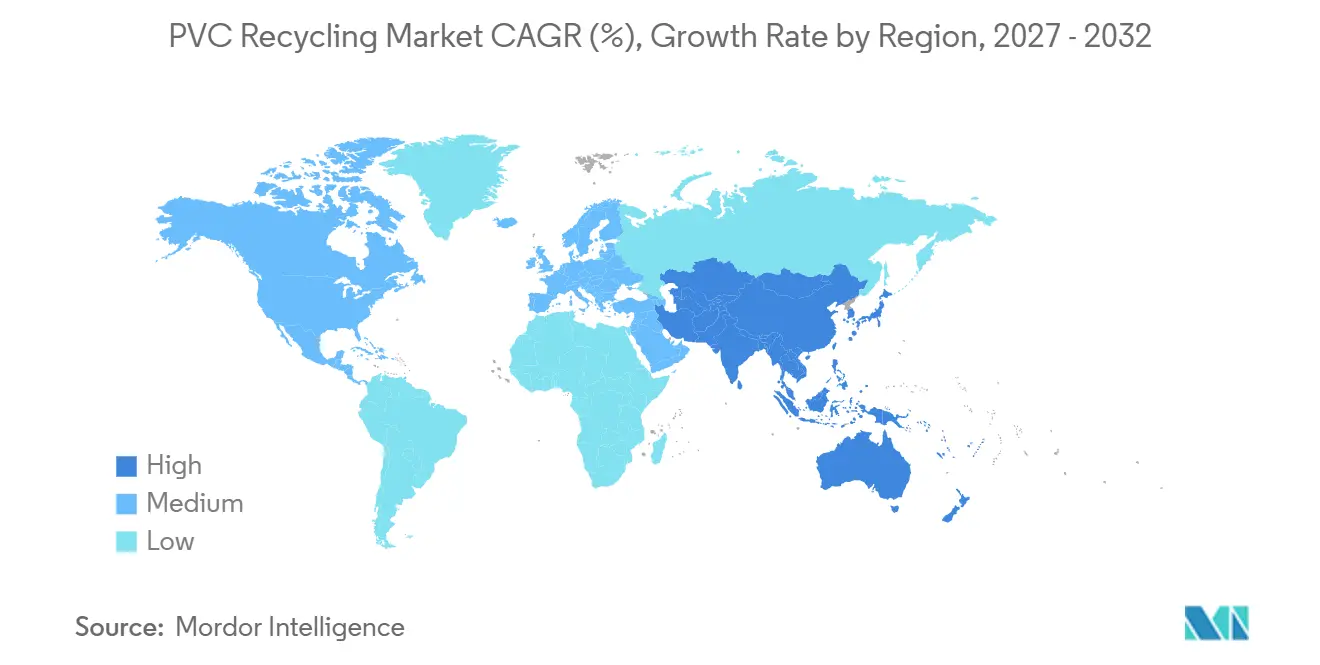
| Fastest Growing Market | Asia-Pacific |
| Largest Market | Europe |
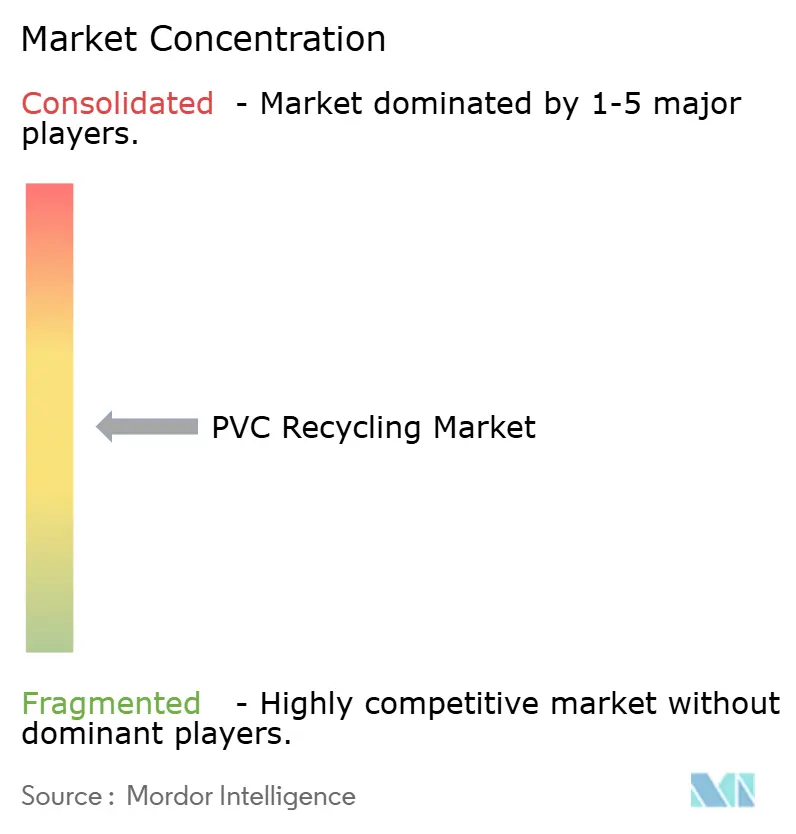
| Market Concentration | Medium |
Major Players *Disclaimer: Major Players sorted in no particular order Image © Mordor Intelligence. Reuse requires attribution under CC BY 4.0. | |
PVC Recycling Market Analysis by Mordor Intelligence
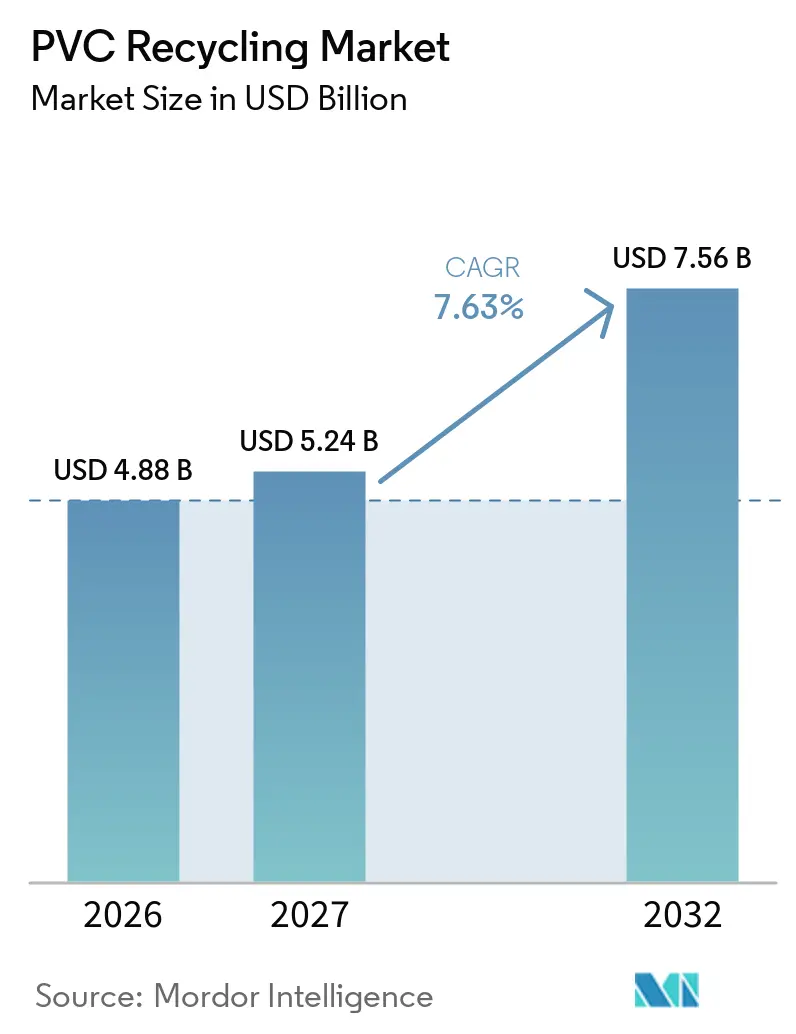
The PVC Recycling Market size was valued at USD 4.88 billion in 2026 and is estimated to grow from USD 5.24 billion in 2027 to reach USD 7.56 billion by 2032, at a CAGR of 7.63% during the forecast period (2027-2032). The Polyvinyl Chloride (PVC) recycling market is being shaped by recycled-content rules, extended producer responsibility programs, and better sorting systems that make post-consumer material more usable. Construction renovation is expanding the available supply of old windows, pipes, flooring, and cable products, while procurement rules are creating clearer demand for recycled compounds. In Europe, product standards and traceability requirements are raising the value of consistent, certified output. In the Asia-Pacific region, formal collection systems are expanding alongside urban development and producer responsibility programs. These conditions create different opportunities for companies that control feedstock, operate closed-loop systems, or can process mixed materials safely.
Key Report Takeaways
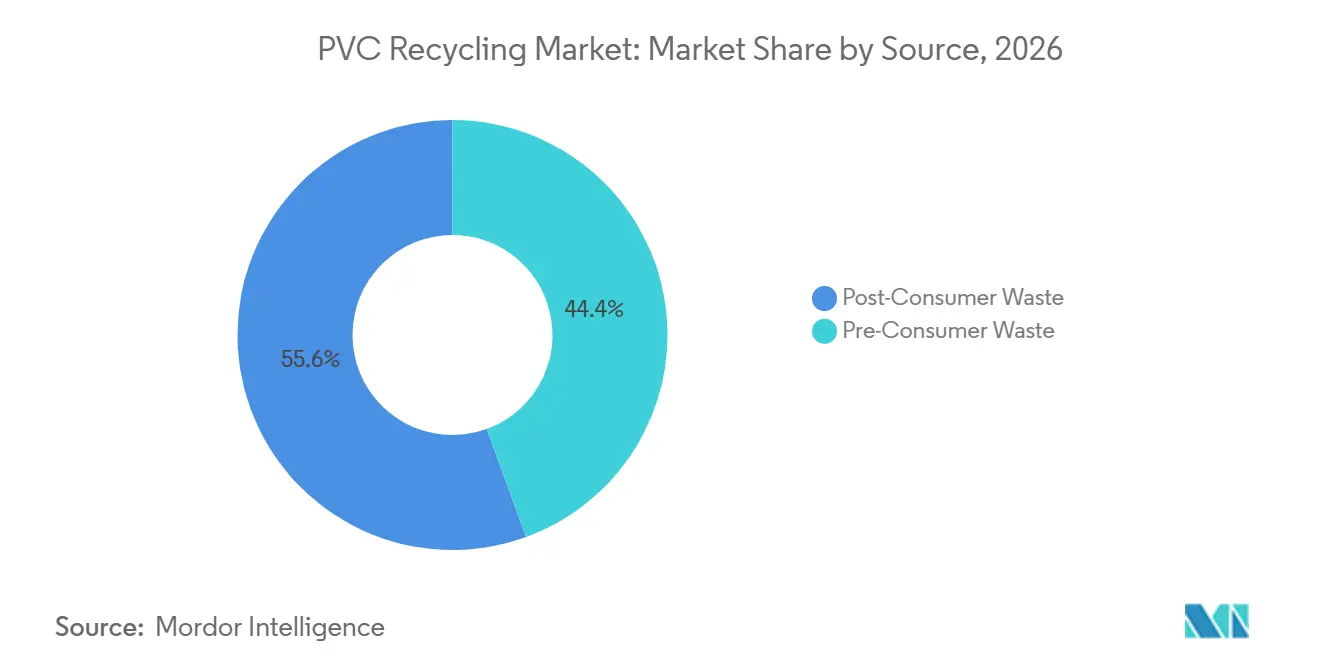
- By source, post-consumer waste held 55.57% of the PVC recycling market share in 2026 and is forecast to advance at an 8.12% CAGR through 2032.
- By type, rigid PVC held 62.04% of the PVC recycling market share in 2026, while flexible PVC is forecast to advance at an 8.34% CAGR through 2032.
- By process, mechanical recycling held 83.19% of the PVC recycling market share in 2026, while chemical recycling is forecast to advance at an 8.51% CAGR through 2032.
- By application, pipes and fittings held 28.22% of the PVC recycling market share in 2026, while window profiles and doors are forecast to advance at a 9.05% CAGR through 2032.
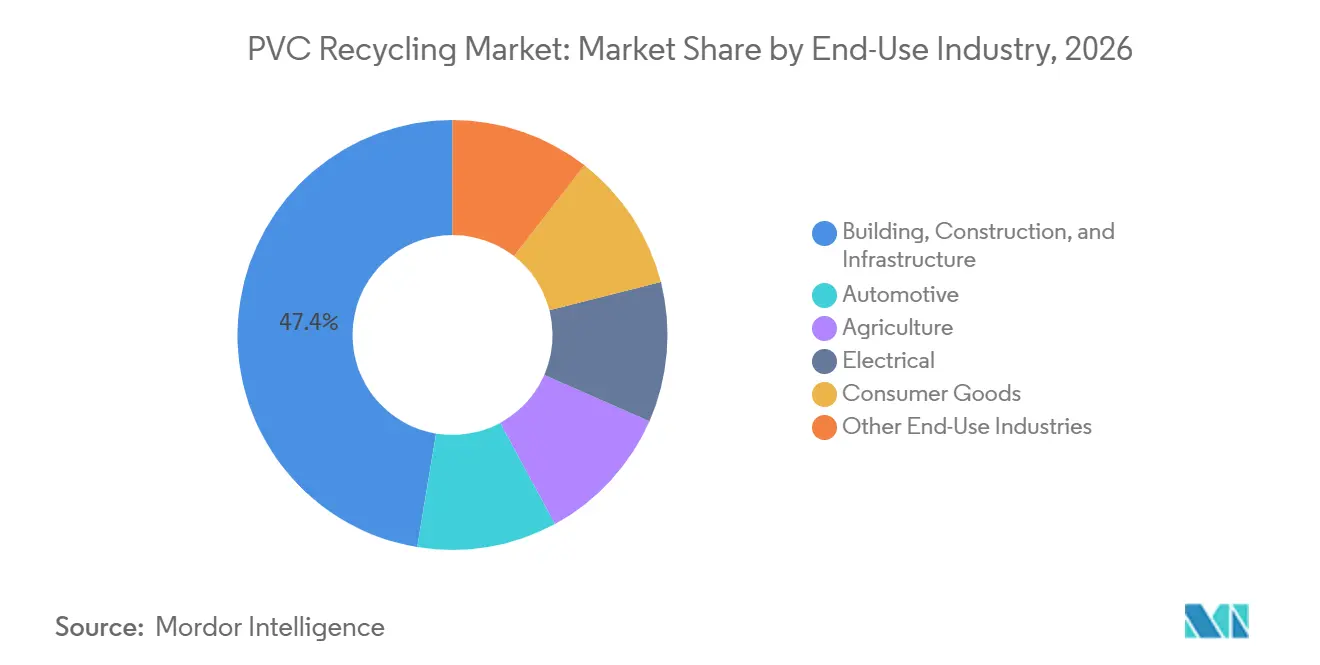
- By end-use industry, building, construction, and infrastructure held 47.38% of the PVC recycling market share in 2026, while automotive is forecast to advance at a 9.32% CAGR through 2032.
- By geography, Europe held 38.45% of the PVC recycling market share in 2026, while Asia-Pacific is forecast to advance at an 8.87% CAGR through 2032.
Note: Market numbers in this report are based on Mordor Intelligence's proprietary estimation framework, which combines nine months of actuals with Q4 projections for base year 2026.
Market Trends and Insights
Drivers Impact Analysis of PVC Recycling Market*
| Driver | (~) % Impact on CAGR Forecast | Geographic Relevance | Impact Timeline |
|---|---|---|---|
| Recycled-Content Mandates and Extended Producer Responsibility | +1.8% | Global, pronounced in EU and North America | Short term (≤ 2 years) |
| Construction and Demolition Waste Diversion | +1.2% | Europe, APAC core, spillover to North America | Medium term (2-4 years) |
| Closed-Loop Procurement by Window, Pipe, and Flooring Producers | +0.9% | Europe, North America | Medium term (2-4 years) |
| Sensor-Based Sorting and Digital Traceability | +0.6% | Global, EU and East Asia early adopters | Medium term (2-4 years) |
| Automotive Lightweighting and Sustainable Interior Materials | +0.5% | Global, emphasis on EU and APAC | Long term (≥ 4 years) |
| Source: Mordor Intelligence | |||
Recycled-Content Mandates and Extended Producer Responsibility
Regulation (EU) 2025/40 entered into force on February 11, 2025, and applies from August 2026. It sets recycled-content targets for plastic packaging of 10% to 30% by 2030 and 50% to 65% by 2040, while also harmonizing extended producer responsibility fee structures across EU member states[1]. The regulation gives the PVC recycling market a more predictable basis for demand in packaging-adjacent applications. Fee modulation links recyclability and recycled content to a producer's cost, which supports material choices that can be recovered and verified. Germany's 2025 minimum standard links packaging recyclability assessment to recognized design and collection requirements. These rules also make documentation, material selection, and supply-chain records more important for window, pipe, and flooring producers.
Construction and Demolition Waste Diversion
Construction and demolition activity is creating larger end-of-life PVC streams, particularly from the renovation of older buildings. Recovinyl recorded 416,889 metric tons of recycled window profiles in 2025, followed by 119,873 metric tons of flooring and 104,633 metric tons of cable waste. These flows strengthen the PVC recycling market because they can be collected in larger and more uniform loads than mixed municipal waste. Pre-demolition audits and source separation rules can help processors identify material before it is mixed with other construction debris. Renovation rules that require better building energy performance can also bring older window frames into the collection system. Recyclers with contractor and fabricator relationships are better placed to secure this feedstock at a lower handling cost.
Closed-Loop Procurement by Window, Pipe, and Flooring Producers
Closed-loop procurement reduces exposure to changes in open-market recyclate prices. REHAU Industries SE & Co. KG operates 3 VinylPlus-certified recycling plants with a combined annual capacity of 70,000 metric tons and uses more than 60% recycled content in EcoPuls profile systems. VEKA Umwelttechnik GmbH operates a dedicated PVC window recycling facility with 100,000 metric tons of annual capacity and a network of more than 2,300 partner fabricators. This model supports the PVC recycling market by connecting collection, sorting, compounding, and profile production in one chain. Captive supply enables producers to maintain recycled-content offerings when virgin resin prices decline. It also gives established companies a supply advantage that a new operator cannot quickly reproduce.
Sensor-Based Sorting and Digital Traceability
Near-infrared and X-ray fluorescence systems can improve the separation of mixed PVC waste by identifying polymer types and additive profiles. PreZero Kunststoffrecycling GmbH & Co. KG opened an artificial intelligence-supported lightweight packaging sorting facility in Sollenau, Austria, in July 2025 with 100,000 metric tons of annual capacity and 35 near-infrared sorters. Better sorting supports higher-quality output for the PVC recycling market because legacy additives and material history affect where a recyclate can be used. REHAU Industries SE & Co. KG's Window.ID approach gives individual profiles a documented material identity, including resin, stabilizer, and color information. Traceability can reduce the need for conservative blending and help processors document material quality for customers.
Restraints Impact Analysis of PVC Recycling Market*
| Restraint | (~) % Impact on CAGR Forecast | Geographic Relevance | Impact Timeline |
|---|---|---|---|
| Virgin PVC Price Competition | -1.6% | Global | Short term (≤ 2 years) |
| Legacy Additives and Contaminant Management | -1.1% | Europe, North America | Medium term (2-4 years) |
| High Capital Intensity of Chemical Recycling | -0.8% | Global | Long term (≥ 4 years) |
| Source: Mordor Intelligence | |||
Virgin PVC Price Competition
Recycled PVC has not reached stable cost parity with virgin PVC in many applications. When naphtha and ethylene dichloride prices declined in 2024 and 2025, virgin compound prices could undercut recycled compounds despite producer responsibility fee differences. This limits growth in the PVC recycling market because many downstream buyers still use virgin resin prices as a purchasing benchmark. Recyclers without captive demand face changing feedstock costs while their selling prices remain constrained. The pressure is greatest for processors that handle mixed waste and must spend more on sorting and cleaning. Clear policy signals and longer supply agreements can reduce the effect of this price gap.
Legacy Additives and Contaminant Management
Older European PVC building products can contain lead- and cadmium-based heat stabilizers that remain in end-of-life waste. These materials were phased out under REACH, but they require testing and controlled handling when recovered products are intended for regulated uses. The issue divides the PVC recycling market into streams with different quality levels and selling values. Food-contact products, children's products, and medical applications have tighter limits on the materials they can use. A 2025 study identified chemical reconstruction as a possible route for treating legacy-additive-bearing PVC, although commercial deployment remains a longer-term prospect. Incoming material tests, documentation, and liability controls also add operating costs for smaller processors.
*Our forecasts treat driver/restraint impacts as directional, not additive. The impact forecasts reflect baseline growth, mix effects, and variable interactions.
PVC Recycling Market Segment Analysis
By Source:
Post-Consumer Waste Shifts the Structural Feedstock BalancePost-consumer waste held 55.57% of the PVC recycling market share in 2026 and is forecast to advance at an 8.12% CAGR through 2032. Its position reflects more material becoming available from demolished buildings, renovation work, and producer responsibility collection systems. This shift changes the feedstock balance because old windows, pipes, flooring, and cable products now contribute more material to recovery systems. Post-consumer collection is more complex than collecting factory offcuts because loads must be identified, transported, and sorted. The resulting need for local collection networks favors companies that already work with demolition contractors, installers, and municipal programs.
Pre-consumer waste retains advantages in material consistency and lower contamination. It comes from controlled manufacturing processes, so its composition is easier to document and process. Its supply is limited by production volumes and does not rise with renovation or demolition activity. Post-consumer collection can expand as older buildings are upgraded or removed, making it a central source of future material for the PVC recycling market. Regulation (EU) 2025/40 reinforces collection investment by linking producer responsibility systems to recyclability and recycled-content outcomes. The change requires capital for distributed collection, but it can create a broader and more durable supply base.
By Type:
Rigid PVC Anchors Revenue, Flexible PVC Commands the Growth PremiumRigid PVC held 62.04% of the market share in 2026. Window profiles, pipes, doors, and cladding create large and relatively uniform rigid streams that are suited to mechanical recycling. Recovinyl recorded 416,889 metric tons of recycled window profiles in 2025, confirming its central role in the European supply. EN 18066:2025 sets design-for-recycling principles for unplasticized PVC (PVC-U) profiles used in construction, which strengthens the case for specification-led recovery. Rigid material can often be cleaned, ground, compounded, and returned to profile production. Chlorinated PVC remains a small recycling stream because it needs additional processing.
Flexible PVC is projected to advance at an 8.34% CAGR through 2032. Its growth is linked to automotive and electrical uses that need flexible materials with documented quality and stable performance. Automotive recycled-content rules create a clearer demand signal for materials used in interiors and cable systems. Flexible products remain harder to collect because they are mixed with other polymers, textiles, and additives. VEKA Umwelttechnik GmbH received RecyClass certification in June 2025 for profiles that incorporate 35% recycled material, including 71% post-consumer material. This shows the level of material control needed to reach higher value uses, even though the certification applies to profile production rather than all flexible PVC uses.
By Process:
Mechanical Recycling Leads, Chemical Recycling Accelerates RapidlyMechanical recycling held 83.19% of the market share in 2026. The process benefits from established collection systems, lower capital needs, and good performance with homogeneous factory waste or clean end-of-life profiles. It preserves polymer structure and can produce compounds that meet many applications' performance requirements. REHAU Industries SE & Co. KG, VEKA Umwelttechnik GmbH, and Eurocell use mechanically recycled material in window-profile systems and related products. Mechanical routes depend on reliable sorting because contamination can limit end uses. As post-consumer supply increases, processors will need better screening for additives, color, and mixed polymers.
Chemical recycling is projected to advance at an 8.51% CAGR through 2032. It can address mixed, contaminated, and legacy-additive-bearing streams that mechanical processes may reject. The PVC recycling market may use chemical routes where the cost of cleaning material exceeds the value of the recovered compound. The Plastic Back pilot at Freepoint Eco-Systems' Ohio facility was targeted for commissioning in the first quarter of 2026 with support from the Vinyl Institute. Commercial progress will depend on plant economics, feedstock contracts, permitting, and safe chlorine management.
By Application:
Pipes and Fittings Lead Revenue, Window Profiles and Doors Expand RapidlyPipes and fittings held 28.22% of the market share in 2026. Their position is supported by construction demand and the relatively consistent composition of material taken from large infrastructure projects. Larger pipe loads can improve collection and processing economics because there are fewer material types to separate. The PVC recycling market also benefits when public works contractors separate pipes during demolition rather than sending them into mixed construction waste. Flooring remains an important application, with 119,873 metric tons recycled through the VinylPlus framework in 2025. Paprec Plastiques' Trémentines facility processes 25,000 metric tons of PVC annually, indicating commercial-scale capacity for flooring-related material.
Window profiles and doors are projected to advance at a 9.05% CAGR through 2032. Renovation activity creates an accessible flow of used profiles, while new design requirements improve the potential for future recovery. EN 18066:2025 guides material selection, recyclability assessment, and recycled PVC-U inclusion for construction profiles. Window systems can support closed-loop routes because fabricators, installers, and recyclers can work within defined collection networks. NIST found in 2025 that closed-loop recycling of PVC roofing membranes can lower embodied carbon compared with disposal routes[2]. Similar lifecycle evidence can help procurement teams justify recycled-content building products.
By End-Use Industry:
Building, Construction, and Infrastructure Command Share, Automotive Delivers the Growth InflectionBuilding, construction, and infrastructure held 47.38% of the market share in 2026. Pipes, profiles, conduits, roofing membranes, and cladding provide a large installed base of material that can enter recovery after use. This end-use sector also has established relationships among product manufacturers, fabricators, installers, and demolition firms. These relationships support collection routes that are more controlled than general municipal waste. The PVC recycling market is closely linked to renovation cycles because a larger flow of old products becomes available when building performance standards require upgrades. Long service lives delay supply, but they also provide large batches of material once replacement begins.
Automotive is projected to advance at a 9.32% CAGR through 2032. The category is supported by the EU's direction toward recycled plastic content in new vehicles, which increases the value of verified recycled polymers. Flexible PVC is used in dashboards, door panels, seat trim, and cable harnesses, although these products may include several materials that must be separated. Electrical uses, particularly cable insulation and sheathing, remain a large opportunity. VinylPlus recorded 104,633 metric tons of recycled cable PVC in 2025. Collection and treatment systems that can separate cable materials safely will be important for growth in both electrical and automotive applications.

Geography Analysis
Europe
Europe held 38.45% of the market share in 2026. The region has decades of collection and processing infrastructure, including voluntary producer action through VinylPlus and rules that support circular design. Recovinyl recorded 765,972 metric tons of PVC waste recycled in 2025, a 5.7% increase from 2024. Germany's Umweltbundesamt issued its 2025 minimum standard for packaging recyclability, and EN 18066:2025 provides a design-for-recycling framework for PVC-U construction profiles. Europe must still manage older building materials that contain legacy additives. VinylPlus is testing near-infrared and X-ray fluorescence sorting approaches to help distinguish these streams. The PVC recycling market in Europe is, therefore, moving toward higher control of materials, records, and end-use quality.
Asia-Pacific
Asia-Pacific is projected to advance at an 8.87% CAGR through 2032. China is strengthening domestic circular-economy capacity, while India is formalizing plastic waste collection through enforcement of its Plastic Waste Management Rules. These changes increase the potential supply of post-consumer material in large urban areas. The Organisation for Economic Co-operation and Development reported that South Korea aims to lift its mechanical recycling rate for municipal plastic waste from 18% to 25%. Japan's target of effective plastic reutilization by 2035 provides a longer planning horizon for collection and processing investment. Vehicle circularity requirements in Japan and South Korea can raise demand for better-quality recycled plastic. The region's core challenge is to improve sorting and quality assurance as capacity grows. That transition can allow the PVC recycling market to move beyond volume recovery toward more demanding construction, electrical, and vehicle applications.
Emerging Markets and Regional Differentiation
North America, South America, and the Middle East and Africa each offer different routes for expansion. In North America, state-level producer responsibility laws in California, Colorado, and Maine are encouraging investment in collection and recycling systems. The Vinyl Institute committed USD 2.7 million through its VIABILITY program as of June 2025, including support for PVC recycling projects. Plastic Back's pilot at Freepoint Eco-Systems in Ohio demonstrates a chemical route designed for PVC-specific recovery. Brazil and Argentina can add post-consumer feedstock as municipal waste systems develop, though formal collection remains at an earlier stage. Saudi Arabia's Vision 2030 infrastructure program points to a longer-term construction-material recovery opportunity. These regions will need stable collection economics, processing standards, and local buyers before the PVC recycling market can scale consistently.
Competitive Landscape
The PVC recycling market is moderately concentrated, with the top five players including Veolia, SUEZ, VEKA Umwelttechnik GmbH, REHAU Industries SE & Co. KG, and Dekura GmbH. European producers have built strong positions through closed-loop collection, certified compounds, and co-extrusion capacity, while North America and Asia-Pacific have more specialist recyclers and waste managers. VEKA Umwelttechnik GmbH works with more than 2,300 European fabricators, giving it access to a large collection network. REHAU Industries SE & Co. KG operates EcoPuls take-back systems with more than 1,200 partners and owns 3 recycling plants. These networks make feedstock supply more secure and reduce dependence on spot purchases. Veolia competes through broad waste aggregation and announced a GBP 70 million investment in a plastic recycling facility in Shropshire in July 2025. The facility is expected to sort 80,000 metric tons of mixed plastics each year.
Scale alone does not determine success in this field. Waste managers can secure large incoming volumes, but profile producers may have a stronger route to return material to defined products. Both positions can be effective when collection quality, sorting capability, and customer specifications are aligned. The commercial outcome depends on whether a company can convert collected material into a grade that a customer will repeatedly buy.
Competitive differentiation increasingly depends on feedstock access, sorting precision, product certification, and the ability to document recycled content. PreZero Kunststoffrecycling GmbH & Co. KG's Sollenau plant combines high-throughput processing with near-infrared sorting capacity, showing how large waste managers can improve output quality across several polymer streams. Eurocell recycled 36,500 metric tons of PVC waste in 2025, including 28,100 metric tons of post-consumer material, and was consolidating its United Kingdom recycling operations at Ilkeston. The investment reflects the advantage of integrating recovery with profile production. Paprec Group operates PVC-processing capacity through Paprec Plastiques and has expanded its sorting position with the July 2025 inauguration of ValcopIA in France. ValcopIA has 68,000 metric tons of annual capacity, 21 optical sorters, and 13 artificial intelligence monitoring gantries. Such investments can improve access to recoverable material, although mixed-plastic sorting is not the same as PVC-specific recycling.
PVC Recycling Industry Leaders
-
Veolia
-
SUEZ
-
VEKA Umwelttechnik GmbH
-
REHAU Industries SE & Co. KG
-
Dekura GmbH
- *Disclaimer: Major Players sorted in no particular order
PVC Recycling Market Companies Covered in this Report
- Adamas Plastic Inc.
- Dekura GmbH
- DS Smith
- Eurocell
- Morris Recycling Ltd
- Morssinkhof Rymoplast
- Paprec Group
- PreZero Kunststoffrecycling GmbH & Co. KG
- Reclaim Plastics
- REHAU Industries SE & Co. KG
- Simplas PVC Recycling
- SUEZ
- VEKA Umwelttechnik GmbH
- Veolia
- WRC Recycling
Recent Industry Developments in PVC Recycling Market
- October 2026: Paprec Group signed an agreement to acquire Danish waste management company Marius Pedersen A/S's operations in the Czech Republic and Slovakia, strengthening its presence in Central Europe. Upon completion, the acquisition will expand Paprec's network to 600 facilities across 15 countries, supporting its waste collection, recycling, and recovery capabilities.
- August 2026: Researchers at Virginia Tech developed a chemical process to convert hard-to-recycle PVC waste into polyalphaolefin (PAO), a key component of synthetic industrial lubricants and engine oils. The development supports the PVC Recycling Market by introducing a value-added chemical recycling pathway that converts difficult-to-process PVC waste into high-performance industrial products.
Global PVC Recycling Market Report Scope
PVC recycling involves the collection, sorting, and processing of discarded polyvinyl chloride materials to recover reusable polymers. The recovered material can be reprocessed into new products, helping reduce plastic waste and dependence on virgin PVC.
The PVC Recycling Market is segmented by source, type, process, application, end-use industry, and geography. By source, the market is segmented into pre-consumer waste and post-consumer waste. By type, the market is segmented into rigid PVC, flexible PVC, and chlorinated PVC. By process, the market is segmented into mechanical recycling, chemical recycling, and other processes. By application, the market is segmented into pipes and fittings, window profiles and doors, flooring, automotive interiors, and other applications. By end-use industry, the market is segmented into building, construction, and infrastructure, electrical, automotive, consumer goods, agriculture, and other end-use industries. The report also covers the market size and forecasts for PVC recycling across 15 countries. For each segment, the market sizing and forecasts have been done on the basis of value (USD).
Segmentation Overview
| Pre-Consumer Waste |
| Post-Consumer Waste |
| Rigid PVC |
| Flexible PVC |
| Chlorinated PVC |
| Mechanical Recycling |
| Chemical Recycling |
| Other Processes |
| Pipes and Fittings |
| Window Profiles and Doors |
| Flooring |
| Automotive Interiors |
| Other Applications |
| Building, Construction, and Infrastructure |
| Electrical |
| Automotive |
| Consumer Goods |
| Agriculture |
| Other End-Use Industries |
| Asia-Pacific | China |
| India | |
| Japan | |
| South Korea | |
| ASEAN Countries | |
| Rest of Asia-Pacific | |
| North America | United States |
| Canada | |
| Mexico | |
| Europe | Germany |
| United Kingdom | |
| France | |
| Italy | |
| NORDIC Countries | |
| Rest of Europe | |
| South America | Brazil |
| Argentina | |
| Rest of South America | |
| Middle East and Africa | Saudi Arabia |
| South Africa | |
| Rest of Middle East and Africa |
| By Source | Pre-Consumer Waste | |
| Post-Consumer Waste | ||
| By Type | Rigid PVC | |
| Flexible PVC | ||
| Chlorinated PVC | ||
| By Process | Mechanical Recycling | |
| Chemical Recycling | ||
| Other Processes | ||
| By Application | Pipes and Fittings | |
| Window Profiles and Doors | ||
| Flooring | ||
| Automotive Interiors | ||
| Other Applications | ||
| By End-Use Industry | Building, Construction, and Infrastructure | |
| Electrical | ||
| Automotive | ||
| Consumer Goods | ||
| Agriculture | ||
| Other End-Use Industries | ||
| By Geography | Asia-Pacific | China |
| India | ||
| Japan | ||
| South Korea | ||
| ASEAN Countries | ||
| Rest of Asia-Pacific | ||
| North America | United States | |
| Canada | ||
| Mexico | ||
| Europe | Germany | |
| United Kingdom | ||
| France | ||
| Italy | ||
| NORDIC Countries | ||
| Rest of Europe | ||
| South America | Brazil | |
| Argentina | ||
| Rest of South America | ||
| Middle East and Africa | Saudi Arabia | |
| South Africa | ||
| Rest of Middle East and Africa | ||
Key Questions Answered in the Report
What is the size of the PVC recycling market?
The PVC recycling market size was valued at USD 4.88 billion in 2026 and is estimated to grow from USD 5.24 billion in 2027 to reach USD 7.56 billion by 2032, at a CAGR of 7.63% during the forecast period (2027-2032).
What is driving PVC recycling demand?
Recycled-content requirements, extended producer responsibility programs, construction renovation, and improved sorting are strengthening demand for recycled PVC.
Which source held the largest share in 2026?
Post-consumer waste held 55.57% of the market share in 2026, supported by renovation and end-of-life collection systems.
Which process is projected to advance fastest through 2032?
Chemical recycling is projected to advance at an 8.51% CAGR through 2032 because it can handle some mixed and contaminated streams.