
Prosthetic Foot Market Size and Share
Market Overview
| Study Period | 2021 - 2032 |
|---|---|
| Market Size (2027) | USD 1.64 Billion |
| Market Size (2032) | USD 2.31 Billion |
| Growth Rate (2027 - 2032) | 7.12 % |
| Fastest Growing Market | Asia-Pacific |
| Largest Market | North America |
| Market Concentration | Medium |
Major Players *Disclaimer: Major Players sorted in no particular order Image © Mordor Intelligence. Reuse requires attribution under CC BY 4.0. | |
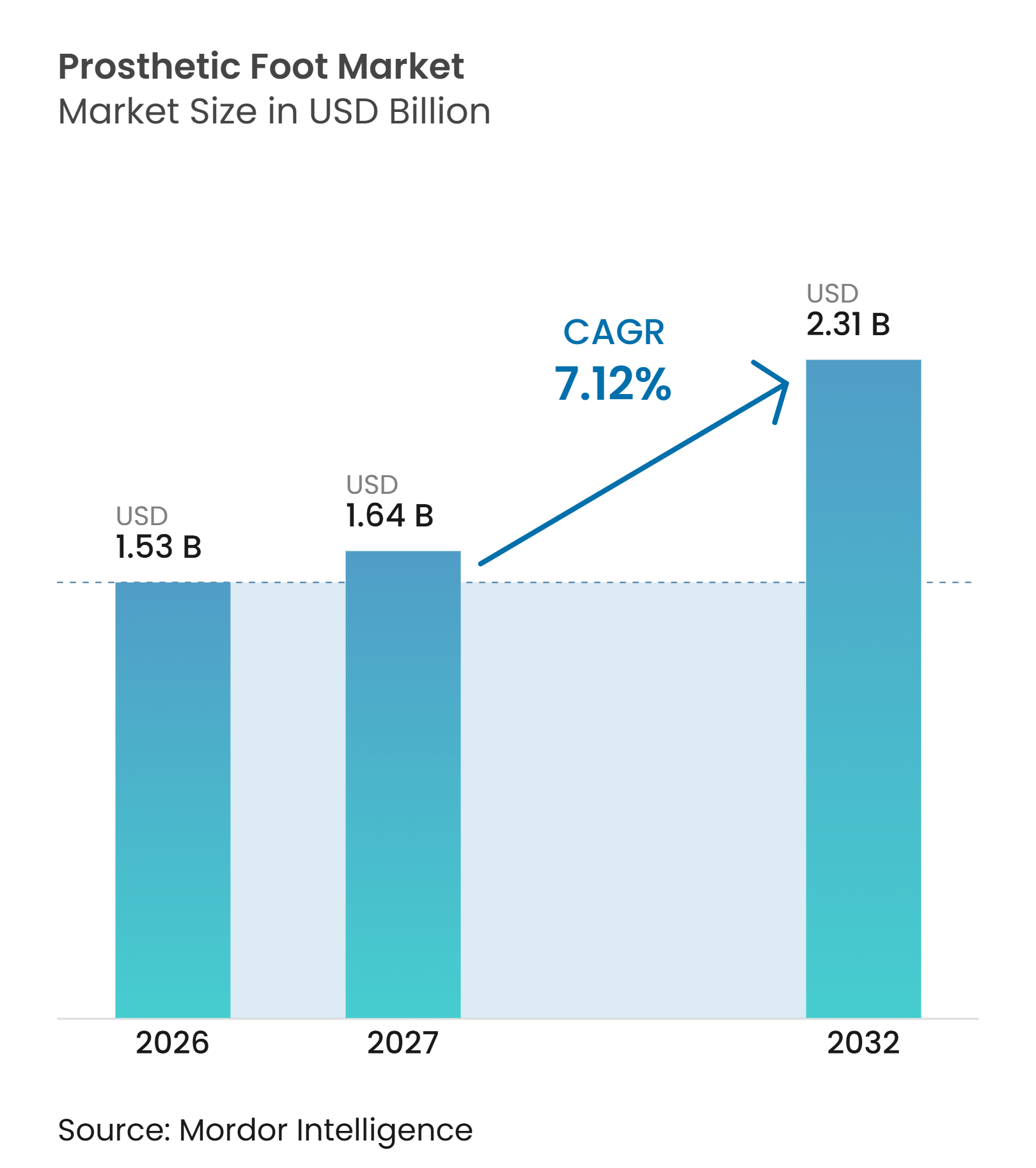
Prosthetic Foot Market Analysis by Mordor Intelligence
The Prosthetic Foot Market size is projected to be USD 1.53 billion in 2026, USD 1.64 billion in 2027, and reach USD 2.31 billion by 2032, growing at a CAGR of 7.12% from 2027 to 2032.
The prosthetic foot market is supported by the growing number of people living with limb loss and the continuing burden of diabetes and vascular disease. Demand is also moving toward products that improve stability, energy return, and use across uneven or wet environments. Clinical pathways matter because timely rehabilitation increases the chance that an eligible patient receives a prosthesis. Manufacturers are therefore strengthening product portfolios while building closer relationships with clinics and rehabilitation providers. Cost, reimbursement rules, and shortages of trained professionals continue to limit access in many countries.
Key Report Takeaways
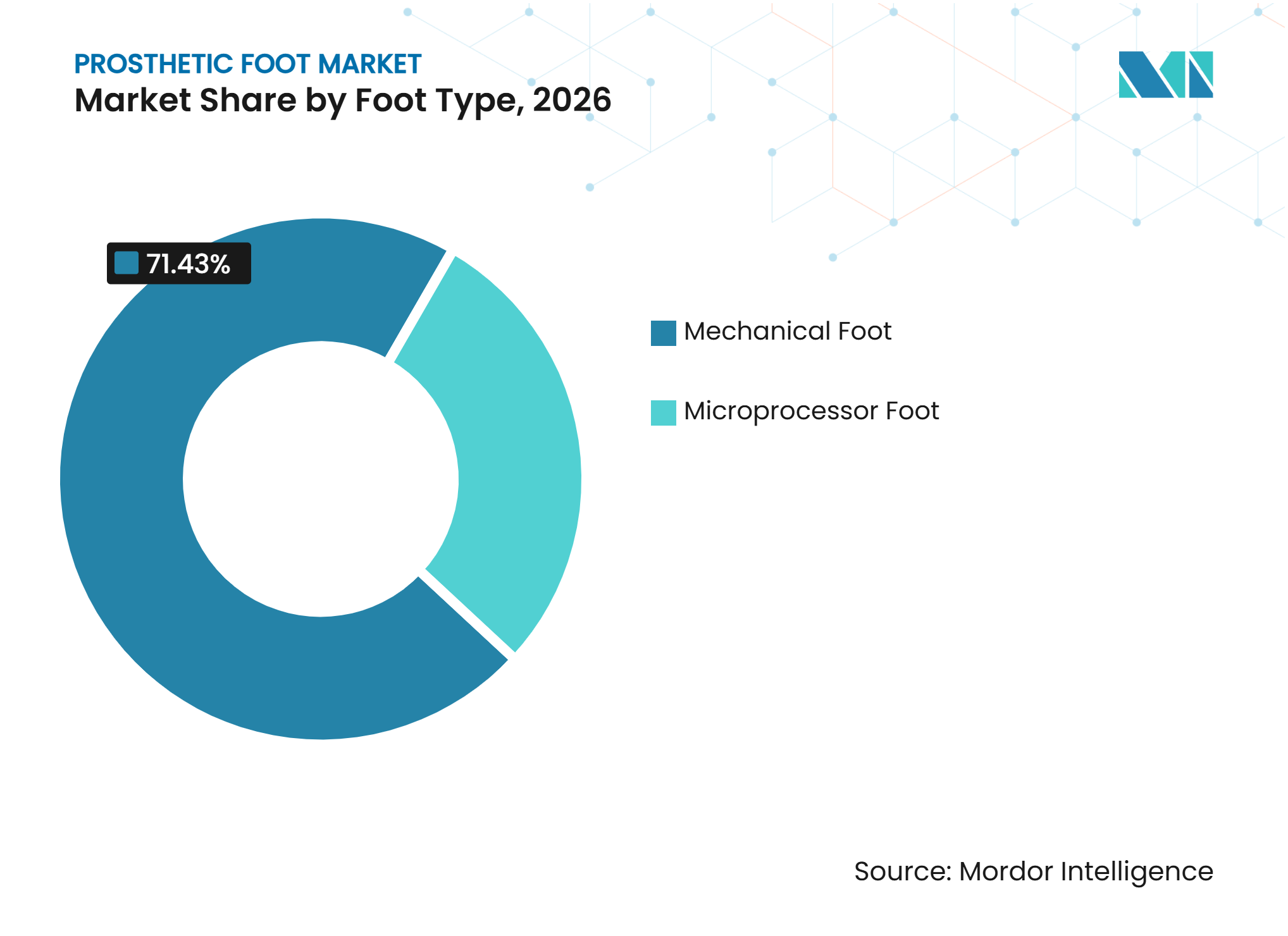
- By foot type, mechanical feet held 71.4% revenue share in 2026, while microprocessor-controlled feet are forecast to grow at a 9.5% CAGR through 2032.
- By material, carbon fiber held 34.7% revenue share in 2026, while composite materials are forecast to grow at a 9.4% CAGR through 2032.
- By application, daily living activities held 55.7% revenue share in 2026, while rehabilitation and therapy are forecast to grow at a 9.7% CAGR through 2032.
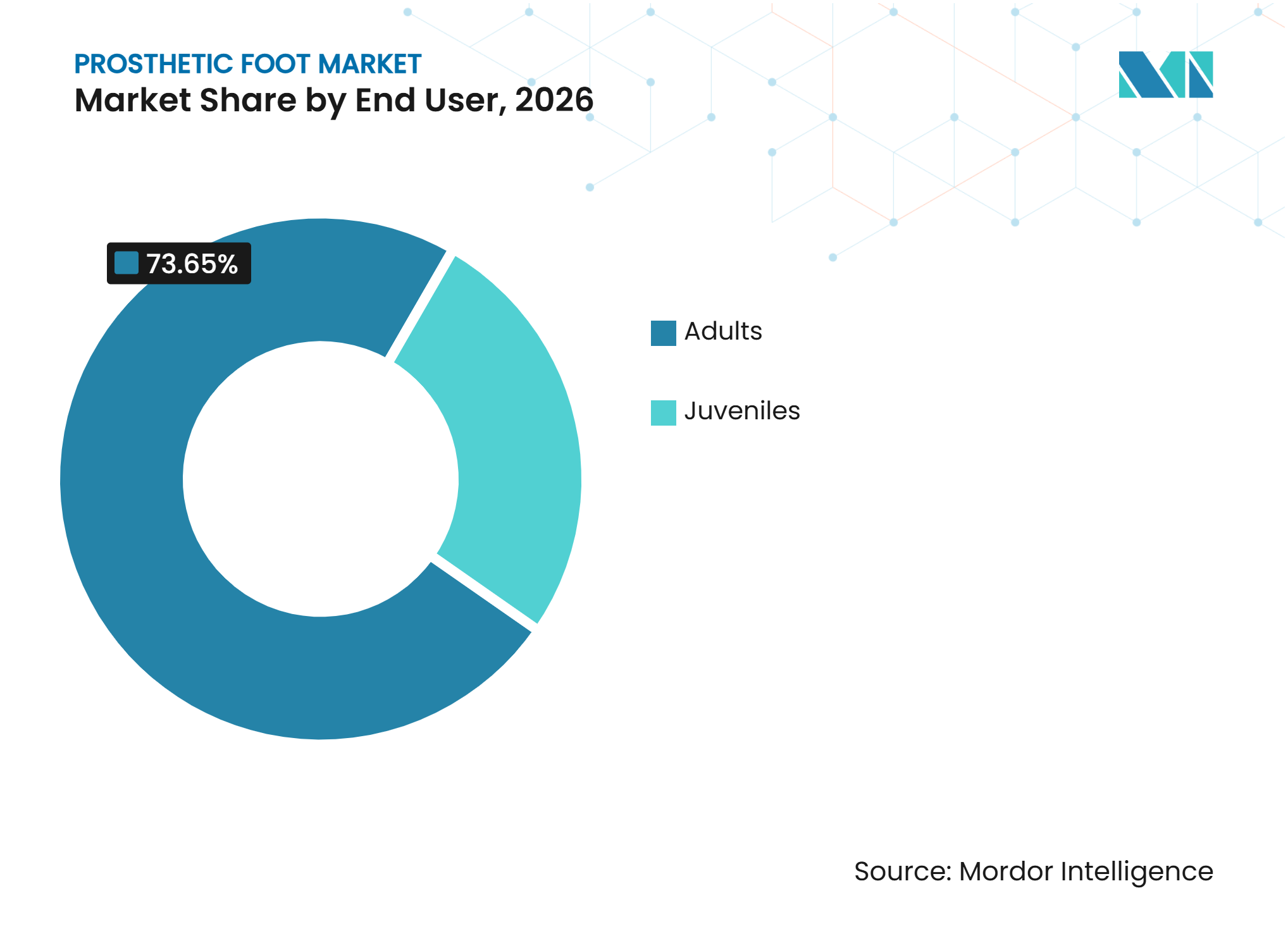
- By end user, adults held 73.7% revenue share in 2026, while juvenile users are forecast to grow at a 10.7% CAGR through 2032.
- By care setting, prosthetic clinics held 52.5% revenue share in 2026, while rehabilitation centers are forecast to grow at a 10.4% CAGR through 2032.
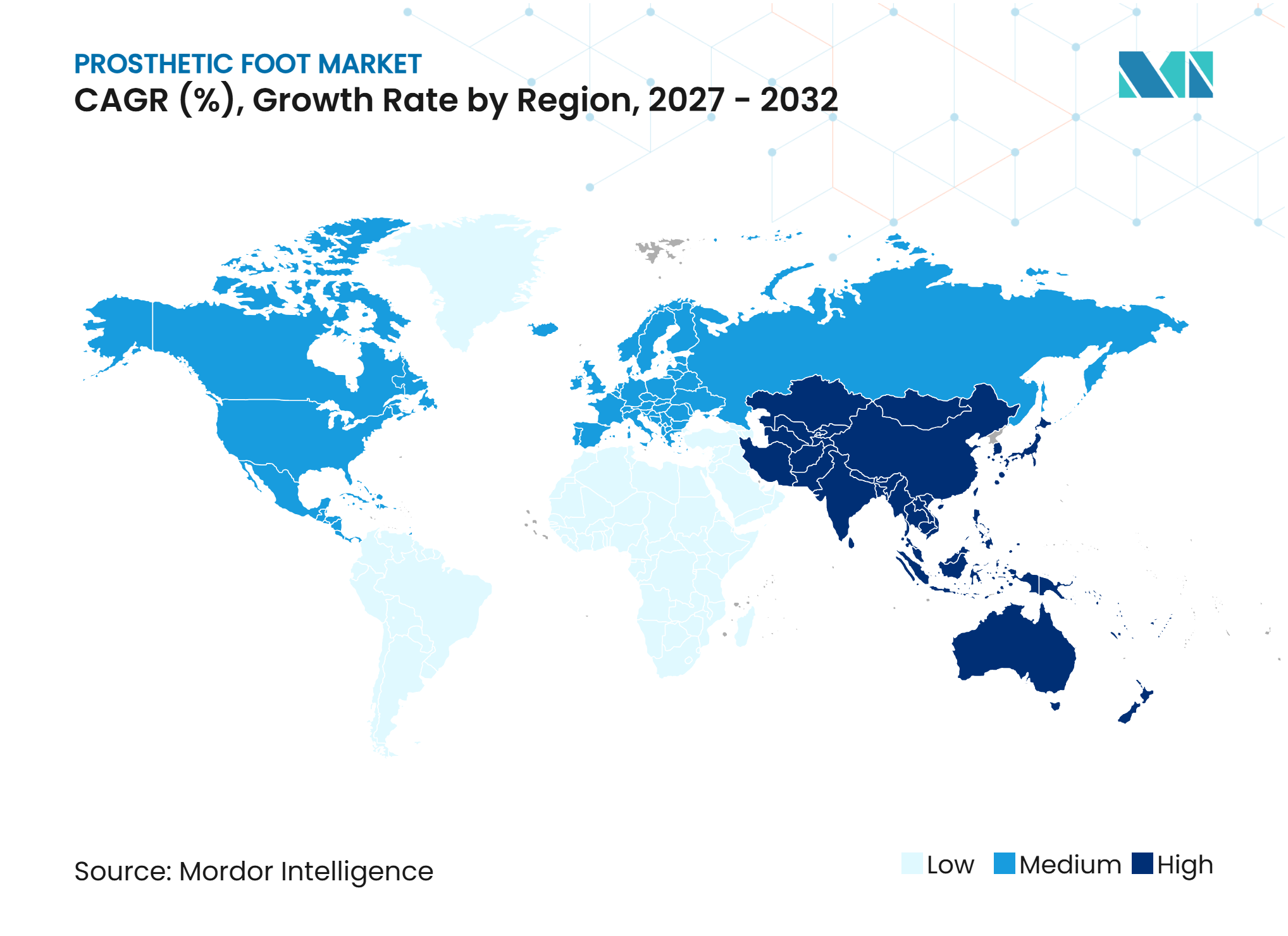
- By geography, North America held 43.2% revenue share in 2026, while Asia-Pacific is forecast to grow at an 8.5% CAGR through 2032.
Note: Market numbers in this report are based on Mordor Intelligence's proprietary estimation framework, which combines nine months of actuals with Q4 projections for base year 2026.
Market Trends and Insights
Drivers Impact Analysis of Prosthetic Foot Market*
| Driver | (~) % Impact on CAGR Forecast | Geographic Relevance | Impact Timeline |
|---|---|---|---|
| Rising Prevalence of Limb Loss | +1.80% | Global | Long term (≥ 4 years) |
| Growing Diabetes and Peripheral Vascular Disease Burden | +1.90% | Global; highest impact in South Asia, Southeast Asia, Sub-Saharan Africa | Long term (≥ 4 years) |
| Advances in Carbon-Fiber and Energy-Return Designs | +1.20% | North America & Europe; growing APAC penetration | Medium term (2–4 years) |
| Expansion of Rehabilitation and Mobility Programs | +0.90% | North America & Europe; emerging market adoption accelerating | Medium term (2–4 years) |
| Digital Fitting and Additive Manufacturing for Customization | +0.70% | Global; early gains in APAC and Latin America | Short to medium term |
| Demand for Waterproof and Terrain-Adaptive Mobility | +0.60% | North America, Europe, Australia | Short term (≤ 2 years) |
| Source: Mordor Intelligence | |||
Rising Prevalence of Limb Loss
The prosthetic foot market draws its core demand from the number of people living with limb loss. A 2025 study estimated that 2.3 million people in the United States were living with limb loss and projected the total to reach 4.6 million by 2050. Vascular disease and diabetes were the principal causes identified in that study. The American Diabetes Association reported that lower-extremity amputation incidence increased at an annual rate of 11.5% during 2021 to 2023[1]. Minor amputations can also create later demand because a 2025 clinical study found a 27% cumulative 5-year risk of progression to major amputation among diabetic patients with peripheral artery disease. This pattern expands the need for first-time fittings, replacement components, and continuing rehabilitation services.
Growing Diabetes and Peripheral Vascular Disease Burden
Diabetes and peripheral vascular disease remain central to demand across the Prosthetic foot market. The Centers for Disease Control and Prevention states that diabetes is linked to 80% of lower-limb amputations in the United States. Texas recorded 18,536 diabetes-associated amputation hospitalizations in 2024, but that earlier data point is not used as current evidence in this report. A 2025 review reported that diabetes accounted for 50% to 70% of lower-extremity amputations globally. The combination of diabetes and peripheral artery disease is especially important because patients with both conditions face a higher risk of amputation. South Asia and Southeast Asia have a large unmet need, although constrained health budgets can delay access to suitable prosthetic care.
Advances in Carbon-Fiber and Energy-Return Designs
Material development is widening the practical use of mechanical devices in the Prosthetic foot market. A 2026 study found that honeycomb sandwich structures for running prostheses increased strain-energy storage by 57.4% and reduced distal mass by 63.9% while retaining a structural safety factor of 1.95[2]. Research on the SoftFoot Pro found lower loading at the contralateral knee and hip than with a conventional carbon-fiber device during walking on uneven terrain. These findings support the use of compliant structures that adapt to different surfaces without electronic actuation. Such designs can extend mobility options for users who need stability but cannot obtain premium electronic systems. ISO 10328 remains an important compliance framework because it sets structural testing requirements for lower-limb prosthetic components.
Expansion of Rehabilitation and Mobility Programs
Rehabilitation programs influence whether clinical need becomes a completed prosthetic fitting in the Prosthetic foot market. A 2025 Journal of Vascular Surgery study found that patients in an integrated prosthetic care program had 3.32 times higher odds of receiving a prosthesis within 1 year than those receiving standard care[3]. The median time to fitting in the same study fell from 223 days to 110 days. The Department of Defense and Department of Veterans Affairs updated their lower-limb amputation rehabilitation guideline in 2025, adding evidence on pain care, neurostimulation, and peer support. These programs place fitting decisions earlier in the rehabilitation journey. They also increase the value of manufacturer relationships with rehabilitation teams, not only with outpatient clinics.
Restraints Impact Analysis of Prosthetic Foot Market*
| Restraint | (~) % Impact on CAGR Forecast | Geographic Relevance | Impact Timeline |
|---|---|---|---|
| High Device, Fitting, and Maintenance Costs | -1.30% | Global; most acute in LMIC, Sub-Saharan Africa, South Asia | Long term (≥ 4 years) |
| Uneven Reimbursement and Prior-Authorization Requirements | -1.00% | North America primarily; secondary impact in EU | Long term (≥ 4 years) |
| Shortage of Certified Prosthetic-Care Specialists | -0.70% | Global; critical gap in MEA, South Asia, Eastern Europe | Long term (≥ 4 years) |
| Durability Validation and Serviceability Challenges for Advanced Feet | -0.30% | North America & Europe (where advanced feet are prescribed) | Medium term (2–4 years) |
| Source: Mordor Intelligence | |||
High Device, Fitting, and Maintenance Costs
High costs remain a persistent barrier to access in the Prosthetic foot market. The International Society for Prosthetics and Orthotics has called for prosthetic and orthotic products to be more accessible and affordable, particularly for people in low-resource settings. A 2025 study on service delivery in Africa described financing, component availability, and service capacity as connected obstacles to prosthetic provision. The purchase price is only one part of the burden because users may also need fitting, transport, alignment adjustments, and later maintenance. These costs are harder to absorb where imported components dominate local supply. The result is a gap between clinical need and the number of people able to receive and sustain a fitted device.
Uneven Reimbursement and Prior Authorization Requirements
Coverage rules can limit access to higher-value devices in the Prosthetic foot market even when a patient has a clinical need. The Centers for Medicare & Medicaid Services requires prior authorization for selected durable medical equipment, prosthetics, orthotics, and supplies. Össur notes that prior authorization for lower-limb prostheses focuses on documentation of functional level and clinical eligibility. A July 2026 Federal Register notice updated the DMEPOS Master List and required prior authorization list. CMS also established an exemption process for suppliers with a 90% provisional affirmation rate. These processes can favor providers with strong documentation systems and can increase administrative work for smaller clinics.
*Our forecasts treat driver/restraint impacts as directional, not additive. The impact forecasts reflect baseline growth, mix effects, and variable interactions.
Prosthetic Foot Market Segment Analysis
By Foot Type:
Mechanical Feet Retain Broad Access While Electronic Designs Gain GroundMechanical feet captured 71.4% of Prosthetic foot market share in 2026 because they remain accessible across a wide range of care settings and budgets. Passive carbon-fiber designs are durable, familiar to clinicians, and generally require less maintenance than electronic systems. These advantages support their continued use in public health systems and in regions where servicing advanced components is difficult. Mechanical designs are also improving through better materials, split-toe geometries, and compliant soles. The Prosthetic foot market therefore continues to rely on mechanical products for a large share of routine daily mobility needs.
Microprocessor-controlled feet are forecast to grow at a 9.5% CAGR through 2032, the fastest rate within this segmentation. A 2026 multicenter crossover study found that the RoFT MPA-2 motor-driven microprocessor ankle delivered greater ankle range of motion, peak ankle power, and power-generation symmetry than conventional devices. These outcomes help explain interest in devices that adjust to slope, cadence, and surface changes. However, reimbursement criteria often limit access to patients with higher functional classifications. Adoption is likely to remain gradual until coverage and service capacity better match the clinical case for these products.


By Material:
Carbon Fiber Holds the Lead as Composite Designs ExpandCarbon fiber held 34.7% of revenue in 2026, supported by its combination of low weight, strength, and energy return. It is well suited to users who need an active response during walking or recreation. Fiberglass, thermoplastics, advanced polymers, and metal alloys remain relevant where flexibility, appearance, pediatric fit, or lower cost has greater importance. Material selection also depends on the expected activity level and availability of repair services. Within the Prosthetic foot market, this range allows providers to match a component more closely to functional need and local affordability.
Composite materials are forecast to grow at a 9.4% CAGR through 2032 as manufacturers combine fibers and matrix systems in one structure. Össur introduced the Pro-Flex Terra in 2025 with a pre-tensioned carbon unit and BASF Cellasto microcellular polyurethane foam. The product uses progressive stiffness to respond to changing loads without a mechanical or electronic adjustment. A 2026 Scientific Reports article also found that rapid-curing, out-of-autoclave carbon-fiber prepreg methods could achieve mechanical properties suitable for prosthetic feet. The Prosthetic foot market gains from manufacturing approaches that improve design flexibility and lower production barriers over time.
By Application:
Daily Mobility Forms the Base While Rehabilitation Gains ImportanceDaily living activities accounted for 55.7% of revenue in 2026, reflecting the central need for safe and reliable mobility at home and in the community. Users generally need feet that support walking, standing, transfers, and routine movement across common surfaces. Occupational applications add demand when people return to work that requires extended standing or outdoor movement. Sports and recreation products are also relevant for active users, although they serve a smaller share of total revenues. The Prosthetic foot market remains anchored in products that restore dependable everyday function.
Rehabilitation and therapy are forecast to grow at a 9.7% CAGR through 2032. The integrated care study reported that prosthesis receipt occurred 113 days sooner for patients receiving the program than for those in standard care. Early fitting can support gait training, balance work, and confidence during recovery. It also makes rehabilitation settings an important first point of engagement for manufacturers and clinicians. The Prosthetic foot market benefits when care models connect surgical recovery, therapy, fitting, and follow-up instead of treating them as separate services.
By End User:
Adult Demand Leads While Juvenile Needs Drive Replacement CyclesAdults held 73.7% of revenue in 2026. Diabetes and vascular disease are concentrated among middle-aged and older adults, which supports this large revenue base. Adult users also include people managing trauma-related limb loss and those who need replacements as activity levels or residual-limb conditions change. Their requirements range from basic stability to higher energy return and water resistance. The Prosthetic foot market must serve these needs within payer criteria and available service capacity.
Juvenile users are forecast to grow at a 10.7% CAGR through 2032. Ottobock launched the Maverick Junior in 2025 for active children and adolescents, with a fiberglass structure and water resistance for salt, fresh, and chlorinated water. Growing children need repeated adjustments and component replacement as their body size and activity change. This creates a distinct care requirement that is different from adult fitting. The Prosthetic foot market needs designs that account for low build height, comfort, durability, and participation in school and recreational activities.

By Care Setting:
Clinics Lead Today While Rehabilitation Centers Expand Their RoleProsthetic clinics accounted for 52.5% of care-setting revenue in 2026. Their position reflects access to trained prosthetists, component selection, fitting expertise, and established relationships with payers. Clinics also manage alignment adjustments and follow-up care after a device is delivered. Hospitals and ambulatory surgical centers have an important role during immediate post-operative care, but they often refer patients for specialized fitting. The Prosthetic foot market still relies on clinic-based provision because successful use depends on individual assessment and repeated adjustment.
Rehabilitation centers are forecast to grow at a 10.4% CAGR through 2032. MedStar National Rehabilitation Hospital describes an amputee program that provides an average of 2.8 hours of therapy per day, 5 days each week. CARF specialty accreditation supports a structured model for these services. Integrated programs can identify suitable patients earlier and bring prosthetists into the care pathway before discharge. For the Prosthetic foot market, this shift encourages partnerships with health systems in addition to traditional clinic networks.
Geography Analysis
North America
North America held 43.2% of the prosthetic foot market share in 2026. The region combines a large clinical network with Medicare, commercial insurance, and specialized rehabilitation providers. The Centers for Disease Control and Prevention links diabetes to 80% of lower-limb amputations in the United States. Prior authorization shapes access to premium components because documentation must support functional eligibility. The 2025 Department of Defense and Department of Veterans Affairs guideline reinforces structured amputation rehabilitation in the military health system.
Asia-Pacific
Asia-Pacific is forecast to grow at an 8.5% CAGR through 2032, the highest rate among the geographic segments. The region has a growing need for diabetic-foot prevention, amputation care, and rehabilitation services. Japan remains important for higher-precision devices because of its older population and biomedical engineering base. Ottobock reported double-digit core revenue growth in Asia-Pacific during 2025 and acquired Northern Prosthetics in Australia.
Europe, South America, and the Middle East and Africa
Europe operates within a regulation-intensive environment where the EU Medical Device Regulation affects device approval and evidence expectations. Ottobock reported 12.7% revenue growth in EMEA in 2025, with Taleo products and Patient Care activity contributing to the result. The United Kingdom faces a workforce issue, with 13 prosthetists per million people against a WHO reference of 15 per million. NHS England updated its specification for amputee rehabilitation and prosthetics services in 2025. In South America and the Middle East and Africa, demand exists alongside funding, supply-chain, and workforce limitations.
Competitive Landscape
Market Concentration
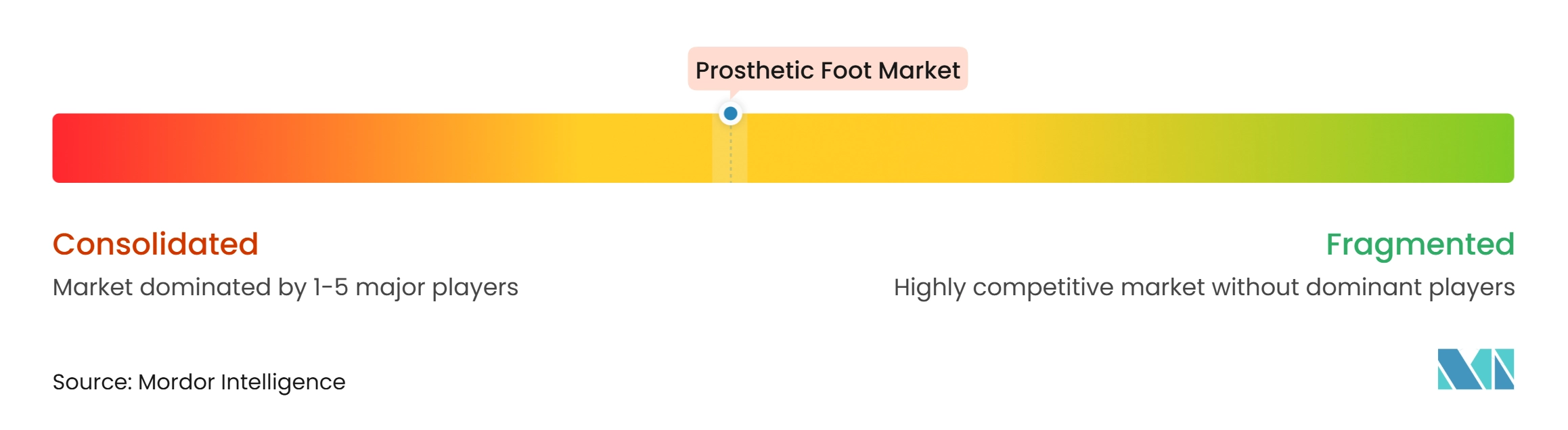
The prosthetic foot market is moderately concentrated, with Ottobock holding the broadest global portfolio among the companies identified in the supplied research. Össur, Blatchford, Fillauer, College Park Industries, PROTEOR, and WillowWood Global maintain positions through different product and activity niches. Competition includes mechanical, hydraulic, and microprocessor-controlled products. Companies also compete through clinic relationships, service capability, and evidence that supports reimbursement. ISO 10328 and ISO 22675 affect development timelines for carbon-fiber, composite, and waterproof designs.
Ottobock reported EUR 1.6 billion in core revenue for 2025, an 11.7% increase from the prior year, and named the Taleo foot family as a growth contributor in EMEA. In May 2026, it acquired Blatchford Norway A/S for EUR 110 million, adding 8 patient-care clinics and 200 employees. This move shows that direct care delivery is becoming part of the competitive model. In February 2026, Ottobock also led a USD 5 million investment in Blue Arbor Technologies, which is developing an implanted neuromuscular interface for prosthetic control. These actions extend the company’s position beyond conventional component sales.
Product innovation continues to create room for companies that can address specific user needs. College Park Industries offers the Odyssey IQ, which combines hydraulic ankle movement with onboard sensors and processors for terrain adaptation. Össur’s Pro-Flex Terra uses polyurethane and carbon-fiber elements to respond to changing loads without electronic adjustment. Additive manufacturing and digital fitting could reduce fabrication time when solutions meet applicable clinical and regulatory expectations.
Prosthetic Foot Industry Leaders
-
Ottobock SE & Co. KGaA
-
Össur hf.
-
Blatchford Group
-
Fillauer LLC
-
PROTEOR
- *Disclaimer: Major Players sorted in no particular order
Prosthetic Foot Market Companies Covered in this Report
- Ability Dynamics
- Beckton Dickinson
- Blatchford Group
- College Park Industries, Inc.
- Dycor Manufacturing, Inc.
- Fillauer
- NABTESCO Corporation
- Össur hf.
- Ottobock
- PROTEOR
- Protunix
- Roadrunnerfoot
- Steeper Group
- Streifeneder ortho.production
- Trulife
- Willow Wood Global
Recent Industry Developments in Prosthetic Foot Market
- May 2026: Ottobock SE & Co. KGaA acquired the Patient Care business of Blatchford Ltd. in Norway, Blatchford Norway A/S, for EUR 110 million, adding 8 clinic locations and around 200 employees to Ottobock’s Patient Care network. The acquisition marks Ottobock’s direct entry into the Norwegian market and is consistent with its strategy of integrating clinical delivery infrastructure across Europe. Blatchford retains its UK operations and continues to focus on prosthetics and orthotics product innovation.
- May 2026: Ortmos Group, Alcare Co., invested in Instalimb Inc. and signed a basic cooperation agreement to advance AI and 3D-CAD-based prosthetic socket solutions and digital manufacturing in Japan and other Asian markets.
- May 2025: Ottobock launched the Taleo Adapt, its first hydraulic prosthetic foot developed entirely in-house. The device combines a hydraulic ankle joint with the Taleo Low Profile carbon platform and is waterproof and corrosion-resistant in fresh, salt, and chlorinated water.
- February 2025: Össur launched the Pro-Flex Terra prosthetic foot with BASF Cellasto microcellular polyurethane technology. The product uses a progressive-stiffness foam that adapts to varying load conditions without mechanical or electronic adjustment.
Global Prosthetic Foot Market Report Scope
According to the report’s scope, a prosthetic foot is an artificial device that replaces the foot after amputation or limb loss. It helps provide support, balance, and movement during standing and walking.
The prosthetic foot market is segmented into foot type, material, application, end user, care setting, and geography. By foot type, the market is segmented into mechanical foot and microprocessor foot. By material, the market is segmented into carbon fiber, fiberglass, thermoplastics and advanced polymers, metal alloys, and composite materials. By application, the market is segmented into daily living activities, occupational use, sports and recreation, and rehabilitation and therapy. By end user, the market is segmented into adults and juveniles. By care setting, the market is segmented into prosthetic clinics, hospitals, rehabilitation centers, and ambulatory surgical centers. By geography, the market is segmented into North America, Europe, Asia-Pacific, the Middle East and Africa, and South America. The report also covers the estimated market sizes and trends for 17 countries across major regions globally. The report offers values (USD) for all the above segments.
Segmentation Overview
| Mechanical Foot |
| Microprocessor Foot |
| Carbon Fiber |
| Fiberglass |
| Thermoplastics and Advanced Polymers |
| Metal Alloys |
| Composite Materials |
| Daily Living Activities |
| Occupational Use |
| Sports and Recreation |
| Rehabilitation and Therapy |
| Adults |
| Juveniles |
| Prosthetic Clinics |
| Hospitals |
| Rehabilitation Centers |
| Ambulatory Surgical Centers |
| North America | United States |
| Canada | |
| Mexico | |
| Europe | Germany |
| United Kingdom | |
| France | |
| Italy | |
| Spain | |
| Rest of Europe | |
| Asia-Pacific | China |
| Japan | |
| India | |
| Australia | |
| South Korea | |
| Rest of Asia-Pacific | |
| Middle East and Africa | GCC |
| South Africa | |
| Rest of Middle East and Africa | |
| South America | Brazil |
| Argentina | |
| Rest of South America |
| By Foot Type | Mechanical Foot | |
| Microprocessor Foot | ||
| By Material | Carbon Fiber | |
| Fiberglass | ||
| Thermoplastics and Advanced Polymers | ||
| Metal Alloys | ||
| Composite Materials | ||
| By Application | Daily Living Activities | |
| Occupational Use | ||
| Sports and Recreation | ||
| Rehabilitation and Therapy | ||
| By End User | Adults | |
| Juveniles | ||
| By Care Setting | Prosthetic Clinics | |
| Hospitals | ||
| Rehabilitation Centers | ||
| Ambulatory Surgical Centers | ||
| Geography | North America | United States |
| Canada | ||
| Mexico | ||
| Europe | Germany | |
| United Kingdom | ||
| France | ||
| Italy | ||
| Spain | ||
| Rest of Europe | ||
| Asia-Pacific | China | |
| Japan | ||
| India | ||
| Australia | ||
| South Korea | ||
| Rest of Asia-Pacific | ||
| Middle East and Africa | GCC | |
| South Africa | ||
| Rest of Middle East and Africa | ||
| South America | Brazil | |
| Argentina | ||
| Rest of South America | ||
Key Questions Answered in the Report
What is the projected value of the Prosthetic foot market by 2032?
The prosthetic foot market is forecast to reach USD 2.3 billion by 2032, growing at a 7.1% CAGR from 2027.
Which prosthetic foot type holds the largest revenue share?
Mechanical feet lead with 71.4% of revenue in 2026 because they are durable, accessible, and easier to maintain across care settings.
Which prosthetic foot segment is growing fastest?
Microprocessor-controlled feet are the fastest-growing foot type, with a projected 9.5% CAGR through 2032.
Why is rehabilitation important for prosthetic foot adoption?
Integrated care was associated with 3.32 times higher odds of receiving a prosthesis within 1 year and reduced median time to fitting from 223 days to 110 days.
Which region is growing fastest for prosthetic feet?
Asia-Pacific is projected to grow at an 8.5% CAGR through 2032, supported by rising care needs and digital manufacturing investment.
What are the main barriers to prosthetic foot access?
High device, fitting, and maintenance costs, along with uneven reimbursement and prior authorization requirements, remain the main barriers.