
Premium Finance Market Size and Share
Market Overview
| Study Period | 2021 - 2032 |
|---|---|
| Market Size (2027) | USD 117.5 Billion |
| Market Size (2032) | USD 158.80 Billion |
| Growth Rate (2027 - 2032) | 6.22 % |
| Fastest Growing Market | Asia-Pacific |
| Largest Market | North America |
| Market Concentration | Low |
Major Players *Disclaimer: Major Players sorted in no particular order Image © Mordor Intelligence. Reuse requires attribution under CC BY 4.0. | |
Premium Finance Market Analysis by Mordor Intelligence
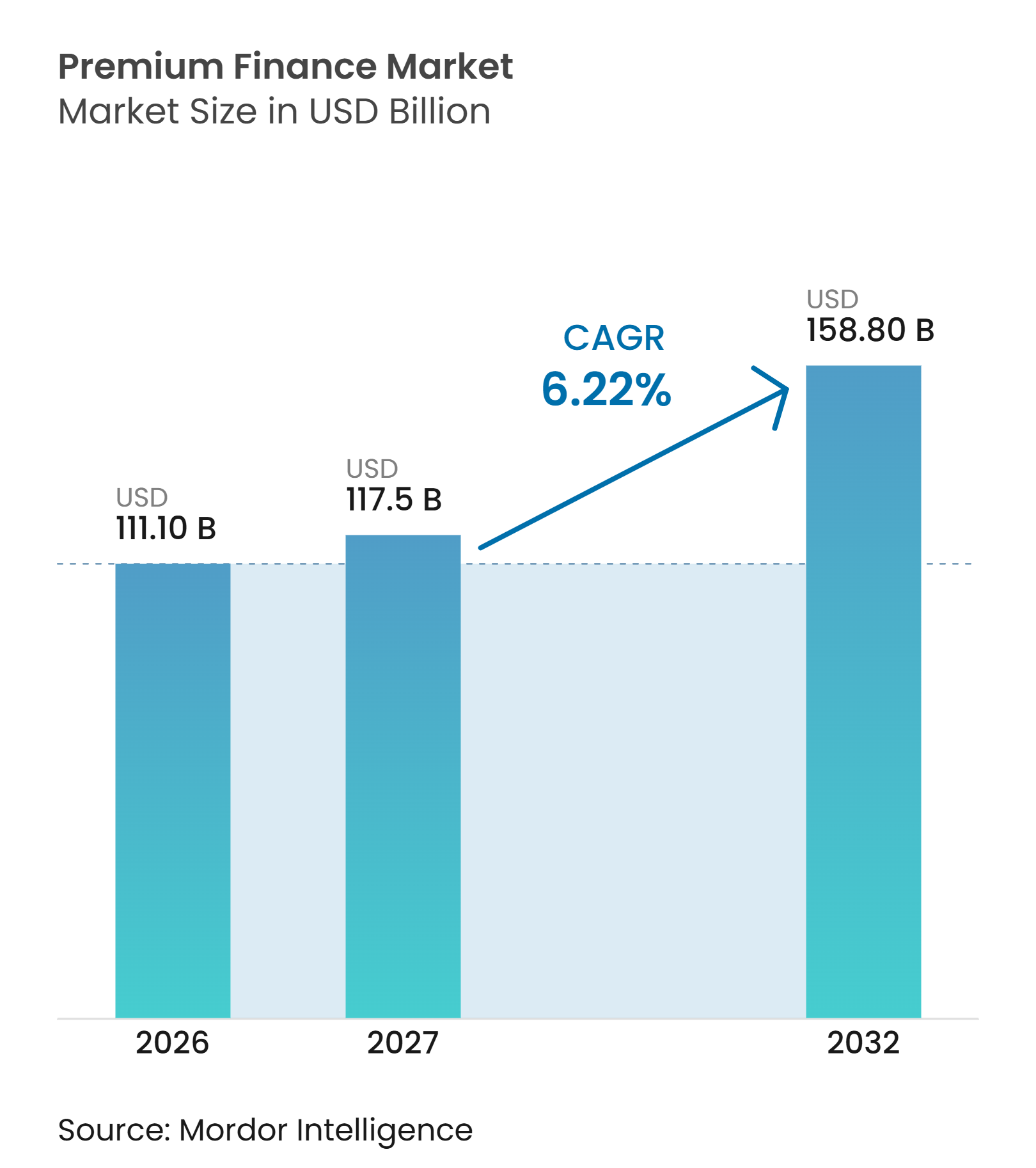
The Premium Finance Market size was valued at USD 111.10 billion in 2026 and is estimated to grow from USD 117.5 billion in 2027 to reach USD 158.80 billion by 2032, at a CAGR of 6.22% during the forecast period (2027-2032).
Premium finance gives policyholders a way to spread large insurance payments into scheduled installments, which can protect cash available for payroll, suppliers, and other operating needs. Demand remains linked to commercial coverage that requires sizable upfront payments, especially liability, auto, specialty, and excess and surplus policies. Digital distribution is also changing access, as brokers can offer financing during the policy purchase process rather than through a separate application. The premium finance market is supported by the secured nature of the receivable, because lenders can seek unearned premium after a policy cancellation when contractual conditions are met. Competition remains centered on funding capacity, broker relationships, credit controls, and the ability to reduce friction in origination and servicing.
Key Report Takeaways
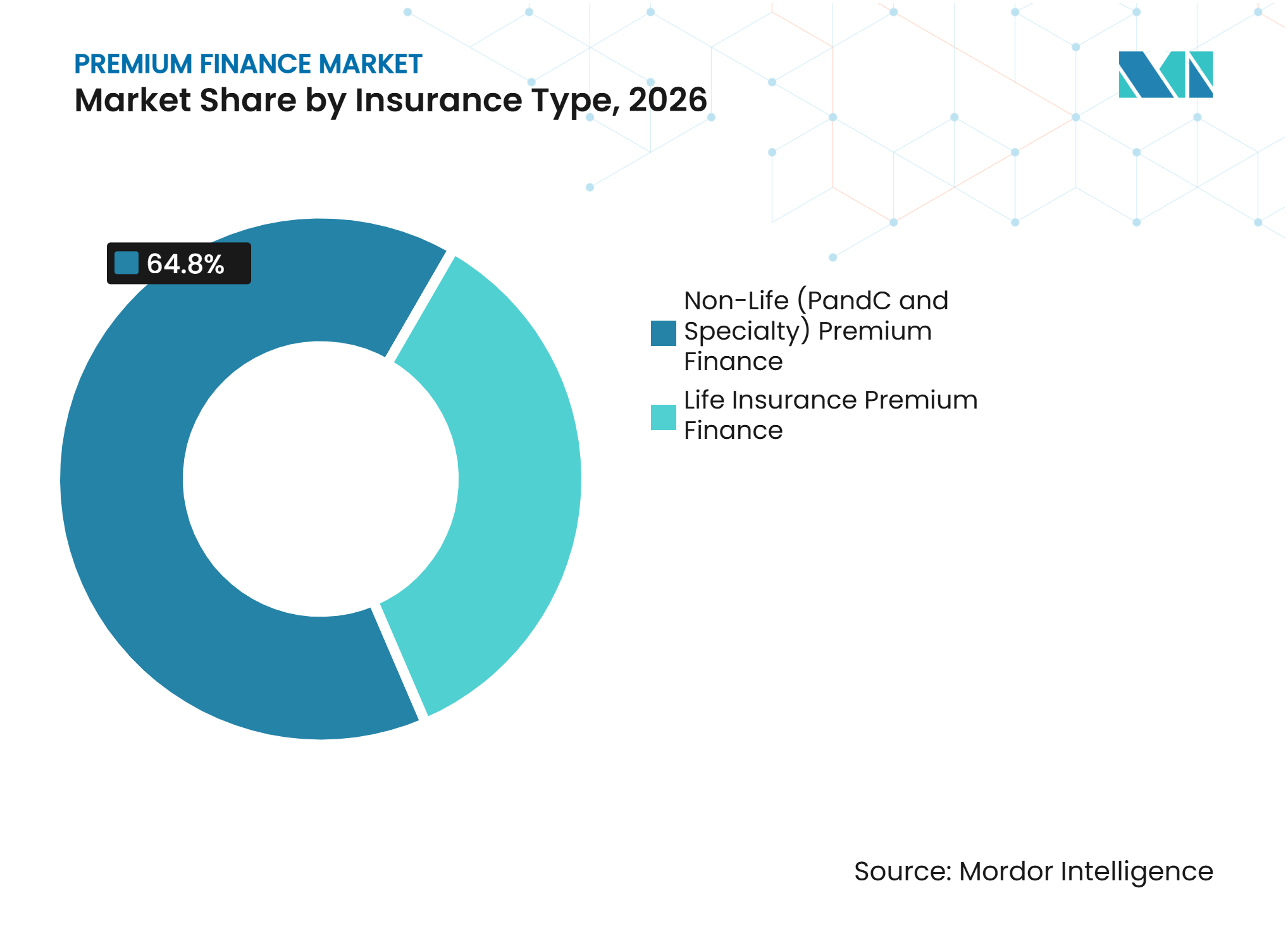
- By insurance type, non-life insurance, including property and casualty and specialty coverage, captured 64.8% of the premium finance market share in 2026, while life insurance premium finance is projected to grow at a CAGR of 8.5% through 2032.
- By interest rate structure, fixed-rate financing held 70.3% of the premium finance market share in 2026, while floating-rate financing is projected to grow at a CAGR of 6.8% through 2032.
- By provider type, specialist premium finance companies held 45.1% of the premium finance market share in 2026 and are projected to grow at a CAGR of 7.2% through 2032.
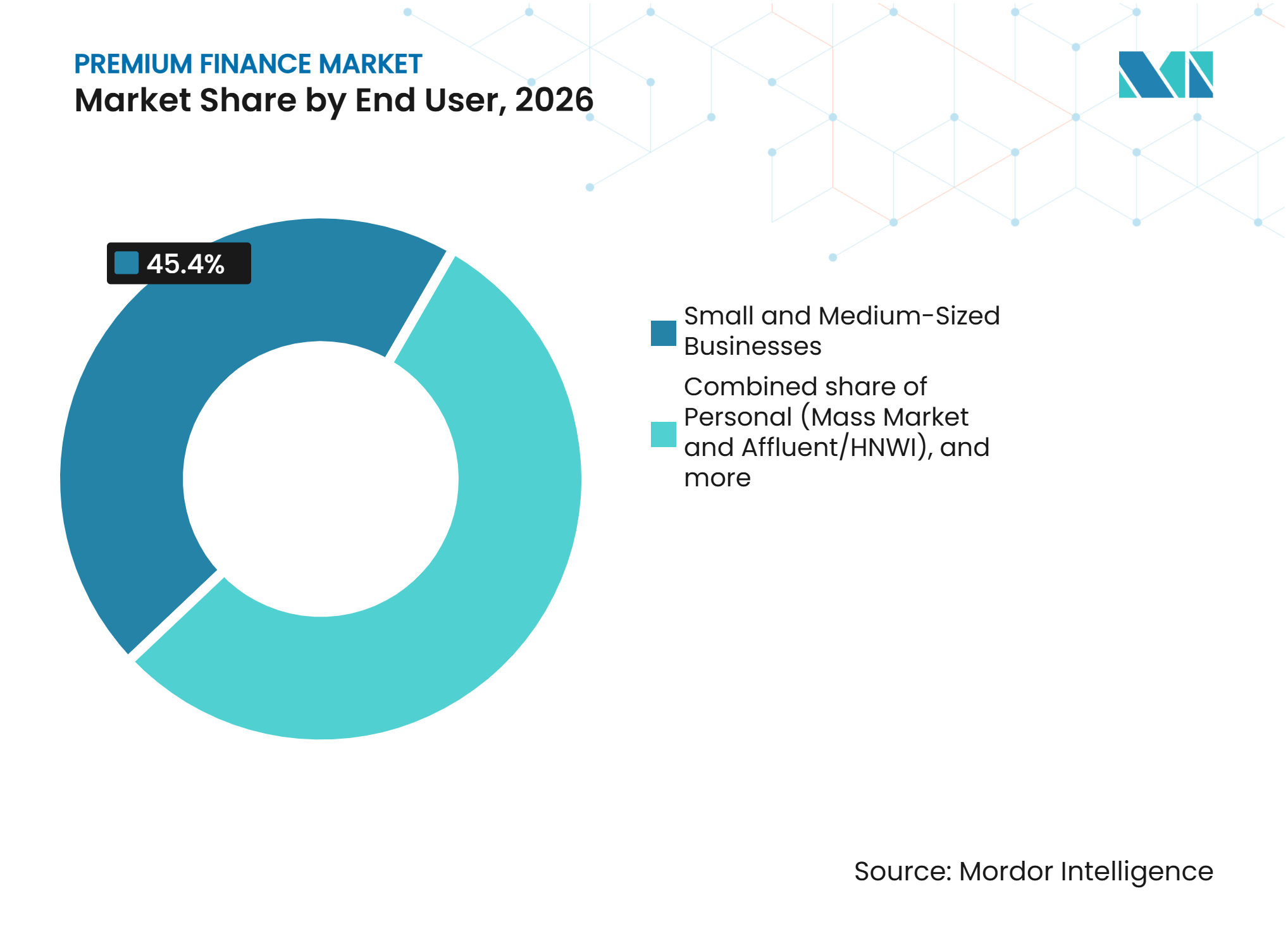
- By end user, small and medium-sized businesses accounted for 45.4% of the premium finance market share in 2026, while personal borrowers, including mass-market and affluent high-net-worth individuals, are projected to grow at a CAGR of 7.8% through 2032.
- By financing term, short-term financing captured 79.7% of the premium finance market share in 2026, while long-term financing is projected to grow at a CAGR of 9.5% through 2032.
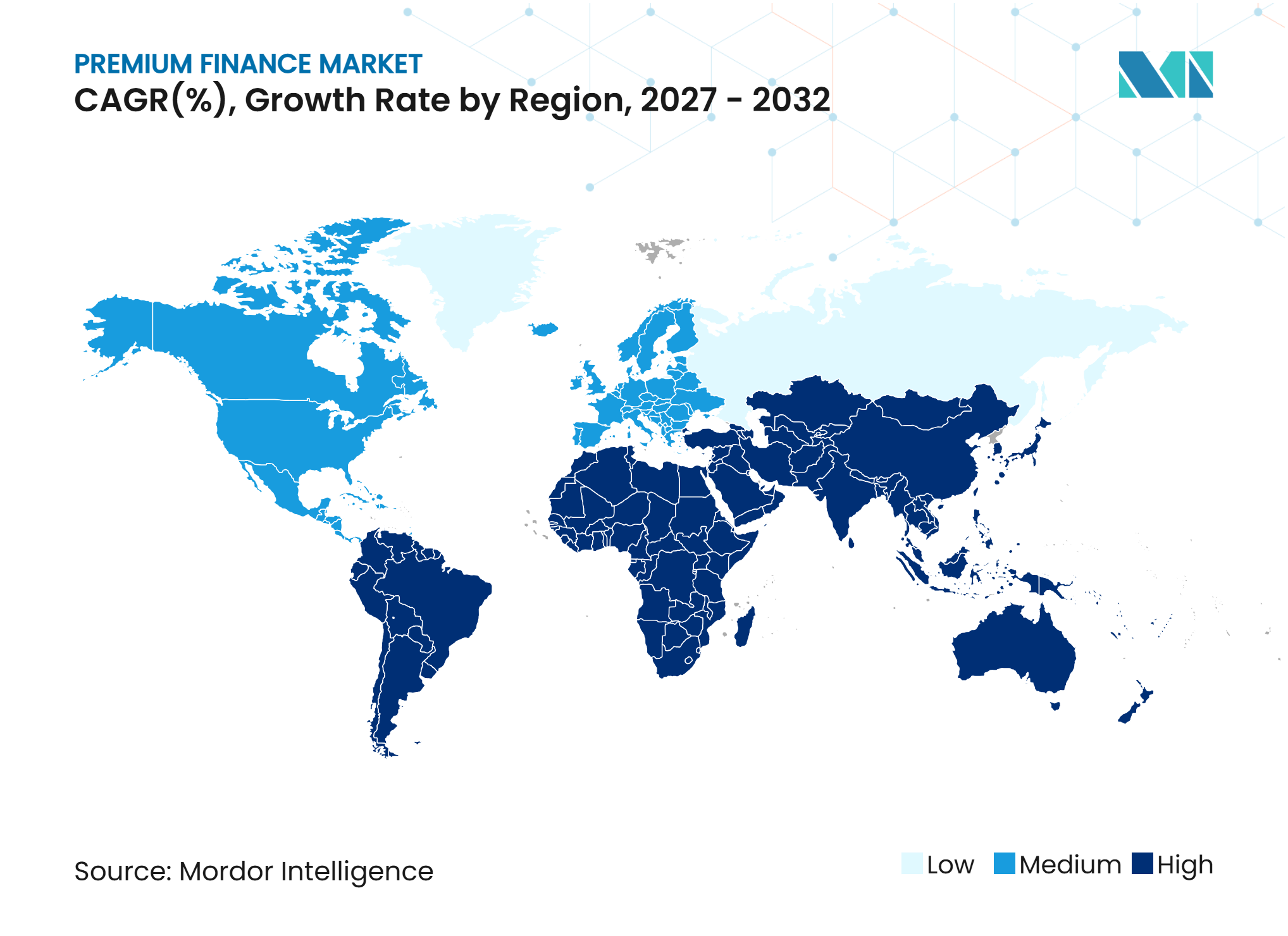
- By geography, North America accounted for 47.9% of the premium finance market size in 2026, while Asia-Pacific is projected to grow at a CAGR of 9.1% through 2032.
Note: Market numbers in this report are based on Mordor Intelligence's proprietary estimation framework, which combines nine months of actuals with Q4 projections for base year 2026.
Market Trends and Insights
Drivers Impact Analysis of Premium Finance Market*
| Driver | (~) % Impact on CAGR Forecast | Geographic Relevance | Impact Timeline |
|---|---|---|---|
| Rising Commercial Insurance Premiums and Higher Upfront Payment Requirements | +1.5% | North America and Europe, with spillover to Asia-Pacific | Short term (≤ 2 years) |
| Expansion of Excess and Surplus Insurance and Specialty Coverage Financing | +1.2% | North America, led by the United States | Medium term (2-4 years) |
| Business Demand for Working-Capital Preservation | +1.0% | Global, concentrated in North America, the United Kingdom, and Australia | Medium term (2-4 years) |
| Embedded Premium Financing Through Insurance Brokers and Digital Platforms | +0.8% | Global, led by the United Kingdom, the United States, India, and Australia | Medium term (2-4 years) |
| Growth in Commercial Policy Financing and Multi-Policy Premium Bundling | +0.7% | North America and Europe | Long term (≥ 4 years) |
| Institutional Funding and Securitization of Premium Finance Receivables | +0.6% | The United States and the United Kingdom, with emerging activity in Asia-Pacific | Long term (≥ 4 years) |
| Source: Mordor Intelligence | |||
Rising Commercial Insurance Premiums Sustain Financeable Volume
Commercial insurance premiums remain a central support for the Premium Finance Market because larger upfront obligations increase the value of installment payment options. The Council of Insurance Agents and Brokers reported that umbrella premiums rose 5.3% in the second quarter of 2026, extending a long period of rate increases in that line[1]. Commercial auto premiums increased 4.5% in the same survey, which matters because many smaller firms finance this compulsory coverage. Small accounts decreased slightly, by an average of 0.5% in the second quarter of 2026, while larger accounts recorded a 3.7% decline. Continued pressure in casualty and specialty lines helps maintain financing demand even when property insurance prices ease.
Expansion of Excess and Surplus Insurance Creates Specialty Financing Demand
Excess and surplus insurance expands the addressable base for premium financing, as these policies often carry higher premiums and serve insureds when standard coverage is unavailable. Businesses with complex legal, climate, technology, or risk-transfer requirements often need specialty casualty and liability placements. These policies can generate larger individual loan balances than standardized admitted coverage. The premium finance market benefits when insurers tighten underwriting standards, and brokers place more complex risks through specialty channels. Financing enables insureds to manage higher premiums without committing all working capital at the beginning of the policy term.
Business Demand for Working-Capital Preservation Supports Small Businesses
Premium financing allows businesses to replace large annual insurance payments with scheduled installments, helping preserve cash for regular operations. The Federal Reserve reported that 56% of United States small businesses sought financing to meet operating expenses, while 86% used financing regularly[2]. The British Business Bank found that working capital was the leading reason smaller businesses sought external finance in 2025, cited by 50% of applicants[3]. For companies purchasing property, liability, or commercial auto coverage, the payment schedule can be as important as the total premium. This makes the premium finance market relevant to firms with limited cash buffers and recurring insurance obligations.
Embedded Financing Through Brokers and Digital Platforms Expands Access
Broker platforms and digital insurance applications are making premium financing easier to offer at the point of purchase. Applied Systems states that its Applied Pay product connects AFCO Direct, FIRST Insurance Funding, and Imperial PFS within the Applied Epic workflow[4]. The company reports that this type of automation can increase financed policy ratios from 10% to 15% to 30%. In April 2026, PremFina and Cuvva announced a three-year arrangement to integrate real-time monthly installment decisions into a mobile checkout for annual auto policies in the United Kingdom. These connections can reduce manual work for brokers and shorten the time between a policy quote and a financing decision. The approach can also extend the premium finance market to customers who prefer a digital purchasing experience.
Restraints Impact Analysis of Premium Finance Market*
| Restraint | (~) % Impact on CAGR Forecast | Geographic Relevance | Impact Timeline |
|---|---|---|---|
| Borrower Defaults and Insufficient Unearned-Premium Recoveries | -1.2% | North America, with emerging exposure in Asia-Pacific | Short term (≤ 2 years) |
| Rising Funding Costs and Margin Compression | -0.9% | Global, most acute in North America and the United Kingdom | Medium term (2-4 years) |
| State-Level Regulatory Complexity and Consumer-Protection Compliance Costs | -0.7% | The United States on a state-by-state basis and the United Kingdom under Consumer Duty | Medium term (2-4 years) |
| Policy Cancellation, Premium Refund, and Lender Reconciliation Delays | -0.5% | Global | Short term (≤ 2 years) |
| Source: Mordor Intelligence | |||
Borrower Defaults and Collateral Recovery Gaps
Credit performance depends on a lender's ability to cancel a policy after default and recover the unearned premium. This process is generally supported by the financing agreement, but it can be slowed by policy terms, servicing steps, and reconciliation between the lender, insurer, and broker. The Financial Conduct Authority found that average bad debt among United Kingdom premium finance brokers was 3% of loan balances, compared with 1.9% for credit cards and 1.8% for personal loans. Recovery may be weaker when a policy has already earned a substantial share of its premium before cancellation. The risk is particularly relevant for contracts with minimum-deposit features or more complex commercial coverage. Strong cancellation procedures and timely premium reconciliation remain important for the premium finance market.
Rising Funding Costs and Margin Compression Weigh on Profitability
Premium finance companies depend on credit facilities and securitization programs to fund their receivables, so financing costs directly affect margins. Higher benchmark rates can create a mismatch when lenders hold fixed-rate receivables while their own funding costs adjust more quickly. This exposure is more difficult for smaller specialist providers with limited scale or fewer sources of capital. The resulting pressure can encourage operators to improve pricing discipline, use more flexible funding structures, or seek larger partners. It can also accelerate consolidation in the premium finance market when firms cannot maintain operational investment and competitive pricing at the same time.
*Our forecasts treat driver/restraint impacts as directional, not additive. The impact forecasts reflect baseline growth, mix effects, and variable interactions.
Premium Finance Market Segment Analysis
By Insurance Type:
Non-Life Coverage Leads While Life Financing BuildsNon-life property and casualty and specialty financing accounts for 64.8% of the premium finance market share in 2026. Commercial property, liability, commercial auto, and specialty policies produce large annual bills that many businesses prefer to spread across monthly payments. These products are widely used by firms that must maintain coverage to meet contractual, legal, or lender requirements. Casualty and specialty policies can remain expensive even when broader commercial pricing becomes less firm. The segment therefore provides a stable base of recurring policy renewals for finance providers.
Life insurance premium finance is projected to expand at an 8.5% CAGR from 2027 to 2032. This product is used primarily by affluent and high-net-worth individuals who finance substantial permanent life insurance premiums. The financing may use policy value, cash surrender value, or death benefit proceeds as security, subject to the transaction structure. These arrangements require detailed underwriting because trust structures, estate planning goals, and loan duration can differ materially between clients. Long-term funding expertise is therefore important for providers serving this part of the premium finance industry.


By Interest Rate Structure:
Fixed Rates Lead While Floating Rates GainFixed-rate financing accounted for 70.3% of the premium finance market size in 2026. Short-duration commercial property and casualty agreements commonly use fixed payments because borrowers value predictability over the policy term. A fixed installment amount also fits the annual renewal pattern for many commercial policies. Lenders can reprice new business at subsequent renewals, which helps them respond to changing conditions. This format remains well suited to businesses financing annual insurance premiums.
Floating-rate financing is projected to grow at 6.8% CAGR from 2027 to 2032. Growth is linked to longer-duration life insurance financing and larger commercial accounts where lenders may not be able to offer a long fixed-rate commitment. High-net-worth borrowers may accept a rate tied to a reference benchmark when the policy and estate-planning horizon extends for many years. The structure can reduce the interest-rate mismatch for lenders when borrowing costs change. Fixed and floating products therefore serve distinct financing needs rather than directly replacing one another.
By Provider Type:
Specialist Companies Combine Focus and ScaleSpecialist premium finance companies held 45.1% of the Premium Finance Market share in 2026. These providers focus on insurance-linked origination, credit assessment, cancellation monitoring, and unearned-premium recovery. Their operating model is different from a bank that offers premium finance as one product within a broader lending portfolio. Specialist companies can develop close broker relationships and tailor workflows to insurance renewal cycles. Their focus can also support quicker adoption of broker and agency technology.
Specialist premium finance companies are projected to grow at a 7.2% CAGR from 2027 to 2032. Bank-affiliated providers retain advantages in funding access and cross-selling with commercial banking customers. Captive providers connected to insurers or brokers can also use financing to support retention within their own distribution channels. Smaller independent companies may face pressure to invest in compliance, technology, and funding capacity at the same time. These conditions favor operators with durable capital relationships and established servicing infrastructure.
By End User:
Small Businesses Lead While Personal Borrowers Grow FasterSmall and medium-sized businesses held a 45.4% share of the Premium Finance Market in 2026. These firms often face mandatory insurance requirements and may find a single annual payment difficult to absorb from normal cash reserves. The Federal Reserve reported that 60% of United States small businesses applied for financing during the prior 12 months. Operating expenses were a leading reason businesses sought funds in that survey. Embedded broker distribution is important because the segment requires a large number of individually smaller transactions.
Personal borrowers, including mass-market and affluent high-net-worth individuals, are projected to grow at a 7.8% CAGR from 2027 to 2032. Mass-market consumers often use financing to spread home or motor insurance costs into manageable payments. The Financial Conduct Authority found that 48% of United Kingdom home and motor policies were paid through premium finance arrangements. Affluent borrowers use a different model that can involve life insurance, trusts, estate planning, and longer loan terms. Providers need simple digital experiences for mass-market customers and specialized underwriting for high-net-worth clients.

By Financing Term:
Short-Term Agreements Dominate, Long-Term Loans ExpandShort-term financing of less than 12 months captured 79.7% of the Premium Finance Market size in 2026. The structure closely matches the annual cycle of commercial property and casualty insurance policies. Borrowers finance the premium, make monthly payments, and may refinance at the next renewal. The short duration allows lenders to adjust new pricing as credit or funding conditions change. This model supports high asset turnover and remains the core format for commercial insurance financing.
Long-term financing of more than 3 years is projected to grow at 9.5% CAGR from 2027 to 2032. The segment is tied mainly to life insurance financing for high-net-worth individuals, where policy objectives can extend over many years. Longer loans require capital sources that can support duration, careful underwriting, and complex collateral arrangements. They also require lenders to assess interest-rate exposure over a longer period than annual commercial policies. This creates a clear distinction between high-volume short-term financing and specialized long-duration arrangements.
Geography Analysis
North America accounted for 47.9% of the premium finance market share in 2026. The United States is the region's core market because commercial insurance financing is well established across property, casualty, auto, and specialty coverage. Casualty and specialty policies support demand where coverage is costly or difficult to place. State licensing requirements can increase compliance costs, but they can also reinforce the position of established providers. Standard Premium Finance Holdings expanded its credit facility capacity to USD 115 million in September 2025 and operated across 40 licensed United States.
Europe is led by the United Kingdom, where consumer-protection requirements are reshaping how brokers price and explain premium finance. The Financial Conduct Authority reported that weighted average annual percentage rates declined from 23.3% in 2022 to 19.2% in 2026. The same study reported that the United Kingdom premium finance sector generated GBP 1 billion (USD 1.28 billion) in revenue during 2023. Premium Credit Limited reported GBP 6 billion (USD 7.68 billion) in lending volumes during 2025. Close Brothers Premium Finance extended its commercial-lines partnership with Cobra Network in September 2025, reflecting the continued value of broker distribution in the United Kingdom.
Asia-Pacific is projected to grow at a 9.1% CAGR from 2027 to 2032. Rising insurance penetration and the development of digital lending and insurance platforms support the regional opportunity. India, China, Singapore, and other Southeast Asian markets offer different regulatory settings and insurance purchasing behaviors. This diversity requires providers to build local distribution relationships and adapt underwriting approaches. The premium finance market in Asia-Pacific is likely to develop through digital access, broker partnerships, and more tailored products for both commercial and personal policyholders.
Competitive Landscape
Market Concentration
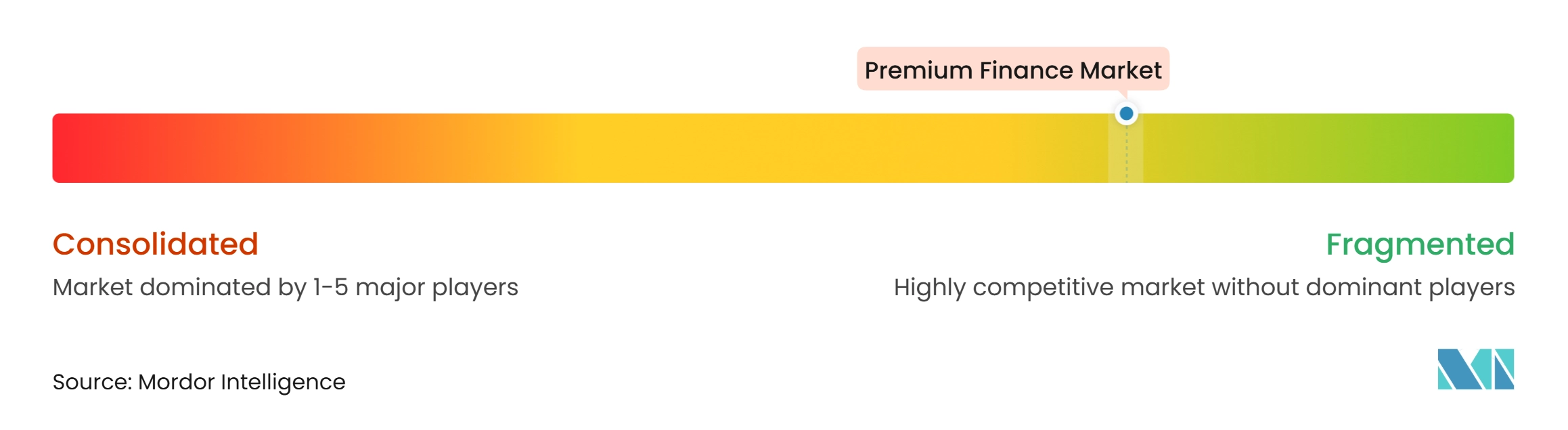
The premium finance market is fragmented, with competition spread across specialist premium finance companies, bank-affiliated lenders, insurance technology platforms, and embedded financing providers. Competitive positions vary by geography, customer segment, broker relationships, and access to funding, rather than being controlled by a small group of global providers. Bank-affiliated platforms benefit from established lending capabilities and commercial relationships, while specialist providers compete through insurance-specific technology, broker distribution, and policy servicing expertise. Applied Systems integrates financing options into the Applied Epic workflow through Applied Pay, allowing insurance professionals to incorporate premium financing into the policy placement process. This embedded approach can improve access and convenience for brokers and policyholders without requiring a separate financing journey.
PremFina illustrates the importance of funding capacity and distribution partnerships in this fragmented market. In July 2026, the company secured a GBP 400 million senior debt facility from Lloyds Banking Group to support growth in its loan book. In April 2026, PremFina partnered with Cuvva to embed monthly premium payment options directly into the insurer’s mobile app for annual policies, extending financing access through a digital insurance channel. Gracie Point expanded specialist competition in March 2025 by launching GP Affluent Markets, focused on leveraged life insurance financing for high-net-worth individuals. These developments highlight how providers differentiate themselves through institutional funding, digital integration, and tailored financing solutions.
Opportunities remain in digital financing for small commercial businesses, cross-border premium finance for multinational companies, and embedded financing for personal insurance products across additional markets. Automation can streamline applications, payment processing, and servicing, although responsible underwriting, transparent pricing, and clear customer disclosures remain essential. Established providers can leverage broker networks and funding relationships, while smaller specialists can compete through targeted products, flexible technology, and customer service.
Premium Finance Industry Leaders
-
IPFS Corporation
-
FIRST Insurance Funding
-
AFCO Credit Corporation
-
Close Brothers Premium Finance
-
US Premium Finance
- *Disclaimer: Major Players sorted in no particular order
Premium Finance Market Companies Covered in this Report
- IPFS Corporation
- AFCO Credit Corporation
- FIRST Insurance Funding
- Close Brothers Premium Finance
- US Premium Finance
- Standard Premium Finance Holdings, Inc.
- PremFina Limited
- Agile Premium Finance
- ARI Financial Group
- ClassicPlan Premium Financing Inc.
- Capital Premium Financing
- Succession Capital Alliance
- People's Premium Finance
- Finsall
- EPIC Premium Finance
- Honor Capital Corporation
- The Premins Company
- Express Premium Finance Co
- IFS Financial Services Inc.
- QPR Premium Funding
Recent Industry Developments in Premium Finance Market
- October 2026: Right Choice Insurance Brokers renewed its five-year partnership with PremFina, extending a relationship established in 2023 to support premium finance distribution and improve broker and customer experience.
- July 2026: PremFina secured a GBP 400 million (USD 508 million) senior debt facility from Lloyds Banking Group to support loan book growth and expand its premium finance lending capacity.
- April 2026: Cuvva and PremFina announced a three-year embedded premium finance partnership, integrating monthly instalment options and real-time decisioning into Cuvva’s mobile app checkout for annual motor insurance policies in the United Kingdom.
- April 2026: PremFina secured an upsize and extension of its junior capital facility with Waterfall Asset Management to GBP 100 million (USD 127 million), increasing funding capacity to support continued expansion in the United Kingdom.
Global Premium Finance Market Report Scope
Segmentation Overview
| Life Insurance Premium Finance |
| Non-Life (P&C and Specialty) Premium Finance |
| Fixed-Rate Financing |
| Floating-Rate Financing |
| Banks / Bank-Affiliated Providers |
| Specialist Premium Finance Companies |
| Insurer- and Broker-Funded / Captive Providers |
| Personal (Mass Market and Affluent/HNWI) |
| Small and Medium-Sized Businesses |
| Large Enterprises and Multinational Corporations |
| Short-Term (Less than 12 Months) |
| Medium-Term (1–3 Years) |
| Long-Term (More than 3 Years) |
| North America | United States |
| Canada | |
| Mexico | |
| South America | Brazil |
| Argentina | |
| Rest of South America | |
| Europe | United Kingdom |
| Germany | |
| France | |
| Italy | |
| Spain | |
| Rest of Europe | |
| Asia-Pacific | China |
| Japan | |
| India | |
| South Korea | |
| Australia | |
| Indonesia | |
| Thailand | |
| Malaysia | |
| Singapore | |
| Vietnam | |
| Rest of Asia-Pacific | |
| Middle East and Africa | Saudi Arabia |
| United Arab Emirates | |
| Turkey | |
| South Africa | |
| Egypt | |
| Rest of Middle East and Africa |
| By Insurance Type | Life Insurance Premium Finance | |
| Non-Life (P&C and Specialty) Premium Finance | ||
| By Interest Rate Structure | Fixed-Rate Financing | |
| Floating-Rate Financing | ||
| By Provider Type | Banks / Bank-Affiliated Providers | |
| Specialist Premium Finance Companies | ||
| Insurer- and Broker-Funded / Captive Providers | ||
| By End User | Personal (Mass Market and Affluent/HNWI) | |
| Small and Medium-Sized Businesses | ||
| Large Enterprises and Multinational Corporations | ||
| By Financing Term | Short-Term (Less than 12 Months) | |
| Medium-Term (1–3 Years) | ||
| Long-Term (More than 3 Years) | ||
| By Geography | North America | United States |
| Canada | ||
| Mexico | ||
| South America | Brazil | |
| Argentina | ||
| Rest of South America | ||
| Europe | United Kingdom | |
| Germany | ||
| France | ||
| Italy | ||
| Spain | ||
| Rest of Europe | ||
| Asia-Pacific | China | |
| Japan | ||
| India | ||
| South Korea | ||
| Australia | ||
| Indonesia | ||
| Thailand | ||
| Malaysia | ||
| Singapore | ||
| Vietnam | ||
| Rest of Asia-Pacific | ||
| Middle East and Africa | Saudi Arabia | |
| United Arab Emirates | ||
| Turkey | ||
| South Africa | ||
| Egypt | ||
| Rest of Middle East and Africa | ||
Key Questions Answered in the Report
What is driving growth in premium finance?
Growth is supported by higher-value commercial insurance payments, working-capital needs, specialty coverage, and embedded financing through brokers and digital insurance platforms.
How large is the Premium Finance Market?
The Premium Finance Market is projected to increase from USD 117.9 billion in 2027 to USD 158.8 billion by 2032, at a 6.2% CAGR.
Which insurance type has the largest premium financing share?
Non-Life property and casualty and specialty coverage held 64.8% share in 2026, supported by annual commercial policy payment requirements.
Which region is growing fastest for premium finance?
Asia-Pacific is projected to grow at a 9.1% CAGR through 2032 as insurance penetration and digital distribution expand.
Why do small businesses use premium financing?
It converts a large insurance payment into installments, helping businesses preserve cash for operating costs such as payroll and supplier payments.
What are the main risks for premium finance providers?
Key risks include borrower defaults, lower unearned-premium recovery, funding-cost pressure, compliance requirements, and delays in policy cancellation or refund reconciliation.