
Pregelatinized Starch Market Size and Share
Market Overview
| Study Period | 2022 - 2032 |
|---|---|
| Market Size (2027) | USD 688.54 Million |
| Market Size (2032) | USD 836.21 Million |
| Growth Rate (2027 - 2032) | 3.96 % |
| Fastest Growing Market | Europe |
| Largest Market | Asia-Pacific |
| Market Concentration | Medium |
Major Players *Disclaimer: Major Players sorted in no particular order Image © Mordor Intelligence. Reuse requires attribution under CC BY 4.0. | |
Pregelatinized Starch Market Analysis by Mordor Intelligence
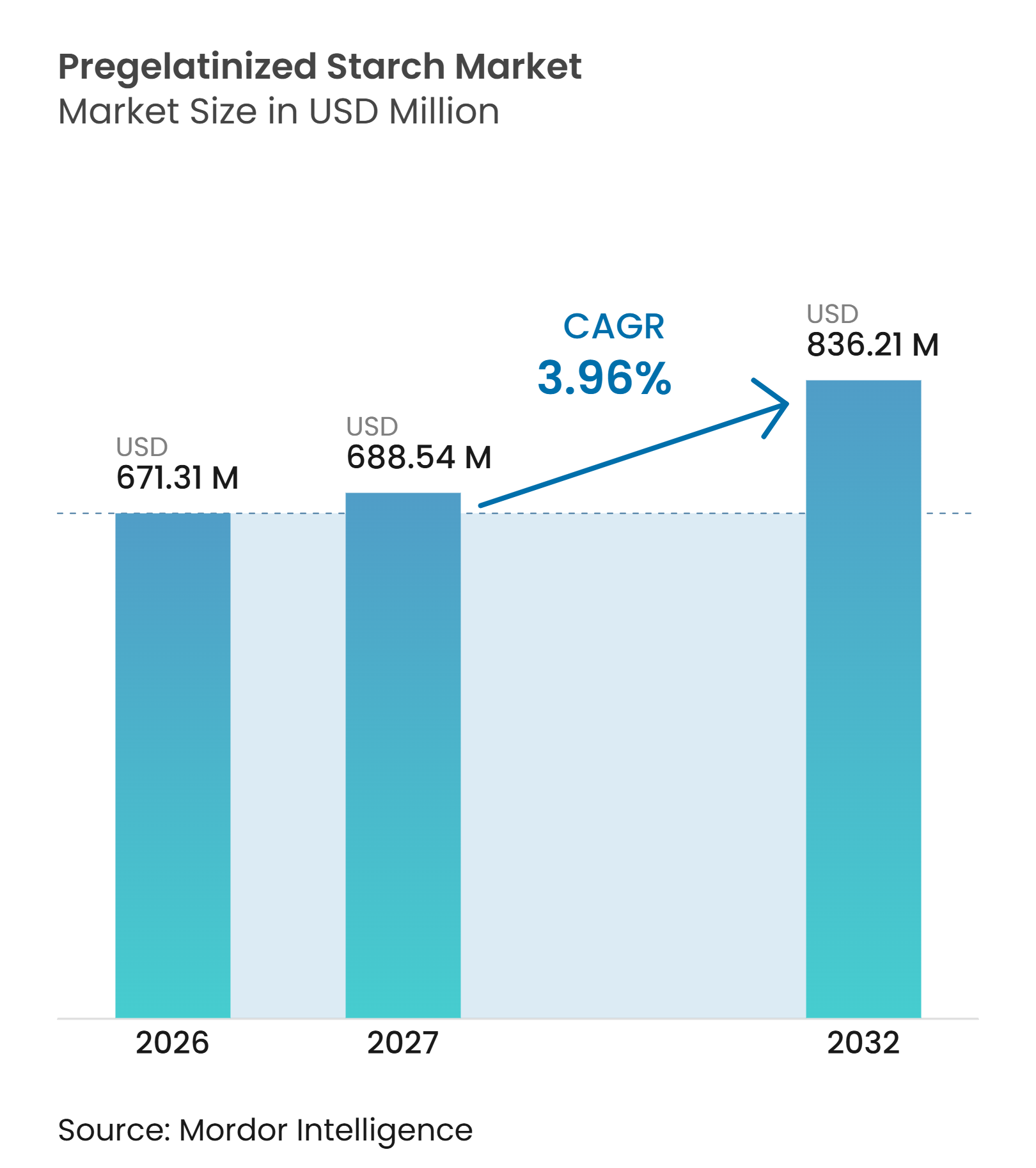
The pregelatinized starch market size is projected to expand from USD 671.31 million in 2026 and USD 688.54 million in 2027 to USD 836.21 million by 2032, registering a CAGR of 3.96% between 2027 and 2032. The pregelatinized starch market benefits from demand in processed foods, pharmaceutical formulations, and products with shorter preparation times. Cold-water solubility gives manufacturers a way to create viscosity without a separate cooking step. That function supports instant foods and direct-compression tablets where processing speed and product consistency matter. Clean-label reformulation is also shifting attention toward physically processed grades that can be declared more simply on food labels. Input costs, quality requirements, and competition from other binders remain important constraints for the pregelatinized starch market.
Key Report Takeaways
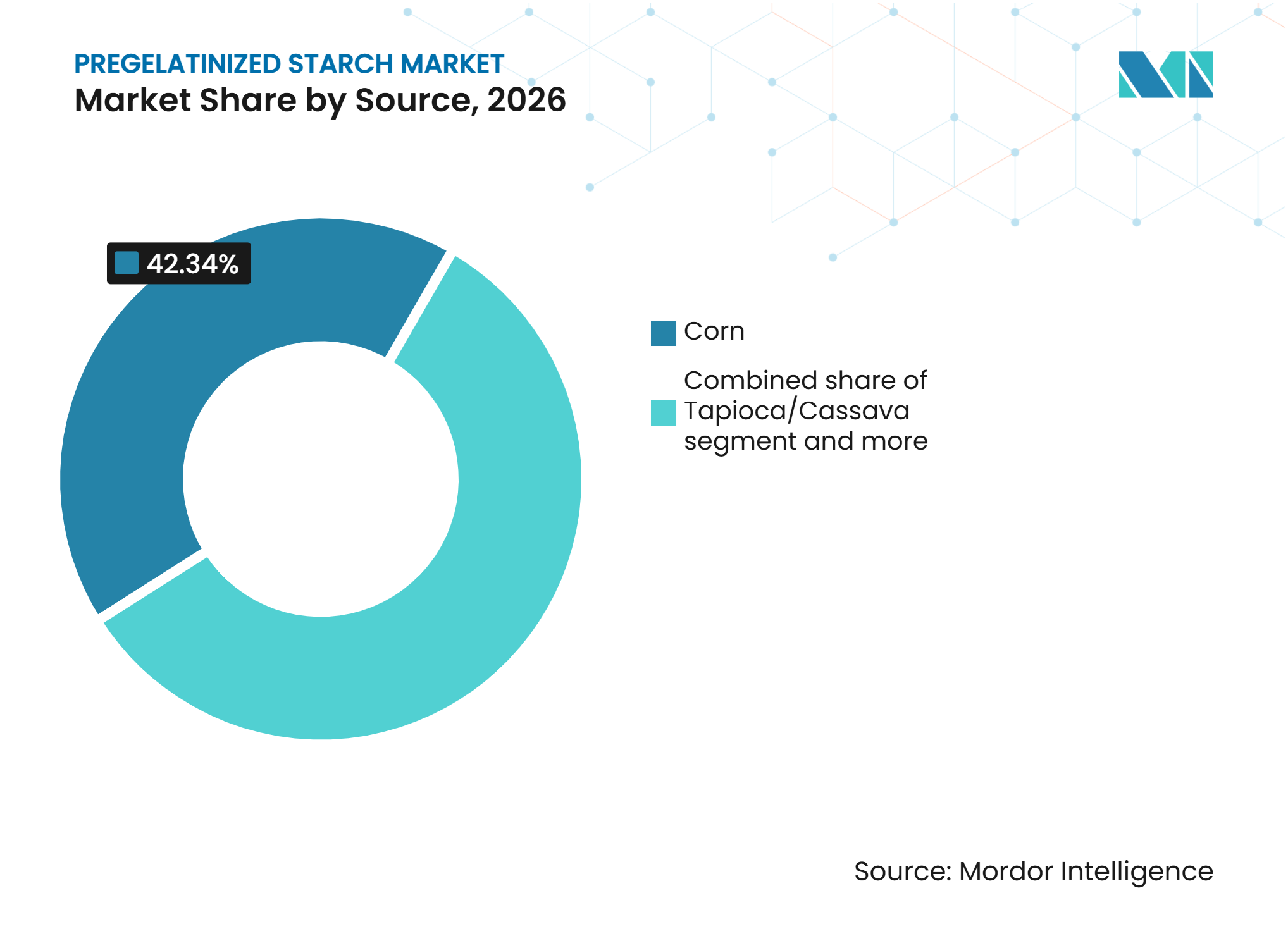
- By source, corn held 42.34% of the Pregelatinized Starch Market share in 2026, while tapioca/cassava is forecast to expand at a 4.81% CAGR through 2032.
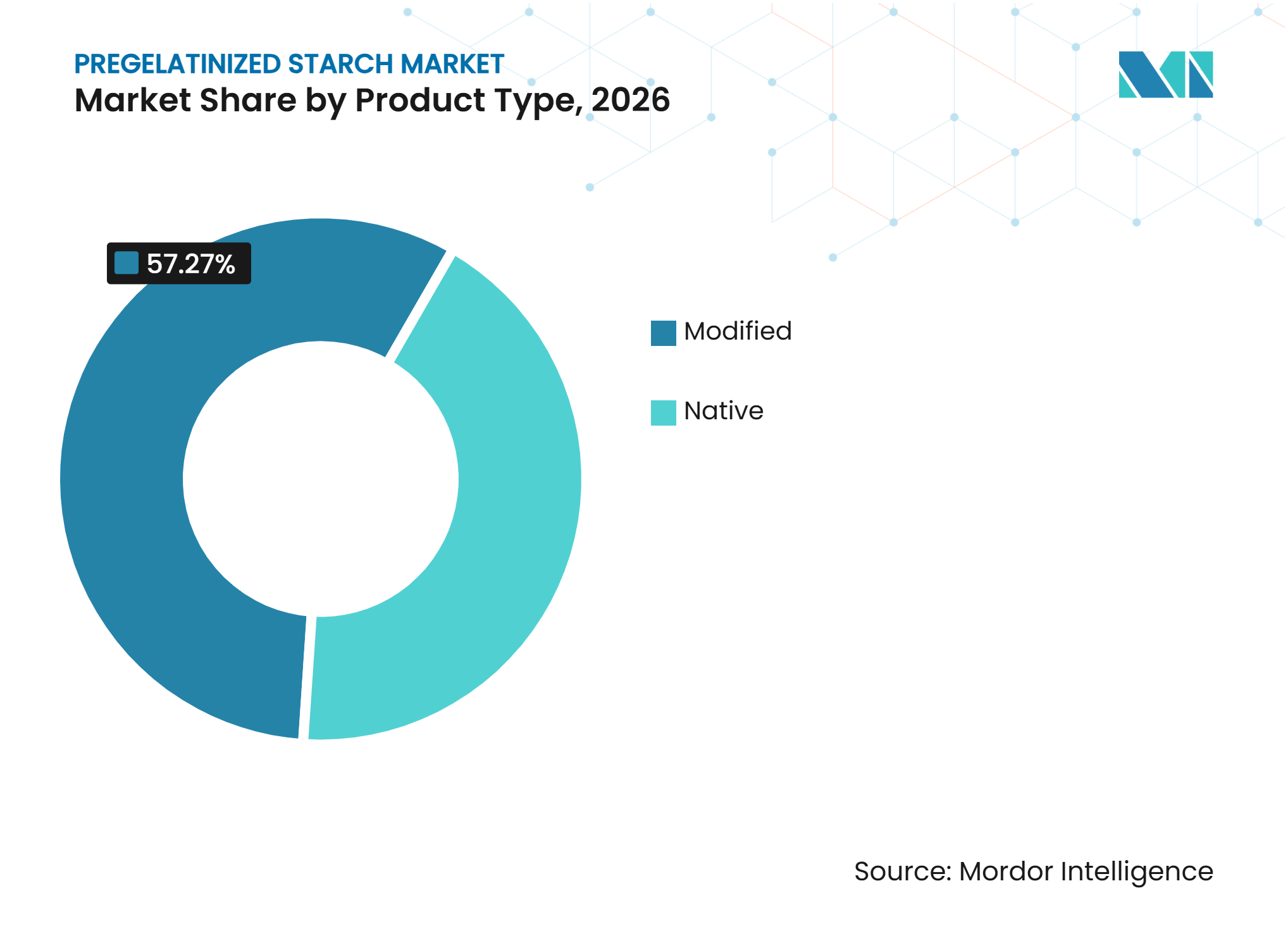
- By product type, modified starch held 57.27% of the pregelatinized starch market in 2026, while native starch is forecast to grow at a 5.69% CAGR through 2032.
- By application, food and beverage accounted for 39.45% of the Pregelatinized Starch Market size in 2026, while pharmaceutical applications are forecast to grow at a 5.56% CAGR through 2032.
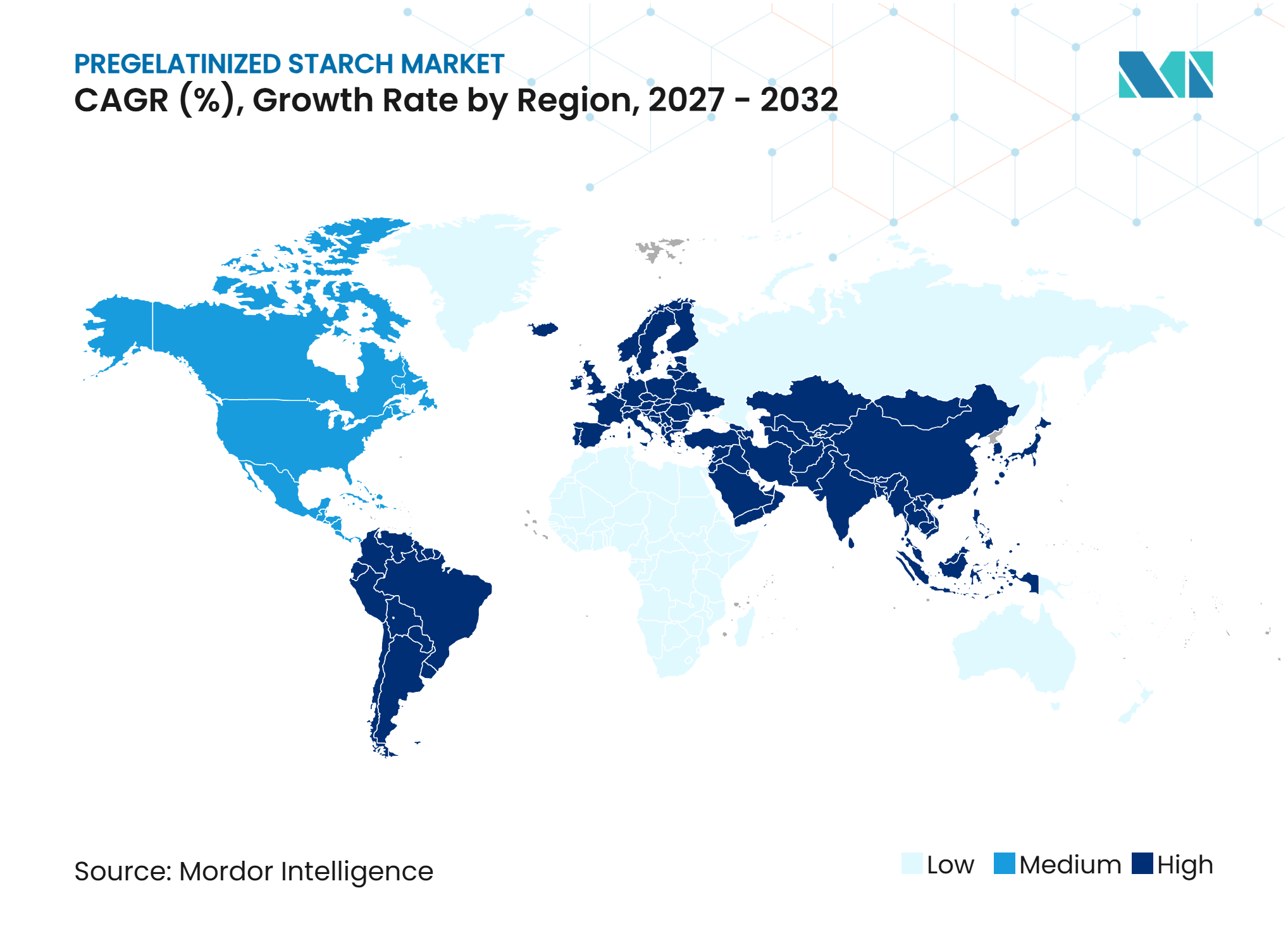
- By geography, Asia-Pacific held 38.71% of the pregelatinized starch market in 2026, while Europe is forecast to expand at a 4.75% CAGR through 2032.
Note: Market numbers in this report are based on Mordor Intelligence's proprietary estimation framework, which combines nine months of actuals with Q4 projections for base year 2026.
Market Trends and Insights
Drivers Impact Analysis of Pregelatinized Starch Market*
| Driver | (~) % Impact on CAGR Forecast | Geographic Relevance | Impact Timeline |
|---|---|---|---|
| Rising Demand for Convenience and Processed Foods | +1.1% | Global, with intensity in the Asia-Pacific and South America | Medium term (2–4 years) |
| Growing Adoption of Pharmaceutical Starch Excipients | +0.9% | Global; strongest in India, China, North America, and Europe | Long term (≥ 4 years) |
| Increasing Demand for Clean-Label Food Ingredients | +0.6% | Europe and North America core; the Asia-Pacific spill-over | Medium term (2–4 years) |
| Growing Utilization in Ready-to-Eat Food Formulations | +0.5% | The Asia-Pacific core; spill-over to the Middle East and Africa, and South America | Short term (≤ 2 years) |
| Rising Industrial Demand for Starch-Based Binders | +0.4% | Global, with concentration in North America and Europe | Medium term (2–4 years) |
| Expanding Applications Across Cosmetics and Personal Care | +0.3% | The Asia-Pacific and Europe core | Long term (≥ 4 years) |
| Source: Mordor Intelligence | |||
Rising Demand for Convenience and Processed Foods
Urbanization is fundamentally reshaping dietary patterns across emerging economies, with pregelatinized starch directly benefiting from this structural shift. Its ability to develop viscosity without heat enables food manufacturers to formulate products that hydrate, thicken, and stabilize during cold-fill and ambient processing, thereby reducing production-line energy consumption. For buyers, this capability provides a competitive advantage: manufacturers using cold-process formulations can lower line energy costs while reducing product reconstitution time. Instant noodles, dehydrated soups, and dried sauce mixes, among the fastest-growing processed food subcategories in Southeast Asia and South Asia, depend on this functionality. Expanding middle-class populations across Asia-Pacific markets are creating sustained demand for these products, adding structural volume that is unlikely to decline even amid economic headwinds.
Growing Adoption of Pharmaceutical Starch Excipients
Pregelatinized starch is a preferred binder-disintegrant combination for direct-compression tablet manufacturing because it eliminates the wet granulation step, reduces formulation cycle time, and lowers water activity in the final dosage form. A 2025 review in the European Journal of Pharmaceutics and Biopharmaceutics is expected to identify pregelatinized starch as one of the most versatile multifunctional excipients for solid dosage systems, citing its documented safety profile in the FDA Inactive Ingredient Database (IID). This listing holds strategic importance, as formulators developing Abbreviated New Drug Applications (ANDAs) often prefer excipients already listed in the FDA IID to reduce regulatory risk. This preference creates a self-reinforcing adoption cycle for pregelatinized starch among generic drug manufacturers. India’s expanding ANDA pipeline, together with Ingredion’s planned May 2026 joint venture with Sanstar Limited to establish a greenfield specialty pharmaceutical ingredient facility, indicates that the demand base is likely to strengthen during the forecast period.
Increasing Demand for Clean-Label Food Ingredients
The European Union’s regulatory framework creates a commercially significant distinction: physically modified starches, including pregelatinized variants produced through drum-drying or spray-drying, are not classified as food additives under Regulation (EC) No. 1333/2008[1]. Consequently, they do not require E-numbers on ingredient lists. This distinction is driving reformulation across European food processing, as manufacturers replace chemically modified starches (E1404–E1452) with physically treated alternatives that provide comparable functionality while appearing on labels as “starch” or “tapioca starch.” A 2025 study published in a peer-reviewed food science journal demonstrated that an ultrasound-treated rice and potato starch blend, a clean-label starch system, replicated xanthan gum’s viscosity profile in ketchup applications, achieving a predictive accuracy of R² = 0.988[2]. The findings suggest that physical modification can replace more complex hydrocolloid systems. The IFT reports that 38% of new food launches in the United States and Canada in 2025 carry clean-label positioning, confirming similar momentum in North America.
Growing Utilization in Ready-to-Eat Food Formulations
Ready-to-eat (RTE) and ready-to-mix (RTM) formats represent a demand tier in which pregelatinized starch plays an integral role. Its ability to provide immediate viscosity without cooking makes it effectively irreplaceable in powdered soups, meal-replacement mixes, and instant beverages that rehydrate at ambient or cool temperatures. A frequently underweighted commercial advantage is faster speed to consumer: RTM formats that eliminate in-home cooking simplify retail logistics, reduce energy costs at the point of consumption, and align with health-conscious consumers seeking portion-controlled meals. Cold-water-soluble specialty grades, the fastest-growing sub-tier within the pregelatinized starch market, are attracting disproportionately high research and development investment from ingredient suppliers. Their performance advantages are measurable and difficult to replicate using native starches. Roquette's planned October 2025 launch of AMYSTA L 123, a thermally soluble pea starch produced through a patented enzyme- and chemical-free process, directly responds to demand for label-transparent instant-mix functionality.
Restraints Impact Analysis of Pregelatinized Starch Market*
| Restraint | (~) % Impact on CAGR Forecast | Geographic Relevance | Impact Timeline |
|---|---|---|---|
| Fluctuating Prices of Agricultural Raw Materials | -0.9% | Global; intensity in North America, Europe, and the Asia-Pacific | Short to medium term (≤ 4 years) |
| Competition from Alternative Hydrocolloids and Binders | -0.6% | Europe and North America core; global exposure | Medium term (2–4 years) |
| Moisture Sensitivity During Storage and Transportation | -0.4% | Global, amplified in the Middle East and Africa, and Southeast Asia | Short term (≤ 2 years) |
| Stringent Food and Pharmaceutical Quality Regulations | -0.3% | Europe and North America primary; the Asia-Pacific increasing | Long term (≥ 4 years) |
| Source: Mordor Intelligence | |||
Fluctuating Prices of Agricultural Raw Materials
Corn represents a significant share of pregelatinized starch input costs, and its price behavior in 2025 highlights the market’s vulnerability to concurrent demand-side and supply-side shocks. Regional price variations remain substantial: in Q3 2025, corn starch prices ranged from USD 398/MT in China to USD 615/MT in Germany. This USD 217/MT spread creates asymmetric competitive positions for European and Asian producers. Weather-related yield shocks, US export policies, and changes in biofuel mandates can alter this price spread within a single quarter. Tapioca- and potato-based producers face different, but equally volatile, exposure profiles. Droughts and mosaic virus outbreaks can rapidly constrain cassava supply in Southeast Asia, while European potato harvests have encountered mycotoxin contamination concerns. For buyers, multi-source procurement strategies that blend corn-, tapioca-, and potato-based pregelatinized grades can reduce exposure to single-origin supply risks. However, these strategies also increase formulation complexity.
Competition from Alternative Hydrocolloids and Binders
Pregelatinized starch competes with xanthan gum, guar gum, pectin, and methylcellulose across several food applications. These alternatives provide tailored rheological profiles and, in some cases, superior freeze-thaw and acid stability. In pharmaceutical tablet manufacturing, hydroxypropyl methylcellulose (HPMC) and microcrystalline cellulose (MCC) serve as direct functional alternatives and have strong regulatory acceptance histories. Competitive pressure continues to evolve. Research published in 2025 showed that starch-based polyelectrolyte complex adhesives provide greater water resistance than neat starches, narrowing a key performance gap with synthetic binders in paper and packaging applications[3]. Conversely, sodium alginate has demonstrated sufficient binding and water-retention capabilities to serve as a sole texturizing agent in plant-based burger formulations without added starch, highlighting the porous nature of the competitive boundary. The risk of displacement is highest in segments with lower price sensitivity, where superior functionality can justify a price premium. However, pregelatinized starch maintains cost and scalability advantages in mass-market processed food applications and generic pharmaceutical tiers.
*Our forecasts treat driver/restraint impacts as directional, not additive. The impact forecasts reflect baseline growth, mix effects, and variable interactions.
Pregelatinized Starch Market Segment Analysis
By Source:
Corn Leads as Tapioca/Cassava Gains ShareCorn accounted for 42.34% of the pregelatinized starch market by source in 2026. Its leading position reflects well-established corn wet-milling infrastructure across North America, Europe, and China. Large-scale wet-milling operations enable the efficient conversion of corn into downstream starch ingredients and can maintain lower processing costs than lower-volume source materials. Corn also benefits from established food-grade supply chains and broad familiarity among formulators. These advantages support its use in high-volume food and industrial applications.
Wheat and potato remain relevant in applications where functional performance outweighs raw material scale. Potato-based grades offer neutral flavor and paste clarity, supporting their use in dairy alternatives and culinary sauces. Wheat-based grades continue to see demand in European bakery and food-service formulations. Rice-derived pregelatinized starch supports gluten-free and allergen-sensitive products, including crackers and infant food applications. Tapioca/cassava is forecast to grow at a CAGR of 4.81% through 2032, the highest among source types. Its non-GMO, allergen-free, and naturally gluten-free attributes expand its use in food formulations requiring a simple ingredient profile.



By Product Type:
Modified Grades Retain Scale as Native Grades Gain DemandModified grades are projected to hold a 57.27% share of the pregelatinized starch market in 2026, supported by their stable performance under demanding manufacturing conditions. Compared with native grades, modified materials more reliably withstand high-shear processing, freeze-thaw cycles, and low-pH environments. Foodservice operators and industrial processors often require this level of functionality. Cross-linked and substituted grades remain widely used in applications where product stability is critical. Hydroxypropyl distarch phosphate and acetylated distarch adipate are examples of modified materials used in these settings.
Native pregelatinized starch is forecast to grow at a CAGR of 5.69% from 2027 to 2032. Food manufacturers value grades that can be declared simply as starch or by their botanical source. This labeling approach supports clean-label reformulation while retaining the functional benefits of physical processing. Native grades are suitable for products with less demanding heat, shear, and acidity requirements. Roquette is expected to publish a patent in 2025 for a pregelatinized hydroxypropylated legume starch with film-forming properties for food, cosmetic, and pharmaceutical applications. Process innovation is therefore expected to continue expanding the boundary between native and modified performance requirements.

By Application:
Food and Beverage Provides Volume While Pharmaceuticals Grow FasterFood and beverage is projected to account for 39.45% of the pregelatinized starch market in 2026. Demand is driven by instant foods, bakery fillings, canned soups, and dairy alternatives. Cold-swelling properties support dehydrated convenience foods that require rapid thickening after preparation. Urban population growth is also increasing demand for packaged food formats across Asia-Pacific and the Middle East and Africa. Animal feed represents a smaller but stable application segment, where manufacturers use pregelatinized starch as a digestible, energy-dense binder. Paper, textile, and adhesive applications also use starch-based binders, particularly where renewable content is valued.
Avebe markets PERFECTACOL GM as a 100% bio-based, PFAS-free adhesive for fiber-based packaging. This product positioning supports demand for starch-based solutions in industrial applications with sustainability requirements. Pharmaceutical applications are forecast to expand at a CAGR of 5.56% through 2032. Pregelatinized starch is particularly important in direct compression applications, as it can function as a binder, filler, and disintegrant. Cosmetics and personal care manufacturers also use pregelatinized and modified starches for oil absorption, texture enhancement, and film formation. A 2025 review by PubMed documented the use of starch functionalities in cosmetics and personal care products.
Geography Analysis
Asia-Pacific
Asia-Pacific accounted for 38.71% of the pregelatinized starch market in 2026. China combines extensive corn and cassava processing capabilities with strong demand for processed foods. India generates demand through its pharmaceutical manufacturing base and export activities. Thailand, Vietnam, and Indonesia provide a substantial regional supply base for tapioca and cassava. Suppliers in these countries can serve food manufacturers seeking allergen-free and gluten-free starch options. In 2025, Siam Modified Starch obtained EXCiPACT GMP/GDP certification, demonstrating its focus on pharmaceutical excipient quality systems. Tate & Lyle also launched its Sensation sensory formulation tool in Asia-Pacific in 2025, initially for yogurt applications. This tool demonstrates how suppliers are tailoring formulation support to local texture preferences. Regional processors can benefit by combining quality certifications and application support with strong raw material availability.
Europe
Europe is projected to grow at a CAGR of 4.75% from 2027 to 2032. Under the applicable European regulatory framework, physically modified starch can avoid food additive classification, supporting reformulation efforts by food companies seeking simpler product declarations. Pharmaceutical demand also supports specialty starch consumption across the region. The United Kingdom, Germany, and Poland remain key consumption centers for food processing and pharmaceutical manufacturing. Producers face high energy costs, exposure to the EU Emissions Trading System, and elevated logistics expenses. Roquette highlighted these cost pressures for European starch processors in 2025. During the same year, Ingredion and AGRANA received clearance for their Romanian joint venture and announced a EUR 35 million capacity expansion at the Țăndărei plant. This project demonstrates continued investment in regional starch production capacity despite near-term cost pressures.
North America, South America, and the Middle East and Africa
North America continues to generate demand from generic pharmaceutical manufacturing and processed food reformulation. Clean-label product development remains a priority for food manufacturers in the United States and Canada. Specialty industrial starch capacity also supports packaging and papermaking applications. South America presents a supply-side opportunity, supported by the corn and cassava resources available in Brazil and Argentina. Colombia and other South American countries are expanding processing capabilities to meet regional food demand. The Middle East and Africa remain early-stage markets, although local production is gaining attention. In January 2026, Agbeyewa Industries is expected to complete its acquisition of Matna Foods in Nigeria. The transaction will link cassava cultivation in Ekiti State with industrial processing in Ondo State, reflecting a focus on local starch supply for food and industrial applications. Rice-derived specialty ingredients also support the development of a processing base in Egypt.
Competitive Landscape
Market Concentration
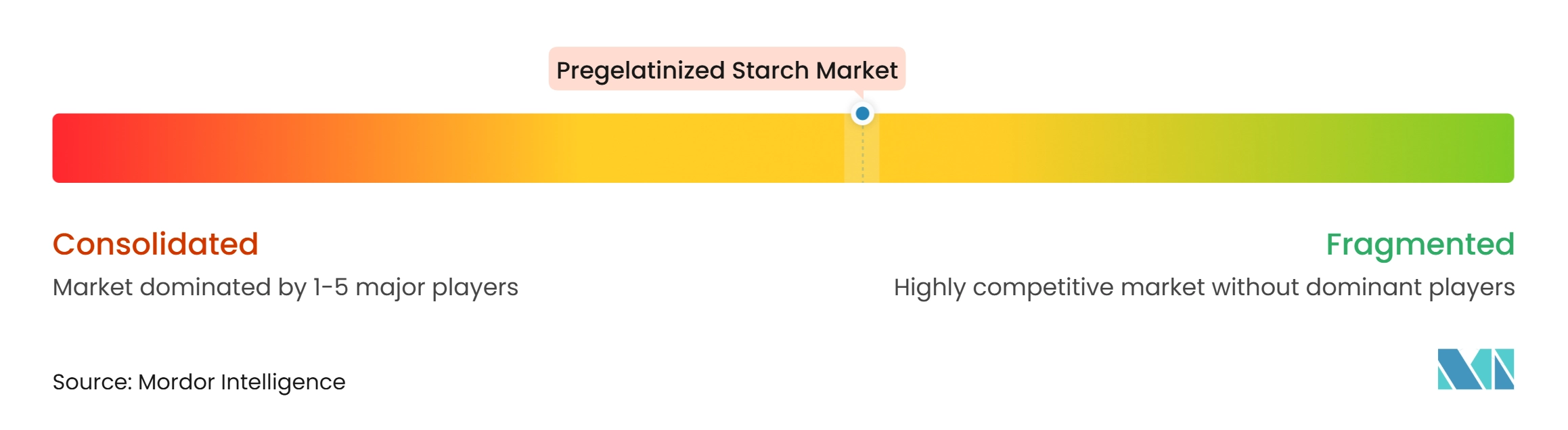
The pregelatinized starch market is moderately consolidated in pharmaceutical-grade and specialty food applications. Cargill, Ingredion, Tate & Lyle, Roquette, and Avebe have established technical capabilities across starch processing and application development. Emsland Group, KMC Ingredients, Universal Starch-Chem Allied, and Siam Modified Starch compete through raw material proximity and application-specific supply. Larger suppliers are expanding specialty portfolios, geographic manufacturing, and formulation support. These activities raise the importance of customer development capabilities beyond raw ingredient production. Companies also compete through documentation, compliance systems, and ability to serve regulated pharmaceutical applications.
Tate & Lyle launched its Sensation precision sensory formulation tool in Asia-Pacific during September 2025. The tool uses consumer mouthfeel preferences to support faster ingredient-solution development. Tate & Lyle also introduced an expanded mouthfeel portfolio at IFT FIRST 2025 after combining with CP Kelco. This combines starches with gums, pectins, and fibers in a broader formulation platform. Roquette launched AMYSTA L 123 in October 2025 for instant food formats that need clean-label soluble starch functionality. These moves show an emphasis on formulation performance, speed, and simpler product labels.
Smaller producers can improve their market position through recognized quality certification. Siam Modified Starch’s EXCiPACT certification provides a basis for access to regulated pharmaceutical excipient markets. This can broaden sourcing options for pharmaceutical formulators in North America and Europe. Opportunities remain in rice starch for allergen-sensitive nutrition and in organic or non-GMO grades. Co-processed excipients can also combine pregelatinized starch with disintegrants or sweeteners in a single granule. Plant-based sources such as pea, lentil, and mung bean can create differentiation when processing knowledge is protected. The competitive position of the pregelatinized starch market will therefore depend on functional performance, compliance readiness, and dependable regional supply.
Pregelatinized Starch Industry Leaders
-
Cargill, Incorporated
-
Ingredion Incorporated
-
Tate & Lyle PLC
-
Roquette Frères
-
Colorcon, Inc.
- *Disclaimer: Major Players sorted in no particular order
Pregelatinized Starch Market Companies Covered in this Report
- Cargill, Incorporated
- Ingredion Incorporated
- Tate & Lyle PLC
- Roquette Frères
- Colorcon, Inc.
- DFE Pharma GmbH & Co. KG
- Grain Processing Corporation
- Avebe U.A.
- AGRANA Beteiligungs-AG
- Emsland Group
- Archer Daniels Midland Company
- Galam Group
- Tereos S.A.
- Universal Starch-Chem Allied Ltd.
- Manildra Group
- Visco Starch
- Everest Starch India Pvt. Ltd.
- KMC Ingredients
- Siam Modified Starch Co., Ltd.
- Associated British Foods plc
Recent Industry Developments in Pregelatinized Starch Market
- May 2026: Sanstar Limited partnered with Ingredion Incorporated through an equity investment and joint venture agreement. The collaboration targeted specialty pharmaceutical excipients and advanced starch derivatives, with plans to establish a manufacturing facility in western India.
- May 2026: Regaal Resources completed an expansion of its Kishanganj manufacturing facility, increasing maize-processing capacity from 825 to 1,650 tonnes per day. It also outlined plans to expand its modified starch portfolio, including pregelatinized starch.
- November 2025: Emsland Group expanded its Asia-Pacific presence through a regional network connecting Singapore and Bangkok. The Bangkok application facility strengthened customer support and product development capabilities for starch-based ingredients across regional food manufacturing markets.
Global Pregelatinized Starch Market Report Scope
Pregelatinized starch is a physically, thermally, or chemically modified starch that has been pre-cooked (gelatinized) in the presence of water and subsequently dried into a fine powder. The pregelatinized starch report is segmented by source, product type, application, and geography. By product type, the market is segmented into corn, wheat, potato, tapioca/cassava, rice, and other sources. By Product Type, the market is segmented into native and modified. By application, the market is segmented into food and beverage, pharmaceutical, cosmetics and personal care, animal feed, paper/textile/adhesive, and other applications. By geography, the market is segmented into North America, Europe, Asia-Pacific, South America, and the Middle East and Africa. The market forecasts are provided in terms of value (USD).
Segmentation Overview
| Corn |
| Wheat |
| Potato |
| Tapioca/Cassava |
| Rice |
| Other Sources |
| Native |
| Modified |
| Food and Beverage |
| Pharmaceutical |
| Cosmetics and Personal Care |
| Animal Feed |
| Paper, Textile and Adhesive |
| Other Applications |
| North America | United States |
| Canada | |
| Mexico | |
| Rest of North America | |
| Europe | United Kingdom |
| Germany | |
| France | |
| Italy | |
| Spain | |
| Sweden | |
| Poland | |
| Netherlands | |
| Rest of Europe | |
| Asia-Pacific | China |
| Japan | |
| India | |
| South Korea | |
| Australia | |
| Rest of Asia-Pacific | |
| South America | Brazil |
| Argentina | |
| Colombia | |
| Rest of South America | |
| Middle East and Africa | United Arab Emirates |
| South Africa | |
| Saudi Arabia | |
| Turkey | |
| Rest of Middle East and Africa |
| By Source | Corn | |
| Wheat | ||
| Potato | ||
| Tapioca/Cassava | ||
| Rice | ||
| Other Sources | ||
| By Product Type | Native | |
| Modified | ||
| By Application | Food and Beverage | |
| Pharmaceutical | ||
| Cosmetics and Personal Care | ||
| Animal Feed | ||
| Paper, Textile and Adhesive | ||
| Other Applications | ||
| By Geography | North America | United States |
| Canada | ||
| Mexico | ||
| Rest of North America | ||
| Europe | United Kingdom | |
| Germany | ||
| France | ||
| Italy | ||
| Spain | ||
| Sweden | ||
| Poland | ||
| Netherlands | ||
| Rest of Europe | ||
| Asia-Pacific | China | |
| Japan | ||
| India | ||
| South Korea | ||
| Australia | ||
| Rest of Asia-Pacific | ||
| South America | Brazil | |
| Argentina | ||
| Colombia | ||
| Rest of South America | ||
| Middle East and Africa | United Arab Emirates | |
| South Africa | ||
| Saudi Arabia | ||
| Turkey | ||
| Rest of Middle East and Africa | ||
Key Questions Answered in the Report
What is the forecast growth rate for pregelatinized starch through 2032?
The category is forecast to grow at a 3.96% CAGR from 2027 to 2032, reaching USD 836.21 million in 2032.
Which raw material leads pregelatinized starch production?
Corn leads by source with a 42.34% share in 2026, supported by established wet-milling infrastructure.
Why is pregelatinized starch used in pharmaceutical tablets?
It can support direct compression by functioning as a binder and disintegrant, reducing the need for wet granulation.
Which application is growing fastest for pregelatinized starch?
Pharmaceutical applications are projected to grow at a 5.56% CAGR through 2032.