
Polyvinyl Chloride (PVC) Additives Market Size and Share
Market Overview
| Study Period | 2022 - 2032 |
|---|---|
| Market Size (2027) | USD 6.88 Billion |
| Market Size (2032) | USD 7.29 Billion |
| Growth Rate (2027 - 2032) | 5.97 % |
| Fastest Growing Market | Asia-Pacific |
| Largest Market | Asia-Pacific |
| Market Concentration | Low |
Major Players *Disclaimer: Major Players sorted in no particular order Image © Mordor Intelligence. Reuse requires attribution under CC BY 4.0. | |
Polyvinyl Chloride (PVC) Additives Market Analysis by Mordor Intelligence
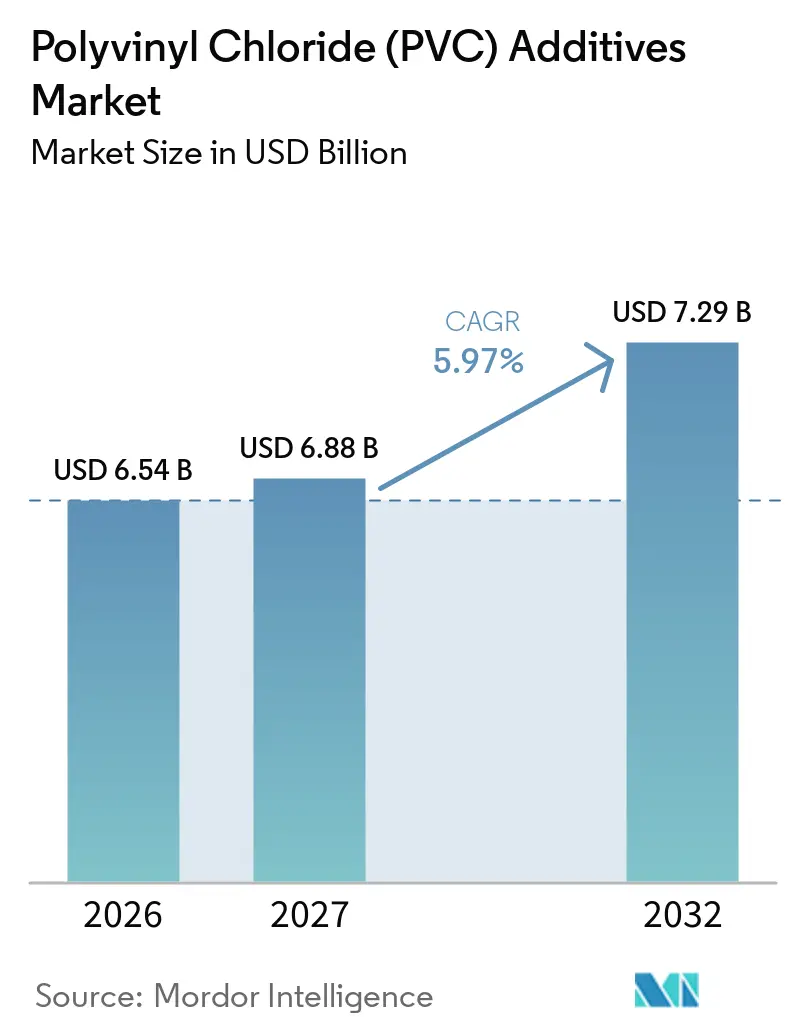
The Polyvinyl Chloride (PVC) Additives Market size was valued at USD 6.54 billion in 2026 and is estimated to grow from USD 6.88 billion in 2027 to reach USD 7.29 billion by 2032, at a CAGR of 5.97% during the forecast period (2027-2032). PVC requires additives to control thermal degradation, impact resistance, processing efficiency, and color stability, which makes additive demand closely connected to polymer conversion activity. Regulatory action on lead-based systems is changing purchasing decisions toward calcium-zinc, organic, and other compliant formulations. Infrastructure investment is supporting demand for PVC pipes, profiles, cable conduits, and related additive packages in emerging economies. Suppliers are responding with lead-free systems, dust-free liquid formats, and formulations that can manage recycled feedstocks. The polyvinyl chloride (PVC) additives market, therefore, combines infrastructure-linked demand with compliance-led reformulation opportunities.
Key Report Takeaways
- By product type, stabilizers held 35.23% of the polyvinyl chloride (PVC) additives market share in 2026 and are forecast to advance at a 6.61% CAGR through 2032.
- By form, powder held 45.67% of the polyvinyl chloride (PVC) additives market share in 2026, while liquid is forecast to advance at a 6.45% CAGR through 2032.
- By fabrication process, extrusion held 50.12% of the polyvinyl chloride (PVC) additives market share in 2026 and is forecast to advance at a 6.77% CAGR through 2032.
- By application, pipes and fittings held 36.86% of the polyvinyl chloride (PVC) additives market share in 2026 and are forecast to advance at a 6.85% CAGR through 2032.
- By geography, Asia-Pacific held 43.71% of the polyvinyl chloride (PVC) additives market share in 2026 and is forecast to advance at a 6.63% CAGR through 2032.
Note: Market numbers in this report are based on Mordor Intelligence's proprietary estimation framework, which combines nine months of actuals with Q4 projections for base year 2026.
Global Polyvinyl Chloride (PVC) Additives Market Trends and Insights
Drivers Impact Analysis*
| Driver | (~) % Impact on CAGR Forecast | Geographic Relevance | Impact Timeline |
|---|---|---|---|
| Construction and Infrastructure Demand for Durable PVC Products | +1.8% | Global, concentrated in Asia-Pacific, Middle East, and South America | Short term (≤ 2 years) |
| Growth of PVC Pipes, Profiles, Wires and Cables in Emerging Markets | +1.5% | APAC core, spillover to MEA and South America | Medium term (2–4 years) |
| Expansion of Lead-Free and Non-Phthalate Additive Systems | +1.2% | Asia-Pacific (China, India), EU, North America | Short term (≤ 2 years) |
| Increasing Demand for High-Performance PVC in Automotive, Medical and Electronics Applications | +0.9% | North America, Europe, Japan, South Korea | Medium term (2–4 years) |
| Additives Designed for Recycled PVC Feedstocks and Circular Manufacturing | +0.6% | EU, North America, spillover to APAC | Long term (≥ 4 years) |
| Source: Mordor Intelligence | |||
Construction and Infrastructure Demand for Durable PVC Products
Construction activity supports the consumption of stabilizers, impact modifiers, and processing aids because pipes, profiles, flooring, and cable conduits require durable formulations. Additives help these products meet requirements for thermal stability, impact resistance, and processing consistency. Water and sanitation projects create continuing demand for pressure-rated unplasticized polyvinyl chloride (PVC-U) pipe and compliant stabilizer packages. Tighter fire-rating and smoke-density requirements for indoor cable conduit can require suppliers to balance flame retardants with thermal stabilizers. This combination can increase the additive content per kilogram of PVC processed in the polyvinyl chloride (PVC) additives market.
Growth of PVC Pipes, Profiles, Wires and Cables in Emerging Markets
PVC pipes, profiles, wires, and cables are expanding across markets where water access, electrification, and housing investment are priorities. Converters compete for specification-grade demand by offering products with required flame resistance, temperature performance, and durability. Electrification gaps in emerging economies continue to support investment in cable networks and related installation materials. PVC cable insulation for humid and high-ultraviolet environments requires additive packages tailored to those service conditions. Lead-free formulations that meet the Bureau of Indian Standards are relevant for pipe tenders and can act as a market-access requirement. These requirements support the polyvinyl chloride (PVC) additives market by moving demand toward tested formulations instead of basic input supply.
Expansion of Lead-Free and Non-Phthalate Additive Systems
The move away from lead-based stabilizers and certain phthalates is changing the formulation mix in PVC. China’s Key Controlled New Pollutants List took effect on July 1, 2025, banning tribasic lead sulfate and dibasic lead phosphite in rigid PVC profiles and water-supply pipes. The resulting substitution favors calcium-zinc, organotin, and organic alternatives where performance and compliance documentation are required. The European Union restricts lead in PVC polymers to below 0.1%, with a May 28, 2033 sunset date for recycled rigid PVC containing residual lead under defined conditions[1]. Chemical-safety reviews continue to focus attention on phthalate use and safer alternatives. These rules encourage producers in the polyvinyl chloride (PVC) additives market to prioritize substitution, re-stabilization, and traceable product documentation.
Increasing Demand for High-Performance PVC in Automotive, Medical and Electronics Applications
Automotive, medical, and electronics uses require PVC compounds with tighter performance specifications than standard construction applications. Thermal cycling, flame suppression, electrical stress, and dimensional stability influence the additives selected for these products. LG Chem presented ultra-high molecular weight PVC applications for electric vehicle charging cables and automotive interior synthetic leather in 2025. Medical-grade rigid PVC also requires ingredients and production controls that align with device and food-contact requirements where applicable. Continental AG and INEOS Inovyn announced a partnership for renewable-energy-certified PVC used in products including automotive seats, food hoses, and conveyor belts. These applications increase the value placed on customized stabilizer and processing-aid combinations in the polyvinyl chloride (PVC) additives market.
Restraints Impact Analysis*
| Restraint | (~) % Impact on CAGR Forecast | Geographic Relevance | Impact Timeline |
|---|---|---|---|
| Regulatory and Reformulation Costs for Legacy Phthalates and Heavy-Metal Stabilizers | -0.6% | EU, North America, Asia-Pacific | Short term (≤ 2 years) |
| Volatility in Tin, Zinc, Chlor-alkali and Petrochemical Feedstock Costs | -0.4% | Global, particularly Asia-Pacific and Europe | Short term (≤ 2 years) |
| Formulation Complexity When Processing Mixed or Contaminated Recycled PVC | -0.3% | EU, North America, spillover to APAC | Long term (≥ 4 years) |
| Source: Mordor Intelligence | |||
Regulatory and Reformulation Costs for Legacy Phthalates and Heavy-Metal Stabilizers
Regulatory change can raise costs for producers that must replace legacy phthalates and heavy-metal stabilizers. Reformulation requires laboratory work, regulatory testing, safety documentation, and customer approval. Regulatory authorities in Europe and the United States continue to review PVC additives and food-contact materials. Quality systems and product documentation often need changes after a new formula is qualified. Customer approval may also take time when material is used in packaging, medical, or long-service applications. These requirements can lengthen conversion cycles and constrain smaller suppliers in the polyvinyl chloride (PVC) additives market.
Volatility in Tin, Zinc, Chlor-alkali and Petrochemical Feedstock Costs
Tin, zinc, chlor-alkali inputs, and petrochemical materials influence the cost base of PVC additive formulations. Price shifts can reduce supplier margins where contracts do not allow rapid price adjustments. Organotin systems are particularly exposed to tin availability and competition from other consuming sectors. Producers can respond through sourcing agreements, inventory planning, and alternative formulations, but each option can add cost or complexity. Raw material changes also affect the working capital needed to maintain a reliable supply to converters. This volatility remains a near-term restraint for the polyvinyl chloride (PVC) additives market.
*Our forecasts treat driver/restraint impacts as directional, not additive. The impact forecasts reflect baseline growth, mix effects, and variable interactions.
Segment Analysis
By Product Type: Stabilizers Drive Scale and Growth
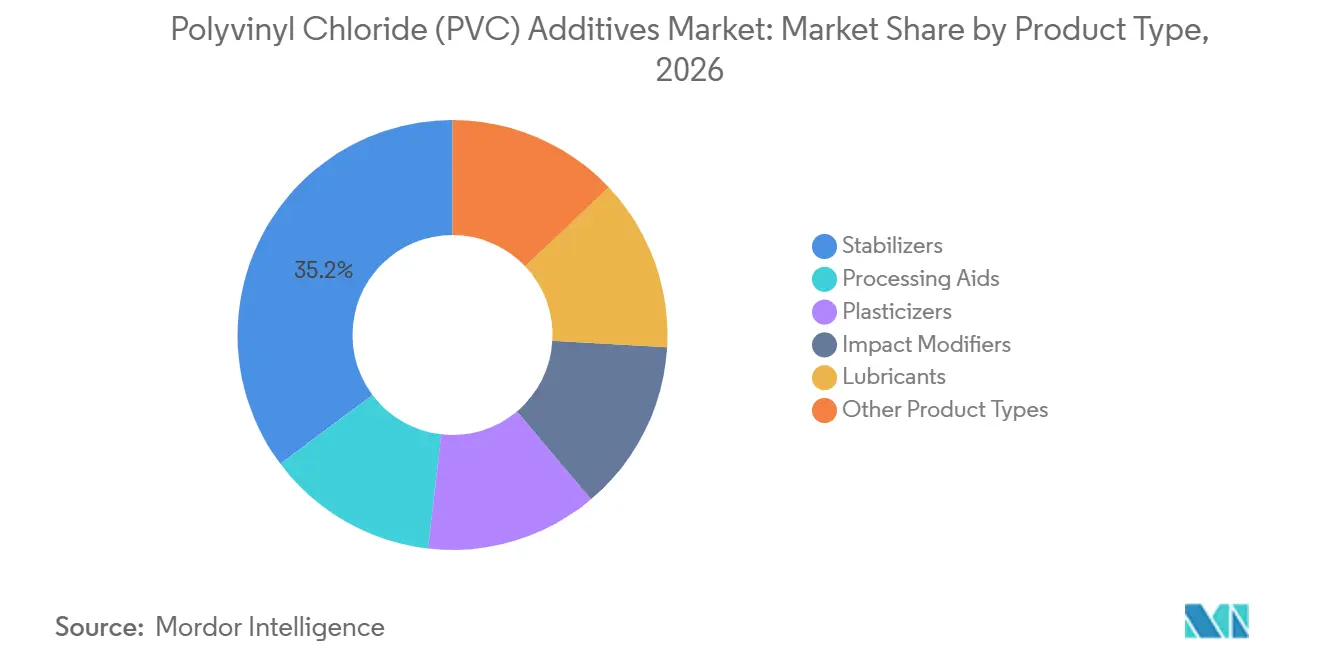
Stabilizers held 35.23% of the polyvinyl chloride (PVC) additives market share in 2026 and are projected to advance at a 6.61% CAGR through 2032. They protect PVC against heat-related degradation during processing and use. The withdrawal of lead-salt systems creates demand for calcium-zinc, organotin, and organic alternatives. Buyers assess performance, compliance documentation, and lifecycle cost before changing a package. This makes stabilizer selection central to formulation decisions and converter qualification work.
Impact modifiers support extrusion and blow-molding applications where toughness and processing performance matter. Arkema announced a proposed divestment of its Methyl Methacrylate Butadiene Styrene (MBS) and Acrylic Impact Modifiers and Processing Aids (AIMPA) impact-modifier businesses to Praana in December 2025. Lubricants support melt flow and equipment performance across PVC conversion processes. Plasticizers are moving toward non-phthalate options in applications with medical or food-contact requirements. These categories broaden the polyvinyl chloride (PVC) additives industry beyond basic thermal stabilization.

By Form: Liquid Form Gains Alongside Established Powder Form
Powder held 45.67% of the polyvinyl chloride (PVC) additives market share in 2026 because it is widely used in continuous extrusion and calendering lines. Existing plants are designed around powder handling and established dosing practices. Liquid is projected to advance at a 6.45% CAGR through 2032 as converters seek dust-free handling and controlled addition. Liquid systems can support volumetric dosing and better formulation control. Granules and pellets remain relevant where uniform melt distribution at high filler loadings is important.
Occupational health and housekeeping needs can favor liquid and prill-based one-pack systems. Valtris Specialty Chemicals received a VinylPlus Supplier Certificate for liquid mixed-metal stabilizer ranges. Liquid products can also support automated systems that reduce handling variability. Powder remains suitable where material flow and throughput are already optimized. This range of forms lets suppliers meet equipment and application requirements without full process redesign.
By Fabrication Process: Extrusion Anchors Demand and Growth
Extrusion held 50.12% of the polyvinyl chloride (PVC) additives market share in 2026 and is projected to advance at a 6.77% CAGR through 2032. Pipes, profiles, cable jackets, and rigid sheets are commonly produced through extrusion. These uses require stable melt behavior and consistent output quality. Additive selection can affect line performance and finished-product properties. Extrusion, therefore, connects additive demand closely to construction and utility infrastructure investment.
Lead-free stabilization systems are increasingly important in extruded pipes and profiles because of regulatory requirements. The Society of Plastics Engineers described lead-free stabilization approaches for PVC pipes in 2025. Injection molding serves fittings, valve bodies, and medical-device housings that need close dimensional control. Blow molding is used for packaging and medical containers, where phthalate restrictions can influence formulation. European Union Regulation 2026/245 authorized rice bran wax derivatives for certain rigid PVC food-contact applications.
By Application: Pipes and Fittings Anchor Demand and Growth
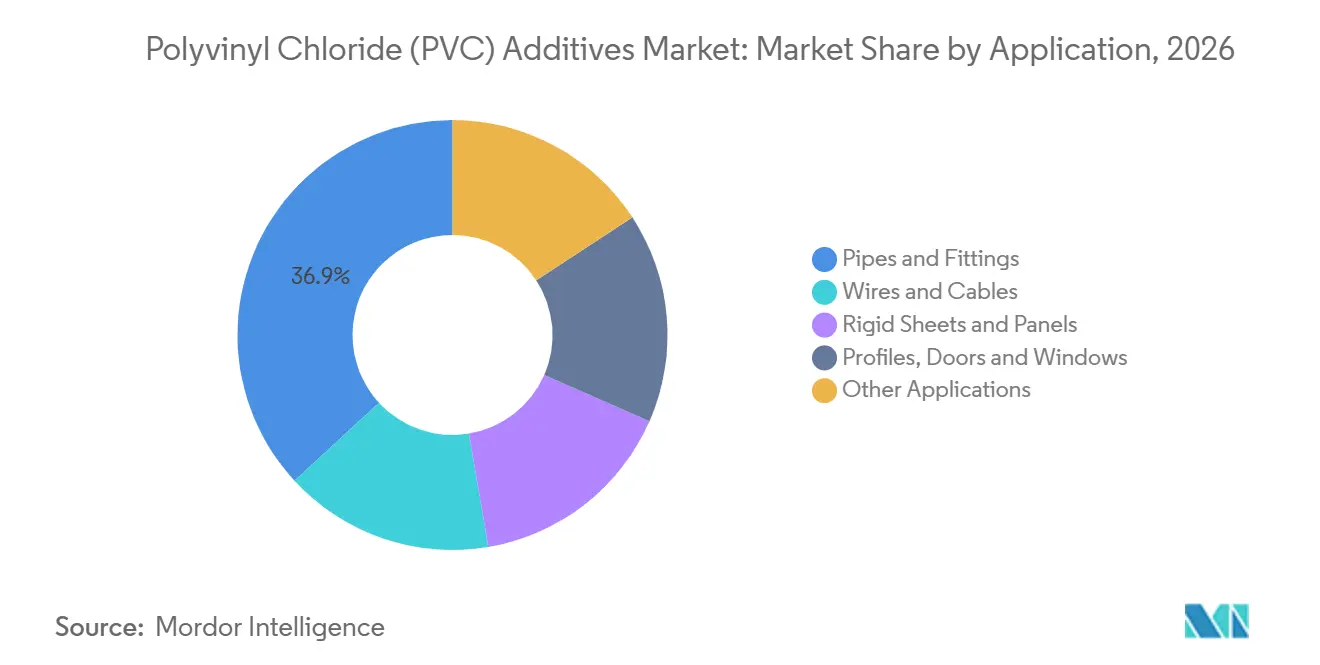
Pipes and fittings held 36.86% of the polyvinyl chloride (PVC) additives market share in 2026 and are projected to advance at a 6.85% CAGR through 2032. Water and sanitation construction supports this application because PVC pipes require durable, compliant formulations. Pressure-rated pipes need additives that support processing, long service life, and potable water standards. Municipal procurement and utility investment, therefore, influence additive purchasing. Lead-free formulations are particularly relevant where pipe standards define allowable material inputs.
Profiles, doors, and windows require weathering resistance, impact performance, and processing consistency. Wires and cables need packages that support flame resistance and thermal durability. Rigid sheets and panels rely on processing aids and impact modifiers to achieve surface quality and workability. Each application places different demands on additives despite using the same base polymer. This diversity supports specialized formulation work across the polyvinyl chloride (PVC) additives industry.
Geography Analysis
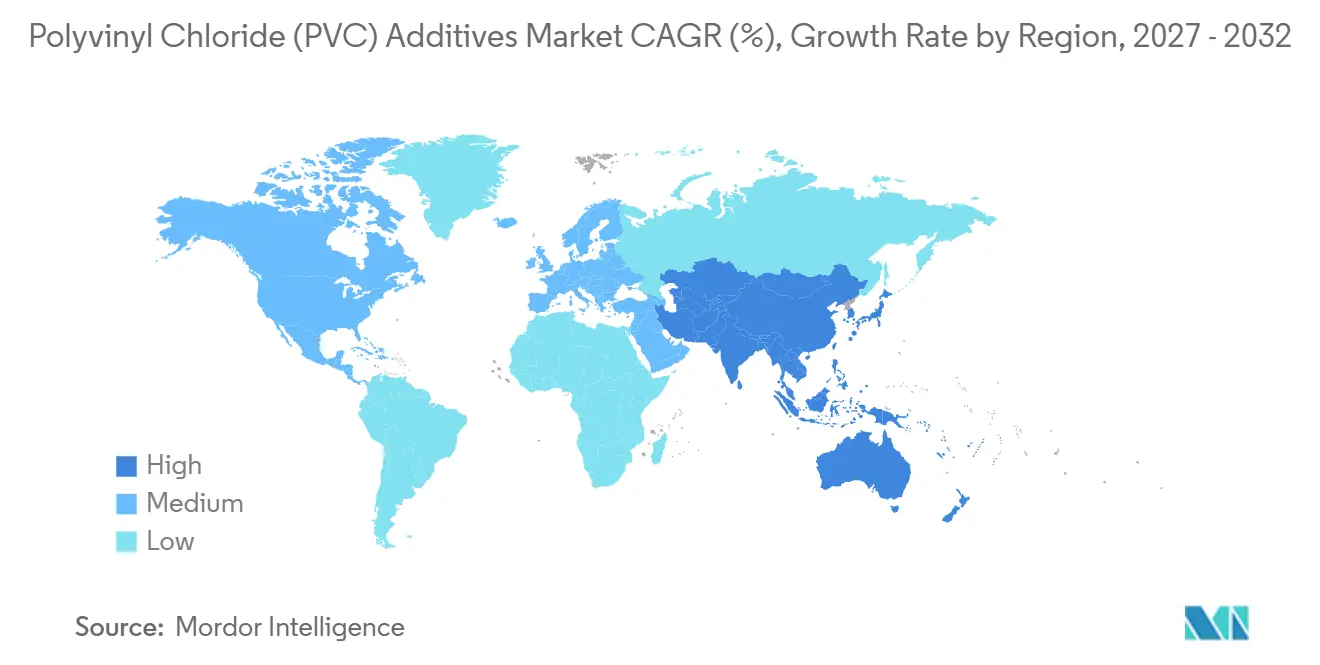
Asia-Pacific held 43.71% of the polyvinyl chloride (PVC) additives market share in 2026 and is projected to advance at a 6.63% CAGR through 2032. China has a central role because of its large PVC production and conversion base. The 2025 restrictions on specified lead-based stabilizers reinforce the move toward alternative systems. India supports demand through pipe, sanitation, housing, and cable applications. KANEKA CORPORATION ended its consignment production contract with Toagosei and expanded its Takasago and Kashima sites to support a stable vinyl chloride resin supply.
North America is shaped by water-system investment and compliance-driven reformulation. Europe is shaped by the lead restriction, PVC recycling requirements, and sustainability standards. VinylPlus highlights the region’s recycling base and the need for additives that manage legacy-material issues. Germany supports demand for high-performance stabilizer packages in automotive and cable conduit applications. Nordic building-envelope renovation activity supports durable window-profile systems.
South America and Middle East and Africa are supported by infrastructure, urban development, and electrification needs. Brazil supports regional demand through sanitation expansion programs. SONGWON partnered with Altek International FZE to distribute PVC stabilizers in Middle East markets from January 2025[2]. These regions create opportunities where converters need reliable access to lead-free grades.
Competitive Landscape
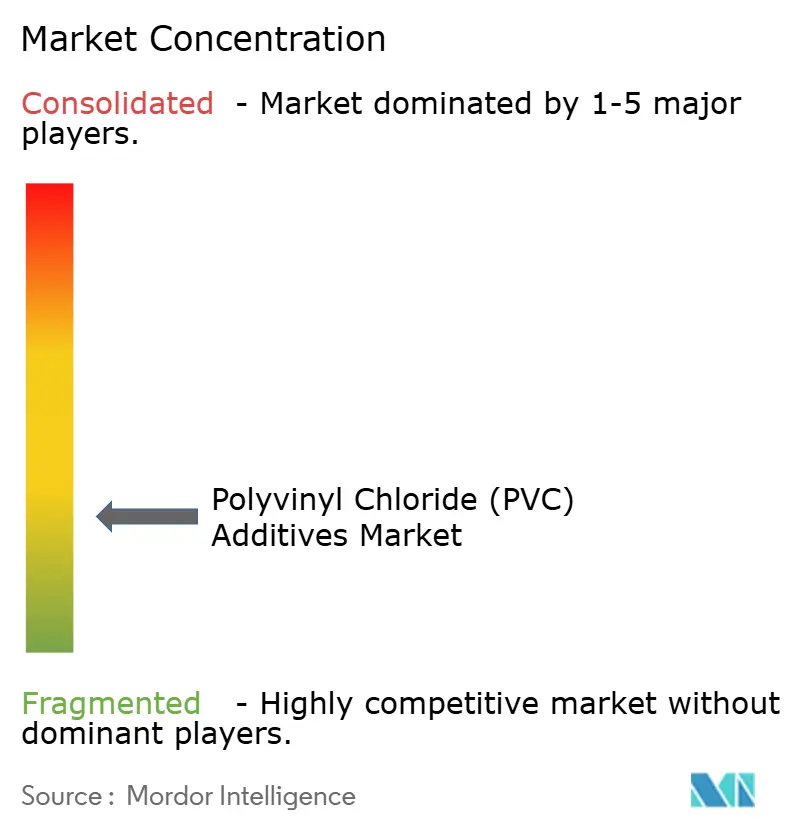
The polyvinyl chloride (PVC) additives market is highly fragmented, with the top five players including BASF, Arkema, SONGWON, Baerlocher GmbH, and ADEKA CORPORATION. Their offerings include one-pack systems, heat stabilizers, processing aids, and application-specific solutions. Regional Asian producers are expanding calcium-zinc capacity as demand shifts away from lead-based systems. The polyvinyl chloride (PVC) additives market is neither fully concentrated nor fully fragmented.
Arkema announced a proposed divestment of its impact modifiers and processing aids businesses to Praana in December 2025. Baerlocher GmbH presented its Tin Replacement program at K 2025, featuring the BAEROSTAB stabilizer family for rigid PVC applications. These actions show portfolio repositioning around compliant stabilizers and higher-value formulations. CLARIANT is directing attention toward phosphorus-based systems, while Chinese suppliers are strengthening calcium-zinc production. Qualification support is becoming as important as production capacity.
Recyclate-compatible additives and supply localization are key areas of activity. Valtris Specialty Chemicals is extending its Thane, India, production facility and continues its VinylPlus sustainability work. SONGWON’s Middle East distribution partnership strengthens local access to PVC stabilizers. Testing capability, application knowledge, and regional availability can reduce the burden of formula conversion for customers.
Polyvinyl Chloride (PVC) Additives Industry Leaders
-
BASF
-
Arkema
-
SONGWON
-
Baerlocher GmbH
-
ADEKA CORPORATION
- *Disclaimer: Major Players sorted in no particular order
Recent Industry Developments
- June 2026: Waldies Compound Limited completed Stage 2 trials at its new PVC additives manufacturing facility in Dausa, Rajasthan, India. The facility has an annual capacity of approximately 25,000 metric tons and produces calcium-zinc stabilizers, lubricants, processing aids, and customized additive formulations.
- May 2026: CLARIANT received U.S. FDA approval for its bio-based Licocare RBW wax additives for rigid PVC food-contact applications. The approval expands their use as processing aids, lubricants, release agents, and slip additives, supporting demand for renewable alternatives to conventional PVC additives.
Global Polyvinyl Chloride (PVC) Additives Market Report Scope
Polyvinyl chloride (PVC) additives are substances incorporated into PVC formulations to improve processing characteristics, durability, flexibility, impact resistance, and overall material performance. They help tailor PVC products to meet specific manufacturing requirements and end-use conditions.
The Polyvinyl Chloride (PVC) Additives Market is segmented by product type, form, fabrication process, application, and geography. By product type, the market is segmented into stabilizers, impact modifiers, processing aids, lubricants, plasticizers, and other product types. By form, the market is segmented into powder, granules and pellets, and liquid. By fabrication process, the market is segmented into extrusion, injection molding, blow molding, and other fabrication processes. By application, the market is segmented into pipes and fittings, profiles, doors and windows, wires and cables, rigid sheets and panels, and other applications. The report also covers the market size and forecasts for polyvinyl chloride (PVC) additives across 15 countries. For each segment, the market sizing and forecasts have been done on the basis of value (USD).
| Stabilizers |
| Impact Modifiers |
| Processing Aids |
| Lubricants |
| Plasticizers |
| Other Product Types |
| Powder |
| Granules and Pellets |
| Liquid |
| Extrusion |
| Injection Molding |
| Blow Molding |
| Other Fabrication Processes |
| Pipes and Fittings |
| Profiles, Doors and Windows |
| Wires and Cables |
| Rigid Sheets and Panels |
| Other Applications |
| Asia-Pacific | China |
| India | |
| Japan | |
| South Korea | |
| ASEAN Countries | |
| Rest of Asia-Pacific | |
| North America | United States |
| Canada | |
| Mexico | |
| Europe | Germany |
| United Kingdom | |
| France | |
| Italy | |
| NORDIC Countries | |
| Rest of Europe | |
| South America | Brazil |
| Argentina | |
| Rest of South America | |
| Middle East and Africa | Saudi Arabia |
| South Africa | |
| Rest of Middle East and Africa |
| By Product Type | Stabilizers | |
| Impact Modifiers | ||
| Processing Aids | ||
| Lubricants | ||
| Plasticizers | ||
| Other Product Types | ||
| By Form | Powder | |
| Granules and Pellets | ||
| Liquid | ||
| By Fabrication Process | Extrusion | |
| Injection Molding | ||
| Blow Molding | ||
| Other Fabrication Processes | ||
| By Application | Pipes and Fittings | |
| Profiles, Doors and Windows | ||
| Wires and Cables | ||
| Rigid Sheets and Panels | ||
| Other Applications | ||
| By Geography | Asia-Pacific | China |
| India | ||
| Japan | ||
| South Korea | ||
| ASEAN Countries | ||
| Rest of Asia-Pacific | ||
| North America | United States | |
| Canada | ||
| Mexico | ||
| Europe | Germany | |
| United Kingdom | ||
| France | ||
| Italy | ||
| NORDIC Countries | ||
| Rest of Europe | ||
| South America | Brazil | |
| Argentina | ||
| Rest of South America | ||
| Middle East and Africa | Saudi Arabia | |
| South Africa | ||
| Rest of Middle East and Africa | ||
Key Questions Answered in the Report
What is the size of the polyvinyl chloride (PVC) additives market?
The polyvinyl chloride (PVC) additives market was valued at USD 6.54 billion in 2026 and is estimated to grow from USD 6.88 billion in 2027 to reach USD 7.29 billion by 2032, at a CAGR of 5.97% during the forecast period (2027-2032).
Which product type leads the PVC additives demand?
Stabilizers held a 35.23% share in 2026 and are projected to advance at a 6.61% CAGR through 2032.
Why are lead-free PVC additives becoming more important?
Regulations in China and Europe are restricting specified lead-based systems, supporting demand for calcium-zinc, organotin, and other compliant alternatives.
Which PVC application is projected to grow fastest through 2032?
Pipes and fittings are projected to advance at a 6.85% CAGR through 2032.