
Polycaprolactone Polyol Market Size and Share
Market Overview
| Study Period | 2022 - 2032 |
|---|---|
| Market Size (2027) | USD 462.40 Million |
| Market Size (2032) | USD 632.05 Million |
| Growth Rate (2027 - 2032) | 6.45 % |
| Fastest Growing Market | Asia-Pacific |
| Largest Market | Asia-Pacific |
| Market Concentration | High |
Major Players *Disclaimer: Major Players sorted in no particular order Image © Mordor Intelligence. Reuse requires attribution under CC BY 4.0. | |
Polycaprolactone Polyol Market Analysis by Mordor Intelligence
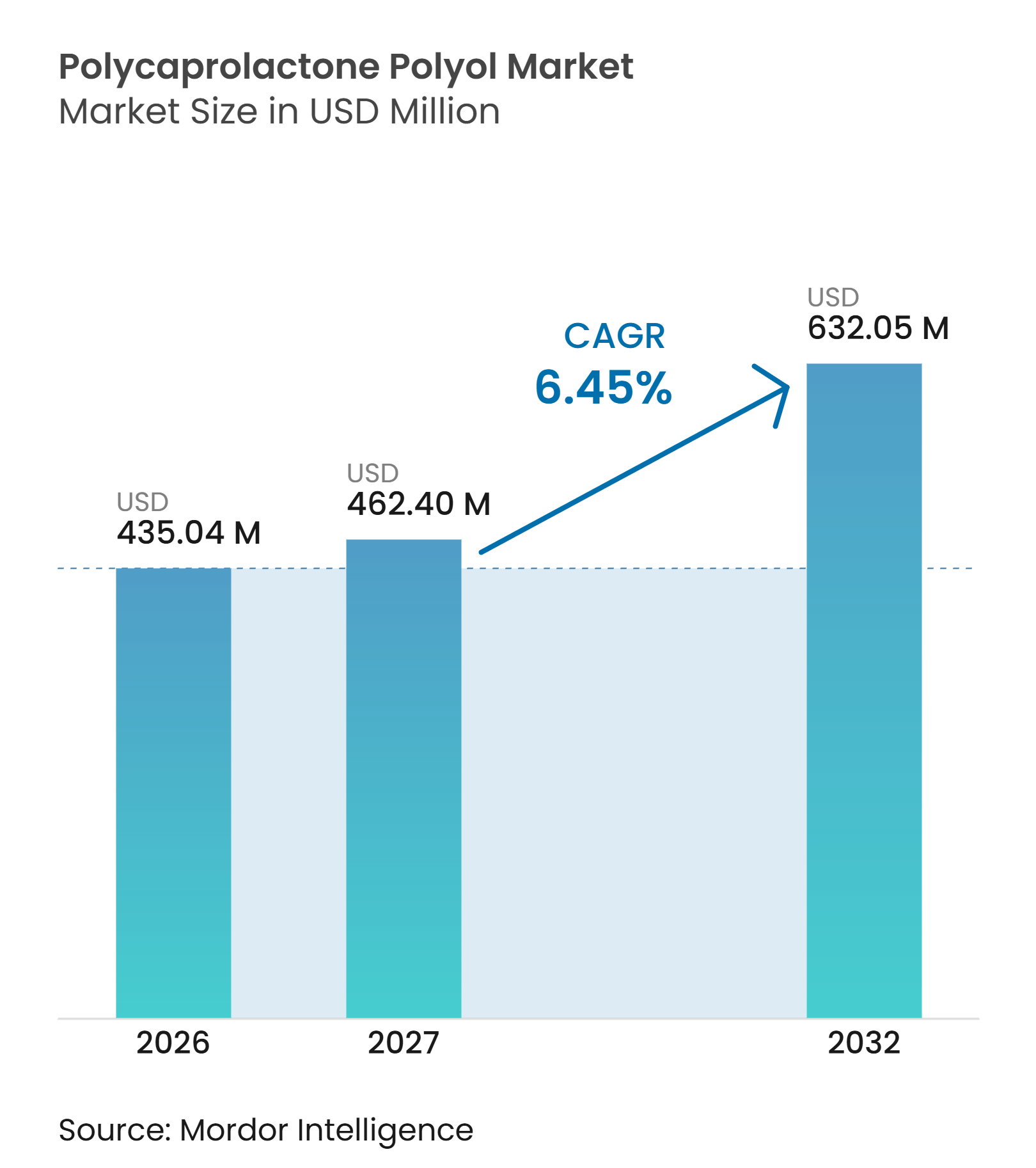
The Polycaprolactone Polyol Market size was valued at USD 435.04 million in 2026 and is estimated to grow from USD 462.40 million in 2027 to reach USD 632.05 million by 2032, at a CAGR of 6.45% during the forecast period (2027-2032). Demand is shifting toward polyurethane formulations that retain performance under moisture, temperature changes, abrasion, and longer service cycles. Coatings, adhesives, sealants, and elastomers producers are using caprolactone-based materials where low-temperature flexibility and hydrolytic stability are required. Tighter volatile organic compound requirements in North America and Europe are also supporting high-solids and solvent-free formulations. In Asia-Pacific, local caprolactone capacity is improving supply access for automotive, footwear, and industrial users. The polycaprolactone polyol market is becoming more contested as Chinese producers expand while established suppliers protect qualified customer positions through product support and application development.
Key Report Takeaways
- By product functionality, diols held 57.12% of the polycaprolactone polyol market share in 2026, while triols are forecast to advance at a 6.89% CAGR through 2032.
- By application, coatings held 35.56% of the polycaprolactone polyol market share in 2026, while biomedical is forecast to advance at a 7.15% CAGR through 2032.
- By end-use industry, automotive held 32.73% of the polycaprolactone polyol market share in 2026, while healthcare is forecast to advance at a 7.43% CAGR through 2032.
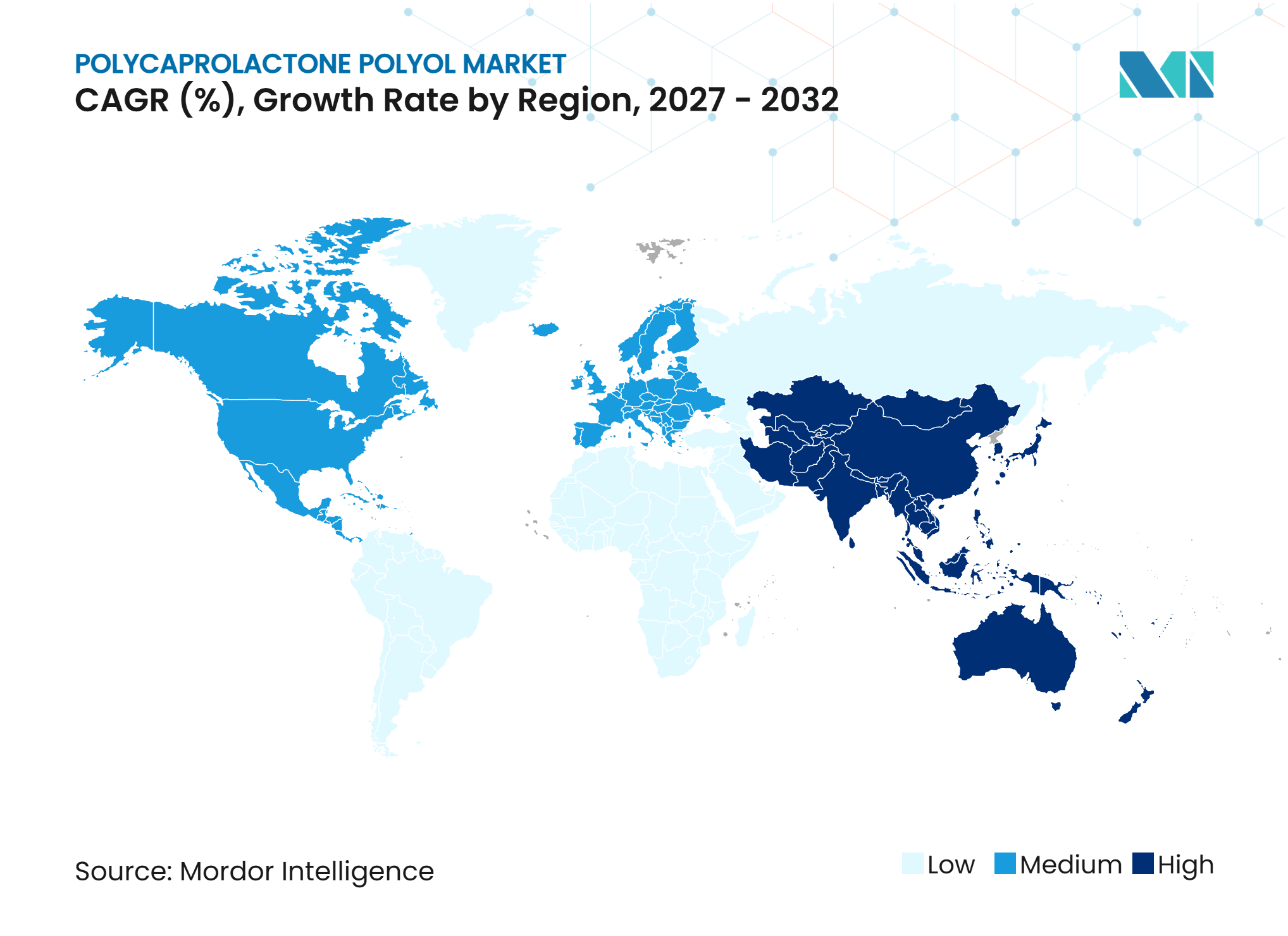
- By geography, Asia-Pacific held 38.67% of the polycaprolactone polyol market share in 2026 and is forecast to advance at a 7.33% CAGR through 2032.
Note: Market numbers in this report are based on Mordor Intelligence's proprietary estimation framework, which combines nine months of actuals with Q4 projections for base year 2026.
Market Trends and Insights
Drivers Impact Analysis of Polycaprolactone Polyol Market*
| Driver | (~) % Impact on CAGR Forecast | Geographic Relevance | Impact Timeline |
|---|---|---|---|
| Growth in High-Performance Polyurethane CASE Formulations | +2.1% | Global, with concentration in North America, Europe, and APAC | Medium term (2-4 years) |
| Low-VOC and Solvent-Free Coating Adoption | +1.5% | North America & EU; spillover to APAC and MEA | Short term (≤ 2 years) |
| Biomedical and Bioresorbable Polymer Development | +1.2% | North America, Europe, Japan | Long term (≥ 4 years) |
| Expansion of Automotive, Industrial, and Footwear Applications in Asia-Pacific | +0.9% | APAC core, spillover to MEA | Medium term (2-4 years) |
| Qualification of Caprolactone Polyols in EV Charging-Cable and Harsh-Environment Components | +0.5% | China, EU, North America | Medium term (2-4 years) |
| Source: Mordor Intelligence | |||
Growth in High-Performance Polyurethane CASE Formulations
Polycaprolactone polyols serve applications where standard polyether materials do not meet durability requirements. Two-component topcoats, elastomeric sealants, and cast polyurethane elastomers can require soft segments that retain tensile properties after hydrothermal aging. This requirement is especially relevant in automotive and industrial specifications, where material changes can trigger further testing. Coatings, adhesives, sealants, and elastomers demand also rises with infrastructure work, recovering automotive output in ASEAN, and the adoption of high-solids systems. Ingevity Corporation produces Capa caprolactone polyols at its Warrington facility and serves customers in polyurethane, elastomers, adhesives, and coatings applications. Once a customer has qualified a caprolactone-based formulation, the polycaprolactone polyol market can retain demand even when commodity polyol prices move.
Low-VOC and Solvent-Free Coating Adoption
Volatile organic compound (VOC) controls support higher-solids polyurethane coatings that require workable viscosity and durable films. The U.S. Environmental Protection Agency (EPA) finalized amendments to the National Volatile Organic Compound Emission Standards for Aerosol Coatings in January 2025, and the compliance deadline is January 17, 2027[1]. European requirements also cover water-based, powder, solvent-free, and low-VOC industrial coatings. Polycaprolactone polyols with molecular weights from 1,000 Da to 2,000 Da can support lower-viscosity two-component polyurethane systems without giving up abrasion or weather resistance. Ingevity Corporation presented Capa PROTX 3112 at European Coatings Show 2025 as a low-viscosity polyol for safer and lower-VOC coatings. Environmental Protection Agency requirements and Registration, Evaluation, Authorisation and Restriction of Chemicals (REACH) compliance can also favor documented suppliers in the polycaprolactone polyol market.
Biomedical and Bioresorbable Polymer Development
Bioresorbable device development is widening the range of medical uses for polycaprolactone-related materials. Polycaprolactone is used in research and commercial development involving implants, drug-delivery systems, sutures, and fillers. Atreon Orthopedics received U.S. Food and Drug Administration 510(k) clearance for its BioCharge Autobiologic Matrix in February 2025, using poly(glycolic acid) and poly(lactide-co-caprolactone) fibers for rotator cuff repair. Materialise also began a U.S. Food and Drug Administration pivotal clinical trial for a 3D-printed polycaprolactone tracheobronchial splint in 2025. These programs create demand for suppliers in the polycaprolactone polyol market that can meet medical material and documentation requirements. China’s National Healthcare Security Administration also standardized pricing items for polycaprolactone-based aesthetic fillers in June 2025, pointing to broader institutional use of these materials.
Qualification of Caprolactone Polyols in EV Charging-Cable and Harsh-Environment Components
Electric vehicle charging infrastructure adds a new use case for thermoplastic polyurethane materials containing caprolactone-based soft segments. Charging cables and connector housings must tolerate moisture, ultraviolet exposure, thermal cycling, and extended outdoor service. The International Electrotechnical Commission’s charging and connector standards guide safety and system performance across these operating conditions. Lubrizol displayed ESTANE ZHF grades for electric vehicle charging, automation, and robotic cables at K Show 2025. Hydrolysis resistance is particularly relevant for charging equipment used in humid parts of Southeast Asia and coastal China. The polycaprolactone polyol market can benefit when cable compounders convert those performance requirements into qualified material specifications.
Restraints Impact Analysis of Polycaprolactone Polyol Market*
| Restraint | (~) % Impact on CAGR Forecast | Geographic Relevance | Impact Timeline |
|---|---|---|---|
| Premium Cost Versus Conventional Polyether and Adipate Polyester Polyols | -2.0% | Global; most acute in price-sensitive APAC and MEA markets | Short term (≤ 2 years) |
| Feedstock Price and Availability Volatility | -1.3% | Global, concentrated in Europe and North America | Medium term (2-4 years) |
| Qualification Cycles for New Grades in Regulated and Safety-Critical Applications | -0.8% | North America, Europe, Japan | Long term (≥ 4 years) |
| Source: Mordor Intelligence | |||
Premium Cost Versus Conventional Polyether and Adipate Polyester Polyols
Polycaprolactone polyols cost 40%-80% more than comparable molecular-weight polyether polyols. That difference limits use in flexible foam, commodity sealants, and lower-value elastomers, where added performance does not support a higher material cost. Production from cyclohexanone-derived caprolactone involves steps that maintain a higher cost base than established propylene oxide routes. Such volume platforms strengthen the price position of conventional materials. In price-sensitive parts of the Middle East and Africa and South America, formulators can therefore select lower-cost alternatives when technical requirements permit.
Qualification Cycles for New Grades in Regulated and Safety-Critical Applications
New material grades for medical devices, automotive safety components, and aerospace adhesives can require 18-36 months of testing, supplier qualification, and regulatory review. This period can delay commercial revenue after a supplier develops a new grade. The European Chemicals Agency’s Community Rolling Action Plan for 2025-2027 includes substance evaluation activity that adds to the regulatory context for chemical suppliers[2]. Medical applications may also require a risk assessment consistent with International Organization for Standardization (ISO) 10993-1 principles. These processes can make it harder to quickly change a qualified material. They can also discourage polycaprolactone polyol market investment where the expected return does not justify a long validation period.
*Our forecasts treat driver/restraint impacts as directional, not additive. The impact forecasts reflect baseline growth, mix effects, and variable interactions.
Polycaprolactone Polyol Market Segment Analysis
By Product Functionality:
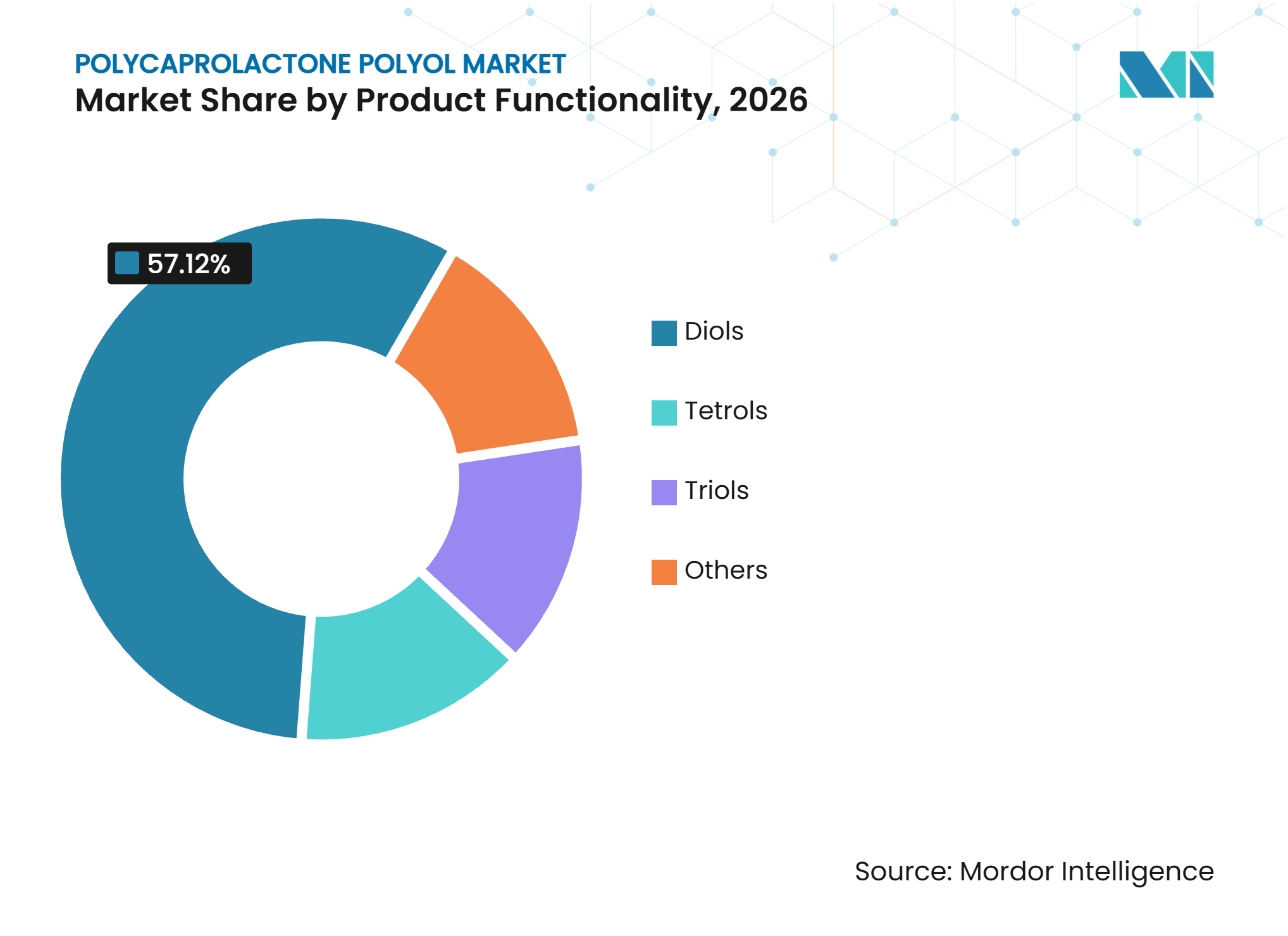
Diols Lead, While Triols Gain Technical GroundDiols held 57.12% of the polycaprolactone polyol market share in 2026 because they fit a wide range of linear polyurethane systems. They are used in cast elastomers and two-component polyurethane coatings where bifunctional soft segments support chain extension and crystallinity control. The molecular-weight range extends from 400 Da for hard coatings to 4,000 Da for softer elastomers. This range gives formulators flexibility without changing polymer families. DAICEL ChemTech Inc. supplies the Placcel portfolio through Gantrade Corporation, with diols, triols, tetraols, and other grades for polyurethane applications. The breadth of these options supports continued use of diols in mainstream formulations.
Triols are projected to advance at a 6.89% CAGR through 2032, supported by uses that require higher crosslink density. The additional functionality can help create networks in coatings, structural adhesives, and radiation-curable materials without adding an external crosslinker. This can reduce formulation steps in systems where curing performance is closely controlled. Tetrols and other grades serve more specialized needs in radiation curing and reactive hot-melt adhesives. Research supported through the European Commission has developed coarse-grained modeling tools for poly(epsilon-caprolactone), which may help researchers screen molecular-weight combinations before synthesis. This work supports technical development, although commercial-grade qualification still determines adoption.



By Application:
Coatings Lead, While Biomedical ExpandsCoatings held 35.56% of the polycaprolactone polyol market share in 2026, supported by demand for high-performance two-component topcoats, ultraviolet-curable systems, and paint protection films. Polycaprolactone polyols can help these products meet requirements for abrasion resistance, weathering, and film performance. Coatings producers are also adapting to lower volatile organic compound limits in the United States and Europe. The January 2025 U.S. Environmental Protection Agency rule provides a specific regulatory driver for aerosol coatings reformulation. Adhesives also represent an important use, including structural laminating, reactive hot-melt, and pressure-sensitive products. Low-temperature flexibility gives caprolactone-derived materials an advantage in applications where adipate polyester performance is insufficient.
Biomedical is projected to advance at a 7.15% CAGR through 2032. Bioresorbable devices and drug-delivery systems are moving from scientific validation into commercial and clinical use. Poly(lactide-co-caprolactone) materials are used in sutures, scaffolds, and drug microspheres. Published work has also examined electrospun poly(L-lactic acid)/polycaprolactone blends for tissue-engineering applications. Elastomers and sealants remain relevant adjacent applications, especially in industrial rolls, conveyor belts, and footwear midsoles. The polycaprolactone polyol market therefore has both a large coatings base and smaller medical applications with higher technical entry requirements.
By End-Use Industry:
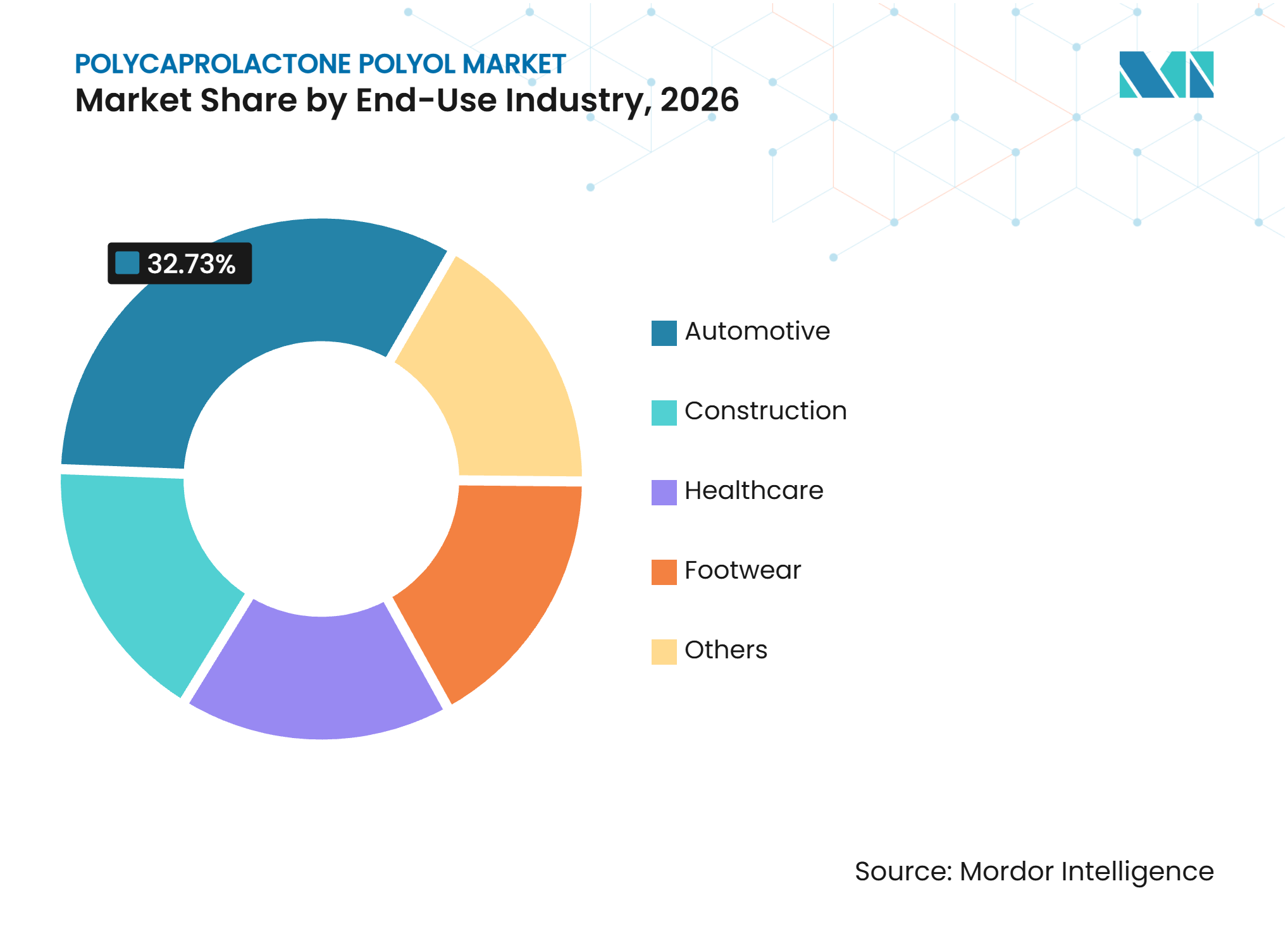
Automotive Anchors Demand, While Healthcare ExpandsAutomotive held 32.73% of the polycaprolactone polyol market share in 2026, reflecting polyurethane use in paint protection films, synthetic microfiber leather, noise, vibration, and harshness dampers, and door seals. These applications require resistance to abrasion, hydrolysis, and repeated movement. Electric vehicle components expand the potential range of use into charging-cable jacketing and thermal-management adhesives. The materials are relevant where a component must withstand outdoor exposure or operating temperature changes. Automotive specifications can support recurring business because material substitutions require validation. This makes the segment important to the polycaprolactone polyol market for suppliers that can maintain product consistency and technical support.
Healthcare is projected to advance at a 7.43% CAGR through 2032, driven by bioresorbable implants, drug-release systems, and aesthetic medical uses. U.S. Food and Drug Administration device pathways and clinical trials are improving the route to commercialization for selected polycaprolactone-related products. China’s National Healthcare Security Administration pricing guidance also identifies polycaprolactone-based aesthetic fillers among regulated service items. Construction continues to use high-durability sealants and waterproofing materials. Footwear producers use high-resilience thermoplastic polyurethane in premium midsoles. These end uses provide several demand channels, but healthcare can support premium pricing where a material is qualified for regulated use.

Geography Analysis
Asia-Pacific
Asia-Pacific held 38.67% of the polycaprolactone polyol market share in 2026 and is projected to advance at a 7.33% CAGR through 2032. Automotive production, electric vehicle activity, footwear manufacturing, and industrial coatings provide multiple demand routes. China’s push to develop high-performance polyurethane materials for new energy vehicles supports the use of advanced polymer inputs. Local capacity projects can reduce delivery times and improve price competitiveness for regional polyurethane processors. Hunan Juren Chemical Hitechnology Co.,Ltd. has pursued capacity upgrades for polycaprolactone products in Yueyang. Lubrizol’s Shanghai line and regional innovation investments show that downstream users are also locating production and development close to demand. International Electrotechnical Commission requirements for charging systems are relevant to cable and connector applications across the region.
North America
North America remains a stable demand center for automotive, medical, and industrial coating applications. Qualified supplier relationships are important because changes to a material often require further tests and approvals. Ingevity Corporation expanded Capa distribution in the United States and Canada through an exclusive agreement with Jamplast for bioplastics grades in 2025. The region also benefits from medical-device development and clinical activity around bioresorbable materials. U.S. Environmental Protection Agency volatile organic compound requirements provide a compliance driver for coatings reformulation. The polycaprolactone polyol market benefits when those rules lead formulators to select higher-solids polyurethane systems. Materialise’s clinical trial program illustrates continued product development using polycaprolactone in regulated medical applications.
Europe, South America, and Middle East and Africa
Europe has demand in specialty coatings, high-performance adhesives, and bioresorbable medical-device production. Germany and the United Kingdom serve as manufacturing and end-use centers for these materials. Registration, Evaluation, Authorisation and Restriction of Chemicals requirements and European Chemicals Agency monitoring shape supplier documentation and substance management. Ingevity Corporation’s Warrington facility remains a key site for Capa production. South America has early-stage demand in Brazil’s automotive and footwear sectors, although infrastructure limitations and import duties can constrain adoption. The Middle East and Africa provide longer-term potential through Saudi petrochemical investment and automotive assembly in South Africa. These geographies tend to be more sensitive to material costs, which can favor conventional polyols unless performance requirements are strict.
Competitive Landscape
Market Concentration
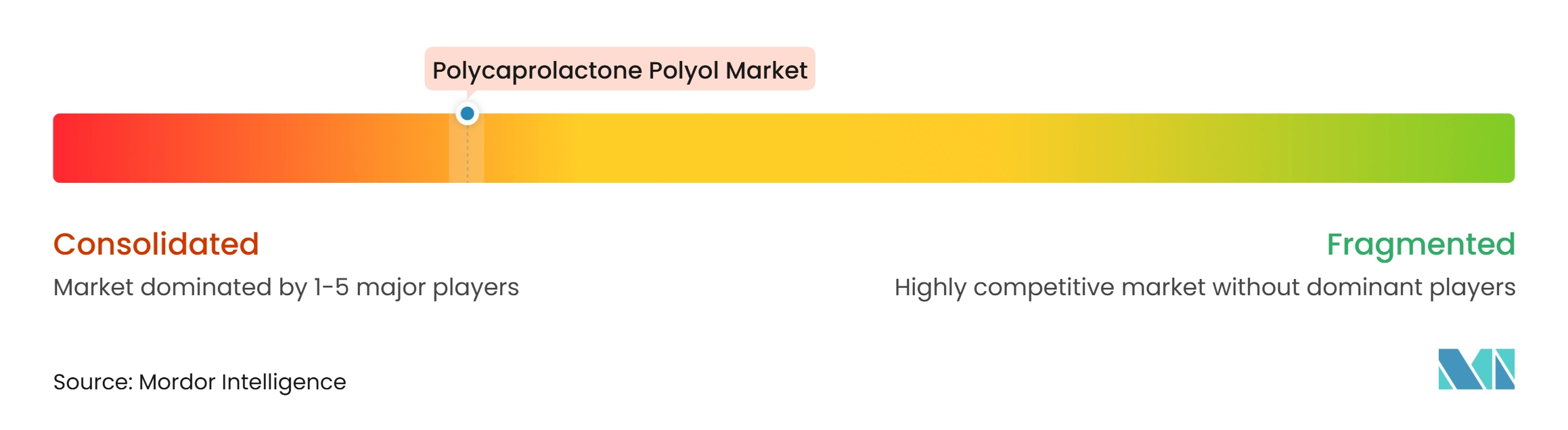
The polycaprolactone polyol market is consolidated, with the top five players including Ingevity Corporation, DAICEL ChemTech Inc., Hunan Juren Chemical Hitechnology Co., Ltd., BASF, and Evonik Industries AG. BASF continues to list epsilon-caprolactone in its product portfolio. DAICEL ChemTech Inc. supplies Placcel products through Gantrade Corporation, which provides a distribution route for polyurethane formulators. Ingevity Corporation produces Capa materials and reported USD 160.2 million in 2025 Advanced Polymer Technologies segment sales. Hunan Juren Chemical Hitechnology Co.,Ltd. is expanding Chinese capacity and has pursued an intelligent manufacturing project focused on specialty polycaprolactone materials. This expansion can change pricing and supply options in Asia-Pacific and in export markets.
Ingevity Corporation announced in December 2025 that it was exploring strategic alternatives for its Advanced Polymer Technologies segment, including a potential sale. The decision introduces uncertainty around one of the established caprolactone supply businesses. UBE Corporation completed the acquisition of the LANXESS polyurethane systems business in April 2025, broadening its downstream polyurethane systems capabilities. UBE Corporation’s polycarbonate diol platform is chemically distinct from polycaprolactone polyols but can address some of the same polyurethane applications. Lubrizol remains an important downstream user through its ESTANE thermoplastic polyurethane business. It received a U.S. patent in May 2025 for a bimodal polycaprolactone polyol-based thermoplastic polyurethane, showing product-development activity at the application level.
Evonik Industries AG supplies polyurethane coating technologies, including VESTAGON BF binders and VERSALINK products. Huntsman International LLC participates in broader polyurethane materials through isocyanates, polyether polyols, and thermoplastic polyurethane products. Shenzhen Esun Industrial Co., Ltd. produces polycaprolactone materials for applications including 3D printing and biomedical use. JAYANT AGRO-ORGANICS LIMITED and Kraton Corporation also operate in chemically adjacent materials. Competition will therefore center on secure monomer supply, medical-grade qualification, technical service, and regional downstream partnerships.
Polycaprolactone Polyol Industry Leaders
-
Ingevity Corporation
-
DAICEL ChemTech Inc.
-
Hunan Juren Chemical Hitechnology Co.,Ltd.
-
BASF
-
Evonik Industries AG
- *Disclaimer: Major Players sorted in no particular order
Polycaprolactone Polyol Market Companies Covered in this Report
- BASF
- DAICEL ChemTech Inc.
- Dow
- Evonik Industries AG
- Gantrade Corporation
- Henan Juren Chemical Hitechnology Co., Ltd.
- HighChem Company Limited
- Hunan Juren Chemical Hitechnology Co.,Ltd.
- Huntsman International LLC
- Ingevity Corporation
- JAYANT AGRO-ORGANICS LIMITED
- Kraton Corporation
- Lubrizol
- Shenzhen Esun Industrial Co., Ltd.
- UBE Corporation
Recent Industry Developments in Polycaprolactone Polyol Market
- June 2025: Ingevity Corporation strengthened the distribution of its Capa polycaprolactone polyol portfolio across the United States and Canada through a partnership with Jamplast. The collaboration supported the polycaprolactone polyol market by expanding regional product accessibility and strengthening customer supply channels for specialty polyurethane applications.
- March 2025: Ingevity Corporation showcased its Capa caprolactone portfolio at the European Coatings Show 2025 and introduced Capa PROTX 3112, a specialty additive designed for lower-VOC two-component polyurethane coatings. The launch supported the polycaprolactone polyol market by expanding specialty polycaprolactone-based solutions for high-performance polyurethane coatings and improving formulation options for coatings manufacturers.
Global Polycaprolactone Polyol Market Report Scope
Polycaprolactone polyols are specialty polyester polyols produced through the polymerization of caprolactone. They provide flexibility, hydrolytic stability, chemical resistance, and mechanical strength, making them suitable for use in polyurethane and other polymer formulations.
The Polycaprolactone Polyol Market is segmented by product functionality, application, end-use industry, and geography. By product functionality, the market is segmented into diols, triols, tetrols, and others. By application, the market is segmented into coatings, adhesives, elastomers, sealants, and others. By end-use industry, the market is segmented into automotive, construction, healthcare, footwear, and others. The report also covers the market size and forecasts for polycaprolactone polyols across 15 countries. For each segment, the market sizing and forecasts have been done on the basis of value (USD).
Segmentation Overview
| Diols |
| Triols |
| Tetrols |
| Others |
| Coatings |
| Adhesives |
| Elastomers |
| Sealants |
| Others |
| Automotive |
| Construction |
| Healthcare |
| Footwear |
| Others |
| Asia-Pacific | China |
| India | |
| Japan | |
| South Korea | |
| ASEAN Countries | |
| Rest of Asia-Pacific | |
| North America | United States |
| Canada | |
| Mexico | |
| Europe | Germany |
| United Kingdom | |
| France | |
| Italy | |
| NORDIC Countries | |
| Rest of Europe | |
| South America | Brazil |
| Argentina | |
| Rest of South America | |
| Middle East and Africa | Saudi Arabia |
| South Africa | |
| Rest of Middle East and Africa |
| By Product Functionality | Diols | |
| Triols | ||
| Tetrols | ||
| Others | ||
| By Application | Coatings | |
| Adhesives | ||
| Elastomers | ||
| Sealants | ||
| Others | ||
| By End-Use Industry | Automotive | |
| Construction | ||
| Healthcare | ||
| Footwear | ||
| Others | ||
| By Geography | Asia-Pacific | China |
| India | ||
| Japan | ||
| South Korea | ||
| ASEAN Countries | ||
| Rest of Asia-Pacific | ||
| North America | United States | |
| Canada | ||
| Mexico | ||
| Europe | Germany | |
| United Kingdom | ||
| France | ||
| Italy | ||
| NORDIC Countries | ||
| Rest of Europe | ||
| South America | Brazil | |
| Argentina | ||
| Rest of South America | ||
| Middle East and Africa | Saudi Arabia | |
| South Africa | ||
| Rest of Middle East and Africa | ||
Key Questions Answered in the Report
What is the size of the polycaprolactone polyol market?
The polycaprolactone polyol market size was valued at USD 435.04 million in 2026 and is estimated to grow from USD 462.40 million in 2027 to reach USD 632.05 million by 2032, at a CAGR of 6.45% during the forecast period (2027-2032).
Which product functionality held the largest share in 2026?
Diols held a 57.12% share in 2026 because they work across linear polyurethane systems, cast elastomers, and two-component coatings.
Which application is expected to grow fastest through 2032?
Biomedical is projected to advance at a 7.15% CAGR through 2032, supported by bioresorbable device and drug-delivery development.
Why are low-VOC coatings relevant to polycaprolactone polyols?
Their viscosity and film-performance properties can support high-solids polyurethane coatings as producers respond to tighter volatile organic compound requirements.