
Platform Supply Vessel (PSV) Market Size and Share
Market Overview
| Study Period | 2022 - 2032 |
|---|---|
| Market Size (2027) | USD 8.61 Billion |
| Market Size (2032) | USD 11.79 Billion |
| Growth Rate (2027 - 2032) | 6.49 % |
| Fastest Growing Market | Asia-Pacific |
| Largest Market | Asia-Pacific |
| Market Concentration | Low |
Major Players *Disclaimer: Major Players sorted in no particular order Image © Mordor Intelligence. Reuse requires attribution under CC BY 4.0. | |
Platform Supply Vessel (PSV) Market Analysis by Mordor Intelligence
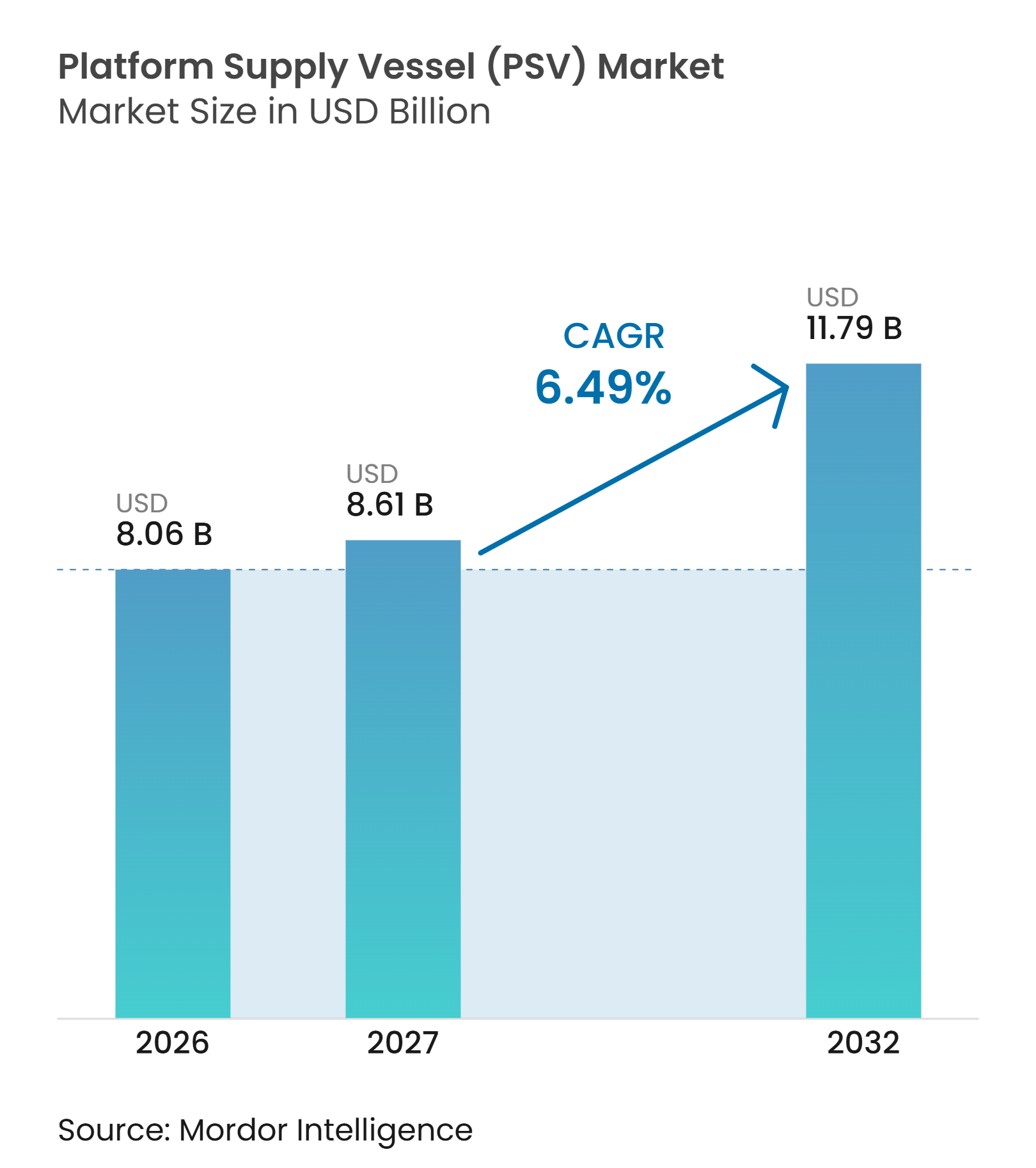
The Platform Supply Vessel Market size is projected to be USD 8.06 billion in 2026, USD 8.61 billion in 2027, and reach USD 11.79 billion by 2032, growing at a CAGR of 6.49% from 2027 to 2032. Offshore development activity is sustaining vessel demand because field installation, commissioning, and production support each require regular marine logistics. The Platform Supply Vessel (PSV) market is also gaining opportunities from offshore wind and decommissioning work, where suitably equipped vessels can support cargo movements, maintenance crews, and subsea operations. Higher specifications now matter more in procurement, particularly dynamic positioning capability, deck capacity, fuel efficiency, and lower-emission propulsion. The Platform Supply Vessel (PSV) market remains exposed to oil-price movements because investment decisions and vessel contracts can slow when offshore operators become more cautious. At the same time, emissions reporting and carbon-cost rules are encouraging fleet renewal and increasing the advantage of operators with modern vessels.
Key Report Takeaways
- By vessel type, cargo-type PSVs held 43.2% of the Platform Supply Vessel (PSV) market share in 2026, and are forecast to expand at a 6.9% CAGR through 2032.
- By application, offshore oil and gas held 67.3% of the Platform Supply Vessel (PSV) market share in 2026, while offshore wind is forecast to expand at a 7.6% CAGR through 2032.
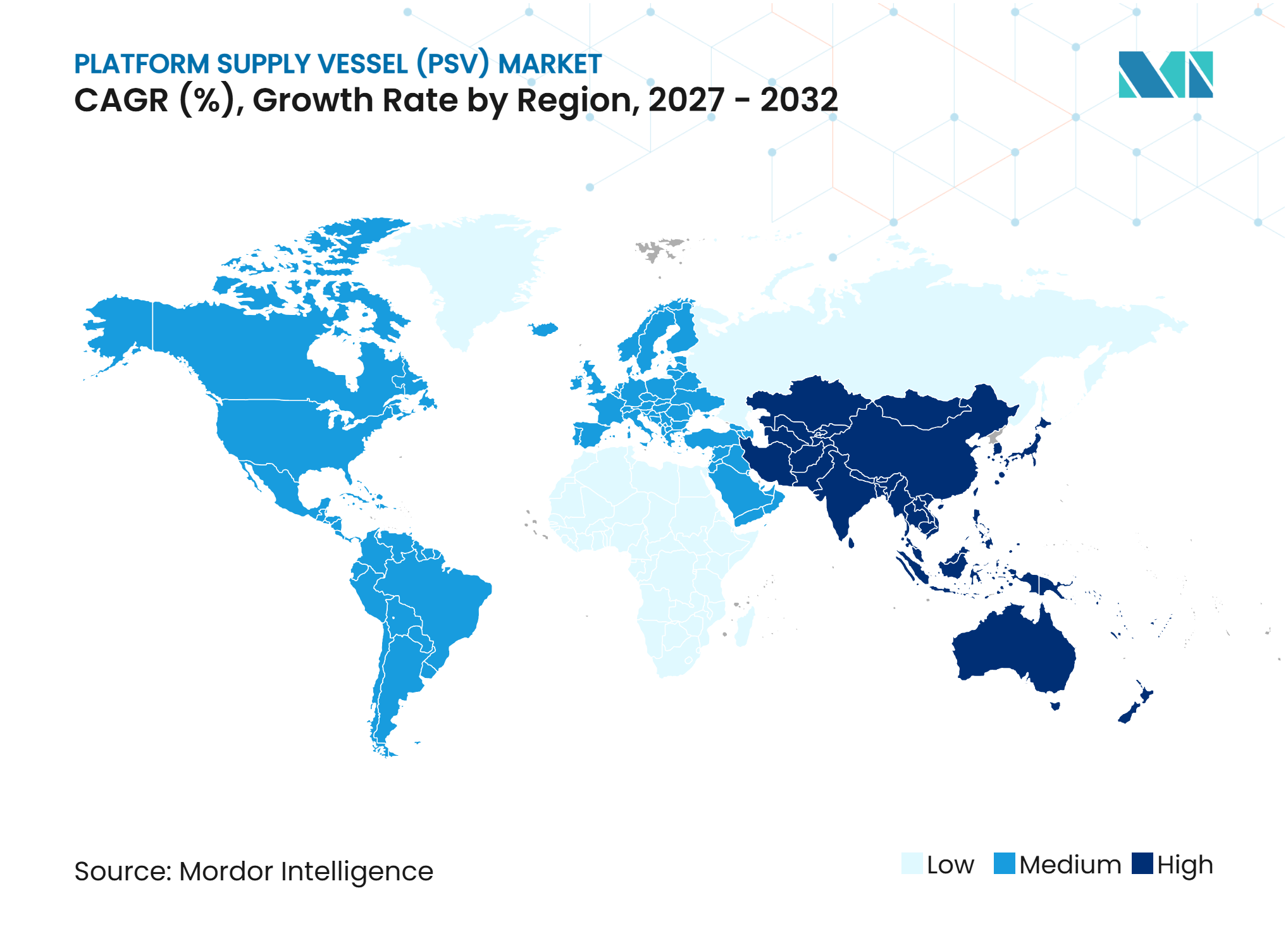
- By geography, Asia-Pacific held 41.1% of the Platform Supply Vessel (PSV) market share in 2026 and is forecast to grow at a 7.3% CAGR through 2032.
Note: Market numbers in this report are based on Mordor Intelligence's proprietary estimation framework, which combines nine months of actuals with Q4 projections for base year 2026.
Market Trends and Insights
Drivers Impact Analysis of Platform Supply Vessel (PSV) Market*
| Driver | (~) % Impact on CAGR Forecast | Geographic Relevance | Impact Timeline |
|---|---|---|---|
| Offshore E&P CapEx Recovery and Upstream Spending Cycle | +2.1% | Global, concentrated in the Gulf of Mexico, Guyana, Brazil, and West Africa | Short term (≤ 2 years) |
| Deepwater and Ultra-Deepwater Project Development | +1.5% | South America, West Africa, Gulf of Mexico, and Asia-Pacific deepwater basins | Medium term (2-4 years) |
| Offshore Wind and Floating Wind Support Requirements | +0.9% | Europe and Asia-Pacific | Medium term (2-4 years) |
| Fleet Renewal and High-Spec Vessel Scarcity | +0.7% | North Sea, Gulf of Mexico, and Australia | Medium term (2-4 years) |
| Cross-Utilization Across Oil, Gas, Subsea, and Renewables | +0.5% | North Sea, U.S. East Coast, and Asia-Pacific wind corridors | Medium term (2-4 years) |
| Brazil and Guyana Offshore Production Expansion | +1.0% | Brazil pre-salt and Guyana Stabroek Block | Medium term (2-4 years) |
| Source: Mordor Intelligence | |||
Offshore E&P CapEx Recovery Anchors Near-Term Demand
Offshore investment is reinforcing demand for marine logistics across the Platform Supply Vessel (PSV) market. Deepwater development costs have also declined, improving the commercial case for projects that need long-term vessel support. The Gulf of Mexico, Guyana, Brazil, and West Africa account for a substantial share of the deepwater project pipeline. Vessel demand usually follows Floating Production Storage and Offloading (FPSO) installation and production support activity after a time lag, which gives operators greater visibility than short-market movements alone. This pattern supports contract demand over several years where sanctioned projects move into execution.
Deepwater Development Supports Longer Contract Coverage
The Platform Supply Vessel (PSV) market benefits when deepwater projects progress from planning to installation and production. These projects need regular shipments of drilling fluids, bulk cargo, fuel, water, equipment, and consumables. They also require vessels with stronger positioning systems as water depth and operating complexity increase. DOF Group reported a USD 5.2 billion contract backlog in the first quarter of 2026, following USD 4 billion in new order intake during 2025. The disclosed backlog indicates that offshore clients remain prepared to use long-duration service arrangements for complex work.[1]
Offshore Wind Broadens Vessel Roles
Offshore wind is widening the addressable work for selected operators in the Platform Supply Vessel (PSV) market. Wind projects use a different operating pattern from deepwater oil and gas work because they require frequent, shorter cargo and crew movements. Vessels with appropriate deck layouts, accommodation, positioning systems, and safety equipment can support these assignments. The American Bureau of Shipping identifies floating offshore wind as a future source of tighter demand for offshore support and multipurpose vessels. Classification rules are becoming more specific for vessels supporting renewable installations, which may make dual-use planning more practical.[2]
Brazil and Guyana Create a Concentrated South American Demand Base
Brazil and Guyana are adding offshore production capacity that requires continued support-vessel activity. The U.S. Energy Information Administration reported that Guyana’s production increased sharply as new floating production facilities entered service. The ONE GUYANA FPSO reached first oil in August 2025, and the Uaru development is scheduled to add further capacity in 2026. In Brazil, Petrobras has linked long-term vessel procurement to domestic content and hybrid propulsion requirements. These requirements favor operators that can meet local operating and technical expectations.[3]
Restraints Impact Analysis of Platform Supply Vessel (PSV) Market*
| Restraint | (~) % Impact on CAGR Forecast | Geographic Relevance | Impact Timeline |
|---|---|---|---|
| Offshore Investment Exposure to Oil-Price Volatility | -0.6% | Global, with greater sensitivity in the North Sea and shallow-water Middle East and Africa | Short term (≤ 2 years) |
| High Newbuild, Retrofit, and Financing Costs | -0.4% | Global, especially Europe | Medium term (2-4 years) |
| Limited Availability of Qualified Maritime Crews | -0.2% | Global, particularly Norway, the United Kingdom, and Southeast Asia | Medium term (2-4 years) |
| PSV Specification Mismatch for Emerging Offshore Wind Applications | -0.2% | Europe, U.S. East Coast, and Asia-Pacific wind corridors | Long term (≥ 4 years) |
| Source: Mordor Intelligence | |||
Oil-Price Cyclicality Can Delay Vessel Commitments
The Platform Supply Vessel (PSV) market remains sensitive to the timing of offshore investment approvals. Oil-price changes can affect capital allocation before they affect vessel utilization. Operators may delay new commitments if project returns become less certain, especially in higher-cost basins. According to Seabrokers, there was a decline in North Sea large-PSV day rates during mid-2025, followed by a partial recovery later in the year. This movement shows why vessel owners need a balanced mix of long-term contracts and spot exposure. It also makes financing harder for new, high-specification tonnage.
Fleet Modernization Requires Significant Capital
Modernization costs can restrict capacity additions in the Platform Supply Vessel (PSV) market. New vessels and major retrofits need investment in propulsion systems, fuel storage, machinery, and operating procedures. The EU Emissions Trading System will extend to qualifying offshore ships from 2027, following expanded monitoring and reporting requirements for offshore ships. The Dutch Emissions Authority explains that covered shipping companies must monitor emissions and surrender allowances under the maritime framework. Alternative-fuel retrofits may help operators meet future requirements, but they can take vessels out of service during the work.[4]
*Our forecasts treat driver/restraint impacts as directional, not additive. The impact forecasts reflect baseline growth, mix effects, and variable interactions.
Platform Supply Vessel (PSV) Market Segment Analysis
By Vessel Type:
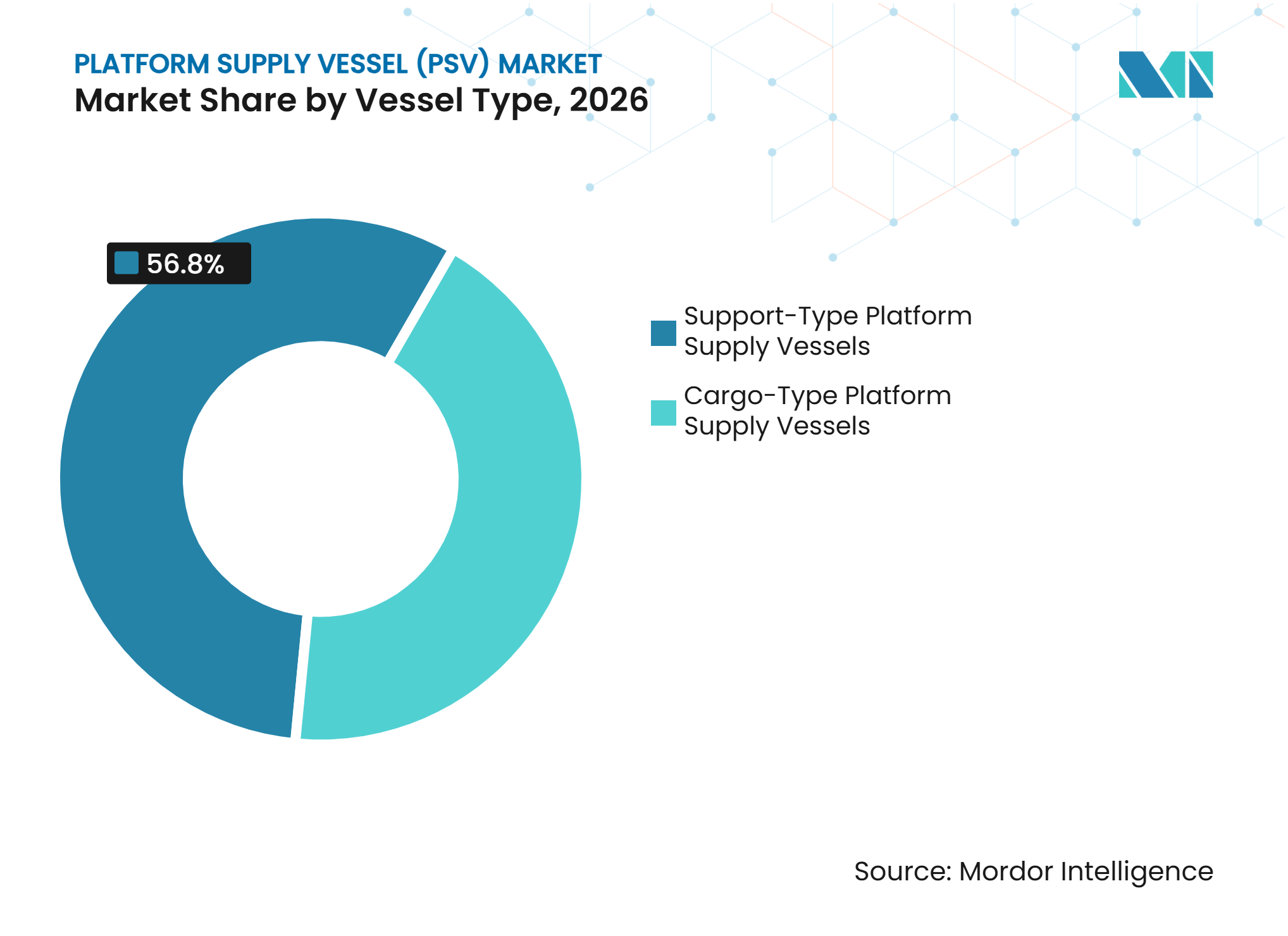
Cargo PSVs Lead Through Multi-Product LogisticsCargo-type PSVs held 43.2% of the Platform Supply Vessel (PSV) market share in 2026. Their position reflects the need to carry several categories of cargo during one offshore rotation. Deepwater campaigns may need drilling mud, bulk materials, base oil, methanol, brine, potable water, and fuel. Cargo-focused vessels can support this requirement through segregated tanks, dry-bulk systems, and usable deck space. This configuration reduces the need for separate vessel calls when operators are managing remote installations.
The Platform Supply Vessel (PSV) market size for cargo vessels is supported by projects that need reliable and repeated deliveries. Operators are also specifying hybrid and battery-enabled systems in new vessel procurement. Petrobras has connected hybrid propulsion and local-content expectations to its long-term Brazilian PSV procurement program. SEACOR Marine has disclosed hybrid battery-powered vessels and further DP-2 newbuild activity in its fleet program. These design choices show that environmental performance is increasingly considered alongside cargo capability.
Support-type PSVs serve personnel transfer, remotely operated vehicle support, diving support, accommodation, and related offshore activities. Their addressable work is narrower where specialized inspection, maintenance, repair, or construction vessels are available. They retain a role in shallow-water activities and mature-field maintenance, where flexibility can be more useful than highly specialized equipment. The Platform Supply Vessel (PSV) market therefore includes a continuing need for support-type configurations even as subsea work becomes more specialized. Dual-purpose equipment can help owners move these vessels between oil and gas maintenance and renewable work.
Classification updates are shaping how operators plan support-type vessel capability. DNV’s rules work covers developments for alternative fuels and offshore vessel requirements. The China Classification Society has also introduced a windfarm service vessel notation, reflecting more defined technical expectations for renewable-energy operations. These frameworks can make vessel upgrades easier to specify and review. They also encourage designs that can meet several offshore use cases without losing core safety and operational capability.



By Application:
Oil and Gas Retains Scale While Offshore Wind Grows FasterOffshore oil and gas accounted for 67.3% of the Platform Supply Vessel (PSV) market size in 2026. The segment remains the main source of demand because it requires vessels through development, commissioning, and production operations. Deepwater fields can use support vessels for years after initial installation. This duration supports fleet investment and longer customer relationships. National oil companies also often use structured procurement programs that provide steadier work than short spot charters.
The Middle East remains relevant to the offshore market, as its programs include both conventional platform work and developing deepwater activity. Saudi Aramco, Abu Dhabi National Oil Company (ADNOC), and Qatari operators represent important sources of future offshore demand. In the North Sea, decommissioning is generating work as mature fields move toward closure. The UK North Sea Transition Authority's 2025 North Sea Future Plan established a new licensing direction for new fields. This policy shift may redirect some vessel work toward maintenance, late-life support, and decommissioning activities.
Offshore wind is forecast to grow at a 7.6% CAGR through 2032 in the Platform Supply Vessel (PSV) market. Its logistics needs are distinct because wind farms require recurring transfers of technicians, equipment, and supplies. This activity can favor vessels with rapid turnaround capability, reliable positioning, suitable accommodation, and adaptable deck arrangements. Floating wind is likely to require greater offshore support as projects move beyond early deployments. The Platform Supply Vessel (PSV) market can serve part of this need where vessels meet the operating requirements.
Recent examples illustrate how operators are adapting vessels for offshore wind operations. Island Offshore deployed the Island Clipper in support of Equinor's Hywind Tampen floating wind farm. Edison Chouest delivered a methanol-ready service operations vessel for Ørsted in 2025. These cases demonstrate that offshore wind applications are feasible for vessels designed or upgraded for the purpose. However, they do not eliminate the need for purpose-built wind vessels, particularly for complex installation and service activities.
Geography Analysis
Asia-Pacific
Asia-Pacific held 41.1% of the Platform Supply Vessel (PSV) market share in 2026 and is forecast to grow at a 7.3% CAGR through 2032. China Oilfield Services Limited reported RMB 2,606 million in marine support services revenue in the first half of 2025, while PSV operating days increased 12.3% to 11,537. The reported activity reflects stronger work in the South China Sea and expanded customer contracts in Southeast Asia. Indonesia, Malaysia, and Vietnam are continuing shallow-water development programs that depend on dependable marine logistics. Australia’s Liquefied Natural Gas (LNG) assets also create maintenance and production-support activity after the construction phase.
Europe
Norway continues to offer more stable conditions for high-specification vessels than parts of the United Kingdom North Sea. Havila Shipping reported 95% fleet utilization across 10 PSVs in 2025, with vessels working for Equinor, TotalEnergies, and Peterson Den Helder. Island Offshore also secured Norwegian Continental Shelf contracts for LNG-powered PSVs for 2026. Compliance factors are becoming more important as EU maritime emissions rules and United Kingdom requirements affect operating costs.
South America, North America, Middle East and Africa
South America is gaining importance as Brazil’s pre-salt production expands and Guyana raises offshore output. Tidewater completed its acquisition of Wilson Sons Ultratug in August 2026, adding 22 Brazil-built PSVs and increasing its Brazilian fleet from 6 to 28 vessels. North America remains shaped by the Jones Act, which supports a separate domestic operating environment for qualifying U.S. vessels. In the Middle East, national oil company procurement can support longer service relationships than spot-driven markets. West Africa continues to provide field support work in established producing countries, while activity in Namibia and South Africa could create later opportunities.
The platform supply vessel (PSV) market is segmented into vessel type, application, and geography. By vessel type, the market is segmented into cargo-type platform supply vessels, and support-type platform supply vessels. By application, the market is segmented into offshore oil and gas, offshore wind, offshore decommissioning, and other applications.
Competitive Landscape
Market Concentration
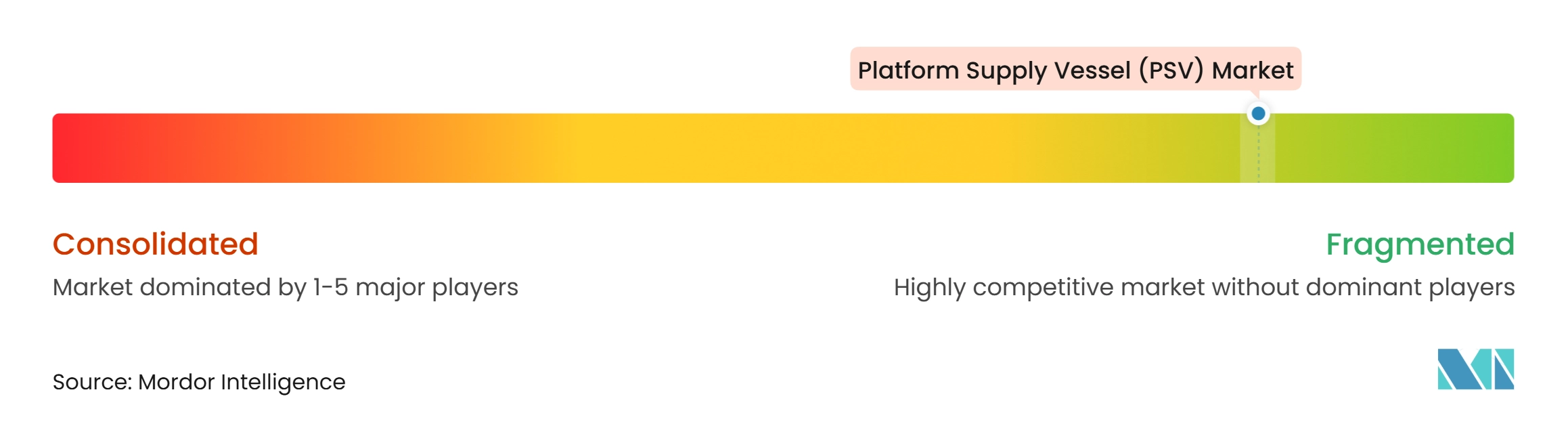
The Platform Supply Vessel (PSV) market is fragmented and includes a small group of global operators and a larger group of regional owners. Large fleets can serve customers across several offshore basins and bid for broader service packages. Regional owners can remain competitive where local knowledge, regulatory qualifications, and customer relationships are important. Tidewater expanded its position through the completed Wilson Sons Ultratug acquisition in August 2026. The transaction added 22 Brazil-built PSVs and took its total fleet to 231 vessels.
Bourbon Maritime completed its financial and capital restructuring in December 2025. The company stated that the transaction brought new majority shareholders and fresh capital for its next phase of development. It subsequently announced a USD 180 million fleet expansion that included offshore vessels and PSVs. This move shows how recapitalization can help a fleet owner pursue demand during an upcycle.
Lower-emission capability is becoming a competitive factor in the Platform Supply Vessel (PSV) market. Eidesvik is converting the Viking Energy to ammonia capability through its Apollo Project. SEACOR Marine has disclosed a fleet program that includes hybrid battery-powered PSVs. Operators with compliant, fuel-efficient vessels may be better placed for contracts where clients assess emissions alongside operational quality and price.
Platform Supply Vessel (PSV) Industry Leaders
-
Tidewater Inc.
-
Edison Chouest Offshore, LLC
-
Bourbon Maritime SAS
-
DOF Group ASA
-
China Oilfield Services Limited
- *Disclaimer: Major Players sorted in no particular order
Platform Supply Vessel (PSV) Market Companies Covered in this Report
- Atlantic Offshore AS
- Bourbon Maritime SAS
- Bram Offshore Transportes Marítimos Ltda.
- Bumi Armada Berhad
- China Oilfield Services Limited
- DOF Group ASA
- Edison Chouest Offshore, LLC
- Eidesvik Offshore ASA
- Harvey Gulf International Marine LLC
- Havila Shipping ASA
- Hornbeck Offshore Services, Inc.
- Island Offshore Management AS
- Pacific Radiance Ltd.
- Rem Offshore AS
- SEACOR Marine Holdings Inc.
- Siem Offshore AS
- Solstad Offshore ASA
- Swire Pacific Offshore Holdings Limited
- Tidewater Inc.
- Vroon B.V.
Recent Industry Developments in Platform Supply Vessel (PSV) Market
- August 2026: Tidewater Inc. completed its USD 500 million acquisition of Wilson Sons Ultratug Participações S.A. and Atlantic Offshore Services S.A. effective August 31, 2026, adding 22 Brazil-built PSVs and expanding its Brazilian fleet from 6 to 28 vessels. The deal increased Tidewater's global fleet to 231 vessels, funded through USD 283.1 million in cash and USD 229.3 million in assumed debt.
- April 2026: Bourbon Maritime announced a USD 180 million fleet expansion of 13 offshore vessels following its December 2025 restructuring. The expansion includes 5 diesel-electric PSVs from Minsheng Group and 2 X-Bow PSVs from ICBC Financial Leasing, illustrating how financial restructuring enables vessel owners to pursue acquisitions during periods of improving offshore activity.
- January 2026: Bourbon Maritime SAS completed its financial and capital restructuring, with funds managed by affiliates of Davidson Kempner Capital Management and Fortress Investment Group becoming majority shareholders following Marseille Economic Affairs Court approval in July 2025. The restructuring reduced Bourbon’s leverage to below 1.5x EBITDA through debt-to-equity conversion and fresh capital injection. Gaël Bodénès became Chief Executive Officer, while Bruno Chabas became Board Chairman. The change gave the operator a stronger financial base for fleet investment and commercial activity.
- August 2025: The ONE GUYANA FPSO achieved first oil on August 8, 2025, adding 250,000 bpd of capacity and lifting Guyana's output above 750,000 bpd by the end of 2025. The Uaru FPSO targets first oil in 2026, expected to push production beyond 1 million bpd by 2027, increasing the operating workload across several floating production assets.
Global Platform Supply Vessel (PSV) Market Report Scope
A Platform Supply Vessel (PSV) is a specialized ship designed to provide logistical support, equipment, and personnel to offshore oil rigs, natural gas platforms, and wind energy installations.
The platform supply vessel (PSV) market is segmented into vessel type, application, and geography. By vessel type, the market is segmented into cargo-type platform supply vessels and support-type platform supply vessels. By application, the market is segmented into offshore oil and gas, offshore wind, offshore decommissioning, and other applications. The report also covers the market size and forecasts for the global platform supply vessel (PSV) market across 23 countries in key regions. For each segment, the market sizing and forecasts have been provided on the basis of value (USD).
Segmentation Overview
| Cargo-Type Platform Supply Vessels |
| Support-Type Platform Supply Vessels |
| Offshore Oil and Gas |
| Offshore Wind |
| Offshore Decommissioning |
| Other Applications |
| North America | United States |
| Canada | |
| Mexico | |
| Europe | United Kingdom |
| Norway | |
| Germany | |
| France | |
| Netherlands | |
| Rest of Europe | |
| Asia-Pacific | China |
| India | |
| Australia | |
| Japan | |
| South Korea | |
| Indonesia | |
| Malaysia | |
| Rest of Asia-Pacific | |
| South America | Brazil |
| Argentina | |
| Rest of South America | |
| Middle East and Africa | Saudi Arabia |
| United Arab Emirates | |
| Qatar | |
| Oman | |
| Nigeria | |
| Angola | |
| Rest of Middle East and Africa |
| By Vessel Type | Cargo-Type Platform Supply Vessels | |
| Support-Type Platform Supply Vessels | ||
| By Application | Offshore Oil and Gas | |
| Offshore Wind | ||
| Offshore Decommissioning | ||
| Other Applications | ||
| By Geography | North America | United States |
| Canada | ||
| Mexico | ||
| Europe | United Kingdom | |
| Norway | ||
| Germany | ||
| France | ||
| Netherlands | ||
| Rest of Europe | ||
| Asia-Pacific | China | |
| India | ||
| Australia | ||
| Japan | ||
| South Korea | ||
| Indonesia | ||
| Malaysia | ||
| Rest of Asia-Pacific | ||
| South America | Brazil | |
| Argentina | ||
| Rest of South America | ||
| Middle East and Africa | Saudi Arabia | |
| United Arab Emirates | ||
| Qatar | ||
| Oman | ||
| Nigeria | ||
| Angola | ||
| Rest of Middle East and Africa | ||
Key Questions Answered in the Report
What is the projected growth rate for platform supply vessels?
The Platform Supply Vessel (PSV) market is projected to grow at a 6.49% CAGR from 2027 to 2032, reaching USD 11.79 billion by 2032.
Which vessel type has the largest share?
Cargo-type PSVs held 43.2% of revenue in 2026 because they can carry several fluid, bulk, and deck-cargo types during one offshore rotation.
Why does offshore oil and gas remain important for PSV operators?
Offshore oil and gas accounted for 67.3% of revenue in 2026 and requires multi-year logistics support through field development and production.
How is offshore wind affecting PSV demand?
Offshore wind is the fastest-growing application at a 7.6% CAGR through 2032, creating demand for vessels that can move personnel, equipment, and supplies.
Which region leads demand for these vessels?
Asia-Pacific held 41.1% of revenue in 2026 and is forecast to grow at a 7.3% CAGR through 2032.
What is the main challenge for fleet owners?
Fleet owners need to balance volatile offshore spending with the cost of new vessels, fuel-system upgrades, and expanding emissions requirements.