
Plastic Depolymerization Catalysts Market Size and Share
Market Overview
| Study Period | 2021 - 2031 |
|---|---|
| Market Size (2026) | USD 0.97 Billion |
| Market Size (2031) | USD 1.60 Billion |
| Growth Rate (2026 - 2031) | 10.51 % |
| Fastest Growing Market | Asia-Pacific |
| Largest Market | Asia-Pacific |
| Market Concentration | Medium |
Major Players *Disclaimer: Major Players sorted in no particular order Image © Mordor Intelligence. Reuse requires attribution under CC BY 4.0. | |
Plastic Depolymerization Catalysts Market Analysis by Mordor Intelligence
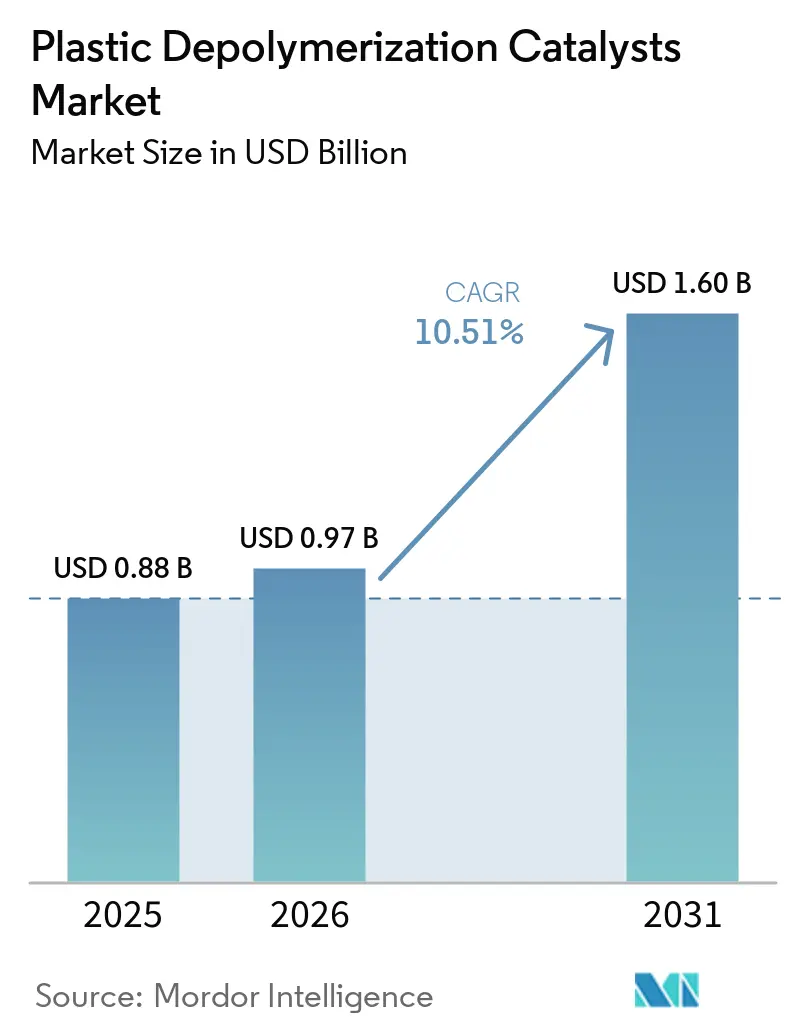
The plastic depolymerization catalysts market size was valued at USD 0.88 billion in 2025 and is estimated to grow from USD 0.97 billion in 2026 to USD 1.60 billion by 2031, at a CAGR of 10.51% during the forecast period (2026-2031). The plastic depolymerization catalysts market is transitioning from specialized research applications to commercial chemical recycling, where catalysts convert post-consumer polymers into virgin-grade monomers. European Union packaging regulations and recycled-content mandates in India are establishing a demand base for monomer-grade materials. Plant construction and licensing activities are shifting procurement toward process-integrated catalyst solutions. Plastics Europe members plan to invest EUR 8 billion (~USD 9.11 billion) in chemical recycling by 2030 and project recycled plastic output to increase from 1.2 million tons in 2025 to 3.4 million tons by 2030. This investment supports procurement potential in the plastic depolymerization catalysts market and may favor suppliers that demonstrate stable performance with contaminated feedstock over suppliers of standard materials. However, inconsistent feedstock quality and lengthy food-contact approval processes constrain near-term adoption. These constraints are directing demand toward textile, engineering polymer, and non-food packaging applications.
Key Report Takeaways
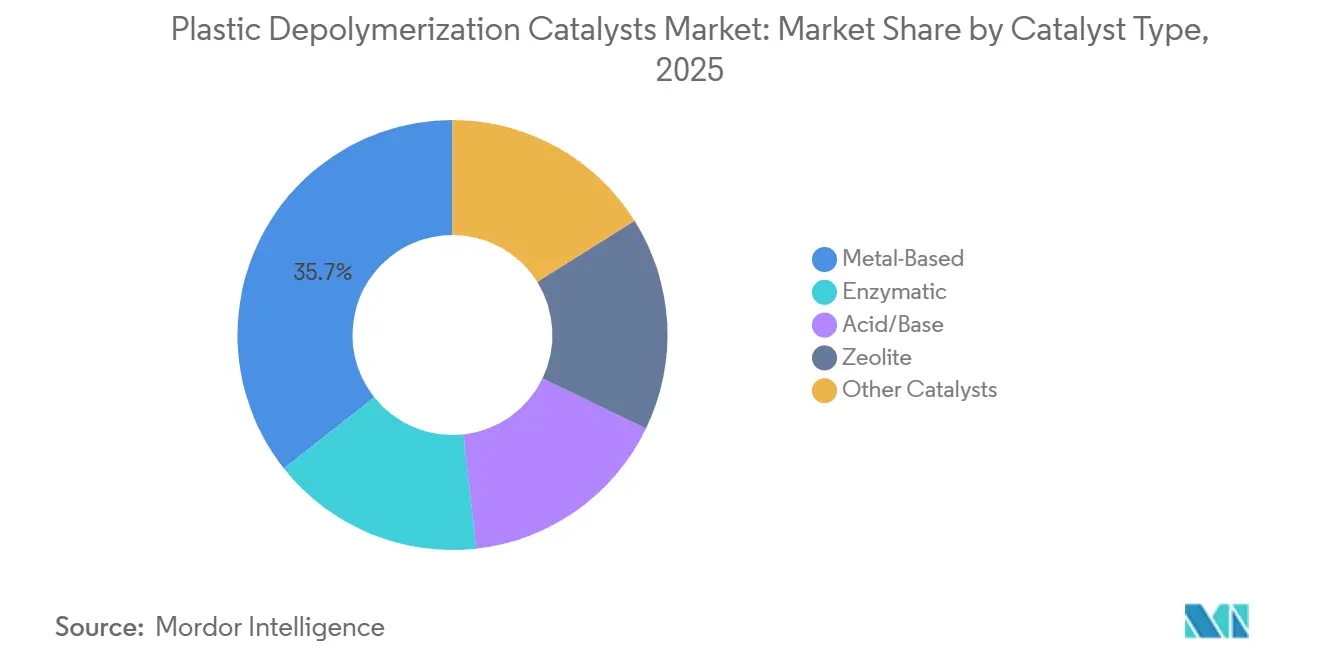
- By catalyst type, metal-based catalysts held 35.67% revenue share in 2025, while enzymatic systems are forecast to expand at a CAGR of 11.34% through 2031.
- By polymer feedstock, Polyethylene Terephthalate (PET) accounted for 42.14% of demand in 2025 and is forecast to expand to the highest CAGR of 11.76% through 2031.
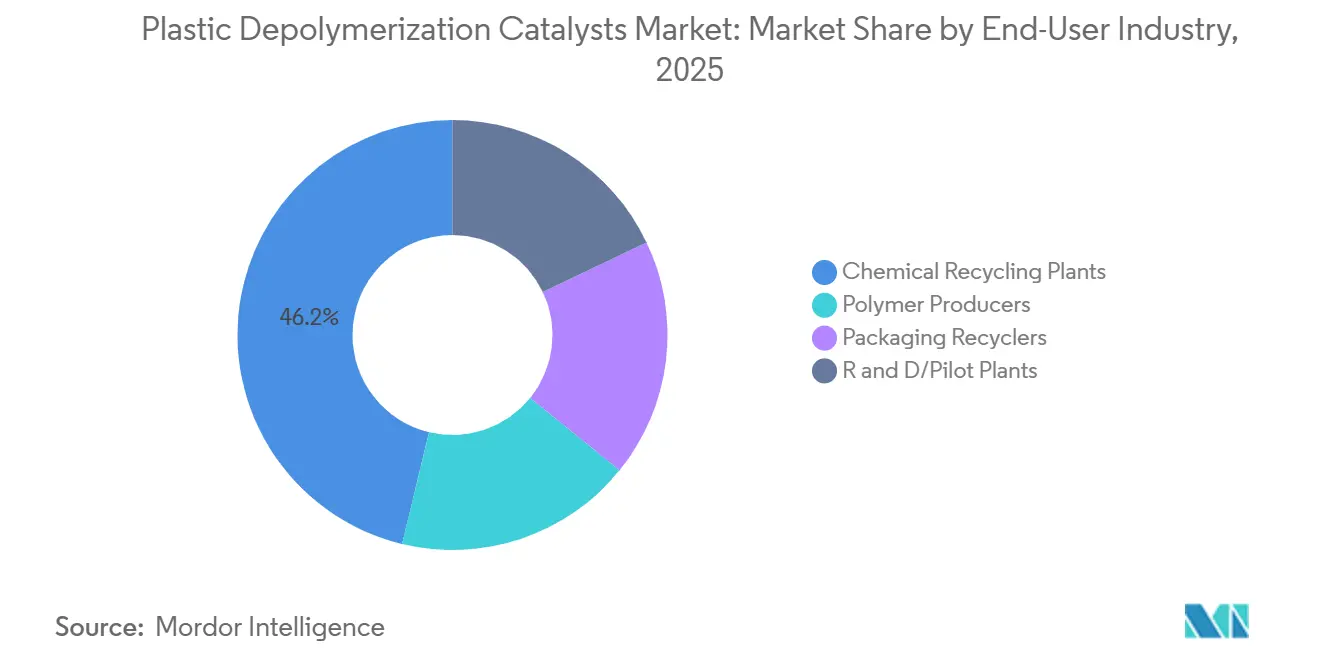
- By end-user industry, chemical recycling plants captured 46.23% of demand in 2025, while R&D and pilot plants are forecast to grow at a CAGR of 12.12% through 2031.
- By geography, Asia-Pacific commanded 41.72% of the plastic depolymerization catalysts market in 2025 and is forecast to grow at a CAGR of 11.87% through 2031.
Note: Market size and forecast figures in this report are generated using Mordor Intelligence’s proprietary estimation framework, updated with the latest available data and insights as of January 2026.
Global Plastic Depolymerization Catalysts Market Trends and Insights
Drivers Impact Analysis*
| Drivers | (~) % Impact on CAGR Forecast | Geographic Relevance | Impact Timeline |
|---|---|---|---|
| Recycled-Content Mandates for Monomer-Grade Output | +2.4% | Global, with a concentrated near-term effect in the EU and India | Medium term (2-4 years) |
| Chemical Recycling Plant and Licensing Pipeline Growth | +2.2% | Global, concentrated in Asia-Pacific, North America, and Europe | Short term (≤ 2 years) |
| Virgin-Equivalent Polyethylene Terephthalate (PET) Demand from Difficult Waste | +1.9% | Asia-Pacific, North America, and Europe | Medium term (2-4 years) |
| Enzyme Engineering and Catalyst Selectivity Improvements | +1.7% | Asia-Pacific and Europe, with early commercialization in France and Australia | Long term (≥ 4 years) |
| Textile-to-Textile Polyester Circularity | +1.3% | Asia-Pacific, with growing spillover to the EU and North America | Long term (≥ 4 years) |
| Source: Mordor Intelligence | |||
Recycled-Content Mandates Pulling Monomer-Grade Output
Recycled-content mandates directly drive demand in the plastic depolymerization catalysts market by requiring materials that meet defined quality standards. Regulation (EU) 2025/40 became fully applicable in August 2026 and establishes recycled-content targets for plastic packaging by 2030. The regulation also requires a 65% packaging waste collection rate in 2025 and a 70% rate by 2030. These requirements apply by packaging type and plant, limiting brand owners’ ability to balance compliance across a broader portfolio. India’s Plastic Waste Management Amendment Rules, 2026 require Category I packaging to increase recycled content from 30% in FY 2025-26 to 60% in FY 2028-29. This framework supports demand for depolymerization catalysts, as chemical recycling can produce high-purity materials from waste streams that mechanical recycling cannot consistently process.
Scaling of Chemical Recycling Plant and Licensing Pipelines
Investment in chemical recycling is creating a procurement pipeline for the plastic depolymerization catalysts market. Neste commissioned a liquefied waste-plastic upgrading facility in Porvoo with a capacity of 150,000 tons per year, and production ramp-up is underway in 2026. ExxonMobil committed more than USD 200 million to expand advanced recycling capacity at its Baytown and Beaumont facilities to 500 million pounds per year in 2026. The company expects its global capacity to reach 1 billion pounds by 2027. WPU announced an 80,000-ton facility at the Port of Rotterdam in 2026, which would increase its total capacity to 100,000 tons per year. Licensing models enable technology providers to certify catalyst performance within defined operating conditions and replicate these configurations at subsequent plants[1].
Demand for Virgin-Equivalent PET From Hard-to-Recycle Waste
Demand for virgin-equivalent PET is expanding the addressable application base for plastic depolymerization catalysts. Colored, contaminated, and multilayer PET materials often cannot achieve food-contact-grade output through mechanical recycling alone. These waste streams require selective conversion processes to manage dyes, additives, and other residual materials. Eastman Chemical Company’s Kingsport polyester renewal facility achieved on-spec initial production in early 2024, demonstrating that post-consumer textile and packaging waste can yield dimethyl terephthalate and ethylene glycol that meet virgin-equivalent specifications. A 2025 study reported that extrusion-based substrate preparation and fed-batch pH management reduced annual operating expenses for enzymatic PET recycling by 74%. The study also reported recycled PET production costs of USD 1.51/kg, compared with USD 1.87/kg for virgin domestic material, supporting its use in packaging and textile applications.
Enzyme Engineering and Catalyst Selectivity Improvements
Enzyme engineering supports the commercial application of plastic depolymerization catalysts, particularly for PET processing. Carbios reached its 100th batch at its Clermont-Ferrand demonstration plant in July 2026. The plant achieved more than 95% PET conversion within 24 hours using complex post-consumer textile waste. China’s T/CIET 1133-2025 standard established technical specifications for the enzymatic recycling of waste PET in March 2025. The standard provides performance benchmarks for Chinese industrial operators and supports systems with demonstrated results. Reproducible yields, improved process economics, and standards development are supporting the production-scale deployment of enzymatic catalysts.
Restraints Impact Analysis*
| Restraints | (~) % Impact on CAGR Forecast | Geographic Relevance | Impact Timeline |
|---|---|---|---|
| Catalyst Integration and Purification Costs | -1.5% | Global, most acute in emerging-market chemical recycling operations | Medium term (2-4 years) |
| Contamination and Feedstock-Quality Variability | -1.1% | Global, concentrated in Asia-Pacific and South America, where collection sorting is less developed | Short term (≤ 2 years) |
| Slow Qualification of Recycled Monomers for Food Contact | -0.9% | EU and North America, where the European Food Safety Authority (EFSA) and the FDA approval processes add delay | Long term (≥ 4 years) |
| Source: Mordor Intelligence | |||
High Catalyst Integration and Purification Costs
Catalyst integration and downstream purification increase operating costs for new facilities in the plastic depolymerization catalysts market, unlike refinery applications, which typically use consistent inputs; chemical recycling reactors process variable feedstock. Contaminated feedstock can affect catalyst activity, purification requirements, and regeneration cycles. Clariant integrates Clarit Pyrolyze catalysts, Clarit Protect adsorbents, and HDMax hydrogenation catalysts across separate processing stages. The company states that this approach can reduce capital costs and energy consumption compared with alternatives requiring three or four separate stages. However, managing multiple catalyst types can increase procurement complexity and working capital requirements for early-stage plants[2].
Contamination and Feedstock-Quality Variability
Feedstock quality variability remains a short-term constraint in the plastic depolymerization catalysts market. Post-consumer waste streams may contain organic residues, pigments, stabilizers, and mixed polymers that reduce process selectivity. These materials can generate by-products and shorten catalyst regeneration intervals. Polyester-cotton-spandex textiles require tailored processing because each constituent behaves differently during conversion. A 2026 Green Chemistry study demonstrated an autocatalytic glycolysis approach for blended textiles that used zinc pyrithione antimicrobial agents already present in the waste. The study indicated that certain contaminants can support catalytic activity; however, feedstock variability continues to affect throughput consistency and monomer quality assurance.
*Our forecasts treat driver/restraint impacts as directional, not additive. The impact forecasts reflect baseline growth, mix effects, and variable interactions.
Segment Analysis
By Catalyst Type: Enzymatic Systems Reshape Depolymerization Economics
Metal-based catalysts accounted for 35.67% of the plastic depolymerization catalysts market in 2025. They are used in glycolysis and hydrolysis processes for PET and polyamide depolymerization. Their operating history and compatibility with chemical plant equipment supported their use in installations commissioned through 2025. Acid and base catalysts are used in applications where throughput takes priority over selectivity, while zeolite systems support pyrolysis-linked treatment of polyolefin-contaminated streams. Metal-based materials remain a commercial option for many operating facilities.
Enzymatic systems are forecast to register the highest CAGR of 11.34% during 2026-2031. The plastic depolymerization catalysts market benefits from lower operating costs in enzyme-based PET recycling. A 2025 study reported a 74% reduction in annual operating expenses, with recycled PET production costs of USD 1.51 per kg, compared with USD 1.87 per kg for virgin domestic material. Other catalyst types, including ionic liquids and metal-complex systems, account for smaller shares and are being developed for difficult feedstocks. In July 2026, researchers at the University of Tokyo and Kyushu University reported a selective iridium catalyst that depolymerized polyurethane in mixed polyester-polyurethane textiles while preserving the polyester fiber fraction.

By Polymer Feedstock: PET Anchors Demand and Growth
PET accounted for a 42.14% share of the plastic depolymerization catalysts market in 2025. It is also forecast to record the highest CAGR among feedstocks, at 11.76% through 2031. PET is a developed substrate for glycolysis, methanolysis, hydrolysis, and enzymatic hydrolysis. Its supply base includes packaging, post-consumer textiles, and other polyester waste. Contaminated, colored, and multilayer materials may require depolymerization, as mechanical recycling cannot consistently produce materials suitable for specific applications.
Textile recovery may expand the PET feedstock base for the plastic depolymerization catalysts market. PET consumption in textile applications was estimated at 67 million tons annually, while less than 1% of fiber-form polyester was recycled into fiber in 2025. In April 2026, Axens, IFPEN, and JEPLAN validated a semi-industrial textile-to-textile process that produced tens of tons of bis(2-hydroxyethyl) terephthalate (BHET) monomer from post-consumer European polyester textiles. Polyamide is the second-fastest-growing feedstock category, driven by recycling demand for nylon 6 and nylon 6,6 in automotive and athletic apparel applications. Polyesters, polyurethane, and mixed plastics remain at earlier stages of commercialization and require greater catalyst selectivity.
By End-User Industry: Chemical Recycling Plants Anchor Procurement
Chemical recycling plants accounted for 46.23% of demand in 2025 and represent the primary institutional purchasers in the plastic depolymerization catalysts market. Plant operators often establish catalyst supply arrangements during process design, creating switching costs after commissioning. Catalyst selection is linked to operating conditions and product specifications, favoring suppliers that offer application engineering and technical services. Packaging recyclers provide an additional channel for demand, particularly in Europe, where recycled-content obligations vary by packaging format.
R&D and pilot plants are forecast to grow at the highest CAGR, 12.12%, through 2031. This segment includes national research institutes, startup-backed pilot lines, and corporate development facilities, including those operated by Japan's National Institute of Advanced Industrial Science and Technology (AIST) and RIKEN. As projects transition from pilot-scale activity to commercial operations, purchasing is expected to shift toward chemical recycling plants. Polymer producers remain relevant; however, food-contact qualification limits their commercial-scale use of chemically recycled monomers. This purchasing pattern supports demand for process-integrated offerings in the plastic depolymerization catalysts market.
Geography Analysis
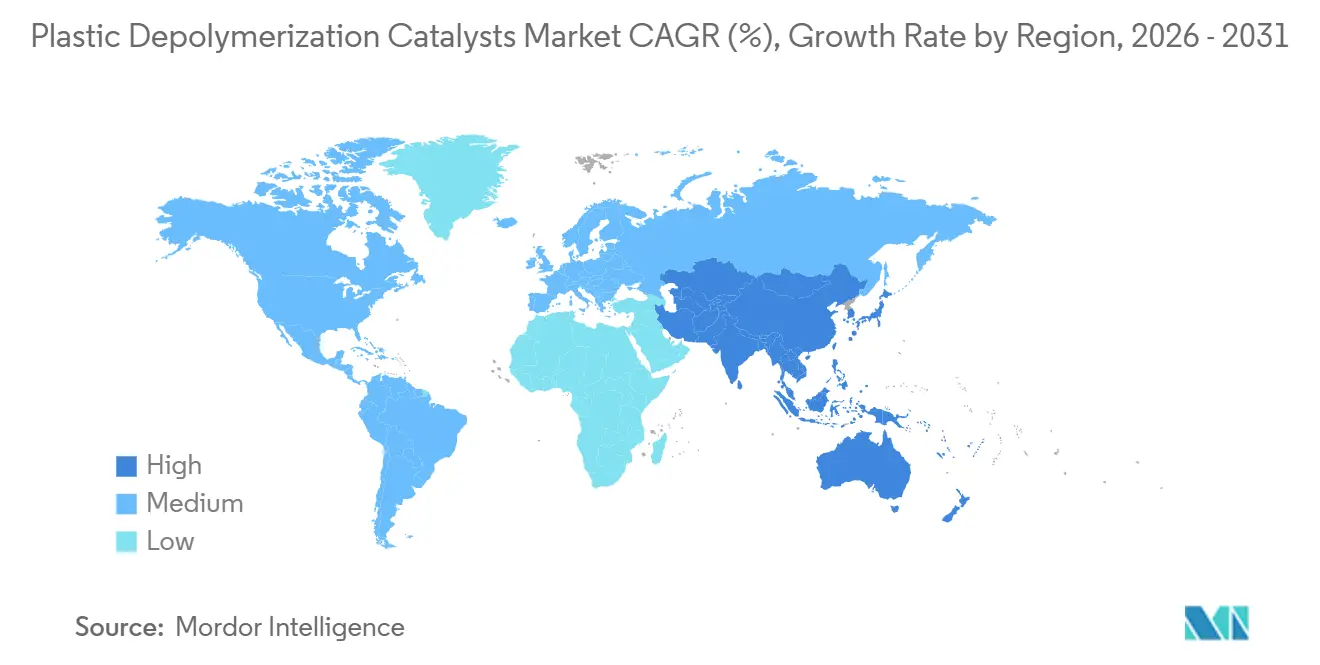
Asia-Pacific accounted for 41.72% of regional demand in 2025 and is projected to register a CAGR of 11.87% through 2031. The region’s PET manufacturing base, investments in recycling plants, and policy frameworks support the plastic depolymerization catalysts market. China formalized technical specifications for the chemical recycling of plastic packaging waste through T/CIET 1257-2025 in April 2025. The National Development and Reform Commission's (NDRC) 2026 action plan supports industrial-scale chemical recycling for high-value applications. In December 2025, Carbios and Wankai established Kaibio Biotechnology Co., Ltd. to develop a PET biorecycling plant in China with an annual capacity of 50,000 tons.
Japan contributes to the plastic depolymerization catalysts market through production-scale testing. In September 2026, Kirin Holdings and Japan Steel Works demonstrated PET alkaline depolymerization using JSW's TEX twin-screw kneading extruder. The demonstration achieved a depolymerization rate of more than 95% at a stable throughput of 250 kg/h while reducing reliance on elevated temperatures. India's 2026 packaging rules require Category I recycled content to increase from 30% in FY2025-26 to 60% in FY2028-29. These requirements create a structured pathway for demand for monomer-grade recycled content and catalyst systems.
Europe and North America have established regulatory environments where quality requirements influence catalyst demand. In March 2026, TotalEnergies became the sole owner of the Grandpuits advanced plastics recycling plant, which has an annual capacity of 15,000 tons and produces synthetic oil for food-contact and medical-grade applications. ExxonMobil's Baytown and Beaumont operations target an advanced recycling capacity of 500 million pounds per year in 2026. South America, the Middle East, and Africa represent smaller shares of the plastic depolymerization catalysts market, with Brazil and Saudi Arabia serving as regional anchors. Brazil's Extended Producer Responsibility (EPR) framework is at an earlier stage of implementation than the requirements in Europe and India. At the same time, Saudi Arabia's market development is supported by SABIC's scale and its chemical recycling joint ventures.
Competitive Landscape
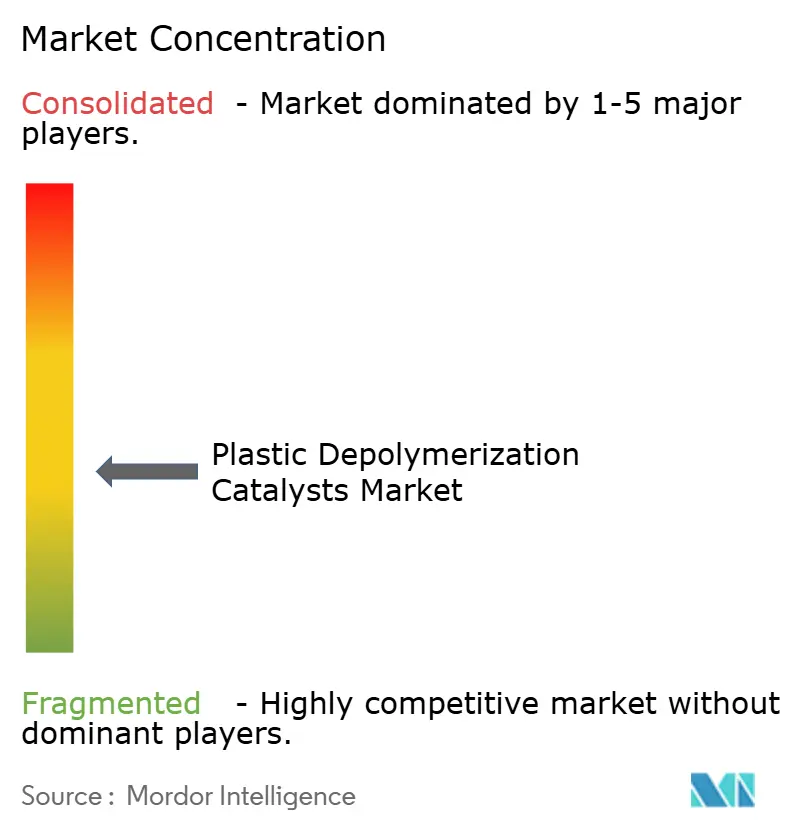
The plastic depolymerization catalysts market is moderately fragmented, with specialty chemical suppliers, process licensors, and biotechnology companies competing across the value chain. BASF SE, Clariant AG, and Johnson Matthey operate in metal-based and zeolite-related applications. Manufacturing scale, certified quality systems, and relationships with polymer producers and refinery operators support their presence. BASF supplies supported metal catalysts, while Clariant develops zeolite formulations for pyrolysis operators processing heterogeneous feedstocks.
A second group competes through integrated process design rather than catalyst supply alone. Carbios, Axens, IFP Énergies nouvelles (IFPEN), Eastman Chemical Company, and JEPLAN license or develop systems that integrate depolymerization with monomer recovery. This approach can generate higher revenue per project but concentrates revenue among a smaller number of large plant agreements. Carbios completed 100 batches at its demonstration plant in July 2026, supporting licensing activities in the textile market. Eastman’s Kingsport facility achieved initial on-spec production in early 2024 using its polyester renewal process.
Mixed-plastics applications remain at an earlier stage of development, as few suppliers have demonstrated selectivity and cost efficiency at the pilot scale. AI-assisted development platforms are shortening design cycles for enzyme variants and metal-organic frameworks. Novonesis focuses on enzyme stability under industrial conditions to reduce catalyst loading per ton of polymer. Incumbents can maintain their positions through process knowledge and intellectual property. Therefore, the plastic depolymerization catalysts market includes chemical catalyst suppliers and process licensors that control conversion steps.
Plastic Depolymerization Catalysts Industry Leaders
-
BASF
-
CLARIANT
-
Johnson Matthey
-
Carbios
-
Eastman Chemical Company
- *Disclaimer: Major Players sorted in no particular order
Recent Industry Developments
- September 2026: Kirin Holdings and Japan Steel Works (JSW) demonstrated polyethylene terephthalate (PET) alkaline depolymerization using JSW’s TEX twin-screw kneading extruder. The process achieved a depolymerization rate above 95% at a stable throughput of 250 kg/h. This mechanochemical-assisted approach supports the development of plastic depolymerization catalysts and chemical recycling applications in Japan’s beverage and packaging sectors.
- February 2026: Loop Industries selected BASF Industriepark Lausitz in Schwarzheide, Germany, for a European PET depolymerization facility planned to process 70,000 tons annually. The facility targets commercial PET recycling, supported by EU recycled-content requirements and technologies for plastic depolymerization catalysts.
Global Plastic Depolymerization Catalysts Market Report Scope
Plastic depolymerization catalysts accelerate the chemical breakdown of waste plastics into their original molecular building blocks, including monomers and raw chemicals, without being consumed in the process.
The plastic depolymerization catalysts market is segmented by catalyst type, polymer feedstock, end-user industry, and geography. By catalyst type, the market is segmented into enzymatic, metal-based, acid/base, zeolite, and other catalysts. By polymer feedstock, the market is segmented into PET, polyamides, polyesters/PU, and mixed plastics. By end-user industry, the market is segmented into chemical recycling plants, polymer producers, packaging recyclers, and R&D/pilot plants. The report also covers the market size and forecasts for plastic depolymerization catalysts in 15 countries across major regions. The market sizes and forecasts are provided in terms of value (USD).
| Enzymatic |
| Metal-Based |
| Acid/Base |
| Zeolite |
| Other Catalysts |
| PET |
| Polyamides |
| Polyesters/PU |
| Mixed Plastics |
| Chemical Recycling Plants |
| Polymer Producers |
| Packaging Recyclers |
| R&D/Pilot Plants |
| Asia-Pacific | China |
| India | |
| Japan | |
| South Korea | |
| ASEAN Countries | |
| Rest of Asia-Pacific | |
| North America | United States |
| Canada | |
| Mexico | |
| Europe | Germany |
| United Kingdom | |
| France | |
| Italy | |
| NORDIC Countries | |
| Rest of Europe | |
| South America | Brazil |
| Argentina | |
| Rest of South America | |
| Middle East and Africa | Saudi Arabia |
| South Africa | |
| Rest of Middle East and Africa |
| By Catalyst Type | Enzymatic | |
| Metal-Based | ||
| Acid/Base | ||
| Zeolite | ||
| Other Catalysts | ||
| By Polymer Feedstock | PET | |
| Polyamides | ||
| Polyesters/PU | ||
| Mixed Plastics | ||
| By End-User Industry | Chemical Recycling Plants | |
| Polymer Producers | ||
| Packaging Recyclers | ||
| R&D/Pilot Plants | ||
| By Geography | Asia-Pacific | China |
| India | ||
| Japan | ||
| South Korea | ||
| ASEAN Countries | ||
| Rest of Asia-Pacific | ||
| North America | United States | |
| Canada | ||
| Mexico | ||
| Europe | Germany | |
| United Kingdom | ||
| France | ||
| Italy | ||
| NORDIC Countries | ||
| Rest of Europe | ||
| South America | Brazil | |
| Argentina | ||
| Rest of South America | ||
| Middle East and Africa | Saudi Arabia | |
| South Africa | ||
| Rest of Middle East and Africa | ||
Key Questions Answered in the Report
What is current market size of Plastic Depolymerization Catalysts Market?
The plastic depolymerization catalysts market size was valued at USD 0.88 billion in 2025 and is estimated to grow from USD 0.97 billion in 2026 to USD 1.60 billion by 2031, at a CAGR of 10.51% during the forecast period (2026-2031).
Which catalyst type is growing fastest?
Enzymatic systems are forecast to grow at a CAGR of 11.34% through 2031. Their potential rests on improved PET conversion economics, reproducible industrial results, and technical standards that support wider use by recycling operators.
Why is PET important in chemical recycling?
PET accounted for 42.14% of catalyst demand in 2025 and is widely available as packaging and textile feedstock. Its conversion pathways include glycolysis, methanolysis, hydrolysis, and enzymatic hydrolysis, while challenging packaging and textile streams necessitate more selective processing.
Which region leads demand for depolymerization catalysts?
Asia-Pacific held 41.72% of demand in 2025 and is forecast to grow at a CAGR of 11.87% through 2031. China’s technical standards, India’s recycled-content requirements, and Japan’s production-scale testing strengthen the regional project pipeline.