
Plant-Based Beef Market Size and Share
Market Overview
| Study Period | 2027 - 2032 |
|---|---|
| Market Size (2027) | USD 3.35 Billion |
| Market Size (2032) | USD 4.72 Billion |
| Growth Rate (2027 - 2032) | 7.10 % |
| Fastest Growing Market | Asia-Pacific |
| Largest Market | Europe |
| Market Concentration | Medium |
Major Players *Disclaimer: Major Players sorted in no particular order Image © Mordor Intelligence. Reuse requires attribution under CC BY 4.0. | |
Plant-Based Beef Market Analysis by Mordor Intelligence
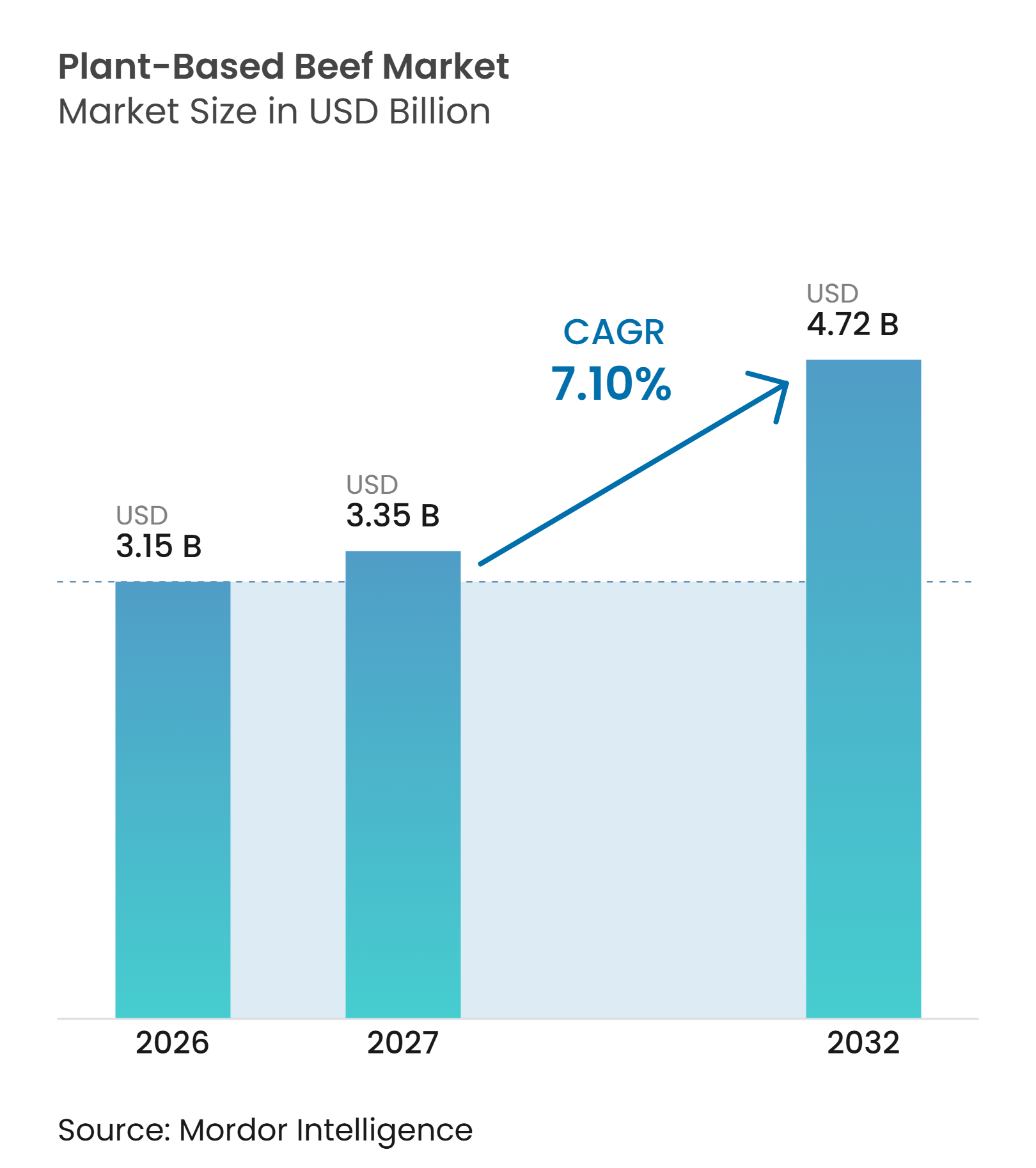
The plant-based beef market size is expected to increase from USD 3.15 billion in 2026 to USD 3.35 billion in 2027 and reach USD 4.72 billion by 2032, growing at a CAGR of 7.10% over 2027–2032. Growth is driven by rising flexitarian and vegetarian populations, increasing demand for sustainable protein alternatives, and continuous product innovation. Soy-based products and frozen formats maintain strong market positions, while blended proteins and refrigerated products are gaining traction. Europe holds the largest regional share, whereas Asia-Pacific is expected to record the fastest growth. However, premium pricing, production costs, and differences in taste and texture compared to conventional beef remain key challenges.
Key Report Takeaways
- By product type, plant-based beef burgers and patties led with a 38.50% share of the plant-based beef market size in 2026, while plant-based beef strips, chunks, and pieces are forecast to grow fastest at a 9.20% CAGR over 2027–2032.
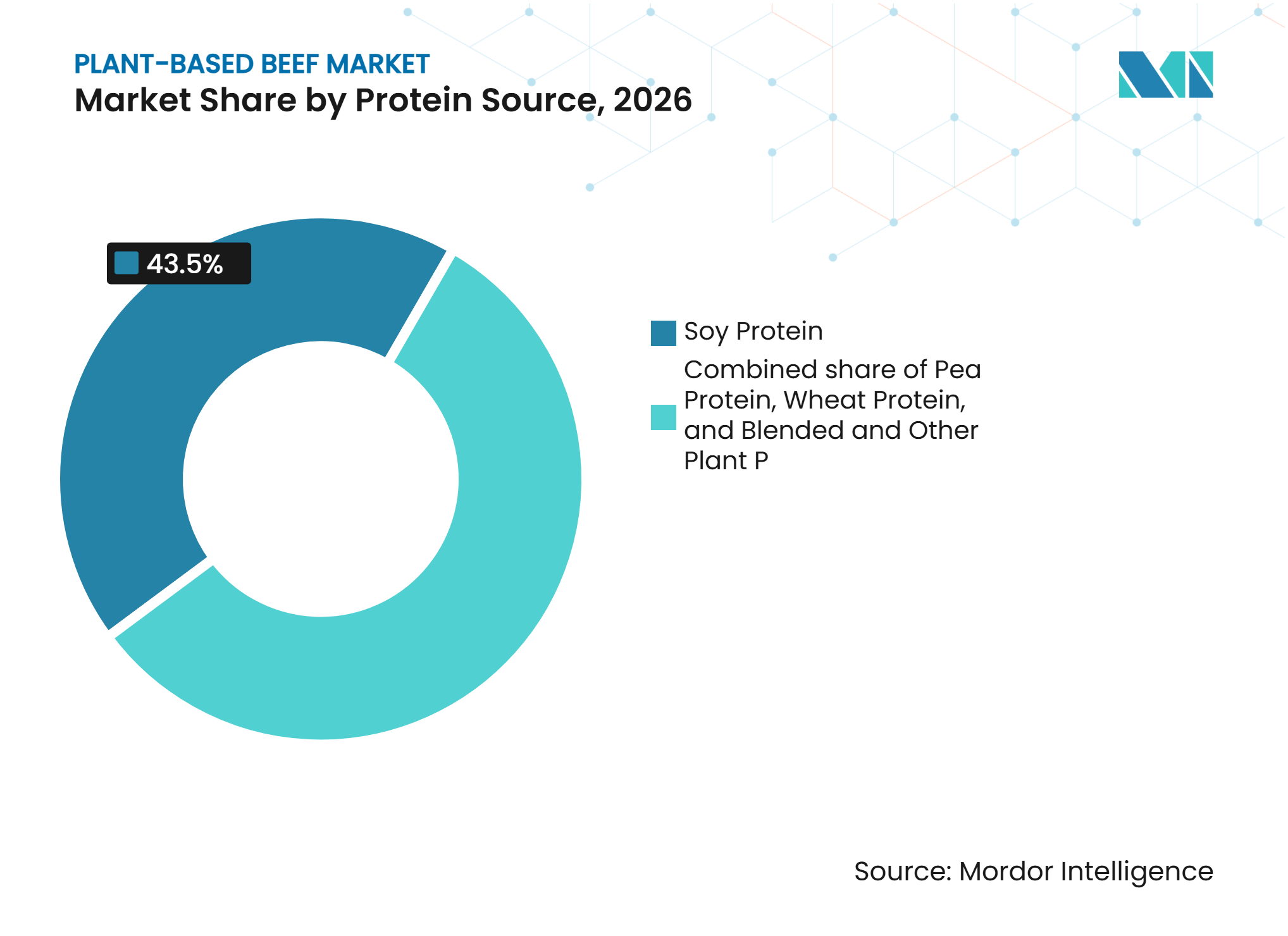
- By protein source, soy protein accounted for the largest share at 43.50% in 2026, while blended and other plant proteins are forecast to grow fastest at a 9.40% CAGR over 2027–2032.
- By storage type, frozen products dominated with a 67.00% market share in 2026, while refrigerated products are projected to record the fastest growth at an 8.30% CAGR over 2027–2032.
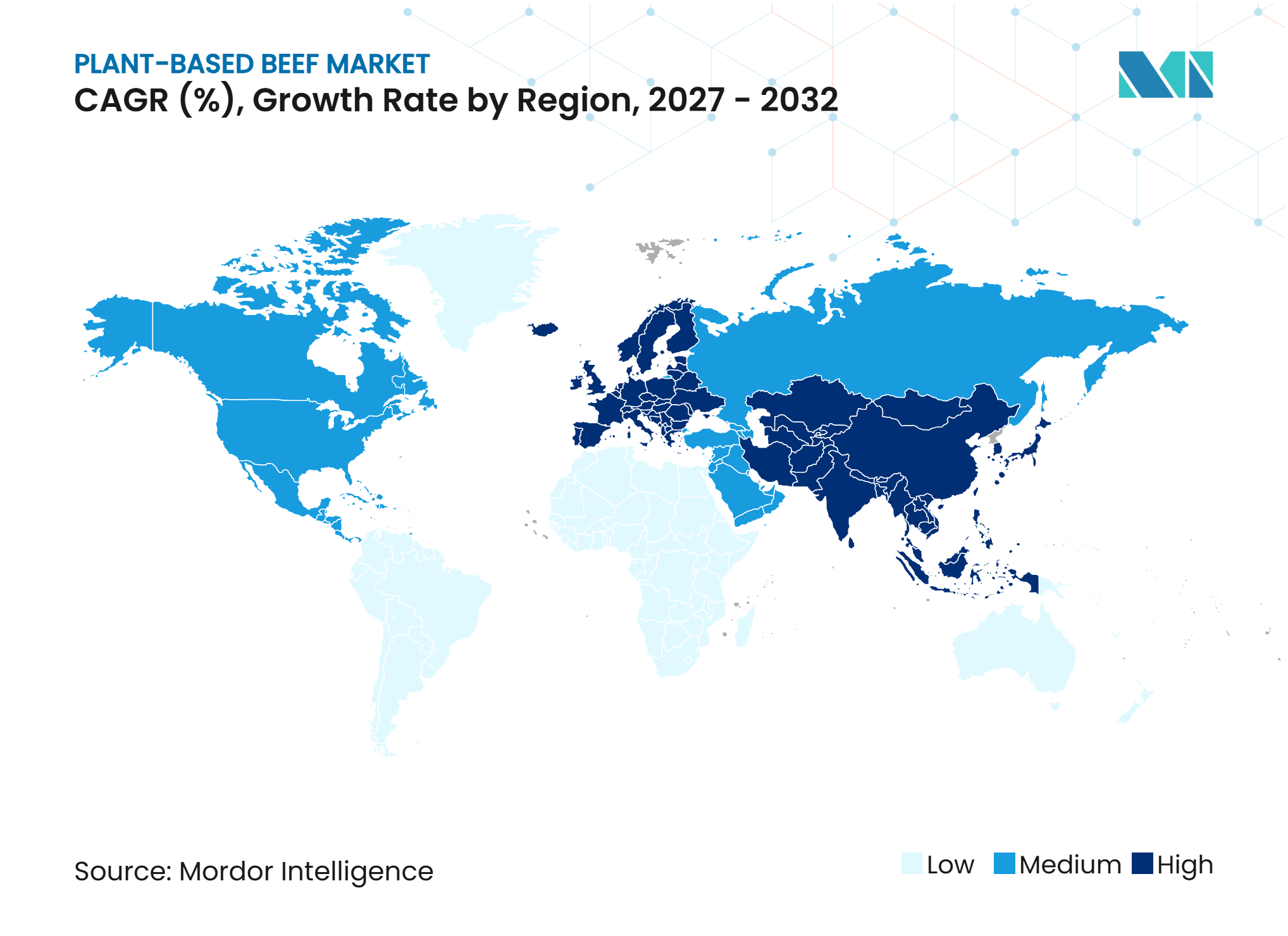
- Among geographies, Europe led with a 42.50% share of the plant-based beef market in 2026, while Asia-Pacific is forecast to grow fastest at a 9.60% CAGR over 2027–2032.
Note: Market numbers in this report are based on Mordor Intelligence's proprietary estimation framework, which combines nine months of actuals with Q4 projections for base year 2026.
Market Trends and Insights
Growing Flexitarian and Vegetarian Consumer Base
Growing interest in flexitarian, vegetarian, and vegan diets is creating opportunities for plant-based beef products as consumers increasingly seek alternatives to conventional meat. Flexitarian consumers are particularly important because they continue to consume animal products while incorporating plant-based substitutes into their diets. The European Commission's Agricultural Outlook 2023–2035 identifies health and environmental concerns as major factors influencing dietary changes and reports that approximately 30% of consumers in selected EU countries followed flexitarian diets in 2021. This shift supports demand for plant-based burgers, patties, meatballs, and other beef alternatives that offer convenient substitutes without requiring consumers to eliminate meat entirely. Manufacturers are therefore expanding product varieties and improving taste and texture to attract both vegetarian consumers and occasional meat reducers.[1]
Drivers Impact Analysis of Plant-Based Beef Market*
| Driver | (~) % Impact on CAGR Forecast | Geographic Relevance | Impact Timeline |
|---|---|---|---|
| Growing flexitarian and vegetarian consumer base | +1.0% | Global, particularly Europe and North America, where plant-based diets and meat alternatives have established consumer markets | Medium term (2–4 years) |
| Increasing demand for sustainable and environmentally friendly protein alternatives | +0.8% | Global, particularly Europe and North America, with growing opportunities across Asia-Pacific | Long term (More than 4 years) |
| Rising investments in plant-based meat product innovation | +0.7% | Global, particularly North America and Europe, where manufacturers are investing in product formulation and sensory improvements | Medium term (2–4 years) |
| Expansion of plant-based beef offerings across retail and foodservice channels | +0.6% | Global, particularly North America and Europe, with expanding distribution opportunities in Asia-Pacific | Medium term (2–4 years) |
| Growing focus on food-system resilience and protein supply diversification | +0.5% | Global, particularly Asia-Pacific and Europe, where alternative protein development supports food supply diversification | Long term (More than 4 years) |
| Increasing adoption of plant-based beef in institutional and workplace meal programs | +0.4% | Global, particularly North America and Europe, with emerging opportunities across Asia-Pacific | Short term (Less than 2 years) |
| Source: Mordor Intelligence | |||
Increasing Demand for Sustainable and Environmentally Friendly Protein Alternatives
Increasing awareness of the environmental impact of conventional livestock production is encouraging interest in alternative protein sources, including plant-based beef. Livestock production contributes to agricultural greenhouse gas emissions and requires substantial land and feed resources, creating opportunities for protein alternatives with potentially lower environmental footprints. The European Environment Agency highlights protein diversification as an important approach to reducing environmental pressures, strengthening food-system resilience, and supporting more sustainable consumption patterns. These considerations are encouraging food manufacturers to develop plant-based beef products using soy, pea, wheat, and blended proteins. Growing sustainability commitments among food companies and consumers are further supporting investment in alternative meat formulations.[2]
Rising Investments in Plant-Based Meat Product Innovation
Investment in food technology and product development is supporting improvements in the taste, texture, nutritional composition, and production efficiency of plant-based beef. Manufacturers are increasingly exploring protein blending, extrusion, texturisation, and flavour-enhancement technologies to develop products that more closely resemble conventional beef. India's Department of Biotechnology, under the BioE3 Policy, identifies plant-based smart proteins as a priority area for research and innovation, including the development of meat analogues from millets, legumes, oilseeds, and underutilised crops. Such initiatives support the development of improved protein ingredients and scalable manufacturing technologies. Continued research and investment can help manufacturers address sensory limitations and expand commercially viable plant-based beef offerings.[3]
Expansion of Plant-Based Beef Offerings Across Retail and Foodservice Channels
The expansion of plant-based meat alternatives across supermarkets, specialty retailers, restaurants, and foodservice outlets is improving product accessibility and supporting market penetration. Retailers are providing more shelf space for meat alternatives, while foodservice operators are incorporating plant-based burgers, patties, and other meat substitutes into their menus to address changing dietary preferences. The European Commission's 2026 policy communication on alternative proteins identifies plant-based protein foods as having significant market potential, supported by consumer acceptance and an established regulatory framework. Wider product availability across retail and foodservice channels enables manufacturers to reach both regular plant-based consumers and flexitarians seeking convenient meat alternatives.[4]
Growing Focus on Food-System Resilience and Protein Supply Diversification
Growing concerns about food security, dependence on imported feed ingredients, and agricultural supply-chain disruptions are increasing interest in diversifying protein production. Plant-based beef offers manufacturers opportunities to use different agricultural protein sources, including soy, peas, wheat, and other legumes, thereby broadening the available raw material base. The European Environment Agency's 2026 report on protein diversification highlights the potential of diversified protein production to strengthen food security, reduce reliance on imported feed, and improve supply-chain resilience. These developments are encouraging governments and food manufacturers to support alternative protein production and develop more diversified sourcing strategies. Such initiatives provide longer-term opportunities for plant-based beef manufacturers to strengthen supply networks and expand production capabilities.[5]
Restraints Impact Analysis of Plant-Based Beef Market*
| Restraint | (~) % Impact on CAGR Forecast | Geographic Relevance | Impact Timeline |
|---|---|---|---|
| High production costs and premium pricing compared to conventional beef | −0.8% | Global, particularly price-sensitive markets across Asia-Pacific, South America, and the Middle East and Africa | Medium term (2–4 years) |
| Taste, texture, and sensory differences compared to animal-based beef | −0.7% | Global, particularly North America and Europe, where consumer expectations for meat-like taste and texture influence repeat purchases | Medium term (2–4 years) |
| Consumer concerns regarding processing and ingredient composition | −0.5% | Global, particularly Europe and North America, where clean-label preferences and scrutiny of processed foods influence purchasing decisions | Medium term (2–4 years) |
| Volatility in plant protein raw material supply and prices | −0.4% | Global, particularly regions dependent on imported soy, pea, wheat, and other plant protein ingredients | Long term (More than 4 years) |
| Source: Mordor Intelligence | |||
High Production Costs and Premium Retail Pricing
Plant-based beef production can involve higher manufacturing costs than conventional beef, particularly when manufacturers use specialised plant protein ingredients, advanced texturisation technologies, and flavour-enhancement processes. Developing products that replicate the taste, texture, and nutritional characteristics of animal-based beef requires investment in ingredient formulation, extrusion equipment, and product testing. The use of protein sources such as soy, pea, and wheat, along with additional binding agents, oils, and flavouring ingredients, can further increase production expenses. These costs may translate into premium retail prices, limiting affordability among price-sensitive consumers and reducing the competitiveness of plant-based beef against conventional meat. Manufacturers therefore need to improve production efficiency, optimise ingredient sourcing, and scale manufacturing operations to achieve more competitive pricing.
Taste, Texture, and Sensory Differences Compared to Animal-Based Beef
Replicating the taste, texture, aroma, and cooking characteristics of conventional beef remains a challenge for plant-based beef manufacturers. Although advances in food processing and protein texturisation have improved meat-like characteristics, differences in juiciness, mouthfeel, browning, and flavour can influence consumer acceptance. Protein ingredients such as soy, pea, and wheat may also produce distinct flavour profiles or textural properties that require additional formulation and processing. These sensory differences can discourage repeat purchases, particularly among flexitarian consumers who expect plant-based alternatives to closely resemble conventional beef. Manufacturers therefore need to invest in improved extrusion technologies, flavour development, and ingredient blending to enhance product quality and strengthen consumer acceptance.
*Our forecasts treat driver/restraint impacts as directional, not additive. The impact forecasts reflect baseline growth, mix effects, and variable interactions.
Plant-Based Beef Market Segment Analysis
By Product Type:
Plant-Based Beef Burgers and Patties Lead While Strips, Chunks, and Pieces Expand FasterIn 2026, plant-based beef burgers and patties accounted for an estimated 38.50% of the plant-based beef market, making them the leading product type. Their position reflects established consumer familiarity with burger formats, convenience in meal preparation, and availability across supermarkets, quick-service restaurants, and foodservice outlets. Meanwhile, plant-based beef strips, chunks, and pieces are projected to record the fastest growth, at an estimated CAGR of 9.20% through 2032. These formats offer versatility across stir-fries, curries, wraps, salads, and ready-to-cook meals, allowing manufacturers to target a wider range of culinary applications.
Plant-based beef meatballs and sausages provide additional options for consumers seeking alternatives to conventional processed meat products. Other plant-based beef products further expand category offerings through different shapes, formulations, and meal applications. However, manufacturers across product categories need to maintain consistent taste, texture, cooking performance, and nutritional quality. The ability to improve product versatility while offering competitive pricing will remain important for expanding consumption.
By Protein Source:
Soy Protein Leads While Blended and Other Plant Proteins Expand FasterIn 2026, soy protein accounted for an estimated 43.50% of the plant-based beef market, making it the leading protein source. Its position reflects established use in meat alternatives, relatively broad raw material availability, and functional properties that support the development of meat-like textures. Meanwhile, blended and other plant proteins are projected to record the fastest growth, at an estimated CAGR of 9.40% through 2032. Combining different protein sources allows manufacturers to improve amino acid profiles, texture, flavour, and functional performance while reducing dependence on individual ingredients.
Pea protein provides an alternative to soy-based formulations, particularly for manufacturers developing products with different allergen and nutritional positioning. Wheat protein also supports meat-like texture and structure through its functional properties. Blended formulations offer opportunities to combine the strengths of different ingredients and improve product characteristics. However, manufacturers need to manage ingredient costs, protein functionality, allergen considerations, and formulation consistency to expand adoption.


By Storage Type:
Frozen Products Lead While Refrigerated Products Expand FasterIn 2026, frozen plant-based beef products accounted for an estimated 67.00% of the plant-based beef market, making them the leading storage type. Their position reflects longer shelf life, established cold-chain distribution networks, and convenience for retailers and consumers. Meanwhile, refrigerated products are projected to record the fastest growth, at an estimated CAGR of 8.30% through 2032. Refrigerated formats appeal to consumers seeking fresh-format alternatives and convenient meal solutions, while their presence in supermarket chillers improves product visibility and accessibility.
Shelf-stable plant-based beef products serve applications where refrigeration is not readily available and longer storage periods are important. These products provide additional distribution opportunities, although maintaining desirable taste and texture without conventional chilled or frozen storage can require specialised processing and packaging. Across all storage categories, manufacturers need to balance shelf life, product quality, distribution costs, and consumer convenience to strengthen market penetration.
Geography Analysis
Europe Plant-Based Beef Market
Europe accounted for an estimated 42.50% of the plant-based beef market in 2026, making it the largest regional market. The region benefits from established consumer awareness of meat alternatives, flexitarian dietary preferences, and the presence of manufacturers offering plant-based burgers, patties, and other beef substitutes. Countries such as Germany, the United Kingdom, France, and the Netherlands provide opportunities through established alternative protein markets and retail distribution networks. The European Commission's initiatives supporting alternative proteins and sustainable food systems further encourage product innovation and diversification. These factors support demand for plant-based beef across retail and foodservice channels.
Asia-Pacific Plant-Based Beef Market
Asia-Pacific is projected to be the fastest-growing regional market, with an estimated CAGR of 9.60% over 2027–2032. The region benefits from established soy and other plant-protein supply chains, growing interest in alternative proteins, and increasing investments in food technology. China, Japan, Australia, and India offer opportunities for manufacturers to develop plant-based beef products suited to local culinary preferences. Government-backed research initiatives, including India's BioE3 Policy, which identifies smart proteins as a biotechnology priority, further support innovation in alternative protein production. However, manufacturers need to address product affordability, taste preferences, and consumer awareness to expand adoption.
North America Plant-Based Beef Market
North America represents an important market for plant-based beef, supported by established alternative protein manufacturers, product innovation, and retail and foodservice distribution networks. The United States and Canada provide opportunities for manufacturers through demand for plant-based burgers, patties, sausages, and other meat alternatives. Product development focused on improving taste, texture, and nutritional composition is supporting category diversification. However, premium pricing and competition from conventional meat products remain important considerations for manufacturers seeking wider consumer adoption.
Competitive Landscape
Market Concentration
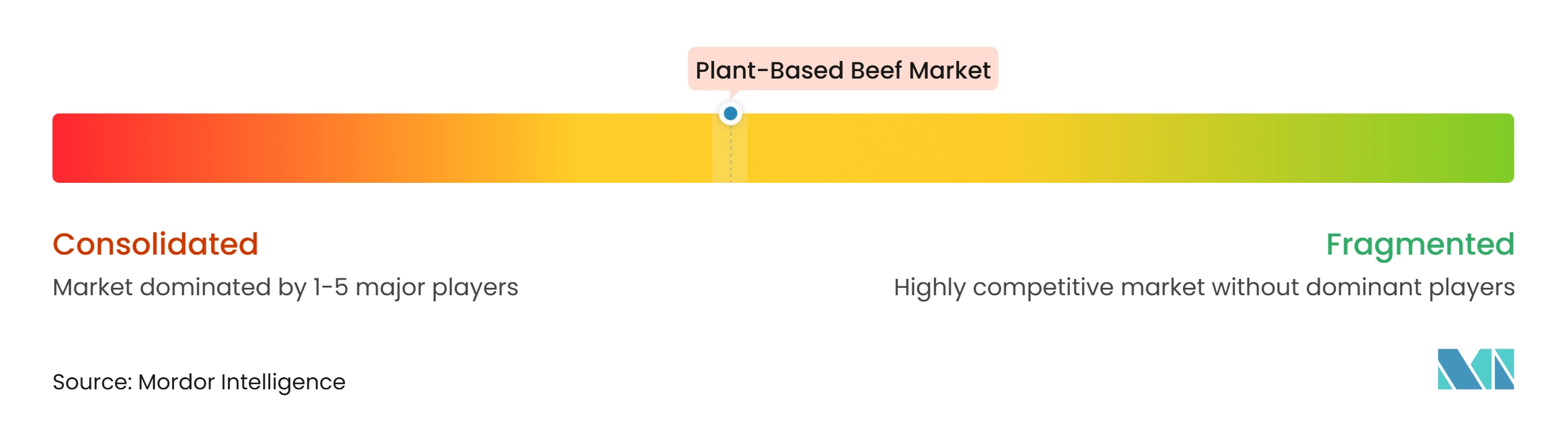
The Plant-Based Beef Market includes multinational food companies, specialist alternative protein manufacturers, and regional plant-based meat producers competing through product innovation, protein formulation, brand positioning, and distribution reach. Companies have varying levels of exposure to plant-based beef through burgers, patties, meatballs, strips, chunks, and other meat alternatives. Specialist manufacturers focus on developing meat-like products using soy, pea, wheat, and blended plant proteins, while larger food companies leverage established manufacturing capabilities, brand portfolios, and retail distribution networks to strengthen their market presence.
Competitive strategies in the Plant-Based Beef Market focus on improving taste and texture, expanding product portfolios, and developing formulations that appeal to flexitarian and vegetarian consumers. Companies such as Beyond Meat and Impossible Foods concentrate on beef alternatives, including burgers and other meat-like products, while Nestlé, Conagra Brands, and Maple Leaf Foods participate through broader plant-based food portfolios. Regional manufacturers such as Heura Foods, Planted Foods, GoodDot, and Vezlay Foods strengthen competition through differentiated formulations and products adapted to regional consumer preferences.
Competitive strategies in the Plant-Based Beef Market focus on expanding beef-alternative portfolios, improving sensory characteristics, and strengthening product availability across retail and foodservice channels. For example, Beyond Meat offers Beyond Burger, Beyond Beef, and Beyond Steak, while Impossible Foods markets plant-based beef, burger patties, ground beef, meatballs, and steak bites. Nestlé's Garden Gourmet offers plant-based burgers and sausages, while Conagra Brands' Gardein portfolio includes plant-based beef strips, tips, ground crumbles, and meatballs. These product strategies allow manufacturers to target different meal occasions and consumer preferences through differentiated formats and formulations.
Plant-Based Beef Industry Leaders
-
Beyond Meat, Inc.
-
Impossible Foods Inc.
-
Nestlé S.A.
-
Conagra Brands, Inc.
-
Unilever PLC
- *Disclaimer: Major Players sorted in no particular order
Plant-Based Beef Market Companies Covered in this Report
- Beyond Meat, Inc.
- Impossible Foods Inc.
- Nestlé S.A.
- Conagra Brands, Inc.
- Mars, Incorporated
- Maple Leaf Foods Inc.
- Monde Nissin Corporation
- Unilever PLC
- Rügenwalder Mühle Carl Müller GmbH & Co. KG
- Heura Foods, S.L.
- Planted Foods AG
- Redefine Meat Ltd.
- Moving Mountains Foods Ltd.
- Hungry Planet, Inc.
- Before the Butcher, LLC
- Abbot's Butcher, Inc.
- Ojah B.V.
- v2food Pty Ltd
- GoodDot Enterprises Pvt. Ltd.
- Vezlay Foods Pvt. Ltd.
Recent Industry Developments in Plant-Based Beef Market
- November 2026: Daring Foods introduced Plant Steak Bites, marking the company’s entry into the plant-based beef category after focusing primarily on plant-based chicken products. Launched as a Publix exclusive in the United States on November 12, the product provides 13 grams of protein and 4 grams of fibre per serving, extending Daring’s portfolio into beef-style alternatives.
- October 2026: Beyond Meat expanded the retail availability of its Beyond Steak Filet to Sprouts Farmers Market stores nationwide. The plant-based whole-cut product, made with faba bean protein, mycelium, and avocado oil, provides 28 grams of plant protein per serving. The rollout followed its earlier availability at Erewhon, Wegmans, H-E-B, and Meijer, increasing its reach across the US retail market.
- September 2026: Impossible Foods entered UK supermarkets through a collaboration with Tesco, introducing four new plant-based products, including Impossible Burger Patties and Impossible Beef Kofta. The launch marked a significant expansion of the company's UK retail presence and brought its plant-based beef alternatives to selected Tesco stores, supported by production at its European co-manufacturing facility.
- September 2026: teakholder Foods commenced retail sales of its Perfecta premium plant-based meat range in the Northeastern United States through KeHE Distributors. The portfolio included plant-based marbled steak and filet mignon alongside chicken and seafood alternatives, marking the commercial introduction of its whole-cut plant-based steak products to US retail outlets.
Global Plant-Based Beef Market Report Scope
For this study, the Plant-Based Beef Market is defined as the sales value of commercially produced meat alternatives made primarily from plant-derived proteins and formulated to replicate the taste, texture, appearance, and cooking characteristics of conventional beef. The market covers plant-based beef burgers and patties, plant-based beef meatballs, plant-based beef strips, chunks and pieces, plant-based beef sausages and hot dogs, and other plant-based beef products. The market is segmented by protein source into soy protein, pea protein, wheat protein, and blended and other plant proteins, and by storage type into frozen, refrigerated, and shelf-stable products. The study evaluates demand across North America, Europe, Asia-Pacific, South America, and the Middle East and Africa, with country-level coverage as specified in the report. Market sizing and forecasts are presented in value terms (USD billion) across the defined product categories, protein sources, storage types, and geographies for the forecast period.
Segmentation Overview
| Plant-Based Beef Burgers and Patties |
| Plant-Based Beef Meatballs |
| Plant-Based Beef Strips, Chunks, and Pieces |
| Plant-Based Beef Sausages and Hot Dogs |
| Other Plant-Based Beef Products |
| Soy Protein |
| Pea Protein |
| Wheat Protein |
| Blended and Other Plant Proteins |
| Frozen |
| Refrigerated |
| Shelf-Stable |
| North America | United States |
| Canada | |
| Mexico | |
| Rest of North America | |
| Europe | United Kingdom |
| Germany | |
| France | |
| Italy | |
| Spain | |
| Sweden | |
| Belgium | |
| Poland | |
| Netherlands | |
| Rest of Europe | |
| Asia-Pacific | China |
| Japan | |
| India | |
| Thailand | |
| Singapore | |
| Indonesia | |
| South Korea | |
| Australia | |
| Rest of Asia-Pacific | |
| South America | Brazil |
| Argentina | |
| Colombia | |
| Peru | |
| Chile | |
| Rest of South America | |
| Middle East and Africa | South Africa |
| Saudi Arabia | |
| United Arab Emirates | |
| Nigeria | |
| Egypt | |
| Morocco | |
| Turkey | |
| Rest of Middle East and Africa |
| By Product Type | Plant-Based Beef Burgers and Patties | |
| Plant-Based Beef Meatballs | ||
| Plant-Based Beef Strips, Chunks, and Pieces | ||
| Plant-Based Beef Sausages and Hot Dogs | ||
| Other Plant-Based Beef Products | ||
| By Protein Source | Soy Protein | |
| Pea Protein | ||
| Wheat Protein | ||
| Blended and Other Plant Proteins | ||
| By Storage Type | Frozen | |
| Refrigerated | ||
| Shelf-Stable | ||
| By Geography | North America | United States |
| Canada | ||
| Mexico | ||
| Rest of North America | ||
| Europe | United Kingdom | |
| Germany | ||
| France | ||
| Italy | ||
| Spain | ||
| Sweden | ||
| Belgium | ||
| Poland | ||
| Netherlands | ||
| Rest of Europe | ||
| Asia-Pacific | China | |
| Japan | ||
| India | ||
| Thailand | ||
| Singapore | ||
| Indonesia | ||
| South Korea | ||
| Australia | ||
| Rest of Asia-Pacific | ||
| South America | Brazil | |
| Argentina | ||
| Colombia | ||
| Peru | ||
| Chile | ||
| Rest of South America | ||
| Middle East and Africa | South Africa | |
| Saudi Arabia | ||
| United Arab Emirates | ||
| Nigeria | ||
| Egypt | ||
| Morocco | ||
| Turkey | ||
| Rest of Middle East and Africa | ||
Key Questions Answered in the Report
What is the current size of the Plant-Based Beef Market?
The Plant-Based Beef Market is estimated at USD 3.15 billion in 2026 and is projected to reach USD 4.72 billion by 2032, registering a CAGR of 7.10% over 2027–2032.
Which product type holds the largest share of the Plant-Based Beef Market?
Plant-Based Beef Burgers and Patties hold the largest share, accounting for an estimated 38.50% of the market in 2026, supported by their established retail presence, familiarity among consumers, and versatility across foodservice applications.
Which protein source dominates the Plant-Based Beef Market?
Soy protein is the leading protein source, accounting for an estimated 43.50% market share in 2026, owing to its established use in meat alternatives, functional properties, and suitability for developing meat-like textures.
Which region is expected to witness the fastest growth in the Plant-Based Beef Market?
Asia-Pacific is projected to be the fastest-growing regional market, registering an estimated CAGR of 9.60% over 2027–2032, supported by increasing awareness of plant-based diets, expanding product availability, and investments in alternative protein development.