
Pipeline Corrosion Imaging Systems Market Size and Share
Market Overview
| Study Period | 2020 - 2031 |
|---|---|
| Market Size (2026) | USD 1.29 Billion |
| Market Size (2031) | USD 1.79 Billion |
| Growth Rate (2026 - 2031) | 6.82 % |
| Fastest Growing Market | Asia-Pacific |
| Largest Market | North America |
| Market Concentration | Medium |
Major Players *Disclaimer: Major Players sorted in no particular order Image © Mordor Intelligence. Reuse requires attribution under CC BY 4.0. | |
Pipeline Corrosion Imaging Systems Market Analysis by Mordor Intelligence
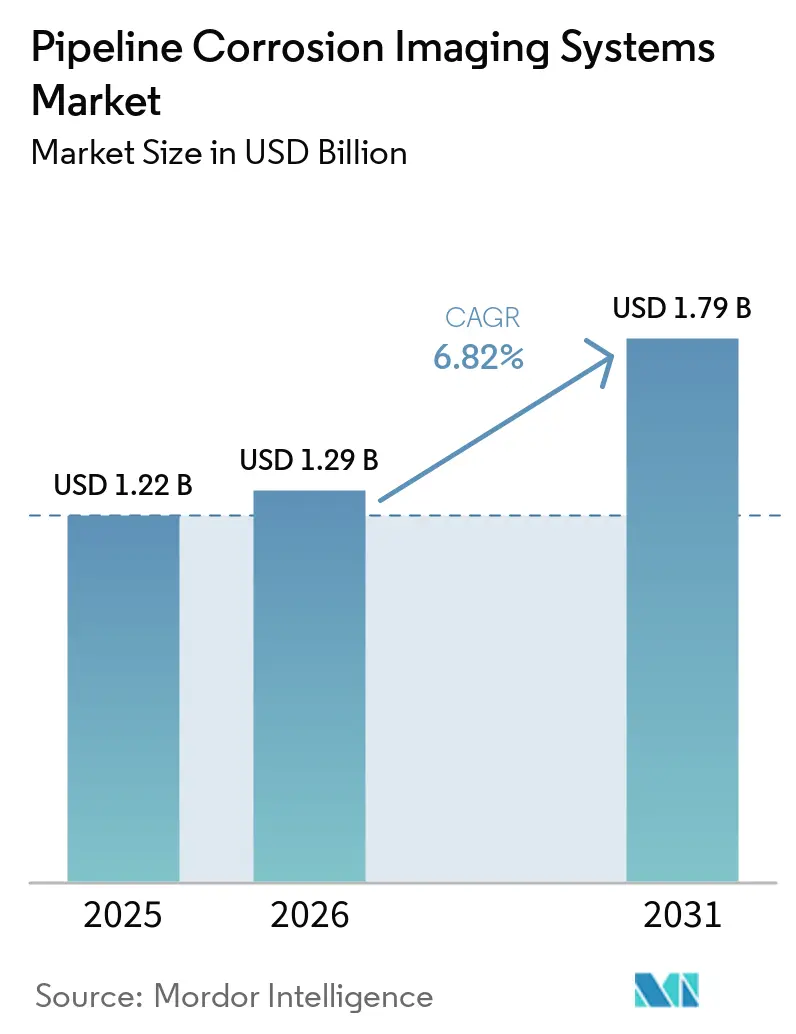
The pipeline corrosion imaging systems market size is projected to expand from USD 1.22 billion in 2025 and USD 1.29 billion in 2026 to USD 1.79 billion by 2031, registering a CAGR of 6.82% between 2026 to 2031. Demand reflects the need to verify pipeline condition and extend the service life of costly assets that were installed before current non-destructive testing practices became common. In North America and Europe, mature infrastructure has shifted purchasing toward risk-based inspection schedules rather than periodic compliance work alone. New gas pipelines in Asia-Pacific and the Middle East also require baseline inspections and embedded monitoring before service begins. The pipeline corrosion imaging systems market is also supported by digitized corrosion records that help operators plan maintenance, while larger suppliers combine inspection tools with data analysis capabilities.
Key Report Takeaways
- By technology, magnetic flux leakage held 32.44% of revenue in 2025, while electromagnetic acoustic transducer technology is projected to expand at a CAGR of 7.92% through 2031.
- By system architecture, free-swimming in-line inspection systems accounted for 38.62% of revenue in 2026, while robotic crawler systems are projected to expand at a CAGR of 7.35% through 2031.
- By deployment environment, onshore pipelines held 71.81% of revenue in 2025, while offshore and subsea pipelines are projected to expand at a CAGR of 7.54% through 2031.
- By end-user, oil and gas pipeline operators accounted for 62.37% of revenue in 2025, while hydrogen infrastructure developers are projected to expand at a CAGR of 7.68% through 2031.
- By geography, North America held 34.73% of pipeline corrosion imaging systems market share in 2025, while Asia-Pacific is projected to expand at a CAGR of 7.57% through 2031.
Note: Market size and forecast figures in this report are generated using Mordor Intelligence’s proprietary estimation framework, updated with the latest available data and insights as of January 2026.
Global Pipeline Corrosion Imaging Systems Market Trends and Insights
Drivers Impact Analysis*
| Driver | (~) % Impact on CAGR Forecast | Geographic Relevance | Impact Timeline |
|---|---|---|---|
| Aging Pipeline Infrastructure and Higher Inspection Frequency | +2.0% | Global, concentrated in North America and Europe | Short term (≤ 2 years) |
| High-Pressure Gas Transmission Network Expansion | +1.6% | North America and Asia-Pacific, with spillover to the Middle East | Short term (≤ 2 years) |
| Hydrogen and Carbon Dioxide Pipeline Integrity Requirements | +1.3% | Europe and North America, with early gains in Northeast Asia | Medium term (2-4 years) |
| Corrosion Data Digitization and Predictive Integrity Management | +1.1% | Global, with early deployment in North America and the European Union | Long term (≥ 4 years) |
| Subsea and Deepwater Pipeline Inspection Growth | +0.9% | Asia-Pacific, Middle East and Africa, and North Sea Europe | Medium term (2-4 years) |
| Inspection Demand for Difficult-to-Pig Pipelines | +0.7% | Global, with particular relevance in aging industrial and distribution networks | Long term (≥ 4 years) |
| Source: Mordor Intelligence | |||
Aging Pipeline Infrastructure Requires More Frequent Inspection
Pipeline assets that have exceeded their original design life create a steady need for corrosion imaging services. Corrosion contributed to 18% of significant U.S. pipeline incidents over a 20-year period, with related industry costs nearing USD 7 billion. Federal rules require assessment intervals of 7-10 years for certain gas transmission pipelines, while risk-based programs can require more frequent work in high-consequence areas. Operators are adding monitoring between in-line inspection runs because defect growth during multiyear gaps can create operational risk. The pipeline corrosion imaging systems market therefore benefits from recurring work on existing assets, not only from newly built pipelines. This pattern keeps advanced inspection platforms in use across aging networks and supports recurring service revenue.
High-Pressure Gas Transmission Networks Expand Inspection Demand
New gas transmission capacity requires baseline in-line inspection and corrosion monitoring before pipelines enter commercial operation. The U.S. Energy Information Administration expects 44.9 Bcf/d of U.S. gas pipeline capacity additions during 2026 and 2027, and 31.6 Bcf/d of that capacity was under construction.[1]U.S. Energy Information Administration, “Most Planned Natural Gas Pipeline Capacity Additions in U.S. History Are Under Construction in 2026 and 2027,” EIA Today in Energy, eia.gov. Texas accounted for 29.7 Bcf/d of planned capacity, supported by Permian Basin takeaway and liquefied natural gas export infrastructure. Enbridge received federal approval in April 2026 for the CAD 4 billion (USD 2.92 billion) Sunrise Expansion Program, which is designed to add 300 MMcf/d to its Westcoast system. Large high-pressure projects favor magnetic flux leakage and electromagnetic acoustic transducer tools, while concurrent commissioning can constrain crew and tool availability. The pipeline corrosion imaging systems market gains when operators supplement delayed inspection runs with fixed sensors and online monitoring systems.
Hydrogen and Carbon Dioxide Networks Need Specialized Integrity Methods
Pipelines used for hydrogen or anthropogenic carbon dioxide require inspection approaches that differ from conventional gas service. Internal corrosion accounts for 45% of reported carbon dioxide pipeline failures because dissolved water can create carbonic acid in supercritical carbon dioxide environments.[2]R. Esmaeili, et al., “Internal Corrosion of Supercritical CO₂ Pipelines: Integrated Influencing Factors, Mitigation Strategies, and Future Perspectives,” Applied Sciences, mdpi.com. The Pipeline Research Council International identified hydrogen embrittlement and hard-spot detection as areas that require new inspection qualification methods for hydrogen pipeline integrity management. Electromagnetic acoustic transducer and phased-array ultrasonic tools can address some of these requirements through direct wall measurement and higher-resolution crack detection. The pipeline corrosion imaging systems market has an opening in this area because operators need qualified methods before investing in full inspection programs. Demand is likely to strengthen as standards clarify inspection requirements for repurposed and new energy-carrier pipelines.
Digitized Corrosion Data Supports Predictive Integrity Management
Operators are moving from periodic inspection snapshots toward continuously updated pipeline integrity models. A 2026 study found that probabilistic digital twins supported by sensor fusion could produce pipe-wall-loss reliability values above 0.85 and reduce depth-sizing error to ±5%.[3]Srikanth S., et al., “Advanced Sensor Systems and Machine Learning for Pipeline Integrity Management: A Review of Corrosion Monitoring and Prediction Strategies,” npj Materials Degradation, nature.com. High-resolution ultrasonic in-line inspection can generate terabytes of data in a single run, while distributed sensing can produce 30 million data points each second on a 1,500-meter pipeline with 5 mm spatial resolution. These data volumes make manual interpretation less practical and increase demand for software-supported analysis. Penspen and Senslytics integrated THEIA and CausX AI to align inspection datasets in digital twins for corrosion prediction and Gas Mega Rule compliance work. The pipeline corrosion imaging systems market is benefiting as suppliers pair hardware with recurring data management and analysis services.
Restraints Impact Analysis*
| Restraint | (~) % Impact on CAGR Forecast | Geographic Relevance | Impact Timeline |
|---|---|---|---|
| High Capital and Mobilization Costs for Advanced Imaging Systems | -1.5% | Global, with particular pressure on independent operators in Asia-Pacific, Middle East and Africa, and South America | Short term (≤ 2 years) |
| Shortage of Certified Pipeline Integrity and NDT Specialists | -1.2% | Global, with the greatest pressure in Asia-Pacific, Middle East and Africa, and sub-Saharan Africa | Medium term (2-4 years) |
| Inconsistent Data Formats and Limited Cross-Vendor Interoperability | -0.8% | Global, with early mitigation in North America and Europe | Long term (≥ 4 years) |
| Sensor Degradation from Coatings, Deposits, and Complex Geometries | -0.5% | Asia-Pacific and Middle East and Africa, and older European distribution networks | Medium term (2-4 years) |
| Source: Mordor Intelligence | |||
High Capital and Mobilization Costs Limit Advanced System Adoption
Multi-sensor in-line inspection tools that combine magnetic flux leakage, electromagnetic acoustic transducer, and caliper functions can be costly to mobilize. Independent and midstream operators may not have enough inspection activity or pipeline coverage to support dedicated service contracts. The issue is more pronounced in South America, Southeast Asia, and sub-Saharan Africa, where periodic assessment requirements can outpace access to financing. A difficult-to-access 10 km section can require mobilization spending similar to a 200 km mainline run, making the cost per kilometer difficult to justify. Some operators choose direct assessment or hydrostatic testing instead of advanced imaging, leaving gaps in their inspection data. Compact robotic crawlers can reduce the footprint of some projects, but the pipeline corrosion imaging systems market remains less accessible for operators facing capital constraints.
Shortages of Certified Specialists Constrain Inspection Throughput
The inspection workforce faces a shortage because higher-level pipeline qualification requires several years of documented field experience. The American Society for Nondestructive Testing reported that 30% of certified NDT personnel were older than 55, while project delays from skill mismatches ranged from 15% to 20% in safety-critical sectors. Limited availability of personnel trained in phased-array ultrasonic testing, full matrix capture, and digital radiography slows use of these advanced methods. Scarcity also increases specialist day rates and can lengthen the completion time for integrity programs. Suppliers are responding with automated defect classification tools that shorten the time needed for post-inspection review. This response raises the value of analytics-enabled systems, but staffing constraints still limit the volume of work service providers can deliver.
*Our forecasts treat driver/restraint impacts as directional, not additive. The impact forecasts reflect baseline growth, mix effects, and variable interactions.
Segment Analysis
By Technology: Magnetic Flux Leakage Leads as Electromagnetic Acoustic Transducer Use Broadens
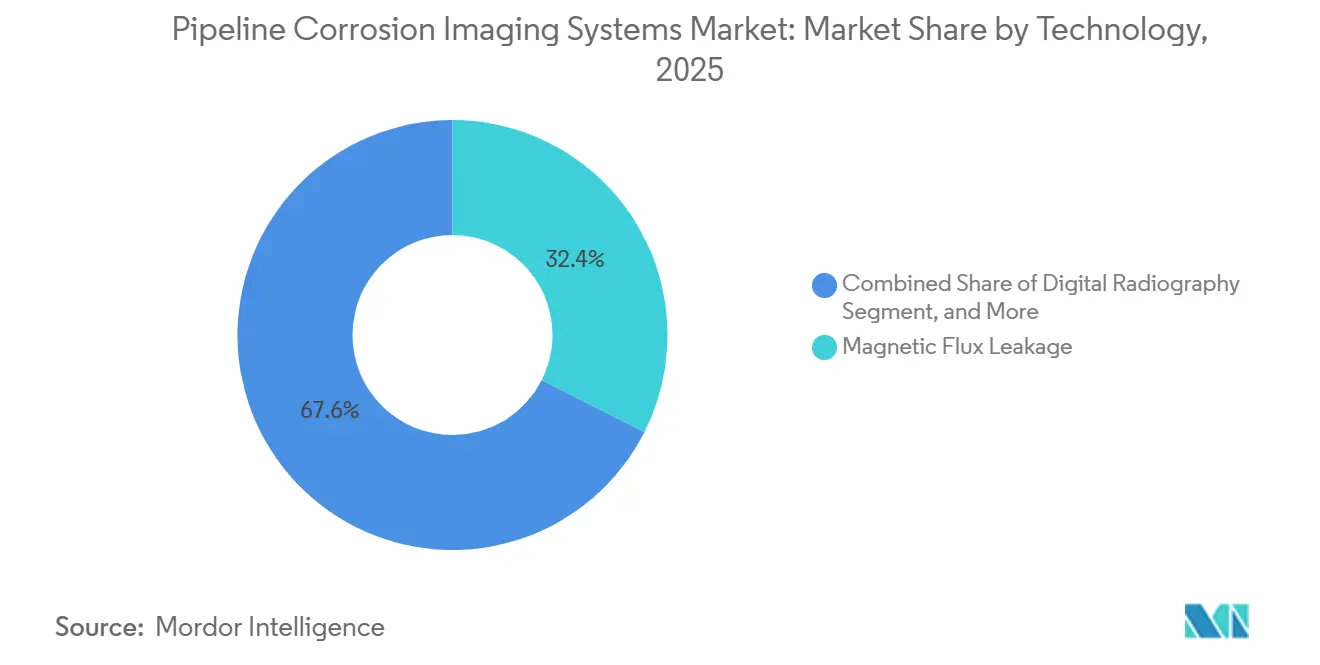
Magnetic flux leakage held 32.44% of pipeline corrosion imaging systems market share in 2025, reflecting its established role in identifying metal loss and corrosion in liquid and gas transmission pipelines. It operates in both liquid and gas media and remains resilient to changes in tool velocity. Its large installed fleet and established calibration practices make it the reference technology for many pipeline operators. Combining magnetic flux leakage with ultrasonic testing in one in-line inspection run can raise defect identification from 60-70% for either method alone to 88% when both methods are used together. The same comparison reported an improvement of up to 30% in depth-sizing accuracy. The pipeline corrosion imaging systems market size for magnetic flux leakage is supported by demand for tools that address crack-corrosion interaction risks. Ultrasonic testing remains important for liquid-filled pipelines because it directly measures wall thickness and detects laminations. Its need for a liquid couplant limits its use in dry gas lines. Eddy current, remote-field electromagnetic testing, optical imaging, and laser systems serve narrower needs in non-ferromagnetic, robotic, and non-piggable applications.
Electromagnetic acoustic transducer technology is projected to expand at a CAGR of 7.92% through 2031, making it the fastest-growing technology category. Its couplant-free operation supports inspection in dry gas pipelines where conventional ultrasonic testing is not suitable. Multi-channel arrays on robotic crawlers improve scanning efficiency for large-diameter pipe. Machine learning methods for denoising and mode identification are helping improve electromagnetic acoustic transducer signal interpretation. ROSEN validated its EMAT-C technology through 5 inspections of 48-inch and 36-inch heavy-wall lines on TC Energy's Canadian system. Acoustic emission imaging also has a role in monitoring active damage mechanisms. Digital radiography and guided-wave ultrasonic testing support weld inspection and long-range screening in inaccessible sections. Lower manpower requirements from drone and semi-automated deployment can widen use of these complementary technologies.



By System Architecture: Free-Swimming In-Line Inspection Remains Foundational as Robotics Scale
Free-swimming in-line inspection systems accounted for 38.62% of revenue in 2026. They travel through high-pressure transmission pipelines at production flow velocities without shutdowns or external power. Their established use in trunk lines supports their position in regulated high-consequence areas. Familiarity with in-line inspection pigging protocols also reduces barriers for operators that already use this method. Tethered and wireline systems hold the next-largest architecture position and inspect short-radius or inaccessible sections. Their advantage is high data fidelity per unit length rather than the coverage rate of free-swimming tools. Fixed sensors and online monitoring systems add continuous information between periodic inspection campaigns. Saudi Aramco installed nonintrusive ultrasonic subsea sensors on 36-inch rich gas trunk lines for real-time top-of-line corrosion monitoring without interrupting production. These systems support operators that require ongoing information from complex assets.
Robotic crawler systems are projected to expand at a CAGR of 7.35% through 2031, the highest rate among system architecture categories. They serve pipelines with multiple diameters, tight bends, one-way sections, and reduced-port valves that conventional free-swimming tools cannot navigate. Electromagnetic acoustic transducer arrays have helped move these systems beyond visual inspection toward full-bore wall-thickness mapping. ROSEN reported that its Non-Intrusive Pipeline Assessment service was deployed across more than 700 km of pipeline in 2025. Handheld and semi-automated scanners remain relevant for above-ground pipelines and facility piping. They are often preferable where full in-line inspection is not economical. The pipeline corrosion imaging systems industry is seeing overlap between architecture categories as tethered tools gain crawler modules. Free-swimming tools are also adding inertial measurement and three-dimensional mapping functions. This overlap places pressure on suppliers that offer only one system type.
By Deployment Environment: Onshore Pipelines Anchor Revenue as Offshore and Subsea Work Accelerates
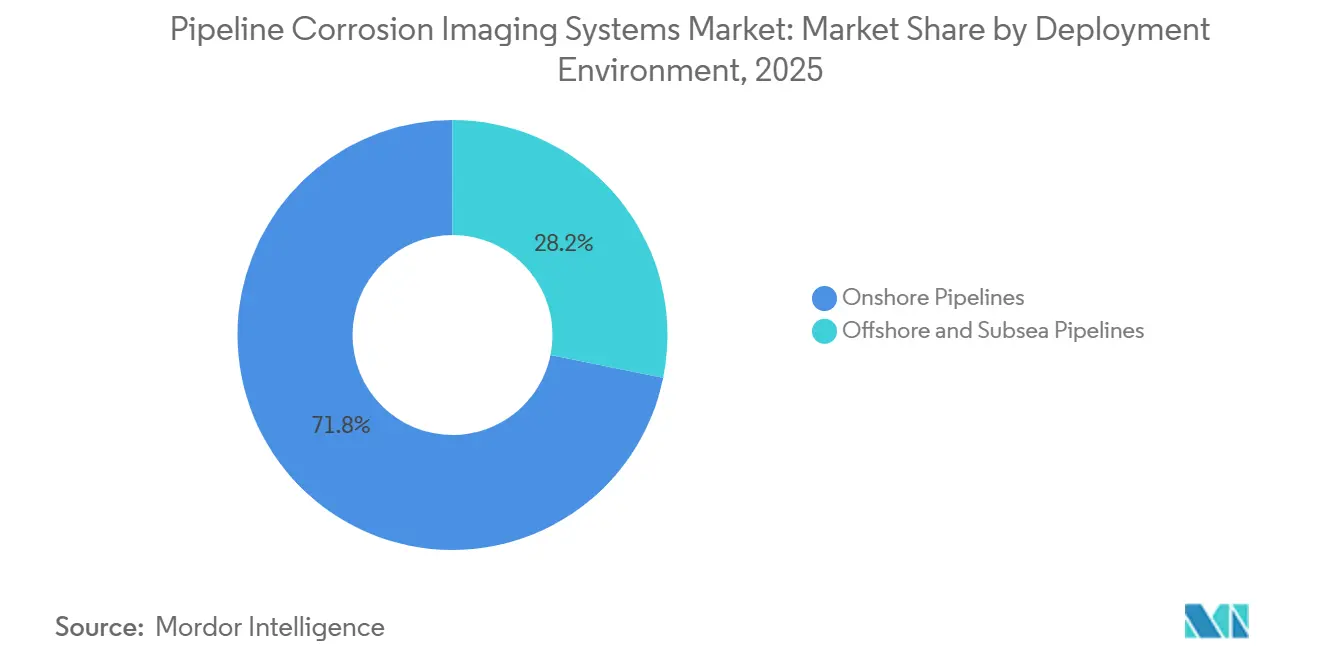
Onshore pipelines held 71.81% of revenue in 2025. This position reflects the larger installed length of terrestrial pipelines and established rules governing inspection schedules. The United States maintained 2.6 million miles of natural gas pipeline, much of it located in buried agricultural and semiurban corridors. Aging cathodic protection systems can increase external corrosion risk in these settings. The Federal Register published an update to NACE SP0502-2025 in April 2026, and the standard takes effect on January 1, 2027 for buried onshore ferrous piping under the relevant federal rules. This creates a compliance window for external corrosion imaging services. Onshore projects also have lower mobilization costs and more familiar logistics than offshore work. These conditions allow regional service companies to compete in local corridors. The pipeline corrosion imaging systems market therefore retains a diverse tail of smaller suppliers in onshore applications.
Offshore and subsea pipelines are projected to expand at a CAGR of 7.54% through 2031. Aging assets in the North Sea, Gulf of Mexico, and Brazilian Presalt fields require detailed integrity work. Production expansion in Southeast Asia and West Africa adds new offshore inspection needs. Offshore operators are concentrating inspection resources on cathodic protection hotspots and areas with known coating deterioration. Carbon dioxide transport creates a further use case because operators are assessing offshore pipelines for carbon capture and storage service. Ørsted and Baker Hughes completed a 302 km subsea in-line inspection run in 2025 to assess carbon dioxide requalification feasibility. The project combined magnetic flux leakage and XYZ mapping tools in low-flow conditions. Tool battery operation exceeded 400 hours during that work. This work brings previously inactive pipelines into inspection programs and adds demand beyond conventional hydrocarbon service.
By End-User: Oil and Gas Operators Remain Central as Hydrogen Developers Advance Fastest
Oil and gas pipeline operators held 62.37% of revenue in 2025. Their position reflects the size of regulated transmission and gathering networks and established inspection obligations. These operators are increasingly using integrity data platforms to convert inspection results into predictive maintenance schedules. This shift supports multiyear agreements that combine in-line inspection services with data analysis. Water and wastewater utilities are the second-largest end-user group. Their demand centers on drinking-water transmission mains where condition-based assessments are replacing age-based replacement decisions. Chemical and petrochemical operators require tailored configurations for process piping, smaller diameters, high temperatures, and corrosive operating conditions. Power generation and mining customers provide steady demand for boiler-tube, cooling-water, and slurry-pipeline inspection. Portable and semi-automated systems are particularly relevant in these applications.
Hydrogen infrastructure developers are projected to expand at a CAGR of 7.68% through 2031, the fastest rate among end-user categories. Developers need research-stage inspection programs because accepted qualification protocols for hydrogen service remain limited. PRCI's consensus engineering requirements identify more conservative defect criteria and tighter sizing tolerances for hydrogen-exposed steel. Carbon capture and storage operators are also emerging customers as carbon dioxide transport networks expand. Commercial carbon capture and storage pipelines reported general corrosion rates of 0.028-0.207 mpy when monitored with metallic weight-loss coupons and electrical resistance techniques. Changes in impurities such as H₂O, H₂S, and SO₂ can accelerate corrosion in supercritical carbon dioxide service. This makes continuous monitoring important for carbon dioxide transport systems. The pipeline corrosion imaging systems industry has a distinct demand base in the 2026-2031 period because new energy carriers add requirements beyond legacy hydrocarbon networks.
Geography Analysis
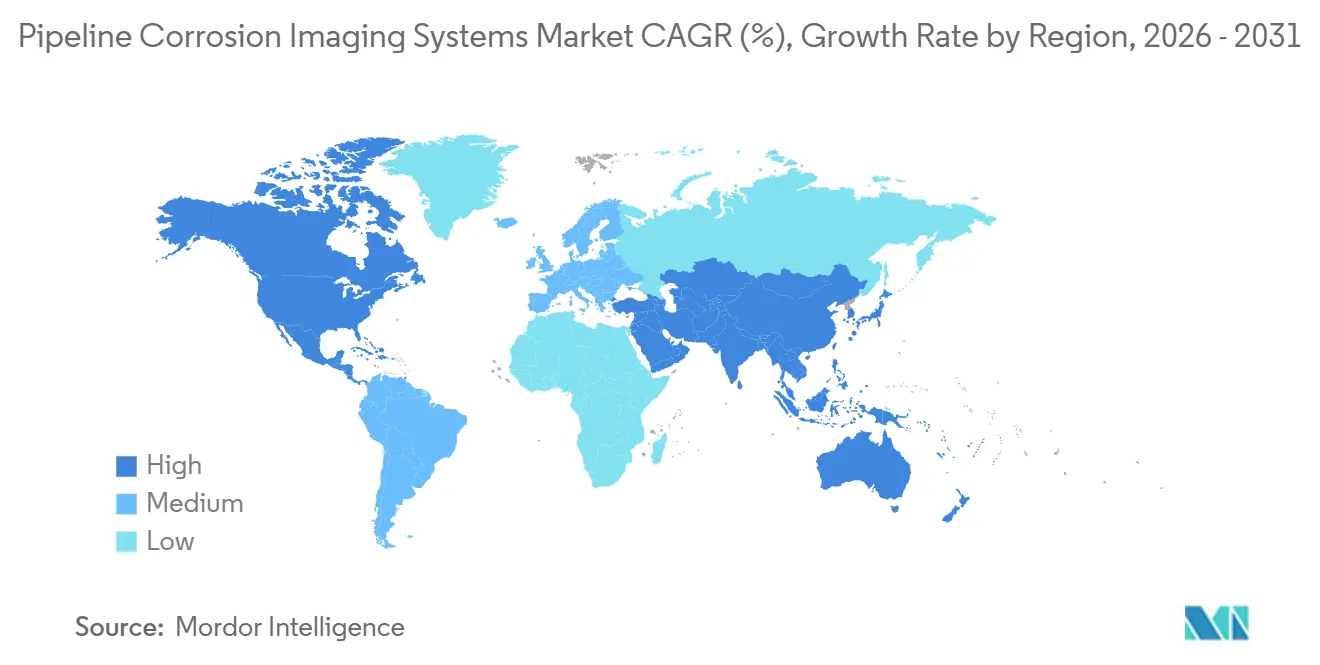
North America held 34.73% of regional revenue in 2025, making it the largest regional market. Its mature and aging network, strict federal inspection requirements, and concentration of service providers support demand. U.S. rules establish recurring internal assessment and external corrosion testing for gas and hazardous liquid pipelines. Canada adds large-diameter gas transmission work, including Enbridge’s Sunrise Expansion Program, which received approval in April 2026 and is planned to enter service in late 2028. The CAD 4 billion (USD 2.92 billion) project is designed to add 300 MMcf/d, while Brazilian deepwater operations give South America a smaller but developing subsea imaging niche.
Europe is the second-largest regional market in the pipeline corrosion imaging systems market. Germany, the United Kingdom, and France support inspection activity through dense gas distribution and industrial networks, while aging North Sea assets require targeted integrity programs. European carbon dioxide transport investment also creates qualification work for new and repurposed pipelines. Asia-Pacific is projected to expand at a CAGR of 7.57% through 2031, the highest regional rate. China’s city-gas additions, India’s authorization program, and Southeast Asian liquefied natural gas infrastructure create new pipeline kilometers and associated baseline inspection needs.
The Middle East and Africa have differing demand conditions across their subregions. Saudi Arabia and the United Arab Emirates continue to invest in high-pressure gathering and transmission infrastructure. Saudi Aramco operates 8,500 km of interconnected pipelines in the Kingdom’s northern area, where advanced integrity management is required. Africa remains the smallest subregion, but Nigeria and South Africa are primary inspection markets, and Mozambique and Tanzania projects create first-time requirements despite limited infrastructure and uneven enforcement.

Competitive Landscape
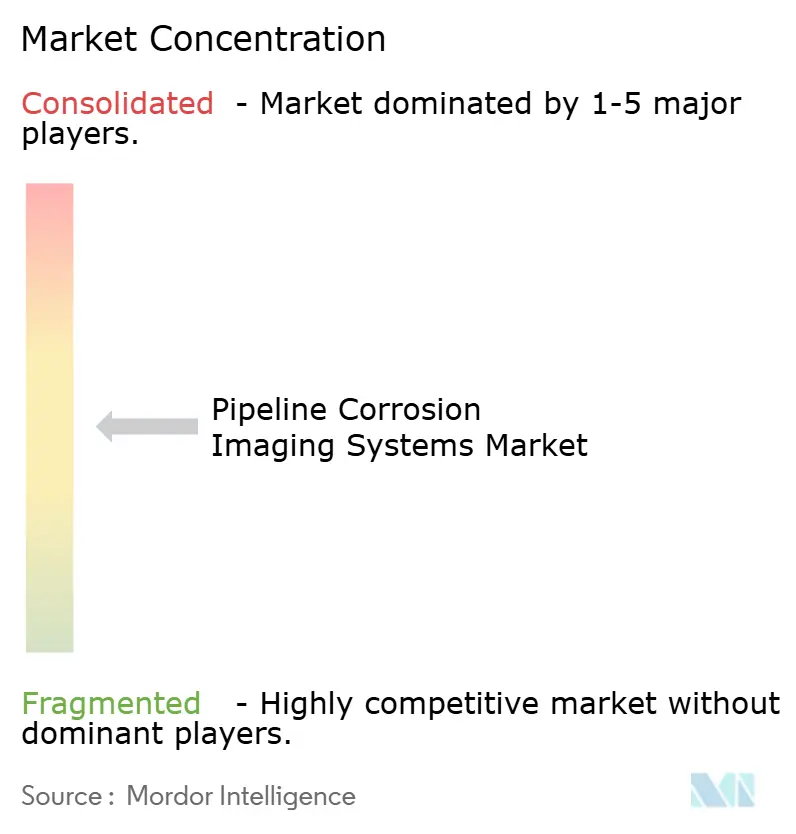
The pipeline corrosion imaging systems market is moderately consolidated in premium inspection services. ROSEN Swiss AG and NDT Global GmbH lead high-resolution in-line inspection through proprietary sensors, global tool fleets, and data analysis capabilities. MISTRAS Group, Quest Integrity Group, Intero Integrity Services, and INGU Solutions compete through regional coverage, mobilization speed, and data management services. Larger providers combine magnetic flux leakage, ultrasonic testing, and electromagnetic acoustic transducer methods, while specialists focus on difficult-to-pig lines, acoustic emission monitoring, and robotic crawlers. Smaller-diameter gas distribution pipelines in emerging markets remain less well served by large-bore fleets. Compact robotic platforms can inspect these pipelines without interrupting gas service.
ESAB Corporation completed its USD 1.45 billion acquisition of Eddyfi Technologies in June 2026, placing Eddyfi’s eddy current, remote-field, and phased-array sensors within ESAB’s industrial distribution network. NDT Global announced the addition of Entegra in July 2025, expanding its ultra-high-resolution magnetic flux leakage, caliper, mapping, and cathodic protection current mapping capabilities. The transaction also broadened joint ultrasonic testing and magnetic flux leakage work for gas operators. ROSEN expanded RoCorr MFL-A with MFL-A Plus in July 2026, using laser-mapped corrosion models to improve pinhole and axial-slotting classification. These moves show that sensor range and analysis capability influence competition, while certification under API RP 1163 and AMPP or NACE standards remains necessary for regulated work.
DDigital analysis has become more important in supplier selection for the pipeline corrosion imaging systems market. A Corrosion study reported low prediction errors in probabilistic digital twin frameworks using Bayesian machine learning. Suppliers use these systems to help operators prioritize excavations and maintenance, while price and mobilization speed remain relevant in routine lower-complexity corridors.
Pipeline Corrosion Imaging Systems Industry Leaders
ROSEN Swiss AG
NDT Global GmbH
T.D. Williamson, Inc.
Eddyfi Technologies Inc.
Intero Integrity Services B.V.
- *Disclaimer: Major Players sorted in no particular order

Recent Industry Developments
- August 2026: Ekoscan Integrity Group signed a definitive agreement to acquire Carestream Health’s U.S.-based NDT digital business, covering computed radiography and digital radiography product lines. The transaction is expected to close in Q4 2026 and expands EIG’s portfolio across pipeline and industrial inspection.
- July 2026: MISTRAS Group launched AEScout, a rapid-deployment acoustic emission monitoring solution that identifies active corrosion and fatigue damage without a pipeline shutdown.
- June 2026: ESAB Corporation completed the acquisition of Eddyfi Technologies for USD 1.45 billion (CAD 2 billion). The transaction combines Eddyfi’s eddy current, phased-array ultrasonic, and remote monitoring tools with ESAB’s industrial distribution network.
- April 2026: Enbridge Inc. received Canadian federal approval for the CAD 4 billion (USD 2.92 billion) Sunrise Expansion Program. Construction began in July 2026, and the project is expected to enter service in late 2028.


Global Pipeline Corrosion Imaging Systems Market Report Scope
The Pipeline Corrosion Imaging Systems Market refers to the global industry focused on imaging and inspection technologies used to detect, monitor, assess, and manage corrosion, cracks, wall-thickness loss, and structural defects in oil and gas, water, chemical, and industrial pipelines.
The Pipeline Corrosion Imaging Systems Market Report is Segmented by Technology (Magnetic Flux Leakage, Ultrasonic Testing, Electromagnetic Acoustic Transducer, Eddy Current and Remote-Field Electromagnetic Testing, Guided-Wave Ultrasonic Testing, Optical and Laser Imaging, Digital Radiography, Acoustic Emission Imaging, and Other Technologies), by System Architecture (Free-Swimming In-Line Inspection Systems, Tethered and Wireline Inspection Systems, Robotic Crawler Systems, Fixed Sensor and Online Monitoring Systems, and Handheld and Semi-Automated Scanning Systems), by Deployment Environment (Onshore Pipelines and Offshore and Subsea Pipelines), by End-User (Oil and Gas Pipeline Operators, Water and Wastewater Utilities, Chemical and Petrochemical Operators, Power Generation Companies, Mining Companies, Hydrogen Infrastructure Developers, Carbon Capture and Storage Operators, and Other End-Users), and by Geography (North America, South America, Europe, Asia-Pacific, and Middle East and Africa). The Market Forecasts are Provided in Terms of Value (USD).
| Magnetic Flux Leakage |
| Ultrasonic Testing |
| Electromagnetic Acoustic Transducer |
| Eddy Current and Remote-Field Electromagnetic Testing |
| Guided-Wave Ultrasonic Testing |
| Optical and Laser Imaging |
| Digital Radiography |
| Acoustic Emission Imaging |
| Other Technologies |
| Free-Swimming In-Line Inspection Systems |
| Tethered and Wireline Inspection Systems |
| Robotic Crawler Systems |
| Fixed Sensor and Online Monitoring Systems |
| Handheld and Semi-Automated Scanning Systems |
| Onshore Pipelines |
| Offshore and Subsea Pipelines |
| Oil and Gas Pipeline Operators |
| Water and Wastewater Utilities |
| Chemical and Petrochemical Operators |
| Power Generation Companies |
| Mining Companies |
| Hydrogen Infrastructure Developers |
| Carbon Capture and Storage Operators |
| Other End-Users |
| North America | United States | |
| Canada | ||
| Mexico | ||
| South America | Brazil | |
| Argentina | ||
| Rest of South America | ||
| Europe | Germany | |
| United Kingdom | ||
| France | ||
| Italy | ||
| Spain | ||
| Rest of Europe | ||
| Asia-Pacific | China | |
| Japan | ||
| India | ||
| South Korea | ||
| ASEAN | ||
| Rest of Asia-Pacific | ||
| Middle East and Africa | Middle East | Saudi Arabia |
| United Arab Emirates | ||
| Turkey | ||
| Rest of the Middle East | ||
| Africa | South Africa | |
| Nigeria | ||
| Rest of Africa | ||
| By Technology | Magnetic Flux Leakage | ||
| Ultrasonic Testing | |||
| Electromagnetic Acoustic Transducer | |||
| Eddy Current and Remote-Field Electromagnetic Testing | |||
| Guided-Wave Ultrasonic Testing | |||
| Optical and Laser Imaging | |||
| Digital Radiography | |||
| Acoustic Emission Imaging | |||
| Other Technologies | |||
| By System Architecture | Free-Swimming In-Line Inspection Systems | ||
| Tethered and Wireline Inspection Systems | |||
| Robotic Crawler Systems | |||
| Fixed Sensor and Online Monitoring Systems | |||
| Handheld and Semi-Automated Scanning Systems | |||
| By Deployment Environment | Onshore Pipelines | ||
| Offshore and Subsea Pipelines | |||
| By End-User | Oil and Gas Pipeline Operators | ||
| Water and Wastewater Utilities | |||
| Chemical and Petrochemical Operators | |||
| Power Generation Companies | |||
| Mining Companies | |||
| Hydrogen Infrastructure Developers | |||
| Carbon Capture and Storage Operators | |||
| Other End-Users | |||
| By Geography | North America | United States | |
| Canada | |||
| Mexico | |||
| South America | Brazil | ||
| Argentina | |||
| Rest of South America | |||
| Europe | Germany | ||
| United Kingdom | |||
| France | |||
| Italy | |||
| Spain | |||
| Rest of Europe | |||
| Asia-Pacific | China | ||
| Japan | |||
| India | |||
| South Korea | |||
| ASEAN | |||
| Rest of Asia-Pacific | |||
| Middle East and Africa | Middle East | Saudi Arabia | |
| United Arab Emirates | |||
| Turkey | |||
| Rest of the Middle East | |||
| Africa | South Africa | ||
| Nigeria | |||
| Rest of Africa | |||


Key Questions Answered in the Report
What is the pipeline corrosion imaging systems market size?
The pipeline corrosion imaging systems market size is USD 1.29 billion in 2026 and is projected to reach USD 1.79 billion by 2031 at a CAGR of 6.82%. Demand is supported by inspection requirements for aging networks and newly commissioned pipelines. Operators increasingly add monitoring between periodic in-line inspection runs because multi-year assessment gaps can leave the growth of corrosion and defects insufficiently understood. This combination of recurring integrity work, baseline runs for new lines, and data-led maintenance planning supports demand across established transmission systems, newer energy infrastructure, and projects requiring continuous corrosion data between planned inspection campaigns. These requirements support continued use of integrated imaging and monitoring services.
Which technology leads pipeline corrosion imaging systems?
Magnetic flux leakage led technology revenue with a 32.44% share in 2025. It supports corrosion and metal-loss inspection in both liquid and gas pipelines and has broad availability across inspection fleets.
Which system architecture is expanding the fastest?
Robotic crawler systems are projected to expand at a CAGR of 7.35% through 2031. They can inspect non-piggable sections with multiple diameters, tight bends, and restricted valves where free-swimming tools cannot operate.
Why are hydrogen pipelines creating demand for corrosion imaging?
Hydrogen service requires specialized qualification for embrittlement, hard spots, and crack detection. Developers are using early inspection programs while standards are being developed for dedicated and repurposed hydrogen transmission systems.
Which deployment environment has the largest revenue base?
Onshore pipelines accounted for 71.81% of revenue in 2025. Terrestrial networks have greater installed length, more established inspection requirements, and more accessible logistics than offshore pipeline systems.
Which region is projected to expand the fastest?
Asia-Pacific is projected to expand at a CAGR of 7.57% through 2031. City-gas projects in China, Indias authorization program, and liquefied natural gas infrastructure support new baseline inspection needs.
Page last updated on:





