
Pile Driver Market Size and Share
Market Overview
| Study Period | 2020 - 2032 |
|---|---|
| Market Size (2027) | USD 2.08 Billion |
| Market Size (2032) | USD 2.57 Billion |
| Growth Rate (2027 - 2032) | 4.31 % |
| Fastest Growing Market | Middle East and Africa |
| Largest Market | Asia-Pacific |
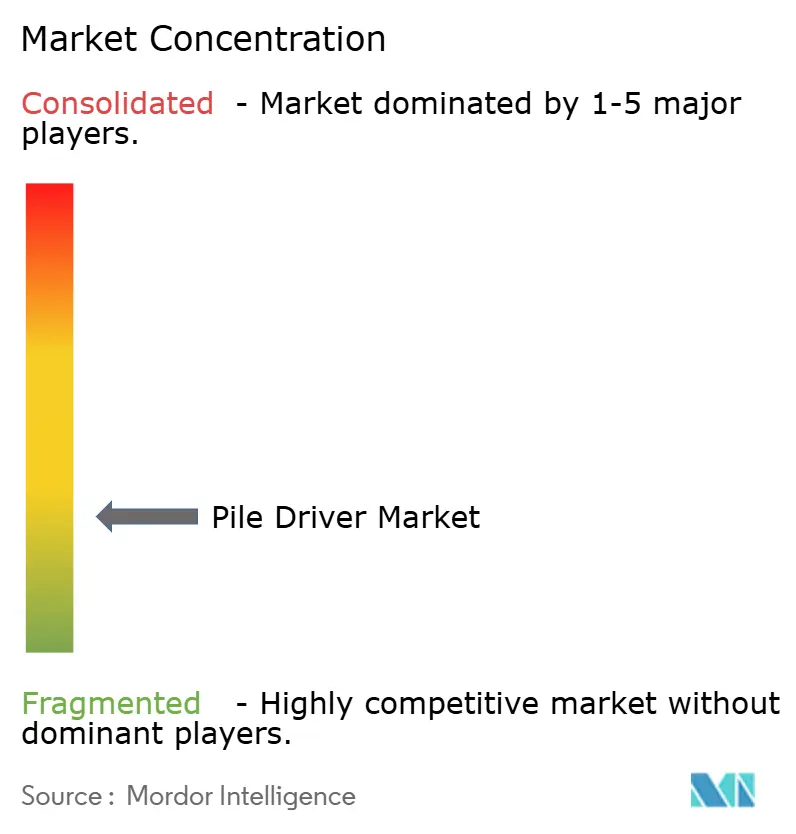
| Market Concentration | Low |
Major Players *Disclaimer: Major Players sorted in no particular order Image © Mordor Intelligence. Reuse requires attribution under CC BY 4.0. | |
Pile Driver Market Analysis by Mordor Intelligence
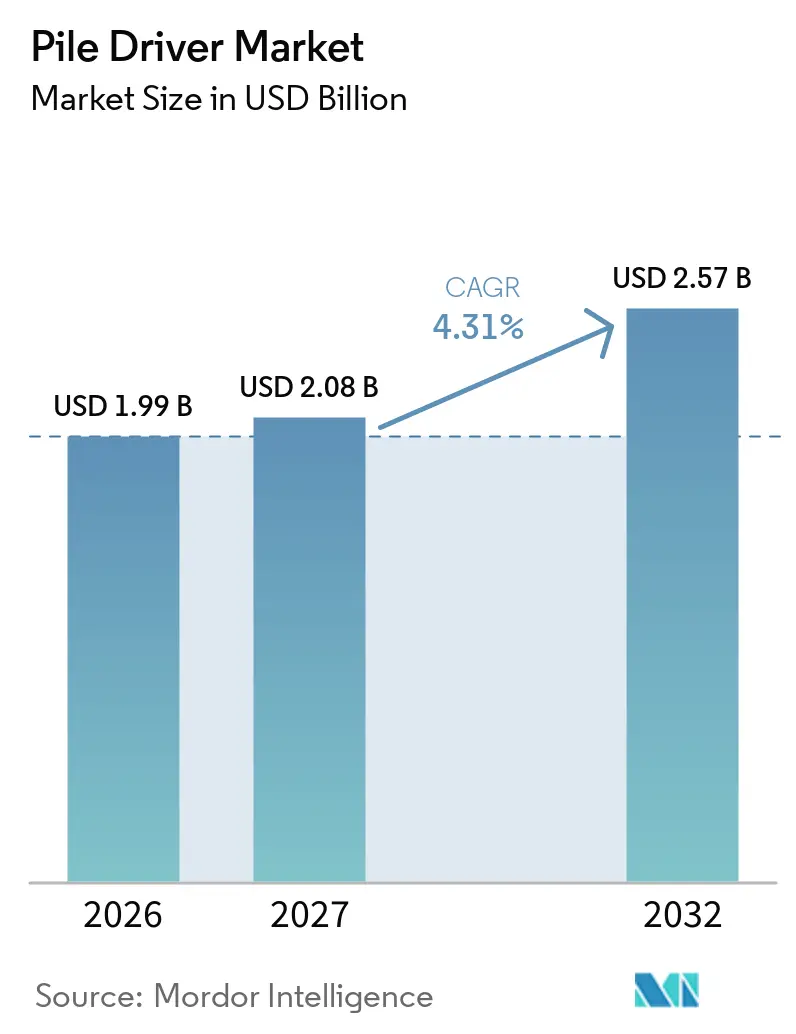
The pile driver market size was valued at USD 1.99 billion in 2026 and is expected to grow from USD 2.08 billion in 2027 to USD 2.57 billion by 2032, at a CAGR of 4.31% during 2027-2032. The pile driver market is supported by long-running bridge renewal, rail construction, port expansion, and urban development programs that require dependable deep foundations. These projects create demand for hydraulic hammers, vibratory equipment, press-in machines, and crawler-mounted rigs across both replacement work and new construction, since equipment choices vary with soil conditions, pile design, available access, and operating-hour constraints. Procurement is also shifting toward machines that can operate near occupied buildings, meet tighter emissions rules, and document installation performance, giving contractors a stronger reason to consider disruption, service support, and reporting requirements before choosing a platform. Offshore wind, marine works, and solar installations add specialized opportunities, although their order patterns are more project-based than the broad infrastructure base. Suppliers are responding through electric and hybrid equipment, digital monitoring, versatile carrier platforms, and lower-noise installation systems.
Key Report Takeaways
- By product type, impact hammers held a 42.18% share in 2026, while press-in piling machines are projected to grow at a 5.97% CAGR through 2032.
- By mounting type, crawler-mounted dedicated piling rigs held a 46.37% share in 2026, while excavator-mounted systems are projected to grow at a 5.12% CAGR through 2032.
- By pile type, steel piles held a 58.42% share in 2026, while composite and other piles are projected to grow at a 5.36% CAGR through 2032.
- By power source, diesel-hydraulic equipment held a 71.26% share in 2026, while electric and hybrid equipment is projected to grow at a 9.73% CAGR through 2032.
- By application, infrastructure held a 37.42% share in 2026, while offshore wind and marine/port works are projected to grow at a 6.83% CAGR through 2032.
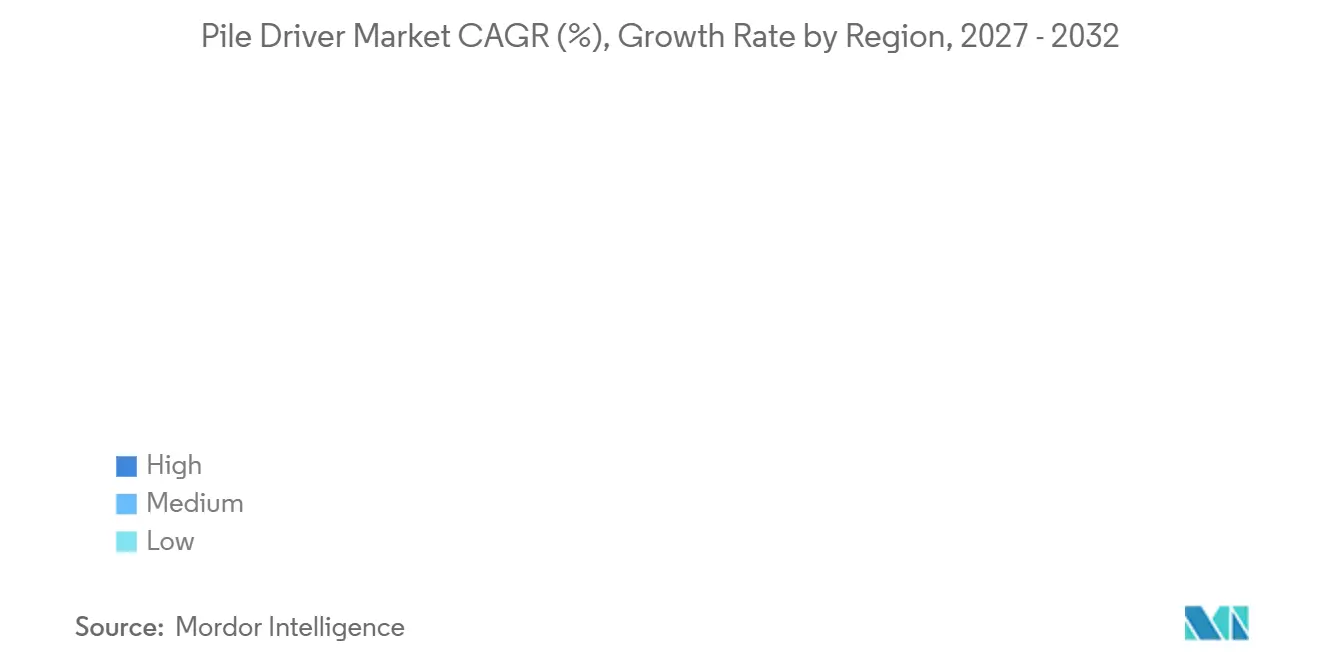
- By geography, Asia-Pacific held a 42.37% share in 2026, while the Middle East and Africa is projected to grow at a 5.26% CAGR through 2032.
Note: Market numbers in this report are based on Mordor Intelligence's proprietary estimation framework, which combines nine months of actuals with Q4 projections for base year 2026.
Market Trends and Insights
Drivers Impact Analysis of Pile Driver Market*
| Driver | (~) % Impact on CAGR Forecast | Geographic Relevance | Impact Timeline |
|---|---|---|---|
| Infrastructure Renewal and Foundation Investment | +1.4% | Global | Medium term (2–4 years) |
| Offshore Wind and Marine Foundation Expansion | +1.0% | Europe, Asia-Pacific, North America | Long term (≥ 4 years) |
| Electrification of Piling Equipment Fleets | +0.7% | Europe, North America | Medium term (2–4 years) |
| Solar Farm and Distributed Energy Foundation Demand | +0.5% | North America, Asia-Pacific, Middle East and Africa | Medium term (2–4 years) |
| Automation and Digital Installation Monitoring | +0.4% | Global | Short term (≤ 2 years) |
| Urban Noise and Vibration Compliance Requirements | +0.3% | Europe, Urban Asia-Pacific | Short term (≤ 2 years) |
| Source: Mordor Intelligence | |||
Infrastructure Renewal and Foundation Investment
Aging bridges in North America and Europe are entering replacement cycles, during which driven piles remain a familiar foundation option for highway and rail structures. The pile driver market benefits because replacement projects often require equipment capable of working around existing pile layouts, active traffic, utility services, nearby buildings, limited working space, and fixed construction schedules. Those site limits favor controlled installation methods, particularly press-in systems and lower-disturbance hydraulic equipment, rather than unrestricted impact driving. India’s National Infrastructure Pipeline adds demand for roads, railways, urban development, and energy assets, broadening the customer base for mid-range machines and creating work across both dense urban locations and major transport corridors. The pile driver market therefore retains a steady infrastructure base even when energy project schedules move slowly, or project permissions take longer than expected. That stability matters to fleet owners because broad civil work can help maintain equipment use between large, specialized assignments.
Offshore Wind and Marine Foundation Expansion
Offshore wind creates a separate equipment requirement because large turbine foundations need powerful installation systems that are not commonly used on ordinary civil works. Marine and port projects also require reliable performance in corrosion-prone environments, challenging ground conditions, and tight construction windows, so buyers place particular value on equipment reliability, experienced service teams, and clear operating procedures. These requirements support demand for high-energy hydraulic hammers, vessel-supported installation equipment, monitoring systems, and mitigation measures that reduce underwater noise. The pile driver market gains from these projects, but suppliers must also plan for concentrated demand because a small number of large campaigns can absorb substantial equipment capacity within short periods. Suppliers with offshore experience, equipment availability, and responsive technical support are better placed to serve these tightly sequenced campaigns.
Electrification of Piling Equipment Fleets
Electric and hybrid systems are becoming more relevant as contractors respond to non-road equipment emissions requirements and zero-emission site conditions. Fleet owners need machines that preserve useful output while reducing local emissions, noise, and reliance on large external power connections, particularly when a project sits near homes, schools, operating facilities, or public transport routes. BAUER presented the eRG 21 T hybrid in 2025 with a diesel engine and an electric motor, managed according to operating demand, positioning the machine for difficult piling tasks while reducing emissions in suitable operating modes[1]. The pile driver market is likely to see fleet replacement decisions increasingly include electric or hybrid options where project rules, site access, and operating hours justify the investment. The change will be gradual because contractors must match powertrain selection to actual working conditions rather than simply replace established equipment.
Solar Farm and Distributed Energy Foundation Demand
Utility-scale solar projects require large volumes of accurately installed steel piles across wide and often uneven sites. This supports demand for dedicated pile drivers that can maintain depth, alignment, and spacing across repetitive foundation layouts. Remote controls and machine guidance help contractors reduce manual positioning and manage labor needs during fast-moving installation programs. The pile driver market also benefits from equipment designed for remote sites, where crews need productive operation without relying on complex site arrangements. These requirements are creating a distinct equipment category for solar foundations, with procurement patterns that differ from conventional building and transport projects.
Restraints Impact Analysis of Pile Driver Market*
| Restraint | (~) % Impact on CAGR Forecast | Geographic Relevance | Impact Timeline |
|---|---|---|---|
| Capital Cost and Specialist Maintenance | -0.8% | Global | Short term (≤ 2 years) |
| Noise, Vibration, and Marine Ecological Restrictions | -0.5% | Europe, Coastal Asia-Pacific | Medium term (2–4 years) |
| Geotechnical Variability and Pile Damage Risk | -0.4% | Global, Emerging Markets | Short term (≤ 2 years) |
| Lead Times for Hydraulic and High-Strength Components | -0.3% | Global | Short term (≤ 2 years) |
| Source: Mordor Intelligence | |||
Capital Cost and Specialist Maintenance
Large crawler rigs and offshore-class hydraulic hammers require substantial capital commitments, which limit ownership to specialist contractors and established rental fleets. The maintenance burden is also high because hydraulic calibration, impact components, and electronic monitoring systems need trained technicians and a dependable parts supply, making after-sales coverage an important part of the equipment decision rather than a separate concern. Smaller operators may rely on rental equipment, particularly when project volume is temporary, or financing does not support a dedicated fleet. This creates different purchasing conditions between established Western contractors and project-led markets in the Middle East and Africa. Equipment-as-a-Service arrangements can ease upfront costs, but contractual models for foundation equipment remain less developed outside mature rental markets. Contractors consequently weigh certainty of utilization, local repair capability, and the residual value of a machine before committing to a major acquisition.
Noise, Vibration, and Marine Ecological Restrictions
Noise, vibration, and marine ecological conditions can limit the use of conventional impact hammers in urban, coastal, and offshore sites. Contractors may need acoustic monitoring, noise attenuation, or different installation methods, which adds preparation work and can affect installation schedules, especially where construction windows are narrow or site approvals include detailed environmental conditions. These factors encourage contractors to favor suppliers with responsive service, broad attachment options, and field-proven installation data. They also make early investigation of ground conditions and clear coordination between designers, contractors, and equipment teams more important before mobilization.
*Our forecasts treat driver/restraint impacts as directional, not additive. The impact forecasts reflect baseline growth, mix effects, and variable interactions.
Pile Driver Market Segment Analysis
By Product Type:
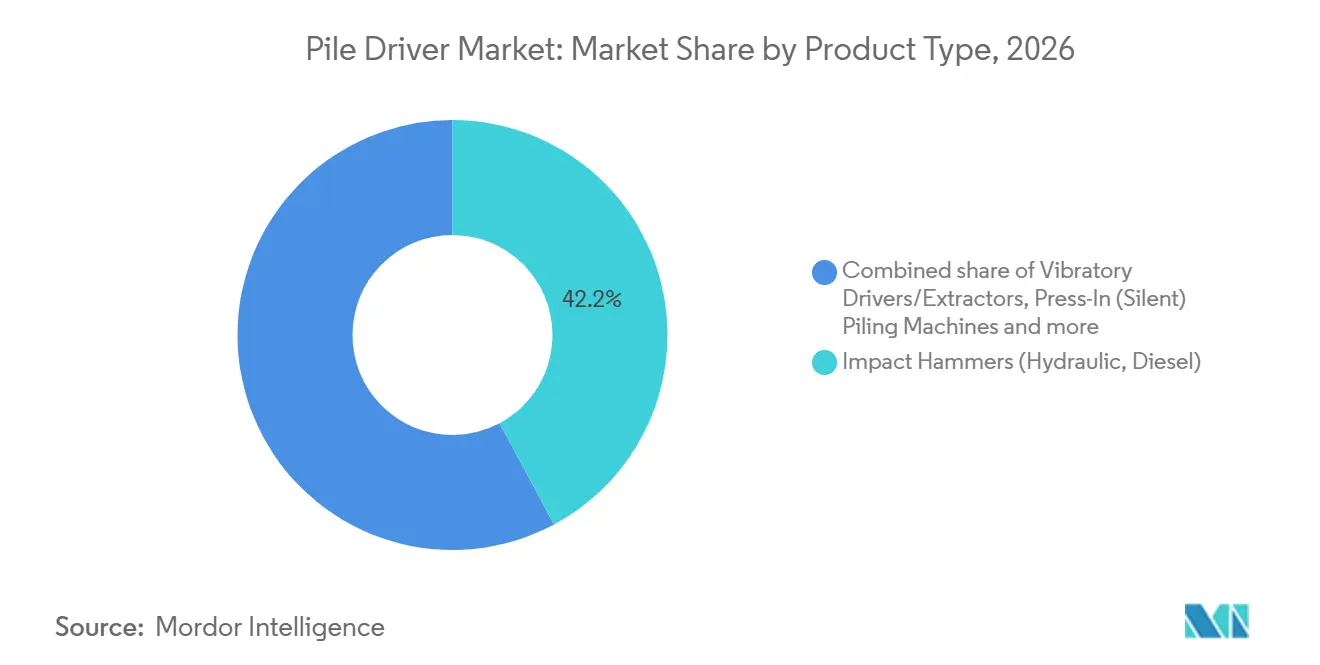
Press-In Piling Gains Ground in Noise-Sensitive ApplicationsImpact hammers held a 42.18% share of the pile driver market in 2026 because they serve applications ranging from bridge foundations to demanding marine installations. Hydraulic and diesel impact hammers remain important where high energy transfer is needed for large sections or difficult ground, and contractors continue to rely on them where the priority is dependable penetration rather than minimum site disturbance. Vibratory drivers and extractors also remain widely used for sheet piles, temporary earth retention, extraction work, and constrained urban construction, because they offer a practical option when projects need both installation capability and later removal of temporary works. Press-in piling machines are forecast to grow at a 5.97% CAGR through 2032 as projects place greater value on low-vibration work around occupied structures. The pile driver industry is therefore moving toward a broader mix of methods rather than a single replacement of impact equipment.
GIKEN marked 50 years of SILENT PILER technology in 2025, and its installed base shows how press-in methods have expanded beyond their original markets[2]. The company’s SX Series combines press-in equipment with battery power, cloud-connected capabilities, and assisted-operating features for jobs where site conditions are restrictive[3]. This approach is relevant where contractors need to work close to existing assets without creating the access, noise, and emissions issues associated with conventional equipment. These features respond to contractor concerns about skilled operator availability, site disturbance, and documentation of installation activity, while helping supervisors compare planned work with completed installation records and manage the equipment more consistently across a changing sequence of sites. Sonic and drop hammer equipment still serves casing installation and cost-sensitive applications, particularly where project conditions do not require advanced monitoring or low-noise performance.

By Mounting Type:
Crawler Rigs Anchor Demand While Excavator Attachments ExpandCrawler-mounted dedicated piling rigs held a 46.37% share of the pile driver market in 2026 because large foundations require a stable, purpose-built platform. They are used for bridge piers, port structures, deep foundations, and other work where mobility on uneven ground and high operating capacity matter, giving contractors a dependable base when pile geometry, loads, and working heights are beyond the range of smaller attachments. Liebherr’s LRB 19 illustrates the emphasis on adaptable equipment, as its hydraulic quick-connection lets operators switch between piling, vibratory, and drilling tools without leaving the cab[4]. Crane-suspended systems remain suited to marine foundation work where the vessel crane handles the lifting task. Other leader-guided arrangements address jobs where a dedicated crawler is excessive, but basic attachment systems do not offer sufficient accuracy.
Excavator-mounted systems are forecast to grow at a 5.12% CAGR through 2032 as contractors seek compact piling capability on restricted-access sites. These systems let contractors adapt existing plant for lighter press-in and vibratory work, reducing the need to acquire a separate rig for every assignment. Their growing use reflects demand for flexibility in urban renovation, small civil works, and projects with limited mobilization budgets, where bringing a large dedicated rig to site can be difficult to justify for a shorter or more contained assignment. The pile driver industry still depends on crawler rigs for high-energy work, because attachment systems cannot replace their stability or duty range on every site. Mounting choices will remain closely tied to pile dimensions, ground conditions, available access, project duration, and the contractor’s existing fleet, which means the right configuration can differ sharply between a major transport project, a compact urban site, and a short-duration civil assignment.
By Pile Type:
Steel Piles Dominate While Composite Options EmergeSteel piles held 58.42% of the pile driver market share in 2026 because sheet, H-pile, and tubular sections support many marine, transport, commercial, and industrial uses. Their structural capacity and suitability for coastal work make them particularly relevant for port walls, heavy foundations, and offshore installations, where designers must balance installation needs with long-term exposure and the expected service life of the asset. Sheet piles serve temporary and permanent retention needs, while H-piles and tubular sections are used for load-bearing work. Concrete piles continue to support routine building foundations in Asian markets where precast supply is well established. Timber remains a smaller option for permitted waterfront uses, although longer-life requirements limit its role in many projects.
Composite and other pile types are forecast to grow at a 5.36% CAGR through 2032, supported by demand in chemically aggressive coastal environments. Fiber-reinforced polymer and recycled plastic options can reduce corrosion-related maintenance concerns where conventional materials face demanding exposure. Coastal bridge replacement work provides a potential route for adoption because owners consider inspection needs over longer asset lives, particularly where saltwater exposure can increase the maintenance burden associated with conventional materials. Design and installation requirements for composite piles are still developing, which makes qualification practices an important part of adoption decisions. Material choice in the pile driver market depends on structural loading, expected exposure, project specifications, available supply, and the contractor’s experience with each pile form, so equipment providers must be able to support several pile geometries and installation approaches instead of relying on a uniform customer requirement.
By Power Source:
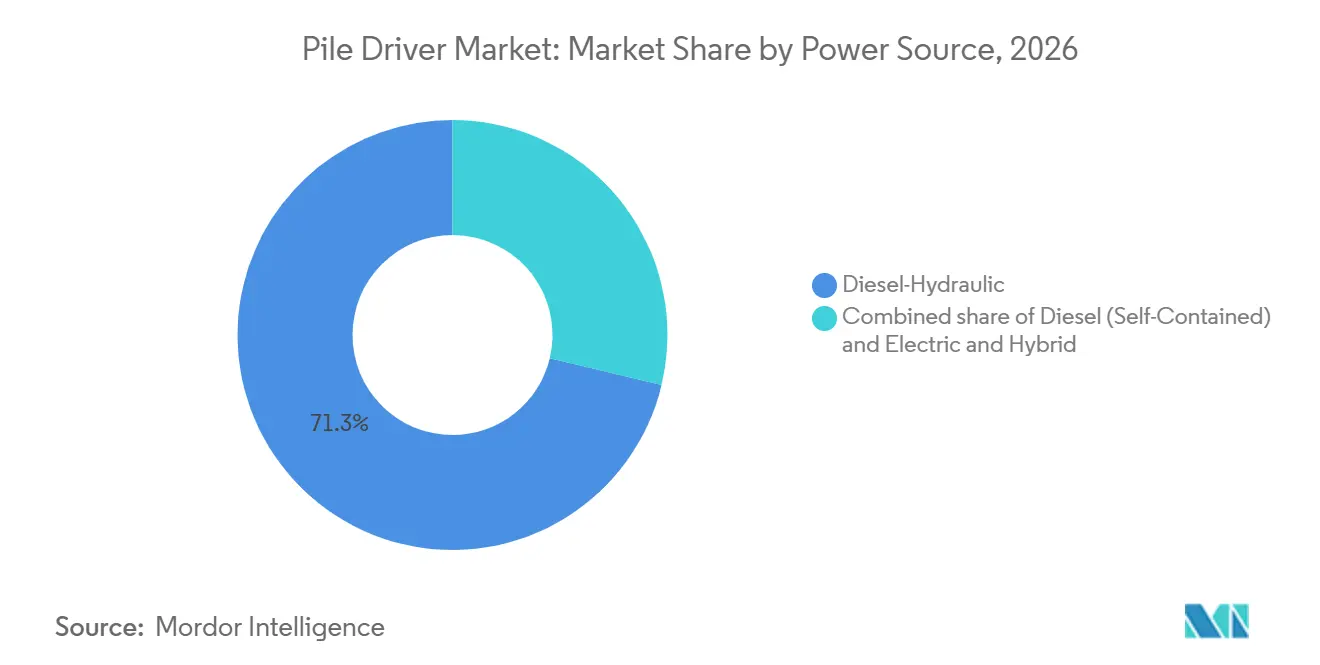
Diesel-Hydraulic Systems Lead While Electric and Hybrid Narrow the GapDiesel-hydraulic equipment held a 71.26% share of the pile driver market in 2026 because pressurized systems meet the demands of hard ground and large-diameter pile installation. Self-contained diesel equipment remains important for diesel impact hammers, engine-powered vibratory units, and sites without practical external power access, including remote locations where grid capacity, charging time, or temporary supply arrangements are not sufficient for the work program. Hydraulic circuits linked to diesel prime movers have long been suited to high-force applications and will remain central to the installed fleet. Contractors also value their established service base and familiarity across a wide range of jobs. The pile driver market will retain this foundation while powertrain choices become more varied.
Electric and hybrid equipment is projected to grow at a 9.73% CAGR through 2032 as emission rules and project requirements influence replacement planning. GIKEN has developed electric power units for its press-in machines, allowing zero on-site emissions where grid power is available. Hybrid designs provide another route because contractors can use conventional capacity when needed and electric operation when conditions favor it, helping fleet owners avoid choosing between a machine built solely for peak output and one designed only for lower-emission operating periods. BAUER’s hybrid equipment reflects this approach by combining conventional and electric power for different operating demands. The pace of change will depend on charging access, duty cycles, emission requirements, available service support, and the cost of replacing existing machines, with adoption likely to be strongest where contractors can use the equipment regularly under rules that reward quieter and lower-emission operation.
By Application:
Infrastructure Leads Demand While Offshore Wind Sets the Growth PaceInfrastructure held a 37.42% share of the pile driver market in 2026 because bridges, roads, and rail projects create the broadest base of foundation work. Mature economies need replacement structures, while developing economies continue to build core transport networks on varied ground conditions, so equipment providers serve both established contractors renewing assets and firms entering new infrastructure programs. Commercial and residential construction also uses large volumes of piles, especially where high-rise development requires dense foundation layouts. Industrial and energy projects contribute further demand, including facility maintenance, solar installations, and utility work. These applications provide contractors with varied workstreams and reduce dependence on any single project category, allowing equipment to move between transport, building, energy, and utility work where attachment compatibility and sufficient carrier capacity are available.
Offshore wind and marine/port works are projected to grow at a 6.83% CAGR through 2032, making them the fastest-growing application segment. Large marine foundations require specialized hammers, vessel coordination, controlled installation, and careful planning around environmental conditions, making the equipment decision closely connected to marine logistics, foundation design, and the sequencing of the wider offshore project. Port works have similar needs for durable structures, coastal access, and reliable installation performance. The pile driver market benefits from the value of these contracts, although schedules can be affected by permitting, weather, vessel availability, and marine protection requirements. Flood defense, levee reinforcement, and utility infrastructure provide additional demand for low-disturbance foundation methods across civil works.
Geography Analysis
Asia-Pacific held a 42.37% share of the pile driver market in 2026 and remains the largest regional demand center. China’s domestic base is supported by urban infrastructure maintenance and rail construction, while India’s infrastructure pipeline contributes demand for mid-range hydraulic piling rigs, creating a broad regional base that includes both high-volume civil work and more specialized foundation assignments. Southeast Asian customers are moving toward higher-specification foundation methods as urban infrastructure and coastal development grow. The press-in method has been adopted on major Indonesian projects, including the Jakarta MRT and the Jakarta Sewerage Development Project, showing the adoption of low-disturbance equipment in Indonesia. Japan remains a technically advanced market for urban seismic work, flood protection, and precision press-in applications.
Europe and North America remain established regions where technical requirements, equipment reliability, and compliance standards shape purchasing decisions. European contractors need high-energy equipment for offshore and marine works, along with lower-noise options for dense urban projects, which creates a market where fleet versatility and documented compliance can be as important as raw driving capacity. North American demand is tied to surface transportation work, deep foundations, and marine construction needs. Liebherr delivered an LRB 19 to Veit & Company in 2026, an example of continued demand for versatile piling and drilling equipment in the United States. Tariff uncertainty surrounding Chinese equipment can make procurement decisions less predictable and can support established suppliers in the premium segment.
Middle East and Africa are forecast to grow at a 5.26% CAGR through 2032, supported by civic, transport, energy, port, and renewable projects. Saudi Arabia and the UAE provide demand across soil conditions that range from reclaimed coastal land to desert sedimentary ground, increasing the value of suppliers that can support different pile designs, site access conditions, and local service requirements. South America grows from Brazilian highway and logistics programs, while African projects add needs in ports, road corridors, and renewable energy installations. Distance from major manufacturing centers increases the role of international rental providers and regional distributors in Middle East and Africa. The pile driver market in these regions is shaped by logistics, customs costs, project duration, local maintenance capacity, and the practicality of equipment ownership for finite assignments, which can make rental arrangements and distributor support more attractive than long-term direct ownership for certain contractors.
Competitive Landscape
The pile driver market has a fragmented competitive structure because leading suppliers do not have pricing authority across the complete product range or all regions. BAUER Aktiengesellschaft, Liebherr-International AG, Junttan Oy, GIKEN LTD., IQIP Holding B.V., ABI Maschinenfabrik GmbH, and Menck GmbH compete through specialized equipment and technical capability. European suppliers retain strong positions in high-specification crawler rigs and large hydraulic hammer applications, where customers often value established engineering support, known performance records, and dependable access to specialized service personnel. IQIP remains active in offshore hammer systems, where planning, monitoring, and post-installation analysis are part of the customer offer.
Product strategy centers on electrification, installation data, automation, and machines that can accept multiple tools. BAUER’s eRG 21 T hybrid demonstrates the focus on lower-emission operation while maintaining capacity for demanding foundation work. Liebherr’s LRB 19 demonstrates the value of a quick-connection system that lets one carrier perform piling, vibratory, and drilling work. These moves matter because contractors increasingly assess total site disruption, operating flexibility, and machine utilization rather than hammer performance alone, especially when a project needs the same fleet to meet different foundation, access, environmental, and reporting requirements during its construction program.
SANY Heavy Industry and XCMG Construction Machinery are extending their piling and drilling portfolios into European and North American markets, increasing competition in the mid-tier. Established suppliers respond by emphasizing engineering support, digital monitoring, emissions performance, and equipment that can perform more than one task, seeking to reduce the operational compromises contractors might otherwise face when projects move between civil, marine, and urban work. Patent activity around quiet piling and battery-electric non-road systems reflects the importance of technical differentiation in markets with high compliance requirements. There is still room for lightweight modular press-in systems aimed at contractors facing access limits, varied soils, and limited capital budgets. Competition in the pile driver market will remain fragmented because customers choose equipment according to ground conditions, pile type, regional service coverage, environmental requirements, and the scale of each foundation program, leaving scope for specialized providers even where larger companies offer a broader collection of piling and drilling equipment.
Pile Driver Industry Leaders
-
BAUER Aktiengesellschaft
-
Liebherr-International AG
-
Junttan Oy
-
GIKEN LTD.
-
IQIP Holding B.V.
- *Disclaimer: Major Players sorted in no particular order
Pile Driver Market Companies Covered in this Report
- BAUER Aktiengesellschaft
- Liebherr-International AG
- Junttan Oy
- Trevi Finanziaria Industriale S.p.A.
- Casagrande S.p.A.
- IQIP Holding B.V.
- Dieseko Group B.V.
- American Piledriving Equipment, Inc.
- International Construction Equipment, Inc.
- GIKEN LTD.
- Vermeer Corporation
- SANY Heavy Industry Co., Ltd.
- XCMG Construction Machinery Co., Ltd.
- Hitachi Construction Machinery Co., Ltd.
- Nippon Sharyo, Ltd.
- ABI Maschinenfabrik GmbH
- Fayat Group
- Menck GmbH
- Sanimex Oy
- Sunward Intelligent Equipment Co., Ltd.
Recent Industry Developments in Pile Driver Market
- October 2026: Xpanner launched the X1 Piling R6, a fully automated, GNSS-guided pile driving system for utility-scale solar and battery energy storage sites, with a 45% faster cycle time than its previous generation.
- June 2026: HD Construction Equipment launched a 40-ton DEVELON pile driver and delivered the first two units to customers.
- March 2026: Liebherr delivered an LRB 19 piling and drilling rig to Veit & Company at CONEXPO-CON/AGG 2026.
- January 2026: Junttan unveiled the PM5 pile driving rig, the latest model in its Evolution Series, with a telescopic mast and optional remote-controlled setup.
Global Pile Driver Market Report Scope
The Pile Driver Market is segmented by Product Type, Mounting Type, Pile Type, Power Source, Application, and Geography. By Product Type, the market is segmented into Impact Hammers (Hydraulic, Diesel), Vibratory Drivers/Extractors, Press-In (Silent) Piling Machines, and Others (Sonic, Drop Hammers). By Mounting Type, the market is segmented into Crawler-Mounted (Dedicated Piling Rigs), Excavator-Mounted, Crane-Suspended, and Others. By Pile Type, the market is segmented into Steel Piles (Sheet, H-Pile, Tubular), Concrete Piles, Timber Piles, and Composite and Others. By Power Source, the market is segmented into Diesel-Hydraulic, Diesel (Self-Contained), and Electric and Hybrid. By Application, the market is segmented into Infrastructure (Bridges, Roads, Rail), Offshore Wind and Marine/Port Works, Commercial and Residential Construction, Industrial and Energy (Oil and Gas, Solar Farms), and Others. By Geography, the market is segmented into North America (United States, Canada, and Mexico), Europe (Germany, United Kingdom, France, Italy, Spain, Netherlands, Norway, Russia, and Rest of Europe), Asia-Pacific (China, India, Japan, South Korea, Australia, Indonesia, Vietnam, and Rest of Asia-Pacific), South America (Brazil, Argentina, Chile, Colombia, and Rest of South America), and Middle East and Africa (Saudi Arabia, United Arab Emirates, Qatar, Turkey, Israel, Egypt, South Africa, Nigeria, and Rest of Middle East and Africa). Market forecasts are provided in terms of Value (USD) and Volume (Units).
Segmentation Overview
| Impact Hammers (Hydraulic, Diesel) |
| Vibratory Drivers/Extractors |
| Press-In (Silent) Piling Machines |
| Others (Sonic, Drop Hammers) |
| Crawler-Mounted (Dedicated Piling Rigs) |
| Excavator-Mounted |
| Crane-Suspended |
| Others |
| Steel Piles (Sheet, H-Pile, Tubular) |
| Concrete Piles |
| Timber Piles |
| Composite and Others |
| Diesel-Hydraulic |
| Diesel (Self-Contained) |
| Electric and Hybrid |
| Infrastructure (Bridges, Roads, Rail) |
| Offshore Wind and Marine/Port Works |
| Commercial and Residential Construction |
| Industrial and Energy (Oil and Gas, Solar Farms) |
| Others |
| North America | United States |
| Canada | |
| Mexico | |
| Europe | Germany |
| United Kingdom | |
| France | |
| Italy | |
| Spain | |
| Netherlands | |
| Norway | |
| Russia | |
| Rest of Europe | |
| Asia-Pacific | China |
| India | |
| Japan | |
| South Korea | |
| Australia | |
| Indonesia | |
| Vietnam | |
| Rest of Asia-Pacific | |
| South America | Brazil |
| Argentina | |
| Chile | |
| Colombia | |
| Rest of South America | |
| Middle East and Africa | Saudi Arabia |
| United Arab Emirates | |
| Qatar | |
| Turkey | |
| Israel | |
| Egypt | |
| South Africa | |
| Nigeria | |
| Rest of Middle East and Africa |
| By Product Type | Impact Hammers (Hydraulic, Diesel) | |
| Vibratory Drivers/Extractors | ||
| Press-In (Silent) Piling Machines | ||
| Others (Sonic, Drop Hammers) | ||
| By Mounting Type | Crawler-Mounted (Dedicated Piling Rigs) | |
| Excavator-Mounted | ||
| Crane-Suspended | ||
| Others | ||
| By Pile Type | Steel Piles (Sheet, H-Pile, Tubular) | |
| Concrete Piles | ||
| Timber Piles | ||
| Composite and Others | ||
| By Power Source | Diesel-Hydraulic | |
| Diesel (Self-Contained) | ||
| Electric and Hybrid | ||
| By Application | Infrastructure (Bridges, Roads, Rail) | |
| Offshore Wind and Marine/Port Works | ||
| Commercial and Residential Construction | ||
| Industrial and Energy (Oil and Gas, Solar Farms) | ||
| Others | ||
| By Geography | North America | United States |
| Canada | ||
| Mexico | ||
| Europe | Germany | |
| United Kingdom | ||
| France | ||
| Italy | ||
| Spain | ||
| Netherlands | ||
| Norway | ||
| Russia | ||
| Rest of Europe | ||
| Asia-Pacific | China | |
| India | ||
| Japan | ||
| South Korea | ||
| Australia | ||
| Indonesia | ||
| Vietnam | ||
| Rest of Asia-Pacific | ||
| South America | Brazil | |
| Argentina | ||
| Chile | ||
| Colombia | ||
| Rest of South America | ||
| Middle East and Africa | Saudi Arabia | |
| United Arab Emirates | ||
| Qatar | ||
| Turkey | ||
| Israel | ||
| Egypt | ||
| South Africa | ||
| Nigeria | ||
| Rest of Middle East and Africa | ||
Key Questions Answered in the Report
What is the projected value of the pile driver market by 2032?
The pile driver market is projected to reach USD 2.57 billion by 2032, from USD 2.08 billion in 2027. The forecast reflects demand from infrastructure, marine, energy, and building foundation activity.
What is driving demand for pile driving equipment?
Bridge renewal, rail construction, port expansion, urban construction, solar projects, and marine foundations support equipment demand. Their equipment needs differ by pile design, site conditions, project duration, and emissions requirements. Contractors also weigh access, required installation control, available power, and the practical availability of trained maintenance support when selecting a machine.
Which product category is growing fastest?
Press-in piling machines are forecast to grow at a 5.97% CAGR through 2032 because they suit low-vibration work near existing structures. They are particularly relevant where access is restricted or adjacent buildings must remain protected.
Why are electric piling systems gaining attention?
Electric and hybrid equipment is projected to grow at a 9.73% CAGR through 2032 as contractors respond to emissions rules and zero-emission site requirements. Hybrid configurations offer a route where contractors still need conventional capacity for demanding work.