
Photocatalytic Coatings Market Size and Share
Market Overview
| Study Period | 2022 - 2032 |
|---|---|
| Market Size (2027) | USD 1.01 Billion |
| Market Size (2032) | USD 1.58 Billion |
| Growth Rate (2027 - 2032) | 9.41 % |
| Fastest Growing Market | Asia-Pacific |
| Largest Market | Asia-Pacific |
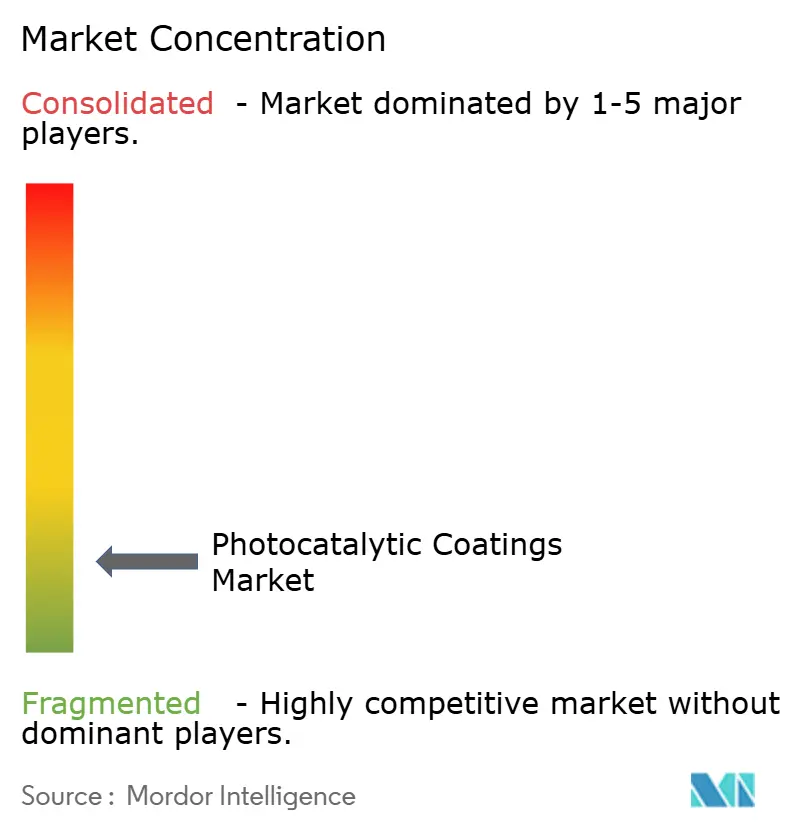
| Market Concentration | Low |
Major Players *Disclaimer: Major Players sorted in no particular order Image © Mordor Intelligence. Reuse requires attribution under CC BY 4.0. | |
Photocatalytic Coatings Market Analysis by Mordor Intelligence
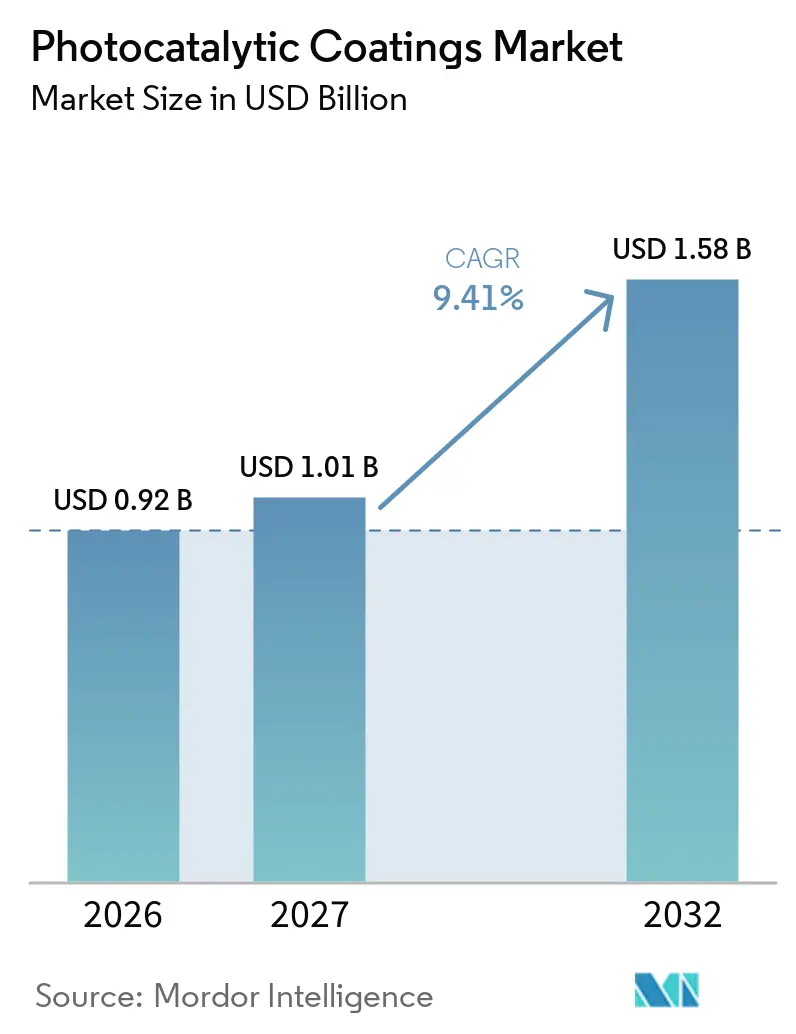
The Photocatalytic Coatings Market size was valued at USD 0.92 billion in 2026 and is estimated to grow from USD 1.01 billion in 2027 to USD 1.58 billion by 2032, at a CAGR of 9.41% during the forecast period (2027-2032). The photocatalytic coatings market is supported by use cases that extend beyond architectural glass, including self-cleaning facades, indoor air treatment, anti-soiling on solar panels, and surface hygiene. Demand increasingly depends on documented field performance, as project owners require evidence that a coating can retain functionality under operating conditions. Green-building procurement and air-quality requirements are making verified pollutant removal more relevant in material selection. Suppliers are responding through proprietary formulations, accredited testing, and application-specific evidence rather than competing solely on price. This creates opportunities for suppliers that can demonstrate long service life and reliable performance across different substrates.
Key Report Takeaways
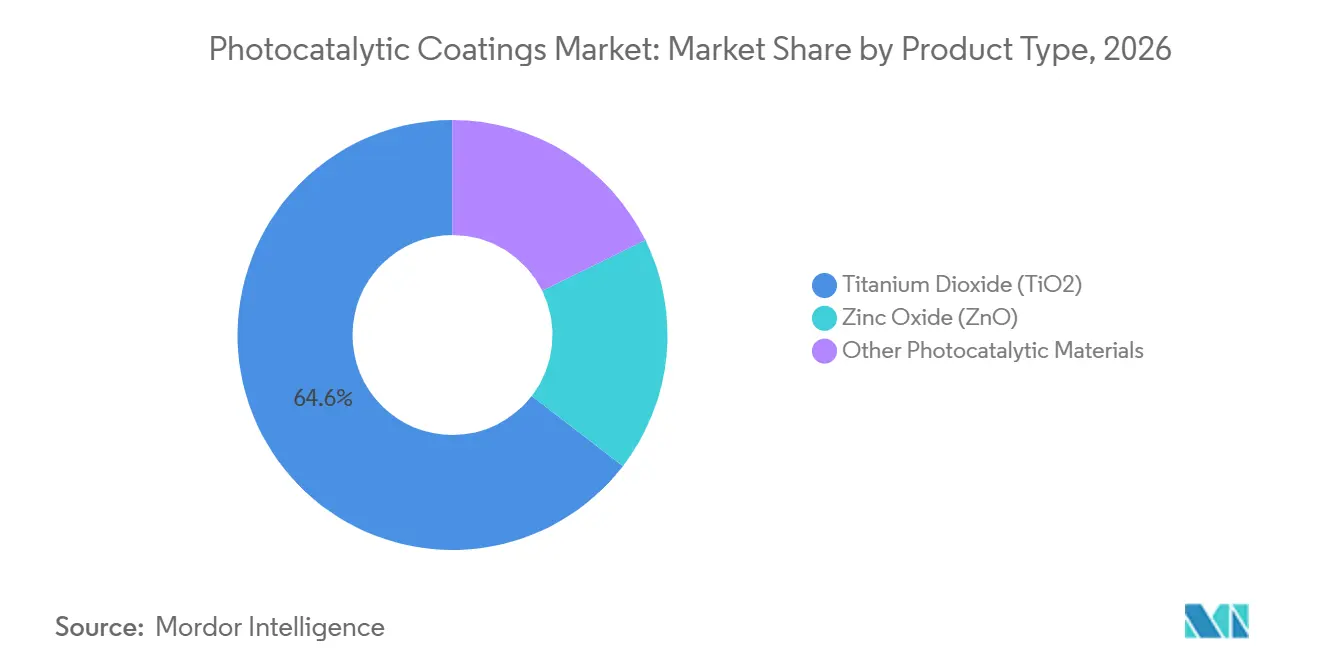
- By product type, Titanium Dioxide held 64.56% revenue share in 2026, while Zinc Oxide is forecast to grow at a 9.73% CAGR through 2032.
- By application, self-cleaning accounted for 41.32% of revenue in 2026, while air purification is forecast to grow at a 9.91% CAGR through 2032.
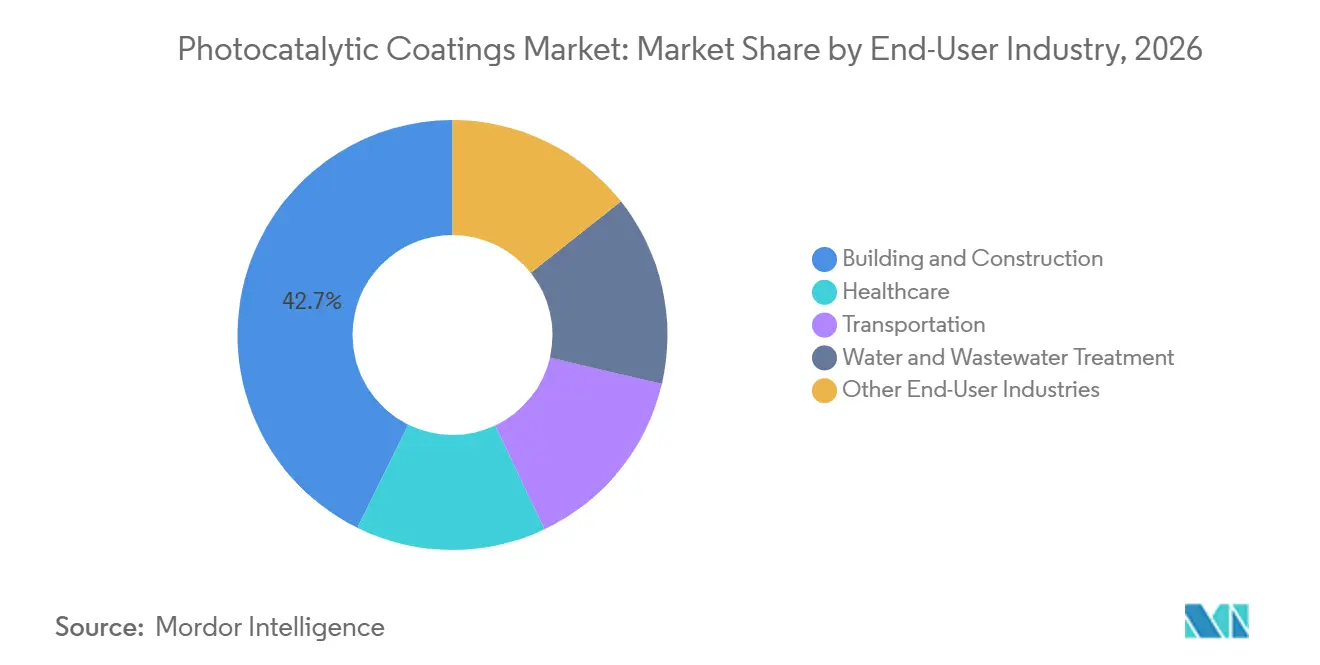
- By end-user industry, building and construction accounted for 42.71% of revenue in 2026, while healthcare is forecast to grow at a 10.22% CAGR through 2032.
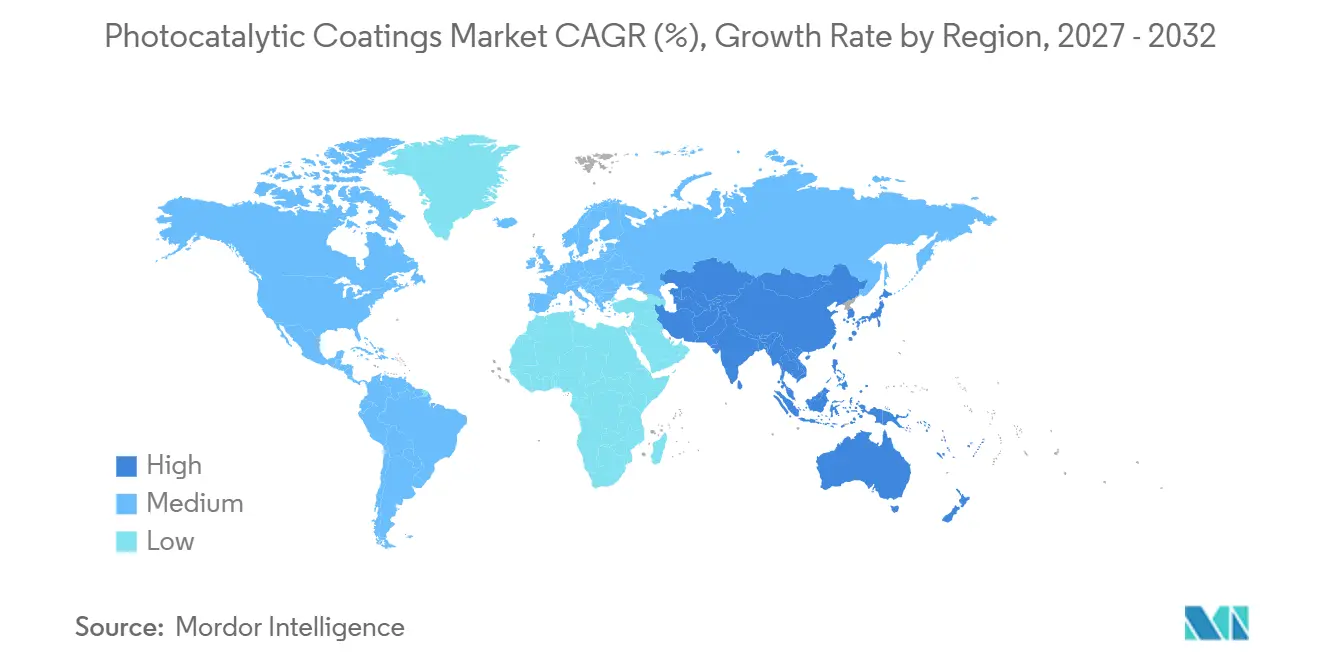
- By geography, Asia-Pacific accounted for 38.14% of revenue in 2026 and is forecast to grow at a 10.16% CAGR through 2032.
Note: Market numbers in this report are based on Mordor Intelligence's proprietary estimation framework, which combines nine months of actuals with Q4 projections for base year 2026.
Market Trends and Insights
Drivers Impact Analysis of Photocatalytic Coatings Market*
| Drivers | (~) % Impact on CAGR Forecast | Geographic Relevance | Impact Timeline |
|---|---|---|---|
| Stricter Green-Building and Air-Quality Procurement Standards | +2.5% | Global, strongest in the EU, Singapore, and China | Medium term (2-4 years) |
| Low-Maintenance Demand for Hard-To-Access Building Envelopes | +1.8% | North America and the EU | Short term (≤ 2 years) |
| Photocatalytic Surfaces in Urban Pollution-Mitigation Projects | +1.5% | Asia-Pacific, with spillover to the Middle East and Africa | Medium term (2-4 years) |
| Visible-Light Activation for Indoor Air and Hygiene Applications | +1.6% | Global, led by Asia-Pacific and North America | Medium term (2-4 years) |
| Photocatalytic Functionality in Solar and Agrivoltaic Glass | +1.0% | APAC and North America, early adoption in MENA | Long term (≥ 4 years) |
| Source: Mordor Intelligence | |||
Stricter Green-Building and Air-Quality Procurement Standards
Green-building frameworks are linking material selection to documented environmental performance, increasing the relevance of the photocatalytic coatings market for regulated projects. Leadership in Energy and Environmental Design (LEED) and BREEAM programs use environmental documentation for materials assessment, requiring suppliers to provide evidence to support project specifications. Singapore extended sustainability requirements to existing buildings through its 2025 amendment, broadening attention from new construction to the existing built asset base[1]. The ISO 10678 revision provides a current benchmark for evaluating self-cleaning surfaces under ultraviolet irradiation, and its development involved recognized European and Japanese standards bodies. Producers that can provide accredited test results are better positioned to meet procurement requirements. This favors suppliers with technical documentation that translates laboratory results into a clear case for material selection.
Low-Maintenance Demand for Hard-to-Access Building Envelopes
High-rise curtain walls, bridge surfaces, tunnel linings, and stadium canopies require costly access arrangements for cleaning and recoating. The photocatalytic coatings market benefits when owners compare coating costs with avoided access-platform and specialist labor expenses over the asset life. Coatings that retain activity across metallic and other substrates give engineers a broader basis for selecting a treatment than glass-only studies provide. The strongest commercial case arises when extending a cleaning interval reduces the need for repeated rope-access or scaffold work. Western Europe, Japan, and South Korea have high maintenance costs for complex building envelopes, which supports this application. Long-cycle field evidence remains important because owners assess the maintenance benefit over multiple years rather than at project handover.
Photocatalytic Surfaces in Urban Pollution-Mitigation Projects
Municipal air-quality programs are considering passive surface technologies alongside vehicle and industrial emission controls. The photocatalytic coatings market can benefit where public projects seek a treatment that can be incorporated into pavements, facades, or solar infrastructure. A field study of titanium dioxide-coated solar panels found reductions in nitrogen oxides of up to 36%, suggesting a possible dual role for coated surfaces. Research on coated permeable concrete reported 77.5% nitrogen oxide removal under ISO 22197-1 testing and retained 80% of its initial activity after 300 hours of accelerated weathering. These results provide public buyers with technical evidence, although field outcomes may differ from those in controlled tests. Approved product lists and multiyear public supply contracts could offer a more durable demand channel than individual construction specifications.
Visible-Light Activation for Indoor Air and Hygiene Applications
Conventional titanium dioxide performs best under ultraviolet light, which limits its usefulness in enclosed spaces that rely on standard indoor lighting. Zinc oxide heterojunctions, nitrogen-doped titanium dioxide, silver-decorated composites, and strontium titanate are intended to increase activity under visible light. A controlled lecture-hall study reported that titanium dioxide coatings, when used with UV-light-emitting diode (UV-LED) illumination, reduced Particulate Matter 2.5 (PM2.5) by 55% to 61% and PM10 by 65% to 73%. ISO 17168-2:2025 provides a test method for air-purification performance under indoor lighting and gives suppliers a defined route for testing such formulations. Healthcare, hospitality, education, and commercial buildings, therefore, require products that match indoor light conditions and verified safety requirements. These shifting application conditions are pushing suppliers to develop chemistry, testing, and sales support tailored to indoor facilities.
Restraints Impact Analysis of Photocatalytic Coatings Market*
| Restraints | (~) % Impact on CAGR Forecast | Geographic Relevance | Impact Timeline |
|---|---|---|---|
| Dependence of Conventional Titanium Dioxide on Sufficient UV Exposure | -1.2% | Northern Europe, overcast Asia-Pacific markets, and interior applications | Short term (≤ 2 years) |
| Weathering, Fouling, and Binder-Degradation Risk | -0.8% | Global, especially humid coastal and industrial areas | Medium term (2-4 years) |
| Weak Comparability of Real-World Performance Claims | -0.5% | Global, especially accountability-led procurement markets | Medium term (2-4 years) |
| Source: Mordor Intelligence | |||
Dependence of Conventional TiO2 on Sufficient UV Exposure
Conventional anatase titanium dioxide requires ultraviolet radiation in the 300-400 nm range to initiate photocatalytic activity. North-facing facades, overcast climates, and indoor settings without dedicated ultraviolet lighting do not consistently provide this condition. A 2025 study found that titanium dioxide-modified paint coatings with low UV-A exposure exhibited reduced photocatalytic activity and binder-decomposition concerns. This constraint creates competition from copper-ion surfaces and HEPA-based air purification in indoor applications. ISO 10820:2025 standardizes UV-A LED equipment and radiometry used in photocatalytic performance testing[2]. The standard helps developers compare visible-light-responsive candidates against a consistent test reference, but it does not resolve the deployment challenge for conventional materials.
Weathering, Fouling, and Binder-Degradation Risk
Photocatalytic performance can decline when binders break down, particulate matter blocks active sites, or surface hydrophilicity decreases over time. These field conditions are difficult to replicate through short, standardized tests, making long-term service-life evidence important for the Photocatalytic Coatings Market. Research on titanium dioxide coatings has identified binder degradation risks even at low irradiation levels, raising concerns about organic binder formulations. The absence of widely accepted performance guarantees beyond the first two to three years can weaken the return-on-investment case for projects with longer payback periods. Suppliers can address this concern by providing extended weathering data and test results aligned with ISO 22197 and UNI 11259. Procurement teams are likely to favor manufacturers that clearly communicate both initial photocatalytic performance and the conditions required to sustain it.
*Our forecasts treat driver/restraint impacts as directional, not additive. The impact forecasts reflect baseline growth, mix effects, and variable interactions.
Photocatalytic Coatings Market Segment Analysis
By Product Type:
TiO2 Retains Scale While ZnO Gains from Visible-Light PotentialTitanium dioxide held 64.56% of the photocatalytic coatings market share in 2026, supported by a mature supply chain and broad compatibility with building materials. It has the largest body of validation for self-cleaning and nitrogen oxide removal applications under ISO 10678 and ISO 22197. The revised ISO 10678 standard provides manufacturers of glass, tile, and wall paint with a recognized basis for making self-cleaning claims. This certification base supports titanium dioxide in exterior applications where ultraviolet exposure is available. Established availability also enables formulators to use familiar raw-material and processing routes. These advantages keep titanium dioxide central to a wide range of commercial coatings.
Zinc oxide is forecast to grow at a 9.73% CAGR through 2032, making it the fastest-growing product type in the photocatalytic coatings market. Its narrower band gap than anatase titanium dioxide enables partial photoactivation under visible light without doping. This characteristic is relevant to indoor and low-ultraviolet conditions where traditional titanium dioxide has limitations. A 2025 study found defect-engineered zinc oxide nanoparticles achieved 73% phenol removal under ultraviolet irradiation and 15% under visible irradiation, compared with 56% and 6% for commercial P25 titanium dioxide. Other materials, including bismuth oxyiodides, strontium titanate, and graphitic carbon nitride, remain less widely used commercially. Their future adoption depends on practical formulation stability, scalable supply, and evidence of certification in real indoor environments.

By Application:
Self-Cleaning is Established While Air Purification Shifts IndoorsSelf-cleaning applications accounted for 41.32% of the photocatalytic coatings market share in 2026. This position reflects established exterior-glass products that combine photocatalytic oxidation with ultraviolet-induced superhydrophilicity. NSG Group, Saint-Gobain, and PPG Industries have commercial products that use this mechanism to support sheet-flow rinsing on exterior glass. The value proposition is clearest where building owners seek to lower washing frequency and improve facade appearance. It also suits surfaces where maintenance access is costly or disruptive. Continued use depends on site conditions, sunlight exposure, coating durability, and the ability to demonstrate a credible maintenance benefit.
Air purification is forecast to expand at a 9.91% CAGR through 2032, supported by applications in hospitals and commercial buildings. The segment is increasingly tied to indoor air conditions rather than outdoor pollution control alone. Formulations must therefore work with actual lighting systems and be supported by exposure and durability data. An indoor study using ultraviolet light-emitting diode (UV-LED) illumination showed meaningful reductions in fine and coarse particulate concentrations, although controlled results must be assessed against operating conditions. Water-treatment coatings are also gaining credibility through immobilized-catalyst systems that avoid the need to recover catalysts from slurry reactors. Anti-fogging coatings serve automotive, eyewear, and cold-chain glass uses, while other applications include transport interiors, packaging, and greenhouse covers.
By End-User Industry:
Construction Drives Demand While Healthcare Requires Stricter Evidence StandardsBuilding and construction accounted for 42.71% of the photocatalytic coatings market share in 2026. Facades, public infrastructure, road surfaces, and tunnel environments drive this demand across dense urban areas. Project specifications often focus on cleaning frequency, appearance, pollutant abatement, and compatibility with existing substrate systems. Certification and environmental documentation can help suppliers move from product demonstration to a formal material specification. Large projects can provide scale, but they also require performance evidence that withstands scrutiny by designers, contractors, and owners. This makes field durability and standard-aligned test data important commercial assets.
Healthcare is forecast to grow at a 10.22% CAGR through 2032. Purchase decisions in this segment involve infection-control teams, clinical review, and facility standards rather than architect-led cost comparisons alone. The photocatalytic coatings market, therefore, requires a distinct route to hospitals and other clinical facilities. Indoor-light performance and compatibility with practical cleaning are especially important because many care settings lack sufficient ultraviolet exposure. Suppliers must also explain how a surface treatment fits into broader hygiene protocols rather than present it as a standalone control measure. Transportation, water and wastewater treatment, and other industries contribute additional demand, particularly where long-term maintenance reduction is valuable. PURETi Group's 2025 European expansion through an exclusive Fleetshield distribution relationship illustrates how transport-surface offerings can enter longer maintenance contracts.
Geography Analysis
Asia-Pacific
Asia-Pacific held 38.14% of the photocatalytic coatings market share in 2026 and is forecast to grow at a 10.16% CAGR through 2032. Construction output, urban density, and manufacturing depth support demand for facade, infrastructure, and solar-related applications. Japan has established positions across the value chain, including photocatalyst materials and coated glass, which support continued product development. The region also has substantial interest in passive pollution-reduction approaches for urban assets. Solar deployment offers coating suppliers another avenue to demonstrate practical value through reduced soiling and higher optical transmission. The regional opportunity depends on local testing, reliable material supply, and product performance under humid, polluted, and high-temperature conditions.
Europe
Europe's photocatalytic coatings market is shaped by environmental documentation requirements, building certification standards, and the need to manage maintenance costs for complex building envelopes. The market benefits where buyers incorporate low-VOC requirements, Environmental Product Declaration (EPD) documentation, and functional surface performance into their specifications. The European Commission imposed definitive anti-dumping duties on titanium dioxide imports originating in China through Regulation (EU) 2025/4, effective January 2025. This action affects the cost environment for formulators that rely on imported titanium dioxide. Fraunhofer IST's work on ISO 10678 provides European suppliers with a technical reference for testing self-cleaning products. Compliance factors and documented durability remain important as purchasers seek assurance beyond short laboratory demonstrations.
North America, South America, the Middle East, and Africa
North America benefits from commercialization efforts in photovoltaics and interest in passive air-quality technologies for public and commercial assets. A U.S. Department of Energy technical report found that AIDA titanium dioxide coatings for photovoltaic modules achieved more than 3% transmittance gain relative to bare glass and a 1% absolute average power-generation gain across field tests. South American demand is linked to urban construction activity and environmental requirements, although adoption remains lower than in Asia-Pacific and Europe. The Middle East and Africa are relevant to anti-soiling photovoltaic glass, as desert dust increases the need for water-intensive cleaning. A 2025 field report on photovoltaic coatings supports the value of self-cleaning thin films for power output under operating conditions. Across these geographies, suppliers need to adapt coating systems to local weather, cleaning practices, solar exposure, and procurement rules.
Competitive Landscape
The photocatalytic coatings market is fragmented. Global coatings companies, including PPG Industries, AkzoNobel, Sika AG, and Saint-Gobain, integrate photocatalytic features into broader architectural and specialty coatings portfolios. Specialist producers, including TOTO Ltd., TAYCA Co., and PURETi Group, compete through photocatalyst depth and application performance. Competitive differentiation extends beyond chemistry, as suppliers must also provide dependable test data, application support, and evidence that a coating remains effective after weathering and routine cleaning.
Large coatings suppliers can leverage established relationships in manufacturing, distribution, and project specifications to deliver functional coatings for construction programs. Specialists can differentiate through proprietary catalyst design and a sharper focus on air quality, self-cleaning, or hygiene applications. Sto registered Environmental Product Declarations in 2025, demonstrating how documented environmental performance can support material selection in certification-led projects. PPG has also reported a continuing focus on coating innovations that improve customer productivity and organic growth. These developments indicate that commercial success depends on integrating functional surface technology into established customer workflows.
Visible-light-activated interior coatings remain a less-developed segment of the photocatalytic coatings market. Many available products still rely on ultraviolet exposure, making them less suitable for LED-lit healthcare and commercial interiors. Real-world warranties for nitrogen oxide or particulate abatement are also limited, as field conditions can affect coating performance. Producers that build monitoring and verification capabilities could differentiate their offerings in accountability-led procurement. ISO 10678, ISO 22197, ISO 17168-2:2025, and ISO 10820:2025 provide reference points for product testing and claims. Standardization is becoming part of commercial positioning, as it helps buyers compare products without relying solely on supplier statements.
Photocatalytic Coatings Industry Leaders
-
Mitsubishi Chemical Group Corporation
-
TOTO LTD.
-
Saint-Gobain
-
PURETi Group, LLC
-
Green Millennium, Inc.
- *Disclaimer: Major Players sorted in no particular order
Photocatalytic Coatings Market Companies Covered in this Report
- Akzo Nobel N.V.
- Evonik Industries AG
- Green Millennium, Inc.
- KRONOS Worldwide, Inc.
- Mitsubishi Chemical Group Corporation
- Nippon Sheet Glass Co., Ltd
- PPG Industries, Inc.
- PURETi Group, LLC
- Saint-Gobain
- Sika AG
- Sto SE & Co. KGaA
- TAYCA Co., Ltd.
- TitanPE Technologies, Inc.
- TOTO LTD.
- USA Nanocoat
Recent Industry Developments in Photocatalytic Coatings Market
- October 2025: China's Ministry of Housing and Urban-Rural Development issued GB/T 30191-2025, an updated national standard for photocatalytic self-cleaning exterior wall coatings. This standard replaced the 2013 version, took effect in May 2026, and established revised performance thresholds that govern product certification for photocatalytic coatings across the world's largest single photocatalytic coatings market.
- September 2025: The Delhi government directed its Environment Department to commission a field study on photocatalytic coatings for roads and public surfaces, with a focus on nitrogen dioxide (NO2) and hydrocarbon abatement. A cabinet proposal for citywide deployment of photocatalytic coatings was contingent on positive results, indicating a potential municipality-scale procurement channel.
Global Photocatalytic Coatings Market Report Scope
Photocatalytic coatings are surface treatments, often containing titanium dioxide (TiO₂) or similar light-activated materials, that use light energy to trigger chemical reactions that break down dirt, pollutants, and microbes. These coatings are applied to a variety of surfaces, including glass, concrete, textiles, and metals, to impart self-cleaning, air-purifying, and antimicrobial properties.
The photocatalytic coatings market is segmented by product type, application, end-user industry, and geography. By product type, the market is segmented into titanium dioxide (TiO2), zinc oxide (ZnO), and other photocatalytic materials. By application, the market is segmented into self-cleaning, air purification, water treatment, anti-fogging, and other applications. By end-user industry, the market is segmented into building and construction, healthcare, transportation, water and wastewater treatment, and other end-user industries. The report also covers market sizes and forecasts for the photocatalytic coatings across 15 countries in major regions. The market sizes and forecasts are provided in terms of value (USD).
Segmentation Overview
| Titanium Dioxide (TiO2) |
| Zinc Oxide (ZnO) |
| Other Photocatalytic Materials |
| Self-Cleaning |
| Air Purification |
| Water Treatment |
| Anti-Fogging |
| Other Applications |
| Building and Construction |
| Healthcare |
| Transportation |
| Water and Wastewater Treatment |
| Other End-User Industries |
| Asia-Pacific | China |
| India | |
| Japan | |
| South Korea | |
| ASEAN Countries | |
| Rest of Asia-Pacific | |
| North America | United States |
| Canada | |
| Mexico | |
| Europe | Germany |
| United Kingdom | |
| France | |
| Italy | |
| NORDIC Countries | |
| Rest of Europe | |
| South America | Brazil |
| Argentina | |
| Rest of South America | |
| Middle East and Africa | Saudi Arabia |
| South Africa | |
| Rest of Middle East and Africa |
| By Product Type | Titanium Dioxide (TiO2) | |
| Zinc Oxide (ZnO) | ||
| Other Photocatalytic Materials | ||
| By Application | Self-Cleaning | |
| Air Purification | ||
| Water Treatment | ||
| Anti-Fogging | ||
| Other Applications | ||
| By End-User Industry | Building and Construction | |
| Healthcare | ||
| Transportation | ||
| Water and Wastewater Treatment | ||
| Other End-User Industries | ||
| By Geography | Asia-Pacific | China |
| India | ||
| Japan | ||
| South Korea | ||
| ASEAN Countries | ||
| Rest of Asia-Pacific | ||
| North America | United States | |
| Canada | ||
| Mexico | ||
| Europe | Germany | |
| United Kingdom | ||
| France | ||
| Italy | ||
| NORDIC Countries | ||
| Rest of Europe | ||
| South America | Brazil | |
| Argentina | ||
| Rest of South America | ||
| Middle East and Africa | Saudi Arabia | |
| South Africa | ||
| Rest of Middle East and Africa | ||
Key Questions Answered in the Report
What is current market size of Photocatalytic Coatings Market?
The Photocatalytic Coatings Market size was valued at USD 0.92 billion in 2026 and is estimated to grow from USD 1.01 billion in 2027 to USD 1.58 billion by 2032, at a CAGR of 9.41% during the forecast period (2027-2032).
Which product type leads photocatalytic coatings?
Titanium Dioxide leads with a 64.56% revenue share in 2026, supported by its established supply chain and standards-based validation. Its broad substrate compatibility and long history of use provide a practical advantage for exterior self-cleaning and pollutant-removal applications.
Which application is growing fastest?
Air purification is forecast to grow at a 9.91% CAGR through 2032 as indoor air applications gain attention. Its growth case depends on coatings that work under real indoor lighting conditions and can be evaluated through relevant performance methods.
Which end-user has the highest growth outlook?
Healthcare is forecast to grow at a 10.22% CAGR through 2032, because it requires solutions that align with hygiene and infection-control processes. Suppliers need evidence suited to clinical procurement, along with products compatible with standard cleaning and facility practices.