
Philippines Liquid Packaging Cartons Market Size and Share
Market Overview
| Study Period | 2021 - 2032 |
|---|---|
| Forecast Data Period | 2027 - 2032 |
| Base Year Market Size (2026) | USD 31.79 Million |
| Market Size (2027) | USD 33.72 Million |
| Market Size (2032) | USD 45.14 Million |
| Growth Rate (2027 - 2032) | 6.01 % |
| Market Concentration | High |
Major Players *Disclaimer: Major Players sorted in no particular order Image © Mordor Intelligence. Reuse requires attribution under CC BY 4.0. | |
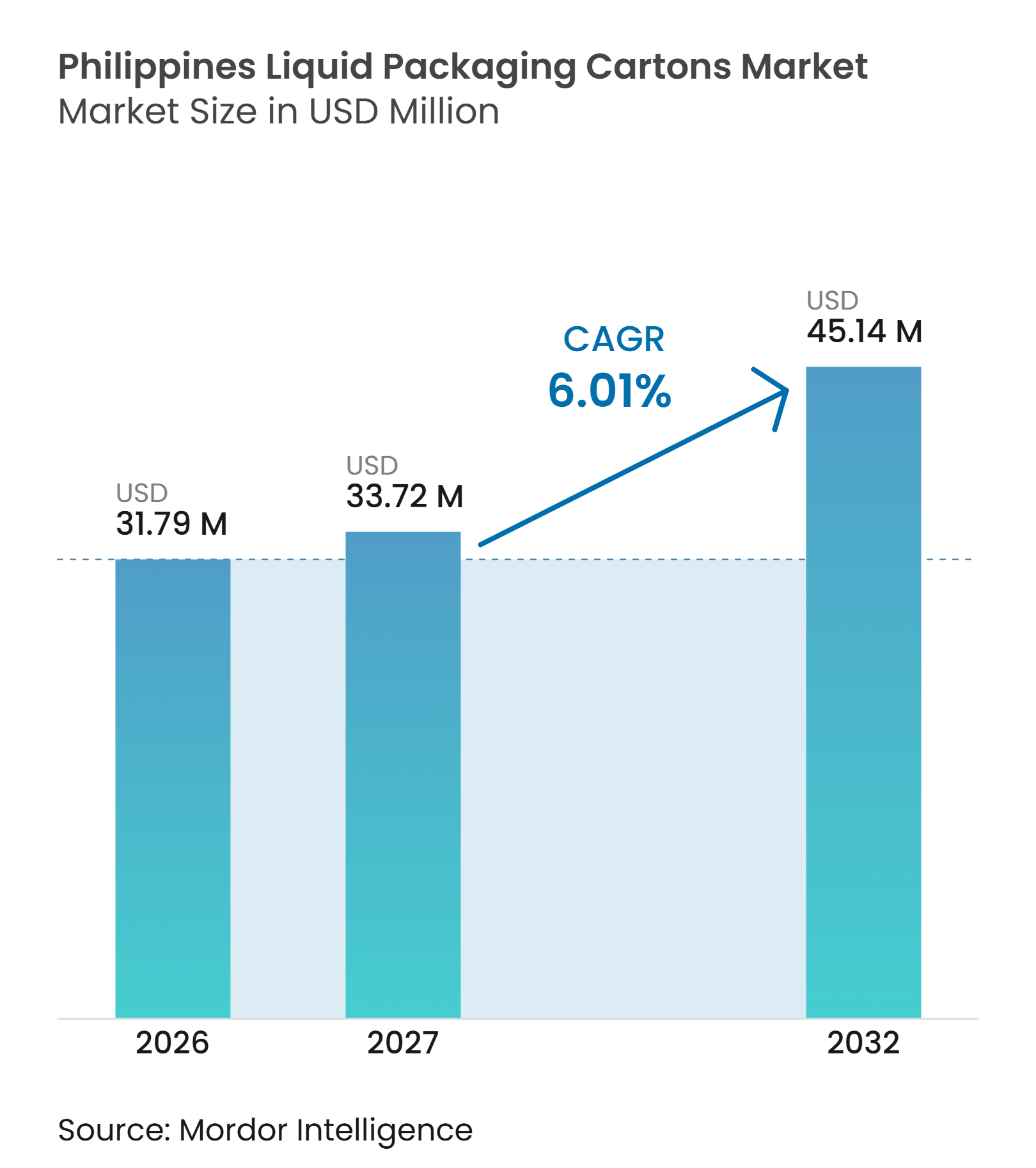
Philippines Liquid Packaging Cartons Market Analysis by Mordor Intelligence
The Philippines Liquid Packaging Cartons Market size is projected to be USD 31.79 million in 2026, USD 33.72 million in 2027, and reach USD 45.14 million by 2032, growing at a CAGR of 6.01% from 2027 to 2032.
The Philippines liquid packaging cartons market is supported by the country’s dispersed island geography and uneven cold-chain coverage, which make shelf-stable formats practical for dairy and beverage distribution. Aseptic packaging allows producers to move products across inter-island routes without relying on continuous refrigeration. Urban consumption and rising demand for packaged dairy, juice, and functional drinks support volume across household and individual formats. The Philippines liquid packaging cartons market also benefits from new co-packing capacity, which lowers the entry barrier for brands that cannot support dedicated filling equipment. Plastic packaging remains a strong alternative in general trade, while extended producer responsibility requirements are directing more attention toward fiber-based formats.
Key Report Takeaways
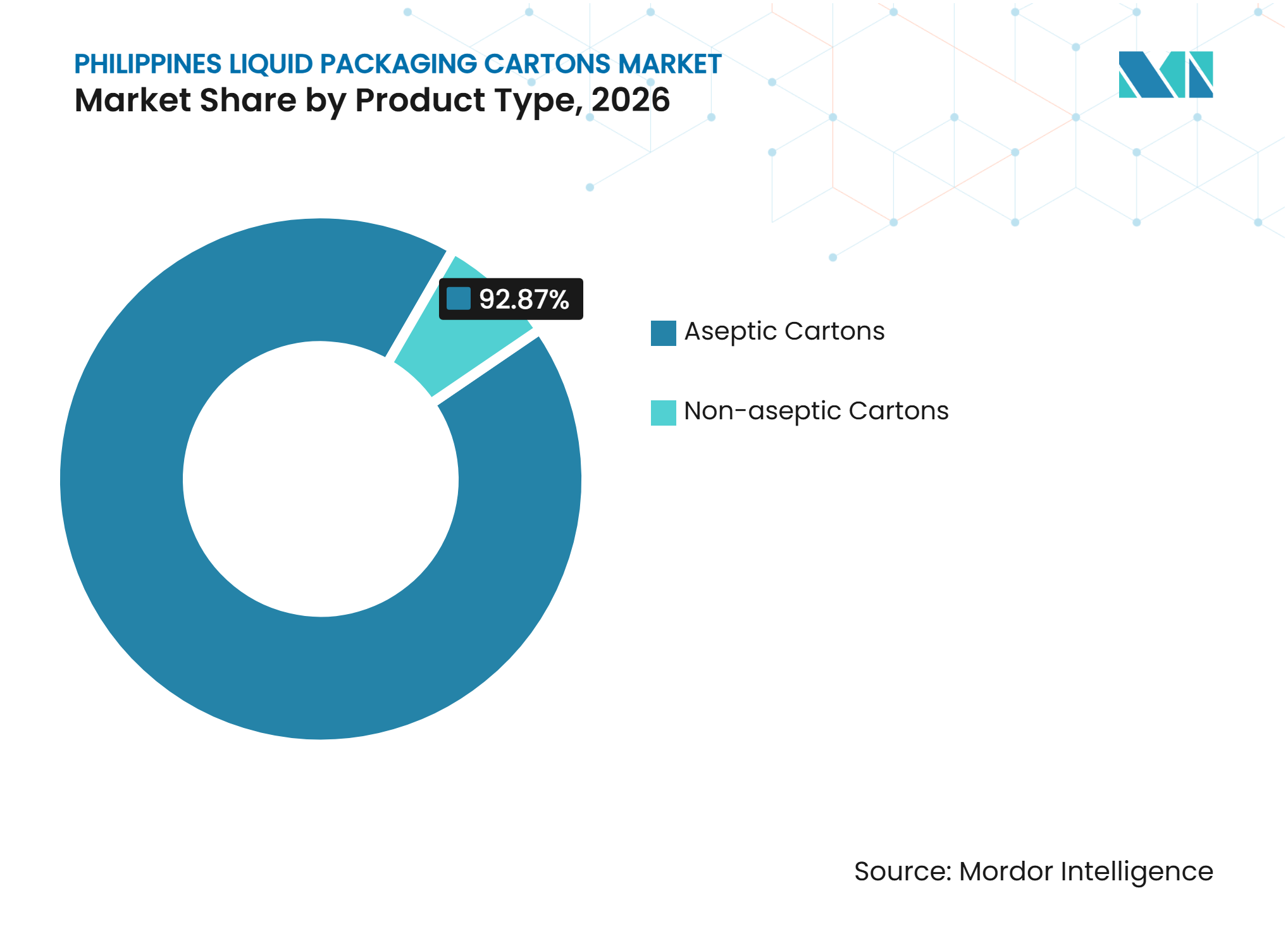
- By product type, aseptic cartons held 92.87% of the Philippines liquid packaging cartons market share in 2026 and are projected to expand at a 6.19% CAGR through 2032.
- By application, milk accounted for 46.26% of the Philippines liquid packaging cartons market size in 2026, while plant-based beverages are projected to expand at a 7.13% CAGR through 2032.
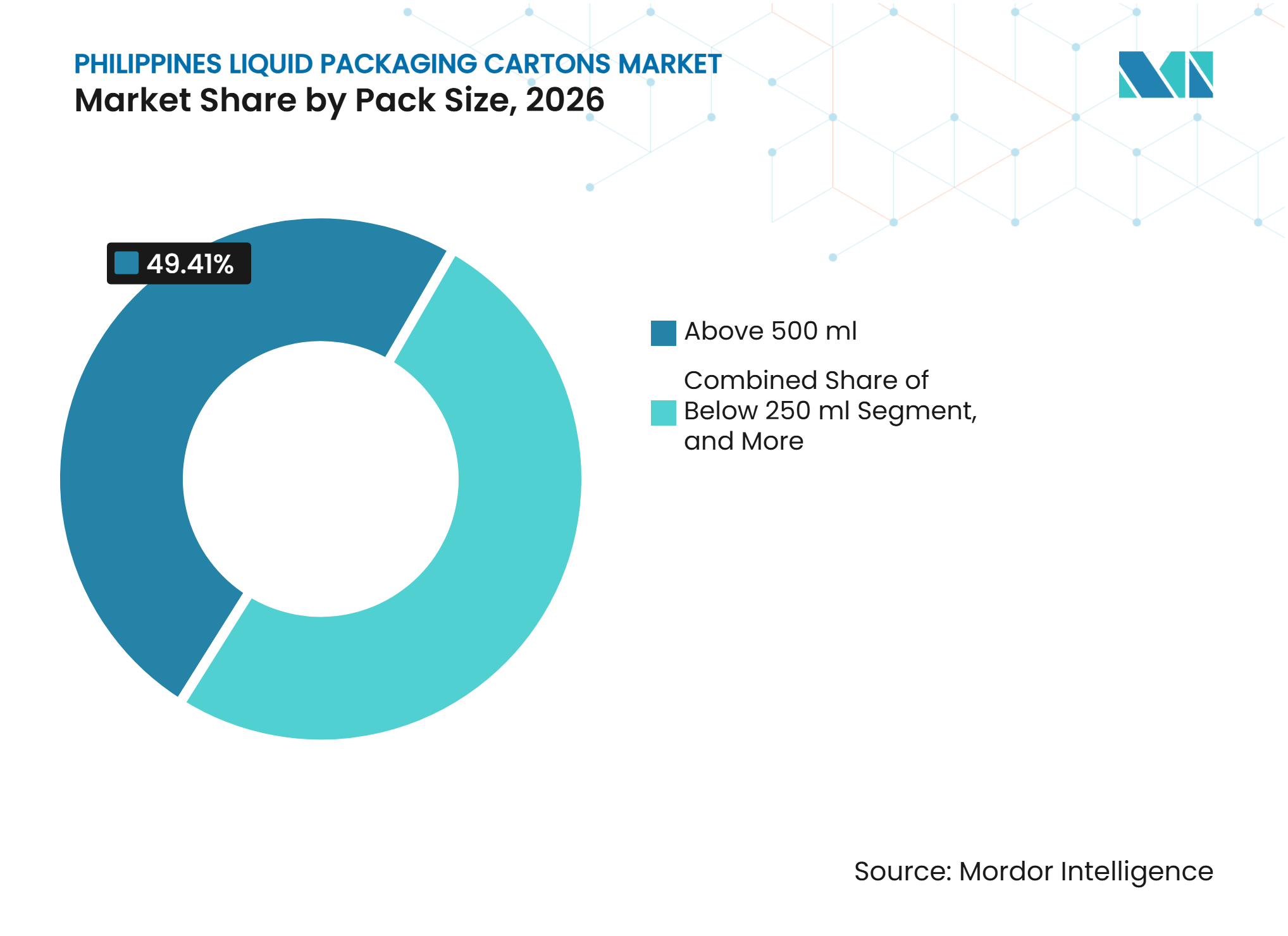
- By pack size, above-500-ml packs accounted for 49.41% of the Philippines liquid packaging cartons market size in 2026, while below-250-ml packs are projected to expand at a 6.62% CAGR through 2032.
Note: Market numbers in this report are based on Mordor Intelligence's proprietary estimation framework, which combines nine months of actuals with Q4 projections for base year 2026.
Market Trends and Insights
Drivers Impact Analysis of Philippines Liquid Packaging Cartons Market*
| Driver | (~) % Impact on CAGR Forecast | Geographic Relevance | Impact Timeline |
|---|---|---|---|
| Expansion of Aseptic Dairy and Beverage Distribution | +1.8% | National, with primary volume gains across Luzon corridors and emerging growth in Visayas and Mindanao distribution networks | Long term (≥ 4 years) |
| Rising Demand for Convenient Shelf-Stable Beverages | +1.4% | National, led by Metro Manila and secondary cities with active modern retail penetration | Medium term (2-4 years) |
| Growth of Plant-Based and Functional Beverages | +0.9% | National, with early adoption in Metro Manila and Cebu and expansion into mid-tier cities through organized retail | Medium term (2-4 years) |
| Increasing Use of Flexible Aseptic Co-Packing Platforms | +0.7% | National, concentrated in Luzon manufacturing clusters in Calamba, Laguna, and Cavite | Short term (≤ 2 years) |
| Smaller Affordable Pack Formats for Mass-Market Consumers | +0.6% | National, with highest impact in general trade channels across Luzon, Visayas, and Mindanao | Short term (≤ 2 years) |
| Regional Availability of New Aseptic Carton Formats | +0.4% | National, supplied from Tetra Pak’s Binh Duong, Vietnam regional hub serving Philippine customers | Medium term (2-4 years) |
| Source: Mordor Intelligence | |||
Expansion of Aseptic Dairy and Beverage Distribution
The Philippines liquid packaging cartons market is supported by aseptic distribution because cold-chain coverage is limited outside major urban corridors. Dairy and beverage producers can use cartons to maintain product integrity for six to twelve months without refrigeration. This capability enables wider distribution runs and reduces the risk of spoilage during inter-island transport. Tetra Pak expanded its Binh Duong facility in Vietnam to supply the Philippines and other regional markets with aseptic carton packaging and formats.[1] The facility’s added capacity supports Philippine producers that need formats suitable for shelf-stable beverages.
Rising Demand for Convenient Shelf-Stable Beverages
Ready-to-drink coffee, ambient juice, and UHT dairy drinks fit the distribution needs of retailers that do not maintain refrigerated storage. The Philippines liquid packaging cartons market gains from this alignment between product convenience and ambient logistics. Modern retail, convenience stores, and foodservice outlets can stock carton-packed drinks with less dependence on refrigerated display space. Tetra Pak’s Binh Duong expansion introduced formats, including the Tetra Prisma Aseptic 500 Edge with DreamCap 26 and the Tetra Brik Aseptic 1000 Slim, for regional beverage applications. These formats give Philippine brand owners options for both single-serve and multi-serve shelf-stable products.
Growth of Plant-Based and Functional Beverages
Plant-based and functional beverages widen the range of products that can be filled in liquid cartons. Ambient oat, soy, and coconut drinks suit carton formats because they can be displayed and distributed without continuous refrigeration. Local production capacity can make carton procurement more relevant for products that had depended on imported finished beverages. Functional beverages also use filling formats that overlap with dairy and juice lines. This allows co-packers to test new products without installing separate equipment for each category. The Philippines liquid packaging cartons market can therefore benefit when brands broaden their shelf-stable drink portfolios.
Increasing Use of Flexible Aseptic Co-Packing Platforms
Flexible co-packing reduces the capital commitment needed to introduce aseptic carton products. Actron Industries installed a SIG Midi 12 Aseptic filling line in Calamba, Laguna, with a capacity of up to 12,000 cartons per hour. The line handles 500-ml, 750-ml, and 1,000-ml formats and supports ready-to-drink juices, teas, dairy beverages, and cooking creams. Brands can use this type of service to test carton products before committing to dedicated machinery. This can make new product launches more feasible for smaller beverage companies.
Restraints Impact Analysis of Philippines Liquid Packaging Cartons Market*
| Restraint | (~) % Impact on CAGR Forecast | Geographic Relevance | Impact Timeline |
|---|---|---|---|
| Imported Cartonboard and Fiber Cost Exposure | -1.5% | National, with strongest pressure on converters in Metro Manila and port-adjacent Batangas clusters | Medium term (2-4 years) |
| Competition from Rigid Plastic Packaging | -1.2% | National, most acute in general trade and sari-sari store channels across Luzon, Visayas, and Mindanao | Short term (≤ 2 years) |
| Limited Local Carton Recycling Infrastructure | -0.7% | National, with operational gaps most evident in Visayas and Mindanao island provinces | Long term (≥ 4 years) |
| High Qualification Costs for Aseptic Filling Systems | -0.5% | National, concentrated among mid-tier beverage producers considering carton-format entry | Medium term (2-4 years) |
| Source: Mordor Intelligence | |||
Imported Cartonboard and Fiber Cost Exposure
The Philippines depends on imported liquid packaging board because local paper capacity is concentrated in recycled grades. The Board of Investments documented 22 domestic paper mills with a combined capacity of 1.65 million tons per year in its pulp and paper analysis.[2] That industrial base does not remove the need for imported virgin-fiber board used in liquid packaging cartons. The Philippines' liquid packaging cartons market is therefore exposed to international movements in pulp, freight, and fiber costs. Converters have limited capacity to accommodate sudden increases in input through fixed beverage supply arrangements. High industrial electricity costs also weaken the case for local investment in virgin-fiber board production.
Competition From Rigid Plastic Packaging
Rigid plastic packaging remains established in general trade and sari-sari store channels because it is familiar, low-cost, and widely supplied. Cartons offer long shelf life and advantages for ambient distribution, but a higher unit cost can limit their use in price-sensitive categories. Republic Act No. 11898 requires obliged enterprises to recover a defined share of their plastic packaging footprint, with the target reaching 60% by December 2026. Compliance requirements may increase the attention given to fiber-based formats in organized retail and institutional procurement. General trade will remain challenging because its purchase decisions are strongly tied to retail price points.
*Our forecasts treat driver/restraint impacts as directional, not additive. The impact forecasts reflect baseline growth, mix effects, and variable interactions.
Philippines Liquid Packaging Cartons Market Segment Analysis
By Product Type:
Aseptic Dominance With A Narrow Competitive BaseAseptic cartons held 92.87% of the Philippines liquid packaging cartons market share in 2026 and are projected to expand at a 6.19% CAGR through 2032. The segment leads because it meets the need for long product life without refrigeration across a large island network. Aseptic cartons enable dairy, juice, and beverage producers to supply locations without reliable cold-chain coverage. Non-aseptic gable-top cartons remain relevant for fresh milk and chilled juice, especially in modern retail outlets in Metro Manila and Cebu.
Their scope is limited because chilled products need refrigerated handling from filling to point of sale. The Philippines' liquid packaging cartons industry, therefore, remains centered on formats that enable ambient transport and storage. Tetra Pak’s regional material expansion gives Philippine customers access to new aseptic formats for beverage applications. New filling capacity at Actron also gives brands an option to place carton products without building their own aseptic line. The strong position of aseptic cartons reflects both the country’s logistics conditions and the limited commercial reach of refrigerated alternatives.



By Applications:
Milk As The Anchor And Plant-Based Beverages As The Growth EngineMilk accounted for 46.26% of the value of liquid packaging cartons in 2026. School feeding programs, hospital procurement, and UHT consumption provide a stable base for the application. The format serves households that need milk products with longer shelf life and limited refrigeration requirements. Juices form a substantial secondary application because tropical fruit inputs and shelf-stable distribution support a broad range of products.
Dairy products excluding milk add volume through cream, condensed milk alternatives, and flavored dairy drinks. Energy drinks, fortified beverages, and liquid food products extend the range of applications that can use aseptic packaging. Plant-based beverages are projected to expand at a 7.13% CAGR through 2032, the highest pace among the listed applications. The Philippines liquid packaging cartons market can serve these products through the same flexible co-packing infrastructure used for dairy and juice. This shared infrastructure can reduce the operational barrier for brands that want to introduce shelf-stable plant-based or functional drinks.
By Pack Size:
Large Formats Hold Ground While Small Packs AccelerateAbove-500-ml packs accounted for 49.41% of the value of liquid packaging cartons in 2026. Household purchases of UHT milk, ambient juice, and plant-based beverages support demand for multi-serve cartons. The 250-500 ml range offers a middle option for foodservice, school canteens, and workplace vending. It combines portion control with a more accessible purchase price than larger household packs.
Below-250-ml packs are projected to expand at a 6.62% CAGR through 2032. Small formats suit sari-sari store distribution and on-the-go consumption occasions. Low-cost carton options can address mass-market demand where affordability shapes brand choice. SIG’s Calamba line demonstrates how flexible production can support multiple fill volumes and rapid format changes. The Philippines liquid packaging cartons industry can use this flexibility to balance household demand for larger packs with demand for convenient smaller formats.

Geography Analysis
Metro Manila and The Luzon Corridor
Metro Manila and the wider Luzon corridor account for the largest share of carton demand and industrial activity, although no regional market share has been provided. The corridor includes Calabarzon locations such as Calamba, Cavite, and Laguna, as well as Central Luzon. Modern retail is more developed in Metro Manila, supporting the availability of UHT dairy, ambient juice, and ready-to-drink coffee in supermarkets, convenience stores, and foodservice outlets. Actron Industries’ Calamba facility entered the aseptic co-packing space with a SIG Midi 12 Aseptic line in 2026.
Tetra Pak’s regional Binh Duong expansion supports the supply of aseptic material and beverage formats to Philippine customers. This access makes Luzon an important entry point for new carton applications. Plant-based drinks, functional beverages, and coconut-based products have a strong fit with manufacturing and distribution activity around Luzon. The concentration of brand owners and converters also makes the area a practical location for filling trials and commercial launches.
Visayas
Visayas has a distinct demand pattern because its island geography fragments distribution across Cebu, Leyte, Samar, and smaller routes. Limited cold-chain coverage makes shelf-stable packaging useful for dairy and beverage producers serving the region. The Philippines' liquid packaging cartons market gains relevance in the Visayas, where producers need stable product quality over longer transport routes. General-trade channels have a greater role than in Luzon, so pack affordability and route-to-market design remain central considerations.
Carton collection systems are also relevant because the region needs recycling routes that align with the broader use of cartons. Tetra Pak reported that its Cartons for Communities program collected more than 700 tonnes of used cartons nationally in 2024 and planned to intensify collection efforts in Visayas and Mindanao. The regional expansion of recovery activity can support the longer-term acceptance of carton formats. Institutional UHT milk demand also provides a stable base for commercial carton distribution across the island group.
Mindanao and Emerging Provincial Markets
Mindanao has a substantial agricultural base in bananas, pineapples, coconuts, and cacao, which can support processing of fruit beverages and coconut products. Carton use in the consumer market trails Luzon and Visayas because logistics are complex and modern retail coverage is more limited. Ambient cartons offer a practical option when refrigerated transport cannot be extended over long distances. The Philippines' liquid packaging cartons market could gain from processing products closer to agricultural feedstocks and broader distribution into provincial communities.
SIG’s Recycle for Good initiative aims to prevent 10,000 tonnes of packaging waste from entering the ocean by December 2028 through community engagement. Collection initiatives matter in island provinces where recovery infrastructure is still developing. Bicol, Eastern Visayas, Caraga, and BARMM constitute a secondary group of markets in which logistics improvements can broaden access to packaged consumer products. Local government coordination and recycling partnerships can influence how quickly carton use spreads beyond the current Luzon-centered base.
Competitive Landscape
Market Concentration
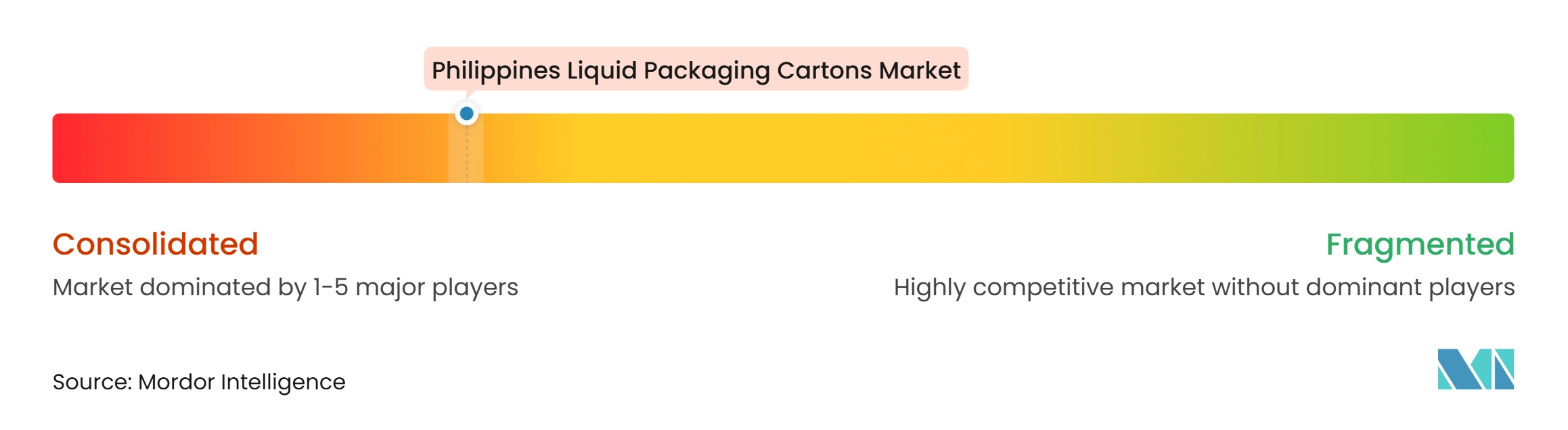
The Philippines liquid packaging cartons market is concentrated at the technology and material supply level. Tetra Pak holds a strong position through an integrated model that combines carton materials, filling equipment, and after-sales support. This structure can increase switching costs for beverage producers because equipment, material specifications, and service relationships are closely connected. SIG Group, Elopak, Greatview Aseptic Packaging, and Lamipak International form the main group of regional alternatives. SIG strengthened its presence in the Philippines by supporting Actron Industries’ co-packing installation in Calamba.
The installation provides a route for emerging brands to use aseptic cartons without owning a filling line. SIG reported that Southeast Asia, Japan, and South Korea maintained momentum in 2025 despite softer conditions in its broader Asia-Pacific business.[3] Greatview reported FY2025 revenue of RMB 1,857.0 million (USD 256.1 million), down 17.1%, and net profit of RMB 52.9 million (USD 7.3 million), down 80.5%. Its results show the pricing pressure faced by carton sleeve suppliers in regional markets. Local converters such as Majestic Printing and Packaging, Flexo Manufacturing, and Packtica serve parts of the conversion and label market, but they do not have the same aseptic material scale as global suppliers.
Tetra Pak added a second material production line in Binh Duong in 2025 through a EUR 97 million (USD 109.5 million) investment, bringing the total investment at the site beyond EUR 217 million (USD 244.9 million). The project more than doubled the site's capacity to 30 billion cartons per year across 15 packaging formats. Lamipak joined the Food and Beverage Carton Alliance in 2025, strengthening its participation in the global carton packaging network. Competition will continue to depend on material availability, compatible filling systems, regional access to supply, and the ability to serve new beverage categories.
Philippines Liquid Packaging Cartons Industry Leaders
-
Tetra Pak International S.A.
-
SIG Group AG
-
Elopak ASA
-
Pactiv Evergreen Inc.
-
Greatview Aseptic Packaging Co., Ltd.
- *Disclaimer: Major Players sorted in no particular order
Philippines Liquid Packaging Cartons Market Companies Covered in this Report
- Tetra Pak International S.A.
- SIG Group AG
- Elopak ASA
- Pactiv Evergreen Inc.
- Greatview Aseptic Packaging Co., Ltd.
- Lamipak International Sdn. Bhd.
- Nippon Paper Industries Co., Ltd.
- Stora Enso Oyj
- Billerud AB (publ)
- Metsä Board Corporation
- Mayr-Melnhof Karton AG
- Oji Holdings Corporation
- Graphic Packaging Holding Company
- United Pulp and Paper Co., Inc.
- Majestic Printing and Packaging Corporation
- Flexo Manufacturing Corporation
- Packtica Inc.
- Actron Industries, Inc.
- Axelum Resources Corporation
- Metro Pacific Dairy Farms
Recent Industry Developments in Philippines Liquid Packaging Cartons Market
- October 2026: Tetra Pak announced the expansion of its Philippine portfolio with Tetra Recart retortable carton packaging for shelf-stable tuna, targeting spreads, flakes, shredded, and chunk formats. The carton, composed of 71% paperboard, 24% plastic, and 5% aluminum foil, carries over 80% less carbon footprint than steel cans and was introduced to support Philippine tuna processors in reaching European markets demanding higher-recyclability packaging.
- September 2026: Tetra Pak’s processing director for Malaysia, Singapore, the Philippines, and Indonesia identified coconut cream as the country’s next major aseptic packaging opportunity in an interview, noting more than 15% annual global growth for the coconut water category and the company’s support for multiple Philippine coconut water processing-plant expansions over the past 2 years.
- May 2026: Actron Industries, Inc. announced the installation of a SIG Midi 12 Aseptic carton-filling line at its Calamba, Laguna plant, with commercial production scheduled for Q2 2026. The line fills up to 12,000 aseptic cartons per hour in 500-ml, 750-ml, and 1,000-ml formats, covering ready-to-drink juices, teas, dairy beverages, and cooking creams, establishing one of the Philippines’ first flexible aseptic co-packing platforms.
- April 2026: The DTI issued Department Administrative Order No. 26-02, rejecting PULPAPEL’s proposal for a definitive safeguard duty on imported corrugating medium paper, following the Tariff Commission recommendation. The decision left Philippine converters exposed to global recovered-fiber pricing cycles and removed a potential input-cost stabilization mechanism for the domestic converting base.
Philippines Liquid Packaging Cartons Market Report Scope
The Philippines Liquid Packaging Cartons Market encompasses the production, supply, distribution, and consumption of paperboard-based cartons for storing, transporting, and preserving liquid and semi-liquid products. These cartons typically comprise multiple layers of paperboard and plastic polymers, with aseptic cartons also incorporating aluminum foil, to ensure structural strength and protection from moisture, oxygen, light, and external contamination.
The Philippines Liquid Packaging Cartons Market Report is Segmented by Product Type (Aseptic Cartons and Non-Aseptic Cartons), Application (Milk, Juices, Plant-Based Beverages, Dairy Products (Excluding Milk), Energy and Functional Drinks, Liquid Food, and Other Applications), and Pack Size (Below 250 ml, 250-500 ml, and Above 500 ml). The Market Forecasts are Provided in Terms of Value (USD).
Segmentation Overview
| Aseptic Cartons |
| Non-Aseptic Cartons |
| Milk |
| Juices |
| Plant Based Beverages |
| Dairy Products (Excluding Milk) |
| Energy and Functional Drinks |
| Liquid Food |
| Other Applications |
| Below 250 ml |
| 250-500 ml |
| Above 500 ml |
| By Product Type | Aseptic Cartons |
| Non-Aseptic Cartons | |
| By Applications | Milk |
| Juices | |
| Plant Based Beverages | |
| Dairy Products (Excluding Milk) | |
| Energy and Functional Drinks | |
| Liquid Food | |
| Other Applications | |
| By Pack Size, | Below 250 ml |
| 250-500 ml | |
| Above 500 ml |
Key Questions Answered in the Report
What is the Philippines liquid packaging cartons value and outlook?
The Philippines liquid packaging cartons market is projected to reach USD 45.14 million by 2032, from USD 33.72 million in 2027, at a 6.01% CAGR.
Why are aseptic cartons widely used in the Philippines?
Aseptic cartons support distribution across island routes because they preserve dairy and beverages without continuous refrigeration.
Which product type leads liquid packaging carton demand in the Philippines?
Aseptic cartons held 92.87% share in 2026 and are projected to expand at a 6.19% CAGR through 2032.
Which application is expanding fastest in Philippine liquid cartons?
Plant-based beverages are projected to expand at a 7.13% CAGR through 2032.
Which carton pack size is gaining momentum in the Philippines?
Below-250-ml packs are projected to expand at a 6.62% CAGR through 2032, supported by single-serve demand and sari-sari store distribution.
What limits wider use of liquid cartons in the Philippines?
Imported cartonboard exposure, rigid plastic competition, limited recycling infrastructure, and aseptic system qualification costs remain key constraints.