
Personality Assessment Solutions Market Size and Share
Market Overview
| Study Period | 2019 - 2030 |
|---|---|
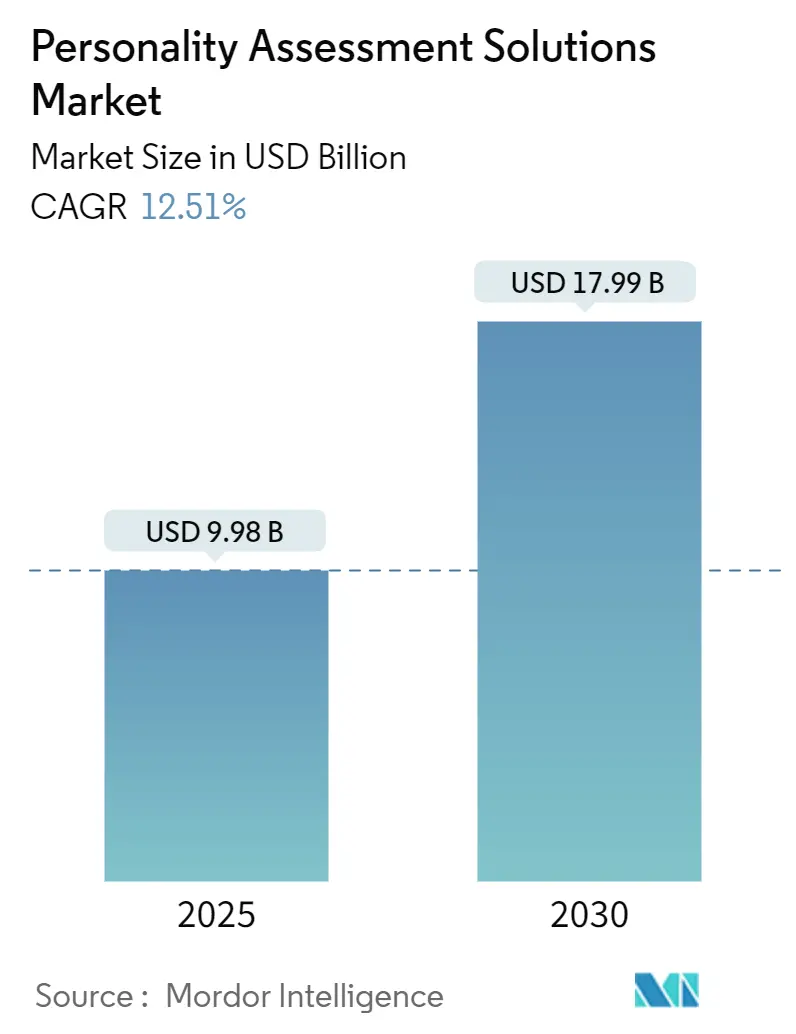
| Market Size (2025) | USD 9.98 Billion |
| Market Size (2030) | USD 17.99 Billion |
| Growth Rate (2025 - 2030) | 12.51% CAGR |
| Fastest Growing Market | Asia Pacific |
| Largest Market | North America |
| Market Concentration | Medium |
Major Players *Disclaimer: Major Players sorted in no particular order Image © Mordor Intelligence. Reuse requires attribution under CC BY 4.0. | |
Personality Assessment Solutions Market Analysis by Mordor Intelligence
The personality assessment solutions market size stands at USD 9.98 billion in 2025 and is projected to reach USD 17.99 billion in 2030, advancing at a 12.51% CAGR. Ongoing digitalization of hiring, integration with broader HR suites, and mounting regulatory demands for algorithmic transparency continue to accelerate adoption. Cloud delivery eliminates infrastructure constraints, while gamified and adaptive formats improve candidate engagement and data quality. Vendors that combine validated psychometrics with explainable AI are widening the gap over questionnaire-only competitors, and pricing flexibility is drawing small and midsized enterprises into a space once dominated by Fortune 500 buyers. Significant white-space remains in neurodiversity hiring, multilingual norm groups, and regional platforms aligned with local privacy statutes.
Key Report Takeaways
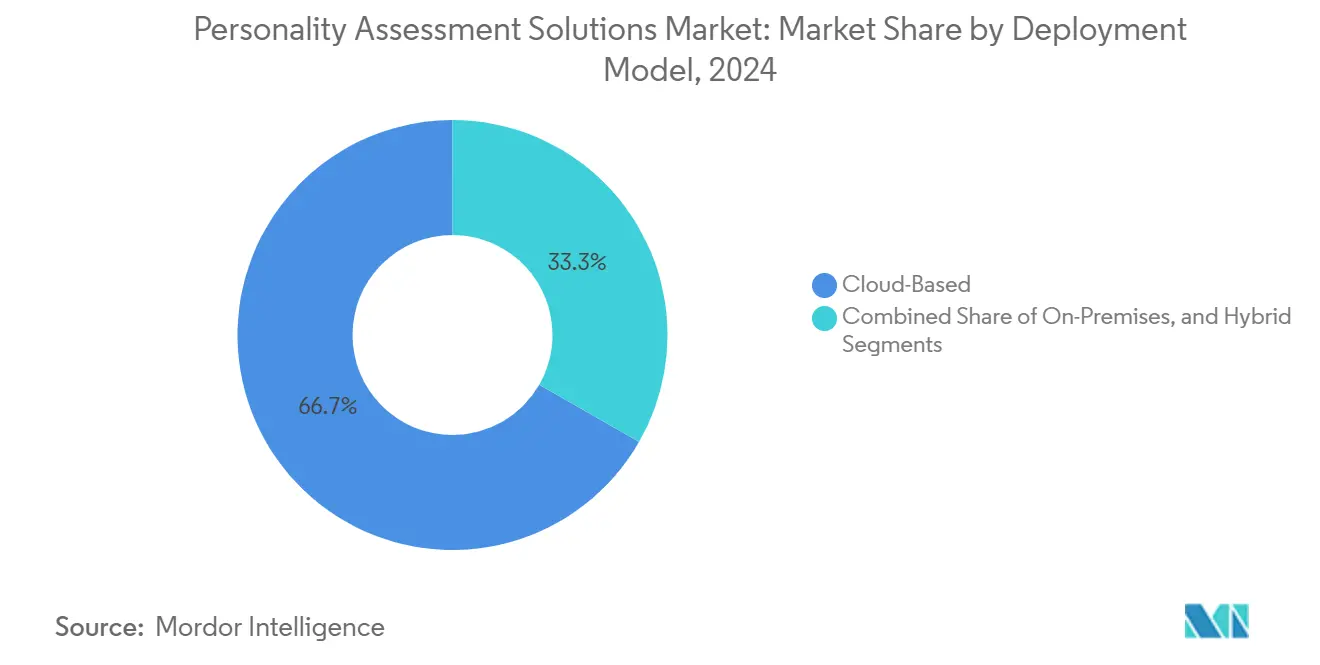
- By deployment model, cloud-based platforms held 66.73% of the personality assessment solutions market share in 2024; hybrid architecture is forecast to expand at a 13.89% CAGR through 2030.
- By end-user industry, corporate enterprises accounted for 43.87% of the personality assessment solutions market size in 2024, while government and defense lead projected growth at 13.11% to 2030.
- By application, recruitment and hiring captured 37.56% of market revenue in 2024; career guidance and counseling is poised to advance at a 12.83% CAGR during the forecast period.
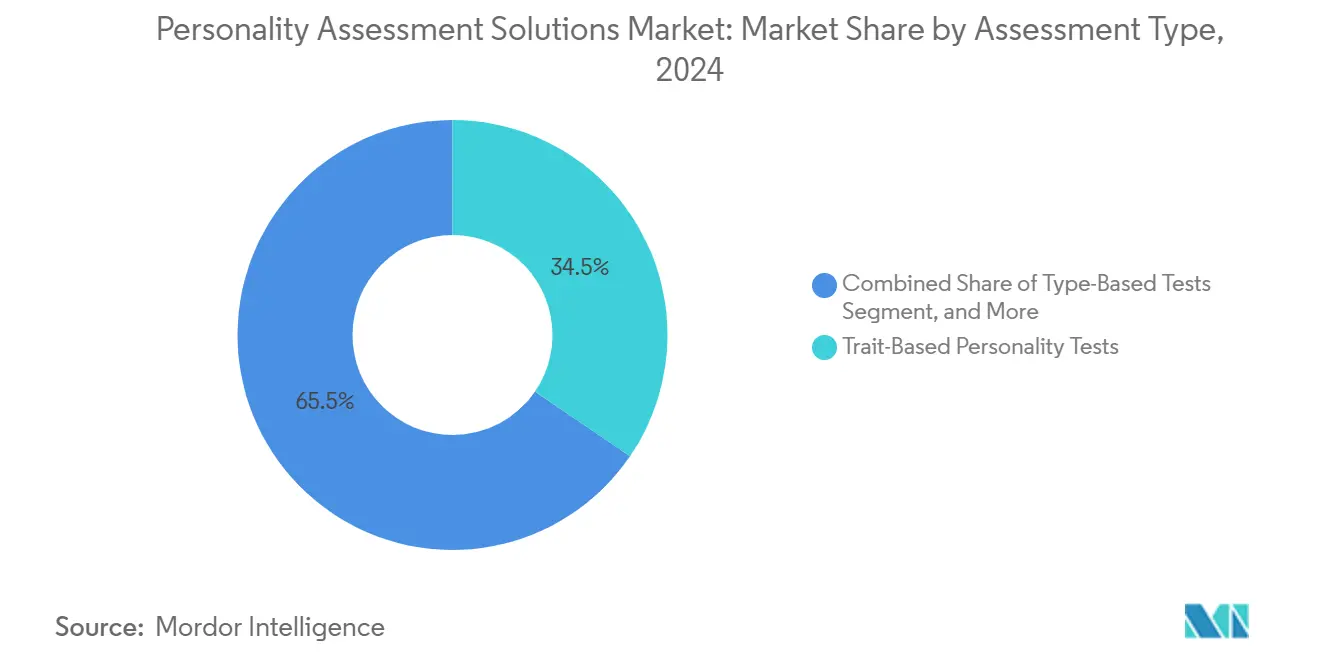
- By assessment type, trait-based tests commanded 34.54% of the personality assessment solutions market share in 2024; adaptive gamified assessments are expected to grow at 13.23% through 2030.
- By organization size, large enterprises represented 59.83% of market value in 2024, and small and midsized enterprises are projected to rise at a 13.96% CAGR.
- By geography, North America represented 39.71% of market value in 2024, and Asia-Pacific is projected to rise at a 12.91% CAGR.
Global Personality Assessment Solutions Market Trends and Insights
Drivers Impact Analysis*
| Driver | (~) % Impact on CAGR Forecast | Geographic Relevance | Impact Timeline |
|---|---|---|---|
| Adoption of data-driven hiring to cut turnover | +2.8% | North America, Europe, Global | Medium term (2-4 years) |
| Cloud-based SaaS assessment platforms | +3.1% | Global, fastest in Asia-Pacific | Short term (≤ 2 years) |
| Integration with ATS and HCM suites | +2.4% | North America, Europe, Asia-Pacific | Medium term (2-4 years) |
| Regulatory push for algorithmic-bias audits | +1.9% | North America, EU, Asia-Pacific | Long term (≥ 4 years) |
| Neurodiversity hiring initiatives | +1.2% | North America, Europe, Australia | Medium term (2-4 years) |
| Gamified adaptive tests enhance engagement | +1.7% | Global, tech-forward markets | Short term (≤ 2 years) |
| Source: Mordor Intelligence | |||
Rising adoption of data-driven hiring to cut turnover
Enterprises replacing résumé screens with validated psychometrics report a 23% drop in first-year attrition, generating USD 15,000 in savings for every retained employee. [1]Society for Human Resource Management, “2024 Employee Job Satisfaction and Engagement Report,” SHRM, shrm.org Evidence of improved retention is propelling the personality assessment solutions market across mid-market firms seeking cost parity with larger rivals. Unilever’s global rollout of gamified assessments removed résumé filtering entirely and trimmed average hiring time by 75%, a case that has become a proof point for both diversity and speed gains.
Proliferation of cloud-based SaaS assessment platforms
Multi-tenant architectures priced below USD 50 per test now deliver real-time scoring, bias analytics, and global language packs. SHL processed over 10 million assessments across 150 countries in 2024 on its cloud backbone, demonstrating the scalability that underpins 66.73% current deployment share. Rapid launch cycles and lower total cost of ownership remain decisive for small enterprises entering the personality assessment solutions market.
Integration with ATS and HCM suites is accelerating uptake.
Open APIs embed assessments inside Workday, SuccessFactors, and BambooHR, removing manual data entry and lifting completion rates. IBM’s Watson Talent ranks applicants in real time against behavioral benchmarks, compressing screening windows from weeks to hours. [2]IBM Corporation, “Watson Talent Platform Integration Report,” IBM, ibm.com The resulting end-to-end workflow visibility makes psychometrics a default rather than an add-on in the personality assessment solutions market.
Regulatory push for algorithmic-bias audits of HR tech
New York City’s Local Law 144 mandates annual bias audits for automated hiring tools, while the EU AI Act imposes similar duties on high-risk recruitment systems. [3]New York City Council, “Local Law 144 of 2021: Automated Employment Decision Tools,” NYC.gov, nyc.gov Vendors must supply explainability dashboards and demographic impact reports, steering buyer preference toward scientifically validated instruments already compliant with audit frameworks.
Restraints Impact Analysis*
| Restraint | (~) % Impact on CAGR Forecast | Geographic Relevance | Impact Timeline |
|---|---|---|---|
| Data-privacy and localization laws tighten data flows | -1.8% | EU, North America, Global | Short term (≤ 2 years) |
| Lack of global standards for scientific validity | -1.4% | Global, emerging markets | Long term (≥ 4 years) |
| Labor-union and investor skepticism | -0.9% | North America, Europe, Asia-Pacific | Medium term (2-4 years) |
| High cost of maintaining multilingual norm groups | -1.1% | Global, emerging markets | Long term (≥ 4 years) |
| Source: Mordor Intelligence | |||
Data privacy and localization laws tighten data flows.
Conflicting residency mandates under GDPR and CCPA force multinationals to mirror databases regionally, inflating program costs by 15-25% and fragmenting global talent analytics. Local storage rules benefit regional vendors and slow large-scale consolidation inside the personality assessment solutions market.
Lack of global standards for scientific validity
Voluntary guidelines from the International Test Commission lack enforcement muscle, allowing subpar tools into circulation and eroding buyer confidence. Enterprises expanding into new regions must fund local validation studies, extending time-to-market, and disadvantaging smaller disruptors without deep research budgets.
*Our forecasts treat driver/restraint impacts as directional, not additive. The impact forecasts reflect baseline growth, mix effects, and variable interactions.
Segment Analysis
By Deployment Model: Cloud Infrastructure Drives Market Evolution
Cloud solutions generated the largest slice of the personality assessment solutions market size, equal to 66.73% of 2024 revenue, reflecting overwhelming demand for subscription pricing and rapid scale-out capacity. Hybrid models are gaining traction among defense and finance players obliged to keep sensitive data on-premises while using cloud analytics. At a 13.89% CAGR, the cloud segment is on track to widen its dominance by 2030 as audit tools, language packs, and candidate dashboards are rolled out centrally rather than through piecemeal upgrades. Vendors that guarantee regional hosting options and end-to-end encryption are best positioned to exploit cross-border recruitment growth.
Peak hiring cycles during 2024’s remote-work surge illustrated the elasticity advantage: top platforms ramped compute loads threefold within weeks without service interruptions. That operational proof, amplified through peer benchmarking, cements cloud as the de facto architecture for enterprises planning high-volume or seasonal campaigns. Conversely, on-premises installations face budget headwinds due to capital hardware refreshes and specialist maintenance teams, keeping them confined to niche compliance contexts.



By End-User Industry: Government Sector Accelerates Adoption
The Corporate / Enterprise Segment retained 43.87% of market share in 2024. However, the strongest momentum lies in government and defense at a CAGR of 13.11%. Federal and municipal agencies now benchmark hiring against validated trait profiles to enhance cohesion and mitigate the risk of insider threats. The U.S. Office of Personnel Management issued guidance in 2024 endorsing structured psychometrics, signaling a shift in policy toward data-driven hiring.
Education, healthcare, and life sciences collectively deepen penetration as universities fold assessments into student success dashboards and hospitals use trait mapping for high-stress clinical teams. Future upside is expected from public-sector re-skilling programs that require portable behavioral credentials. Suppliers tailoring reporting formats to civil-service rules or electronic health-record integration gain a head start in these regulated segments.
By Application: Career Guidance Segment Shows Promise
Recruitment and hiring produced 37.56% of 2024 revenue, underscoring the historical core of the personality assessment solutions market. Yet career guidance and counseling are advancing at a 12.83% CAGR as secondary schools and universities link psychometric outputs to individualized learning pathways. Academic advisors employ trait diagnostics to flag at-risk students earlier, improving retention metrics amid competitive enrollment pressures.
Beyond academia, enterprises repurpose personality data for succession pipelines and leadership coaching, weaving assessments into continuous-development journeys. That multi-life-cycle usage bolsters platform stickiness and drives upsell opportunities such as 360-degree feedback and pulse surveys.
By Assessment Type: Gamification Transforms User Experience
Trait-based instruments anchored in the Big Five model captured 34.54% personality assessment solutions market share in 2024. Adaptive gamified formats, however, top velocity charts at 13.23% CAGR as employers tackle survey fatigue and social-desirability distortions. Short interactive scenarios mimic real-world tasks, generating behavioral telemetry that algorithms convert into trait scores with lower rates of faking.
Type-based tools, such as MBTI and DISC, retain a foothold in corporate learning portfolios, while emotional-intelligence batteries are penetrating leadership tracks. Vendors offering blended suites—classic questionnaires plus immersive simulations—satisfy a spectrum of buyer preferences and mitigate vendor lock-in concerns.
By Organization Size: SME Adoption Accelerates
Large enterprises commanded 59.83% of 2024 spend, buoyed by global HRIS integrations and dedicated analytics teams. The small-and-midsized enterprise cohort is expanding at 13.96% CAGR, fueled by pay-as-you-go pricing and turnkey templates that slash rollout time. SMBs in technology, professional services, and retail deploy assessments early to shape culture and avoid costly mis-hires.
Platform providers that simplify setup through wizard-based job profiles and pre-calibrated norm groups are outpacing rivals reliant on lengthy consulting engagements. As SME usage surges, community benchmarks specific to this cohort will sharpen predictive accuracy, creating a flywheel for further penetration of the personality assessment solutions market.
Geography Analysis
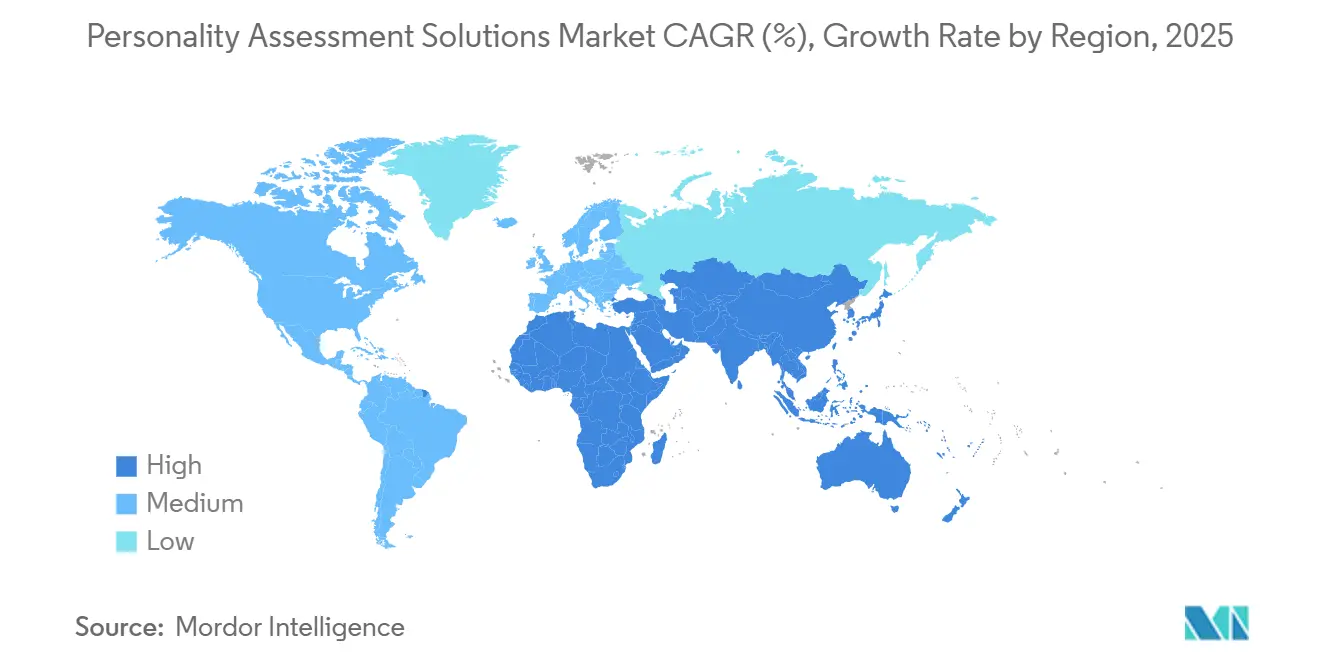
North America secured 39.71% of 2024 revenue on the back of mature HR technology stacks and robust regulatory frameworks mandating algorithmic fairness. Adoption is reinforced by venture investment channeled into AI explainability and bias reduction start-ups, particularly across the U.S. East Coast innovation corridor. Regional buyers value audit-ready dashboards that simplify compliance with Local Law 144 and emerging state-level statutes.
Europe retains second position but faces operational friction from GDPR-driven data-localization clauses. Nevertheless, demand persists among German Mittelstand manufacturers and Nordic public agencies that prioritize psychometrically backed skills taxonomies. Cloud providers offering in-region hosting and automated data-subject-access workflows offset part of the compliance pain, keeping growth on a steady climb.
Asia-Pacific is the fastest-growing territory at 12.91% CAGR, propelled by Singapore’s SkillsFuture blueprint and South Korea’s digital public-sector hiring reforms. Localization of language packs and cultural-norm groups differentiates suppliers, given heterogeneous labor markets across ASEAN. Emerging economies such as Indonesia and Vietnam appear primed for leapfrog adoption directly into mobile-first gamified tools, bypassing legacy desktop formats.

Competitive Landscape
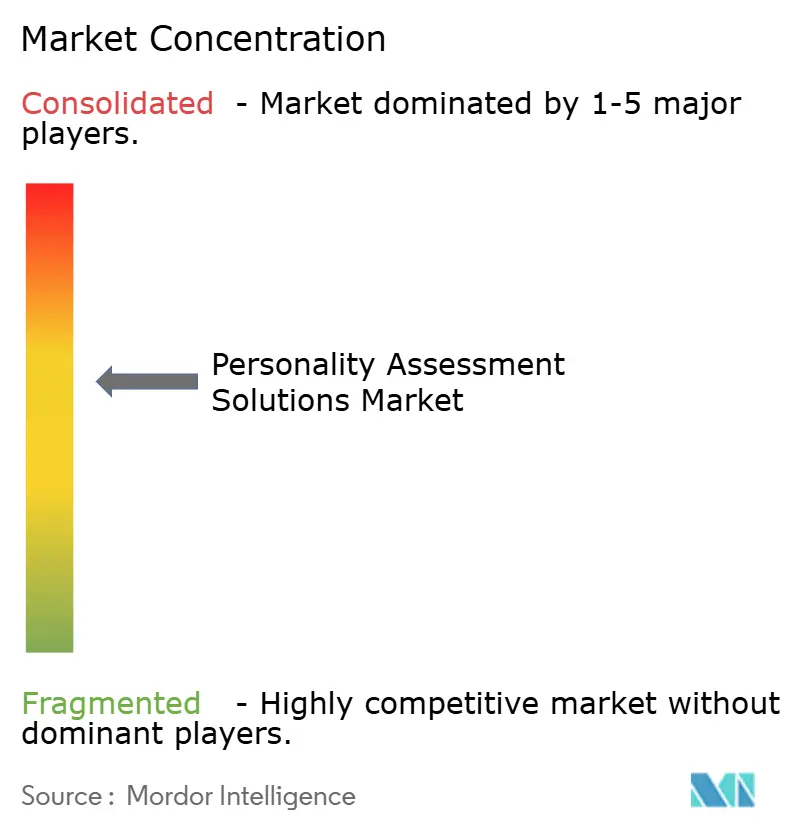
The competitive field remains moderately fragmented; the top five vendors collectively command roughly 35%, implying a healthy but contestable environment. Legacy brands-SHL, Hogan Assessment Systems, Thomas International-capitalize on decades of validation data, while disruptors-Pymetrics, Plum.io, HireVue-inject AI-driven matching and video-based analytics. Strategic deals illustrate convergence: SHL teamed with IBM to embed Watson AI into its suite, and The Myers-Briggs Company acquired Traitify to merge MBTI with mobile gamification.
Patent activity soared 34% in 2024, centering on adaptive item-response theory, adverse-impact mitigation algorithms, and real-time sentiment capture. Vendors with transparent model documentation gain a decisive trust edge as buyers confront escalating audit obligations. Niche openings include sector-specific batteries for healthcare bedside manner or defense risk assessments, areas where off-the-shelf tools underperform.
Price competition is tempered by differentiated analytics depth; platforms bundling workforce planning dashboards sustain premium margins relative to one-off test purveyors. Established providers are racing to add multilingual norm groups to lock in multinational clients before regional point solutions capture share.
Personality Assessment Solutions Industry Leaders
SHL Group Ltd.
Hogan Assessment Systems Inc.
The Predictive Index LLC
Thomas International Ltd.
Mercer (US) Inc.
- *Disclaimer: Major Players sorted in no particular order

Recent Industry Developments
- June 2025: The Myers-Briggs Company launched MBTI NextGen, a mobile-first adaptive version of its flagship instrument that trims completion time to eight minutes and provides instant coaching insights.
- April 2025: Pymetrics rolled out a multilingual neurodiversity assessment battery validated in 25 countries, debuting the solution at the SkillsFuture Singapore Workforce Innovation Forum.
- February 2025: SHL acquired Canadian startup Knockri for USD 48 million to integrate contextual video soft-skill assessments into its cloud portfolio and expand coverage across North America and Asia-Pacific.
- January 2025: HireVue released a bias-mitigation analytics suite for its video-based personality assessments, delivering AI transparency dashboards aligned with upcoming EU AI Act compliance requirements.


Global Personality Assessment Solutions Market Report Scope
| Cloud-Based |
| On-Premises |
| Hybrid |
| Corporate / Enterprise |
| Education and Academia |
| Healthcare and Life-Sciences |
| Government and Defense |
| Other End-User Industry |
| Recruitment and Hiring |
| Talent Development and Succession |
| Academic Admission and Student Support |
| Clinical and Research |
| Career Guidance and Counseling |
| Other Application |
| Trait-Based Personality Tests (Big Five, HEXACO) |
| Type-Based Tests (MBTI, DISC, Enneagram) |
| Emotional and Social-Intelligence Assessments |
| Situational-Judgment and Behavioral Simulations |
| Adaptive Gamified Personality Assessments |
| Large Enterprises |
| Small and Medium Enterprises |
| North America | United States | |
| Canada | ||
| Mexico | ||
| Europe | Germany | |
| United Kingdom | ||
| France | ||
| Russia | ||
| Rest of Europe | ||
| Asia-Pacific | China | |
| Japan | ||
| India | ||
| South Korea | ||
| Australia | ||
| Rest of Asia-Pacific | ||
| Middle East and Africa | Middle East | Saudi Arabia |
| United Arab Emirates | ||
| Rest of Middle East | ||
| Africa | South Africa | |
| Egypt | ||
| Rest of Africa | ||
| South America | Brazil | |
| Argentina | ||
| Rest of South America | ||
| By Deployment Model | Cloud-Based | ||
| On-Premises | |||
| Hybrid | |||
| By End-User Industry | Corporate / Enterprise | ||
| Education and Academia | |||
| Healthcare and Life-Sciences | |||
| Government and Defense | |||
| Other End-User Industry | |||
| By Application | Recruitment and Hiring | ||
| Talent Development and Succession | |||
| Academic Admission and Student Support | |||
| Clinical and Research | |||
| Career Guidance and Counseling | |||
| Other Application | |||
| By Assessment Type | Trait-Based Personality Tests (Big Five, HEXACO) | ||
| Type-Based Tests (MBTI, DISC, Enneagram) | |||
| Emotional and Social-Intelligence Assessments | |||
| Situational-Judgment and Behavioral Simulations | |||
| Adaptive Gamified Personality Assessments | |||
| By Organization Size | Large Enterprises | ||
| Small and Medium Enterprises | |||
| By Geography | North America | United States | |
| Canada | |||
| Mexico | |||
| Europe | Germany | ||
| United Kingdom | |||
| France | |||
| Russia | |||
| Rest of Europe | |||
| Asia-Pacific | China | ||
| Japan | |||
| India | |||
| South Korea | |||
| Australia | |||
| Rest of Asia-Pacific | |||
| Middle East and Africa | Middle East | Saudi Arabia | |
| United Arab Emirates | |||
| Rest of Middle East | |||
| Africa | South Africa | ||
| Egypt | |||
| Rest of Africa | |||
| South America | Brazil | ||
| Argentina | |||
| Rest of South America | |||


Key Questions Answered in the Report
How big is the personality assessment solutions market in 2025?
It is valued at USD 9.98 billion in 2025 and is expected to rise to USD 17.99 billion by 2030.
Which deployment model is growing fastest?
Cloud-based platforms are expanding at a 13.89% CAGR thanks to subscription pricing and elastic scalability.
Why are government agencies adopting personality assessments?
Public-sector bodies use validated psychometrics to improve hiring objectivity and mitigate security risks, driving a 13.11% CAGR in the segment.
What role do regulations play in market growth?
Laws such as NYC’s Local Law 144 and the EU AI Act compel bias audits, boosting demand for transparent, scientifically validated tools.
Which assessment format shows the highest growth?
Adaptive gamified assessments lead at a 13.23% CAGR because they enhance candidate engagement and lower response bias.
How fragmented is the competitive landscape?
With the top five players holding about 35% share, the field remains moderately fragmented, leaving space for new entrants offering niche or regional strengths.
Page last updated on:






