
Payments and Settlements Market Size and Share
Market Overview
| Study Period | 2020 - 2031 |
|---|---|
| Market Size (2026) | USD 2.62 Trillion |
| Market Size (2031) | USD 3.70 Trillion |
| Growth Rate (2026 - 2031) | 7.12 % |
| Fastest Growing Market | Asia-Pacific |
| Largest Market | North America |
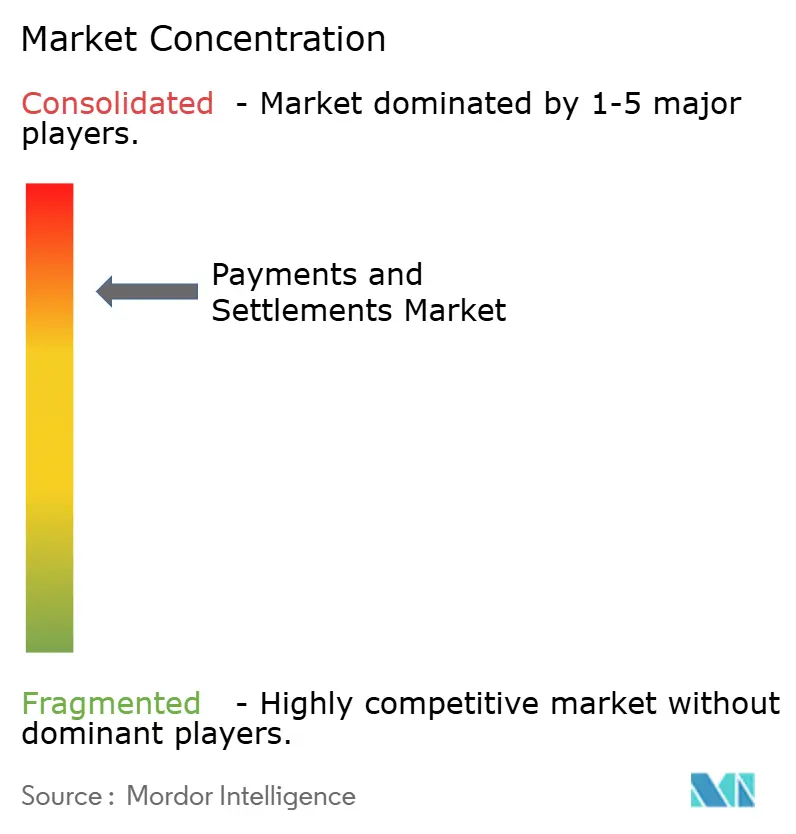
| Market Concentration | High |
Major Players *Disclaimer: Major Players sorted in no particular order Image © Mordor Intelligence. Reuse requires attribution under CC BY 4.0. | |
Payments and Settlements Market Analysis by Mordor Intelligence
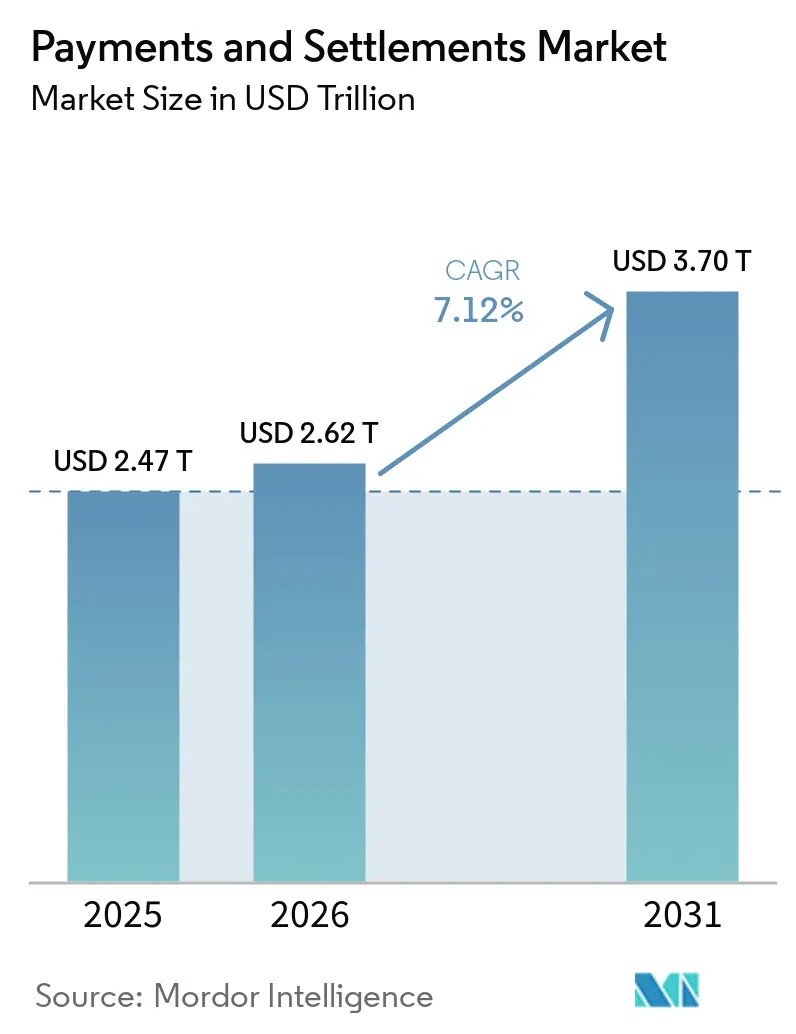
The Payments And Settlements Market size is expected to increase from USD 2.47 trillion in 2025 to USD 2.62 trillion in 2026 and reach USD 3.70 trillion by 2031, growing at a CAGR of 7.12% over 2026-2031.
The payments and settlements market is moving from bilateral, batch-based clearing toward systems that operate continuously and support programmable settlement. Government-backed instant-payment rails, cross-border checkout needs, and tokenized settlement tools are changing how institutions route transactions. These changes reduce settlement delays and place pressure on fee pools that once favored established card and correspondent banking models. The global payments and settlements market is consequently shifting the basis of competition from acceptance reach alone to the quality of connected services. Providers are responding by combining card acceptance, account-to-account transfers, real-time payouts, and tokenized rails in broader service platforms. The global payments and settlements market also faces uneven compliance costs because fraud controls, identity checks, and data-transfer rules differ across jurisdictions.
Key Report Takeaways
- By mode of payment, card payments held 37.7% of the payments and settlements market share in 2025, while digital assets, stablecoins & tokenised payments are forecast to grow at a 16.3% CAGR through 2031.
- By payment type, domestic payments held 72.5% of the payments and settlements market share in 2025, while cross-border payments are forecast to grow at a 9.2% CAGR through 2031.
- By transaction type, consumer-to-business payments held 41.6% of the payments and settlements market share in 2025, while business-to-consumer payments are forecast to grow at a 10.8% CAGR through 2031.
- By end-user industry, retail and e-commerce held 33.9% of the payments and settlements market share in 2025, while transportation and mobility is forecast to grow at an 11.6% CAGR through 2031.
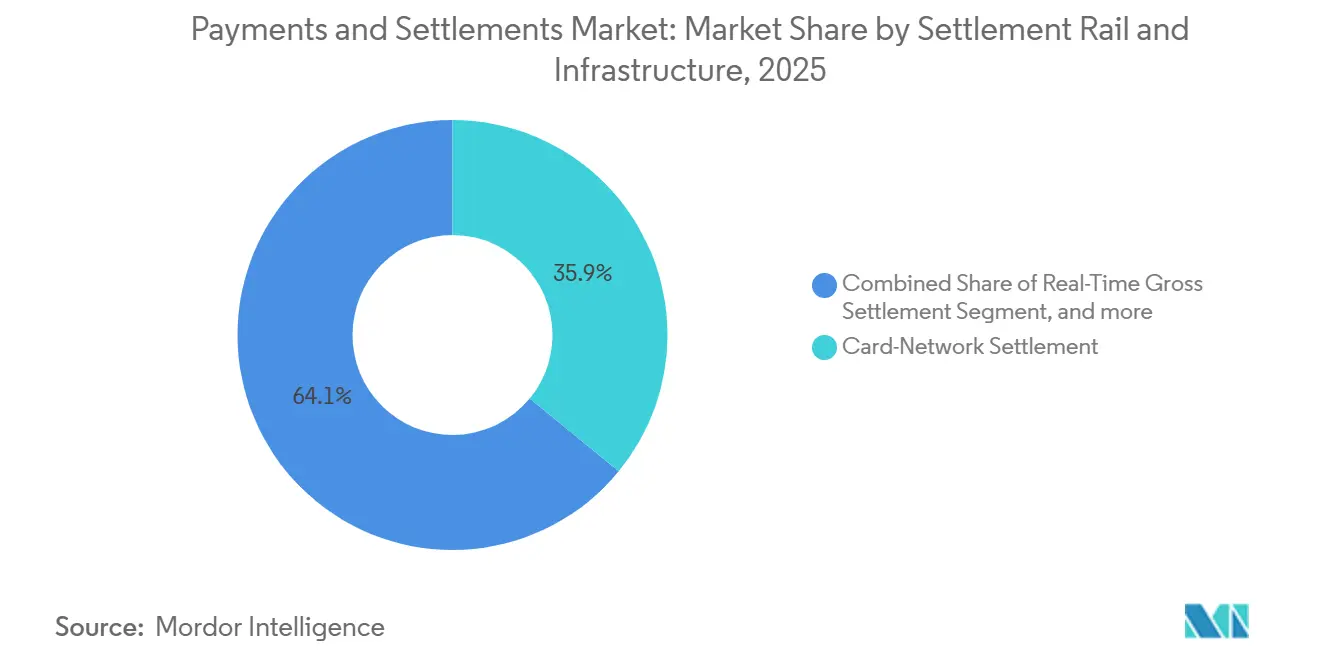
- By settlement rail and infrastructure, card-network settlement held 35.9% of the payments and settlements market share in 2025, while tokenized and distributed-ledger settlement is forecast to grow at a 19.9% CAGR through 2031.
- By geography, North America held 34.5% of the payments and settlements market share in 2025, while Asia-Pacific is forecast to grow at a 9.9% CAGR through 2031.
Note: Market size and forecast figures in this report are generated using Mordor Intelligence’s proprietary estimation framework, updated with the latest available data and insights as of January 2026.
Market Trends and Insights
Drivers Impact Analysis of Payments and Settlements Market*
| Driver | (~) % Impact on CAGR Forecast | Geographic Relevance | Impact Timeline |
|---|---|---|---|
| Cross-Border Commerce and Digital Marketplaces | +1.8% | Global, concentrated in Asia-Pacific, Europe, and North America corridors | Medium term (2-4 years) |
| Government Instant Payment Rails and Account-to-Account Adoption | +1.6% | Asia-Pacific core, with spillover to North America and Europe | Short term (≤ 2 years) |
| Digital Remittances and Embedded Payouts | +1.1% | Middle East and Africa, South Asia, Latin America, North America, and the Gulf states | Medium term (2-4 years) |
| ISO 20022 Payment Automation | +0.9% | Global, with early gains in SWIFT corridors, SEPA, and the Nordics | Long term (≥ 4 years) |
| Payment Sovereignty and Domestic-Rail Linkages | +0.7% | ASEAN, South Asia, the Middle East, Africa, and South America | Long term (≥ 4 years) |
| Source: Mordor Intelligence | |||
Expansion of Cross-Border Commerce and Digital Marketplaces
Digital commerce is increasing the demand for payment services that can settle across borders with clear fees and predictable delivery times. The global payments and settlements market benefits when merchants can serve new countries without having to rebuild checkout and treasury processes for each corridor. Legacy correspondent banking can support global reach, but it remains less effective where domestic delivery creates most of the delay. The BIS identified longer operating hours for fast-payment systems and broader interconnections among them as major actions to improve cross-border payments across 82 jurisdictions[1]Bank for International Settlements, “Enhancing Cross-Border Payments Step by Step,” BIS, bis.org. Swift introduced a retail framework in March 2026 with more than 70 financial institutions, while noting that domestic last-mile delivery accounted for 75% of total end-to-end payment time. This makes domestic infrastructure reform as important as network-level speed for providers serving international merchants.
Government Instant-Payment Rails Accelerating Account-to-Account Adoption
Government-operated instant-payment systems can directly alter merchant payment economics by offering low-cost account-to-account transfers. India’s UPI processed 228.5 billion transactions in 2025, while Brazil’s PIX processed 79.8 billion transactions in the same year, underscoring the scale of public payment infrastructure. PIX represented 54.7% of Brazil’s retail payment transactions in the second half of 2025, which indicates that a zero-fee rail can displace card use in everyday payments. In the United States, FedNow reached 1,800 enrolled institutions and settled USD 853.4 billion during 2025, although its operating model differs from public rail designs[2]Federal Reserve Bank of San Francisco, “FedNow Service,” Federal Reserve Bank of San Francisco, frbsf.org. The global payments and settlements market, therefore, includes both public systems that can set fee conditions and private systems that must balance participant incentives. Payment sovereignty also supports domestic rail links, especially where countries want local control while still connecting to regional payment corridors.
Growth of Digital Remittances and Embedded Payouts
Digital remittances are being reshaped by faster cross-border corridors, stablecoin-based treasury tools, and money-transfer providers' shift toward digital delivery. These services can reduce waiting times for users and improve cash management for the providers that fund local payouts. Western Union announced USDPT on Solana in May 2026 for regulated digital infrastructure and treasury settlement within its global network. MoneyGram introduced MGUSD in June 2026 as part of a plan to use stablecoin within its own global network. Embedded payouts also support gig-worker wallets, insurance claims, and instant refunds, where recipients value immediate access to funds. The global payments and settlements market benefits from these use cases, as they increase demand for dependable business-to-consumer disbursement tools rather than just merchant checkout services.
ISO 20022 Enabling Rich-Data Payment Automation
The global financial community completed the cross-border transition to ISO 20022 on November 22, 2025, ending the coexistence period for the legacy MT format. Swift reported that 97% of payment instructions used the standard within 2 days of the cutoff[3]Swift, “Global Financial Community Completes Switch to ISO 20022,” Swift, swift.com. The standard can improve reconciliation by carrying richer party and remittance data across the payment chain. Its benefits remain incomplete, as banks have only adapted legacy systems to comply with messaging standards rather than redesigning processing workflows. Swift plans to remove support for unstructured postal addresses in November 2026, creating a practical compliance deadline for institutions using cross-border messaging. The global payments and settlements market has a longer-term opportunity in tools that retain structured data across banks, merchants, and corporate finance systems.
Restraints Impact Analysis of Payments and Settlements Market*
| Restraint | (~) % Impact on CAGR Forecast | Geographic Relevance | Impact Timeline |
|---|---|---|---|
| Payment Fraud, Account Takeover, and Authorized Push-Payment Scams | -1.5% | Global, with heavier losses in the United States, the United Kingdom, India, Brazil, and Australia | Short term (≤ 2 years) |
| Cross-Border Compliance and Data-Transfer Rules | -1.0% | Global, with acute friction in the United States-Europe, Asia-Pacific-Gulf, and intra-ASEAN corridors | Long term (≥ 4 years) |
| Legacy Settlement Windows and Liquidity Requirements | -0.8% | Americas and Europe | Medium term (2-4 years) |
| Inconsistent API, Identifier, and Data Standards | -0.5% | Global, especially emerging-market, cross-border corridors | Long term (≥ 4 years) |
| Source: Mordor Intelligence | |||
Payment Fraud, Account Takeover, and Authorized Push-Payment Scams
Real-time payments create a difficult fraud-control problem because funds can move before an institution has time to intervene. Authorized push-payment scams exploit this feature by persuading a customer to approve a payment that appears legitimate. Account-takeover losses exceeded USD 15 billion globally in 2025, even as the reported value declined from the prior year, according to TransUnion. The same release stated that 6 million consumers were affected, a 18% increase in the number of victims. The payments and settlements market must therefore treat verification, monitoring, and customer protection as core payment functions rather than optional additions. Reimbursement requirements and related policy responses can place greater cost pressure on smaller providers that lack mature fraud-detection capabilities.
Fragmented Cross-Border Compliance and Data-Transfer Rules
Different rules for sanctions screening, anti-money-laundering controls, data localization, and privacy can delay payments even where the payment message itself is standardized. The BIS stated that the G20’s 2027 cross-border payment targets remain difficult to achieve because jurisdictions began with different legal, regulatory, and technical positions. Pre-validation services can check payee details, account status, and sanctions information before a payment is initiated, thereby reducing failed payment rates. Yet such services need compatible data access and common implementation across institutions. The global payments and settlements market also remains affected by legacy settlement windows and liquidity needs in regions where extended operating hours are limited. Inconsistent application programming interfaces, identifiers, and data standards add further friction in emerging cross-border corridors, even when settlement rails are technically available.
*Our forecasts treat driver/restraint impacts as directional, not additive. The impact forecasts reflect baseline growth, mix effects, and variable interactions.
Payments and Settlements Market Segment Analysis
By Mode of Payment:
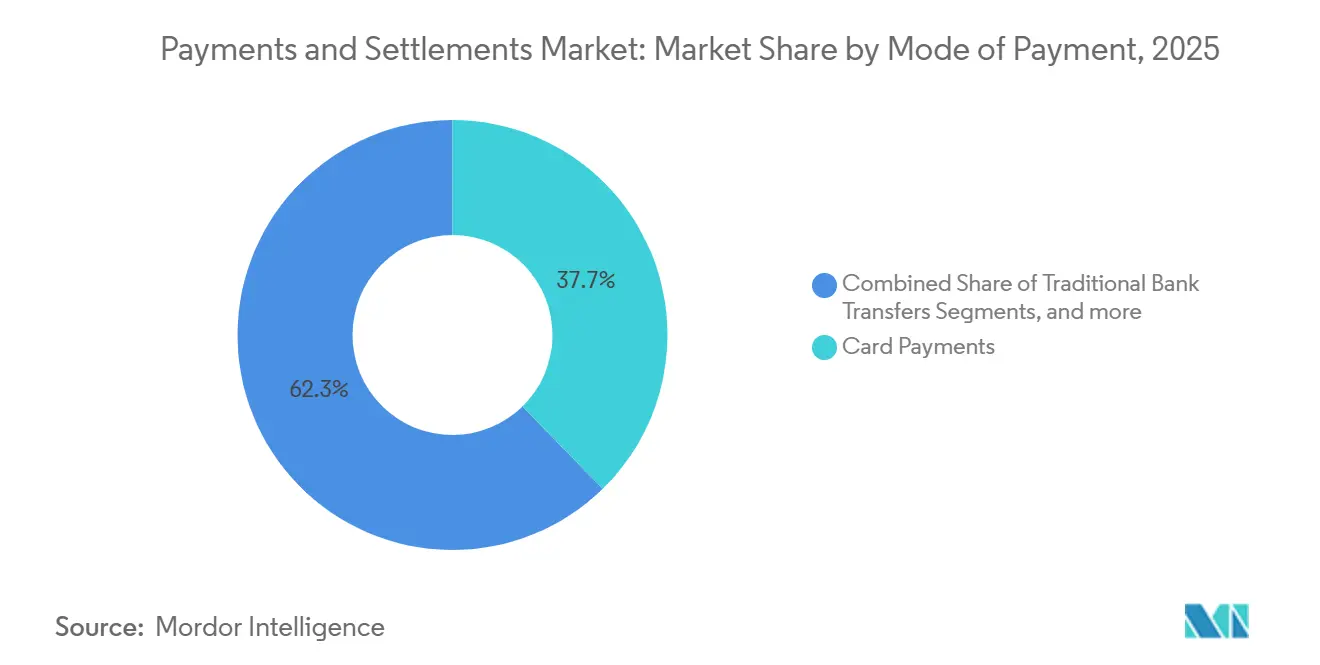
Tokenized Assets Reconfiguring the Settlement StackCard payments accounted for 37.7% of the payments and settlements market in 2025, supported by broad acceptance networks and tokenized credentials that extend card use into digital wallets. Card networks still provide established rules for authorization, dispute management, and fraud liability. In the United States, combined purchase volume across the largest card networks reached USD 11.46 trillion in 2025. Digital wallets and account-to-account payments compete with card-based economics by enabling consumers to pay via applications or bank accounts. The global payments and settlements industry is therefore not replacing cards with a single alternative but adding more choices to the checkout and settlement stack.
Digital assets, stablecoins & tokenised payments are forecast to expand at a 16.3% CAGR through 2031, the fastest growth rate within this segmentation. This mode is being used more often for institutional settlement than for retail cryptocurrency activity alone. Visa reported that its stablecoin settlement program operated across 9 blockchains and reached a USD 7 billion annualized run rate in April 2026[4]Visa Inc., “Visa Accelerates Stablecoin Momentum,” Visa, visa.com. Traditional bank transfers, buy-now-pay-later services, and embedded credit remain part of the payment mix. Buy now, pay later offerings are increasingly built into retail and travel checkout software, rather than being offered only as separate consumer products.



By Payment Type:
Cross-Border Rails Narrowing the Domestic Efficiency GapDomestic payments held 72.5% of the payments and settlements market in 2025 because local retail and business activity remains much larger than international payment flows. Domestic systems also tend to have simpler rules, known participants, and lower processing costs. Cross-border payments are forecast to grow at a 9.2% CAGR through 2031 as faster payment links, corridor digitization, and treasury tools reduce friction. The FSB began a new public-private implementation phase in March 2026 to advance the G20 cross-border payments program. This work prioritizes operational reliability and shared implementation over isolated technical pilots. The global payments and settlements market can benefit when these initiatives turn separate domestic systems into usable commercial corridors.
Project Nexus became a legal entity in 2025 through the participation of the central banks of India, Indonesia, Malaysia, the Philippines, Singapore, and Thailand. The arrangement is designed to support multilateral links between fast-payment systems. Markets with linked domestic rails can reduce cost and settlement delays more quickly than markets that rely only on correspondent banking. Merchants and treasury managers consequently need systems that can route transactions among domestic, real-time, and tokenized rails. The global payments and settlements industry is increasingly adopting payment orchestration platforms that make these choices without disrupting the customer experience.
By Transaction Type:
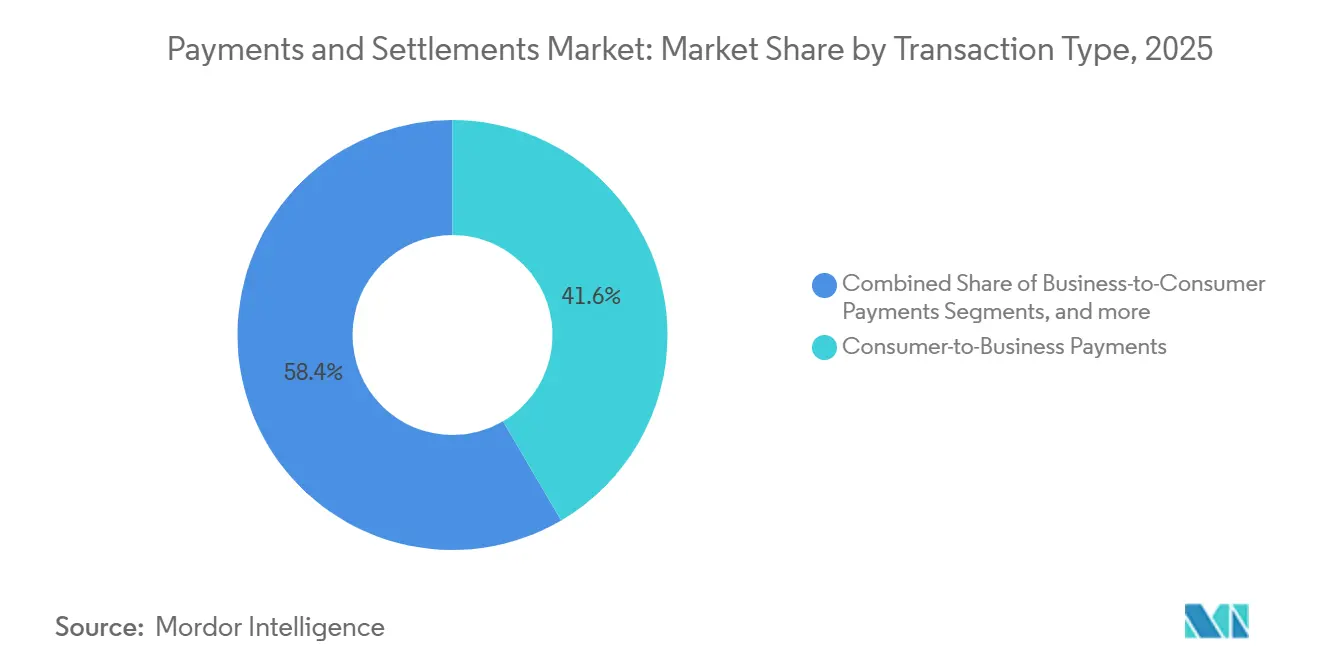
B2C Payouts Redefining Real-Time Settlement ExpectationsConsumer-to-Business payments accounted for 41.6% of the payments and settlements market in 2025, reflecting the scale of consumer purchases across retail, travel, and digital services. This transaction type benefits from familiar payment methods and broad merchant acceptance. Business-to-Consumer Payments are forecast to grow at a 10.8% CAGR through 2031. Earned-wage access, insurance claims, gig-worker payments, and creator payments all require prompt delivery to the recipient. These flows are encouraging businesses to treat payout speed as a service feature instead of an internal finance process.
Business-to-Business payments remain important in terms of value, but many firms still rely on batch files and older treasury workflows. Migration to ISO 20022 can improve reconciliation when systems preserve structured information from initiation through settlement. Consumer-to-Consumer payments continue to expand through wallets and peer-transfer applications. Free features in super-apps create strong competitive pressure in the Asia-Pacific and Latin America. Visa launched Intelligent Commerce Connect in April 2026 to enable AI agents to initiate purchases via a single integration, using both Visa and non-Visa credentials. This development may reduce the practical distinction between consumer-initiated and machine-initiated transactions, while data-consent rules continue to shape where these services can be scaled.
By End-User Industry:
Mobility Emerges as the Fastest-Growing Payment VerticalRetail and e-commerce accounted for 33.9% of the payments and settlements market in 2025, as merchants increasingly integrate payment acceptance into their software platforms. This setting values payment orchestration, recurring payment support, and strong fraud controls. Banking and financial services, healthcare, hospitality, travel & tourism also benefit from real-time payout services and structured payment information. Transportation and mobility are forecast to grow at an 11.6% CAGR through 2031. Ride-hailing, electric vehicle charging, and Mobility-as-a-Service platforms require embedded payments that work across several modes of transport and locations.
Government and public sector payments are gaining use through direct-benefit transfers and faster tax-refund programs. These applications place value on identity, routing accuracy, and accessible receiving accounts. Professional and business services firms also use instant vendor payments and earned-wage tools to support suppliers and employees. The payments and settlements market encompasses a wider range of operating needs, not just consumer checkout. Established bank-hosted payment platforms can compete more effectively by combining real-time fund movement with clear reconciliation for business users.
By Settlement Rail and Infrastructure:
DLT Settlement Moving from Pilot to ProductionCard-Network settlement accounted for 35.9% of the payments and settlements market in 2025, supported by international coverage and established fraud liability practices. Automated clearinghouse systems and correspondent banking continue to handle major business and public-sector flows. Real-time gross settlement systems and fast-payment systems are expanding as central banks extend access and raise transaction limits. Payment-system interlinking is an additional infrastructure layer that can connect domestic schemes without requiring a single global rail.
Tokenized and distributed-ledger settlement is forecast to grow at a 19.9% CAGR through 2031. Major networks are building hybrid structures that connect conventional money movement with regulated digital-asset settlement. Mastercard announced its planned acquisition of BVNK in March 2026 to connect on-chain payments with fiat rails. Visa’s program shows that providers can add tokenized settlement while continuing to support existing network participants. Licensing rules and common standards will determine whether these arrangements move from selected use cases to larger institutional volumes.
Geography Analysis
North America Payments and Settlements Market
North America held a 34.5% regional share in 2025, supported by high card usage and a developing instant-payment ecosystem. FedNow settled USD 853.4 billion in 2025 across 1,800 enrolled institutions. The Clearing House RTP network processed USD 480 billion in the first quarter of 2026, with both major United States rails using a USD 10 million transaction limit. Private operating models mean that banks still need a clear commercial reason to adopt and use those rails at scale. Canada’s open banking work can support account-to-account initiation.
APAC Payments and Settlements Market
Asia-Pacific is forecast to grow at a 9.9% CAGR through 2031, the fastest regional rate in the global payments and settlements market. India’s UPI processed 228.5 billion transactions in 2025, a 33% increase from the prior year. China is developing payment infrastructure with a strong domestic-control approach, including the Digital Renminbi International Operations Center, launched in Shanghai in September 2025. Japan’s cashless payment ratio reached 58% in 2025, exceeding its government target. Indonesia, Vietnam, Thailand, Malaysia, and Singapore are also progressing through regional fast-payment connections.
EMEA and South America Payments and Settlements Market
Europe has advanced wholesale and corporate payment systems, but retail payments remain divided among national schemes. Swedish banks began migrating to a new credit-transfer infrastructure in April 2026, with a wider batch-payment migration planned for November 2026. Wero began rolling out in Germany in late 2025 and is expanding to France and Belgium in 2026. In South America, PIX reached 54.7% of retail payment transactions in Brazil during the second half of 2025. The Middle East and Africa are expanding domestic payment infrastructure and regional interoperability, including payment capabilities connected with Gulf digitization programs.
Competitive Landscape
The payments and settlements market has an oligopolistic top tier in card networks and a fragmented set of processors, cross-border specialists, and digital-asset providers. Visa held 31% of the United States debit purchase volume and 30% of the United States credit purchase volume in 2025. This position gives the largest networks a strong base in acceptance, rules, and transaction data. Competition is increasing where account-to-account payments, wallets, and tokenized settlement can substitute for parts of the traditional card flow. The payments and settlements market has therefore become less defined by a single payment instrument and more defined by the ability to connect several rails safely.
Visa expanded stablecoin settlement to 9 blockchains in April 2026, signaling a strategy to incorporate tokenized settlement into existing network services. Mastercard announced an agreement to acquire BVNK in March 2026, reflecting a similar effort to connect fiat and on-chain payment infrastructure. Global Payments completed its acquisition of Worldpay from FIS in January 2026, which created a larger merchant-acquiring platform. These moves show that scale, regulation, and technical interoperability are becoming connected to competitive requirements. Providers are also working on standards for agent-led payments, where credential security and customer consent remain central.
Payment infrastructure providers such as Stripe, Adyen, and Juspay are expanding payment orchestration capabilities, allowing merchants to connect multiple payment providers, optimize routing, improve authorization rates, and support alternative payment methods through a unified platform.
Cross-border providers compete by offering clearer foreign exchange pricing, business accounts, payment acceptance, and treasury services to small and medium-sized businesses. Airwallex secured USD 320 million in Series H funding in March 2026 and reported USD 1.3 billion in annualized revenue, supporting its expansion across several regions. At the same time, established providers are reassessing portfolios and costs as lower-cost alternatives reduce margins in selected payment flows. Opportunities remain in affordable treasury and reconciliation tools, verified-payee safeguards, and tokenized wholesale settlement for foreign exchange and securities. The global payments and settlements market is likely to reward providers that combine these services with dependable compliance and fraud controls.
Payments and Settlements Industry Leaders
Visa Inc.
Mastercard Incorporated
China UnionPay Co., Ltd.
American Express Company
PayPal Holdings, Inc.
- *Disclaimer: Major Players sorted in no particular order
Payments and Settlements Market Companies Covered in this Report
- Visa Inc.
- Mastercard Incorporated
- China UnionPay Co., Ltd.
- American Express Company
- PayPal Holdings, Inc.
- Fiserv, Inc.
- Fidelity National Information Services, Inc.
- Global Payments Inc.
- Adyen N.V.
- Stripe, Inc.
- Block, Inc.
- Worldline SA
- Ant Group Co., Ltd.
- Apple Inc.
- Google LLC
- Amazon.com, Inc.
- Juspay Technologies
- Wise plc
- Western Union Holdings, Inc.
- MoneyGram International, Inc.
- Airwallex (Hong Kong) Limited
- J.P. Morgan Chase & Co.

Recent Industry Developments in Payments and Settlements Market
- August 2026: Mastercard completed the acquisition of BVNK, signaling a strategic pivot to embed stablecoin infrastructure natively into its global network.
- July 2026: Juspay partnered with Recurly to integrate its Hyperswitch payment orchestration platform into Recurly's subscription payments ecosystem, enabling merchants to connect with 300+ payment providers, improve payment routing, reduce failures, and accelerate global market expansion.
- July 2026: Visa launched a dedicated stablecoin platform to serve 200 million+ merchants globally, providing a one-stop service for financial institutions seeking to integrate stablecoin payments into their infrastructure.
- June 2026: Juspay joined the Mastercard Engage partner network as a certified third-party partner for Click to Pay, helping enterprises accelerate deployment of tokenized checkout experiences across global markets.


Global Payments and Settlements Market Report Scope
| Card Payments (Debit, Credit, Prepaid) |
| Digital Wallets & Mobile Money |
| Account-to-Account & Instant Payments |
| Traditional Bank Transfers |
| Buy Now, Pay Later & Embedded Credit |
| Digital Assets, Stablecoins & Tokenised Payments |
| Other Payments |
| Domestic |
| Cross-Border |
| Business-to-Business Payments |
| Consumer-to-Business Payments |
| Business-to-Consumer Payments |
| Consumer-to-Consumer Payments |
| Retail and E-Commerce |
| Banking and Financial Services |
| Healthcare |
| Hospitality, Travel, and Tourism |
| Government and Public Sector |
| Education |
| Transportation and Mobility |
| Manufacturing and Industrial Services |
| Professional Services and Business Services |
| Other Industries |
| Card-Network Settlement |
| Automated Clearing House Settlement |
| Real-Time Gross Settlement |
| Fast / Instant Payment Systems |
| Correspondent Banking and SWIFT-Based Settlement |
| Payment-System Interlinking |
| Tokenized and Distributed-Ledger Settlement |
| North America | United States |
| Canada | |
| Mexico | |
| South America | Brazil |
| Argentina | |
| Rest of South America | |
| Europe | United Kingdom |
| Germany | |
| France | |
| Italy | |
| Spain | |
| Rest of Europe | |
| Asia-Pacific | China |
| Japan | |
| India | |
| South Korea | |
| Australia | |
| Indonesia | |
| Thailand | |
| Malaysia | |
| Singapore | |
| Vietnam | |
| Rest of Asia-Pacific | |
| Middle East and Africa | Saudi Arabia |
| United Arab Emirates | |
| Turkey | |
| South Africa | |
| Egypt | |
| Rest of Middle East and Africa |
| By Mode of Payment | Card Payments (Debit, Credit, Prepaid) | |
| Digital Wallets & Mobile Money | ||
| Account-to-Account & Instant Payments | ||
| Traditional Bank Transfers | ||
| Buy Now, Pay Later & Embedded Credit | ||
| Digital Assets, Stablecoins & Tokenised Payments | ||
| Other Payments | ||
| By Payment Type | Domestic | |
| Cross-Border | ||
| By Transaction Type | Business-to-Business Payments | |
| Consumer-to-Business Payments | ||
| Business-to-Consumer Payments | ||
| Consumer-to-Consumer Payments | ||
| By End-User Industry | Retail and E-Commerce | |
| Banking and Financial Services | ||
| Healthcare | ||
| Hospitality, Travel, and Tourism | ||
| Government and Public Sector | ||
| Education | ||
| Transportation and Mobility | ||
| Manufacturing and Industrial Services | ||
| Professional Services and Business Services | ||
| Other Industries | ||
| By Settlement Rail and Infrastructure | Card-Network Settlement | |
| Automated Clearing House Settlement | ||
| Real-Time Gross Settlement | ||
| Fast / Instant Payment Systems | ||
| Correspondent Banking and SWIFT-Based Settlement | ||
| Payment-System Interlinking | ||
| Tokenized and Distributed-Ledger Settlement | ||
| By Geography | North America | United States |
| Canada | ||
| Mexico | ||
| South America | Brazil | |
| Argentina | ||
| Rest of South America | ||
| Europe | United Kingdom | |
| Germany | ||
| France | ||
| Italy | ||
| Spain | ||
| Rest of Europe | ||
| Asia-Pacific | China | |
| Japan | ||
| India | ||
| South Korea | ||
| Australia | ||
| Indonesia | ||
| Thailand | ||
| Malaysia | ||
| Singapore | ||
| Vietnam | ||
| Rest of Asia-Pacific | ||
| Middle East and Africa | Saudi Arabia | |
| United Arab Emirates | ||
| Turkey | ||
| South Africa | ||
| Egypt | ||
| Rest of Middle East and Africa | ||


Key Questions Answered in the Report
What is driving growth in global payments and settlements?
Government instant-payment rails, digital commerce, cross-border payment links, and tokenized settlement are expanding the range of payment and payout options.
Which payment method is growing fastest through 2031?
Digital Assets, Stablecoins & Tokenised Payments are forecast to grow at a 16.3% CAGR through 2031.
Why are cross-border payments important for businesses?
Cross-border payments are forecast to grow at a 9.2% CAGR as merchants and treasury teams seek faster, clearer, and more dependable international fund movement.
Which region is expanding fastest?
Asia-Pacific is forecast to grow at a 9.9% CAGR through 2031, supported by India’s UPI, China’s digital payment infrastructure, and regional payment links.
What payment risks should executives prioritize?
Authorized push-payment fraud, account takeover, inconsistent data standards, and cross-border compliance requirements need strong verification and monitoring controls.
How are card networks responding to tokenized settlement?
Visa expanded stablecoin settlement across 9 blockchains, while Mastercard announced its planned acquisition of BVNK to connect on-chain and fiat payment infrastructure.
Page last updated on:


 Your data is secure and never sold or shared.


