
Parenteral Packaging Market Size and Share
Market Overview
| Study Period | 2020 - 2031 |
|---|---|
| Market Size (2026) | USD 22.79 Billion |
| Market Size (2031) | USD 32.05 Billion |
| Growth Rate (2026 - 2031) | 7.06 % |
| Fastest Growing Market | Asia-Pacific |
| Largest Market | North America |
| Market Concentration | Medium |
Major Players *Disclaimer: Major Players sorted in no particular order Image © Mordor Intelligence. Reuse requires attribution under CC BY 4.0. | |
Parenteral Packaging Market Analysis by Mordor Intelligence
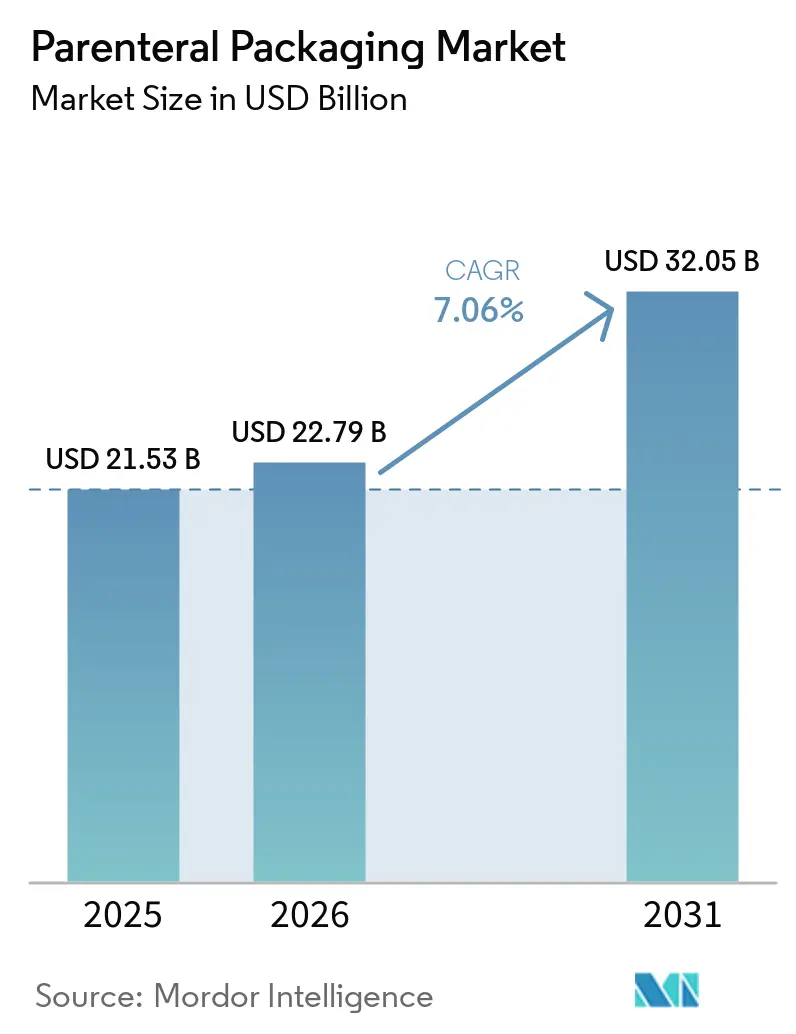
The parenteral packaging market is projected to expand from USD 21.53 billion in 2025 and USD 22.79 billion in 2026 to USD 32.05 billion by 2031, registering a CAGR of 7.06% between 2026 and 2031. The parenteral packaging market is growing because injectable biologics, monoclonal antibodies, biosimilars, and GLP-1 therapies need primary containers with stronger barrier performance and tighter compatibility control than traditional oral products. Packaging decisions now sit earlier in the development path because container closure integrity data and material compatibility are reviewed closely before approval, which makes packaging selection a timing issue for both originators and outsourced manufacturers. The parenteral packaging market is also being reshaped by a split regional pattern, with North America holding the largest position in 2025 and Asia-Pacific posting the fastest growth as biologics development and sterile manufacturing expand across newer hubs. Suppliers are responding with more ready-to-use vials, presterilized systems, and high-specification syringe and cartridge platforms because drug developers want shorter fill-finish changeovers and fewer component qualification risks. The parenteral packaging market still has room to grow as self-administration, biosimilar launches, and capacity additions in the United States and Asia widen the need for validated vial, syringe, cartridge, and closure systems.
Key Report Takeaways
- By product type, vials held 41.24% share in 2025, while prefilled syringes and cartridges are projected to grow at 8.10% CAGR through 2031.
- By material type, glass held 39.44% share in 2025, while plastic and polymer formats are forecasted to grow at 7.44% CAGR through 2031.
- By packaging type, small-volume parenteral packaging held 51.24% share in 2025 and is also expected to be the leading growth pocket through 2031.
- By end-user, pharmaceutical companies held 43.21% share in 2025, while biopharmaceutical companies are projected to grow at 9.14% CAGR through 2031.
- By geography, North America held 44.53% share in 2025, while the Asia-Pacific is projected to grow at 10.33% CAGR through 2031.
Note: Market size and forecast figures in this report are generated using Mordor Intelligence’s proprietary estimation framework, updated with the latest available data and insights as of January 2026.
Market Trends and Insights
Drivers Impact Analysis of Parenteral Packaging Market*
| Driver | (~) % Impact on CAGR Forecast | Geographic Relevance | Impact Timeline |
|---|---|---|---|
| Rising Adoption of Biologics and Specialty Injectables | +2.1% | Global | Long term (≥ 4 years) |
| Shift Toward Ready-to-Use and Presterilized Formats | +1.3% | North America and Europe, with spillover to Asia-Pacific | Medium term (2-4 years) |
| Expansion of Home-Care and Self-Administration Therapies | +1.0% | North America and Europe leading, with spillover to Asia-Pacific | Medium term (2-4 years) |
| Higher Demand for Container-Closure Integrity and Low-Extractables Systems | +0.9% | Global | Medium term (2-4 years) |
| Sustainability Pressure on Glass-To-Polymer Conversion | +0.5% | Europe led, with early gains in North America and Japan | Long term (≥ 4 years) |
| Aseptic Fill-Finish Capacity Expansion in Emerging Manufacturing Hubs | +0.8% | North America and Asia-Pacific core | Short term (≤ 2 years) to Medium term (2-4 years) |
| Source: Mordor Intelligence | |||
Rising Adoption of Biologics and Specialty Injectables
The parenteral packaging market is getting a direct lift from biologics, biosimilars, and specialty injectables because these products need validated primary containers and closures from the start. Each biosimilar developer must establish its own compatibility, extractables, leachables, and integrity profile for its own molecule and container combination, so packaging work rises faster than molecule counts alone would suggest. That dynamic gives the parenteral packaging market a deeper validation workload for every new launch, especially when the same therapy class expands across multiple sponsors and dosage forms. Stevanato Group reported that its GLP-1 packaging revenue grew by more than 50% in 2025, which shows how quickly one therapy class can change supplier demand.[1] The same pattern supports steady demand for high-specification vials, cartridges, syringes, and elastomeric components across the parenteral packaging market.
Shift Toward Ready-to-Use and Presterilized Formats
The parenteral packaging market is moving toward ready-to-use and presterilized formats because fill-finish operators want fewer washing, depyrogenation, and sterilization steps on-site. That change matters most for CDMOs and multi-product plants, where shorter preparation time frees line capacity and lowers the risk of disruption during product changeovers. SCHOTT Pharma expanded vial production in Lebanon, Pennsylvania in June 2026 and added capacity for standard and sterile ready-to-use glass vials, including its adaptiQ and EVERIC lines.[2] Gerresheimer also expanded its Wertheim site in 2025 with a new facility for sterile ready-to-fill vials under its EZ-fill Smart platform. As a result, the parenteral packaging market is treating ready-to-use formats less as a premium add-on and more as a practical way to protect throughput and supply reliability.
Expansion of Home-Care and Self-Administration Therapies
The parenteral packaging market is benefiting from the shift of many chronic therapies from infusion centers to home and outpatient settings. This shift is increasing demand for prefillable systems that support subcutaneous dosing, auto-injectors, wearables, and on-body delivery devices instead of traditional hospital-only formats. SCHOTT Pharma launched a large-volume prefillable glass syringe in July 2026 to support biologics moving from intravenous use toward self-administration.[3] A 2025 peer-reviewed review showed that on-body delivery devices for large-volume subcutaneous administration can match intravenous pharmacokinetic performance while avoiding the infrastructure burden of infusion settings. This pushes the parenteral packaging market toward tighter drug-device integration and raises the value of suppliers that can support both container performance and device compatibility.
Higher Demand for Container-Closure Integrity and Low-Extractables Systems
The parenteral packaging market is also being pushed by stronger expectations for deterministic and quantitative integrity testing. BioPhorum published a unified risk-based framework in 2026 that clarified when full validation is needed and when good scientific practice is sufficient under current CCI approaches. The ECA Visual Inspection Working Group also revised its position paper in late 2025 and added lifecycle control expectations for non-fusion-sealed containers such as vials and prefilled syringes. These steps make validation packages longer and more detailed, which favors suppliers that can provide pre-developed data, cleaner materials, and low-extractables closure systems. That same shift strengthens the role of the parenteral packaging market in approval readiness because packaging evidence now carries more weight throughout clinical and commercial change control.
Restraints Impact Analysis of Parenteral Packaging Market*
| Restraint | (~) % Impact on CAGR Forecast | Geographic Relevance | Impact Timeline |
|---|---|---|---|
| High Validation Burden for Container Closure Compatibility | -0.7% | Global | Medium term (2-4 years) |
| Elevated Cost of High-Barrier and Sterile-Ready Formats | -0.5% | Europe and North America | Short term (≤ 2 years) to Medium term (2-4 years) |
| Breakage And Particulate Risk in Glass-Based Systems | -0.3% | Global | Long term (≥ 4 years) |
| Supply Tightness in Elastomeric Components and Specialty Resins | -0.4% | Global | Short term (≤ 2 years) |
| Source: Mordor Intelligence | |||
High Validation Burden for Container Closure Compatibility
The parenteral packaging market faces a real speed limit because any change in container material, coatings, siliconization, or closure composition can trigger new compatibility and integrity work. Under current guidance, this burden extends beyond first qualification and becomes part of routine change control across development and commercial supply. That slows switching between suppliers, formats, and sterilization approaches, even when a technical replacement appears straightforward. A 2026 paper in the Journal of Pharmaceutical Sciences noted that difficult-to-test parenteral products, including advanced biologic formats and novel container geometries, still lack standardized deterministic methods in some cases. This leaves the parenteral packaging market with longer qualification cycles and more hesitation around rapid adoption of new component systems.
Elevated Cost of High-Barrier and Sterile-Ready Formats
The parenteral packaging market also has a cost barrier because high-barrier polymers, specialty elastomers, and sterile-ready formats carry a premium over standard components. That premium is easier to justify for sensitive biologics and expensive therapies, but it is harder to absorb for routine products with tighter pricing structures. Polymer systems such as COC and COP are gaining favor in sensitive formulations because they reduce breakage and help limit some glass-related particulate concerns, yet they still require a stronger value case than conventional Type I glass in many programs. The result is a parenteral packaging market where demand is rising for premium systems, but adoption still depends on the drug profile, validation burden, and the commercial value of dose protection.
*Our forecasts treat driver/restraint impacts as directional, not additive. The impact forecasts reflect baseline growth, mix effects, and variable interactions.
Parenteral Packaging Market Segment Analysis
By Product Type:
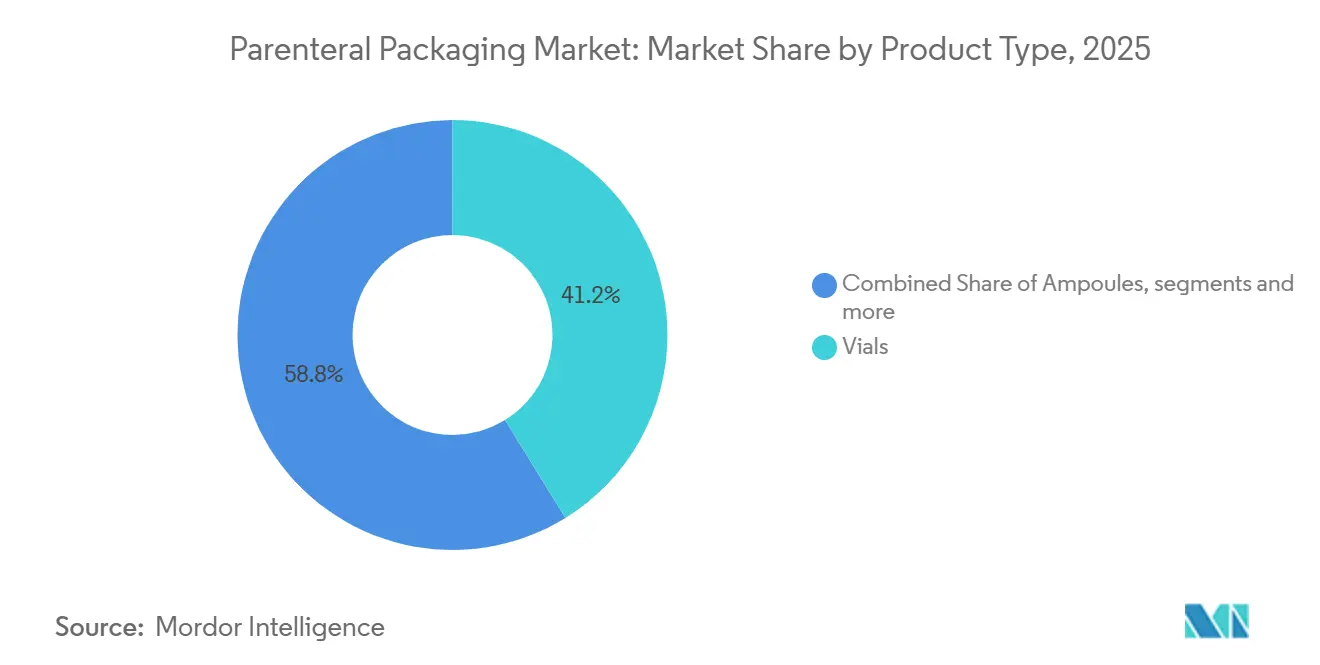
Prefilled Formats Gain as Self-Administration ExpandsVials held 41.24% of the parenteral packaging market share within product type in 2025, while prefilled syringes and cartridges are expected to advance at 8.10% CAGR through 2031. Vials remain deeply embedded in hospital production, CDMO fill-finish lines, and lyophilized or multi-dose applications, so their installed base still matters to the parenteral packaging market. Prefilled syringes and cartridges are gaining popularity faster because developers are converting more chronic therapies into single-use formats that simplify dosing, reduce handling, and fit home-care delivery models.
The parenteral packaging market is seeing this shift most clearly in GLP-1 treatments, subcutaneous monoclonal antibodies, and insulin-related programs, where device compatibility matters almost as much as container protection. The operational case for conversion is also becoming clearer across the parenteral packaging market. Prefilled formats reduce manual preparation steps and help lower product loss linked to withdrawal and dosing variability, which matters more when the active ingredient is costly.

By Material Type:
Polymer Systems Gain Ground in Sensitive FormulationsGlass held 39.44% of the material segment in 2025, while the parenteral packaging market for plastic and polymer formats is projected to expand at 7.44% CAGR through 2031. Glass still anchors a large part of the parenteral packaging market because it has a long validation history, established pharmacopoeial acceptance, and broad familiarity across originators, generic producers, and outsourced manufacturers. At the same time, plastic and polymer formats are gaining popularity because sensitive biologics can react poorly to some glass surface issues, and developers want lower fragmentation risk in transport and use.
The parenteral packaging market is not shifting away from glass in a uniform way. PVC still has a role in large-volume parenteral bags, while polyolefin formats such as polypropylene and polyethylene are drawing interest where recyclability and drug compatibility support the case for substitution. Material choice now depends less on broad category preference and more on the interplay between drug chemistry, particulate risk, sterilization route, and final delivery device.
By Packaging Type:
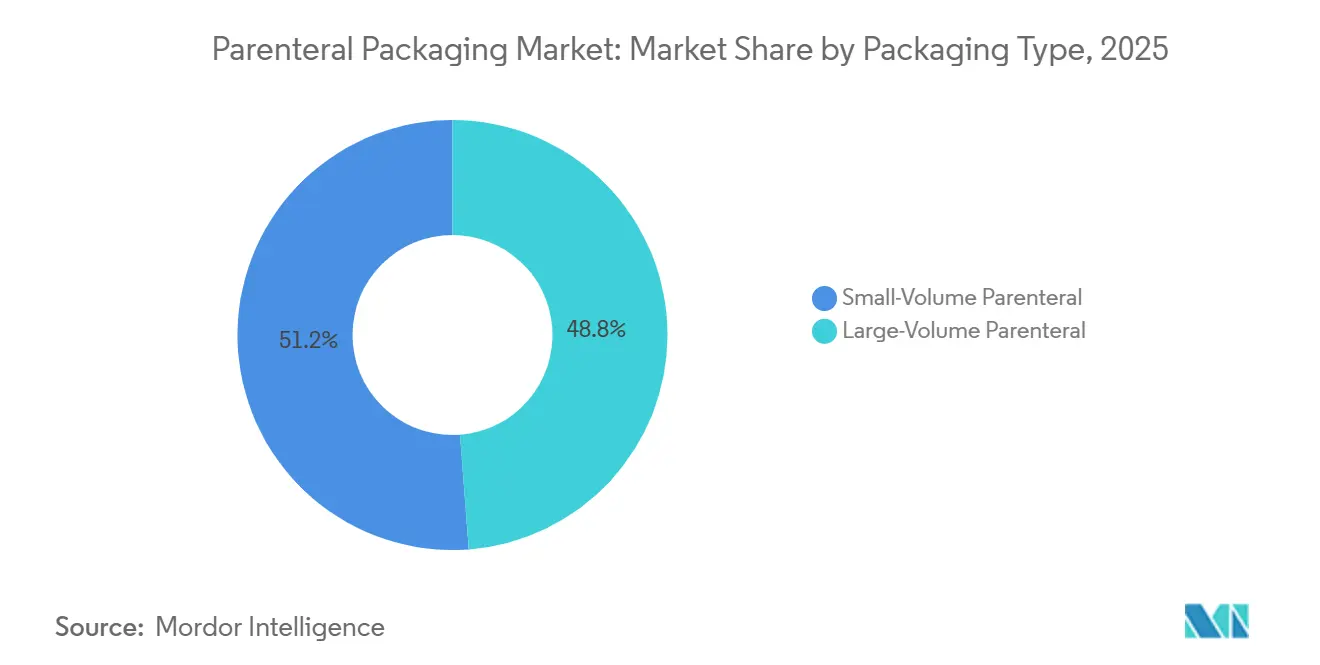
Small-Volume Formats Stay Central to Biologics DemandSmall-volume parenteral packaging held 51.24% share in 2025 and is also expected to grow at 8.54% CAGR through 2031, which kept it at the center of the parenteral packaging market. This segment includes prefilled syringes, cartridges, and vials of 100 mL or less, and it aligns closely with the way most high-value biologics reach patients today. Oncology, immunology, and GLP-1 programs all lean toward single-dose subcutaneous or intramuscular use, so small-volume formats continue to absorb the strongest demand across the parenteral packaging market. For smaller oncology and rare disease programs, long reservation cycles by larger GLP-1 customers can make procurement harder and lengthen qualification planning.
Large-volume parenteral packaging faces a different demand path within the parenteral packaging market. Bags and bottles remain necessary for intravenous fluids, nutrition, and certain hospital antibiotics, but they do not benefit from the same self-administration trend as small-volume formats. SCHOTT Pharma’s July 2026 launch of a large-volume prefillable glass syringe shows how suppliers are targeting this transition point between classic infusion and newer subcutaneous delivery models.
By End-User:
Biopharmaceutical Demand is Rising Faster than Traditional PharmaPharmaceutical companies held 43.21% share in 2025, while biopharmaceutical companies are projected to expand at 9.14% CAGR through 2031. This split matters because the parenteral packaging market is increasingly shaped by firms working on gene therapies, cell therapies, RNA-based products, biosimilars, and complex biologics that need packaging approaches beyond long-established drug formats. Biopharmaceutical customers often need more guidance on drug-container interaction, closure integrity planning, and component selection, which increases demand for suppliers that can deliver technical support alongside physical packaging. Traditional pharmaceutical companies still account for the largest share because they have broader sourcing frameworks, higher recurring procurement volume, and stronger internal fill-finish capabilities.
CDMOs and CPOs remain strategically important to the parenteral packaging market because they aggregate purchasing across multiple client programs and often drive component demand faster than any single sponsor. Hospitals and healthcare facilities add a stable base of demand for standard small-volume formats used in surgery, emergency medicine, and critical care. This mix means the parenteral packaging market is being pulled by both innovation-heavy buyers that need advanced support and volume-heavy buyers that need dependable, repeatable supply.
Geography Analysis
North America Parenteral Packaging Market
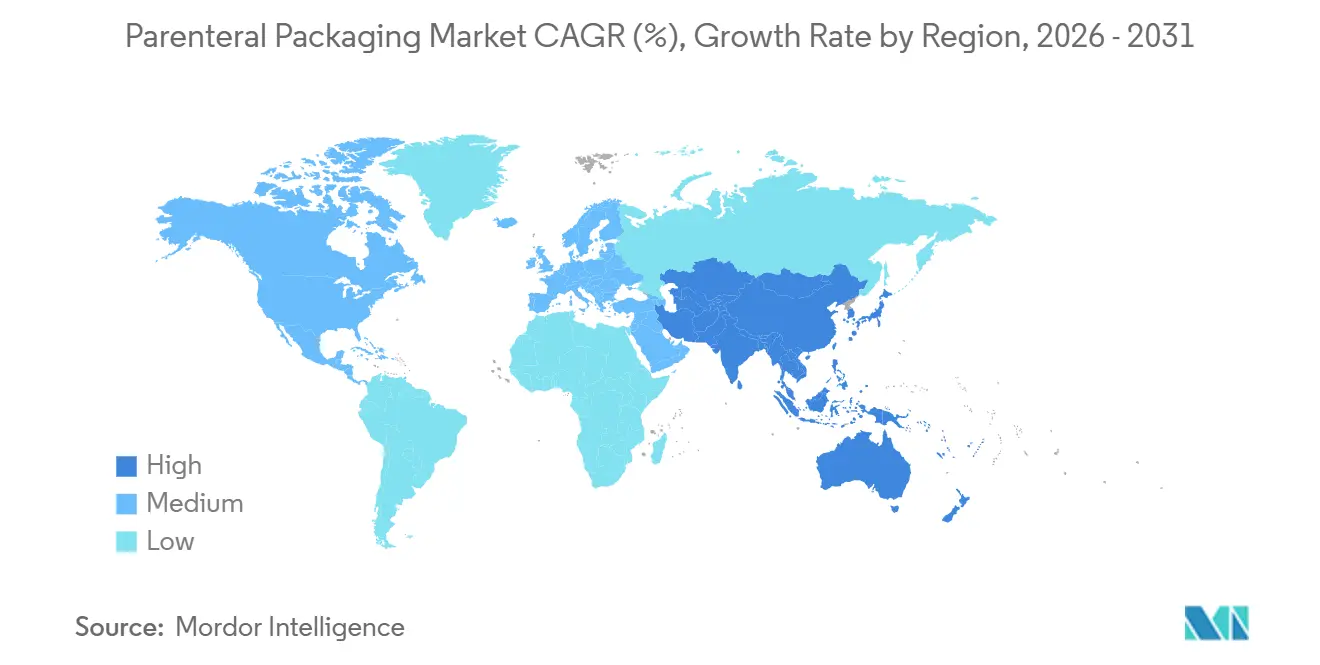
North America accounted for 44.53% share of the parenteral packaging market in 2025, which kept it in the leading regional position. The region benefits from a dense concentration of biologics manufacturing, fill-finish operations, and regulatory oversight that gives container validation and integrity testing a central role in product approval. The parenteral packaging market in the United States is also supported by domestic supply chain investment, especially in ready-to-use vial capacity and advanced sterile systems. SCHOTT Pharma inaugurated expanded production in Lebanon, Pennsylvania, in June 2026 and said the investment added new standard and sterile ready-to-use glass vial lines while more than tripling local capacity for higher-value solutions. PCI Pharma Services also announced a broader sterile fill-finish expansion program in April 2026 that included a new high-speed isolator filling line in San Diego for ready-to-use prefilled syringes and cartridges.
Europe Parenteral Packaging Market
Europe remains the second-largest regional block in the parenteral packaging market because it has a dense base of pharmaceutical glass and polymer container specialists. Regional suppliers continue to serve both local fill-finish operations and global export demand, which keeps Europe central to primary container and component supply. Gerresheimer expanded its Wertheim site in 2025 to strengthen sterile ready-to-fill vial output, which reflects steady demand for premium pharmaceutical packaging in the region. European producers are also trying to lower the carbon footprint of packaging operations without disrupting validated material systems, which supports investment in cleaner production rather than abrupt material substitution.
APAC, South America and MEA Parenteral Packaging Market
Asia-Pacific is projected to grow at 10.33% CAGR through 2031, making it the fastest-growing region in the parenteral packaging market. China remains an important demand center for biologics packaging, and West Pharmaceutical Services used CPHI and PMEC China 2026 to launch its integrated prefillable syringe system for that ecosystem. India is building both local demand and manufacturing depth, with Amcor expanding healthcare packaging production in Karnataka in June 2026 and Nipro having added glass cartridge capacity at Pune in 2025 for wider regional use. South America, the Middle East, and Africa remain smaller parts of the parenteral packaging market, with growth tied more closely to healthcare infrastructure spending and local pharmaceutical manufacturing build-out than to large global supply leadership.
Competitive Landscape
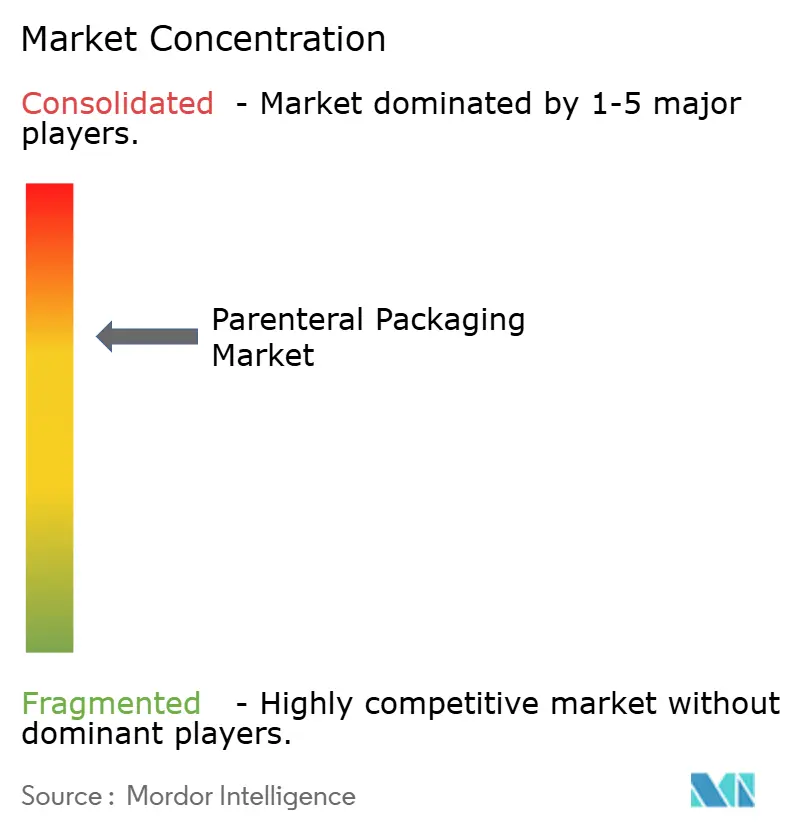
The parenteral packaging market is moderately consolidated at the primary container level, where a limited group of established suppliers in glass, elastomer, and polymer systems still sets the pace for global injectable packaging supply. Competition is no longer based mainly on component price because customers increasingly choose partners that can provide compatibility support, closure integrity documentation, and cleaner change-control pathways. That shifts the parenteral packaging market toward higher-value supplier relationships, especially in biologics and device-linked dosage forms where qualification risk is high. It also raises entry barriers because new participants must show material performance, regulatory readiness, and dependable manufacturing quality at the same time. As a result, the parenteral packaging market rewards companies that combine scale with technical service and a stable production footprint.
Recent strategic moves show how leaders are positioning themselves in the parenteral packaging market. Gerresheimer expanded ready-to-fill vial capability in Wertheim in 2025 and later announced a partnership with Milliken in 2026 to advance protection and performance through its LeneX UltraGuard technology. West Pharmaceutical Services introduced the Synchrony S1 platform in early 2026, which signaled that integrated component systems are becoming a stronger competitive tool than single-part offerings alone.
There is still open space in the parenteral packaging market for ultra-sensitive polymer systems, low-temperature capable containers, and tighter digital links between packaging data and fill-finish analytics. Asian suppliers are also building regional capacity in cartridges, healthcare packaging, and injectable support formats, which may put more pressure on standard products over time. Even so, buyers in the parenteral packaging market are likely to keep favoring suppliers that can offer dual-sourcing flexibility, proven validation packages, and steady delivery through fast demand swings. That means future competition should stay centered on reliability, regulatory preparedness, and device-ready product design rather than on volume alone.
Parenteral Packaging Industry Leaders
-
Gerresheimer AG
-
SCHOTT AG
-
West Pharmaceutical Services, Inc.
-
Stevanato Group S.p.A.
-
Becton, Dickinson and Company
- *Disclaimer: Major Players sorted in no particular order
Parenteral Packaging Market Companies Covered in this Report
- Amcor plc
- AptarGroup, Inc.
- Baxter
- Beckton Dickinson
- Berry Global, Inc.
- Catalent
- Corning
- Daikyo Seiko, Ltd.
- Gerresheimer
- Nipro
- Owen-Illinois, Inc.
- Piramal Glass Private Limited
- SCHOTT
- SGD Pharma
- Shandong Pharmaceutical Glass Co., Ltd.
- Stevanato Group
- Terumo
- West Pharmaceutical Services
- WestRock Company
- Ypsomed
Recent Industry Developments in Parenteral Packaging Market
- July 2026: West Pharmaceutical Services completed the sale of its SmartDose 3.5 mL on-body delivery system to AbbVie for total consideration of USD 112.5 million, allowing West to focus on larger-volume SmartDose platforms and elastomeric closure portfolios. The divestiture repositions West's device strategy toward scalable multi-molecule platforms.
- July 2026: SCHOTT Pharma launched a large-volume prefillable glass syringe and a ready-to-use polymer cartridge simultaneously, targeting the growing pipeline of subcutaneous biologics transitioning from IV infusion formats and the biosimilar pen-injector market, respectively.
- June 2026: SCHOTT Pharma inaugurated expanded production lines in Lebanon, Pennsylvania, with over USD 60 million in investment, adding new ready-to-use vial capacity that more than triples local high-value production for adaptiQ and EVERIC pure vials.
Global Parenteral Packaging Market Report Scope
According to the report’s scope, the parenteral packaging market comprises packaging solutions designed for injectable pharmaceuticals and biologics administered via intravenous, intramuscular, or subcutaneous routes. The market includes vials, ampoules, prefilled syringes, cartridges, infusion bags, and related closure systems that ensure sterility, product stability, contamination prevention, and safe drug delivery throughout storage, transportation, and administration.
The parenteral packaging market is segmented into product type, material type, packaging type, end-user, and geography. By product type, the market is segmented into vials, ampoules, prefilled syringes and cartridges, bags and bottles, and ready-to-mix systems. By material type, the market is segmented into glass, plastic and polymer, poly vinyl chloride, and polyolefin. By packaging type, the market is segmented into small-volume parenteral and large-volume parenteral. By end-user, the market is segmented into pharmaceutical companies, biopharmaceutical companies, CDMOs / CPOs, and hospitals & healthcare facilities. By geography, the market is segmented into North America, Europe, Asia-Pacific, the Middle East and Africa, and South America. The report also covers the estimated market sizes and trends for 17 countries across major regions globally. The report offers values (USD) for all the above segments.
Segmentation Overview
| Vials |
| Ampoules |
| Prefilled Syringes and Cartridges |
| Bags and Bottles |
| Ready-to-Mix Systems |
| Glass |
| Plastic and Polymer |
| Poly Vinyl Chloride |
| Polyolefin |
| Small-Volume Parenteral |
| Large-Volume Parenteral |
| Pharmaceutical Companies |
| Biopharmaceutical Companies |
| CDMOs / CPOs |
| Hospitals & Healthcare Facilities |
| North America | United States |
| Canada | |
| Mexico | |
| Europe | Germany |
| United Kingdom | |
| France | |
| Italy | |
| Spain | |
| Rest of Europe | |
| Asia-Pacific | China |
| Japan | |
| India | |
| Australia | |
| South Korea | |
| Rest of Asia-Pacific | |
| Middle East and Africa | GCC |
| South Africa | |
| Rest of Middle East and Africa | |
| South America | Brazil |
| Argentina | |
| Rest of South America |
| By Product Type | Vials | |
| Ampoules | ||
| Prefilled Syringes and Cartridges | ||
| Bags and Bottles | ||
| Ready-to-Mix Systems | ||
| By Material Type | Glass | |
| Plastic and Polymer | ||
| Poly Vinyl Chloride | ||
| Polyolefin | ||
| By Packaging Type | Small-Volume Parenteral | |
| Large-Volume Parenteral | ||
| By End-User | Pharmaceutical Companies | |
| Biopharmaceutical Companies | ||
| CDMOs / CPOs | ||
| Hospitals & Healthcare Facilities | ||
| By Geography | North America | United States |
| Canada | ||
| Mexico | ||
| Europe | Germany | |
| United Kingdom | ||
| France | ||
| Italy | ||
| Spain | ||
| Rest of Europe | ||
| Asia-Pacific | China | |
| Japan | ||
| India | ||
| Australia | ||
| South Korea | ||
| Rest of Asia-Pacific | ||
| Middle East and Africa | GCC | |
| South Africa | ||
| Rest of Middle East and Africa | ||
| South America | Brazil | |
| Argentina | ||
| Rest of South America | ||
Key Questions Answered in the Report
What is the projected value of the parenteral packaging space by 2031?
The parenteral packaging market is projected to reach USD 32.05 billion by 2031, up from USD 21.53 billion to USD 22.79 billion in 2026, with a 7.06% CAGR from 2026 to 2031.
Which product format is growing fastest in injectable packaging?
Prefilled syringes and cartridges are the fastest-growing product type, with a projected 8.10% CAGR through 2031, supported by self-administration and device-linked dosing.
Why are polymer formats gaining traction in parenteral applications?
Plastic and polymer formats are forecasted to grow at 7.44% CAGR because sensitive biologics need lower breakage risk, tighter compatibility, and better control over some glass-related particulate concerns.
Which region leads current demand, and which region is growing fastest?
North America led with 44.53% share in 2025, while Asia-Pacific is projected to be the fastest-growing region with a 10.33% CAGR through 2031.