
Pakistan Liquid Packaging Cartons Market Size and Share
Market Overview
| Study Period | 2021 - 2032 |
|---|---|
| Forecast Data Period | 2027 - 2032 |
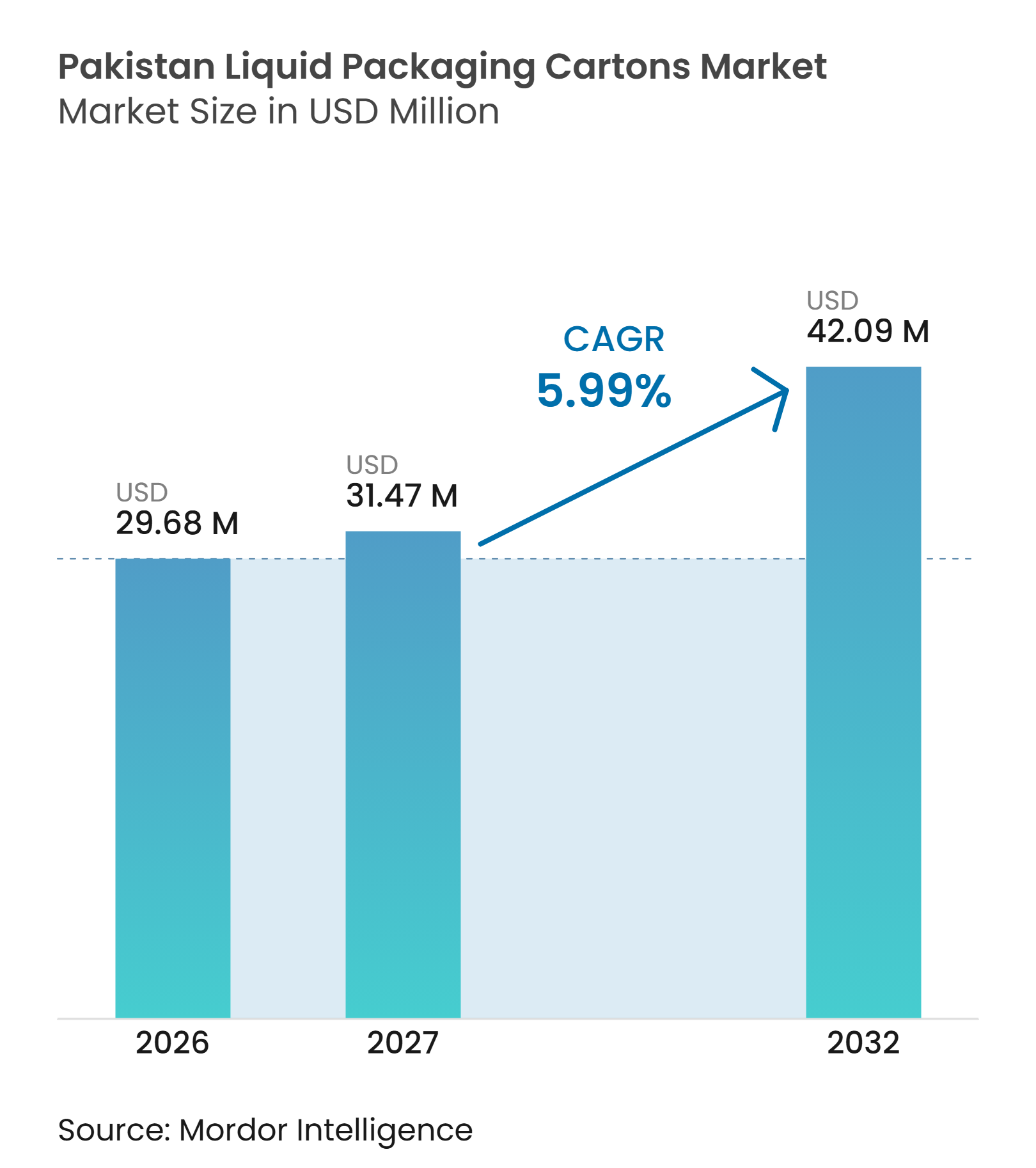
| Base Year Market Size (2026) | USD 29.68 Million |
| Market Size (2027) | USD 31.47 Million |
| Market Size (2032) | USD 42.09 Million |
| Growth Rate (2027 - 2032) | 5.99 % |
| Market Concentration | High |
Major Players *Disclaimer: Major Players sorted in no particular order Image © Mordor Intelligence. Reuse requires attribution under CC BY 4.0. | |
Pakistan Liquid Packaging Cartons Market Analysis by Mordor Intelligence
The Pakistan Liquid Packaging Cartons Market size is expected to grow from USD 29.68 million in 2026 to USD 31.47 million in 2027 and is forecast to reach USD 42.09 million by 2032 at 5.99% CAGR over 2027-2032.
The Pakistan liquid packaging cartons market is supported by the need to distribute milk and beverages beyond limited refrigerated logistics. Formal dairy processing remains a central opportunity because much of Pakistan's milk supply is sold outside the organized channel. The 18% GST on packaged dairy continues to constrain formal milk volumes, while small packs and ambient distribution help producers reach price-sensitive consumers. Suppliers are responding with compact filling equipment, paper-based barriers, and recycling partnerships that can improve access to export-oriented customers and strengthen end-of-life collection.
Key Report Takeaways
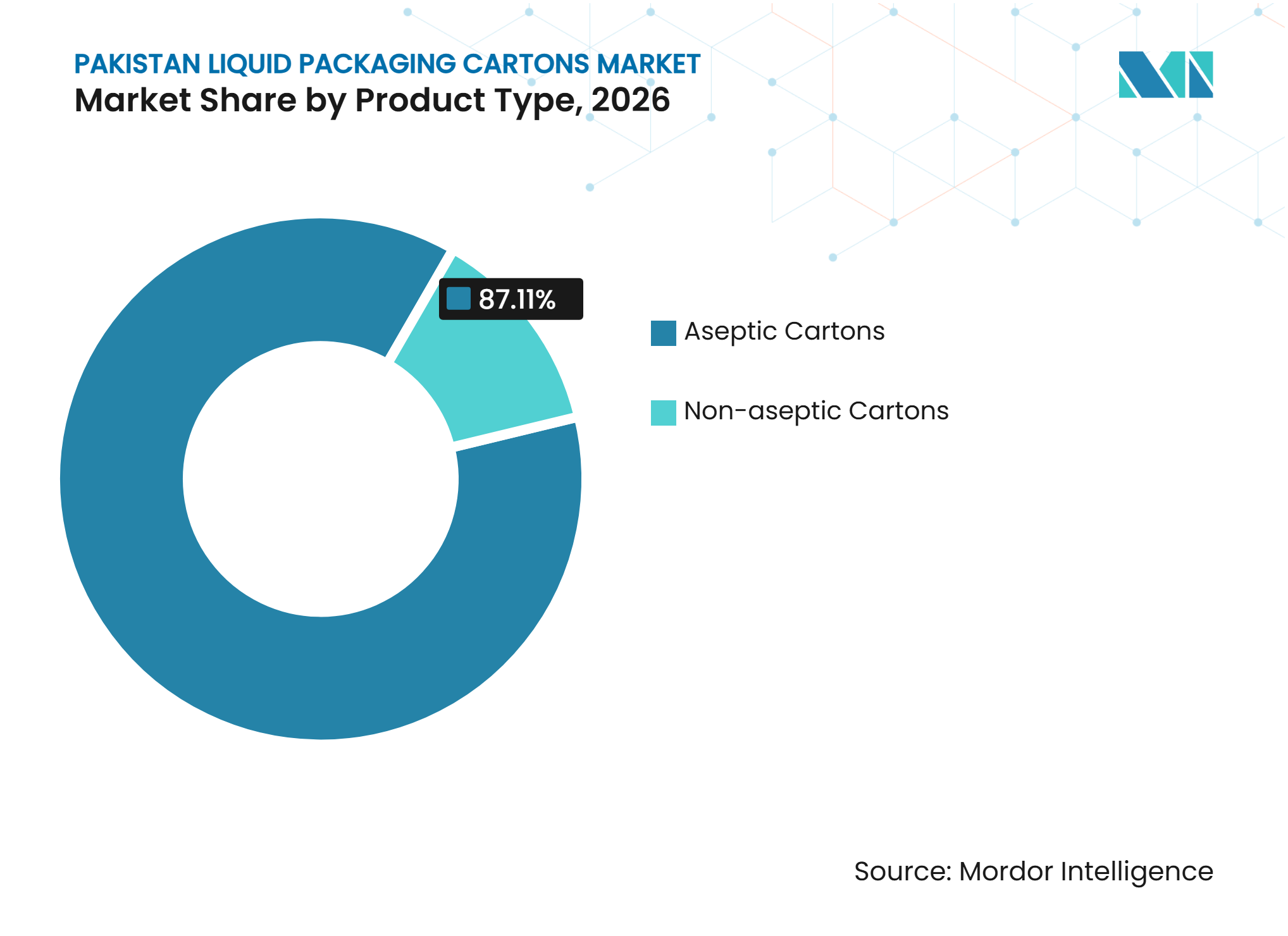
- By product type, aseptic cartons held 87.11% of the Pakistan liquid packaging cartons market share in 2026 and are projected to expand at a 6.16% CAGR through 2032.
- By application, milk accounted for 68.93% of the Pakistan liquid packaging cartons market size in 2026, while plant-based beverages are projected to expand at a 6.99% CAGR through 2032.
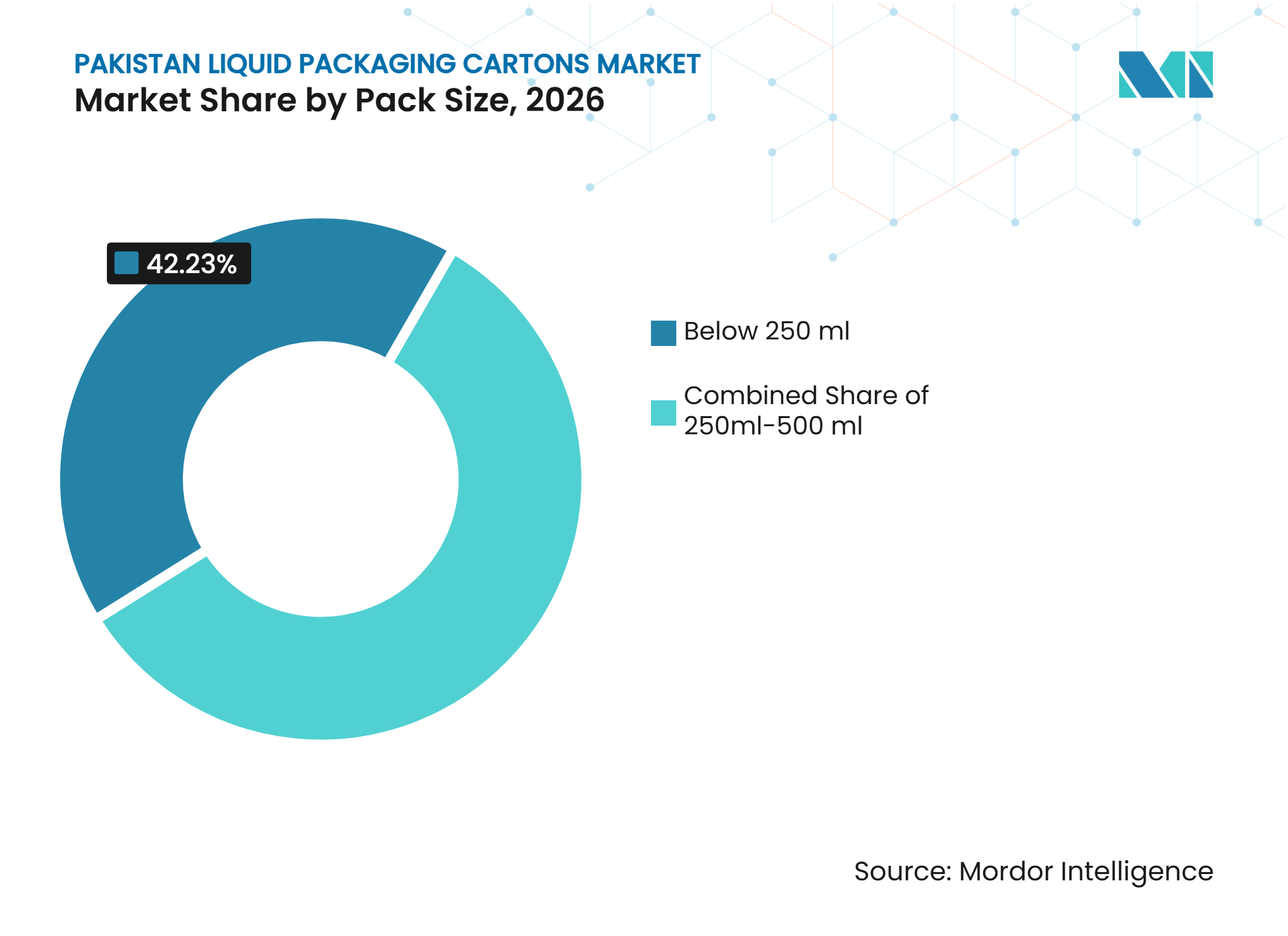
- By pack size, below 250 ml formats held 42.23% market share in 2026 and are projected to expand at a 6.54% CAGR through 2032.
Note: Market numbers in this report are based on Mordor Intelligence's proprietary estimation framework, which combines nine months of actuals with Q4 projections for base year 2026.
Market Trends and Insights
Drivers Impact Analysis of Pakistan Liquid Packaging Cartons Market*
| Driver | (~) % Impact on CAGR Forecast | Geographic Relevance | Impact Timeline |
|---|---|---|---|
| Formalization of Packaged Milk Consumption | +2.1% | National, with early gains in Lahore, Faisalabad, and Karachi | Long term (≥ 4 years) |
| Ambient Distribution for Milk and Juice | +1.4% | National, with faster uptake in urban Punjab and Sindh | Medium term (2-4 years) |
| Small-Format On-the-Go Beverage Packs | +1.1% | Karachi, Lahore, and Islamabad | Medium term (2-4 years) |
| Demand for Fiber-Based Packaging | +0.7% | Global supply chains and export-focused Pakistan processors | Long term (≥ 4 years) |
| Retail and Cold-Chain Modernization | +0.6% | Urban Punjab and Sindh corridors | Medium term (2-4 years) |
| Local Recycling Partnerships | +0.4% | Lahore, Karachi, and Faisalabad collection hubs | Medium term (2-4 years) |
| Source: Mordor Intelligence | |||
Rising Formalization of Packaged Milk Consumption
The Pakistan liquid packaging cartons market has a large addressable base because formal dairy consumption remains low relative to national milk output. Pakistan produced more than 70 billion liters of milk annually, while only 3%-4% of the population consumed packaged milk, according to the Pakistan Dairy Association. Pakistan ranked among the world’s leading milk producers, yet less than 10% of milk moved through formal processing channels. Each shift from loose milk to UHT processing requires aseptic filling and supports carton demand. Policy discussions convened by the Sustainable Development Policy Institute called for a lower GST rate and greater formalization of loose milk trading. The same discussions identified milk collection centers, chilling capacity, and logistics as requirements for a more formal dairy system. This structure leaves the Pakistan liquid packaging cartons market tied to the pace at which processors can move consumers into regulated packaged dairy channels.
Expansion of Ambient Distribution for Milk and Juice
Ambient distribution remains a practical route for beverage producers serving areas without dependable cold storage. Fewer than 6% of Pakistan’s perishable goods move through temperature-controlled logistics. Aseptic cartons allow UHT milk, juices, and similar products to travel and remain shelf-stable without refrigerated handling. This capability gives the Pakistan liquid packaging cartons market an advantage where retail outlets cannot fund or reliably operate cold equipment. Tetra Pak said its Prisma Aseptic 300 Edge format, used with the A3/CompactFlex platform, allows rapid changes between pack sizes for producers serving varied distribution conditions. Each additional ambient route can extend formal beverage availability without requiring cold-storage investment at the point of sale. The format therefore remains relevant even when dairy tax policy limits overall packaged-milk consumption.
Growth of Small-Format, On-the-Go Beverage Packs
Small cartons align with the purchasing patterns of consumers who buy individual beverages at kiosks, schools, and transit locations. Formats below 200 ml lower the upfront cost of a purchase and can make packaged products more accessible to lower-income households. Dairyland commissioned Pakistan’s first SIG XSlim 24 aseptic filling machine, which handles nine volumes from 80 ml to 200 ml at 24,000 packs per hour. The equipment supports producers that need multiple stock-keeping units without installing a dedicated line for each pack size. Organized retail and quick-commerce operations in Karachi and Lahore can broaden access to these small formats. The Pakistan liquid packaging cartons market can therefore benefit from equipment that aligns production economics with frequent, lower-value purchases.
Sustainability-Led Demand for Fiber-Based Packaging
Export-facing processors are preparing for sustainability requirements that affect packaging sourcing and product documentation. Packages Group held a September 2026 session covering the EU Deforestation Regulation, the Corporate Sustainability Due Diligence Directive, the Ecodesign for Sustainable Products Regulation, and the Digital Product Passport. Fiber-based aseptic cartons can offer a credible option where customers seek renewable content and documented material sourcing. Tetra Pak extended its paper-based barrier technology to high-speed A3/Speed lines in February 2026.[1] The company stated that the Tetra Brik Aseptic 200 Slim carton reached 87% renewable content and had a 26% lower carbon footprint than aluminum-barrier equivalents, based on Carbon Trust verification. Domestic demand may still prioritize price and availability, but procurement requirements from multinational customers can favor suppliers with compatible materials and traceability. This supports a longer-term sustainability pathway in the Pakistan liquid packaging cartons market.
Restraints Impact Analysis of Pakistan Liquid Packaging Cartons Market*
| Restraint | (~) % Impact on CAGR Forecast | Geographic Relevance | Impact Timeline |
|---|---|---|---|
| GST Pressure on Formal Packaged Dairy Demand | -1.5% | National, with greater pressure in rural and peri-urban markets | Short term (≤ 2 years) |
| Imported Barrier Materials and Foreign-Exchange Exposure | -1.0% | National, across converters using imported polyethylene and aluminum foil | Medium term (2-4 years) |
| Low Used Carton Collection Density | -0.5% | National, especially Tier 2 and Tier 3 cities | Long term (≥ 4 years) |
| Fragmented Filling Infrastructure and Uneven Food-Safety Enforcement | -0.4% | Rural Punjab, Khyber Pakhtunkhwa, and Balochistan | Long term (≥ 4 years) |
| Source: Mordor Intelligence | |||
GST Pressure on Formal Packaged Dairy Demand
The 18% GST on packaged dairy has shifted demand away from formal packaged dairy products and toward loose milk. The Pakistan Dairy Association reported a 20% decline in formal packaged milk volumes after the tax was introduced, with more than 500 processing units closing and employment falling by 20%. The association also reported that dairy tax receipts rose to PKR 44 billion (USD 158.68 million) in fiscal year 2024-2025 from PKR 13.72 billion (USD 49.48 million) in the prior year. Loose milk remains untaxed and is consumed by most households, which weakens the formal channel that uses aseptic cartons. The Pakistan liquid packaging cartons market is exposed because milk remains the leading application for the format. Stakeholders have proposed reducing the GST to 5%-10% to support formalization and improve the taxable processing base. Any tax adjustment would be important for carton volumes, as it could restore demand among formal processors.
Imported Barrier Materials and Foreign-Exchange Exposure
Aseptic carton production depends on aluminum foil, low-density polyethylene, and multilayer barrier inputs that are largely imported. Pakistan’s currency movements between 2023 and 2025 raised input costs and placed pressure on converter margins. The lack of commercial-scale domestic production of polyethylene film limits the ability to localize these inputs. Packaging represented 5%-6% of an FMCG company’s total cost structure, allowing many buyers to accept price adjustments to avoid disruption to filling operations. Freight increases and war-risk insurance premiums added further supply-chain cost pressure in 2026, according to FrieslandCampina Engro Pakistan’s first-half results commentary. The Pakistan liquid packaging cartons market can maintain volumes under this model, but converter profitability remains exposed to foreign-exchange and commodity costs.
*Our forecasts treat driver/restraint impacts as directional, not additive. The impact forecasts reflect baseline growth, mix effects, and variable interactions.
Pakistan Liquid Packaging Cartons Market Segment Analysis
By Product Type:
Aseptic Cartons Support National DistributionAseptic cartons held 87.11% of Pakistan's liquid packaging carton market share in 2026 and are projected to expand at a 6.16% CAGR through 2032. Their position reflects the need to distribute products at ambient temperatures where refrigerated logistics are scarce. Fewer than 6% of perishable goods move through temperature-controlled channels, making shelf-stable packaging important for national beverage distribution. UHT milk remains the principal volume user, while juices, plant-based beverages, and functional drinks also use the format. This product type lets processors protect product quality during longer routes and reduce their reliance on refrigerated outlets.
Tetra Pak’s February 2026 paper-based barrier extension to the A3/Speed lines offers high-volume processors a material option that can reduce the format’s footprint. The company reported 87% renewable content and a 26% lower carbon footprint for the related carton solution compared with aluminum-barrier alternatives. Their distribution is more limited because dependable cold chains are concentrated around large metropolitan areas. Supermarkets, hypermarkets, and quick-commerce operators in Karachi and Lahore can support the selection of chilled products, but wider adoption depends on additional cold-storage investment and reliable temperature management throughout the delivery process. The Pakistan liquid packaging cartons market is therefore likely to remain centered on aseptic formats, while ambient distribution is the more scalable route.



By Application:
Milk Anchors Demand and Plant-Based Beverages AdvanceMilk accounted for 68.93% of the liquid packaging carton market in Pakistan in 2026. Pakistan produced more than 70 billion liters of milk each year, yet less than 10% entered formal processing, creating a substantial opportunity for UHT dairy packaging. The 18% GST reduced formal packaged-milk volumes, but milk remained the largest carton application because no other category reached similar absolute volumes. Juices represented another important use, although additional duties have weakened the formal juice category. Formal juice revenue declined significantly by 2025 from the levels projected for fiscal year 2023.
Plant-based beverages are projected to expand at a 6.99% CAGR through 2032, the fastest rate among applications in the Pakistan liquid packaging cartons market. Imports of liquid non-dairy creamer increased 88.96% from 2023 to 2024, indicating wider interest in dairy alternatives. A 2025 study found consumer acceptance for oat-almond beverage blends in Pakistan, while oat, soy, almond, and coconut products are becoming more available through organized retail and café channels. Aseptic cartons are well-suited to these products because UHT plant-based beverages require barrier performance comparable to that of conventional dairy. The Pakistan liquid packaging cartons industry can use existing aseptic infrastructure to serve this emerging application without relying on a separate distribution model.
By Pack Size:
Below 250 ml Formats Combine Affordability and FlexibilityBelow 250 ml packs held a 42.23% share in 2026 and are projected to expand at a 6.54% CAGR through 2032. These formats suit individual purchases at kiosks, schools, workplaces, and transit points. Their lower upfront price helps consumers who may not purchase family-size packs. Small packs can be distributed through convenience channels that are not designed to hold large household quantities. This behavior is particularly relevant to products sold through vending and convenience channels.
Dairyland’s SIG XSlim 24 line handles 80 ml to 200 ml volumes and produces 24,000 packs per hour, showing that local investment is aligned with smaller cartons.[2] The 250-500 ml range serves consumers seeking a full milk or juice serving at a contained price point. Packs above 500 ml, mainly 1-liter formats, remain household staples but have a slower profile as shoppers make smaller, more frequent purchases. Quick-commerce and modern retail can reinforce this shift by encouraging small-basket buying and faster stock rotation. The Pakistan liquid packaging cartons market can benefit from multi-volume lines, as they enable suppliers to serve multiple pack sizes from a single platform.

Geography Analysis
Punjab
Punjab is the main demand center for the Pakistan liquid packaging cartons market because it has the largest concentration of UHT dairy processing and consumer goods manufacturing. Lahore and Faisalabad host a major group of filling lines, FMCG facilities, and processors that use aseptic cartons. Tetra Pak operates in Sundar Industrial Estate, Lahore, which places it close to local dairy and beverage customers. Organized retailers, including Carrefour, Al-Fatah, Metro Cash and Carry, and hypermarkets along Lahore’s Ring Road, provide formal channels for shelf-stable beverages. Quick-commerce and dark-store operations also support frequent purchases of smaller cartons in the province.
Sindh
Sindh plays a strategic role in Pakistan's liquid packaging cartons market because Karachi is the primary entry point for imported aluminum foil, polyethylene, and other barrier materials. The city’s industrial areas also support demand from beverage, liquid food, and functional-drink manufacturers. Dark-store networks in Karachi are expanding access to single-serve packaged beverages in dense urban neighborhoods. Ambient cartons remain useful beyond the immediate metropolitan market where cold distribution is not consistently available. FrieslandCampina Engro Pakistan reported a 12.1% increase in first-half 2026 revenue, indicating continuing formal FMCG demand despite dairy tax pressure.
Khyber Pakhtunkhwa, Balochistan, and Azad Kashmir
Khyber Pakhtunkhwa, Balochistan, and Azad Kashmir account for a smaller but growing share of the Pakistan liquid packaging cartons market. Improving roads and mobile commerce can extend the reach of packaged beverages into locations that have historically relied on informal milk channels. Balochistan remains harder to serve because of sparse population, limited formal retail, and continued reliance on loose commodity markets. Food-safety compliance under PSQCA standards can become more important as formal retailers expand, favoring suppliers that can provide consistent product labeling and packaging integrity.
Competitive Landscape
Market Concentration
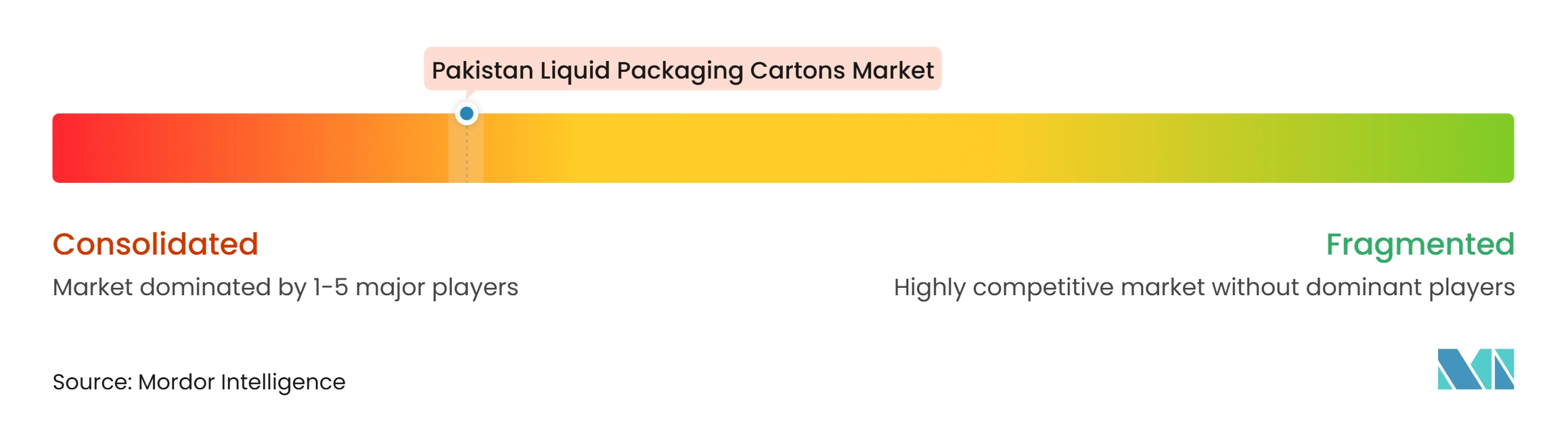
The Pakistan liquid packaging cartons market is concentrated around Tetra Pak’s installed filling lines and its supply relationships with UHT dairy and juice processors. This equipment base makes replacement difficult because a competing supplier must overcome both sleeve pricing and the cost of changing production equipment. SIG has strengthened its local position through Dairyland’s first SIG XSlim 24 aseptic filler in Pakistan. The line targets 80 ml to 200 ml formats and enables processors to achieve faster volume changeovers. Greatview Aseptic Packaging, Shandong Bihai Packaging Materials, and Lamipak compete in sleeve supply by offering pricing and equipment options to mid-tier dairy processors.
Packages Limited and Bulleh Shah Packaging serve domestic board and folding-carton requirements, while Bulleh Shah Packaging also provides a route for used-carton recovery. Tetra Pak Pakistan and Bulleh Shah Packaging signed a memorandum in July 2025 to develop a used beverage carton collection and recycling value chain. The collaboration uses collection hubs, digital traceability, and local production of recycled liner, fluting, and kraft from recovered fibers. This move addresses collection constraints and can help suppliers respond to customer demands for documented circularity. Packages Group also prepared its export-facing businesses for EU sustainability rules through a September 2026 internal compliance session.[3]
Tetra Pak’s paper-based barrier technology is another differentiator because it gives producers an option with higher renewable content on high-speed lines. SIG’s September 2025 transformation program focused the company on higher-margin aseptic businesses and simpler operations. The Pakistan liquid packaging cartons market offers openings in Tier 2 and Tier 3 distribution, plant-based beverage packs, and energy-drink formats where capacity is not fully used. Suppliers that combine flexible equipment, reliable material supply, and recycling traceability can compete without directly replacing every incumbent filling line.
Pakistan Liquid Packaging Cartons Industry Leaders
-
Tetra Pak International S.A.
-
Trepak International
-
Bulleh Shah Packaging (Private) Limited
-
Ecolean AB
-
Packages Group
- *Disclaimer: Major Players sorted in no particular order
Pakistan Liquid Packaging Cartons Market Companies Covered in this Report
- Tetra Pak International S.A.
- SIG Group AG
- Elopak ASA
- Greatview Aseptic Packaging Co. Ltd.
- UFlex Limited
- Pactiv Evergreen Inc.
- Nippon Paper Industries Co., Ltd.
- IPI S.r.l.
- Visy Industries
- Klabin S.A.
- Nampak Limited
- Obeikan Industrial Investment Group
- Parksons Packaging Ltd.
- Shandong Bihai Packaging Materials Co., Ltd.
- Lamipak (SuZhou) Co., Ltd.
- Southern Packaging Group Ltd.
- Packages Group
- Bulleh Shah Packaging (Private) Limited
- Trepak International
- Ecolean AB
- FrieslandCampina Pakistan (Private) Limited
- Haleeb Foods Limited
- Nestlé Pakistan Limited
- Shakarganj Limited
- Shezan International Limited
Recent Industry Developments in Pakistan Liquid Packaging Cartons Market
- October 2026: Packages Group marked the International Day of Awareness of Food Loss and Waste with a month-long campaign across its group companies, including Bulleh Shah Packaging and Packages Convertors Limited, with food waste audits conducted at plant level to identify reduction opportunities and improve resource efficiency.
- September 2026: Packages Group organized a focused session on evolving EU sustainability requirements, covering the EU Deforestation Regulation, Corporate Sustainability Due Diligence Directive, Ecodesign for Sustainable Products Regulation, and Digital Product Passport, for teams across Bulleh Shah Packaging and Packages Convertors Limited, preparing the group’s export-facing businesses for international packaging compliance timelines.
- September 2026: Tetra Pak participated in a 2-day national food systems dialogue in Islamabad, with Tetra Pak’s Director for Corporate Affairs for Pakistan calling for strengthened food processing, packaging, storage, and distribution infrastructure to address Pakistan’s nutrition challenges and attract investment into the food value chain.
- February 2026: Tetra Pak announced on February 10, 2026, the expansion of its paper-based barrier technology to high-speed Tetra Pak A3/Speed filling lines, with Maeil Dairies in South Korea becoming the first producer globally to implement the solution on this platform for a plant-based soy beverage. The technology achieves 87% renewable content and a verified 26% lower carbon footprint versus aluminum-barrier equivalents, certified by the Carbon Trust, and allows existing A3/Speed lines to be upgraded without significant capital expenditure, opening a sustainability upgrade pathway for Pakistan’s larger processors.
Pakistan Liquid Packaging Cartons Market Report Scope
The Pakistan Liquid Packaging Cartons Market covers the production, supply, distribution, and consumption of paperboard-based cartons used to store, transport, and preserve liquid and semi-liquid products. These cartons generally comprise multiple layers of paperboard, plastic polymers, and, for aseptic packaging, aluminum foil, which provide structural strength and protection against moisture, oxygen, light, and external contamination.
The Pakistan Liquid Packaging Cartons Market Report is Segmented by Product Type (Aseptic Cartons and Non-Aseptic Cartons), Application (Milk, Juices, Plant-Based Beverages, Dairy Products (Excluding Milk), Energy and Functional Drinks, Liquid Food, and Other Applications), and Pack Size (Below 250 ml, 250-500 ml, and Above 500 ml). The Market Forecasts are Provided in Terms of Value (USD).
Segmentation Overview
| Aseptic Cartons |
| Non-Aseptic Cartons |
| Milk |
| Juices |
| Plant Based Beverages |
| Dairy Products (Excluding Milk) |
| Energy and Functional Drinks |
| Liquid Food |
| Other Applications |
| Below 250 ml |
| 250-500 ml |
| Above 500 ml |
| By Product Type | Aseptic Cartons |
| Non-Aseptic Cartons | |
| By Applications | Milk |
| Juices | |
| Plant Based Beverages | |
| Dairy Products (Excluding Milk) | |
| Energy and Functional Drinks | |
| Liquid Food | |
| Other Applications | |
| By Pack Size | Below 250 ml |
| 250-500 ml | |
| Above 500 ml |
Key Questions Answered in the Report
How large is the Pakistan liquid packaging cartons category?
The category is projected to rise from USD 31.47 billion in 2027 to USD 42.09 billion by 2032 at a 5.99% CAGR. It is supported by ambient distribution requirements and formal dairy processing opportunities. The outlook also depends on whether policy changes support a gradual return of consumers to formal packaged milk and juice products.
What is driving demand for liquid packaging cartons in Pakistan?
Formalization of dairy processing, ambient distribution, smaller beverage packs, and fiber-based packaging requirements support demand. These forces allow processors to reach outlets that lack reliable refrigerated logistics and extend shelf-stable product availability. They also improve the commercial case for standardizing filling operations across several product categories.
Which product type leads liquid packaging cartons in Pakistan?
Aseptic cartons held 87.11% share in 2026 and are projected to expand at a 6.16% CAGR through 2032. Their performance reflects the need to distribute UHT products over long distances without a continuous cold chain.
Which application is expanding fastest in Pakistan’s liquid packaging cartons sector?
Plant-based beverages are projected to expand at a 6.99% CAGR through 2032, supported by organized retail availability and compatibility with UHT filling. Existing aseptic lines can support new plant-based products without a separate distribution model. This can reduce the operational barriers to introducing additional dairy-alternative stock-keeping units.
Why are below 250 ml cartons important in Pakistan?
Below 250 ml formats held 42.23% share in 2026 because they suit individual purchases through kiosks, schools, workplaces, and transit channels. Flexible filling equipment also allows producers to offer several small volumes on one platform.
What is limiting formal dairy carton demand in Pakistan?
The 18% GST on packaged dairy has reduced formal packaged-milk volumes and shifted some demand toward untaxed loose milk. Imported barrier materials and currency exposure also continue to pressure converter costs and margins. These constraints affect both processing economics and the accessibility of packaged products for cost-sensitive households.