
Packaging Technical Textiles Market Size and Share
Market Overview
| Study Period | 2021 - 2032 |
|---|---|
| Market Size (2027) | USD 20.68 Billion |
| Market Size (2032) | USD 26.39 Billion |
| Growth Rate (2027 - 2032) | 5.00 % |
| Fastest Growing Market | Middle East and Africa |
| Largest Market | Asia-Pacific |
| Market Concentration | Low |
Major Players *Disclaimer: Major Players sorted in no particular order Image © Mordor Intelligence. Reuse requires attribution under CC BY 4.0. | |
Packaging Technical Textiles Market Analysis by Mordor Intelligence
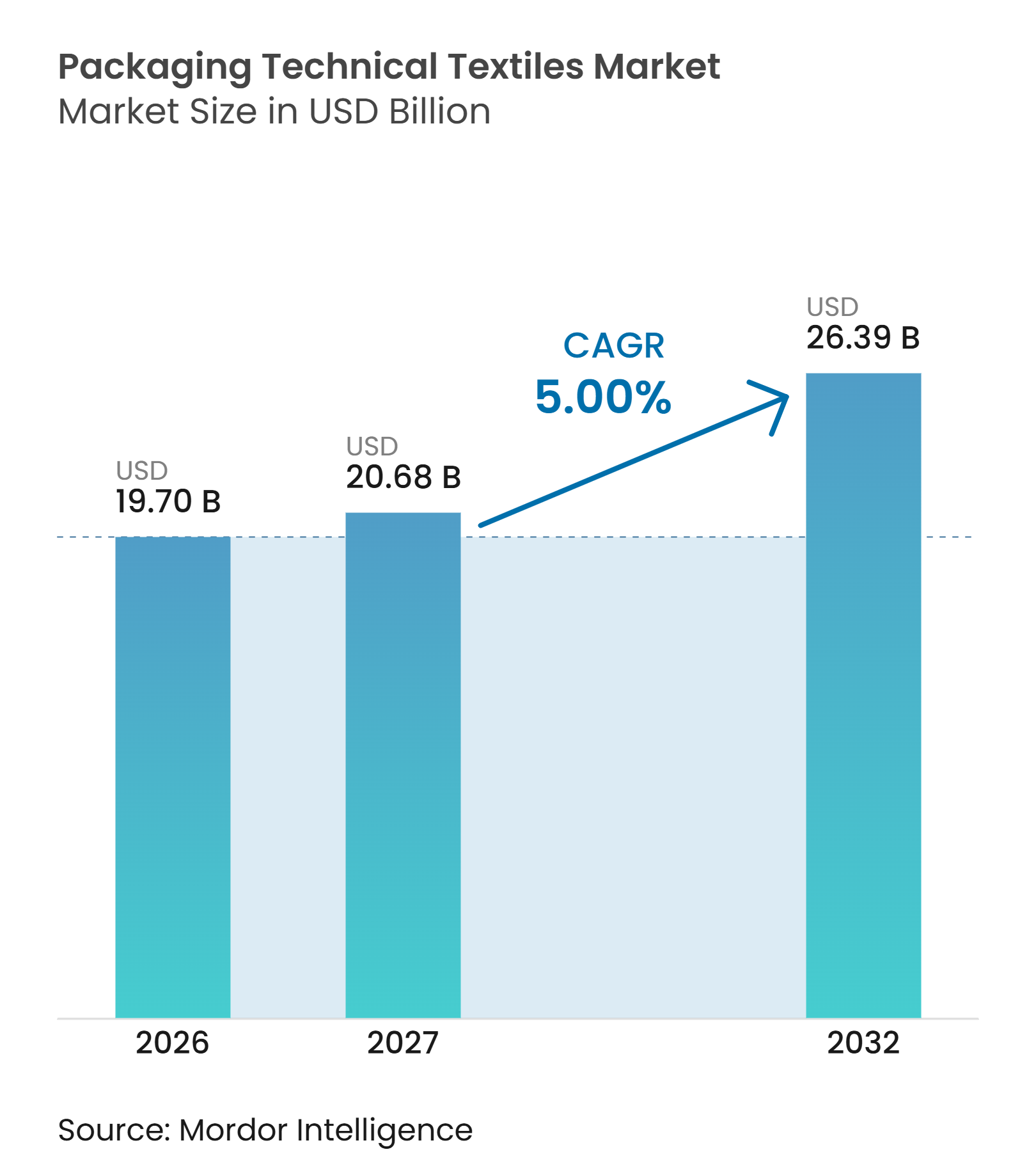
The Packaging Technical Textiles Market size is projected to expand from USD 19.70 billion in 2026 and USD 20.68 billion in 2027 to USD 26.39 billion by 2032, registering a CAGR of 5% between 2027 and 2032.
The packaging technical textile market supports transport and containment needs that rigid formats do not meet as efficiently in agriculture, bulk chemicals, construction, and food processing. Bulk commodity trade and more demanding safety requirements in food, pharmaceutical, and hazardous-goods supply chains support demand for engineered textile packaging. Producers are responding by increasing their focus on certified, coated, reusable, and automation-compatible products rather than undifferentiated bags. The packaging technical textile market also faces cost pressure because raw-material prices, freight conditions, and trade policy can affect export-led supply chains.
Key Report Takeaways
- By product type, flexible intermediate bulk containers accounted for 32% of the packaging technical textile market share in 2026, while nonwoven and specialty textile packaging is projected to grow at a 6.8% CAGR through 2032.
- By material type, polypropylene accounted for 48% of packaging technical textile market size in 2026, while regenerated cellulosic fibers are forecast to expand at a 7% CAGR through 2032.
- By end-use application, agriculture and fresh produce packaging accounted for 25% of the market in 2026.
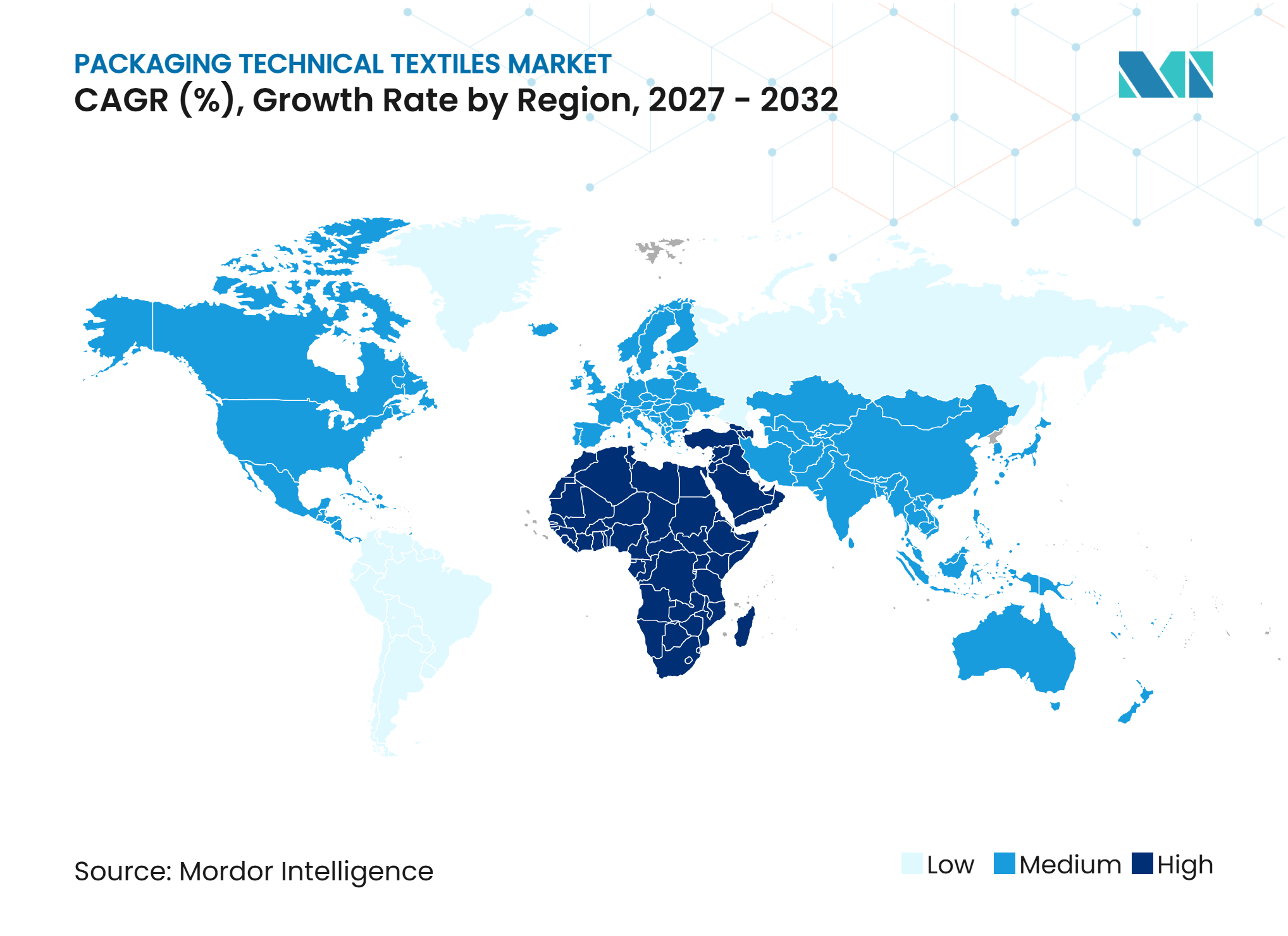
- By geography, Asia-Pacific accounted for 50.2% of the market in 2026, while the Middle East and Africa is projected to grow at a 7.8% CAGR through 2032.
Note: Market numbers in this report are based on Mordor Intelligence's proprietary estimation framework, which combines nine months of actuals with Q4 projections for base year 2026.
Market Trends and Insights
Drivers Impact Analysis of Packaging Technical Textiles Market*
| Driver | (~) % Impact on CAGR Forecast | Geographic Relevance | Impact Timeline |
|---|---|---|---|
| Growth in Global Bulk Commodity Production and Trade | +1.2% | Global | Medium term (2-4 years) |
| Expansion of Chemicals, Fertilizers, and Petrochemical Packaging Demand | +0.9% | Global, with Asia-Pacific and Middle East and Africa core | Medium term (2-4 years) |
| Rising Consumption of Packaged Food Grains and Agricultural Commodities | +0.8% | Asia-Pacific and South America | Short term (≤ 2 years) |
| Growth in Cement, Minerals, and Construction Material Packaging | +0.7% | Asia-Pacific, Middle East and Africa, and South America | Medium term (2-4 years) |
| Increasing Adoption of FIBCs for Bulk Handling and Transportation | +0.6% | Global, with North America and Europe emphasis | Long term (≥ 4 years) |
| Fresh Produce Packaging and Cold Chain Distribution Requirements | +0.5% | Asia-Pacific, Middle East and Africa, and Europe | Short term (≤ 2 years) |
| Source: Mordor Intelligence | |||
Growth in Global Bulk Commodity Production and Trade
The packaging technical textile market depends on cross-border movements of fertilizers, minerals, grains, and construction aggregates. These products need containers that can be lifted, stored, and discharged within established industrial systems. The European Union’s chemical exports reached EUR 560 billion (USD 658.7 billion) in 2024, 7% above the prior year, which supports continued throughput in supply chains using bulk packaging. FIBCs provide a practical format for dry bulk materials because they combine high payload capacity with a lower empty weight than rigid containers. Export-oriented bag producers therefore remain closely tied to trade activity even when their production base is far from final customers.
Expansion of Chemicals, Fertilizers, and Petrochemical Packaging Demand
Chemical and fertilizer customers require packaging that manages contamination, electrostatic risk, and hazardous-goods handling. That requirement increases the importance of conductive formats, protective coatings, and controlled production environments. Asia is expected to add 28.8 million tons per annum of purified terephthalic acid capacity between 2025 and 2030, including projects in China and India, which supports demand for industrial packaging across the related supply chain. Petrochemical investment in the Gulf also creates local demand for certified bags while strengthening the regional supply of polypropylene and polyethylene feedstocks. The packaging technical textile market benefits, as producers can supply demanding users without compromising traceability or safety.
Rising Consumption of Packaged Food Grains and Agricultural Commodities
Agricultural supply chains continue to require sacks, nets, and bulk containers for grains, sugar, oilseeds, and fresh produce. India’s Jute Packaging Materials Act requires jute packaging for 100% of food grains and 20% of sugar, demonstrating the direct role that public policy can play in material choice.[1] In 2025, raw-jute scarcity drove market prices above INR 11,000 (USD 122.4) per quintal and led the government to allow HDPE and PP substitutes for the Kharif Marketing Season. This shows how fiber availability can shift demand between natural and synthetic packaging in a short period. Woven polyolefin producers can benefit when jute supply is tight, while natural-fiber producers recover volume when supply conditions improve. The packaging technical textile market must therefore manage agricultural demand as a policy-sensitive as well as a cost-sensitive category.
Growth in Cement, Minerals, and Construction Material Packaging
Cement, minerals, and construction materials create steady demand for woven polypropylene sacks and standard FIBCs because these products must move efficiently from plants and storage sites to project locations. These applications favor packaging that can carry heavy loads, resist handling damage, and fit established filling, palletizing, and transport processes. FIBCs can reduce empty-storage requirements and handling weight when compared with rigid containers, which supports their use in dry bulk material logistics. The demand base is strongest where infrastructure construction, mining activity, and bulk-material distribution expand together. Lightweight, high-tenacity bag development can help producers lower polymer use per unit while maintaining the performance needed for demanding loads. The Packaging and Packaging Waste Regulation also increases the importance of recycled-content planning for plastic packaging suppliers serving regulated European customers.[2]
Restraints Impact Analysis of Packaging Technical Textiles Market*
| Restraint | (~) % Impact on CAGR Forecast | Geographic Relevance | Impact Timeline |
|---|---|---|---|
| Volatility In Polypropylene, Polyethylene, And Jute Prices | -1% | Global | Short term (≤ 2 years) |
| Competition From Paper, Plastic Film, And Rigid Packaging Alternatives | -0.6% | North America and Europe | Medium term (2-4 years) |
| High Price Sensitivity In Commodity Packaging Markets | -0.5% | Asia-Pacific, Middle East and Africa, and South America | Short term (≤ 2 years) |
| Packaging Waste Regulations And Single-Use Material Restrictions | -0.6% | Europe and North America | Long term (≥ 4 years) |
| Source: Mordor Intelligence | |||
Volatility in Polypropylene, Polyethylene, and Jute Prices
Polypropylene is an important input for nonwoven bags, FIBC fabric, and woven sacks, so pricing changes can quickly affect margins. Buyers often respond to uncertainty by limiting orders and reducing inventory. In 2025, polypropylene prices moved sharply after changes in trade conditions and then declined across North America, Europe, and Asia as downstream demand weakened. Jute has a separate risk profile because supply depends on crop conditions, acreage, and export rules. Bangladesh restricted raw-jute exports in September 2025 after acreage had declined, limiting available material for Indian users. The packaging technical textile market remains vulnerable when prices move faster than producers can reset contract terms or pass costs to customers.
Competition from Paper, Plastic Film, and Rigid Packaging Alternatives
Woven polypropylene sacks compete with paper sacks, plastic films, and rigid containers in several end uses. Paper alternatives can be attractive to European customers facing recycled-content obligations on plastic packaging. The Packaging and Packaging Waste Regulation changes the compliance conditions for plastic formats, making recycled feedstock availability a commercial issue for woven products.[3] Rigid intermediate bulk containers still have a clear role in liquids and pressure-sensitive applications. This limits substitution by FIBCs in those uses even when flexible formats offer transport and storage benefits. The packaging technical textile market consequently has stronger room for expansion in applications where dry bulk performance, low weight, and efficient handling matter most.
*Our forecasts treat driver/restraint impacts as directional, not additive. The impact forecasts reflect baseline growth, mix effects, and variable interactions.
Packaging Technical Textiles Market Segment Analysis
By Product Type:
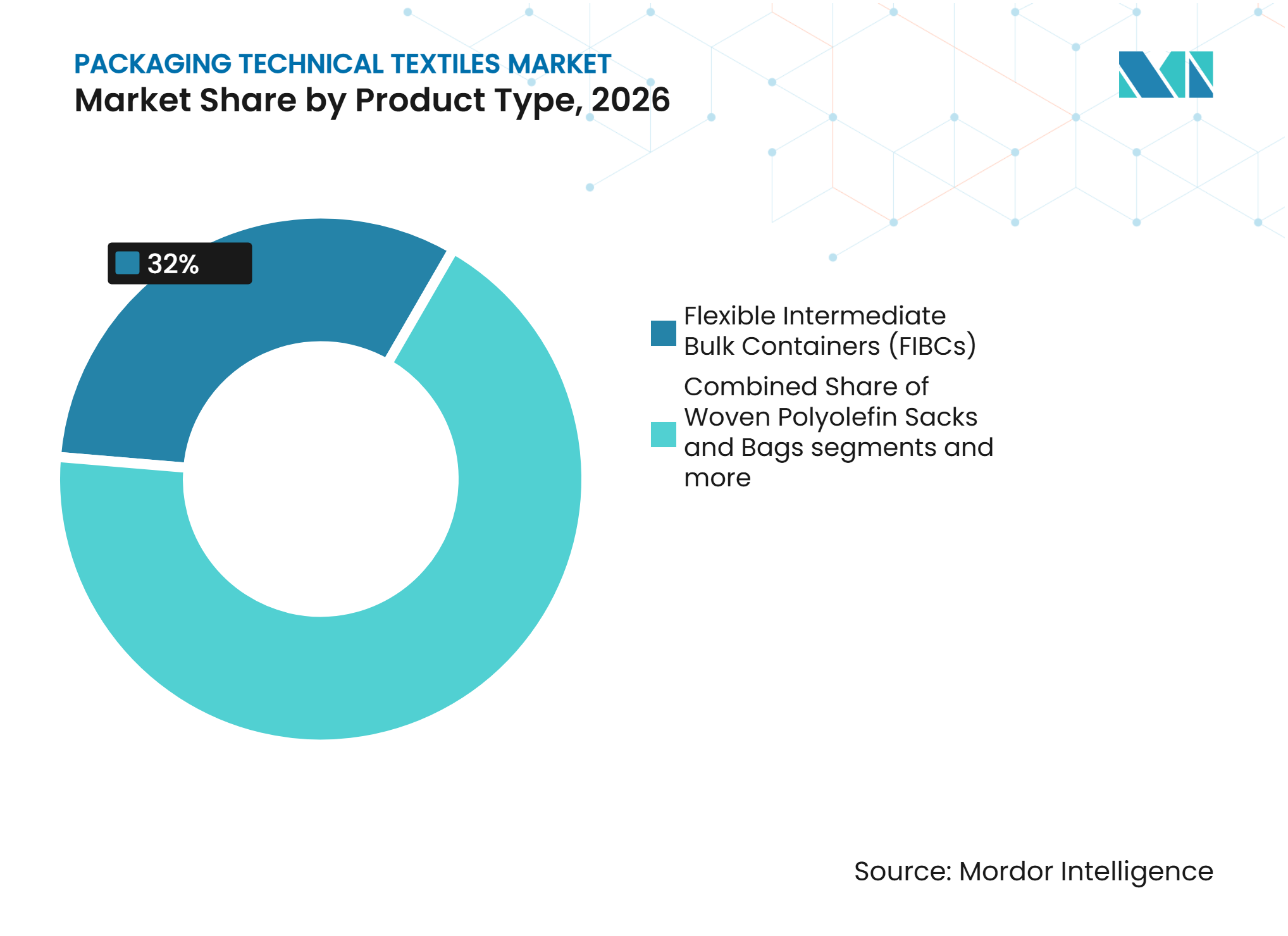
FIBCs Lead, Nonwovens Redefine the Growth CeilingFlexible intermediate bulk containers accounted for 32% of the packaging technical textile market share in 2026, reflecting their role in chemical, mineral, construction, and food-ingredient logistics. Their performance depends on load capacity, lifting design, fabric strength, liners, and discharge requirements, while food-grade, anti-static, and UN-certified configurations serve more demanding users. ISO 21898 provides a technical framework for FIBCs, and IEC 61340-4-4 supports electrostatic classification in controlled applications. These requirements create a material value difference between general-purpose bulk bags and highly controlled formats in the Packaging technical textile industry. Woven polyolefin sacks remain important for cement, fertilizer, food grain, and consumer goods where moisture resistance, print quality, and unit cost matter.
Nonwoven and specialty textile packaging is forecast to grow at a 6.8% CAGR through 2032, supported by retail, e-commerce, and fresh-food use cases. Spunbond polypropylene can support reusable shopping and delivery formats, while fresh-produce liners and ventilated products protect contents without blocking airflow. Mesh bags, Raschel nets, leno bags, and tubular sleeves remain established formats for fruit, vegetables, and firewood. Product development in this group is more closely tied to customer handling practices than to bulk commodity volumes.



By Material Type:
Polypropylene Dominates, Regenerated Cellulosics AcceleratePolypropylene accounted for 48% of the packaging technical textile market in 2026 because it offers cost efficiency, tensile strength, moisture resistance, UV-stabilization capability, and suitability for woven and spunbond production. It is selected for load rating, tear resistance, and sewing strength across FIBCs, woven sacks, nonwoven bags, and coated fabrics. Polyethylene is also used in liners and coated fabrics, while polyester serves high-tenacity straps, loops, and specialty sacks needing chemical stability. The Packaging technical textile industry continues to rely on polypropylene because alternatives have not displaced it at comparable cost in many heavy-duty applications.
Regenerated cellulosic fibers are expected to grow at a 7% CAGR through 2032 as food and pharmaceutical packaging users seek traceable, biodegradable, and lower-carbon material options. Their potential is strongest where sustainability requirements carry as much weight as price and extended producer responsibility frameworks favor biodegradable materials. This gives regenerated fibers a different adoption route from conventional polypropylene. Jute remains important in India and Bangladesh because policy and export traditions support its use in sacks and finished bags, but its availability can be volatile. Material selection in the packaging technical textile market will remain application-specific because durability, food safety, recyclability, and cost do not favor one universal material.
By End-Use Application:
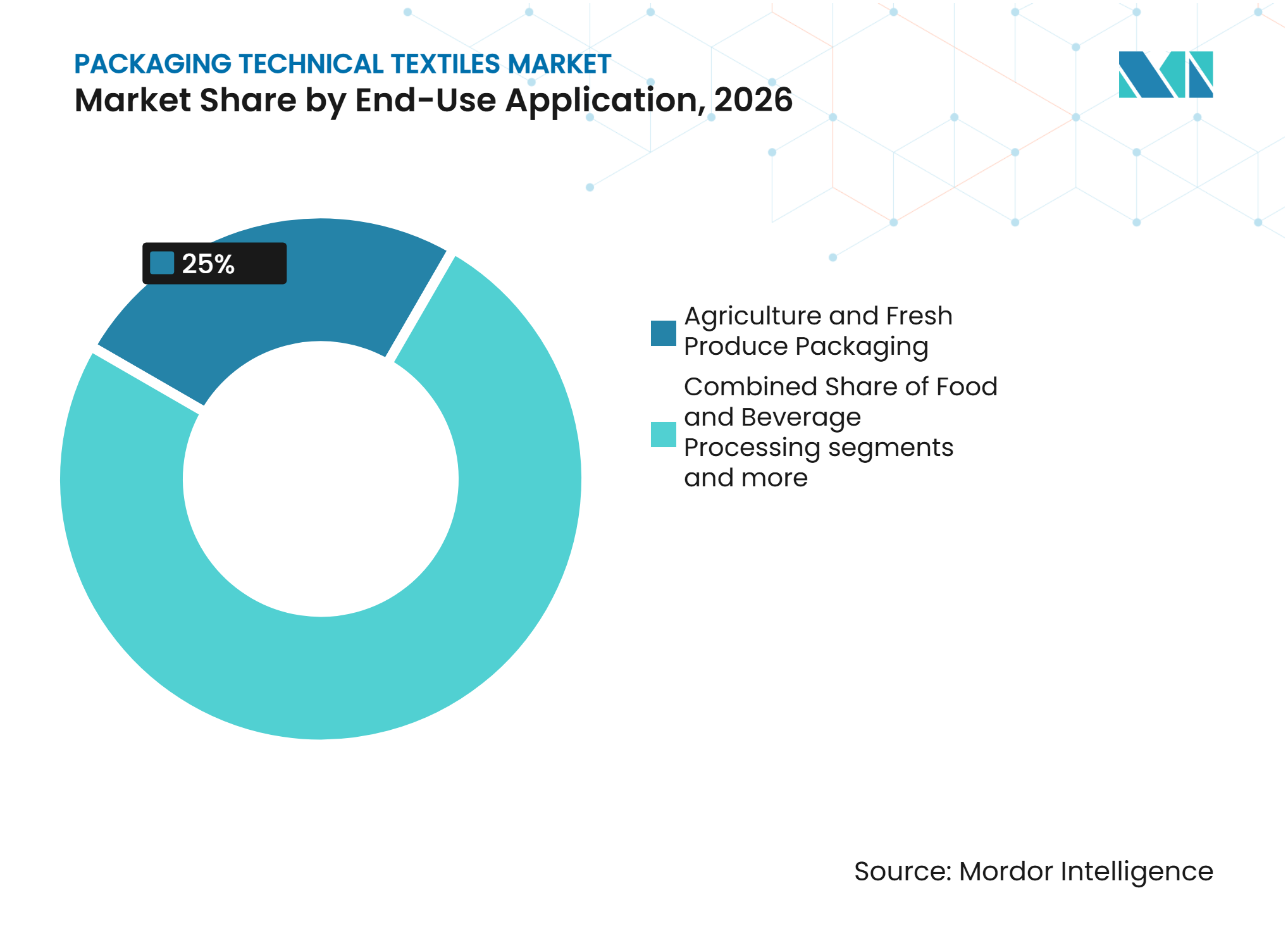
Agriculture Anchors Volume, E-Commerce Drives ValueAgriculture and fresh produce packaging accounted for 25% of the packaging technical textile market in 2026, covering jute and polypropylene sacks for grains and oilseeds, nets for fruit and vegetables, and ventilated FIBCs for root crops and bulbs. India’s mandatory jute packaging policy provides a baseline for food-grain procurement. Breathable mesh and ventilated packaging are important to export supply chains where cold-chain reliability and shelf life affect commercial outcomes. Agricultural customers also need formats that can be filled quickly and handled through fragmented distribution networks. These needs favor dependable supply and consistent bag quality.
Food and beverage processing requires food-grade and cleanroom FIBCs for food grains, flour, sugar, feed, and processed ingredients. At the same time, chemicals and fertilizers need UN-certified and conductive Type C formats. Construction, minerals, and mining remain high-volume users of standard FIBCs and woven polypropylene sacks. Retail and e-commerce support lighter nonwoven and specialty formats that move efficiently through delivery networks. The packaging technical textile market therefore needs distinct product and quality strategies for industrial and consumer-facing applications.

Geography Analysis
Asia-Pacific: Manufacturing Powerhouse and Expanding Consumer Market
Asia-Pacific held 50.2% of the packaging technical textile market share in 2026. India and China combine large manufacturing bases for FIBCs and woven polypropylene sacks with extensive agricultural and industrial demand. The region’s export role links its factories to buyers in Europe and North America while exposing orders to freight, resin, and policy changes. India’s jute packaging rules preserve a role for natural-fiber bags in food-grain procurement and can redirect demand toward synthetic alternatives when supply is scarce. Compliance with ISO 21898 and electrostatic requirements helps regional suppliers serve certified global customers.
Middle East and Africa: Commodity Production and Infrastructure Investment Drive Uptake
The Middle East and Africa is forecast to grow at a 7.8% CAGR from 2027 to 2032. GCC petrochemical expansion supports local demand for industrial packaging and increases the relevance of regional polypropylene and polyethylene supply. Agricultural exports support use of woven sacks, mesh bags, and bulk containers, while infrastructure activity broadens demand in construction and minerals. The packaging technical textile market can benefit when converters supply certified products close to chemical, fertilizer, and export customers. Product qualification remains important because food-contact and hazardous-goods requirements vary by customer and destination.
Regional Contrasts: North America, Europe, and South America
North America is a major consumption center for FIBCs and woven polypropylene bags used in chemicals, food ingredients, pet food, and construction. Europe has high-specification demand and strong compliance factors because the Packaging and Packaging Waste Regulation establishes recycled-content requirements for plastic packaging. The packaging technical textile market size in Europe is therefore tied more closely to recycled polypropylene access and documented compliance. South America remains relevant to agricultural and commodity packaging, while rigid containers, paper sacks, and plastic film remain active alternatives across the three regions.
Competitive Landscape
Market Concentration
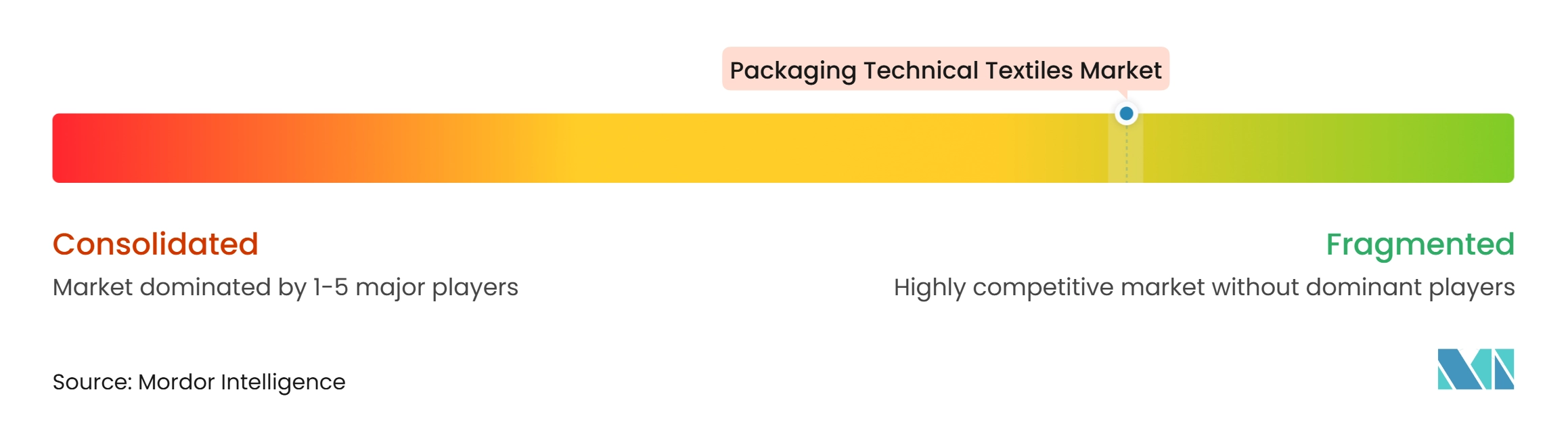
The packaging technical textile market exhibits a low level of market concentration. Indian manufacturers, including Rishi FIBC Solutions, Emmbi Industries, Kanpur Plastipack, and Shree Tirupati Balajee, have meaningful export positions in FIBCs and woven sacks. European and Gulf suppliers compete on proximity to high-specification customers, engineering capability, and compliance with food-contact and packaging requirements. Intermas Group and KARATZIS S.A. operate in mesh and netted packaging, where agri-net technology and leno weaving create more specialized positions.
Compliance infrastructure is a central differentiator for producers serving hazardous goods, food ingredients, and pharmaceutical customers. ISO 21898 conformity and IEC 61340 ratings can create qualification barriers that commodity manufacturers find difficult to match. Emmbi Industries approved the acquisition of a 50% stake in Britpac AB, which trades as FortaPac, to enter European reusable industrial and commercial packaging distribution. The move reflects the growing value of reconditioning, retesting, and closed-loop return services. Starlinger presented its ADSTAR prime bag in 2025 with a high proportion of recycled polypropylene and a welded pinch-bottom construction.
Automated filling-compatible sacks, pharmaceutical-grade bulk bags, and recyclable monomaterial woven sacks remain product-development opportunities. The packaging technical textile market will remain price-competitive in standard grades where buyers can switch suppliers easily. Certified formats are more defensible where users must validate safety, cleanliness, conductivity, or recycled-content documentation.
Packaging Technical Textiles Industry Leaders
-
Royal LC Packaging
-
Thrace Group
-
Flexituff Ventures International Ltd.
-
Rishi FIBC Solutions Pvt. Ltd.
-
Kanpur Plastipack Ltd.
- *Disclaimer: Major Players sorted in no particular order
Packaging Technical Textiles Market Companies Covered in this Report
- Royal LC Packaging
- Thrace Group
- Flexituff Ventures International Ltd.
- Rishi FIBC Solutions Pvt. Ltd.
- Kanpur Plastipack Ltd.
- Commercial Syn Bags Ltd.
- Shree Tirupati Balajee FIBC Ltd.
- Umasree Texplast Pvt. Ltd.
- SafeFlex International Ltd.
- Emmbi Industries Ltd.
- Knack Packaging Ltd.
- KARATZIS S.A.
- Intermas Group
- Gloster Ltd.
- Ludlow Jute & Specialities Ltd.
- United Bags Inc.
- Ahlstrom
- Magnera Corporation
Recent Industry Developments in Packaging Technical Textiles Market
- October 2026: Emmbi Industries board approved the acquisition of a 50% equity stake in Britpac AB, Sweden, trading as FortaPac, through its Singapore-based wholly-owned subsidiary, Zastian Pte. Ltd., targeting entry into European reusable industrial and commercial packaging distribution. The acquisition is intended to establish a supply channel for Emmbi's FIBC products into Scandinavian and European logistics markets.
- October 2025: Starlinger presented the AD*STAR prime bag at K 2025, a woven polypropylene block-bottom bag produced with a high proportion of recycled PP and featuring a welded rather than glued pinch-bottom construction. The design reduces product contamination risk and moisture ingress for cement, food grain, and construction material packaging applications.
Global Packaging Technical Textiles Market Report Scope
The Packaging Technical Textile Market Report is Segmented by Product Type ( Flexible Intermediate Bulk Containers, Woven Polyolefin Sacks and Bags, and More), by Material Type (Polypropylene, Polyethylene, and More), by End-Use Application (Agriculture and Fresh Produce Packaging, Food and Beverage Processing, and More), and by Geography (North America, Europe, and More). The Market Forecasts are Provided in Terms of Value (USD).
Segmentation Overview
| Flexible Intermediate Bulk Containers (FIBCs) | Conventional Bulk FIBCs |
| Form-Stable and Baffle FIBCs | |
| Ventilated FIBCs | |
| Other Specialized FIBCs | |
| Woven Polyolefin Sacks and Bags | |
| Jute and Other Natural-Fiber Packaging Textiles | Jute Sacking and Finished Packaging Bags |
| Others (Hessian, Burlap, Natural-Fiber Packaging Cloth, Speciality Packaging) | |
| Mesh and Netted Packaging Textiles | Leno Woven Packaging Bags |
| Raschel Knitted Packaging Bags | |
| Tubular Knitted Packaging Nets and Sleeves | |
| Other Textile Mesh Packaging Products | |
| Wrapping and Transit-Protection Textiles | Industrial Bale and Goods Wrapping Fabrics |
| Textile Packaging Covers and Protective Wraps | |
| Textile-Based Container Liners and Cargo Protection Fabrics | |
| Textile Pallet Netwrap and Load-Securing Materials | |
| Textile Packaging Sleeves, Padding, and Dunnage | |
| Nonwoven and Specialty Textile Packaging Products (Shopping and Carrying Bags, Protective Packaging Bags and Pouches, etc.) |
| Polypropylene |
| Polyethylene |
| Polyester |
| Jute |
| Cotton and Other Natural Fibers |
| Regenerated Cellulosic Fibers |
| Polyamide and Other Specialty Synthetic Fibers |
| Other Materials |
| Agriculture and Fresh Produce Packaging | Fresh Fruits and Vegetables |
| Seeds and Other Agricultural Commodities | |
| Food and Beverage Processing | Food Grains, Flour, and Sugar |
| Processed Food and Food Ingredients | |
| Animal Feed and Pet Food | |
| Beverage Ingredients and Infusion Products | |
| Chemicals, Petrochemicals, and Fertilizers | |
| Construction Materials, Minerals, and Mining | |
| Pharmaceuticals and Healthcare Products | |
| Retail, E-Commerce, and Consumer Goods | |
| Other Industrial Products and Materials |
| North America | United States |
| Canada | |
| Mexico | |
| Europe | Germany |
| United Kingdom | |
| France | |
| Italy | |
| Spain | |
| Netherlands | |
| Belgium | |
| Poland | |
| Rest of Europe | |
| Asia-Pacific | China |
| India | |
| Japan | |
| South Korea | |
| Taiwan | |
| Indonesia | |
| Vietnam | |
| Thailand | |
| Bangladesh | |
| Australia | |
| Rest of Asia-Pacific | |
| Middle East and Africa | Saudi Arabia |
| United Arab Emirates | |
| South Africa | |
| Egypt | |
| Nigeria | |
| Rest of Middle East and Africa | |
| South America | Brazil |
| Argentina | |
| Chile | |
| Colombia | |
| Rest of South America |
| By Product Type | Flexible Intermediate Bulk Containers (FIBCs) | Conventional Bulk FIBCs |
| Form-Stable and Baffle FIBCs | ||
| Ventilated FIBCs | ||
| Other Specialized FIBCs | ||
| Woven Polyolefin Sacks and Bags | ||
| Jute and Other Natural-Fiber Packaging Textiles | Jute Sacking and Finished Packaging Bags | |
| Others (Hessian, Burlap, Natural-Fiber Packaging Cloth, Speciality Packaging) | ||
| Mesh and Netted Packaging Textiles | Leno Woven Packaging Bags | |
| Raschel Knitted Packaging Bags | ||
| Tubular Knitted Packaging Nets and Sleeves | ||
| Other Textile Mesh Packaging Products | ||
| Wrapping and Transit-Protection Textiles | Industrial Bale and Goods Wrapping Fabrics | |
| Textile Packaging Covers and Protective Wraps | ||
| Textile-Based Container Liners and Cargo Protection Fabrics | ||
| Textile Pallet Netwrap and Load-Securing Materials | ||
| Textile Packaging Sleeves, Padding, and Dunnage | ||
| Nonwoven and Specialty Textile Packaging Products (Shopping and Carrying Bags, Protective Packaging Bags and Pouches, etc.) | ||
| By Material Type | Polypropylene | |
| Polyethylene | ||
| Polyester | ||
| Jute | ||
| Cotton and Other Natural Fibers | ||
| Regenerated Cellulosic Fibers | ||
| Polyamide and Other Specialty Synthetic Fibers | ||
| Other Materials | ||
| By End-Use Application | Agriculture and Fresh Produce Packaging | Fresh Fruits and Vegetables |
| Seeds and Other Agricultural Commodities | ||
| Food and Beverage Processing | Food Grains, Flour, and Sugar | |
| Processed Food and Food Ingredients | ||
| Animal Feed and Pet Food | ||
| Beverage Ingredients and Infusion Products | ||
| Chemicals, Petrochemicals, and Fertilizers | ||
| Construction Materials, Minerals, and Mining | ||
| Pharmaceuticals and Healthcare Products | ||
| Retail, E-Commerce, and Consumer Goods | ||
| Other Industrial Products and Materials | ||
| By Geography | North America | United States |
| Canada | ||
| Mexico | ||
| Europe | Germany | |
| United Kingdom | ||
| France | ||
| Italy | ||
| Spain | ||
| Netherlands | ||
| Belgium | ||
| Poland | ||
| Rest of Europe | ||
| Asia-Pacific | China | |
| India | ||
| Japan | ||
| South Korea | ||
| Taiwan | ||
| Indonesia | ||
| Vietnam | ||
| Thailand | ||
| Bangladesh | ||
| Australia | ||
| Rest of Asia-Pacific | ||
| Middle East and Africa | Saudi Arabia | |
| United Arab Emirates | ||
| South Africa | ||
| Egypt | ||
| Nigeria | ||
| Rest of Middle East and Africa | ||
| South America | Brazil | |
| Argentina | ||
| Chile | ||
| Colombia | ||
| Rest of South America | ||
Key Questions Answered in the Report
What is the forecast for packaging technical textiles through 2032?
The Packaging Technical Textiles Market is projected to grow from USD 19.70 billion in 2026 and USD 20.68 billion in 2027 to USD 26.39 billion by 2032, registering a CAGR of 5.00% during 2027–2032.
Which product category leads demand for packaging technical textiles?
Flexible intermediate bulk containers lead with a 32% share in 2026, supported by chemical, mineral, construction, and food-ingredient logistics.
Why is polypropylene widely used in technical textile packaging?
Polypropylene held 48% of demand in 2026 because it combines cost efficiency, tensile strength, moisture resistance, and manufacturing versatility.
Which region has the highest growth outlook?
The Middle East and Africa is forecast to grow at a 7.8% CAGR through 2032, supported by petrochemical activity, agriculture, and infrastructure investment.
How do packaging rules affect FIBCs and woven bags?
The European Union’s Packaging and Packaging Waste Regulation increases the importance of recycled-content sourcing, reuse systems, and compliance records.
What differentiates higher-value FIBC suppliers?
Suppliers with documented safety, electrostatic control, food-grade capability, and reconditioning services can compete beyond price alone.