
Overhead Crane Market Size and Share
Market Overview
| Study Period | 2020 - 2032 |
|---|---|
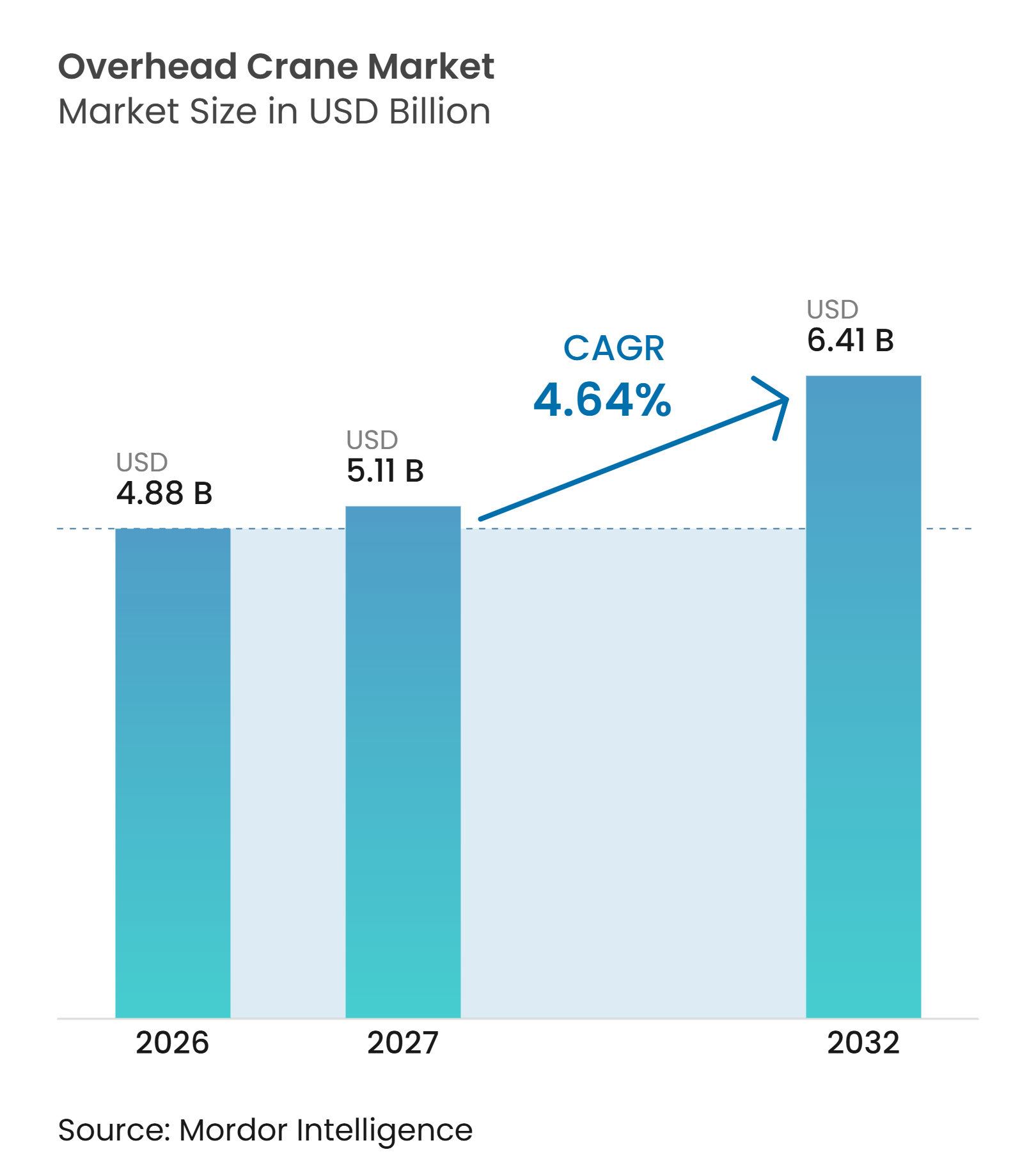
| Market Size (2027) | USD 5.11 Billion |
| Market Size (2032) | USD 6.41 Billion |
| Growth Rate (2027 - 2032) | 4.64 % |
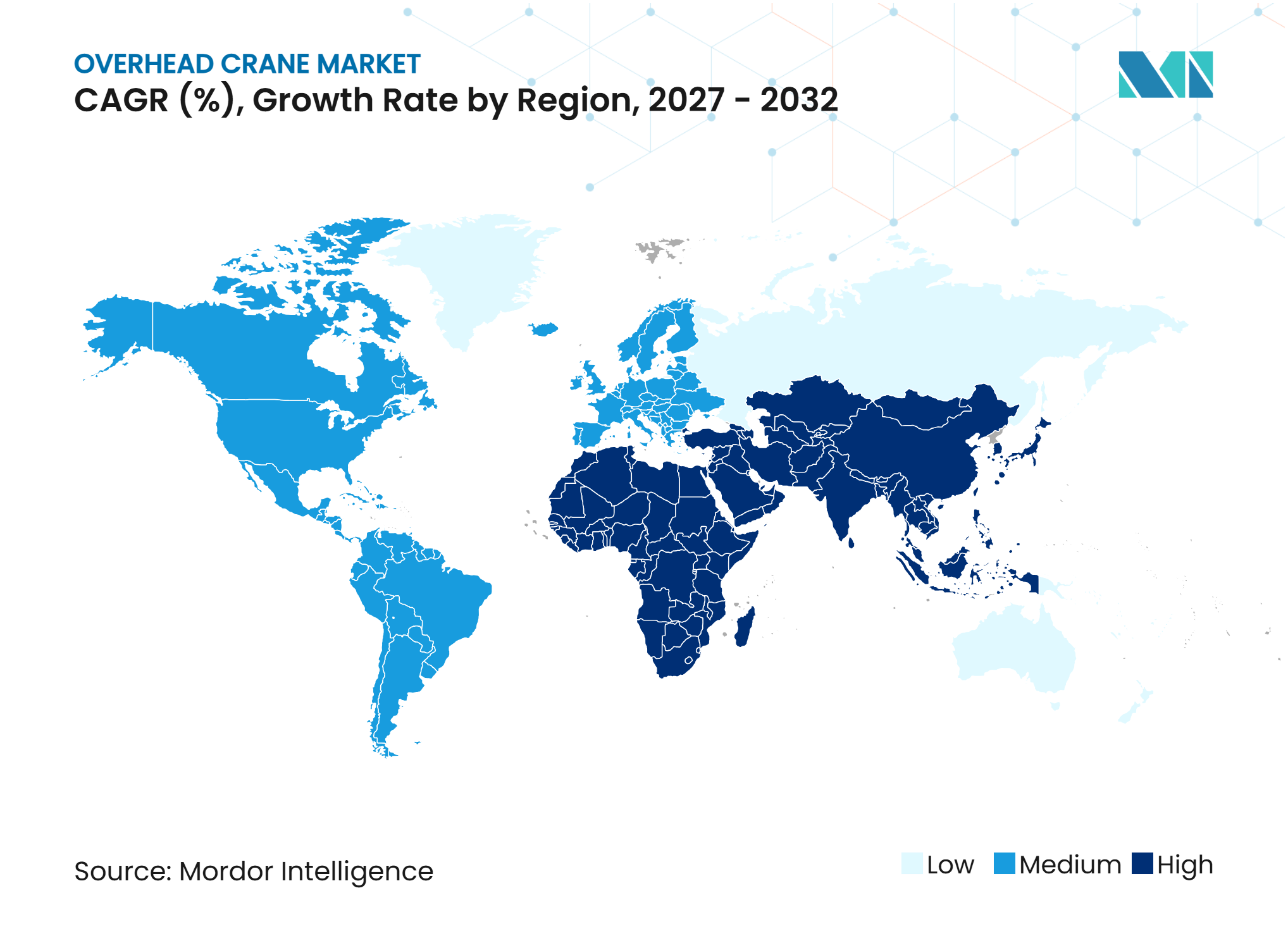
| Fastest Growing Market | North America |
| Largest Market | Asia-Pacific |
| Market Concentration | Medium |
Major Players *Disclaimer: Major Players sorted in no particular order Image © Mordor Intelligence. Reuse requires attribution under CC BY 4.0. | |
Overhead Crane Market Analysis by Mordor Intelligence
The overhead crane market size was valued at USD 4.88 billion in 2026 and is expected to grow from USD 5.11 billion in 2027 to USD 6.41 billion by 2032, at a CAGR of 4.64% during 2027-2032. Demand is tied to steelmaking, automotive production, power generation, shipbuilding, and logistics facilities where controlled lifting is essential to daily operations. Electric arc furnace projects create demand for specialized heavy-duty equipment, while factory automation supports investment in cranes with sensors, controls, and remote monitoring. Suppliers are responding by pairing new equipment with modernization, inspection, and digital service offerings. This approach gives manufacturers a route to recurring revenue from installed fleets while customers seek better uptime and safer handling. The overhead crane market also faces higher installation costs and complex integration work in older facilities, which can delay projects even when equipment demand is present.
Key Report Takeaways
- By type, bridge cranes held a 37.13% share in 2026, while gantry cranes are projected to grow at a 6.53% CAGR through 2032.
- By lifting capacity, cranes up to 10 tons held a 45.23% share in 2026, while cranes above 100 tons are projected to grow at a 7.23% CAGR through 2032.
- By operation, semi-automatic cranes held a 54.63% share in 2026, while fully automatic cranes are projected to grow at a 9.23% CAGR through 2032.
- By end user, steel and metals held a 25.83% share in 2026, while warehousing and logistics is projected to grow at an 8.43% CAGR through 2032.
- By sales type, new equipment held a 67.13% share in 2026, while modernization and services are projected to grow at a 7.43% CAGR through 2032.
- By geography, Asia-Pacific held a 37.63% share in 2026, while North America is projected to grow at a 6.83% CAGR through 2032.
Note: Market numbers in this report are based on Mordor Intelligence's proprietary estimation framework, which combines nine months of actuals with Q4 projections for base year 2026.
Market Trends and Insights
Drivers Impact Analysis of Overhead Crane Market*
| Driver | (~) % Impact on CAGR Forecast | Geographic Relevance | Impact Timeline |
|---|---|---|---|
| Expansion of Automated Manufacturing and Smart Factories | +1.4% | Global, strongest in North America, Germany, and East Asia | Medium term (2–4 years) |
| Growth in Steel, Metals, Automotive, and Power-Generation Capacity | +1.1% | Asia-Pacific, Middle East, and North America | Medium term (2–4 years) |
| Rising Demand for Lifecycle Modernization and Remote Monitoring | +0.9% | Global, led by North America and Europe | Medium term (2–4 years) |
| Replacement of Aging Overhead-Crane Fleets | +0.8% | North America, Western Europe, and Japan | Short term (≤ 2 years) |
| Shortage of Skilled Crane Operators and Maintenance Technicians | +0.6% | Asia-Pacific, Middle East, and South America | Long term (≥ 4 years) |
| Higher Safety Requirements for Precision Load Handling | +0.4% | North America and Europe | Short term (≤ 2 years) |
| Source: Mordor Intelligence | |||
Expansion of Automated Manufacturing and Smart Factories
Smart factory spending is moving cranes from stand-alone lifting equipment into connected plant systems. Rockwell Automation outlines a framework that combines variable-frequency drives, plant controllers, analytics, and digital-twin support for local, remote, and autonomous crane operation[1]. This integration supports anti-sway control, positioning, and operating visibility where material flow must be coordinated with production equipment. AutoStore reported in 2025 that 50% of surveyed organizations had automated at least half of warehouse operations, while only 3% reported no automation at all. Retrofit projects can be more accessible than new construction because operators may keep the existing runway while replacing controls, sensors, and software. This gives the overhead crane market an upgrade path that is less dependent on greenfield building activity.
Growth in Steel, Metals, Automotive, and Power-Generation Capacity
New steel capacity is creating direct demand for high-capacity lifting systems. The OECD projected that 165.2 million metric tons of global steelmaking capacity would be under construction or planning during 2025 to 2027, with electric arc furnace projects representing nearly 60% of the total[2]. Electric arc furnace operations use cranes for scrap charging, ladle handling, and electrode movement under demanding heat and cycle conditions. Nippon Steel decided in May 2025 to invest JPY 868.7 billion (about USD 6 billion) in conversion projects that add 2.9 million tons of annual electric arc furnace capacity at three Japanese plants. These projects favor suppliers with experience in thermal shielding, high-precision positioning, and heavy-lift engineering. Automotive and power projects add demand for production, maintenance, and component-handling applications across the overhead crane market.
Rising Demand for Lifecycle Modernization and Remote Monitoring
Modernization is helping crane suppliers reduce reliance on new-facility construction cycles. Konecranes states that its TRUCONNECT service captures running time, motor starts, work cycles, load history, and emergency-stop events to support condition-based maintenance. Konecranes also offers RailQ 3D runway surveys and uses TRUCONNECT data in predictive maintenance models that forecast potential faults and replacement needs. Konecranes reported a 21.8% comparable EBITA margin for Industrial Service in 2025, compared with 9.4% for Industrial Equipment. The difference supports the commercial importance of inspection, maintenance, monitoring, and upgrade contracts. Suppliers that maintain long-term equipment data can make maintenance recommendations earlier and strengthen customer retention.
Shortage of Skilled Crane Operators and Maintenance Technicians
A limited supply of trained crane operators and maintenance workers encourages facilities to use automation for repeatable handling tasks. Semi-automatic systems can retain human supervision while applying anti-sway, load-positioning, and hook-centering functions. Weihua introduced its S-series platform in October 2025 with modular components, operating noise below 75 decibels, and a stated 20% shorter delivery cycle. The company positioned the platform for maintenance that can be completed by personnel after basic training. A 2025 ICSOBA paper described an intelligent monitoring system for aluminum smelter cranes that is designed to issue 24-hour advance fault warnings and kept wireless packet loss below 0.1% in the reported application. The combination of workforce limits and safety expectations is supporting demand for systems that standardize routine handling and simplify diagnostics.
Restraints Impact Analysis of Overhead Crane Market*
| Restraint | (~) % Impact on CAGR Forecast | Geographic Relevance | Impact Timeline |
|---|---|---|---|
| High Installation, Building-Modification, and Commissioning Costs | -0.6% | Global, most acute in brownfield North American and European sites | Short term (≤ 2 years) |
| Integration Risk Between Legacy Controls and Digital Crane Systems | -0.4% | Global, most acute in Middle East and South America | Long term (≥ 4 years) |
| Long Approval Cycles for Facility Shutdowns and Capital Projects | -0.3% | North America and Europe | Medium term (2–4 years) |
| Limited Availability of Certified Service Personnel in Emerging Markets | -0.2% | Middle East and South America | Long term (≥ 4 years) |
| Source: Mordor Intelligence | |||
High Installation, Building-Modification, and Commissioning Costs
The cost of an installation extends beyond the crane itself. Older sites can require structural assessment, runway reinforcement, electrical work, load testing, and production shutdowns before commissioning. The U.S. Federal Register stated in June 2026 that the information-collection requirements for OSHA standard 29 CFR 1910.179 cover 31,495 respondents and 321,345 annual burden hours. OSHA requirements and ASME B30.2 practices add documentation and testing work to projects in the United States. Brownfield facilities with limited headroom or weak floor capacity face the highest risk of cost escalation. Low-headroom and modular designs can address part of this challenge, but they do not remove the need for site-specific engineering.
Integration Risk Between Legacy Controls and Digital Crane Systems
Many installed cranes operate with proprietary programmable logic controllers or hardwired relay controls that were not designed for modern industrial networks. Connecting sensors, anti-sway software, and remote monitoring tools can require full control replacement or specialized integration layers. Electrical instability and limited connectivity can make these projects harder to plan in emerging locations. Facility managers also need to schedule shutdowns and approve capital work before upgrades can proceed. Limited certified service coverage in parts of the Middle East and South America can further increase project timelines for the overhead crane market.
*Our forecasts treat driver/restraint impacts as directional, not additive. The impact forecasts reflect baseline growth, mix effects, and variable interactions.
Overhead Crane Market Segment Analysis
By Type:
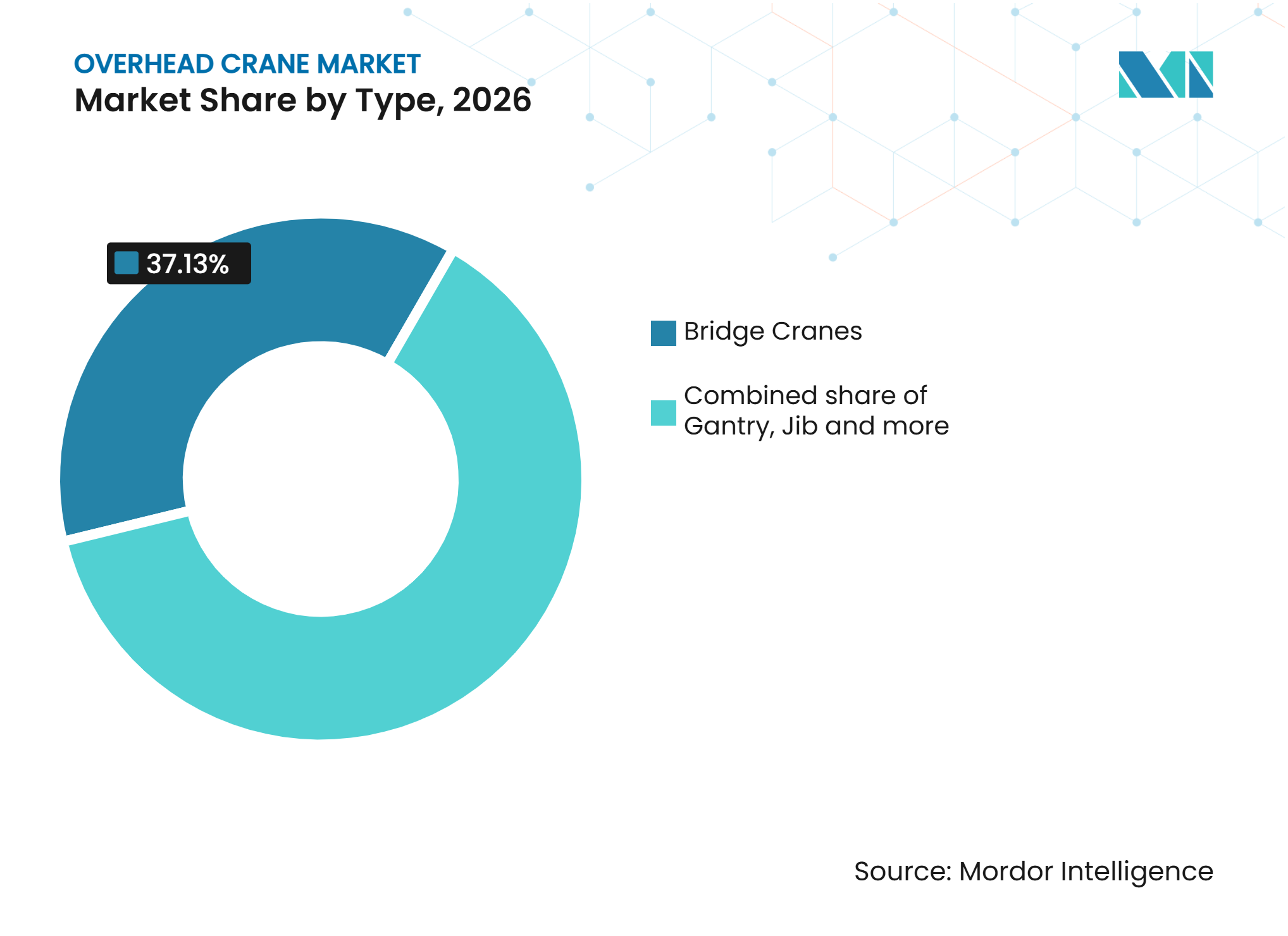
Gantry Growth Supports Bridge Crane LeadershipBridge cranes held 37.13% of the overhead crane market share in 2026, supported by their use across general manufacturing, assembly, and process facilities. Single-girder systems serve light and medium lifting requirements where lower structural weight is important. Double-girder designs support heavier applications and more demanding duty cycles. Gantry cranes are projected to record a 6.53% CAGR through 2032. Their growth is connected to ports, offshore wind assembly, shipyards, and fabrication sites that need outdoor heavy-lift capability.
Weihua won the August 2025 bid for a 3,800-ton gantry crane for the Zhejiang offshore wind port. The project indicates how offshore construction is increasing specifications for lifting height and capacity. Jib and workstation cranes remain relevant for ergonomic handling in assembly areas. Monorail and underhung systems support fixed movement paths in automotive and food-processing facilities. Each equipment type has different replacement cycles, installation requirements, and automation potential. This range of applications keeps the overhead crane market dependent on both standardized products and engineered systems.



By Lifting Capacity:
Heavy-Duty Equipment Gains From Electric Arc Furnace InvestmentUp to 10 tons accounted for 45.23% of revenue in 2026, reflecting the wide installed base across light manufacturing, logistics, and maintenance work. This category is characterized by higher unit volumes, short replacement cycles, and price-sensitive purchasing. Above 100 tons is forecast to grow at a 7.23% CAGR through 2032. Electric arc furnace construction drives demand for cranes used in scrap handling, ladle transport, and other high-temperature tasks. The above-100-ton overhead crane market size is supported by projects that need high availability and strict load control.
The 10 to 50-ton category serves automotive plants, paper operations, and medium-process production. The 50 to 100-ton range is used in aluminum casthouses and heavy fabrication. Nippon Steel's 2025 electric arc furnace investment program illustrates the scale of industrial conversion activity that can require specialized material handling systems. Heavy-duty electric arc furnace projects can require configurations above 300 tons. Such specifications narrow the supplier field because they require specialized design, thermal protection, and process knowledge. This concentration can support pricing discipline within the heavy-lift category of the overhead crane industry.
By Operation:
Fully Automatic Systems Gain PaceSemi-automatic cranes held 54.63% of revenue in 2026, as many facilities retain operator supervision while using automated positioning functions. These systems can add anti-sway control, hook centering, and load positioning without requiring complete operational autonomy. Fully automatic cranes are projected to grow at a 9.23% CAGR through 2032. This is the highest projected growth rate across the reported segmentation types. Labor availability, safety requirements, and throughput targets are increasing interest in automated operating models.
Manual cranes remain useful for job shops and cost-sensitive applications with low utilization. Many facilities move first to semi-automation before considering fully autonomous systems. Suppliers with modular controls can participate at both stages of this transition. Rockwell Automation's 2025 framework supports multiple operating modes, including local, remote, and autonomous control, within a common technology structure. The ICSOBA monitoring study also supports the practical use of connected monitoring in industrial settings with high interference. The overhead crane market is therefore moving toward operating systems that improve control without forcing every facility into the same level of automation.
By End User:
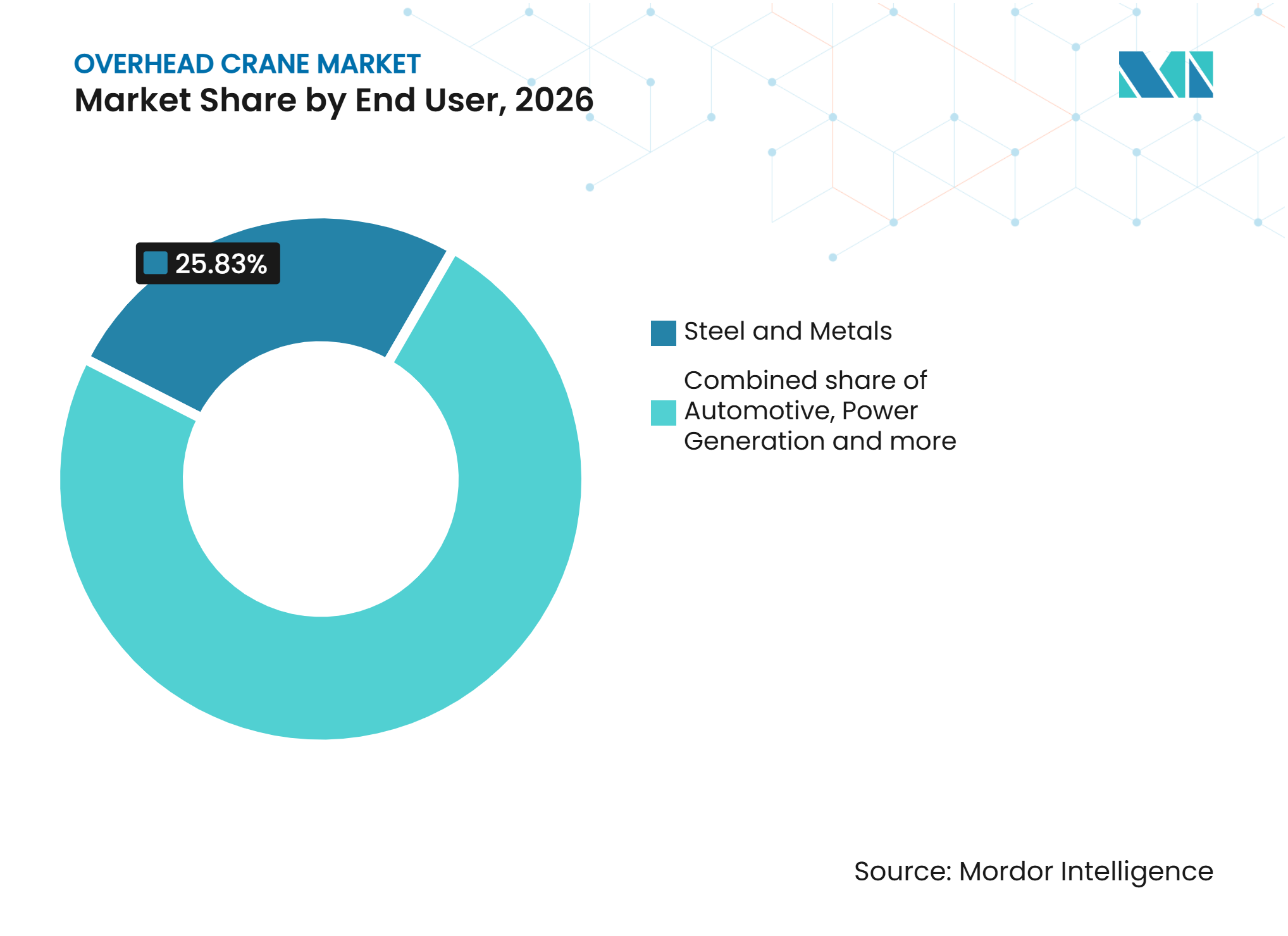
Logistics Expands Alongside Steel and MetalsSteel and metals held 25.83% of revenue in 2026, based on the use of cranes in scrap charging, liquid metal handling, slab transport, and coil storage. This sector requires reliable equipment because handling interruptions can affect the full production sequence. Warehousing and logistics is forecast to record an 8.43% CAGR through 2032. E-commerce fulfillment and third-party logistics providers are adopting higher levels of automation in storage and material movement. The overhead crane market size for warehousing is supported by demand for equipment that works within automated high-bay facilities.
AutoStore reported that warehouse automation adoption has advanced materially among surveyed organizations. Automotive plants continue to buy cranes for body shops, stamping lines, and component handling. Power generation provides a high-specification channel through nuclear, hydroelectric, and other facility modernization projects. Konecranes cites power and defense among the growing customer segments of its Industrial Equipment business. Shipbuilding, aerospace, and paper applications require different combinations of corrosion protection, clean operation, or spark-control features. These requirements create opportunities for suppliers that can engineer equipment for a defined process environment.

By Sales Type:
Services and Modernization Outgrow New EquipmentNew equipment held 67.13% of revenue in 2026 and remained the main source of demand for the sector. Modernization and services are forecast to expand at a 7.43% CAGR through 2032. The faster rate indicates rising customer interest in extending asset life and improving existing fleets. Modernization can include controls replacement, variable-frequency drive upgrades, sensor retrofits, structural inspections, and hoist refurbishment. The revenue share held by new equipment remains substantial, but service activity is becoming more important to future revenue mix.
Konecranes describes its Crane Reliability Study and TRUCONNECT modem upgrades as tools that help customers decide between modernization and replacement. Digital connections to installed equipment give suppliers a continuing view of condition and maintenance requirements. This can create recurring work that is less exposed to short-term capital spending cycles. Customers can retain existing structural systems while adding monitoring, controls, or safety functions. Suppliers with broad service networks can use those relationships to strengthen retention. The sales shift makes service capability as important as equipment manufacturing in the overhead crane market.
Geography Analysis
Asia-Pacific
Asia-Pacific held 37.63% of the overhead crane market share in 2026, supported by manufacturing, steelmaking, automotive production, shipbuilding, and logistics activity in China, India, Japan, and South Korea. The OECD projected that China and India would account for 80.4% of Asia's steelmaking capacity additions through 2027. This capacity pipeline supports demand for heavy bridge and ladle cranes in meltshop and rolling operations. Nippon Steel's JPY 868.7 billion (about USD 6 billion) electric arc furnace conversion investment provides a multi-year project pipeline in Japan. Domestic suppliers such as Weihua, Nucleon, and Henan Mine Crane compete on price and delivery speed. Weihua's 2025 modular S-series launch shows the region's focus on faster delivery, standardized components, and easier maintenance.
North America
North America is forecast to grow at a 6.83% CAGR through 2032, making it the fastest-growing reported regional segment. Reshoring activity, defense manufacturing, warehouse investment, and electric arc furnace projects support this outlook. These investments create requirements for lifting equipment across several production stages. OSHA standard 29 CFR 1910.179 and ASME B30.2 influence documentation, testing, and operating practices for U.S. crane owners. The compliance requirements favor suppliers with established service capacity and local technical documentation. Konecranes reported higher 2025 orders in the Americas and cites defense among its growing customer segments.
Europe, South America, and Middle East and Africa
Europe has distinct demand patterns between Western markets focused on energy efficiency and Central and Eastern European markets investing in production capacity. Konecranes reported 2025 investment in digital service tools and electrified product platforms, which supports the regional shift toward connected and energy-aware equipment. The Middle East offers demand through power generation, petrochemicals, and infrastructure programs that require heavy-duty equipment and remote service support. South American demand is linked mainly to mining, metals, and logistics investment in Brazil and Chile. Limited access to certified service personnel can slow modernization in both regions. Africa and selected Southeast Asian countries provide longer-term opportunities for compact, lightweight, and low-headroom systems. ISO 4301 classification and local safety requirements remain important compliance factors for suppliers serving export markets.
Competitive Landscape
Market Concentration
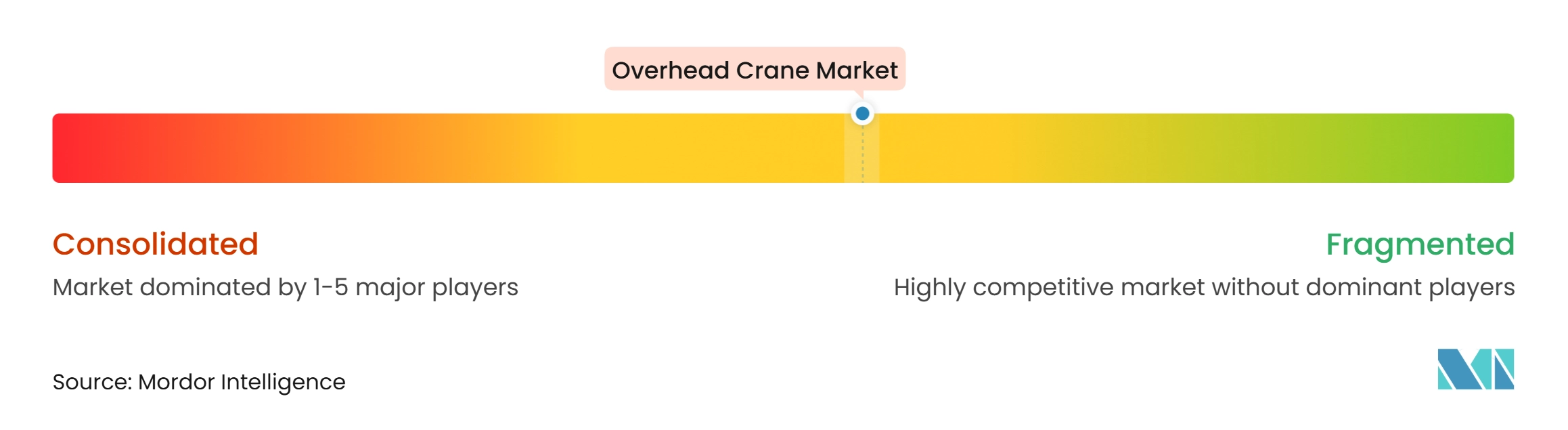
The overhead crane market is moderately concentrated globally, with Konecranes holding a strong position among Western suppliers and Weihua representing a capable Chinese competitor. Columbus McKinnon completed its acquisition of Kito Crosby on February 4, 2026, bringing Kito, Crosby, Harrington, Gunnebo Industries, Peerless, and eepos into one material handling platform. The company stated that the transaction was expected to produce USD 70 million in net annual run-rate cost synergies. This move expands Columbus McKinnon's product coverage and service reach. It also makes Kito a brand within the combined platform rather than a separate competitive entity.
Konecranes reported EUR 4,389.3 million in 2025 order intake, a 9.7% increase, and a 14.0% comparable EBITA margin. Its R&D expenditure was EUR 78.1 million in the same year. The company is building service differentiation through predictive maintenance, RailQ runway analysis, and connected fleet data. These capabilities can reduce the time needed to develop modernization proposals. They also make service history and equipment data more valuable to customers and suppliers over time.
Weihua introduced its S-series in 2025 with a reported 20% shorter delivery cycle and 15% to 30% lower dead weight and wheel pressure. The platform highlights how modular design can support cost and lead-time competition. The company also won the bid for a 3,800-ton gantry crane for the Zhejiang offshore wind port in 2025. Smaller and mid-sized manufacturers can compete through practical smart-retrofit packages for plants that cannot purchase premium service contracts. ASME B30.2 and ISO 4301 continue to shape design and certification requirements for suppliers serving North American and European customers.
Overhead Crane Industry Leaders
-
Konecranes Plc
-
Columbus McKinnon Corporation
-
Weihua Group Co., Ltd.
-
ABUS Kransysteme GmbH
-
Industrias Electromecánicas GH, S.A.
- *Disclaimer: Major Players sorted in no particular order
Overhead Crane Market Companies Covered in this Report
- Konecranes Plc
- Columbus McKinnon Corporation
- ABUS Kransysteme GmbH
- Industrias Electromecánicas GH, S.A.
- Street Crane Company Limited
- Gorbel, Inc.
- Weihua Group Co., Ltd.
- HENAN MINE CRANE IM&EX CO., LTD
- Eilbeck Cranes
- Spanco, Inc.
- American Crane & Equipment Corporation
- Munck Cranes Inc.
- ElectroMech Material Handling Systems (India) Pvt. Ltd.
- Nucleon (Xinxiang) Crane Co., Ltd.
- Ralf Teichmann GmbH
- Sumitomo Heavy Industries Material Handling Systems Co., Ltd.
- Liebherr-International AG
- Shanghai Zhenhua Heavy Industries Co., Ltd.
- Crane 1 Services, Inc.
Recent Industry Developments in Overhead Crane Market
- May 2026: Konecranes agreed to supply two CXTD double-girder overhead cranes, each with a 2 x 80-ton main hoist, for Westcon Helgeland’s new production facility in Nesna, Norway, with delivery scheduled for October 2026.
- May 2026: Konecranes agreed to supply nine cranes, including eight CXT and S-series overhead cranes with TRUCONNECT remote monitoring, to PT Tata Metal Lestari’s Sadang facility in West Java, Indonesia.
- May 2026: Jiangsu Weihua Ocean Heavy Industry began lifting a 2,400-ton single-girder gantry crane at Wison New Energies’ Qidong yard in China.
- February 2026: Columbus McKinnon completed the acquisition of Kito Crosby Limited, integrating the Kito, Crosby, Harrington, Gunnebo Industries, Peerless, and eepos brands.
- August 2025: Weihua signed a contract to build a 3,800-ton gantry crane with a 130-meter lifting height for Zhejiang Wenzhou Zhehaifeng Home Port Equipment Development, an offshore wind home port developer.
Global Overhead Crane Market Report Scope
The overhead crane market is segmented by type, lifting capacity, operation, end user, sales type, and geography. By type, the market is segmented into bridge cranes (single-girder and double-girder), gantry, jib, monorail, and workstation cranes. By lifting capacity, the market is segmented into up to 10 tons, 10 to 50 tons, 50 to 100 tons, and above 100 tons. By operation, the market is segmented into manual, semi-automatic, and fully automatic. By end user, the market is segmented into automotive, steel and metals, power generation, shipbuilding and ports, warehousing and logistics, aerospace, paper, and other end users. By sales type, the market is segmented into new equipment and modernization and services. By geography, the market is segmented into North America, Europe, Asia-Pacific, South America, and the Middle East and Africa. North America includes the United States, Canada, and Mexico; Europe includes Germany, the United Kingdom, France, Italy, Spain, Poland, the Netherlands, Sweden, Russia, and Rest of Europe; Asia-Pacific includes China, Japan, India, South Korea, Australia, Indonesia, Vietnam, Thailand, Malaysia, and Rest of Asia-Pacific; South America includes Brazil, Argentina, Chile, Colombia, Peru, and Rest of South America; and Middle East and Africa includes Saudi Arabia, the United Arab Emirates, Qatar, Turkey, Egypt, South Africa, Nigeria, Morocco, and Rest of Middle East and Africa. The market forecasts are provided in terms of value (USD) and volume (units).
Segmentation Overview
| Bridge Cranes (Single-Girder and Double-Girder) |
| Gantry |
| Jib |
| Monorail |
| Workstation Cranes |
| Up to 10 Tons |
| 10 to 50 Tons |
| 50 to 100 Tons |
| Above 100 Tons |
| Manual |
| Semi-Automatic |
| Fully Automatic |
| Automotive |
| Steel and Metals |
| Power Generation |
| Shipbuilding and Ports |
| Warehousing and Logistics |
| Aerospace |
| Paper |
| Other End Users |
| New Equipment |
| Modernization and Services |
| North America | United States |
| Canada | |
| Mexico | |
| Europe | Germany |
| United Kingdom | |
| France | |
| Italy | |
| Spain | |
| Poland | |
| Netherlands | |
| Sweden | |
| Russia | |
| Rest of Europe | |
| Asia-Pacific | China |
| Japan | |
| India | |
| South Korea | |
| Australia | |
| Indonesia | |
| Vietnam | |
| Thailand | |
| Malaysia | |
| Rest of Asia-Pacific | |
| South America | Brazil |
| Argentina | |
| Chile | |
| Colombia | |
| Peru | |
| Rest of South America | |
| Middle East and Africa | Saudi Arabia |
| United Arab Emirates | |
| Qatar | |
| Turkey | |
| Egypt | |
| South Africa | |
| Nigeria | |
| Morocco | |
| Rest of Middle East and Africa |
| By Type | Bridge Cranes (Single-Girder and Double-Girder) | |
| Gantry | ||
| Jib | ||
| Monorail | ||
| Workstation Cranes | ||
| By Lifting Capacity | Up to 10 Tons | |
| 10 to 50 Tons | ||
| 50 to 100 Tons | ||
| Above 100 Tons | ||
| By Operation | Manual | |
| Semi-Automatic | ||
| Fully Automatic | ||
| By End User | Automotive | |
| Steel and Metals | ||
| Power Generation | ||
| Shipbuilding and Ports | ||
| Warehousing and Logistics | ||
| Aerospace | ||
| Paper | ||
| Other End Users | ||
| By Sales Type | New Equipment | |
| Modernization and Services | ||
| By Geography | North America | United States |
| Canada | ||
| Mexico | ||
| Europe | Germany | |
| United Kingdom | ||
| France | ||
| Italy | ||
| Spain | ||
| Poland | ||
| Netherlands | ||
| Sweden | ||
| Russia | ||
| Rest of Europe | ||
| Asia-Pacific | China | |
| Japan | ||
| India | ||
| South Korea | ||
| Australia | ||
| Indonesia | ||
| Vietnam | ||
| Thailand | ||
| Malaysia | ||
| Rest of Asia-Pacific | ||
| South America | Brazil | |
| Argentina | ||
| Chile | ||
| Colombia | ||
| Peru | ||
| Rest of South America | ||
| Middle East and Africa | Saudi Arabia | |
| United Arab Emirates | ||
| Qatar | ||
| Turkey | ||
| Egypt | ||
| South Africa | ||
| Nigeria | ||
| Morocco | ||
| Rest of Middle East and Africa | ||
Key Questions Answered in the Report
What is the forecast growth rate for overhead cranes through 2032?
The sector is projected to grow at a 4.64% CAGR from 2027 to 2032, rising from USD 5.11 billion in 2027 to USD 6.41 billion in 2032.
Which crane type has the strongest projected growth?
Gantry cranes are forecast to grow at a 6.53% CAGR through 2032, supported by port, offshore wind, and large-fabrication work.
Which lifting-capacity category is growing fastest?
Cranes above 100 tons are forecast to grow at a 7.23% CAGR through 2032, supported by electric arc furnace and other heavy-process applications.
Which end-user segment offers the fastest growth?
Warehousing and logistics is expected to expand at an 8.43% CAGR through 2032 as high-bay storage and fulfillment facilities add automation.