
Organic Rheological Modifiers Market Size and Share
Market Overview
| Study Period | 2021 - 2031 |
|---|---|
| Market Size (2026) | USD 4.40 Billion |
| Market Size (2031) | USD 5.39 Billion |
| Growth Rate (2026 - 2031) | 4.16 % |
| Fastest Growing Market | Asia-Pacific |
| Largest Market | Asia-Pacific |
| Market Concentration | Medium |
Major Players *Disclaimer: Major Players sorted in no particular order Image © Mordor Intelligence. Reuse requires attribution under CC BY 4.0. | |
Organic Rheological Modifiers Market Analysis by Mordor Intelligence
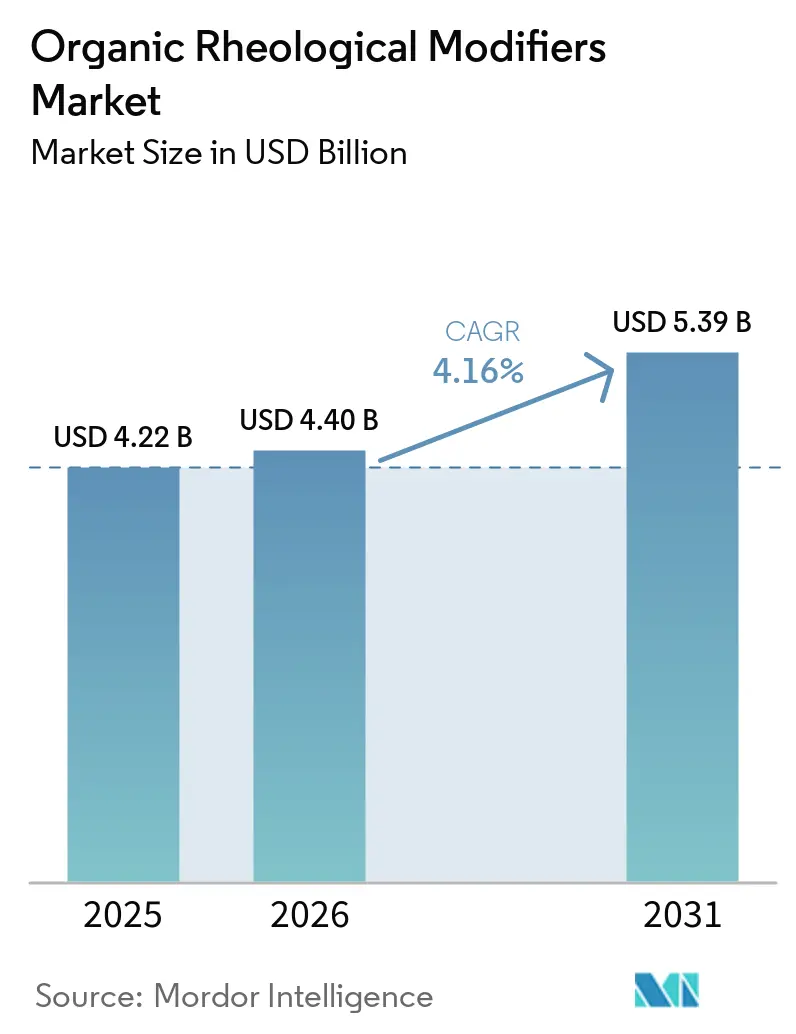
The Organic Rheological Modifiers Market size was valued at USD 4.22 billion in 2025 and is estimated to grow from USD 4.40 billion in 2026 to reach USD 5.39 billion by 2031, at a CAGR of 4.16% during the forecast period (2026-2031). The organic rheological modifiers market is benefiting from the shift from solvent-borne formulations toward waterborne and bio-based systems. Tighter controls on volatile organic compounds (VOCs) are increasing the need for additives that provide viscosity, flow, and sag resistance in waterborne paints. The revised European Union Ecolabel criteria for paints and varnishes, published in February 2026 and valid through 2032, set stricter volatile organic compound and semi-volatile organic compound limits. The criteria also introduced a product group for water-based aerosol spray paints, which supports demand for low-VOC additive systems. Suppliers are responding through bio-based feedstocks, certified carbon accounting, and products designed for high-performance waterborne coatings.
Key Report Takeaways
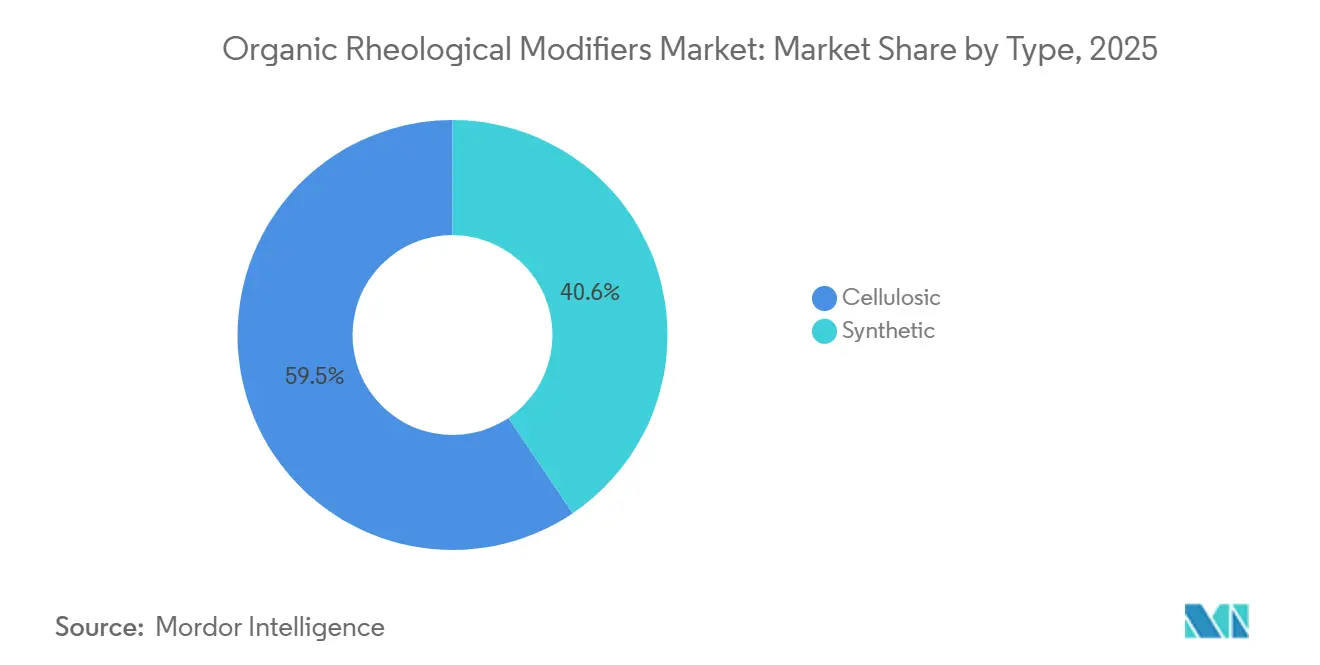
- By type, cellulosic held 59.45% of the organic rheological modifiers market share in 2025, while synthetic is projected to advance at a 4.67% CAGR through 2031.
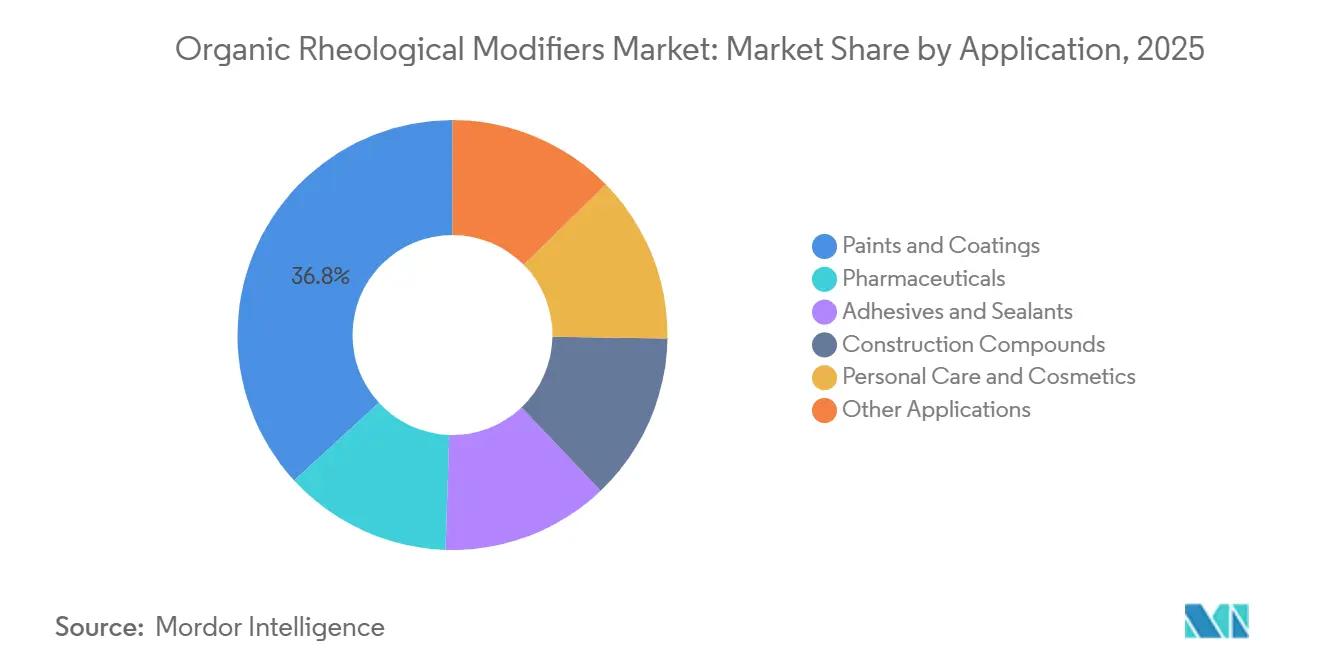
- By application, paints and coatings held 36.84% of the organic rheological modifiers market share in 2025 and are projected to advance at a 5.05% CAGR through 2031.
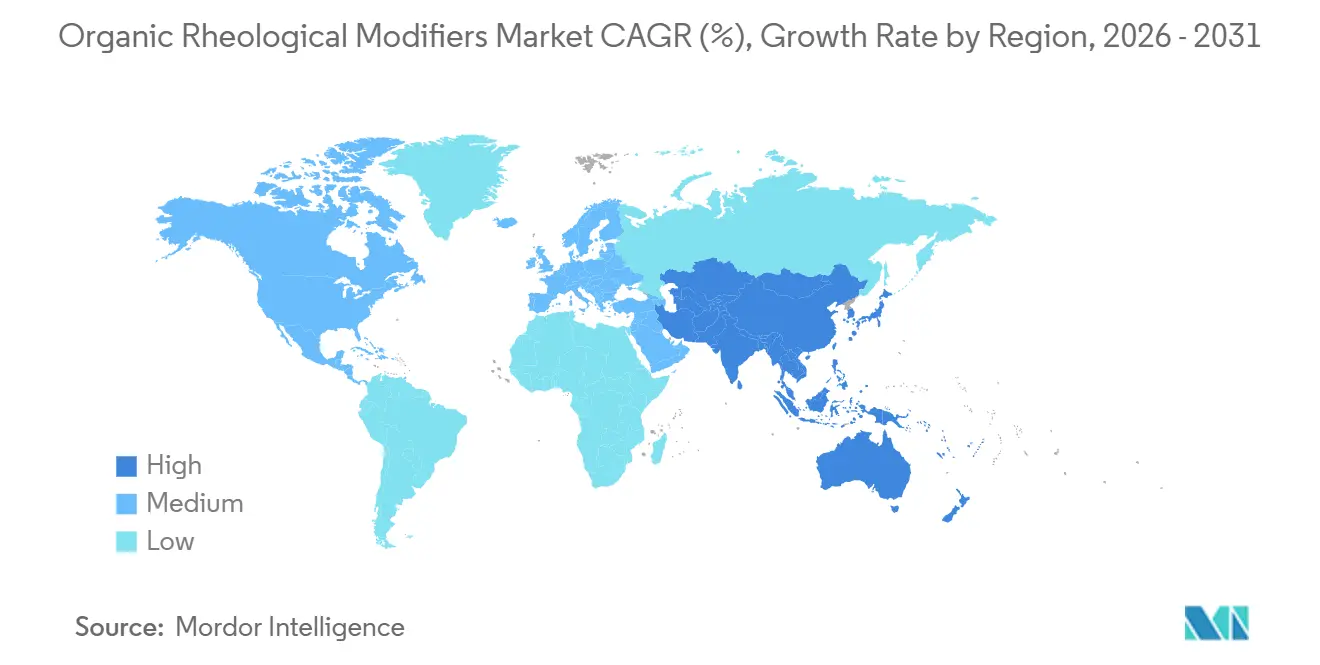
- By geography, Asia-Pacific held 40.26% of the organic rheological modifiers market share in 2025 and is projected to advance at a 5.78% CAGR through 2031.
Note: Market size and forecast figures in this report are generated using Mordor Intelligence’s proprietary estimation framework, updated with the latest available data and insights as of January 2026.
Market Trends and Insights
Drivers Impact Analysis of Organic Rheological Modifiers Market*
| Driver | (~) % Impact on CAGR Forecast | Geographic Relevance | Impact Timeline |
|---|---|---|---|
| Waterborne and Low-VOC Formulation Adoption | +1.5% | Global | Short term (≤ 2 years) |
| Demand for Bio-Based and Biodegradable Modifiers | +0.9% | Global | Medium term (2–4 years) |
| Growth of Construction, Architectural Coatings and Infrastructure | +0.8% | APAC core, spillover to MEA | Medium term (2–4 years) |
| Rising Personal Care and Pharmaceutical Formulation Complexity | +0.5% | North America & EU | Long term (≥ 4 years) |
| Reformulation Demand from Microplastics Restrictions | +0.4% | EU core, spill-over to North America | Short term (≤ 2 years) |
| Source: Mordor Intelligence | |||
Waterborne and Low-VOC Formulation Adoption
Waterborne and low-VOC coating systems are a central source of demand for the organic rheological modifiers market. The U.S. Environmental Protection Agency updated National Volatile Organic Compound Emission Standards for Aerosol Coatings in January 2025. California South Coast Air Quality Management District Rule 1113 capped most architectural coatings below 50 grams per liter of volatile organic compounds, and formulators increasingly apply that approach more broadly to avoid maintaining separate formulas. China set a 50-gram-per-liter limit for selected interior paints and applied a 4% consumption tax to products that exceeded 420 grams per liter. Organic rheological modifiers have negligible volatile organic compound content, and waterborne systems require 1.5 to 2 times higher additive loadings than comparable solvent-borne systems to achieve application and sag properties.
Demand for Bio-Based and Biodegradable Modifiers
Demand for bio-based and biodegradable chemistries is widening the organic rheological modifiers market beyond conventional performance requirements. In June 2025, BASF completed the transition of its Rheovis range in Ludwigshafen, Germany, and Bradford, United Kingdom[1]BASF, “BASF’s Rheovis Range Transitions to Bio-Based Ethyl Acrylate (EA),” BASF, basf.com. The range achieved up to 35% biogenic content traceable through carbon-14 testing under American Society for Testing and Materials (ASTM) D6866-18 and up to 30% lower product carbon footprint, with unchanged composition and performance specifications. In April 2025, Arkema converted its European acrylic thickener line, sold under Rheotech, Thixol, and Viscoatex, to bio-sourced ethyl acrylate from Carling, France. The products offered up to 30% bio-based content and up to 25% lower product carbon footprint under International Organization for Standardization (ISO) 14040, ISO 14044, and ISO 14067 methods. Nouryon launched a fully biobased and biodegradable carboxymethyl cellulose in February 2026 for laundry detergent applications, reinforcing the role of bio-cellulosic materials in the organic rheological modifiers market.
Growth of Construction, Architectural Coatings and Infrastructure
Construction, architectural coatings, and infrastructure activity support demand across the organic rheological modifiers market. Hydroxyethyl cellulose (HEC) and hydroxypropyl methylcellulose (HPMC) act as water-retention and workability agents in cement-based mortars. Their functions cannot be replaced with inorganic additives without affecting application properties. India’s National Infrastructure Pipeline included more than 7,400 projects, while urban corridor development in Southeast Asia supported demand for concrete admixtures and tile adhesives. China’s residential investment declined 17% year over year through December 2025, but renovation and interior refurbishment continued to support modifier use. Growth in prefabricated construction and high-performance dry-mix mortars also maintained demand for cellulosic and synthetic products in the organic rheological modifiers market.
Rising Personal Care and Pharmaceutical Formulation Complexity
Rising personal care and pharmaceutical formulation complexity adds higher-value demand to the organic rheological modifiers market. The U.S. Food and Drug Administration Quality by Design (QbD) framework for semi-solid topical dosage forms identifies apparent viscosity as a critical quality attribute. It requires detailed rheological characterization across temperature and shear-rate ranges in regulatory submissions. A 2026 American Association of Pharmaceutical Scientists (AAPS) Open paper describes rheology-based indices as foundational to Quality by Design for topical formulation development. In personal care, bouncy gels, slime-like primer textures, and cushion creams require multi-polymer systems that combine polysaccharide networks with acrylic co-thickeners. Nouryon introduced Structure Silk starch in September 2024, a non-genetically modified potato-derived modifier that was readily biodegradable under Organisation for Economic Co-operation and Development (OECD) 301B and had a Renewable Carbon Index above 90%.
Restraints Impact Analysis of Organic Rheological Modifiers Market*
| Restraint | (~) % Impact on CAGR Forecast | Geographic Relevance | Impact Timeline |
|---|---|---|---|
| Performance Variability Across Natural Feedstocks | -0.7% | Global | Long term (≥ 4 years) |
| High-Cost Premium for Bio-Based and Specialty Chemistries | -0.5% | North America & EU | Medium term (2–4 years) |
| Temperature- and Electrolyte-Sensitivity in Natural Polymers | -0.4% | Global | Long term (≥ 4 years) |
| Source: Mordor Intelligence | |||
Performance Variability Across Natural Feedstocks
Performance variability across natural feedstocks limits use in quality-sensitive applications within the organic rheological modifiers market. Cellulose ether performance is affected by changes in cotton linter or wood pulp molecular-weight distribution. Seasonal conditions, processing chemistry, and regional sourcing can all affect that distribution. In pharmaceutical production, the International Council for Harmonisation Q9 risk-management guidelines require documented control of critical material attributes, and an out-of-specification HEC or HPMC batch can lead to rejection and reprocessing. A 2025 study found that higher-molecular-weight modifiers diffused more slowly at interfaces and provided greater stability, which underscores the importance of consistent molecular-weight control. Tightly specified formulation-grade materials commanded a 15% to 25% premium over industrial grades, though smaller formulators had limited ability to secure specification-locked supply agreements.
High-Cost Premium for Bio-Based and Specialty Chemistries
High-cost premiums for bio-based and specialty chemistries remain a barrier for price-sensitive applications. Bio-based and fossil-derived organic rheological modifiers showed a 15% to 30% cost gap for comparable performance grades. Bio-sourced ethyl acrylate, bio-cellulose feedstocks, and enzymatic derivatization add raw material, quality assurance, and certification costs. Certifications such as REDcert², International Sustainability and Carbon Certification Plus (ISCC Plus), and United States Department of Agriculture BioPreferred add requirements that are difficult to absorb at commodity price points. For mid-tier coatings producers in Southeast Asia and South America, a bio-content Hydrophobically Modified Alkali-Soluble Emulsion (HASE) or Hydrophobically Modified Ethoxylated Urethane (HEUR) modifier with a 20% to 25% premium can be difficult to recover through retail pricing. The narrow supply base for bio-based acrylic acid and ethyl acrylate also constrains near-term cost reductions in the organic rheological modifiers market.
*Our forecasts treat driver/restraint impacts as directional, not additive. The impact forecasts reflect baseline growth, mix effects, and variable interactions.
Organic Rheological Modifiers Market Segment Analysis
By Type:
Cellulosic Demand Supported by Waterborne CoatingsCellulosic held 59.45% of the organic rheological modifiers market size in 2025. The segment was supported by the cost position of HEC, HPMC, carboxymethyl cellulose (CMC), and methyl hydroxyethyl cellulose (MHEC) in waterborne paints, dry-mix mortars, and pharmaceutical semi-solid formulations. These materials provide both water retention and viscosity building in cementitious systems. Synthetic associative thickeners cannot fully replicate this combination at a comparable cost. Nouryon presented Bermocoll EHM MAX at the European Coatings Show in March 2025, stating that it delivered up to 10% higher efficiency than comparable cellulose ethers and improved spatter resistance and sag control.
The organic rheological modifiers industry benefits from cellulosic materials that align with bio-derived and biodegradable polymer criteria in paint and construction adhesive formulations. That position supports compliance with European Union Ecolabel requirements. Synthetic materials also serve a growing part of the organic rheological modifiers market, particularly in high-end waterborne architectural coatings, automotive refinish, and industrial coatings. The synthetic segment is projected to advance at a 4.67% CAGR through 2031. BASF launched Rheovis PU 1294 in January 2026 as an alkylphenol ethoxylate-free and solvent-free polyurethane thickener for waterborne wood and architectural coatings. BASF also extended its Rheovis portfolio in July 2026 with REDcert²-certified biomass-balanced grades, Rheovis PU 1333 MB and Rheovis HS 1169 MB, linking certified upstream feedstocks with HEUR and HASE chemistries.


By Application:
Paints and Coatings Lead Both Market Share and GrowthPaints and coatings held 36.84% of the organic rheological modifiers market size in 2025. The application is projected to advance at a 5.05% CAGR through 2031. Waterborne architectural and industrial paints require rheological additives for stable application properties. Modifier loading per liter of finished waterborne paint was 30% to 50% higher than in comparable solvent-borne formulations. Adhesives and sealants used organic modifiers for flow control and sag resistance in moisture-cure polyurethane and two-part epoxy systems. Construction compounds used HEC and HPMC in dry-mix mortars and remained tied to building activity and mortar consumption.
The organic rheological modifiers industry also serves personal care, cosmetics, and pharmaceutical applications, where formulation requirements support higher value. European Union REACH Regulation 2023/2055 has directed cosmetics formulators away from synthetic polymer microparticles and toward soluble or bio-derived alternatives[2]European Commission, “Commission Regulation (EU) 2023/2055 Restriction of Microplastics Intentionally Added to Products,” European Commission, single-market-economy.ec.europa.eu. Elementis PLC introduced the BENTONE ULTIMATE series at In-Cosmetics Global 2025, using organically modified hectorite clay and a 100% natural activation system. Pharmaceutical programs incorporate modifier selection and characterization into product quality frameworks. This requirement increases the importance of defined viscosity behavior in the organic rheological modifiers market.

Geography Analysis
APAC Organic Rheological Modifiers Market
Asia-Pacific held 40.26% of the market share in 2025 and is projected to advance at a 5.78% CAGR through 2031. Provincial enforcement by the Ministry of Ecology and Environment (MEE) supported the transition to waterborne coatings. China’s dual-carbon goals also increased procurement of cellulosic and HEUR modifiers for industrial and decorative coatings. India’s infrastructure programs and urban housing activity increased dry-mix mortar consumption. HPMC and MHEC remained primary workability aids in these formulations.
ASEAN, North America and Europe Organic Rheological Modifiers Market
Southeast Asian countries, including Vietnam, Indonesia, and the Philippines, expanded architectural coating and personal care manufacturing. This supported investment by regional and international suppliers seeking diversified production footprints. Elementis PLC expanded NiSAT technology production to China in July 2024. The company localized RHEOLATE HX, IF, and CVS Series materials for Asian architectural coatings, with grades described as free from volatile organic compounds, isothiazoline, tin, and alkylphenol ethoxylates. North America and Europe accounted for most of the remaining organic rheological modifiers market size in 2025. Both regions had high specification requirements and a faster shift toward bio-based modifier grades.
The Americas and EMEA Organic Rheological Modifiers Market
In North America, the Environmental Protection Agency update in January 2025 and the California Rule 1113 threshold reinforced waterborne reformulation in architectural and industrial coatings. In Europe, the revised European Union Ecolabel criteria, Registration, Evaluation, Authorisation and Restriction of Chemicals (REACH) disclosure requirements, and the planned Digital Product Passport encouraged earlier adoption of bio-certified grades. BASF completed its Rheovis bio-based ethyl acrylate transition in June 2025, and Arkema introduced bio-based Rheotech, Thixol, and Viscoatex products in April 2025. South America remained relevant through Brazil’s construction recovery and premium skin care and hair care demand. Argentina faced macroeconomic volatility that limited import-dependent modifier adoption. The Middle East and Africa drew support from Saudi Arabia’s Vision 2030 infrastructure activity, construction compound demand, waterproofing needs, and halal-certified personal care development.

Competitive Landscape
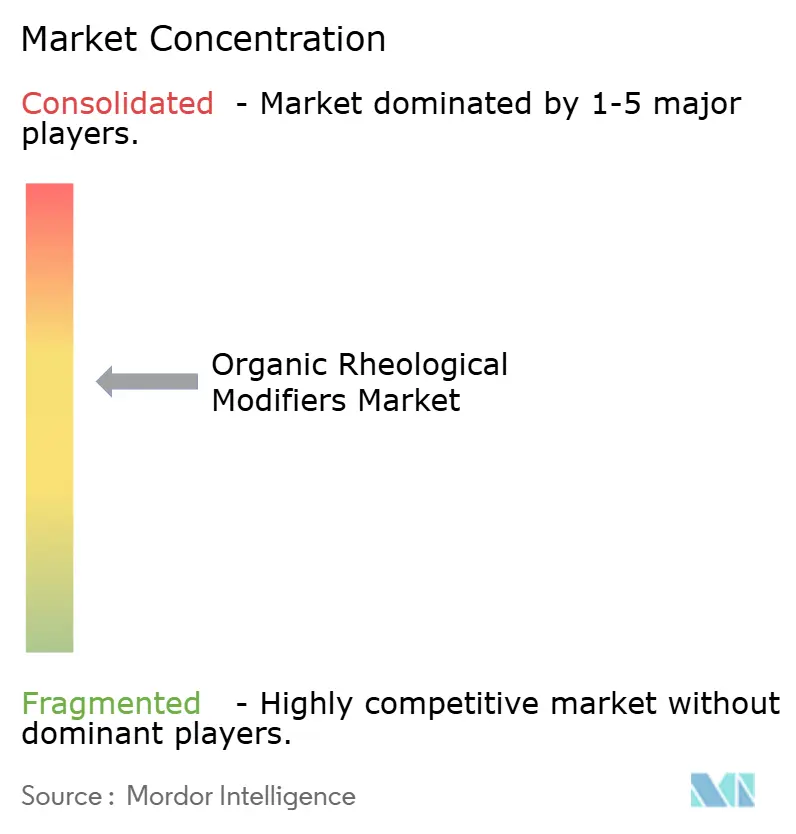
The organic rheological modifiers market is moderately concentrated, with the top five players including BASF, Dow, Ashland, Arkema, and Clariant. Their positions are supported by switching costs in premium and regulated applications. They compete through application-specific performance, bio-based credentials, and manufacturing reach. Regional producers in China, India, and Eastern Europe compete on price in commodity cellulosic and low-specification HASE products. This creates a clear difference between specification-driven specialty products and price-led grades.
The organic rheological modifiers market has seen suppliers strengthen feedstock certifications and product carbon-footprint disclosures. BASF launched REDcert²-certified biomass-balanced Rheovis products in July 2026, including Rheovis PU 1333 MB and Rheovis HS 1169 MB. The launch also includes Dispex AA 4145 MB for architectural coatings. Arkema converted its European acrylic thickener line to bio-sourced ethyl acrylate in April 2025. Elementis PLC expanded NiSAT production in China in July 2024 to localize supply for the Asian architectural coatings sector. These actions address both product performance and procurement requirements.
Pharmaceutical-grade cellulosic modifiers with documented lot-to-lot molecular-weight consistency remain an important area for product differentiation. Alkylphenol ethoxylate-free synthetic associative thickeners also address a defined need in Asian architectural coatings. Domestic Chinese specialty chemical producers are expanding HASE and HEUR capacity for local coatings customers. Smaller bio-specialty firms are developing enzymatic and fermentation-derived alternatives to conventional cellulose derivatives. Lamberti S.p.A., Lubrizol, Croda International Plc, and Evonik Industries AG focus on specialty personal care and pharmaceutical grades supported by technical service. ALTANA AG’s BYK brand, Dow, Wacker Chemie AG, and Cargill, Incorporated participate across industrial coatings, construction, cellulose-based products, biopolymer feedstocks, xanthan gum, and specialty starches. The organic rheological modifiers market, therefore, combines global specialty suppliers with regional producers and upstream bio-based ingredient providers.
Organic Rheological Modifiers Industry Leaders
BASF
Dow
Ashland
Arkema
CLARIANT
- *Disclaimer: Major Players sorted in no particular order
Organic Rheological Modifiers Market Companies Covered in this Report
- ALTANA AG
- Arkema
- Ashland
- BASF
- Cargill Incorporated
- CLARIANT
- Croda International Plc
- Dow
- Elementis PLC
- Evonik Industries AG
- Lamberti S.p.A.
- Lubrizol
- Nouryon
- Syensqo
- Wacker Chemie AG

Recent Industry Developments in Organic Rheological Modifiers Market
- April 2026: Lubrizol launched Oilkemia 7S polymer, a biodegradable rheology modifier for oil-based systems offering high thickening efficiency, suspension, clarity, and long-term stability. The launch expanded the portfolio of organic rheological modifiers for oil-based formulations, particularly in beauty and personal-care applications.
- March 2026: CLARIANT launched Tonnegel 50, an attapulgite-based rheology modifier providing stable thixotropic performance across varying pH, temperature, and salt conditions for pesticides, seed coatings, and suspension fertilizers. The launch strengthened the use of rheology modifiers in agricultural formulations requiring consistent viscosity and coating performance.


Global Organic Rheological Modifiers Market Report Scope
Organic rheological modifiers are additives used to control the flow behavior, viscosity, stability, and application characteristics of liquid and semi-solid formulations. They help optimize processing and product performance by influencing how formulations respond to shear, settling, spreading, and storage conditions.
The Organic Rheological Modifiers Market is segmented by type, application, and geography. By type, the market is segmented into cellulosic and synthetic. By application, the market is segmented into paints and coatings, adhesives and sealants, construction compounds, personal care and cosmetics, pharmaceuticals, and other applications. The report also covers the market size and forecasts for organic rheological modifiers in 15 countries across major regions. For each segment, the market sizing and forecasts have been done on the basis of value (USD).
| Cellulosic |
| Synthetic |
| Paints and Coatings |
| Adhesives and Sealants |
| Construction Compounds |
| Personal Care and Cosmetics |
| Pharmaceuticals |
| Other Applications |
| Asia-Pacific | China |
| India | |
| Japan | |
| South Korea | |
| ASEAN Countries | |
| Rest of Asia-Pacific | |
| North America | United States |
| Canada | |
| Mexico | |
| Europe | Germany |
| United Kingdom | |
| France | |
| Italy | |
| NORDIC Countries | |
| Rest of Europe | |
| South America | Brazil |
| Argentina | |
| Rest of South America | |
| Middle East and Africa | Saudi Arabia |
| South Africa | |
| Rest of Middle East and Africa |
| By Type | Cellulosic | |
| Synthetic | ||
| By Application | Paints and Coatings | |
| Adhesives and Sealants | ||
| Construction Compounds | ||
| Personal Care and Cosmetics | ||
| Pharmaceuticals | ||
| Other Applications | ||
| By Geography | Asia-Pacific | China |
| India | ||
| Japan | ||
| South Korea | ||
| ASEAN Countries | ||
| Rest of Asia-Pacific | ||
| North America | United States | |
| Canada | ||
| Mexico | ||
| Europe | Germany | |
| United Kingdom | ||
| France | ||
| Italy | ||
| NORDIC Countries | ||
| Rest of Europe | ||
| South America | Brazil | |
| Argentina | ||
| Rest of South America | ||
| Middle East and Africa | Saudi Arabia | |
| South Africa | ||
| Rest of Middle East and Africa | ||


Key Questions Answered in the Report
What is the size of the organic rheological modifiers market?
The organic rheological modifiers market stands at USD 4.40 billion in 2026 and is projected to reach USD 5.39 billion by 2031.
What is driving demand for organic rheological modifiers?
Waterborne coatings, low-VOC rules, bio-based material demand, construction activity, and more complex personal care and pharmaceutical formulations support demand.
Which type led the market share in 2025?
Cellulosic held a 59.45% share in 2025, supported by use in waterborne paints, dry-mix mortars, and semi-solid pharmaceutical products.
Which application is expected to grow fastest through 2031?
Paints and coatings are projected to advance at a 5.05% CAGR through 2031.
Page last updated on:





