
Organic Chocolate Market Size and Share
Market Overview
| Study Period | 2022 - 2032 |
|---|---|
| Market Size (2027) | USD 0.92 Billion |
| Market Size (2032) | USD 1.24 Billion |
| Growth Rate (2027 - 2032) | 6.21 % |
| Fastest Growing Market | Asia-Pacific |
| Largest Market | Europe |
| Market Concentration | Low |
Major Players *Disclaimer: Major Players sorted in no particular order Image © Mordor Intelligence. Reuse requires attribution under CC BY 4.0. | |
Organic Chocolate Market Analysis by Mordor Intelligence
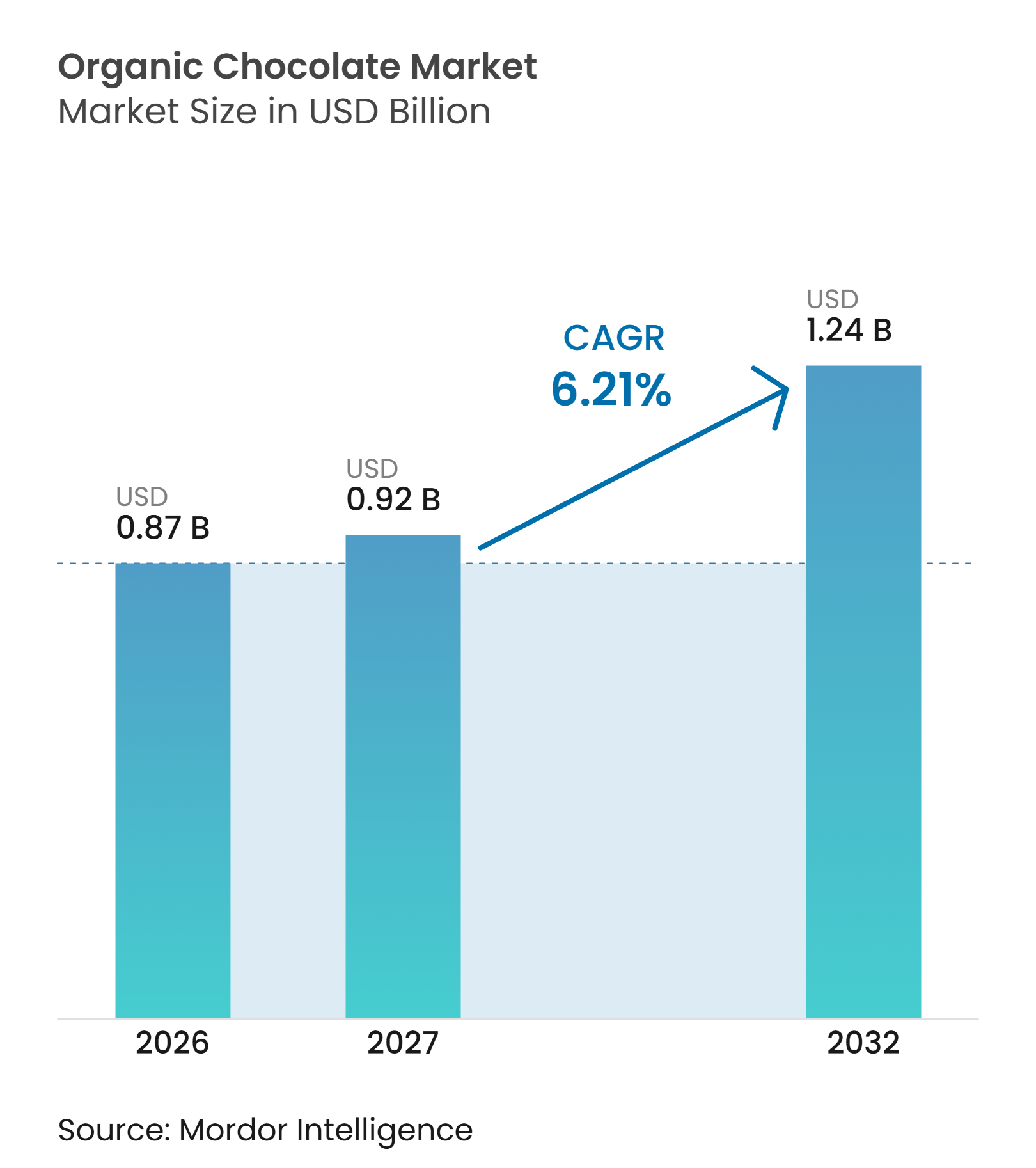
The organic chocolate market size was valued at USD 0.87 billion in 2026 and is estimated to grow from USD 0.92 billion in 2027 to reach USD 1.24 billion by 2032, at a CAGR of 6.21% during the forecast period (2027-2032). The organic chocolate market benefits when consumers regard certification as a practical purchasing signal rather than a niche claim. High-cocoa dark chocolate, traceable sourcing, vegan formats, and premium gifting expand the consumption occasions for organic products. However, limited organic cocoa availability, certification costs, and cocoa price volatility constrain smaller brands’ ability to convert consumer interest. Consequently, the market favors companies that can secure supply, communicate certification benefits clearly, and reach consumers through both grocery and digital channels.
Key Report Takeaways
-
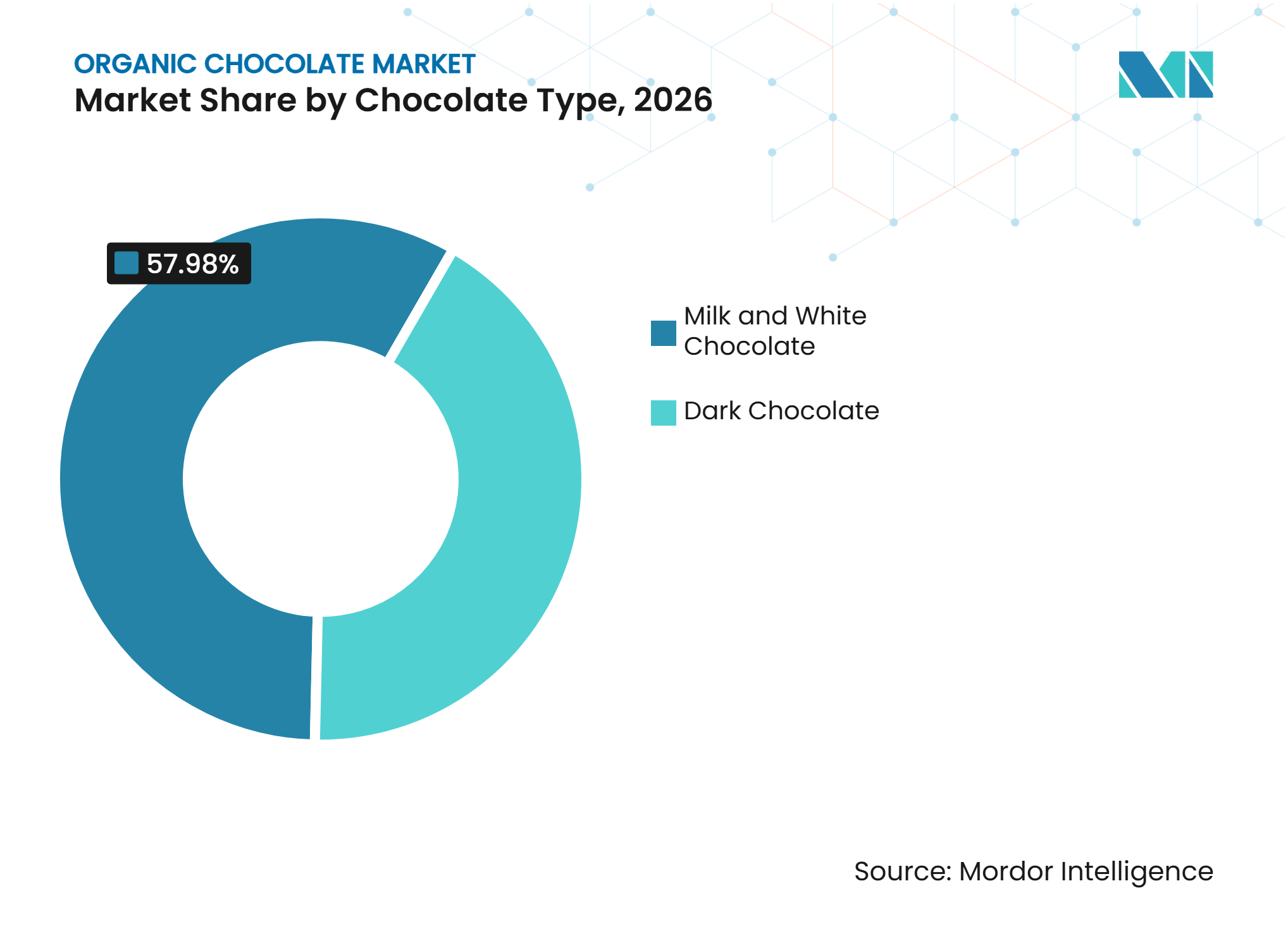
By chocolate type, milk and white chocolate dominated the organic chocolate market with a share of 57.98% in 2026, while dark chocolate is anticipated to register the fastest CAGR of 7.42% during 2027-2032.
-
By form, bars and tablets dominated the market with a 51.82% share in 2026, while pralines and truffles are expected to register the fastest CAGR of 7.63% during 2027-2032.
-
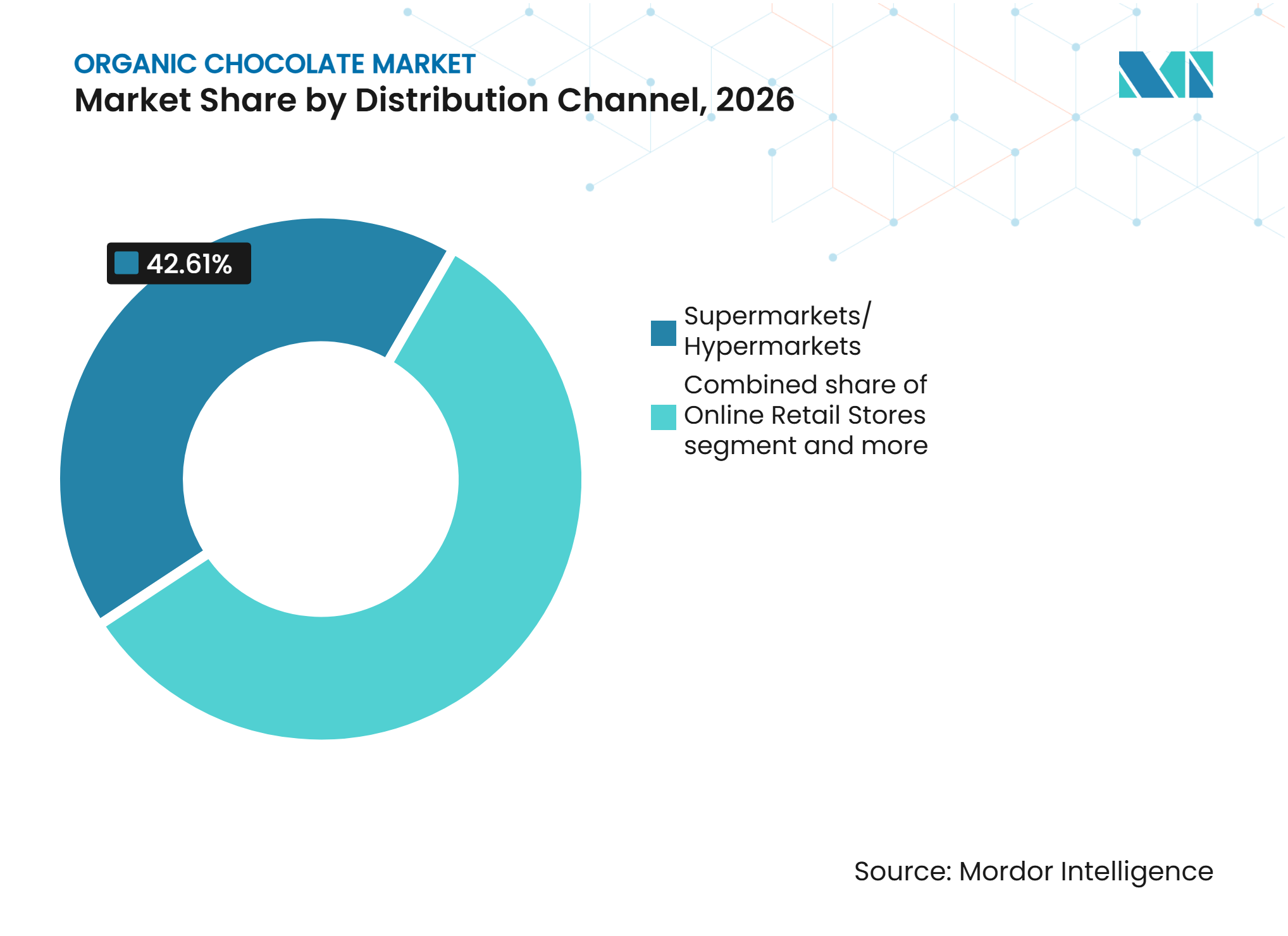
By distribution channel, supermarkets/hypermarkets dominated the market with a share of 42.61% in 2026, while online retail stores are anticipated to register the fastest CAGR of 7.95% during 2027-2032.
-
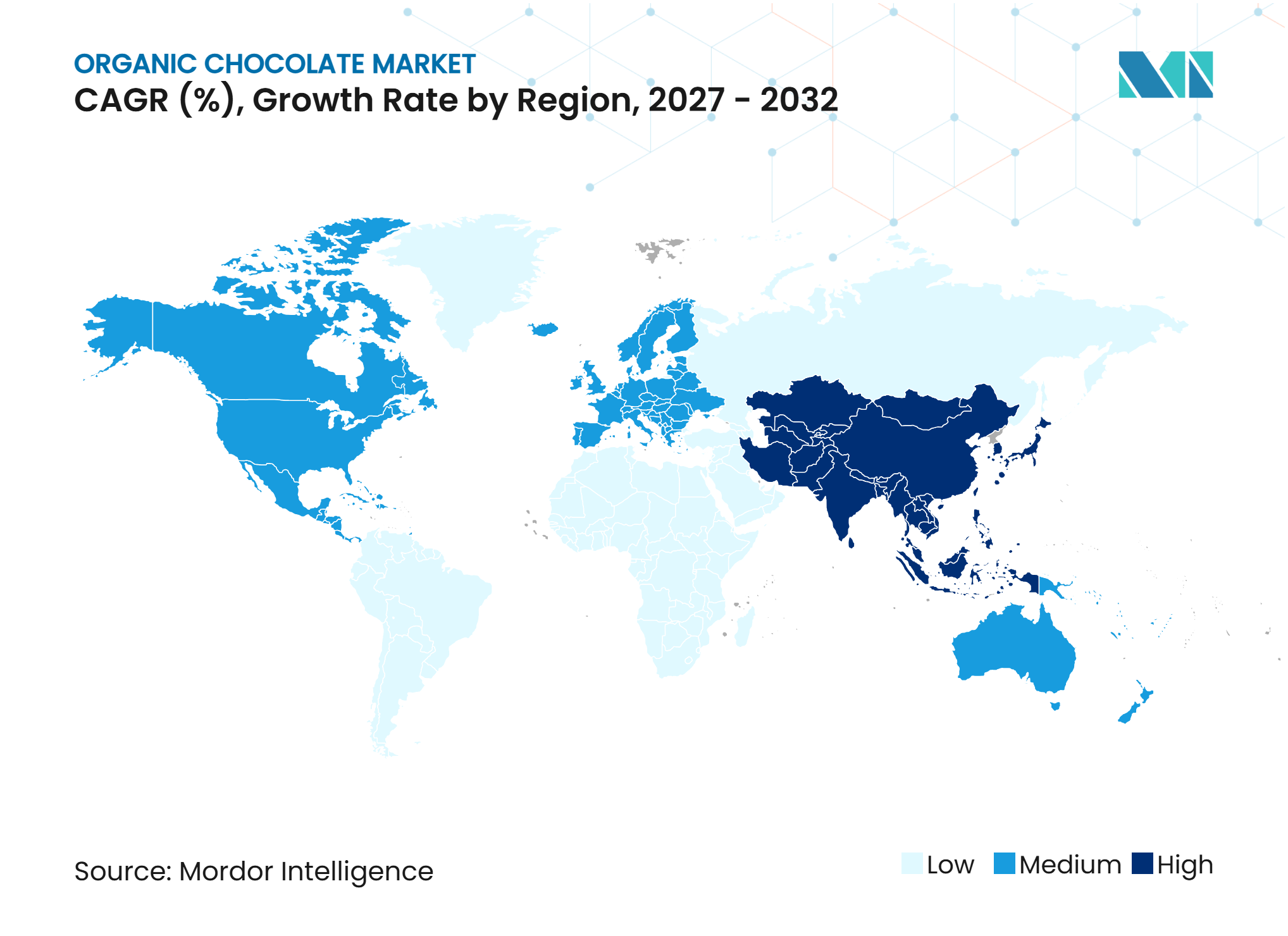
By geography, Europe dominated the organic chocolate market with a share of 37.81% in 2026, while Asia-Pacific is anticipated to register the fastest CAGR of 8.02% during 2027-2032.
Note: Market numbers in this report are based on Mordor Intelligence's proprietary estimation framework, which combines nine months of actuals with Q4 projections for base year 2026.
Market Trends and Insights
Drivers Impact Analysis of Organic Chocolate Market*
| Driver | (~) % Impact on CAGR Forecast | Geographic Relevance | Impact Timeline |
|---|---|---|---|
| Rising consumer preference for organic food products | +1.5% | Global | Short term (≤ 2 years) |
| Demand for premium high-cocoa dark chocolate | +1.0% | Global, led by Europe and North America | Medium term (2-4 years) |
| Growing preference for ethically sourced and traceable cocoa | +0.7% | Global, led by Europe | Medium term (2-4 years) |
| Product innovation and expansion of organic chocolate portfolios | +0.6% | Global | Short term (≤ 2 years) |
| Specialty retail, grocery, and online channel expansion | +0.8% | Global, led by Asia-Pacific and North America | Short term (≤ 2 years) |
| Rising demand for vegan and plant-based chocolate alternatives | +0.5% | Global, led by Europe and North America | Medium term (2-4 years) |
| Source: Mordor Intelligence | |||
Rising Consumer Preference for Organic Food Products
Growing consumer awareness of food quality, ingredient authenticity, and agricultural practices is driving demand for organic food products, including organic chocolate. Consumers increasingly prioritize organically certified ingredients and transparent sourcing practices when purchasing food products. This preference creates opportunities for organic chocolate manufacturers to differentiate their offerings through certified organic cocoa, sugar, and other ingredients. According to the Indian Organic Market and Export Promotion Strategy report January 2025, 79% of Indian consumers planned to increase organic products' share of grocery purchases. Additionally, 91% identified health benefits as the primary factor influencing their organic food purchasing decisions[1]. This shift in consumer preferences supports the broader adoption of organic food products and creates favorable conditions for organic chocolate manufacturers.
Rising Demand for Premium High-Cocoa Organic Dark Chocolate
Increasing consumer interest in premium confectionery, distinctive cocoa flavors, and products with higher cocoa content is driving demand for organic dark chocolate. Consumers are increasingly seeking chocolate varieties with richer cocoa profiles, lower sweetness, and certified organic ingredients. According to the Centre for the Promotion of Imports (CBI), in its 2026 analysis of the United Kingdom cocoa market, premium dark chocolate is a growing category through 2031[2]. This growth is supported by consumer preferences for higher cocoa content, lower sugar levels, and premium-quality products. The report classifies dark chocolate containing at least 55% cocoa as a premium product category. It creates opportunities for organic chocolate manufacturers to strengthen their premium product portfolios through high-cocoa-content formulations and certified organic ingredients.
Growing Preference for Ethically Sourced and Traceable Cocoa
Traceability is becoming a critical commercial requirement in the organic chocolate market. The European Union Deforestation Regulation requires cocoa supply chains serving the European Union to maintain geolocation information and due diligence records. Organic cocoa groups must therefore manage organic compliance alongside traceability documentation. Although these requirements increase operational complexity, they can strengthen the market position of brands with well-established supplier records. Moreover, manufacturers need to invest in robust supplier monitoring systems, digital documentation, and sourcing verification processes to ensure regulatory compliance and supply chain transparency. These capabilities also improve supply chain accountability, support responsible sourcing claims, and strengthen buyer confidence in the authenticity of organic cocoa products.
Rising Demand for Vegan and Plant-Based Chocolate Alternatives
Vegan products expand the appeal of organic chocolate among consumers who prioritize dietary preferences and animal-free ingredients. Many dark chocolate products are already dairy-free, allowing vegan certification to complement an existing organic positioning. The availability of plant-based formulations using ingredients such as oat milk, almond milk, and coconut-based alternatives further enables manufacturers to cater to consumers seeking dairy-free confectionery options. This combination is particularly relevant in premium specialty retail channels, where consumers often expect multiple product credentials. It also enables brands to differentiate dark bars, truffles, and gifting products without altering their core cocoa proposition. This positioning supports a focused approach to product formulation, price positioning, and retail channel selection.
Restraints Impact Analysis of Organic Chocolate Market*
| Restraint | (~) % Impact on CAGR Forecast | Geographic Relevance | Impact Timeline |
|---|---|---|---|
| High production costs and premium product pricing | -0.7% | Global | Short term (≤ 2 years) |
| Limited availability of certified organic cocoa | -0.6% | Global | Medium term (2-4 years) |
| Cocoa price volatility and raw material cost fluctuations | -0.5% | Global, led by West Africa supply regions | Short term (≤ 2 years) |
| Complexities in organic cocoa sourcing and supply-chain traceability | -0.4% | Global | Medium term (2-4 years) |
| Source: Mordor Intelligence | |||
High Production Costs and Premium Product Pricing
Organic chocolate manufacturing entails additional operational requirements that can increase production costs compared with conventional chocolate production. Manufacturers must source certified organic cocoa and other ingredients, maintain separate storage and processing facilities, undergo regular inspections, and comply with organic production standards. These requirements can pose particular challenges for smaller manufacturers that lack established organic procurement networks and dedicated processing facilities. According to the Netherlands Enterprise Agency's Centre for the Promotion of Imports (CBI), the revised European Union Organic Regulation (EU) 2018/848 becomes applicable on January 1, 2025, introducing stricter certification and inspection requirements for organic cocoa producers and exporters[3]. Under the revised regulation, certain larger farms must obtain individual certification instead of relying on group certification, while additional audits and documentation requirements will increase operational complexity.
Limited Availability of Certified Organic Cocoa
The limited availability of certified organic cocoa can constrain the production capacity and expansion of organic chocolate manufacturers. Organic cocoa cultivation requires farmers to comply with stringent agricultural standards, avoid prohibited synthetic pesticides and fertilizers, maintain certification records, and adhere to approved farming practices. These requirements reduce the number of eligible suppliers, making it challenging for manufacturers to secure adequate quantities of certified cocoa. Furthermore, the concentration of certified organic cocoa production in specific geographic regions exposes manufacturers to sourcing uncertainties, seasonal fluctuations, and potential supply disruptions. Consequently, limited raw material availability can restrict production scalability, complicate procurement planning, and affect manufacturers’ ability to maintain consistent supplies of organic chocolate products.
*Our forecasts treat driver/restraint impacts as directional, not additive. The impact forecasts reflect baseline growth, mix effects, and variable interactions.
Organic Chocolate Market Segment Analysis
By Chocolate Type:
Dark Chocolate Builds Demand Through Ingredient SimplicityMilk and White Chocolate accounted for 57.98% of the organic chocolate market share in 2026. The segment benefits from familiar taste profiles and its established presence across bars, gifting products, and mainstream retail assortments. Its versatility also allows manufacturers to incorporate ingredients such as nuts, fruits, caramel, and other inclusions to broaden product appeal. Milk chocolate remains relevant for products that prioritize indulgence and broad consumer accessibility. However, white chocolate faces greater pressure as consumers increasingly prefer products with a stronger cocoa identity and lower perceived sugar content.
Dark Chocolate is projected to grow at a CAGR of 7.42% through 2032, outpacing the overall category forecast. This growth reflects rising demand for products with higher cocoa content, lower sugar formulations, and simpler labels. The Dark Chocolate segment of the organic chocolate market is supported by formulations that use a short list of recognizable ingredients. Cocoa mass, cocoa butter, and cane sugar provide manufacturers with a relatively direct path to organic certification. These products are also commonly dairy-free, enabling brands to combine organic and vegan credentials. This combination can increase the relevance of dark chocolate bars among specialty retailers and consumers seeking plant-based options.


By Form:
Bars Stay Central While Truffles Expand Gifting DemandBars and tablets accounted for 51.82% of the organic chocolate market share in 2026. Their leading position reflects demand for everyday snacking, consistent shelf presentation, and convenient portion sizes. Manufacturers can standardize and distribute bars more easily through supermarkets and online channels. This format also enables consumers to compare cocoa content, organic certifications, and flavor variants more easily. The availability of different cocoa percentages, ingredient combinations, and portion sizes also allows brands to cater to varied consumer preferences. Blocks continue to serve baking and specialty food applications, where organic certification reinforces their artisan appeal. In addition, their portability, longer shelf life, and availability in various pack sizes support repeat purchases among regular chocolate consumers.
Pralines and truffles are forecast to grow at a CAGR of 7.63% through 2032. These products support organic chocolate market growth by addressing gifting and premium-occasion demand. Their presentation encourages higher-value purchases that are less driven by everyday price comparisons. Truffles also enable manufacturers to highlight sustainability attributes through seasonal packs and recyclable packaging. Furthermore, premium fillings, distinctive flavor combinations, and visually appealing gift-oriented packaging help manufacturers differentiate their offerings and attract consumers seeking specialized chocolate experiences. Limited-edition assortments and festive collections also create opportunities for brands to generate seasonal demand and strengthen their premium market positioning.
By Distribution Channel:
Grocery Scale and Digital Discovery Work TogetherSupermarkets and hypermarkets accounted for 42.61% of the organic chocolate market share in 2026. These outlets remain the primary discovery channel for organic confectionery in developed consumer markets. Grocery retailers expanded their organic product portfolios as private-label offerings and specialist brands compete for shelf space. Their extensive reach enables consumers to try organic products alongside conventional chocolate. Convenience and grocery stores continue to support impulse purchases and urban consumption occasions. Specialty food stores, foodservice outlets, and corporate gifting channels also remain relevant, particularly where brands require greater space to communicate product provenance and premium value.
Online retail stores are forecast to grow at a CAGR of 7.95% through 2032. The organic chocolate market benefits from online retail because smaller brands can reach consumers without facing the listing barriers associated with large retail chains. Direct sales also support subscriptions, repeat purchases, and detailed communication of certification claims. This channel mix can help specialty producers build brand awareness before converting consumers into repeat digital buyers.


Geography Analysis
Europe
Europe held a 37.81% share of the organic chocolate market in 2026. Mature demand for organic products, strong Fairtrade awareness, and well-established artisan chocolate traditions support the region's leading position. Germany, the United Kingdom, France, Italy, and Belgium have consumer bases familiar with premium confectionery. Retailers across these countries support organic private-label and branded products through extensive grocery distribution networks. Regulatory influence also remains significant, as the European Union Deforestation Regulation requires cocoa suppliers to provide traceability records to access the market. This requirement favors organic brands that already maintain detailed sourcing and certification documentation.
Asia-Pacific
Asia-Pacific is projected to expand at a CAGR of 8.02% through 2032, making it the fastest-growing region in the organic chocolate market. Rising urban incomes and the expansion of premium food retail are broadening the addressable consumer base in China and India. India benefits from certification frameworks under the National Programme for Organic Production, while Japan has an established consumer base for premium confectionery. Digital retail also enables specialty products to reach consumers beyond major urban centers. Thailand presents potential as a processing hub, as local facilities increasingly align with export-quality requirements. These conditions create opportunities for brands that can address price sensitivity while clearly communicating their organic certifications and sourcing credentials.
Americas, Middle East and Africa
North America represents a mature, high-value region for premium specialty retail, including Whole Foods, Sprouts, and other health-focused channels. These outlets provide organic brands with a distribution base that can help offset certification and sourcing costs. South America serves as both an organic cocoa origin base and an emerging consumption region, particularly in Brazil, Peru, Colombia, and Argentina. Farm-to-bar activity in Peru and Ecuador links export supply with local premium demand. The Middle East and Africa remain early-stage consumption regions; however, urban Gulf markets are generating demand for imported premium confectionery. The organic chocolate market share opportunity across these diverse regions will depend on the expansion of premium retail, consumer education, and product pricing aligned with local purchasing power.
Competitive Landscape
Market Concentration
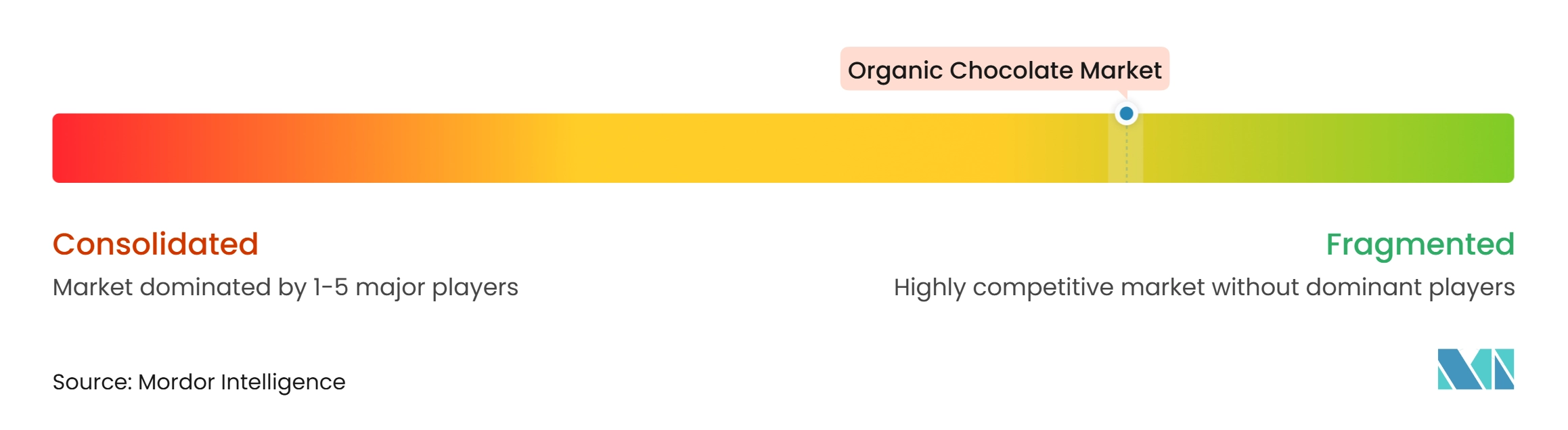
The organic chocolate market is fragmented, with specialty brands and mission-led producers competing across a diverse landscape. Certification depth, cocoa provenance, and direct relationships with farmers often carry more weight than manufacturing scale. Brands differentiate themselves through combinations of USDA Organic, Fairtrade, B Corp, and Regenerative Organic Certified credentials. Replicating this approach at high volumes is challenging when supply chain records are incomplete. While larger companies retain advantages in procurement and distribution, specialty brands compete through transparent sourcing. As a result, trust in the product story is as important as retail presence.
Distribution expansion remains a key strategy in the organic chocolate market. Brands are moving beyond specialty outlets while maintaining a premium positioning. Competition primarily centers on product portfolio expansion, premium positioning, ethical cocoa sourcing, and sustainable packaging. Alter Eco focuses on organic dark chocolate bars, truffles, and environmentally responsible packaging, while Theo Chocolate emphasizes organic and Fairtrade formulations. Original Beans differentiates itself through single-origin cocoa, traceability, and regenerative sourcing practices.
Packaging innovation and supply chain resilience are also shaping competitive strategies. In March 2026, Amcor and Alter Eco introduced a paper-based wrapper for Alter Eco's 200 g chocolate range. The packaging reduced package weight by 61% and is recyclable through the French paper recycling stream. In November 2025, Barry Callebaut entered into a long-term partnership with Planet A Foods to develop ChoViva, a cocoa-free alternative made from sunflower seeds. These initiatives demonstrate how material innovation can address packaging regulations and cocoa supply risks. Digital traceability tools, including farm-level data and consumer-facing QR codes, are becoming increasingly important for compliance in Europe. The organic chocolate market is likely to favor smaller companies that can rigorously document their sourcing practices while maintaining a clear premium proposition.
Organic Chocolate Industry Leaders
-
Divine Chocolate Limited
-
Lindt & Sprüngli AG
-
Vivani
-
Raaka Chocolate
-
Daylesford Organic Limited
- *Disclaimer: Major Players sorted in no particular order
Organic Chocolate Market Companies Covered in this Report
- Green & Black’s
- Alter Eco Foods
- Theo Chocolate, Inc.
- Divine Chocolate Limited
- Lindt & Sprüngli AG
- Vivani
- Taza Chocolate
- Equal Exchange Coop
- Lake Champlain Chocolates
- Original Beans
- Beyond Good
- Pana Chocolate Pty Ltd.
- Rococo Chocolates London Limited
- Seed & Bean
- Raaka Chocolate
- Daylesford Organic Limited
- NibMor
- Kicking Horse Chocolate Co. Ltd.
- Pascha Chocolate Co.
- Luker Chocolate
Recent Industry Developments in Organic Chocolate Market
- May 2026: Vinte launched a range of organic, single-origin chocolate bars made exclusively from organic cocoa sourced from the Mava Ottange plantation in Madagascar’s Sambirano Valley. The range includes 75%, 85%, and 100% dark chocolate variants, emphasizing the cocoa’s origin.
- February 2026: Natural Grocers introduced two organic dark chocolate bar varieties, Raspberry and Caramel & Sea Salt, made with organic, non-GMO ingredients and Fairtrade-certified Belgian cocoa.
- May 2025: Justin's launched United States Department of Agriculture (USDA) certified organic Peanut Caramel Nougat Chocolate Candy Bars in dark chocolate and milk chocolate varieties. Available in single-serve bars and multipack pouches, the products expanded the company's organic confectionery portfolio with filled chocolate offerings and convenient packaging formats.
Global Organic Chocolate Market Report Scope
Organic chocolate refers to chocolate manufactured using organically certified cocoa and other ingredients cultivated without prohibited synthetic pesticides, fertilizers, or genetically modified organisms, following applicable organic farming standards.
The organic chocolate market is segmented by chocolate type, form, distribution channel, and geography. By chocolate type, the market is segmented into dark chocolate and milk and white chocolate. By form, the market is segmented into bars and tablets, pralines and truffles, blocks, and other forms. By distribution channel, the market is segmented into supermarkets/hypermarkets, convenience/grocery stores, online retail stores, and other distribution channels. Based on geography, the market is classified into North America, Europe, South America, Asia-Pacific, and the Middle East and Africa. The market forecasts are provided in terms of value (USD).
Segmentation Overview
| Dark Chocolate |
| Milk and White Chocolate |
| Bars and Tablets |
| Pralines and Truffles |
| Blocks |
| Other Forms |
| Supermarkets/Hypermarkets |
| Convenience/Grocery Stores |
| Online Retail Stores |
| Other Distribution Channels |
| North America | United States |
| Canada | |
| Mexico | |
| Rest of North America | |
| Europe | Germany |
| United Kingdom | |
| Italy | |
| France | |
| Spain | |
| Poland | |
| Belgium | |
| Netherlands | |
| Rest of Europe | |
| Asia-Pacific | China |
| India | |
| Indonesia | |
| Thailand | |
| Australia | |
| Japan | |
| Rest of Asia-Pacific | |
| South America | Brazil |
| Argentina | |
| Peru | |
| Colombia | |
| Rest of South America | |
| Middle East and Africa | South Africa |
| Saudi Arabia | |
| United Arab Emirates | |
| Turkey | |
| Egypt | |
| Rest of Middle East and Africa |
| By Chocolate Type | Dark Chocolate | |
| Milk and White Chocolate | ||
| By Form | Bars and Tablets | |
| Pralines and Truffles | ||
| Blocks | ||
| Other Forms | ||
| By Distribution Channel | Supermarkets/Hypermarkets | |
| Convenience/Grocery Stores | ||
| Online Retail Stores | ||
| Other Distribution Channels | ||
| By Geography | North America | United States |
| Canada | ||
| Mexico | ||
| Rest of North America | ||
| Europe | Germany | |
| United Kingdom | ||
| Italy | ||
| France | ||
| Spain | ||
| Poland | ||
| Belgium | ||
| Netherlands | ||
| Rest of Europe | ||
| Asia-Pacific | China | |
| India | ||
| Indonesia | ||
| Thailand | ||
| Australia | ||
| Japan | ||
| Rest of Asia-Pacific | ||
| South America | Brazil | |
| Argentina | ||
| Peru | ||
| Colombia | ||
| Rest of South America | ||
| Middle East and Africa | South Africa | |
| Saudi Arabia | ||
| United Arab Emirates | ||
| Turkey | ||
| Egypt | ||
| Rest of Middle East and Africa | ||
Key Questions Answered in the Report
What is the current size and future growth outlook of the organic chocolate market?
The organic chocolate market was valued at USD 0.87 billion in 2026 and is projected to grow from USD 0.92 billion in 2027 to USD 1.24 billion by 2032, registering a CAGR of 6.21% during the forecast period.
Which chocolate type segment held the largest share of the organic chocolate market in 2026?
The milk and white chocolate segment held the largest market share in 2026, accounting for 57.98% of market.
Which form segment dominated the organic chocolate market in 2026?
The bars and tablets segment dominated the market in 2026, capturing 51.82% of the total market share.
Which distribution channel accounted for the largest market share in 2026?
Supermarkets/hypermarkets led the organic chocolate market in 2026, holding 42.61% of the market share.
Which region held the largest share of the organic chocolate market in 2026?
Europe was the leading regional market in 2026, accounting for 37.81% of organic chocolate market.