
Organic Chicken Market Size and Share
Market Overview
| Study Period | 2022 - 2032 |
|---|---|
| Market Size (2027) | USD 6.86 Billion |
| Market Size (2032) | USD 12.68 Billion |
| Growth Rate (2027 - 2032) | 13.07 % |
| Fastest Growing Market | Asia-Pacific |
| Largest Market | North America |
| Market Concentration | Medium |
Major Players *Disclaimer: Major Players sorted in no particular order Image © Mordor Intelligence. Reuse requires attribution under CC BY 4.0. | |
Organic Chicken Market Analysis by Mordor Intelligence
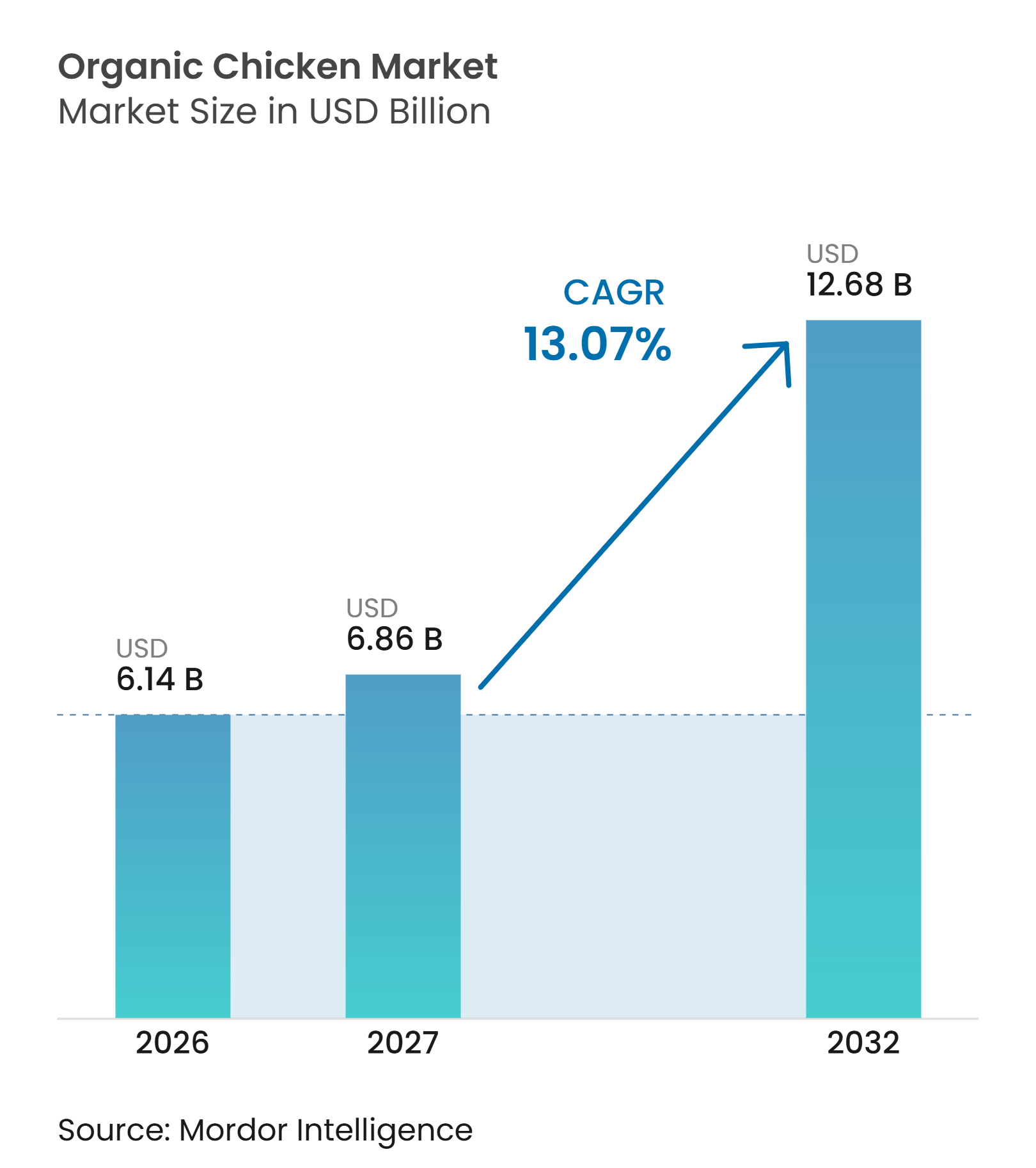
The organic chicken market size is expected to grow from USD 6.14 billion in 2026 to USD 6.86 billion in 2027 and is forecast to reach USD 12.68 billion by 2032 at a 13.07% CAGR over 2027-2032. The market is experiencing steady growth, supported by increasing consumer preference for naturally produced, certified, and clean-label protein products. Growing awareness of food quality, animal welfare, traceability, and production practices is encouraging consumers to consider organic poultry as an alternative to conventionally produced meat. Rising health consciousness and greater interest in transparent food sourcing are further strengthening demand, while expanding availability through modern retail and online distribution is improving product accessibility. Manufacturers are also broadening their organic poultry offerings through convenient, value-added formats to cater to evolving consumption habits.
Key Report Takeaways
-
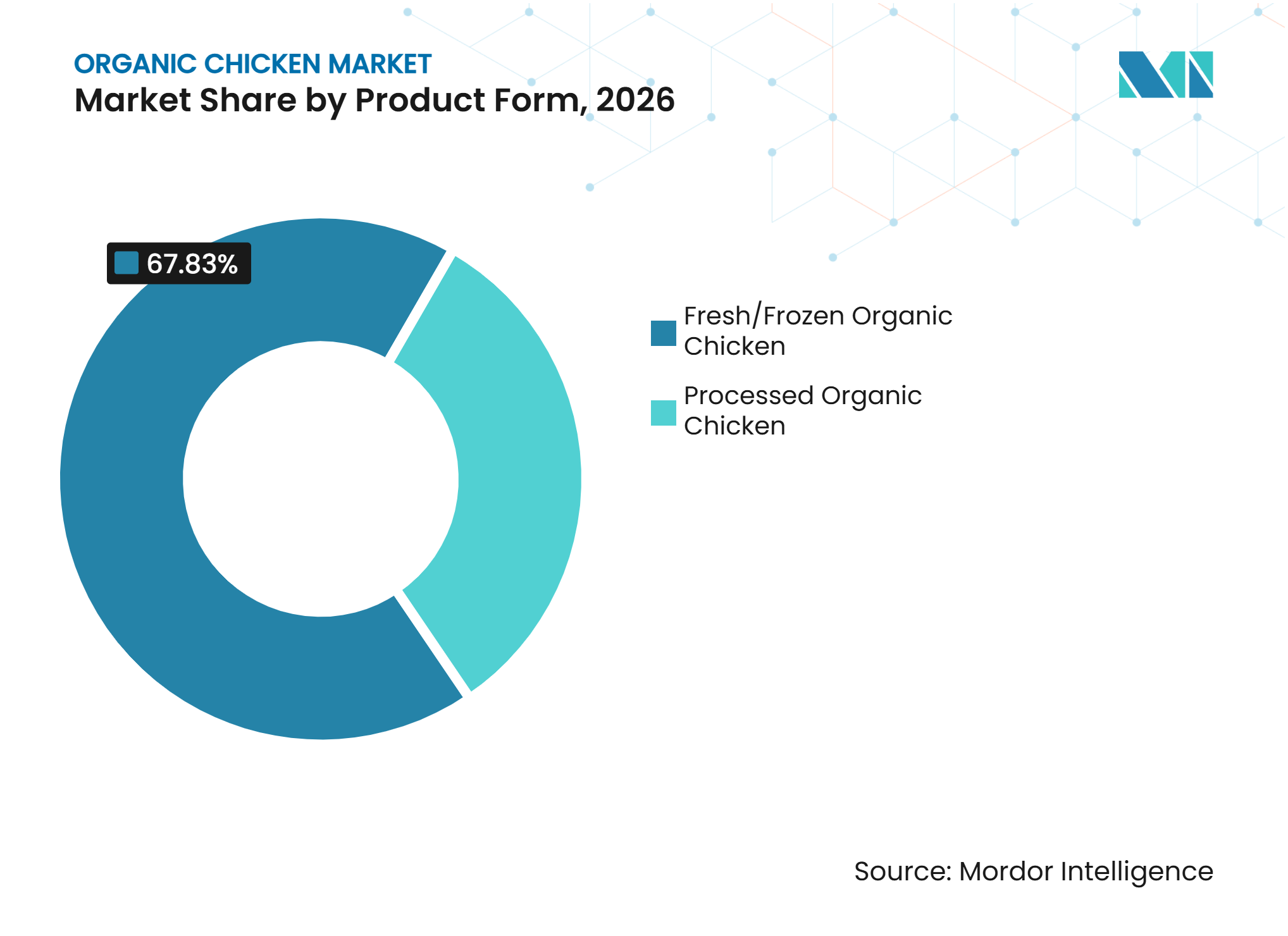
By product form, Fresh/Frozen Organic Chicken held a 67.83% share in 2026, while Processed Organic Chicken is forecast to grow at a 14.53% CAGR from 2027 to 2032.
-
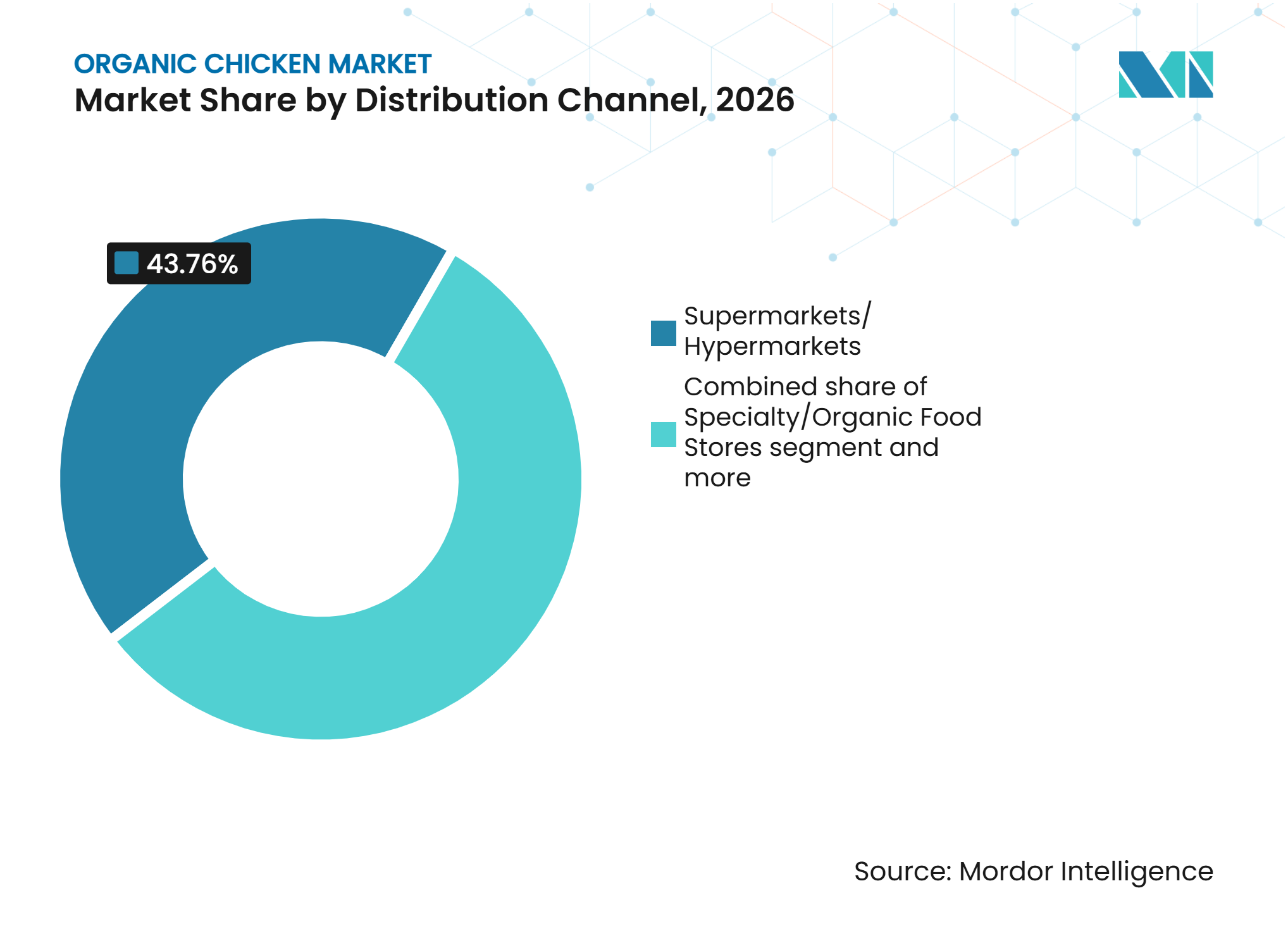
By distribution channel, Supermarkets/Hypermarkets held a 43.76% share in 2026, while Online Retail/Direct-to-Consumer is forecast to grow at a 15.13% CAGR from 2027 to 2032.
-
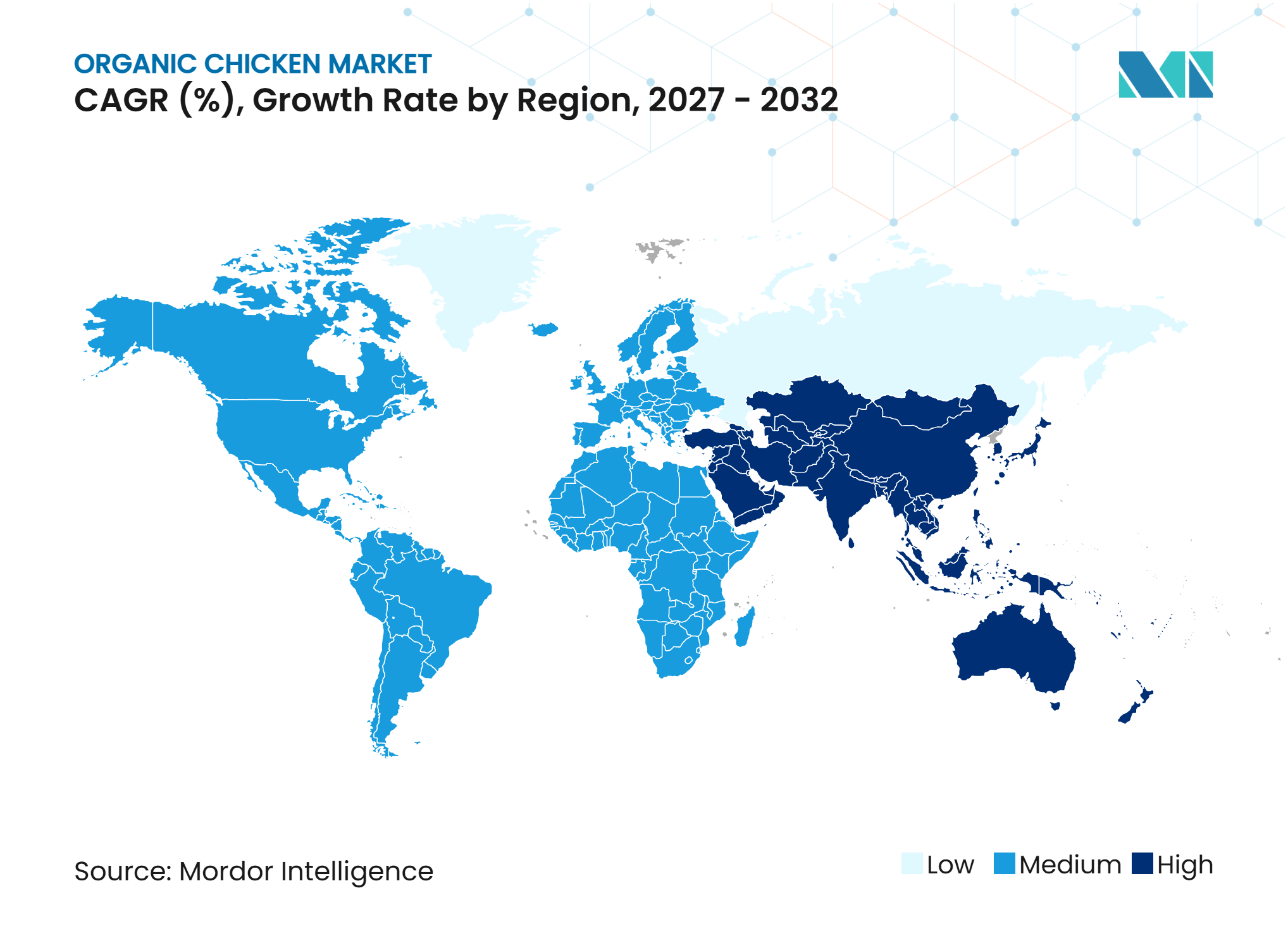
By geography, North America held a 39.37% share in 2026, while Asia-Pacific is forecast to grow at a 14.83% CAGR from 2027 to 2032.
Note: Market numbers in this report are based on Mordor Intelligence's proprietary estimation framework, which combines nine months of actuals with Q4 projections for base year 2026.
Market Trends and Insights
Drivers Impact Analysis of Organic Chicken Market*
| Driver | (~) % Impact on CAGR Forecast | Geographic Relevance | Impact Timeline |
|---|---|---|---|
| Premiumization and consumer preference for organic chicken | +2.5% | Global, strongest in North America and Western Europe | Long term (≥ 4 years) |
| Growth in organic poultry sales and consumption | +2.0% | Global, with acceleration in Asia-Pacific and South America | Medium term (2–4 years) |
| Expansion of mainstream retail and private-label organic poultry offerings | +1.5% | North America, Europe, Asia-Pacific core | Medium term (2–4 years) |
| Improving availability and affordability of organic feed | +1.5% | North America, Europe, Brazil | Long term (≥ 4 years) |
| Expansion of certified organic broiler production capacity | +1.5% | North America, Western Europe | Medium term (2–4 years) |
| Product innovation in convenient and value-added organic chicken products | +1.0% | North America, Europe, Asia-Pacific core, spill-over to the Middle East and Africa | Medium term (2–4 years) |
| Source: Mordor Intelligence | |||
Premiumization and Consumer Preference for Organic Chicken
Increasing consumer emphasis on food quality, production standards, and certified sourcing is strengthening organic chicken's position as a premium protein choice. Consumers increasingly value organic certification as an indicator of compliance with established production requirements, product integrity, and transparent sourcing practices. According to the 2025 Connecticut Organic Market Study, published by the Connecticut Department of Agriculture, 61.3% of consumers were willing to pay more for United States Department of Agriculture (USDA)-certified organic products, including 18% who were definitely willing and 43.3% who were somewhat willing to pay a premium[1]. This willingness to pay more for certified organic products supports the premium positioning of organic chicken and creates opportunities for producers to differentiate their offerings through verified organic standards.
Growth in Organic Poultry Sales and Consumption
Increasing uptake of organically produced poultry is contributing to the expansion of the organic chicken market, supported by growing consumer interest in certified animal products and greater incorporation of organic protein into regular food purchases. Chicken's position as a widely consumed protein also provides opportunities for organic alternatives to gain traction among consumers seeking organically produced meat. According to the Organic Trade Association's (OTA) 2026 Organic Market Report, sales of organic meat, poultry, and seafood in the United States increased by 22.5% in 2025[2]. This growth reflects expanding demand for organically produced animal proteins and reinforces the potential for organic chicken consumption to increase as organic poultry gains wider market acceptance.
Expansion of Mainstream Retail and Private-Label Organic Chicken Offerings
The expansion of organic poultry across mainstream grocery retailers is improving product visibility and accessibility, allowing organic chicken to reach consumers beyond specialist natural food stores. Retailers are increasingly incorporating certified organic products into their broader meat assortments to meet demand for differentiated protein options, while private-label offerings provide additional opportunities to position organic chicken at different price points. According to the United States Department of Agriculture's (USDA) Economic Research Service (ERS), conventional grocery retailers account for 55% of organic food sales in the United States, underscoring the importance of mainstream retail channels in organic product distribution [3]. This established retail presence provides opportunities for organic poultry producers and retailers to expand consumer reach through wider product availability and dedicated organic offerings.
Improving Availability and Affordability of Organic Feed
Improving access to organically certified feed ingredients and the gradual development of dedicated organic feed supply chains are supporting the expansion of organic chicken production. Greater availability of certified grains, oilseeds, and other approved nutritional inputs enables poultry producers to maintain compliance with organic production standards while improving procurement flexibility. Increasing participation from agricultural suppliers, feed manufacturers, and organic farming networks is also helping strengthen supply-chain integration and broaden sourcing options. These developments can support more consistent feed procurement, improve production planning, and encourage greater participation in organic poultry farming.
Restraints Impact Analysis of Organic Chicken Market*
| Restraint | (~) % Impact on CAGR Forecast | Geographic Relevance | Impact Timeline |
|---|---|---|---|
| Higher organic feed and certified processing cost premiums | -1.5% | Global, most acute in North America and Europe | Long term (≥ 4 years) |
| Limited certified organic poultry processing and segregation capacity | -1.0% | North America, Emerging Asia-Pacific markets | Medium term (2–4 years) |
| Organic certification and compliance costs for small-scale producers | -0.8% | Global, most acute in Asia-Pacific and South America | Long term (≥ 4 years) |
| Consumer confusion between certified organic and alternative poultry claims | -0.5% | Global | Short term (≤ 2 years) |
| Source: Mordor Intelligence | |||
Higher Organic Feed and Certified Processing Cost Premiums
The higher costs associated with organic feed procurement and certified poultry processing can constrain the commercial expansion of organic chicken production. Organic poultry producers must source feed ingredients that comply with established organic production standards, limiting procurement flexibility compared with conventional farming. Additionally, maintaining organic certification requires adherence to specific production, handling, segregation, and documentation procedures throughout the supply chain. Certified processing facilities may also involve additional operational requirements to prevent commingling with conventionally produced poultry. These cost considerations increase overall production expenses, potentially limiting producers' pricing flexibility and making organic chicken less accessible to price-sensitive consumers.
Limited Certified Organic Poultry Processing and Segregation Capacity
Limited availability of processing facilities equipped to handle certified organic poultry can restrict the expansion of organic chicken production. Organic processing requires dedicated handling procedures, appropriate segregation from conventional poultry, and compliance with established certification requirements to preserve organic integrity throughout processing and packaging. Producers may therefore face challenges in securing suitable processing partners, particularly when operating in regions with limited certified infrastructure. The need to maintain separate procedures for handling, storage, transportation, and documentation can further complicate processing operations and supply-chain coordination. These constraints may limit production scalability, delay market entry for smaller producers, and restrict the consistent availability of certified organic chicken products.
*Our forecasts treat driver/restraint impacts as directional, not additive. The impact forecasts reflect baseline growth, mix effects, and variable interactions.
Organic Chicken Market Segment Analysis
By Product Form:
Fresh/Frozen Formats Anchor Demand, While Processed Formats AccelerateFresh/Frozen Organic Chicken accounts for the largest market share, at 67.83%, in 2026, supported by its established position as the primary format for organic poultry consumption. Consumer preference for minimally processed protein products, greater visibility of product characteristics, and flexibility in meal preparation contribute to the segment's dominance. Whole birds, bone-in portions, and boneless cuts cater to diverse household cooking requirements and purchasing preferences. The segment also benefits from its suitability for regular consumption occasions and established presence across retail distribution channels, supporting its continued prominence in the organic chicken market.
Processed Organic Chicken is the fastest-growing product form segment, registering a projected CAGR of 14.53% during 2027–2032. Growth is supported by increasing consumer interest in convenient poultry products that combine organic sourcing with ease of preparation. Processed formats, including sausages, nuggets, patties, and ready-to-cook portions, offer alternatives to conventional fresh cuts and cater to evolving meal-preparation habits. Continued product development and broader availability of value-added organic poultry options are further supporting segment expansion. These offerings also enable manufacturers to diversify their portfolios and address a wider range of consumer preferences and consumption occasions.


By Distribution Channel:
Supermarkets Lead, While Online Retail Expands RapidlySupermarkets and hypermarkets account for the largest share of the distribution channel at 43.76% in 2026, supported by their extensive retail networks, established grocery-shopping patterns, and broad product assortments. These outlets provide consumers with convenient access to certified organic chicken alongside conventional poultry products, supporting product visibility and repeat purchases. The availability of organic poultry through mainstream grocery retailers also helps introduce certified products to a wider consumer base beyond specialist organic food stores. Specialty food stores further contribute to distribution by catering to consumers seeking dedicated organic and natural food assortments, while other channels, including foodservice and direct farm sales, provide additional routes to market.
Online Retail and Direct-to-Consumer (DTC) channels represent the fastest-growing distribution segment, with a projected CAGR of 15.13% during 2027–2032. Growth is supported by increasing adoption of digital grocery shopping, wider availability of organic poultry through online platforms, and the convenience of home delivery. Online channels also enable consumers to compare product attributes, certification information, sourcing practices, and available product formats before purchasing. Subscription-based purchasing models and direct ordering platforms further support repeat purchases by simplifying procurement and improving access to specialized organic poultry offerings. These developments are strengthening the role of digital distribution in the organic chicken market.


Geography Analysis
North America
North America accounts for the largest share of the organic chicken market, representing 39.37% in 2026, supported by established organic certification frameworks, developed retail infrastructure, and growing consumer acceptance of certified organic poultry. The region benefits from well-defined organic production requirements, established distribution networks, and a strong presence of organic poultry producers. Increasing consumer interest in food traceability, animal welfare, and transparent sourcing practices further supports market demand. The availability of organic chicken through mainstream grocery retailers, specialty food stores, and online platforms also strengthens market accessibility across the region. Canada contributes to regional demand through its established organic farming network, while Mexico presents emerging opportunities as awareness of organic food products expands.
Asia-Pacific
Asia-Pacific is the fastest-growing regional market, with a projected CAGR of 14.83% during 2027–2032, supported by rising food safety awareness, urbanization, and increasing consumer interest in premium protein products. Growing disposable incomes and changing dietary preferences are encouraging consumers to consider certified organic poultry as an alternative to conventional meat. China and India offer considerable growth opportunities as awareness of organic production practices and demand for quality-assured food products increase. Japan and South Korea benefit from established consumer interest in food traceability and domestic production standards, while Singapore's developed premium grocery sector supports the availability of organic poultry products. Expanding modern retail infrastructure and digital grocery channels are further improving access to organic chicken across the region.
Europe, South America, and the Middle East and Africa
Europe represents an established market for organic chicken, supported by mature organic certification systems, consumer awareness, and a developed organic food industry. Countries such as Germany, France, and Spain contribute to regional demand through established organic poultry production and retail distribution networks. South America presents emerging opportunities, particularly in Brazil, where agricultural resources and developing organic production capabilities support market potential, while Argentina, Colombia, and Chile are gradually developing their domestic organic food markets. The Middle East and Africa remain comparatively emerging markets, with demand supported by expanding premium grocery infrastructure, growing interest in certified food products, and increasing availability of imported organic poultry. The United Arab Emirates, Saudi Arabia, and South Africa represent important markets for the gradual development of organic poultry distribution and consumption.
Competitive Landscape
Market Concentration
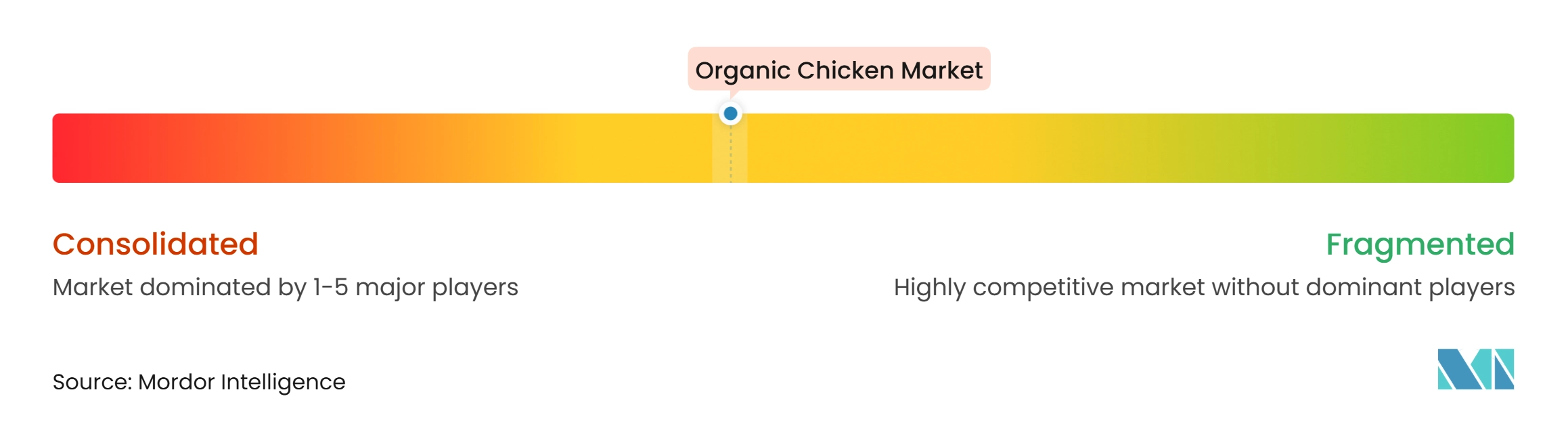
The organic chicken market is moderately concentrated, with established poultry producers, regional organic specialists, and emerging market participants. The competitive landscape is led by Perdue Farms, Bell & Evans, Tecumseh Poultry LLC, Foster Farms, and Farmer Focus, which benefit from established poultry production capabilities, organic product portfolios, and distribution networks. These companies compete through product quality, organic certification, sourcing transparency, production capabilities, and relationships with retail and foodservice customers. Competition is also influenced by the ability to maintain consistent organic standards across farming, processing, and distribution operations.
Leading players are strengthening their market positions through investments in production infrastructure, processing capabilities, product portfolio development, and supply-chain integration. Companies are also expanding their presence across retail and foodservice channels while developing organic poultry offerings in different product formats to address changing consumer preferences. Greater emphasis on traceability, animal welfare standards, organic feed sourcing, and quality assurance is shaping competitive differentiation. In addition, established producers are focusing on operational improvements and distribution partnerships to strengthen market coverage and support long-term growth.
Emerging and regional participants are contributing to market competition through specialized organic poultry offerings, differentiated sourcing practices, and direct-to-consumer business models. These companies often focus on locally sourced production, transparent farming practices, and closer relationships with organic poultry consumers. Some are also targeting underserved markets through online distribution, subscription-based purchasing, and partnerships with specialty retailers. Their focus on product differentiation, regional market penetration, and consumer engagement is gradually broadening the competitive landscape and creating additional alternatives to established large-scale producers.
Organic Chicken Industry Leaders
-
Perdue Farms
-
Bell & Evans
-
Tecumseh Poultry LLC
-
Foster Farms
-
Farmer Focus
- *Disclaimer: Major Players sorted in no particular order
Organic Chicken Market Companies Covered in this Report
- Perdue Farms
- Bell & Evans
- Tecumseh Poultry LLC
- Pilgrim’s Pride Corporation
- Foster Farms
- Plainville Farms
- Plukon Food Group
- Eversfield Organic
- Farmer Focus
- Pitman Family Farms
- Greener Pastures Chicken
- Full Moon Farm, Inc.
- Hormel Foods Corporation
- Capestone Organic Poultry Ltd
- Bostocks
- Yorkshire Valley Farms
- Miller Poultry, Inc.
- Eight Mile Creek Farm, Inc.
- Nick's Organic Farm
- Enviroganic Farm
Recent Industry Developments in Organic Chicken Market
- July 2026: Miller Poultry announced plans to expand its Kidron, Ohio, processing facility through a nearly USD 90 million investment. The project covered a 90,000-square-foot expansion and was expected to increase facility operations by more than 40%. As a producer and processor of organic and all-natural chicken, the company strengthened its processing infrastructure and supported its poultry operations.
- June 2026: Farmer Focus expanded its organic chicken portfolio with four fully cooked products, including chicken sausages, meatballs, and grilled chicken skewers. The products carried United States Department of Agriculture (USDA) Organic and Certified Humane certifications and targeted convenient, ready-to-heat consumption occasions. The launch extended the company's organic chicken offering into value-added poultry products and broadened its retail portfolio.
- December 2025: South Korean organic poultry producer Orge Agricultural Company introduced Organic Chicken Drumstick and Organic Chicken Whole Leg as additions to its product portfolio. The launches accompanied the company's expansion efforts in Hong Kong and Japan, targeting international demand for certified organic poultry products.
Global Organic Chicken Market Report Scope
The organic chicken market comprises the production, processing, and distribution of chicken raised in accordance with certified organic farming standards, including requirements for organic feed, animal welfare, and production practices. The market is segmented by product form into fresh/frozen organic chicken and processed organic chicken; by distribution channel into supermarkets/hypermarkets, specialty/organic food stores, online retail/direct-to-consumer, and others; and by geography into North America, Europe, Asia-Pacific, South America, and the Middle East and Africa. The market forecasts are provided in USD.
Segmentation Overview
| Fresh/Frozen Organic Chicken |
| Processed Organic Chicken |
| Supermarkets/Hypermarkets |
| Specialty/Organic Food Stores |
| Online Retail/Direct-to-Consumer |
| Others |
| North America | United States |
| Canada | |
| Mexico | |
| Rest of North America | |
| Europe | Germany |
| United Kingdom | |
| Italy | |
| France | |
| Spain | |
| Netherlands | |
| Poland | |
| Belgium | |
| Sweden | |
| Rest of Europe | |
| Asia-Pacific | China |
| India | |
| Japan | |
| Australia | |
| Indonesia | |
| South Korea | |
| Thailand | |
| Singapore | |
| Rest of Asia-Pacific | |
| South America | Brazil |
| Argentina | |
| Colombia | |
| Chile | |
| Peru | |
| Rest of South America | |
| Middle East and Africa | South Africa |
| Saudi Arabia | |
| United Arab Emirates | |
| Nigeria | |
| Egypt | |
| Morocco | |
| Turkey | |
| Rest of Middle East and Africa |
| By Product Form | Fresh/Frozen Organic Chicken | |
| Processed Organic Chicken | ||
| By Distribution Channel | Supermarkets/Hypermarkets | |
| Specialty/Organic Food Stores | ||
| Online Retail/Direct-to-Consumer | ||
| Others | ||
| By Geography | North America | United States |
| Canada | ||
| Mexico | ||
| Rest of North America | ||
| Europe | Germany | |
| United Kingdom | ||
| Italy | ||
| France | ||
| Spain | ||
| Netherlands | ||
| Poland | ||
| Belgium | ||
| Sweden | ||
| Rest of Europe | ||
| Asia-Pacific | China | |
| India | ||
| Japan | ||
| Australia | ||
| Indonesia | ||
| South Korea | ||
| Thailand | ||
| Singapore | ||
| Rest of Asia-Pacific | ||
| South America | Brazil | |
| Argentina | ||
| Colombia | ||
| Chile | ||
| Peru | ||
| Rest of South America | ||
| Middle East and Africa | South Africa | |
| Saudi Arabia | ||
| United Arab Emirates | ||
| Nigeria | ||
| Egypt | ||
| Morocco | ||
| Turkey | ||
| Rest of Middle East and Africa | ||
Key Questions Answered in the Report
What is the projected value of the organic chicken market by 2032?
The market is projected to reach USD 12.68 billion by 2032, rising at a 13.07% CAGR from 2027 to 2032.
Which product format has the largest share?
Fresh/frozen organic chicken held 67.83% share in 2026, supported by regular household demand for minimally processed poultry.
Which sales channel is growing fastest?
Online retail/direct-to-consumer is forecast to grow at a 15.13% CAGR from 2027 to 2032.
Which region leads global demand?
North America held 39.37% share in 2026, supported by mature grocery access and established certification systems.