
Organic Cheese Market Size and Share
Market Overview
| Study Period | 2027 - 2032 |
|---|---|
| Market Size (2027) | USD 9.94 Billion |
| Market Size (2032) | USD 13.43 Billion |
| Growth Rate (2027 - 2032) | 6.10 % |
| Fastest Growing Market | Asia-Pacific |
| Largest Market | Europe |
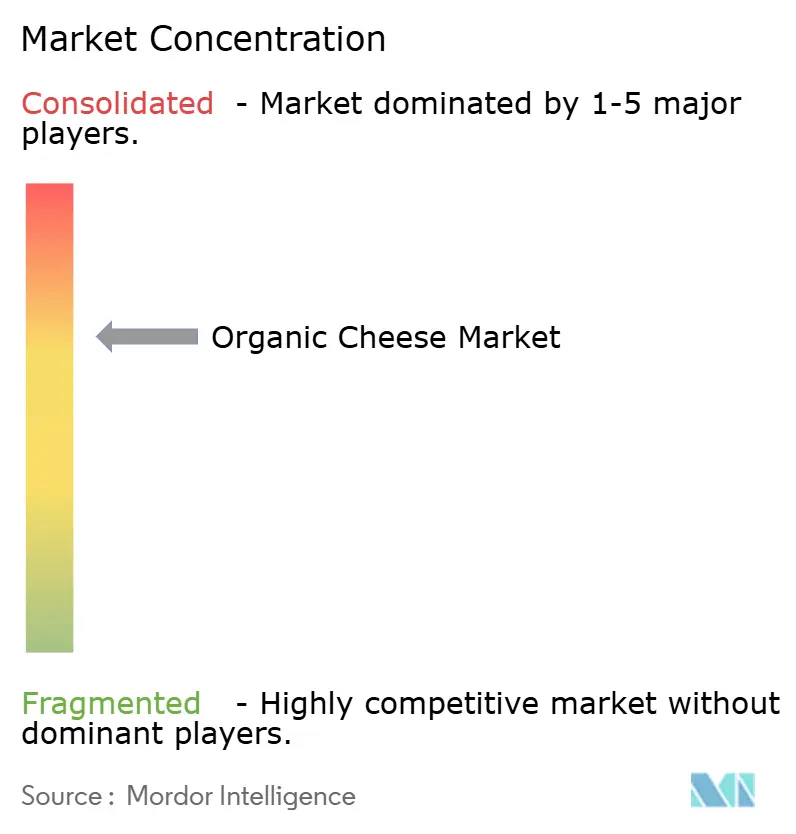
| Market Concentration | Medium |
Major Players *Disclaimer: Major Players sorted in no particular order Image © Mordor Intelligence. Reuse requires attribution under CC BY 4.0. | |
Organic Cheese Market Analysis by Mordor Intelligence
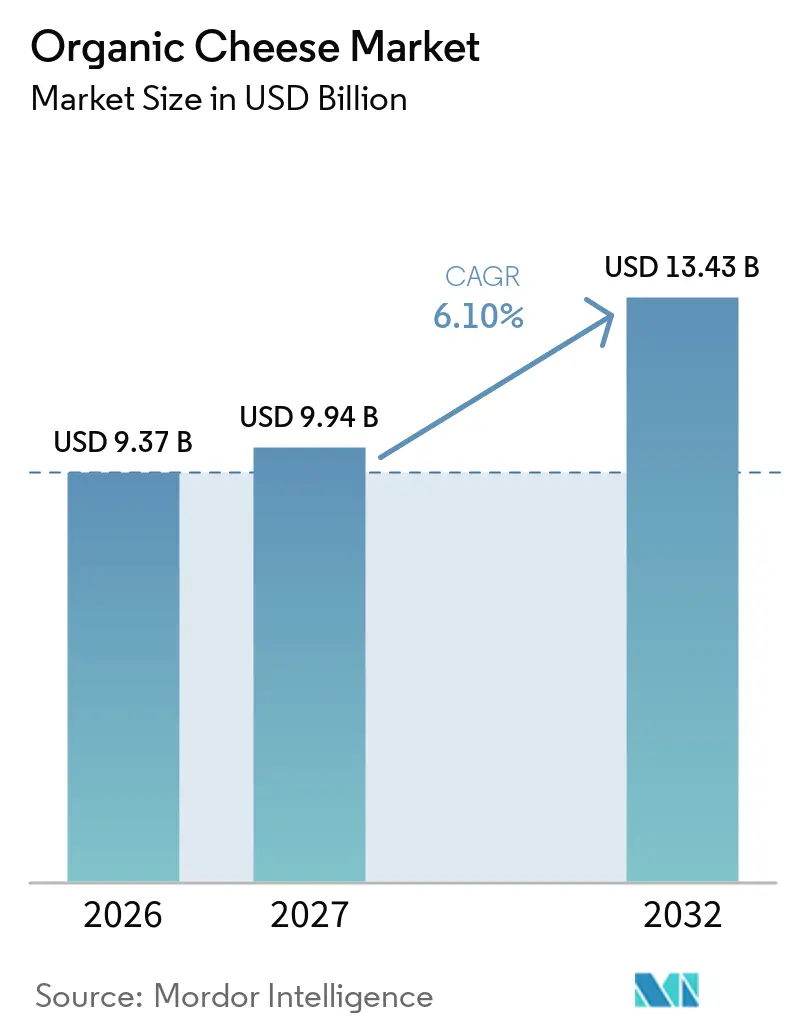
The Organic Cheese Market size is estimated at USD 9.37 billion in 2026 and USD 9.94 billion in 2027, and is projected to reach USD 13.43 billion by 2032, registering a compound annual growth rate (CAGR) of 6.1% between 2027 and 2032. This growth reflects increasing consumer interest in organic dairy products and cheese produced using certified organic farming practices. Rising preferences for clean-label foods, naturally produced ingredients, and premium dairy offerings are supporting demand for organic cheese across retail and foodservice channels. The market encompasses organic natural cheese and organic processed cheese, with cow milk serving as the leading milk source and blocks and wheels representing a prominent product format. Expanding online retail availability is also creating additional opportunities for organic cheese producers to reach consumers seeking specialty and certified organic products. Geographically, Europe represents the largest regional market, while Asia-Pacific is expected to record comparatively strong growth during the forecast period.
Key Report Takeaways
- By product type, Organic Natural Cheese accounted for 59.48% of the global Organic Cheese Market share in 2026, whereas Organic Processed Cheese is forecast to expand at a 6.25% CAGR through 2032.
- By milk source, cow milk dominated with an 82.36% contribution to the global Organic Cheese Market size in 2026, while goat milk cheese is set to advance at a 6.91% CAGR through 2032.
- By format, blocks and wheels accounted for 47.12% of the global Organic Cheese Market size in 2026, yet sliced cheese is forecast to grow at a 6.65% CAGR through 2032.
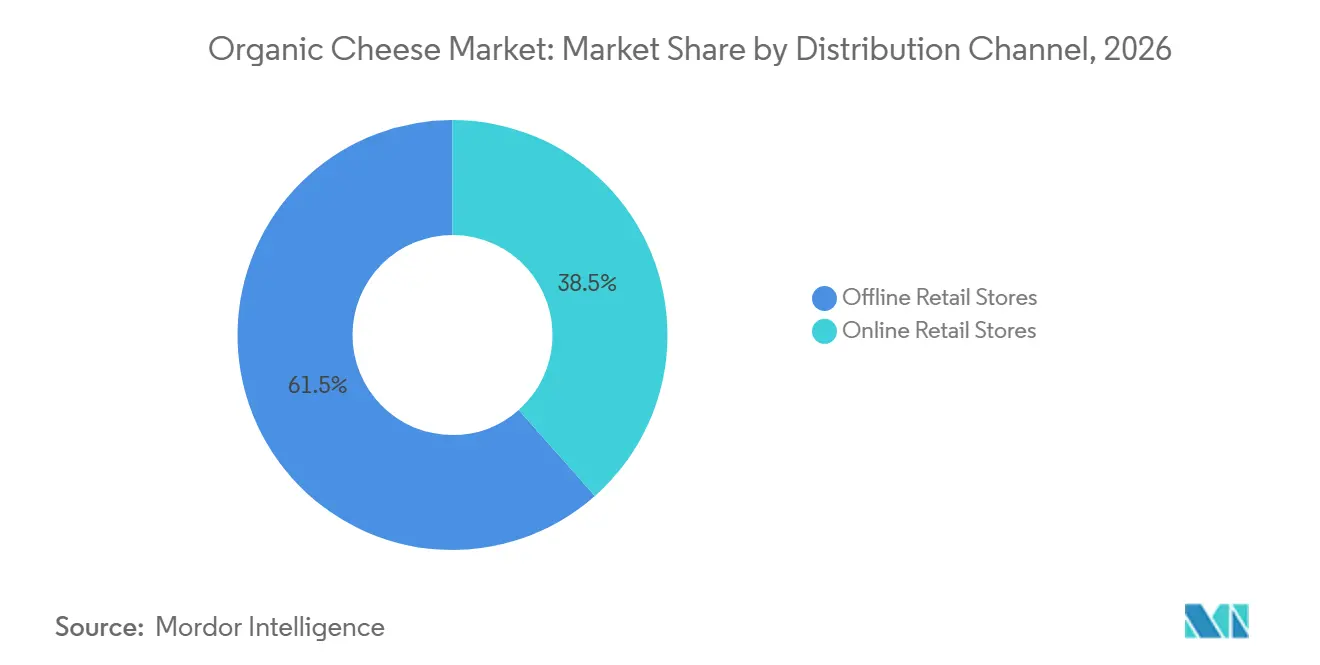
- By distribution channel, offline retail held a 61.52% share of the global Organic Cheese Market in 2026, while online retail is projected to expand at the fastest rate, with a 6.80% CAGR through 2032.
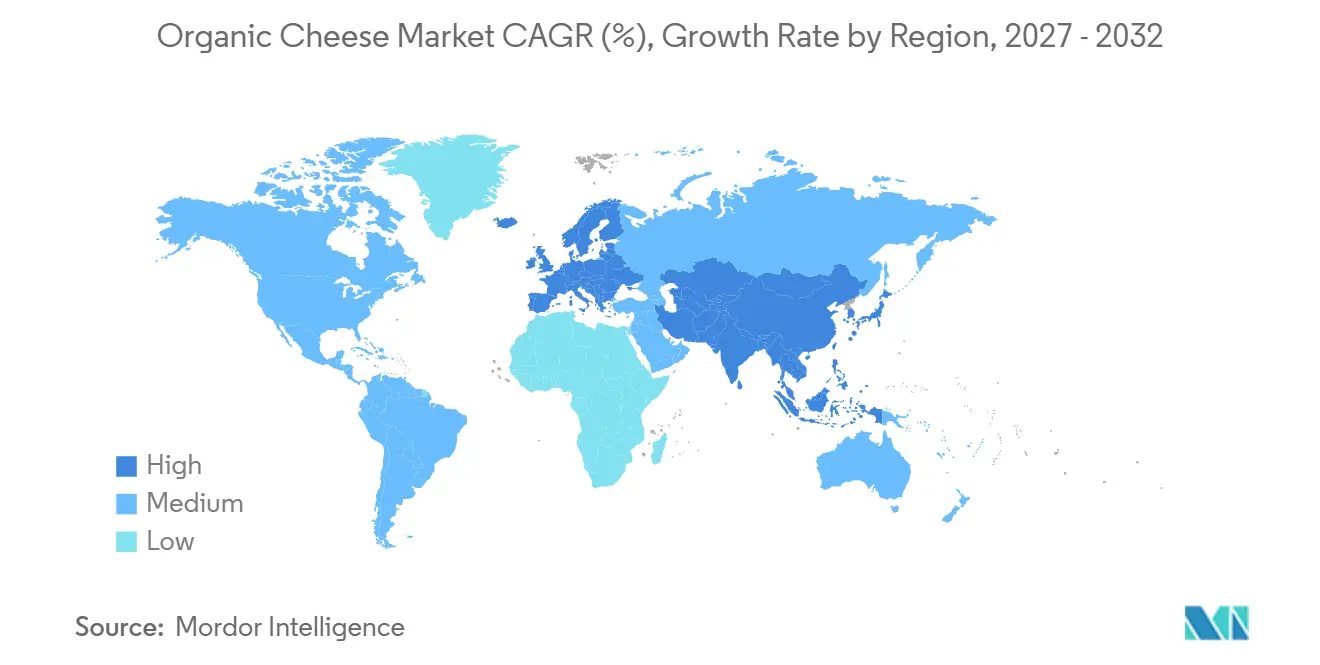
- By geography, Europe led the global Organic Cheese Market with a 37.60% share in 2026, while Asia-Pacific is forecast to record the highest growth at a 6.50% CAGR through 2032.
Note: Market numbers in this report are based on Mordor Intelligence's proprietary estimation framework, which combines nine months of actuals with Q4 projections for base year 2026.
Market Trends and Insights
Drivers Impact Analysis of Organic Cheese Market*
| DRIVER | (~) % IMPACT ON CAGR FORECAST | GEOGRAPHIC RELEVANCE | IMPACT TIMELINE |
|---|---|---|---|
| Rising consumer preference for certified organic dairy products | +1.2% | Global, with established organic food demand in North America and Europe | Medium term (2–4 years) |
| Growing demand for clean-label and naturally produced cheese | +0.9% | Global, particularly North America and Europe | Medium term (2–4 years) |
| Increasing availability of organic cheese through modern retail channels | +0.8% | Global, with expanding online and offline distribution across Asia-Pacific | Short term (Less than 2 years) |
| Expansion of premium and specialty organic cheese offerings | +0.7% | North America and Europe, with opportunities in affluent Asia-Pacific markets | Medium term (2–4 years) |
| Growing adoption of organic dairy farming practices | +0.6% | Europe and North America, with gradual adoption in other regions | Long term (More than 4 years) |
| Source: Mordor Intelligence | |||
Rising Consumer Preference for Certified Organic Dairy Products
Consumer interest in certified organic foods is supporting demand for organic dairy products, including cheese, as shoppers place greater emphasis on production standards, ingredient transparency, and verified product claims. In February 2025, the Organic Trade Association reported findings from a survey of more than 2,500 US consumers conducted with Euromonitor International in October 2024. The findings indicated that the USDA Organic label was strongly associated with health among shoppers and attracted trust across age groups, with Millennials and Generation Z showing particularly strong engagement with organic products [1]. For organic cheese manufacturers, recognized certification can help communicate compliance with defined production standards and differentiate products from conventional alternatives. However, consumer preference does not automatically translate into purchases, as price premiums and household budget constraints can affect willingness to pay. Producers therefore need to combine credible organic certification with product quality, accessible pack sizes, and clear on-pack information to encourage repeat purchases.
Growing Demand for Clean-Label and Naturally Produced Cheese
Demand for clean-label foods is encouraging cheese manufacturers to emphasize recognizable ingredients, straightforward formulations, and transparent production practices. A study published in the Journal of Dairy Science in 2025 found that consumers associated clean-label products with simple, recognizable ingredients, with natural ingredients, recognizable ingredients, and organic attributes ranking among the important characteristics considered by surveyed consumers. Organic cheese can align with these preferences when its ingredient composition and certification support the product claims displayed on its packaging. For example, Organic Valley introduced its Flavor Favorites range in February 2024, including Italian Herb Mozzarella Shreds, Spicy Cheddar Shreds, Spicy Cheddar Slices, and Smoky Cheddar Slices, promoting the products around organic ingredients and convenient meal preparation [2]. Nevertheless, “clean label” is not a standardized synonym for “organic,” and consumer expectations may vary. Manufacturers must therefore substantiate organic claims through applicable certification and ensure that ingredient and labeling information accurately reflects each product.
Increasing Availability of Organic Cheese Through Modern Retail Channels
The expansion of organic cheese across supermarkets, specialty food stores, and online retail platforms can improve product visibility and make certified options easier for consumers to access. The USDA Economic Research Service identifies conventional grocery retailers as major outlets for organic foods, reflecting the importance of mainstream retail distribution alongside natural and specialty stores [3]. Retail expansion can also introduce organic cheese to consumers seeking familiar formats, such as slices, blocks, and shredded cheese, rather than only specialty varieties. In March 2025, Organic Valley announced that its new Organic American Cheese Blocks would be available at Whole Foods stores nationwide, followed by a rollout to additional stores. Such distribution strategies can help brands reach consumers through established grocery networks and offer more occasions for household use. However, maintaining refrigerated distribution, managing shelf life, and securing sufficient certified organic milk remain operational considerations as producers expand retail coverage.
Expansion of Premium and Specialty Organic Cheese Offerings
Cheese producers are expanding organic portfolios beyond basic everyday varieties into flavored, specialty, and convenience-oriented products to serve consumers looking for differentiated tastes and formats. In February 2024, Organic Valley introduced four premium flavored organic cheeses in sliced and shredded formats, including spicy cheddar and Italian herb mozzarella. In May 2025, Natural Grocers announced five additions to its organic cheese range, including Havarti and cheddar blocks, cheddar slices, and cheddar shreds [4]. These launches illustrate how product development can combine organic certification with flavor variation and familiar formats, broadening the range of organic cheese options available to consumers. Specialty offerings may also provide opportunities for producers to differentiate their brands in a competitive dairy aisle. However, premium positioning must be supported by perceived quality and consumer value, since higher prices can limit adoption among shoppers who prioritize affordability.
Restraints Impact Analysis of Organic Cheese Market*
| RESTRAINT | (~) % IMPACT ON CAGR FORECAST | GEOGRAPHIC RELEVANCE | IMPACT TIMELINE |
|---|---|---|---|
| High production costs and premium retail prices of organic cheese | −0.9% | Global, particularly price-sensitive markets in Asia-Pacific and Latin America | Medium term (2–4 years) |
| Limited availability of certified organic milk and dairy inputs | −0.7% | Global, particularly North America and Europe, with supply limitations in emerging markets | Long term (More than 4 years) |
| Complex organic certification and regulatory compliance requirements | −0.5% | Global, particularly markets with stringent organic certification and labeling frameworks, including Europe and North America | Medium term (2–4 years) |
| Shelf-life and cold-chain management challenges for organic cheese | −0.4% | Global, especially regions with less-developed refrigerated distribution infrastructure | Short term (Less than 2 years) |
| Source: Mordor Intelligence | |||
High Production Costs and Premium Retail Prices of Organic Cheese
Organic cheese production can involve higher costs than conventional cheese manufacturing because producers must source certified organic milk, comply with organic production standards, and maintain certification and traceability records. Organic dairy farms may also face higher feed, land-management, and operational expenses, which can increase the cost of raw materials for cheese processors. These costs can translate into premium retail prices, potentially limiting purchases among consumers who prioritize affordability or have access to lower-priced conventional alternatives. Smaller manufacturers may face additional pressure because certification, processing, packaging, and distribution costs are spread across lower production volumes. Although premium positioning can appeal to consumers seeking certified organic products, sustained growth depends on whether buyers consider the perceived quality and production standards worth the additional price. Consequently, the cost gap between organic and conventional cheese remains a potential barrier to broader adoption, particularly in price-sensitive markets.
Limited Availability of Certified Organic Milk and Dairy Inputs
The availability of certified organic milk is a critical supply-side constraint for organic cheese manufacturers because production depends on sourcing dairy inputs that meet applicable organic standards. The USDA Economic Research Service’s 2024 report on certified organic dairy production documents differences in farm structure, production costs, and organic milk production across US states, highlighting the uneven distribution of supply capacity. Organic dairy farms must meet requirements covering feed, livestock management, pasture access, and production records, which can limit the pool of eligible suppliers compared with conventional dairy production . When certified milk supplies are insufficient in a particular region, cheese manufacturers may face higher procurement costs, longer sourcing distances, and greater difficulty scaling production consistently. Limited access to certified organic feed and other compliant dairy inputs can add further pressure to farm-level operations. As a result, expanding the Organic Cheese Market depends partly on the development of reliable regional supplier networks and increased capacity among certified organic dairy farms.
*Our forecasts treat driver/restraint impacts as directional, not additive. The impact forecasts reflect baseline growth, mix effects, and variable interactions.
Organic Cheese Market Segment Analysis
By Product Type:
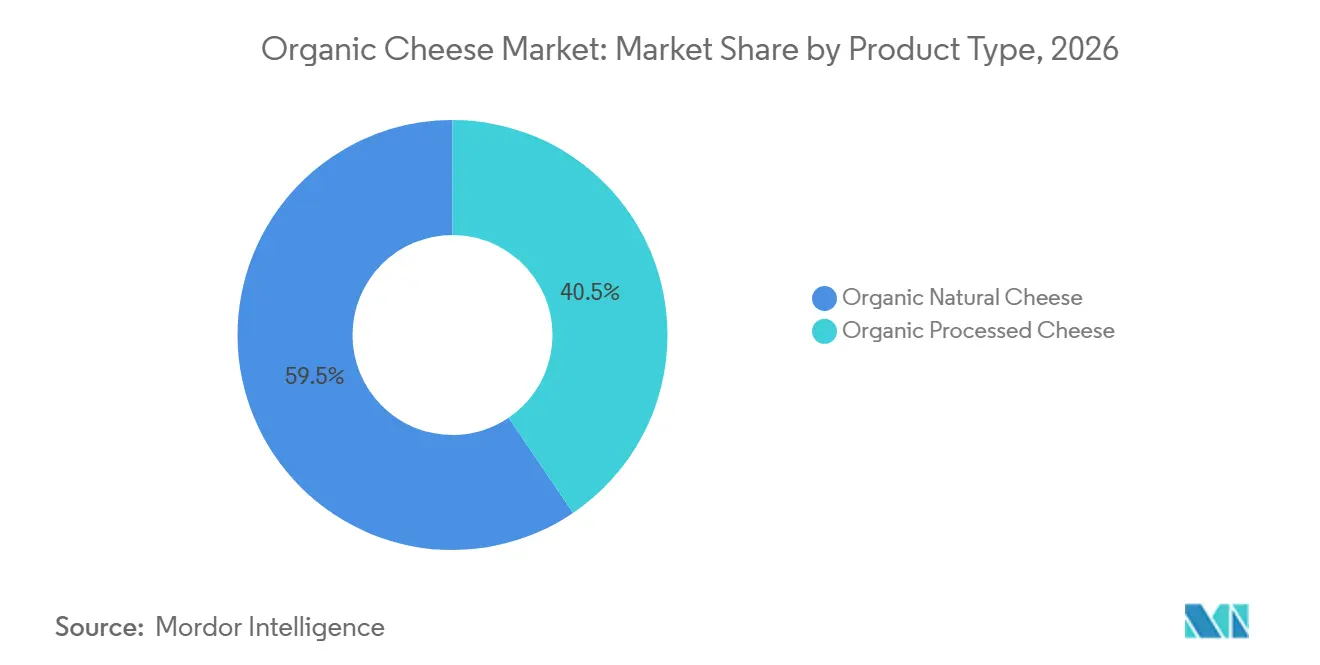
Organic Natural Cheese Leads While Processed Variants ExpandIn 2026, organic natural cheese accounted for 59.48% of the Organic Cheese Market share, reflecting its leading position among products manufactured using certified organic dairy ingredients. Demand for organic natural cheese is supported by consumer interest in certified organic foods, ingredient transparency, and minimally processed dairy products. Meanwhile, organic processed cheese is forecast to expand at a CAGR of 6.25% through 2032, supported by opportunities to combine organic positioning with convenient formats and versatile applications in household meals and foodservice. Product innovation across slices, spreads, and other convenient formats can help manufacturers appeal to consumers seeking alternatives to conventional processed cheese while retaining ease of use.
Within organic natural cheese, familiar varieties such as cheddar, mozzarella, and specialty cheeses can serve different household and foodservice needs, while organic processed cheese offers opportunities in sandwiches, burgers, snacks, and quick meal preparation. However, manufacturers must maintain compliance with organic certification and labeling requirements while managing production costs and the availability of certified organic milk. The ability to balance product quality, convenience, and price will remain important for expanding consumer adoption across both product categories.

By Milk Source:
Cow Milk Dominates While Goat Milk Gains MomentumIn 2026, cow milk accounted for 82.36% of the Organic Cheese Market share, making it the leading milk source for organic cheese production. Its established role in dairy farming and broad use across cheese varieties support its position in the market. Meanwhile, goat milk cheese is forecast to grow at a CAGR of 6.91% through 2032, reflecting opportunities to serve consumers seeking alternative dairy products and differentiated cheese varieties. Sheep milk also contributes to the market through specialty cheeses valued for their distinctive flavor and traditional applications.
Cow milk is widely used in familiar cheese varieties, including cheddar and mozzarella, giving manufacturers flexibility to serve household and foodservice demand. Goat and sheep milk offer opportunities for product differentiation, particularly in specialty and regional cheese categories. However, organic cheese manufacturers across all milk sources must maintain certified supply chains and manage the availability and cost of compliant milk.
By Format:
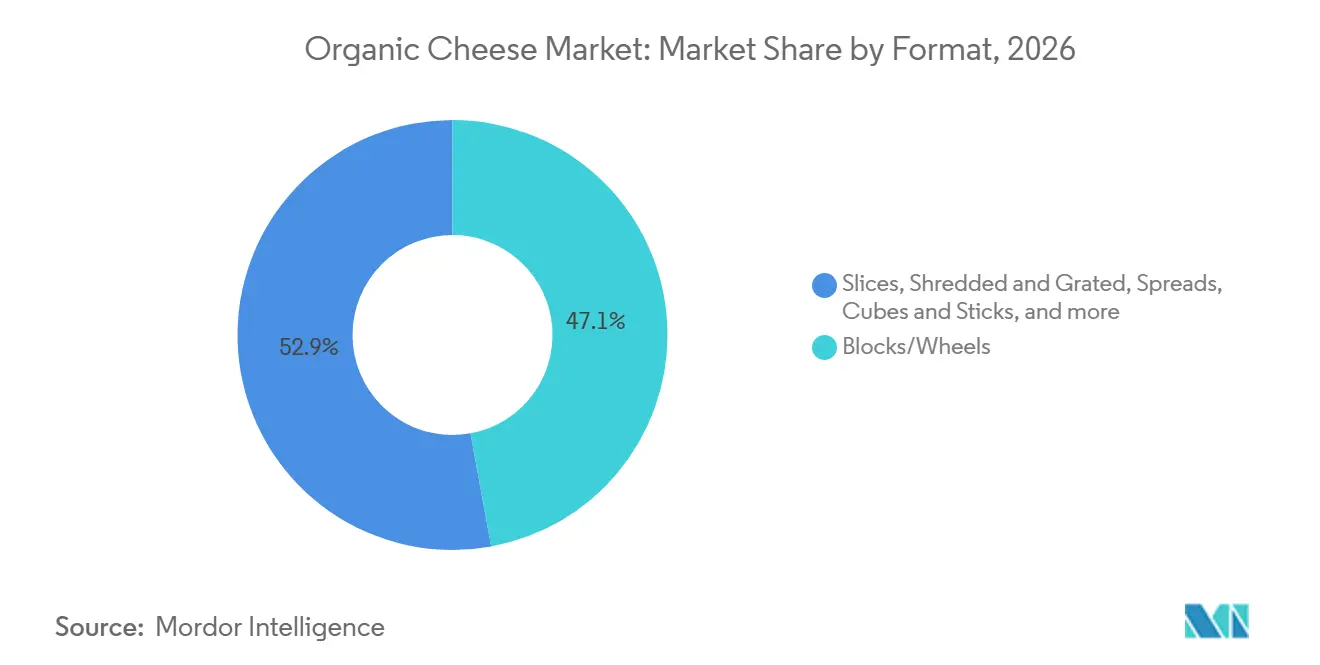
Blocks and Wheels Lead While Sliced Cheese Records Faster GrowthIn 2026, blocks and wheels accounted for 47.12% of the Organic Cheese Market share, establishing them as the leading product format. Their versatility supports household consumption, food preparation, and further processing into different portion sizes. Sliced organic cheese is forecast to grow at a CAGR of 6.65% through 2032, supported by its convenience for sandwiches, burgers, and quick meals. Shredded and grated cheese also serves consumers seeking ready-to-use ingredients for cooking, baking, and foodservice applications.
Organic cheese spreads, cubes, and sticks provide additional options for snacking, entertaining, and portion-controlled consumption. These formats allow manufacturers to differentiate products by convenience, packaging, and usage occasion. However, processing, packaging, refrigeration, and shelf-life management requirements can influence product costs and distribution efficiency across different formats.
By Distribution Channel:
Offline Retail Leads as Online Sales ExpandIn 2026, offline retail stores accounted for 61.52% of the Organic Cheese Market share, highlighting the importance of supermarkets, hypermarkets, specialty food retailers, and other physical grocery outlets. These channels allow consumers to compare brands, review certification and ingredient labels, and purchase organic cheese alongside other dairy products. Online retail stores are forecast to grow at a CAGR of 6.80% through 2032, supported by the convenience of home delivery, broader product discovery, and access to specialty organic cheese brands.
Offline retailers can strengthen product visibility through dedicated organic sections, in-store promotions, and a broad selection of cheese formats. Online platforms provide additional opportunities for niche producers to reach consumers beyond their immediate retail markets. However, both channels must address refrigerated storage and delivery requirements, while online sellers also need to ensure that temperature-sensitive products remain within appropriate handling conditions throughout fulfilment.
Geography Analysis
Europe Organic Cheese Market
Europe Organic Cheese Market
EU Organic Cheese Market
In 2026, Europe accounted for 37.60% of the global Organic Cheese Market, making it the largest regional market according to the provided dataset. The region’s established dairy industry, consumer familiarity with specialty cheeses, and organic food certification frameworks support the availability of certified organic cheese products. Countries such as Germany, France, Italy, and the Netherlands have established dairy and cheese industries, providing a base for organic product development and distribution. However, growth opportunities must be considered alongside higher production costs, the availability of certified organic milk, and compliance with organic production and labeling requirements. The European Union’s organic production framework establishes rules for livestock management, feed, processing, and certification, helping define the standards under which products can be marketed as organic. Producers can compete through differentiated cheese varieties, certified sourcing, transparent labeling, and premium product positioning. At the same time, manufacturers must manage refrigerated distribution and maintain product quality across retail channels. These factors make supply-chain efficiency and reliable access to certified dairy inputs important considerations for regional market development.
APAC Organic Cheese Market
Asia-Pacific Organic Cheese Market
Asia-Pacific is projected to be the fastest-growing region in the Organic Cheese Market, with a CAGR of 6.50% through 2032, according to the provided dataset. Market development can be supported by expanding modern retail networks, greater consumer exposure to international cheese varieties, and opportunities to distribute certified organic dairy products through supermarkets and e-commerce platforms. China, Japan, Australia, South Korea, and India represent distinct markets in which consumer preferences, dairy consumption patterns, and retail structures vary. Australia and New Zealand have established dairy industries, while Japan and South Korea offer established markets for differentiated dairy products. In India and Southeast Asian countries, wider access to specialty foods and improved refrigerated distribution may create opportunities for organic cheese producers, although affordability and consumer familiarity can affect adoption. Producers seeking regional expansion must also account for differences in organic certification and labeling requirements between countries. The region’s growth prospects will therefore depend on the availability of certified organic milk, competitive pricing, distribution capabilities, and product formats suited to local consumption habits.
North America Organic Cheese Market
North America remains an important market for organic cheese, supported by established organic food retail channels and formal certification frameworks. In the United States, the USDA National Organic Program sets requirements for organic livestock feed, animal management, processing, and labeling, providing a defined framework for products marketed as organic [1]. Canada and Mexico offer additional opportunities through grocery retail, specialty food outlets, and cross-border distribution, although manufacturers must meet the applicable requirements in each market. High production costs and the availability of certified organic milk remain relevant considerations for suppliers seeking to expand production and distribution.
Competitive Landscape
The Organic Cheese Market features a mix of multinational dairy companies, organic food brands, dairy cooperatives, and specialty cheese producers competing through product differentiation, certification, distribution reach, and premium positioning. Key participants identified in the market scope include Organic Valley, Arla Foods amba, Groupe Lactalis, Danone S.A., Emmi Group, Savencia Fromage and Dairy, Fonterra Co-operative Group Limited, Bel Group, General Mills Inc., Aurora Organic Dairy, Maple Hill Creamery, Stonyfield Organic, Horizon Organic, and Organic Meadow Inc. These companies operate across different parts of the dairy value chain, with their relevance to organic cheese varying according to their product portfolios and market presence. Established dairy groups can leverage existing processing and distribution networks, while specialized organic brands can differentiate through organic certification, sourcing transparency, and focused product offerings.
Competitive strategies in the Organic Cheese Market center on expanding product portfolios, improving retail availability, and serving different consumer preferences across product types and formats. Organic natural cheese provides opportunities to target consumers seeking certified organic dairy products, while organic processed cheese, slices, spreads, and shredded varieties can address convenience-oriented applications. Specialty offerings, including flavored and differentiated cheeses, can help companies distinguish their products in retail environments. However, manufacturers must balance product innovation and premium positioning against higher production costs and the availability of certified organic milk. Maintaining consistent quality and substantiating organic claims are also important for building consumer confidence.
Distribution and supply-chain management remain important competitive considerations. Companies with established grocery retail relationships can improve product visibility and expand access to consumers, while online channels can help specialty producers reach customers beyond their immediate geographic markets. At the same time, refrigerated storage, transportation, and shelf-life management require operational coordination throughout the supply chain. Producers must also maintain appropriate certification, documentation, and labeling practices in the markets where their products are sold. These requirements can create additional challenges for smaller businesses seeking to expand across borders.
Organic Cheese Industry Leaders
-
Organic Valley
-
Arla Foods amba
-
Groupe Lactalis
-
Danone S.A.
-
Emmi Group
- *Disclaimer: Major Players sorted in no particular order
Organic Cheese Market Companies Covered in this Report
- Organic Valley
- Arla Foods amba
- Groupe Lactalis
- Danone S.A.
- Emmi Group
- Savencia Fromage and Dairy
- Fonterra Co-operative Group Limited
- Bel Group
- General Mills Inc.
- Aurora Organic Dairy
- Maple Hill Creamery
- Stonyfield Organic
- Horizon Organic
- Norseland Ltd.
- Wensleydale Creamery
- Neal's Yard Dairy
- Organic Meadow Inc.
- Yeo Valley Organic
- Isigny Sainte-Mère
- Greenfields Ireland Ltd.
Recent Industry Developments in Organic Cheese Market
- June 2026: Organic Valley launched individually wrapped organic cheese snack sticks in Colby Jack, with Medium Cheddar scheduled to follow in July. Each serving provides 5 grams of protein, extending the company’s organic cheese portfolio into convenient, portion-controlled snacking formats.
- March 2026: Kingston Creamery introduced Organic Gorgonzola alongside two other blue cheese varieties, expanding its specialty cheese portfolio. The launch adds an organic option within the blue cheese category and reflects product development across differentiated cheese formats.
- May 2025: Natural Grocers expanded its private-label organic cheese range with five varieties: Havarti, Mild Cheddar and Medium Cheddar blocks, Medium Cheddar slices, and Sharp Cheddar shreds. The additions broadened its organic cheese assortment across multiple formats, with products made from California milk and sold exclusively through its stores.
- March 2025: Organic Valley introduced Organic American Cheese Blocks in Original and Fiesta flavors, expanding its existing sliced-cheese range into a block format. The 11-ounce products were scheduled for launch at Whole Foods stores nationwide, with subsequent rollout to additional retailers, providing more format versatility for cooking and meal preparation.
Global Organic Cheese Market Report Scope
For this study, the Organic Cheese Market is defined as the sales value of commercially produced cheese made from organically produced milk and manufactured, packaged, distributed, and sold through retail and other commercial channels. The market covers organic natural cheese and organic processed cheese, segmented by milk source, including cow milk, goat milk, and sheep milk; format, including blocks and wheels, slices, shredded and grated cheese, spreads, and cubes and sticks; and distribution channel, including online retail stores and offline retail stores. The market is analyzed across North America, Europe, Asia-Pacific, South America, and the Middle East and Africa, with country-level coverage as specified in the report. Market sizing and forecasts are presented in value terms across the defined segments and geographies.
Segmentation Overview
| Organic Natural Cheese |
| Organic Processed Cheese |
| Cow |
| Goat |
| Sheep |
| Blocks/Wheels |
| Slices |
| Shredded and Grated |
| Spreads |
| Cubes and Sticks |
| Online Retail Stores |
| Offline Retail stores |
| North America | United States |
| Canada | |
| Mexico | |
| Rest of North America | |
| Europe | United Kingdom |
| Germany | |
| France | |
| Italy | |
| Spain | |
| Sweden | |
| Belgium | |
| Poland | |
| Netherlands | |
| Europe | |
| Asia-Pacific | China |
| Japan | |
| India | |
| Thailand | |
| Singapore | |
| Indonesia | |
| South Korea | |
| Australia | |
| Rest of Asia-Pacific | |
| South America | Brazil |
| Argentina | |
| Colombia | |
| Peru | |
| Chile | |
| Rest of South America | |
| Middle East and Africa | South Africa |
| Saudi Arabia | |
| United Arab Emirates | |
| Nigeria | |
| Egypt | |
| Morocco | |
| Turkey | |
| Rest of Middle East and Africa |
| By Product Type | Organic Natural Cheese | |
| Organic Processed Cheese | ||
| By Milk Source | Cow | |
| Goat | ||
| Sheep | ||
| By Format | Blocks/Wheels | |
| Slices | ||
| Shredded and Grated | ||
| Spreads | ||
| Cubes and Sticks | ||
| By Distribution Channel | Online Retail Stores | |
| Offline Retail stores | ||
| By Geography | North America | United States |
| Canada | ||
| Mexico | ||
| Rest of North America | ||
| Europe | United Kingdom | |
| Germany | ||
| France | ||
| Italy | ||
| Spain | ||
| Sweden | ||
| Belgium | ||
| Poland | ||
| Netherlands | ||
| Europe | ||
| Asia-Pacific | China | |
| Japan | ||
| India | ||
| Thailand | ||
| Singapore | ||
| Indonesia | ||
| South Korea | ||
| Australia | ||
| Rest of Asia-Pacific | ||
| South America | Brazil | |
| Argentina | ||
| Colombia | ||
| Peru | ||
| Chile | ||
| Rest of South America | ||
| Middle East and Africa | South Africa | |
| Saudi Arabia | ||
| United Arab Emirates | ||
| Nigeria | ||
| Egypt | ||
| Morocco | ||
| Turkey | ||
| Rest of Middle East and Africa | ||
Key Questions Answered in the Report
What is the Organic Cheese Market size in 2026?
The Organic Cheese Market size is USD 9.37 billion in 2026.
What is the projected size of the Organic Cheese Market by 2032?
The Organic Cheese Market is projected to reach USD 13.43 billion by 2032.
What is the CAGR of the Organic Cheese Market during the 2027–2032 forecast period?
The Organic Cheese Market is expected to register a CAGR of 6.1% during the 2027–2032 forecast period.
Which segment holds the largest share of the Organic Cheese Market in 2026?
Organic natural cheese holds the largest share of the Organic Cheese Market, accounting for 59.48% in 2026.