
Optical Biometry Devices Market Size and Share
Market Overview
| Study Period | 2020 - 2031 |
|---|---|
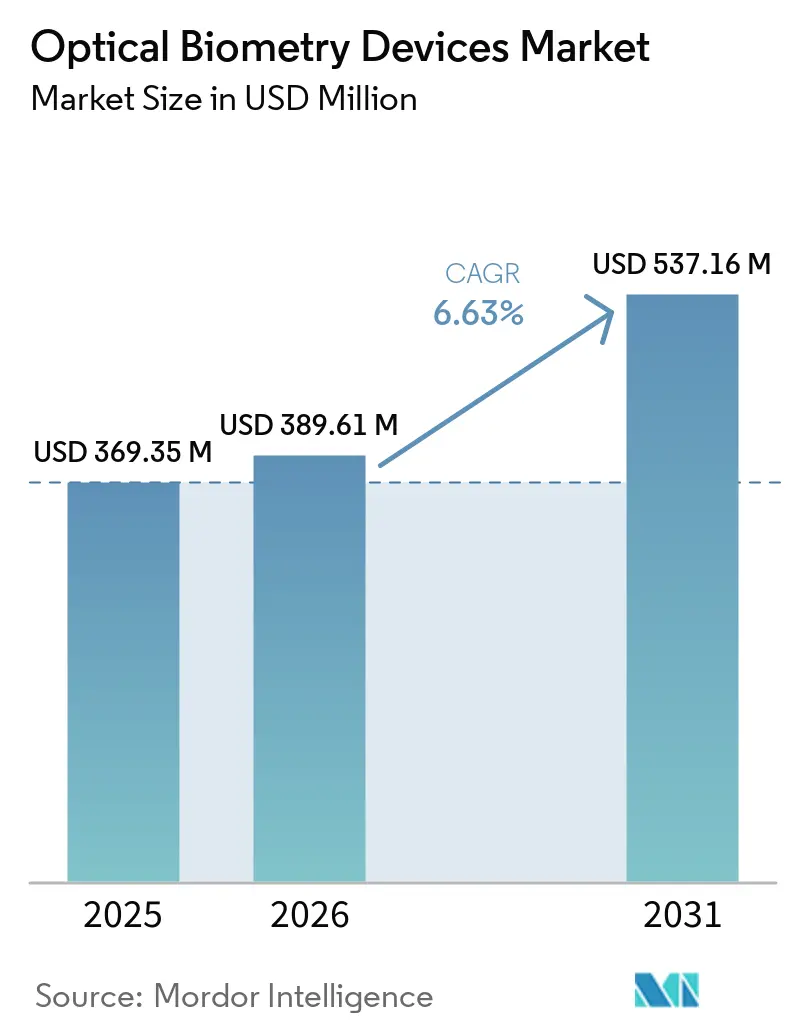
| Market Size (2026) | USD 389.61 Million |
| Market Size (2031) | USD 537.16 Million |
| Growth Rate (2026 - 2031) | 6.63 % |
| Fastest Growing Market | Asia-Pacific |
| Largest Market | North America |
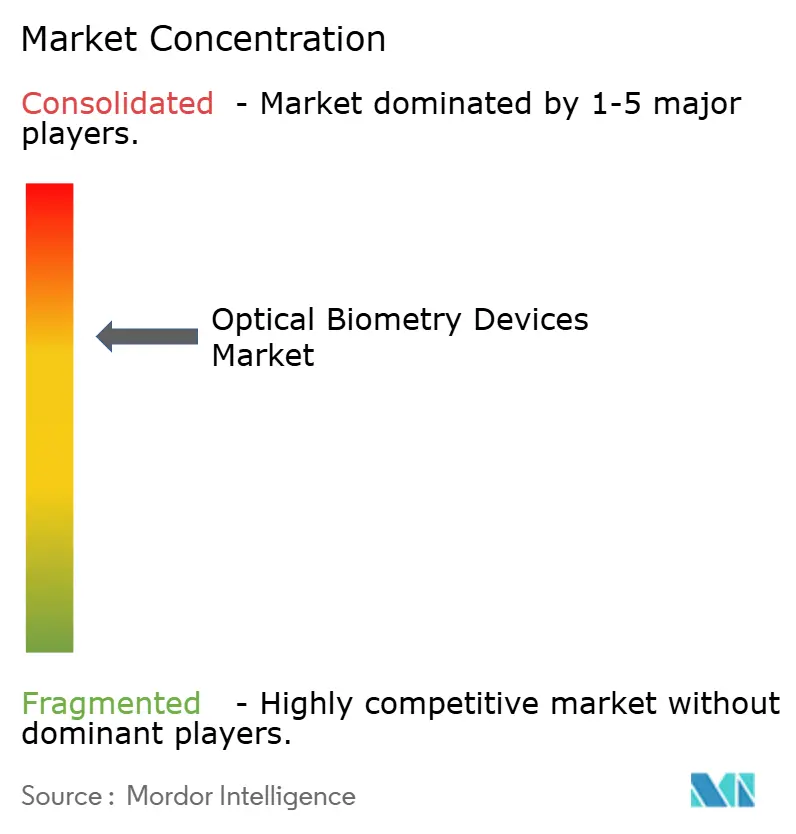
| Market Concentration | Medium |
Major Players *Disclaimer: Major Players sorted in no particular order Image © Mordor Intelligence. Reuse requires attribution under CC BY 4.0. | |
Optical Biometry Devices Market Analysis by Mordor Intelligence
The optical biometry devices market was valued at USD 369.35 million in 2025 and estimated to grow from USD 389.61 million in 2026 to reach USD 537.16 million by 2031, at a CAGR of 6.63% during the forecast period (2026-2031). Demand is linked to cataract surgery planning, premium intraocular lens use, and the replacement of contact ultrasound in clinical settings. Global effective cataract surgical coverage was 48.2% in 2025, leaving a large unmet need for surgery in many health systems. That gap supports long-term demand for reliable preoperative measurements, even when hospitals delay capital purchases. Software connections now matter as much as optical performance because clinics want faster data transfer and fewer manual steps. Competition is therefore moving toward integrated planning tools, service support, and software features rather than hardware specifications alone.
Key Report Takeaways
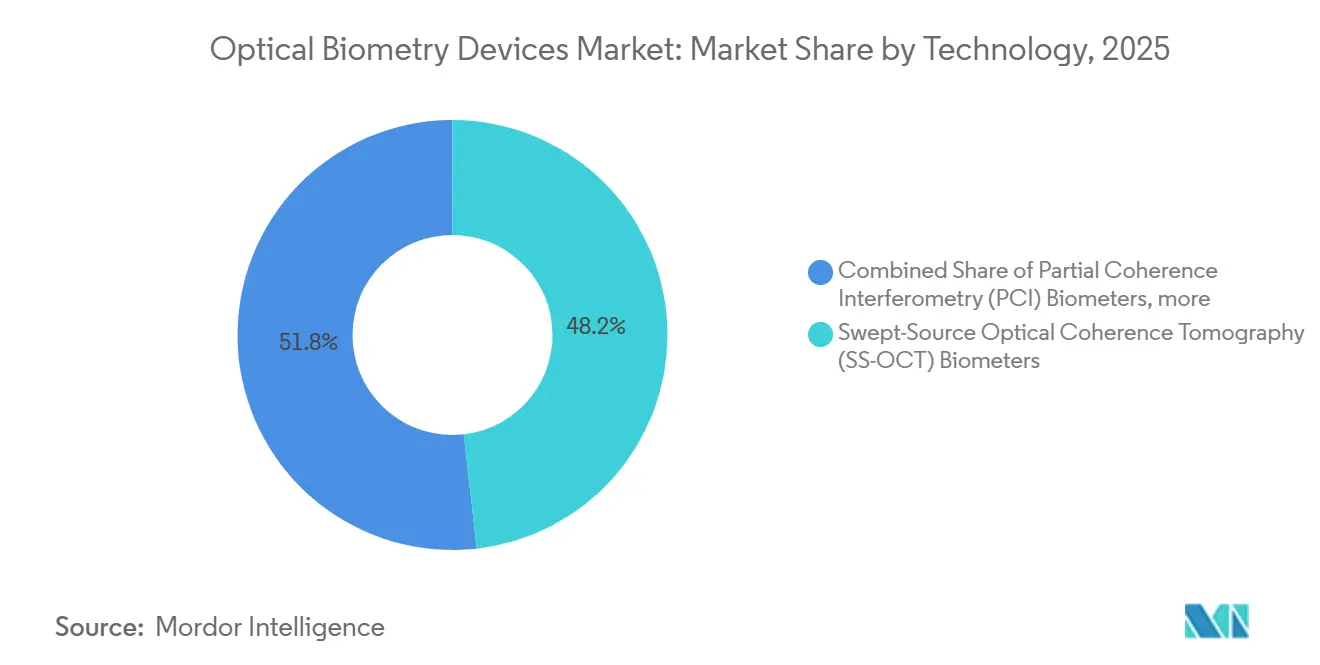
- By technology, swept-source optical coherence tomography (SS-OCT) biometers held 48.23% of the optical biometry devices market share in 2025, while optical low-coherence reflectometry (OLCR) biometers are forecasted to expand at a 7.28% CAGR through 2031.
- By device type, non-contact optical biometry devices held 53.27% revenue share in 2025, while contact optical biometry devices recorded the highest projected CAGR at 8.34% through 2031.
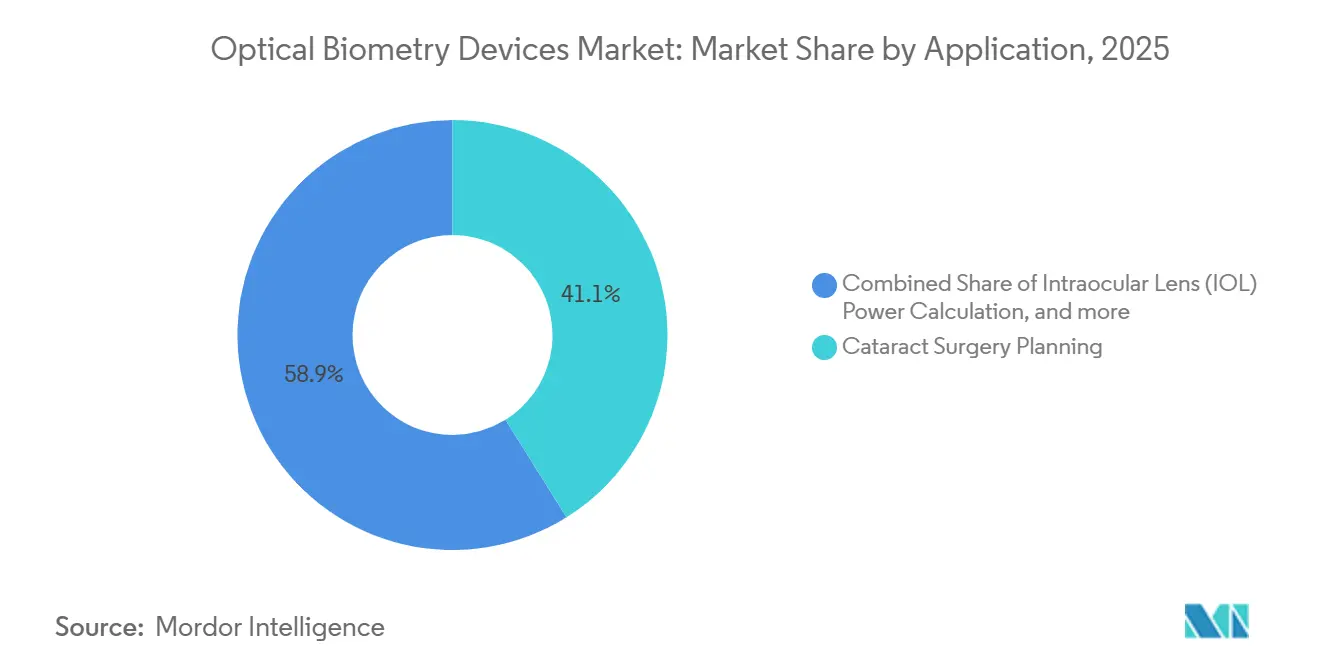
- By application, cataract surgery planning accounted for 41.11% of the optical biometry devices market in 2025, while intraocular lens power calculation is expected to advance at a 7.63% CAGR through 2031.
- By end-user, hospitals held 43.56% revenue share in 2025, while ophthalmology clinics and specialized eye care centers are forecasted to grow at a 6.92% CAGR through 2031.
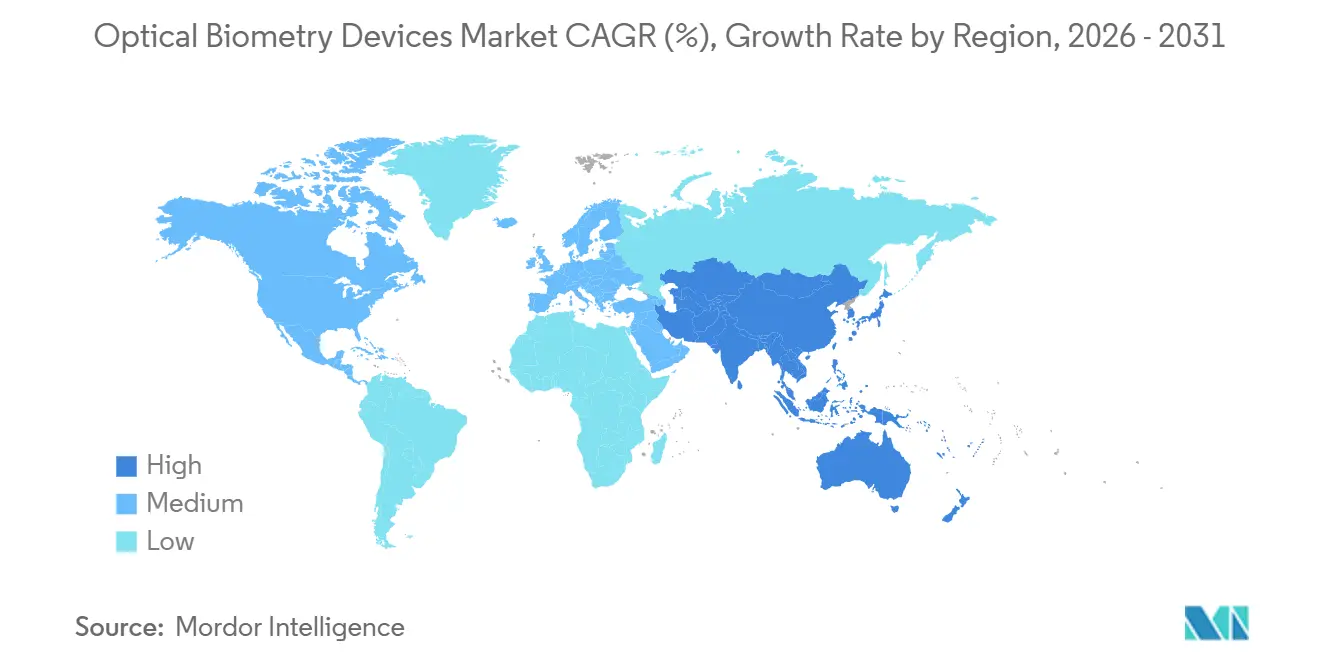
- By geography, North America held 48.36% revenue share in 2025, while Asia-Pacific is projected to expand at an 8.37% CAGR through 2031.
Note: Market size and forecast figures in this report are generated using Mordor Intelligence’s proprietary estimation framework, updated with the latest available data and insights as of January 2026.
Global Optical Biometry Devices Market Trends and Insights
Drivers Impact Analysis*
| Driver | (~) % Impact on CAGR Forecast | Geographic Relevance | Impact Timeline |
|---|---|---|---|
| Rising Cataract Surgery Volumes in Aging Populations | +1.8% | Global, concentrated in Asia-Pacific, Europe, and North America | Long term (≥ 4 years) |
| Shift to Swept-Source OCT for Dense Cataracts and Complex Eyes | +1.5% | North America, Western Europe, Japan, and South Korea | Medium term (2-4 years) |
| Premium IOL Adoption Increasing Measurement Requirements | +1.2% | North America, Europe, and urban Asia-Pacific | Medium term (2-4 years) |
| Integration of Biometry with Digital Cataract Planning Workflows | +0.9% | North America and Europe | Medium term (2-4 years) |
| Cloud-Connected and Portable Biometry Expanding Decentralized Care | +0.6% | Asia-Pacific, Middle East and Africa, and South America | Medium term (2-4 years) |
| Axial-Length Monitoring Supporting Myopia Management | +0.4% | Asia-Pacific, Europe, and selected global markets | Short term (≤ 2 years) |
| Source: Mordor Intelligence | |||
Rising Cataract Surgery Volumes in Aging Populations
Cataract prevalence rises with age and continues to shape the long-term need for preoperative eye measurements. Cataract surgical coverage reached 48.2% globally in 2025 and is projected to reach 52.3% by 2030.[1] The expected improvement remains below the stated decade target, which leaves a large backlog of patients needing treatment. The WHO African region recorded effective cataract surgical coverage of 23.6% in 2025, showing the scale of the access gap. The optical biometry devices market benefits when cataract programs expand because each surgery requires dependable measurements before lens selection. Suppliers with durable and portable products are better positioned where first-time equipment placement matters more than replacement demand.
Shift to Swept-Source OCT for Dense Cataracts and Complex Eyes
Swept-Source Optical Coherence Tomography uses a 1,050 nm wavelength that can obtain measurements through denser cataracts than some earlier optical methods. A 2026 prospective study reported that ARGOS with the Barrett Universal II formula placed 98% of eyes within ±0.50 D of refractive prediction error across normal and long axial lengths.[2] This performance matters for patients with high myopia and for premium toric or multifocal lens procedures. The optical biometry devices market is gaining from this clinical use because complex cases are often treated in high-volume surgical centers. When a biometer obtains dependable readings in difficult eyes, clinics have less reason to retain immersion A-scan ultrasound as a routine fallback. That pattern can support replacement purchases where clinical teams seek one device for both standard and challenging cases.
Premium IOL Adoption Increasing Measurement Requirements
Multifocal, extended-depth-of-focus, and toric intraocular lenses require accurate keratometry and axial-length measurements. A measurement error above 0.3 D can affect refractive results and patient satisfaction in these procedures. Surgeons using premium lenses increasingly need total keratometry values that include anterior and posterior corneal information. This requirement favors platforms that combine high-quality optical acquisition with current lens calculation formulas. ZEISS presented expanded Kane formula integration for the IOLMaster 700 at ASCRS 2026.[3] The optical biometry devices market can benefit as practices upgrade equipment to support premium lens consultations and the higher expectations that follow these procedures.
Integration of Biometry with Digital Cataract Planning Workflows
Connected biometry systems can transfer measurements directly into cataract planning software and reduce manual data entry. A published workflow study found that digital preparation reduced overall time from 30.58 minutes to 16.48 minutes and removed manual data transfer. The same work reported a 46% reduction in preparation time, which helps high-volume surgery centers improve process consistency. The optical biometry devices market increasingly rewards suppliers that offer planning tools, connectivity, and reliable support after installation. Digital workflows can also make it harder for clinics to change brands once patient records and operating processes are linked to a vendor system. Interoperability requirements such as DICOM and HL7 add value to vendors that can work within hospital information systems.
Restraints Impact Analysis*
| Restraint | (~) % Impact on CAGR Forecast | Geographic Relevance | Impact Timeline |
|---|---|---|---|
| High Capital Cost and Budget Constraints in Emerging Markets | -1.5% | Asia-Pacific excluding Japan and South Korea, Middle East and Africa, and South America | Long term (≥ 4 years) |
| Shortage of Trained Ophthalmic Technicians and Biometry Operators | -0.8% | Sub-Saharan Africa, South Asia, and Southeast Asia | Long term (≥ 4 years) |
| Inter-Device Measurement Variability and Formula Dependence | -0.6% | Global | Medium term (2-4 years) |
| Workflow and Data-Interoperability Friction in Multi-Vendor Cataract Suites | -0.5% | North America and Europe | Medium term (2-4 years) |
| Source: Mordor Intelligence | |||
High Capital Cost and Budget Constraints in Emerging Markets
Capital budgets limit the adoption of advanced optical instruments in district hospitals and smaller outpatient centers. Many facilities in South Asia, Southeast Asia, and sub-Saharan Africa continue to rely on ultrasound because funding and reimbursement are limited. Without payment mechanisms for optical biometry, providers may struggle to recover the cost through procedure revenue. This can keep facilities on lower-accuracy equipment even when clinicians prefer optical measurements. Guidance for low-resource eye care settings identifies maintenance, calibration, and fallback measurement practices as important quality issues. The optical biometry devices market therefore faces a slower adoption path where equipment finance, service capacity, and reimbursement remain weak.
Shortage of Trained Ophthalmic Technicians and Biometry Operators
Advanced optical biometry needs trained staff who can obtain consistent measurements and recognize unreliable scans. Research in Southern Ethiopia found that 18.2% of sampled facilities employed dedicated eye care technical staff. Staff shortages can lead to repeat scans, inconsistent results, and poor lens power selection. These issues are more serious where premium lenses or complex cataract cases require narrow measurement tolerances. Formula updates, total keratometry functions, and connected software can create further training needs after a device is installed. The optical biometry devices market is constrained in these settings until training and clinical support are available alongside equipment purchases.
*Our forecasts treat driver/restraint impacts as directional, not additive. The impact forecasts reflect baseline growth, mix effects, and variable interactions.
Segment Analysis
By Technology: SS-OCT Leads in Complex Cases While OLCR Expands in Routine Settings
Swept-source optical coherence tomography biometers held 48.23% revenue share in 2025. They are widely used in tertiary surgical centers that need readings through dense cataracts and posterior corneal data for toric lens planning. A 2026 comparison of CASIA2 and IOLMaster 700 examined the agreement of ocular biometry and lens calculation performance in cataract patients.
Optical low-coherence reflectometry is the fastest-growing technology category, with a projected 7.28% CAGR through 2031. Its price position and validated performance in routine cataract cases support demand among mid-volume providers, while the Topcon Aladdin platform combines OLCR biometry, corneal topography, calculation tools, and DICOM or HL7 connectivity. Within the optical biometry devices industry, the technology choice increasingly reflects patient mix, workflow needs, and capital limits rather than a single performance standard.

By Device Type: Non-Contact Systems Lead While Contact Options Serve Difficult Cases
Non-contact optical biometry devices captured 53.27% revenue share in 2025. They reduce corneal compression concerns associated with contact ultrasound and support patient-friendly testing. Automated alignment can help clinics manage high patient throughput during cataract surgery sessions. Their use in routine preoperative care supports a large installed base across the optical biometry devices market, hospitals, and ophthalmology clinics.
Contact optical biometry devices are the fastest-growing device type, with a projected 8.34% CAGR through 2031. Their demand reflects clinical conditions in which severe media opacity can limit non-contact optical readings. Hybrid systems that provide contact and non-contact options can address varied patient severity within one facility. The optical biometry devices market retains a role for contact modalities even as non-contact testing remains the preferred approach for standard cases.
By Application: Cataract Planning Remains Central While IOL Calculation Grows
Cataract surgery planning held 41.11% revenue share in 2025. It remains the main use because biometric measurements guide lens selection before cataract procedures. Accurate data has become closely linked to surgical quality and refractive expectations. A 2025 study found that changes in ocular biometry over time affected intraocular lens power calculation accuracy. That finding supports repeat measurement close to the procedure when clinical circumstances require it.
Intraocular lens power calculation is the fastest-growing application, with a forecasted CAGR of 7.63% through 2031. Artificial intelligence and machine-learning formulas depend on detailed biometric inputs and can be integrated into planning systems, while ZEISS describes its AI IOL Calculator as a formula option in the VERACITY Surgery Planner. The optical biometry devices market can therefore capture value from both procedure volume and digital planning use.
By End-User: Hospitals Hold Volume While Clinics Expand Premium Services
Hospitals held 43.56% revenue share in 2025. They treat many high-acuity cataract cases, including dense cataracts, corneal pathology, and post-refractive surgery eyes. These clinical needs support investment in high-uptime systems with service coverage. Ambulatory surgical centers often consider mid-tier systems that meet routine care requirements at lower capital cost.
Ophthalmology clinics and specialized eye care centers are expected to be the fastest-growing end-user group at a 6.92% CAGR through 2031. Private practices in Asia-Pacific are expanding premium lens consultations that can justify investment in more capable biometers and support serial axial-length monitoring for children and adolescents in myopia management programs. The optical biometry devices industry and the optical biometry devices market have a broader customer base when equipment can serve cataract workflows and ongoing monitoring needs.
Geography Analysis
North America held 48.36% of the optical biometry devices market share in 2025. The region benefits from high cataract surgery volumes, dense ophthalmology networks, premium lens use, and reimbursement support. The United States remains an important launch setting for integrated pretesting and workflow products, and Topcon Healthcare received FDA 510(k) clearance for its OMNIA 4-in-1 automated pretesting solution in November 2025. Academic medical centers and specialist practices also provide clinical evidence that supports wider adoption of high-end biometry platforms.
Europe is a significant contributor to revenue, with Germany, the United Kingdom, and France among its larger national markets. Universal health systems fund cataract procedures and commonly treat biometry as a standard preoperative step. Established reimbursement can slow upgrades when existing devices meet approved clinical protocols and reduce replacement urgency even where newer SS-OCT systems offer additional features. The optical biometry devices market faces a higher compliance burden in Europe, while established suppliers can use certified portfolios to protect access.
Asia-Pacific is projected to be the fastest-growing region, with a projected 8.4% CAGR through 2031. The optical biometry devices market in China, India, South Korea, and Japan gains support from private ophthalmology expansion, premium lens adoption, and local manufacturing. The Middle East and Africa show a sharp divide between premium demand in Gulf Cooperation Council markets and limited access in sub-Saharan Africa. South America remains a smaller growth area where import tariffs and restricted reimbursement constrain adoption, although private clinics in major cities continue to create demand.
Competitive Landscape
The optical biometry devices market has moderate concentration, with Carl Zeiss Meditec, Haag-Streit, Alcon, Topcon, and NIDEK among the leading global suppliers. ZEISS has reinforced its IOLMaster 700 position by adding Kane formula integration and introducing the VisioGen patient engagement platform in 2026. This approach links hardware with planning, calculation, and practice engagement tools, while Haag-Streit competes through the Lenstar platform and its broader digital workflow offering. Suppliers are seeking to increase customer retention by making device data part of the clinical workflow.
Performance differences between leading biometers are becoming less decisive in many routine cases. A 2024 retrospective comparison evaluated prediction accuracy across ARGOS, IOLMaster 700, and Lenstar in short, medium, and long eyes. As clinical accuracy becomes more comparable, vendors compete through software, data connections, service, and user support. Topcon has also moved toward workflow consolidation with OMNIA, which combines multiple pretesting functions in one system.
A lower-cost, durable system could create optical biometry devices market access for providers that cannot support premium hospital-grade equipment, while myopia management can increase the use of biometers outside cataract surgery. The optical biometry devices market is likely to remain centered on established brands because software ecosystems, clinical validation, and post-sale support create meaningful switching barriers. The optical biometry devices market remains moderately concentrated rather than dominated by one supplier.
Optical Biometry Devices Industry Leaders
-
Carl Zeiss Meditec AG
-
Haag-Streit AG
-
Topcon Corporation
-
NIDEK CO., LTD.
-
Alcon Inc.
- *Disclaimer: Major Players sorted in no particular order
Recent Industry Developments
- May 2026: Alcon Science published multicenter prospective data demonstrating statistically superior accuracy of the Barrett True Axial Length (BTAL) formula paired with ARGOS biometer measurements in post-refractive surgery and short axial-length eyes, compared to Barrett Universal II, reinforcing the ARGOS ecosystem's clinical differentiation in complex IOL planning cases.
- April 2026: Carl Zeiss Meditec AG showcased the enhanced IOLMaster 700 with expanded Kane formula integration at ASCRS 2026 in Washington, D.C., alongside the commercial launch of ZEISS VisioGen, an AI-powered patient engagement platform for ophthalmology practices available in the United States.
- January 2026: ZEISS Vision Care launched the MYO 200 Biometer, a dedicated myopia management device using Partial Coherence Interferometry technology validated across over 100 million scans. The device completes axial-length measurements in 7.5 seconds and debuted in Hong Kong and China before a planned global rollout, marking the first purpose-built biometer from a tier-1 manufacturer for pediatric myopia monitoring workflows.
Global Optical Biometry Devices Market Report Scope
According to the report’s scope, the optical biometry devices market is the segment of ophthalmic equipment focused on non‑contact devices that measure eye parameters (axial length, corneal curvature, anterior chamber depth) to guide cataract surgery and intraocular lens (IOL) selection.
The optical biometry devices market is segmented into technology, device type, application, end-user, and geography. By technology, the market is segmented into swept-source optical coherence tomography (SS-OCT) biometers, optical low-coherence reflectometry (OLCR) biometers, and partial coherence interferometry (pci) biometers. By device type, the market is segmented into non-contact optical biometry devices and contact optical biometry devices. By application, the market is segmented into cataract surgery planning, intraocular lens (IOL) power calculation, refractive lens exchange planning, and other applications. By end-user, the market is segmented into hospitals, ophthalmology clinics and specialized eye care centers, ambulatory surgical centers, and diagnostic and vision-care centers. By geography, the market is segmented into North America, Europe, Asia-Pacific, the Middle East and Africa, and South America. The report also covers the estimated market sizes and trends for 17 countries across major regions globally. The report offers values (USD) for all the above segments.
| Swept-Source Optical Coherence Tomography (SS-OCT) Biometers |
| Optical Low-Coherence Reflectometry (OLCR) Biometers |
| Partial Coherence Interferometry (PCI) Biometers |
| Non-Contact Optical Biometry Devices |
| Contact Optical Biometry Devices |
| Cataract Surgery Planning |
| Intraocular Lens (IOL) Power Calculation |
| Refractive Lens Exchange Planning |
| Other Applications |
| Hospitals |
| Ophthalmology Clinics and Specialized Eye Care Centers |
| Ambulatory Surgical Centers |
| Diagnostic and Vision-Care Centers |
| North America | United States |
| Canada | |
| Mexico | |
| Europe | Germany |
| United Kingdom | |
| France | |
| Italy | |
| Spain | |
| Rest of Europe | |
| Asia-Pacific | China |
| Japan | |
| India | |
| Australia | |
| South Korea | |
| Rest of Asia-Pacific | |
| Middle East and Africa | GCC |
| South Africa | |
| Rest of Middle East and Africa | |
| South America | Brazil |
| Argentina | |
| Rest of South America |
| By Technology | Swept-Source Optical Coherence Tomography (SS-OCT) Biometers | |
| Optical Low-Coherence Reflectometry (OLCR) Biometers | ||
| Partial Coherence Interferometry (PCI) Biometers | ||
| By Device Type | Non-Contact Optical Biometry Devices | |
| Contact Optical Biometry Devices | ||
| By Application | Cataract Surgery Planning | |
| Intraocular Lens (IOL) Power Calculation | ||
| Refractive Lens Exchange Planning | ||
| Other Applications | ||
| By End-User | Hospitals | |
| Ophthalmology Clinics and Specialized Eye Care Centers | ||
| Ambulatory Surgical Centers | ||
| Diagnostic and Vision-Care Centers | ||
| By Geography | North America | United States |
| Canada | ||
| Mexico | ||
| Europe | Germany | |
| United Kingdom | ||
| France | ||
| Italy | ||
| Spain | ||
| Rest of Europe | ||
| Asia-Pacific | China | |
| Japan | ||
| India | ||
| Australia | ||
| South Korea | ||
| Rest of Asia-Pacific | ||
| Middle East and Africa | GCC | |
| South Africa | ||
| Rest of Middle East and Africa | ||
| South America | Brazil | |
| Argentina | ||
| Rest of South America | ||
Key Questions Answered in the Report
How large is the optical biometry devices market in 2026?
The optical biometry devices market is estimated at USD 369.35 million in 2025 to reach USD 389.61 million in 2026 and is projected to reach USD 537.16 million by 2031, at a 6.63% CAGR.
Which technology leads optical biometry use?
Swept-source optical coherence tomography (SS-OCT) biometers held 48.23% revenue share in 2025 because it supports challenging cataract and premium lens cases.
Why are non-contact optical biometers widely used?
Non-contact optical biometry devices held 53.27% revenue share in 2025 because they support patient-friendly testing, automated alignment, and digital data transfer.
Which region is growing fastest for optical biometry equipment?
Asia-Pacific is forecasted to grow at an 8.37% CAGR through 2031, supported by private eye care expansion and myopia management demand.