
Oilfield Surfactants Market Size and Share
Market Overview
| Study Period | 2022 - 2032 |
|---|---|
| Market Size (2027) | USD 3.38 Billion |
| Market Size (2032) | USD 4.19 Billion |
| Growth Rate (2027 - 2032) | 4.34 % |
| Fastest Growing Market | Asia-Pacific |
| Largest Market | North America |
| Market Concentration | Medium |
Major Players *Disclaimer: Major Players sorted in no particular order Image © Mordor Intelligence. Reuse requires attribution under CC BY 4.0. | |
Oilfield Surfactants Market Analysis by Mordor Intelligence
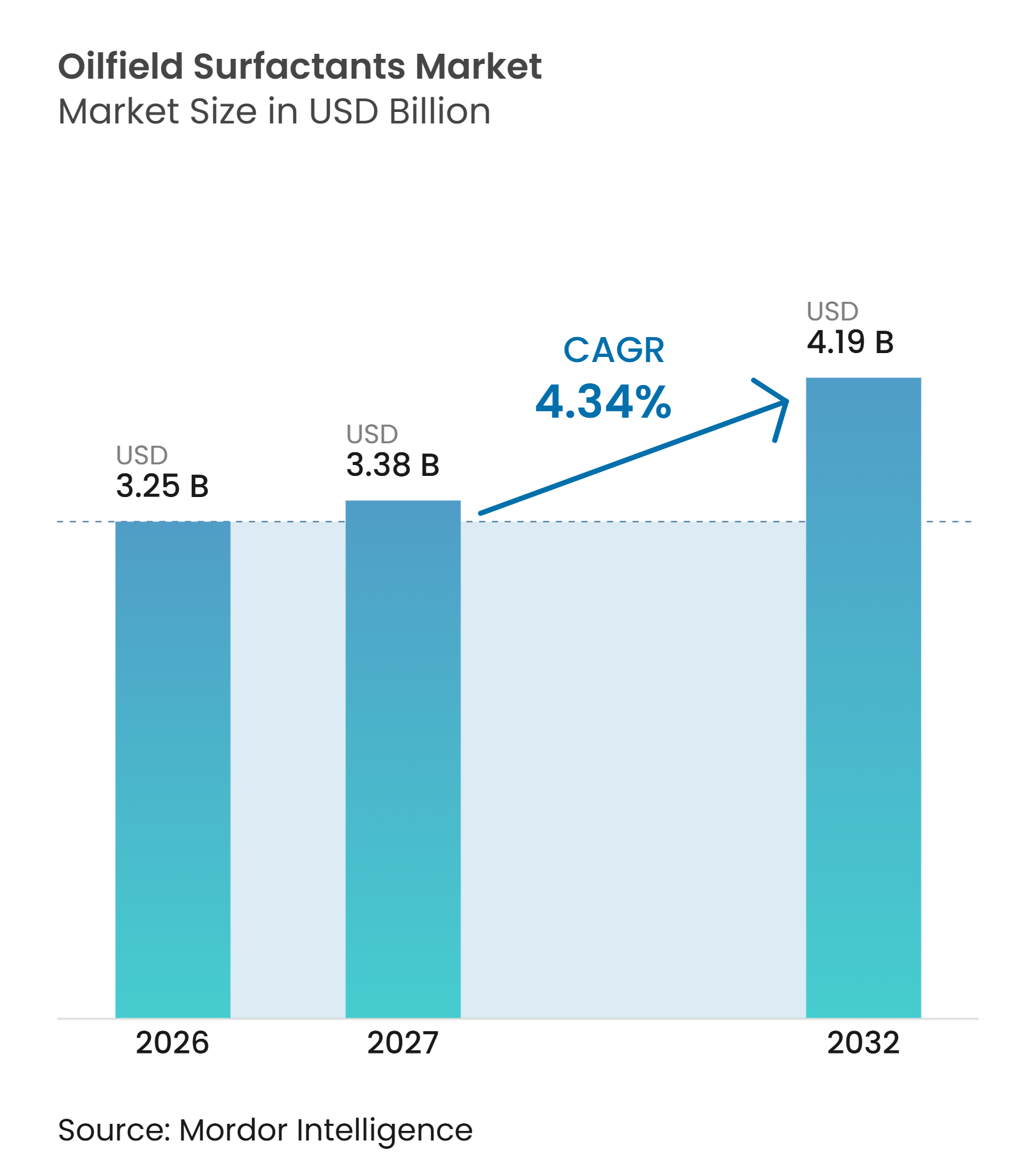
The Oilfield Surfactants Market size was valued at USD 3.25 billion in 2026 and is estimated to grow from USD 3.38 billion in 2027 to USD 4.19 billion by 2032, at a CAGR of 4.34% during the forecast period (2027-2032). The oilfield surfactants market is supported by mature reservoirs that require chemical intervention to sustain production, while unconventional wells and deepwater projects demand more specialized production chemistry. Chemical enhanced oil recovery (chemical EOR) is shifting surfactant spending toward programs that measure the value of incremental barrels recovered, rather than only the number of wells completed. Global oil supply reached 108 MMb/d in September 2025, and non-OPEC+ producers added 1.6 MMb/d in 2025, maintaining a broad base of upstream activity that consumed production chemicals. Suppliers responded with integrated service offerings, application-specific formulations, and manufacturing capacity to support longer recovery programs. The market also faces short-term budget pressure when oil prices weaken, although mature-field work and complex offshore production keep chemical programs tied to production continuity.
Key Report Takeaways
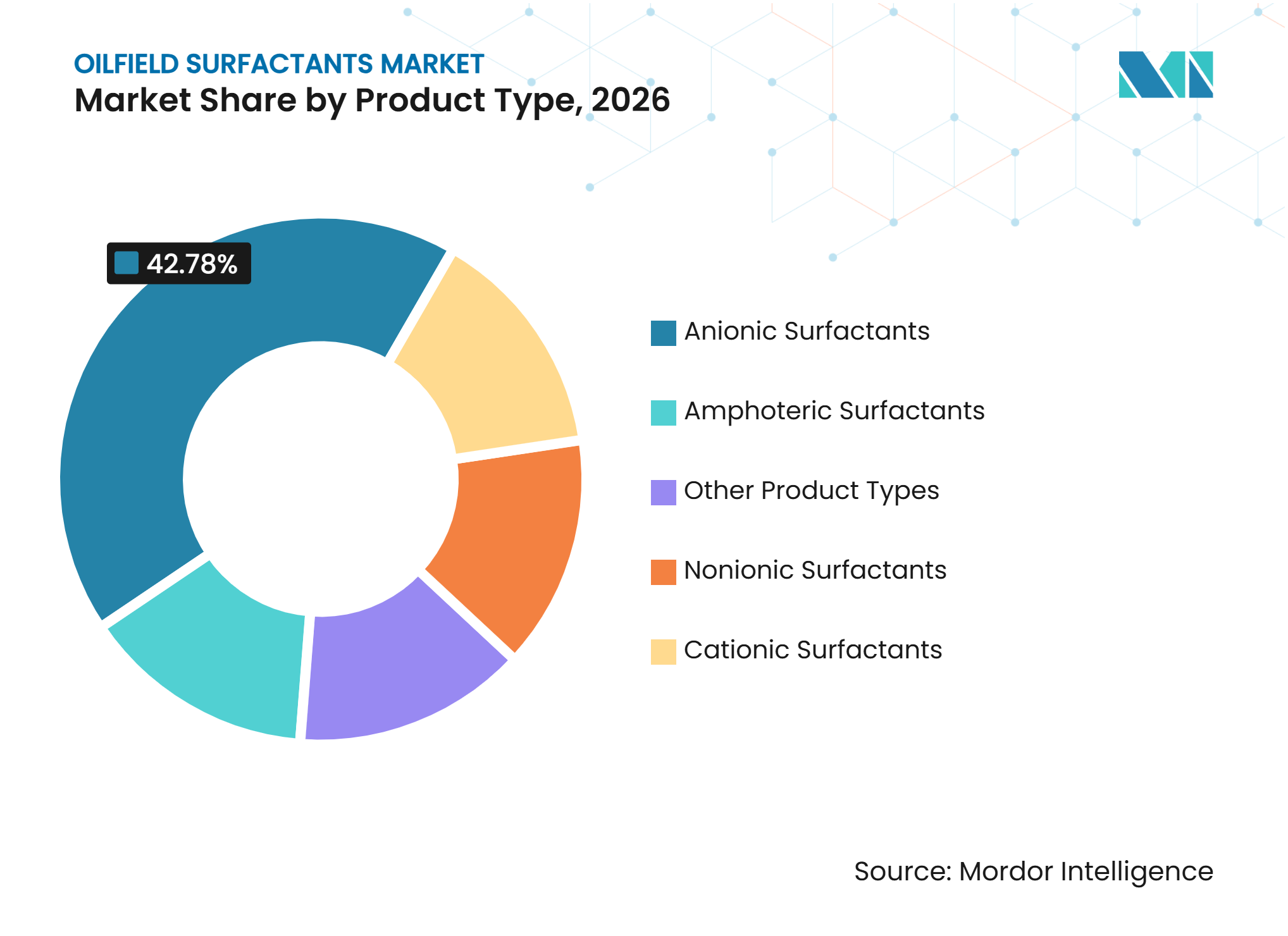
- By product type, anionic surfactants accounted for 42.78% of market share in 2026, and this segment is forecast to grow at a 4.89% CAGR through 2032.
- By source, synthetic surfactants accounted for 70.23% of market share in 2026, while bio-based surfactants are forecast to advance at a 5.12% CAGR through 2032.
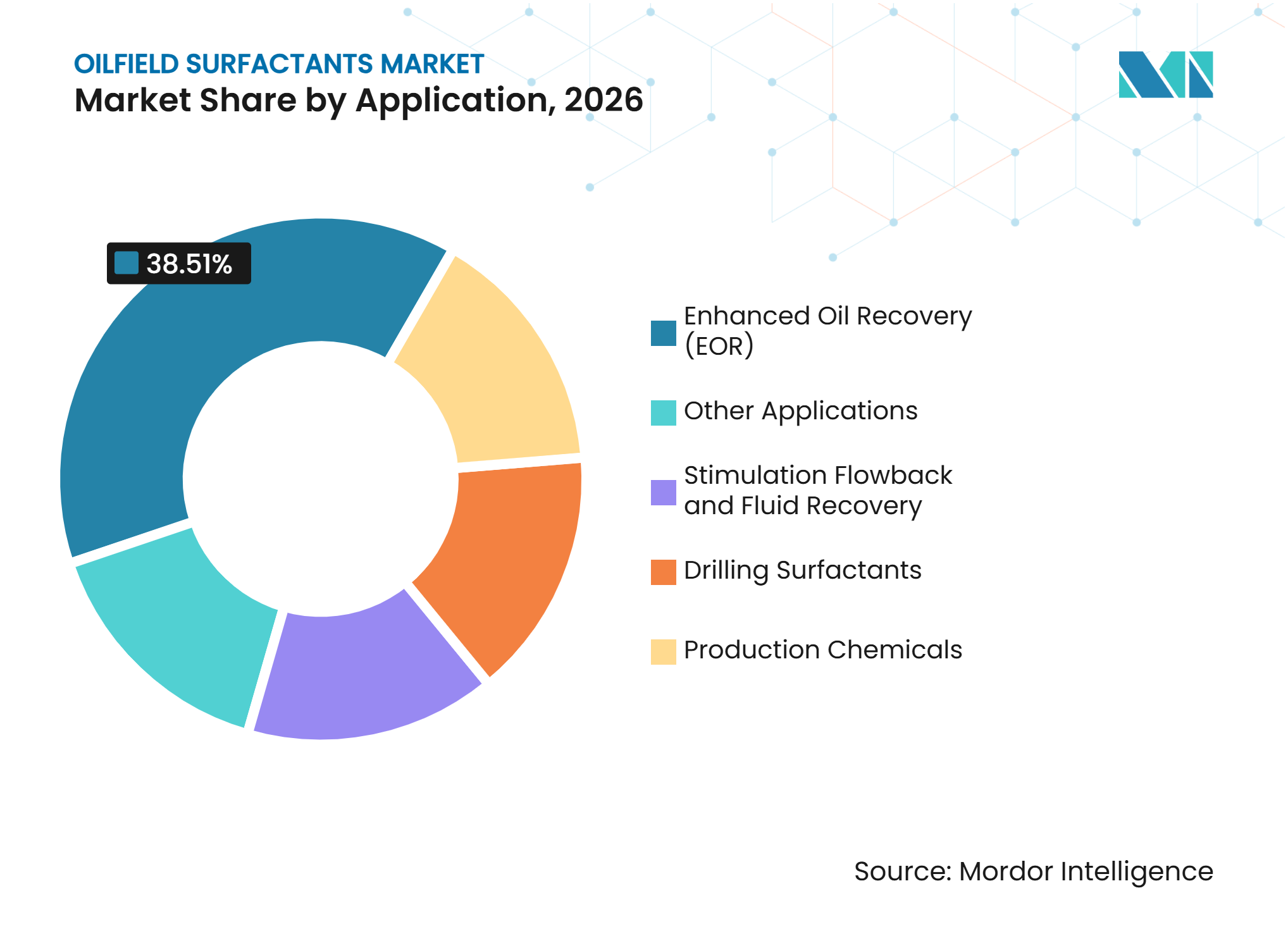
- By application, EOR accounted for 38.51% of market share in 2026 and is forecast to expand at a 5.47% CAGR through 2032.
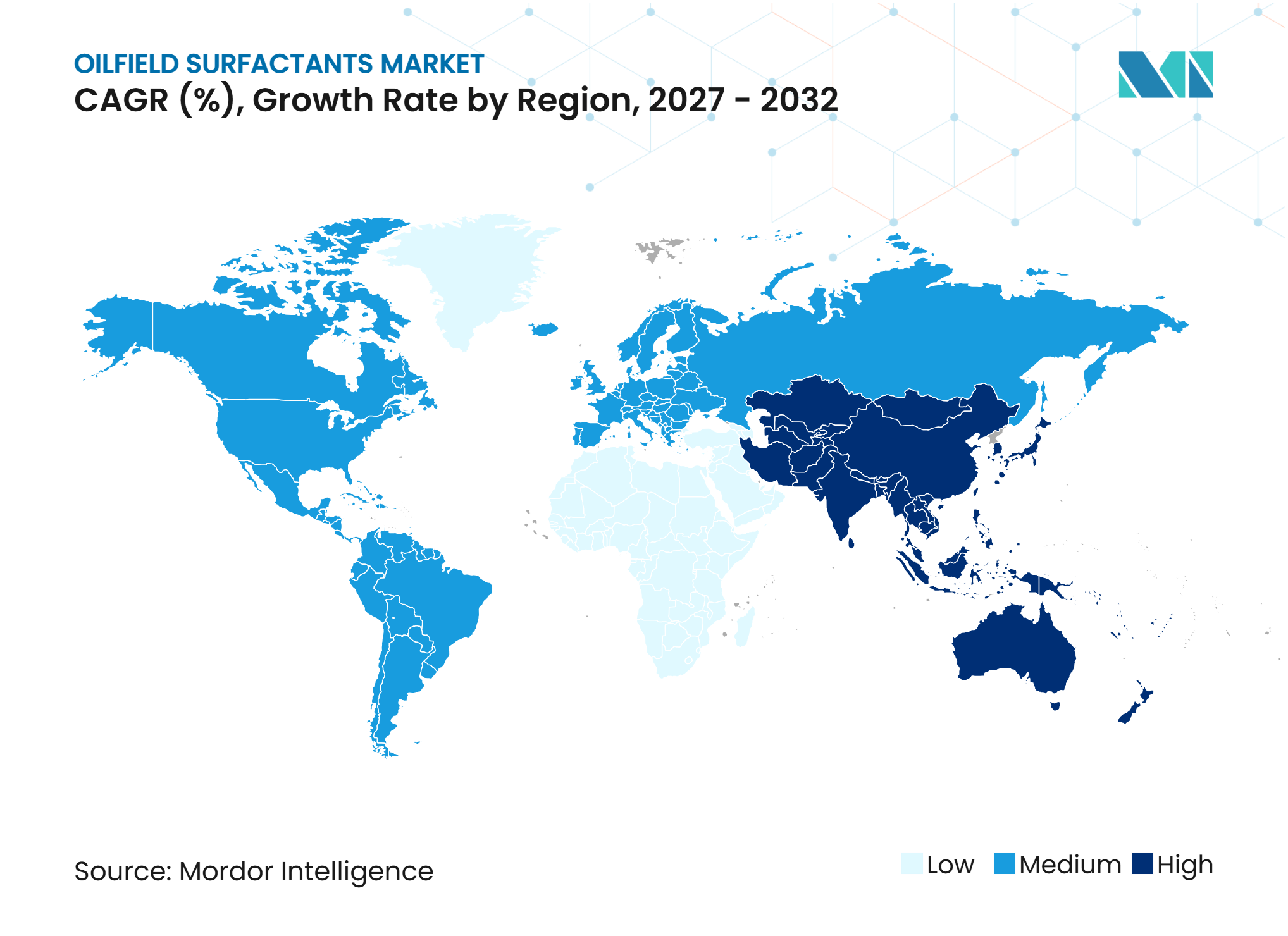
- By geography, North America held 36.83% of market share in 2026, while Asia-Pacific is forecast to record a 5.33% CAGR through 2032.
Note: Market numbers in this report are based on Mordor Intelligence's proprietary estimation framework, which combines nine months of actuals with Q4 projections for base year 2026.
Market Trends and Insights
Drivers Impact Analysis of Oilfield Surfactants Market*
| Drivers | (~) % Impact on CAGR Forecast | Geographic Relevance | Impact Timeline |
|---|---|---|---|
| Mature-Field Recovery and Chemical EOR Demand | +2.0% | Global | Medium term (2-4 years) |
| Shale Stimulation and Unconventional Production | +0.8% | North America | Short term (≤ 2 years) |
| Bio-Based and Low-Toxicity Formulation Adoption | +0.6% | Global | Long term (≥ 4 years) |
| Deepwater and Offshore Production Chemistry | +0.5% | Global | Medium term (2-4 years) |
| Real-Time Chemical Dosing and Digital Optimization | +0.4% | Global | Medium term (2-4 years) |
| Source: Mordor Intelligence | |||
Mature-Field Recovery and Chemical EOR Demand
Chemical Enhanced Oil Recovery (EOR) progressed from pilot activity to larger reservoir-scale programs. BASF started its EOR surfactant plant in Dahej, India, in 2025 to supply an alkali-surfactant-polymer project targeting a 65% oil recovery rate. A Society of Petroleum Engineers paper reported a 7% incremental oil gain from surfactant-polymer flooding in India's Western Onshore Basin. These results link surfactant purchasing to reserve recovery plans and can extend contract periods beyond individual drilling campaigns. Consistent batch quality is becoming a purchasing factor, as product variations can limit the economic value of a commercial EOR program. The Oilfield Surfactants Market benefits when operators treat chemical performance as part of field recovery planning rather than a short-term operating expense.
Shale Stimulation and Unconventional Production
Unconventional wells are driving surfactant demand during both completion and production. A 2025 Permian Basin study found that surfactant additions below 100 parts per million (ppm) delivered oil-rate gains of 10% to 38% in gas-lift wells. This use case adds chemical demand over the productive life of a well without replacing completion chemistry. Mixed-charge surfactant systems can control viscosity, reduce friction pressure, and lower surface tension in slickwater fluids, reducing the need for separate additive packages. Stepan expanded alpha-olefin sulfonate capacity by 25% across three U.S. facilities in 2025, reflecting supplier preparation for sustained demand[1]. The Oilfield Surfactants Market gains from treatments that improve production from existing unconventional wells.
Bio-Based and Low-Toxicity Formulation Adoption
Bio-based formulations are becoming relevant where operators require lower-toxicity options and field performance that supports production goals. Locus FS reported that its SUSTAIN SF101 treatment increased oil production by 20%, raised gas output by 15%, and lowered the water-oil ratio by 23% in comparable Permian Delaware Basin wells. AGAE Technologies began industrial-scale rhamnolipid production in Asia in 2025, with a capacity exceeding 1,000 metric tons per year. A scientific review reported 31% to 44% additional oil recovery in laboratory core-flooding tests using biosurfactants. Field performance remains the central test, as results in controlled cores do not automatically translate to reservoir conditions. This distinction explains why the Oilfield Surfactants Market continues to rely primarily on synthetic products while bio-based capacity builds.
Deepwater and Offshore Production Chemistry
Deepwater developments require products that address hydrate risks, asphaltene and paraffin deposition, and flow assurance under high-pressure and high-temperature conditions. Innospec introduced three LaZuli subsea chemicals in 2025 certified to API 17TR5 and API 17TR6 standards. These standards determine which suppliers can enter subsea specification contracts. SLB reported that CLEAN SWEEP and foam-based diverters increased production by more than 6,000 barrels per day at a Nigerian deepwater asset. SLB also reported 1.1 million barrels of incremental oil from a four-year BrightWater deployment in Alaska. The Oilfield Surfactants Market has a consistent opportunity in offshore projects where certified chemistry can protect production and support long project cycles.
Restraints Impact Analysis of Oilfield Surfactants Market*
| Restraints | (~) % Impact on CAGR Forecast | Geographic Relevance | Impact Timeline |
|---|---|---|---|
| Crude-Price Volatility and Upstream Capital Discipline | -0.5% | Global | Short term (≤ 2 years) |
| Environmental Compliance and Chemical-Disclosure Costs | -0.3% | North America and EU | Medium term (2-4 years) |
| Biosurfactant Scale-Up and Reservoir-Performance Parity | -0.2% | Global | Long term (≥ 4 years) |
| Source: Mordor Intelligence | |||
Crude-Price Volatility and Upstream Capital Discipline
Oil price movements affect chemical budgets because many operators still view production enhancement programs as discretionary. The International Energy Agency reported that oil prices reached a four-year low between April and May 2025 amid trade tensions and demand uncertainty. Mid-tier independent operators can reduce chemical spending more sharply than integrated producers because their balance sheets are more sensitive to price changes. The Oilfield Surfactants Market is exposed when approvals for Enhanced Oil Recovery (EOR) and completion activity are deferred. Digital dosing systems can limit this exposure by demonstrating the production value of chemical use in real time. Weatherford reported that precision capillary injection reduced chemical use by 65% and operating cost per barrel by 52% compared with conventional batch treatment[2]. Better dosing efficiency can help operators preserve effective programs even when capital spending is constrained.
Environmental Compliance and Chemical-Disclosure Costs
Disclosure and environmental requirements increase the costs of reformulation, testing, and documentation for chemical suppliers. Colorado's Energy and Carbon Management Commission (ECMC) required manufacturer-level chemical disclosure in 2025, and by July 27, 2025, 4,942 chemical entries across 169 locations had been logged. The U.S. Environmental Protection Agency's National Pollutant Discharge Elimination System (NPDES) permit framework restricts the use of nonylphenol ethoxylate surfactants in Gulf of Mexico operations, encouraging substitution but requiring qualification work. The European Chemicals Agency added new substances to its Candidate List on June 25, 2025, while broader restrictions on per- and polyfluoroalkyl substances (PFAS) can affect upstream chemistry used in Europe. These compliance factors create a greater burden for smaller formulators that cannot spread development costs across a large portfolio. As a result, the Oilfield Surfactants Market may become more concentrated among suppliers with the resources to maintain compliant product lines.
*Our forecasts treat driver/restraint impacts as directional, not additive. The impact forecasts reflect baseline growth, mix effects, and variable interactions.
Oilfield Surfactants Market Segment Analysis
By Product Type:
Anionic Chemistry Supports Recovery and StimulationAnionic surfactants held 42.78% of the Oilfield Surfactants Market share in 2026 and are forecast to grow at a 4.89% CAGR through 2032. Their cost-to-performance balance supports chemical Enhanced Oil Recovery (EOR) flooding and high-volume fracturing programs. Their charge characteristics help reduce interfacial tension and mobilize hydrocarbons retained in reservoir rock, making them suitable for recovery programs that require repeatable performance at scale. Nonionic surfactants typically act as performance modifiers in blended systems, supporting wettability alteration and tolerance to high-salinity and high-temperature reservoir conditions.
Cationic materials serve specific acidizing needs, including a single-phase retarded acid system covered by an SLB patent granted in November 2025. Amphoteric materials are used in corrosion inhibition and specialty demulsification, where variable charge behavior has practical value. Mixed-charge systems can provide viscosity control, friction reduction, and surface-tension reduction in slickwater fluids, reducing the number of additive packages that field crews handle. Anionic-amphoteric blends can therefore add functionality without displacing the established role of anionic products. In October 2025, Evonik received a U.S. patent for a wax dispersant that reduces interfacial tension in crude oil systems. The Oilfield Surfactants Market is moving toward multifunctional formulations while retaining a large base of anionic demand.



By Source:
Synthetic Supply Retains Scale While Bio-Based Capacity ExpandsSynthetic surfactants accounted for 70.23% of the total in 2026. Their position rests on established supply chains and a long record of reliable use. Reservoir engineers use these products in mature and offshore assets where a chemical failure can affect production uptime. They perform across a range of temperatures, salinity levels, and pH levels. Technical literature on synthetic anionic and nonionic materials gives operators a broad base of application knowledge. Sasol, Stepan, Nouryon, and Dow can adjust supply through integrated manufacturing networks to support large recovery projects.
Bio-based surfactants are forecast to grow at a 5.12% CAGR through 2032, ahead of the synthetic segment. AGAE Technologies opened a rhamnolipid facility in Asia during 2025, creating a larger supply base for biosurfactants. Locus FS reported more than USD 40 million in total funding in 2025 to support biomanufacturing growth. Laboratory tests indicate the potential for 31% to 44% additional oil recovery, but reservoir performance under actual field conditions remains the commercial threshold. The Oilfield Surfactants Market will continue to use proven synthetic products while bio-based alternatives establish larger field records.
By Application:
EOR Combines the Largest Demand Base with the Fastest GrowthEOR accounted for 38.51% of the total in 2026 and is forecast to grow at a 5.47% CAGR through 2032, making it both the largest and fastest-growing application in the forecast. Large Alkali-Surfactant-Polymer (ASP) projects require significant quantities of surfactant, as treatment is tied to reservoir sweep and recovery targets. BASF's Aspiro portfolio supports EOR applications, including a project in Dahej with a targeted recovery rate of 65%. CNPC reported that a surfactant-CO2-polymer test in the Dagang Oilfield improved recovery by 2.4%. Sinopec's Shengli Oilfield tender for 2025 to 2026 covered 12,000 tons of petroleum sulfonate EOR surfactant, indicating recurring purchasing rather than a single pilot program.
Stimulation, flowback, and fluid recovery form the next major demand group, particularly in North American unconventional wells. These activities use alpha-olefin sulfonates and mixed-charge systems to manage fluid behavior and production conditions. Drilling applications have smaller quantities but require specialized products for emulsion stability and lubrication. SLB received a 2025 patent for an anionic ether surfactant package used in direct-emulsion drilling fluid. Production chemicals, including corrosion inhibitors, scale inhibitors, and demulsifiers, provide a stable base of demand. Precision injection can reduce chemical use without compromising production benefits, making the delivery method as commercially important as product formulation.

Geography Analysis
North America: Established Production Activity Supports Broad Chemical Demand
North America accounted for 36.83% of the oilfield surfactants market share in 2026. The region combines Permian Basin stimulation activity with mature-field EOR demand in the U.S. mid-continent and Canada. Stepan reported double-digit growth for oilfield surfactants during the second quarter of 2025 and expanded alpha-olefin sulfonate capacity by 25% across three U.S. sites. Nouryon opened its Houston Innovation Center in June 2025 to develop oilfield solutions for demulsification, corrosion and scale control, and stimulation. A Permian study found that additions below 100 ppm could lift oil rates by 10% to 38% in gas-lift wells, extending chemical use into production maintenance.
Asia-Pacific: State-Led EOR Programs Drive Regional Growth
Asia-Pacific is forecast to grow at a 5.33% CAGR through 2032, the highest regional rate in the forecast. China and India support demand through state oil company recovery programs that are larger and more sustained than isolated pilot projects. Sinopec's Shengli Oilfield issued a 12,000-ton petroleum sulfonate tender for 2025 to 2026, while PetroChina's Changqing tender included gemini surfactants for water-injection wells. BASF's Dahej plant serves ASP projects linked to Indian and Chinese activity. A study in India's Western Onshore Basin reported a 7% incremental oil gain from surfactant-polymer flooding, providing local decision-makers with field evidence to support further recovery spending.
Europe, South America, and the Middle East and Africa: Different Operating Needs Shape Demand
Europe's North Sea field maturity and EU REACH requirements support demand for reformulated and halogen-free products. Brazil's pre-salt fields and Argentina's Vaca Muerta development create demand for flow assurance and stimulation products in South America. The Middle East and Africa are building domestic capability for mature-field recovery work, with Saudi Multichem operating ISO-certified EOR solutions for Aramco reservoirs. Saudi Aramco's 34 agreements and memoranda with U.S. companies, valued at USD 90 billion as of May 2025, indicate continued upstream technology partnerships.
Competitive Landscape
Market Concentration
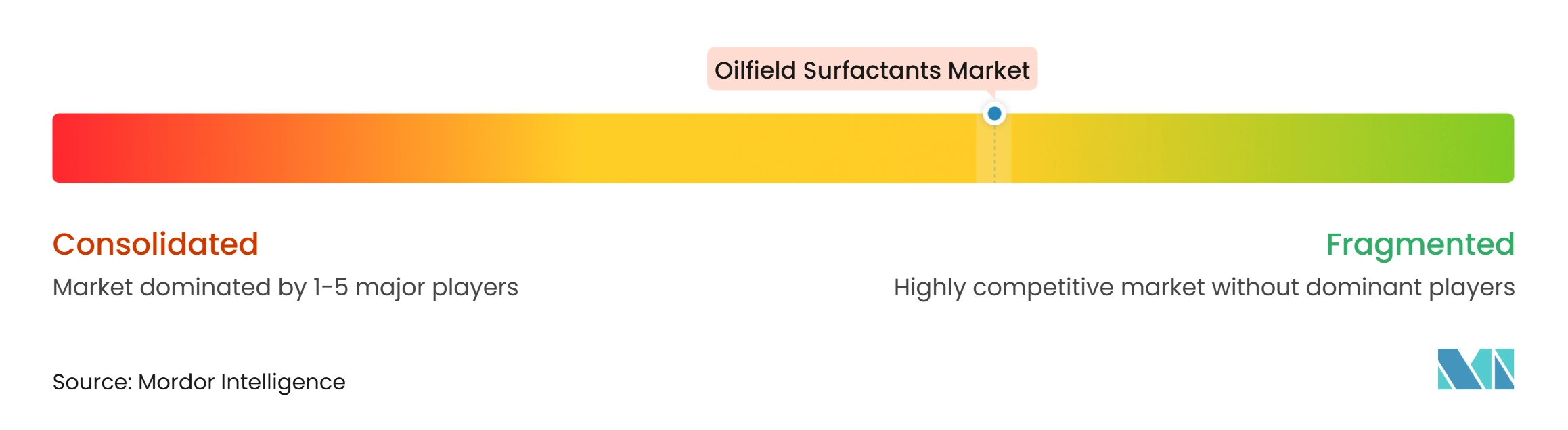
The oilfield surfactants market is moderately consolidated among large service and chemical suppliers, while regional and specialized application segments remain fragmented. SLB completed its acquisition of ChampionX in July 2025, combining production chemistry, flow assurance, monitoring, and EOR capabilities on a single platform. This transaction prompted large operators to evaluate suppliers through integrated service contracts rather than on a product-by-product basis. Halliburton divested its Multi-Chem chemical business to Sterling Specialty Chemicals under Praana Group in May 2026. Syensqo sold its Oil and Gas Business Unit to SNF Group for EUR 135 million in January 2026.
Product certification and application-specific formulation work remain important means for suppliers to defend their market positions. Clariant introduced its Phasetreat Nan aromatic-solvent-free nano-emulsion demulsifier and launched the ClariHub digital portal in September 2025, combining product differentiation with digital customer support. In deepwater applications, API 17TR5 and API 17TR6 certification can restrict participation to companies with qualified products and accredited testing capability, creating a structural advantage for established suppliers in high-specification subsea contracts.
Opportunities remain in bio-based supply, EOR field validation, and connected chemical dosing tools, with no supplier having established a dominant position across these emerging areas. Larger companies can serve high-output recovery projects, while focused formulators can compete on reservoir-specific performance and local technical service. The oilfield surfactants market rewards field-proven performance, regulatory readiness, and reliable support throughout a producing asset's life.
Oilfield Surfactants Industry Leaders
-
SLB
-
Halliburton
-
Baker Hughes Company
-
CLARIANT
-
BASF
- *Disclaimer: Major Players sorted in no particular order
Oilfield Surfactants Market Companies Covered in this Report
- Baker Hughes Company
- BASF
- CLARIANT
- Croda International Plc
- Dow
- Evonik Industries AG
- Halliburton
- Huntsman International LLC
- Innospec
- Lubrizol
- Nouryon
- Sasol
- SLB
- Solvay
- Stepan Company
Recent Industry Developments in Oilfield Surfactants Market
- November 2026: SLB launched its ChampionX nano-enabled chemical technology portfolio at ADIPEC in Abu Dhabi, combining engineered nanomaterials with production chemicals to address scale, corrosion, paraffin, and heavy oil recovery in mature wells. The Extended Release nano-enabled scale squeeze treatment delivered more than twice the treatment life of conventional treatments in offshore oilfield surfactant applications.
- May 2026: Praana Group acquired Halliburton's Multi-Chem chemical business on May 4, 2026, integrating it as Sterling Multi-Chem within the Sterling Specialty Chemicals platform. Multi-Chem operates five manufacturing facilities across the United States and the Middle East, including the Desert Rose plant in Jubail, Saudi Arabia, adding oilfield surfactant production capacity to Praana's specialty chemicals portfolio.
Global Oilfield Surfactants Market Report Scope
Oilfield surfactants are amphiphilic organic compounds that contain both hydrophilic (water-attracting) and hydrophobic (water-repelling) groups. These compounds adsorb at fluid interfaces to reduce surface and interfacial tension. They are used across multiple upstream and downstream oil and gas operations, including drilling, cementing, enhanced oil recovery, and production.
The oilfield surfactants market is segmented by product type, source, application, and geography. By product type, the market is segmented into anionic surfactants, nonionic surfactants, cationic surfactants, amphoteric surfactants, and other product types. By source, the market is segmented into synthetic surfactants and bio-based surfactants. By application, the market is segmented into enhanced oil recovery (EOR), stimulation flowback and fluid recovery, drilling surfactants, production chemicals, and other applications. The report also covers market sizes and forecasts for oilfield surfactants across 15 countries in major regions. The market sizes and forecasts are provided in terms of value (USD).
Segmentation Overview
| Anionic Surfactants |
| Nonionic Surfactants |
| Cationic Surfactants |
| Amphoteric Surfactants |
| Other Product Types |
| Synthetic Surfactants |
| Bio-Based Surfactants |
| Enhanced Oil Recovery (EOR) |
| Stimulation Flowback and Fluid Recovery |
| Drilling Surfactants |
| Production Chemicals |
| Other Applications |
| Asia-Pacific | China |
| India | |
| Japan | |
| South Korea | |
| ASEAN Countries | |
| Rest of Asia-Pacific | |
| North America | United States |
| Canada | |
| Mexico | |
| Europe | Germany |
| United Kingdom | |
| France | |
| Italy | |
| NORDIC Countries | |
| Russia | |
| Rest of Europe | |
| South America | Brazil |
| Argentina | |
| Rest of South America | |
| Middle East and Africa | Saudi Arabia |
| United Arab Emirates | |
| South Africa | |
| Rest of Middle East and Africa |
| By Product Type | Anionic Surfactants | |
| Nonionic Surfactants | ||
| Cationic Surfactants | ||
| Amphoteric Surfactants | ||
| Other Product Types | ||
| By Source | Synthetic Surfactants | |
| Bio-Based Surfactants | ||
| By Application | Enhanced Oil Recovery (EOR) | |
| Stimulation Flowback and Fluid Recovery | ||
| Drilling Surfactants | ||
| Production Chemicals | ||
| Other Applications | ||
| By Geography | Asia-Pacific | China |
| India | ||
| Japan | ||
| South Korea | ||
| ASEAN Countries | ||
| Rest of Asia-Pacific | ||
| North America | United States | |
| Canada | ||
| Mexico | ||
| Europe | Germany | |
| United Kingdom | ||
| France | ||
| Italy | ||
| NORDIC Countries | ||
| Russia | ||
| Rest of Europe | ||
| South America | Brazil | |
| Argentina | ||
| Rest of South America | ||
| Middle East and Africa | Saudi Arabia | |
| United Arab Emirates | ||
| South Africa | ||
| Rest of Middle East and Africa | ||
Key Questions Answered in the Report
What is current market size of Oilfield Surfactants Market?
The Oilfield Surfactants Market size was valued at USD 3.25 billion in 2026 and is estimated to grow from USD 3.38 billion in 2027 to USD 4.19 billion by 2032, at a CAGR of 4.34% during the forecast period (2027-2032).
Why is Enhanced Oil Recovery (EOR) important for oilfield surfactant suppliers?
EOR accounts for a 38.51% share in 2026 and has the highest Oilfield Surfactants Market growth rate at a 5.47% CAGR, supported by large chemical recovery programs.
Which region is growing fastest for oilfield surfactants?
Asia-Pacific is projected to grow at a 5.33% CAGR through 2032 as state-owned oil companies in China and India expand chemical EOR programs.
What limits wider use of bio-based surfactants in oilfields?
Bio-based surfactants must demonstrate reliable performance under actual reservoir conditions, even though the segment is forecast to grow at a 5.12% CAGR.