
Offshore Lubricants Market Size and Share
Market Overview
| Study Period | 2022 - 2032 |
|---|---|
| Market Size (2027) | USD 196.53 Million |
| Market Size (2032) | USD 214.89 Million |
| Growth Rate (2027 - 2032) | 3.64 % |
| Fastest Growing Market | North America |
| Largest Market | Asia-Pacific |
| Market Concentration | Medium |
Major Players *Disclaimer: Major Players sorted in no particular order Image © Mordor Intelligence. Reuse requires attribution under CC BY 4.0. | |
Offshore Lubricants Market Analysis by Mordor Intelligence
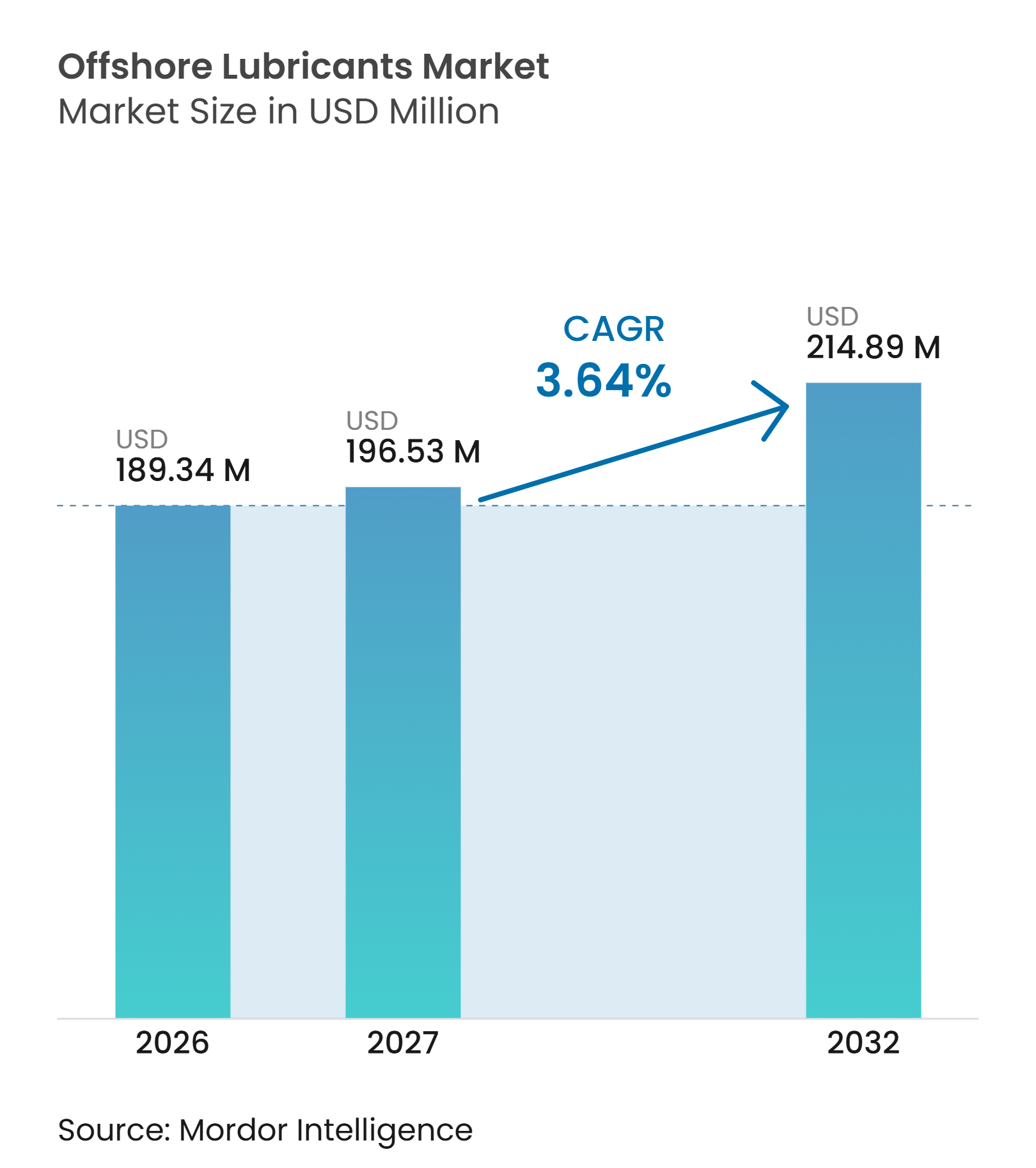
The Offshore Lubricants Market size is expected to grow from USD 189.34 million in 2026 to USD 196.53 million in 2027 and is forecast to reach USD 214.89 million by 2032 at a 3.64% CAGR over 2027-2032. The global offshore lubricants market is supported by deepwater oil and gas activity and the installation of offshore wind assets. These demand sources have different operating cycles, which helps suppliers balance exposure to changes in oil prices. Offshore operators are also placing more value on products that protect equipment, meet environmental rules, and remain available at remote sites. The global offshore lubricants market, therefore, favors suppliers with approved products, dependable distribution, and technical support for long service periods.
Key Report Takeaways
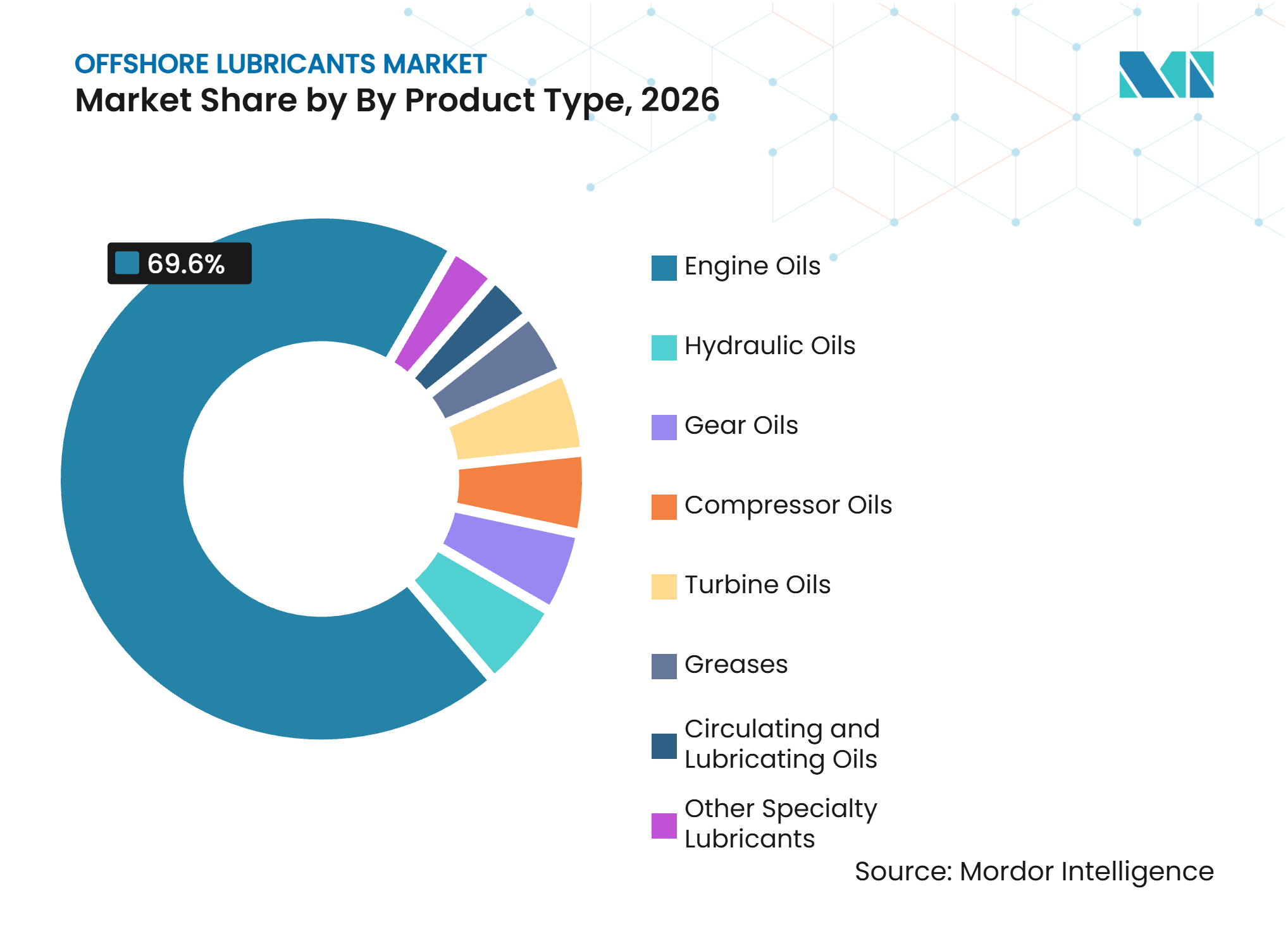
- By product type, engine oils held a 69.6% share in 2026, while greases are projected to record the highest CAGR of 4.3% through 2032.
- By offshore asset, offshore support vessels held a 45.5% share in 2026, while FPSO units are projected to record the highest CAGR of 4.9% through 2032.
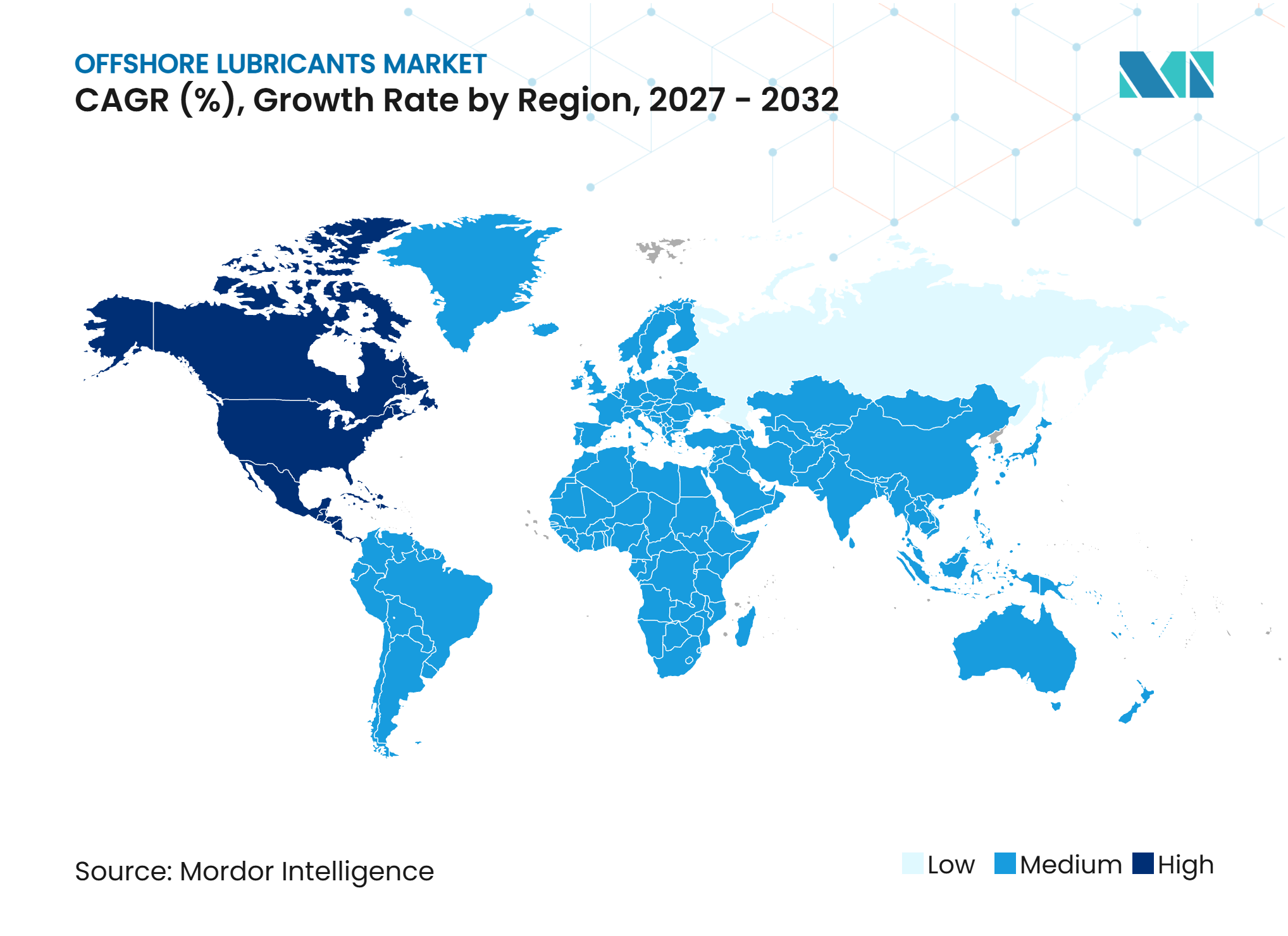
- By geography, Asia-Pacific held a 26.3% share in 2026, while North America is projected to record the highest CAGR of 4.1% through 2032.
Note: Market numbers in this report are based on Mordor Intelligence's proprietary estimation framework, which combines nine months of actuals with Q4 projections for base year 2026.
Market Trends and Insights
Drivers Impact Analysis of Offshore Lubricants Market*
| Driver | (~) % Impact on CAGR Forecast | Geographic Relevance | Impact Timeline |
|---|---|---|---|
| Deepwater and Ultra-Deepwater Asset Development | +1.0% | Global; highest in Latin America, West Africa, Southeast Asia | Medium term (2–4 years) |
| Offshore Wind Turbine and Installation-Fleet Expansion | +0.8% | Europe, APAC (China, South Korea), North America East Coast | Medium term (2–4 years) |
| EAL Adoption at Oil-to-Sea Interfaces | +0.6% | Global; US-led, EU follow-on | Short term (≤ 2 years) |
| Aging-Asset Life Extension and Reliability Spending | +0.5% | Global; highest in MEA and Southeast Asia | Short term (≤ 2 years) |
| OEM-Approved High-Performance Lubricants for Remote Assets | +0.4% | Global; highest in APAC and MEA | Medium–Long term (≥ 2 years) |
| Subsea Tiebacks and Electrified Offshore Systems | +0.3% | North Sea, Gulf of Mexico, Brazil | Long term (≥ 4 years) |
| Source: Mordor Intelligence | |||
Deepwater and Ultra-Deepwater Asset Development
Deepwater development supports the global offshore lubricants market because equipment at great water depths operates under demanding pressure and temperature conditions. These installations need lubricants that retain viscosity and carry loads reliably during long drilling campaigns. In March 2025, SLB received a contract from Woodside Energy for 18 ultra-deepwater wells at Trion offshore Mexico, with services scheduled to begin in early 2026 at depths of up to 2,500 meters. In January 2025, SLB also received Shell contracts covering deepwater work in the United Kingdom North Sea, Trinidad and Tobago, and the Gulf of Mexico.[1] Drillships and semisubmersible rigs cannot risk lubricant failures during multi-year programs, so equipment approvals are commonly set before work begins. This process gives suppliers of premium synthetic products an advantage because lower-specification alternatives may not meet the required operating and approval standards.
EAL Adoption at Oil-to-Sea Interfaces
Environmentally acceptable lubricants, known as EALs, are becoming more important in the global offshore lubricants market as environmental requirements extend to more equipment. The United States Environmental Protection Agency finalized national standards in October 2024 that require EALs at oil-to-sea interfaces and include above-deck equipment where lubricant loss may occur.[2] The wider definition covers components such as stern-tube seals, deck-crane slewing rings, and pitch-control drives. A 2025 review in the ASME Journal of Tribology found that stern-tube EAL adoption had been affected by past compatibility concerns, showing that product reliability remains important even where regulations require use.[3] Suppliers, therefore, need both certification and evidence that their formulations work reliably in the required equipment. This requirement raises the importance of testing, equipment compatibility, and documented performance in supplier selection.
Offshore Wind Turbine and Installation-Fleet Expansion
Offshore wind creates a separate demand source for the global offshore lubricants market that is not tied directly to oil price movements. Turbine gearboxes, pitch-control systems, and slewing drives need products that resist water washout, protect against corrosion, and work with automatic lubrication systems. Castrol reported in May 2025 that its low-friction gear oil increased mean annual energy production by 1.09% at wind speeds where lubrication affects turbine output.[4] This performance link makes lubricant selection relevant to turbine availability and power output, rather than only to maintenance cost. Offshore wind projects are also planned under long-term power arrangements, which can make their lubricant requirements easier to schedule than short-cycle oil and gas work. Suppliers that obtain turbine manufacturer approvals early may be better placed as offshore wind installations move from pilot activity to larger commercial projects.
Aging-Asset Life Extension and Reliability Spending
The aging of offshore vessels and production equipment supports demand for higher-performance lubricants in the global offshore lubricants market. Older equipment can face higher bearing wear, seal degradation, and greater risk of unplanned downtime. Operators extending an asset beyond its original design life may place more weight on reliable lubricant performance than on the lowest purchase price. This is especially relevant where vessels operate under long-term contracts and equipment availability is closely watched by the chartering customer. The operating environment in the Middle East, Africa, and Southeast Asia makes reliable protection important for vessels working in humid and saline conditions. As a result, life-extension work can shift lubricant purchasing toward approved products with stronger technical support and documented reliability.
Restraints Impact Analysis of Offshore Lubricants Market*
| Restraint | (~) % Impact on CAGR Forecast | Geographic Relevance | Impact Timeline |
|---|---|---|---|
| Premium Cost of Synthetic and Environmentally Acceptable Lubricants | -0.7% | Global; highest in cost-sensitive APAC and MEA markets | Short–Medium term (1–4 years) |
| Longer Drain Intervals and Condition-Based Top-Up Reduction | -0.5% | Global; highest in North Sea, Gulf of Mexico fleets | Short term (≤ 2 years) |
| Compatibility Testing, OEM Approval Cycles, and Retrofit Risk | -0.4% | Global | Medium–Long term (≥ 2 years) |
| Remote-Site Logistics and Emergency Delivery Constraints | -0.3% | West Africa, South America frontier, Arctic | Medium term (2–4 years) |
| Source: Mordor Intelligence | |||
Premium Cost of Synthetic and Environmentally Acceptable Lubricants
The higher cost of synthetic and biodegradable products limits adoption in parts of the global offshore lubricants market. Products certified under programs such as OSPAR, Blue Angel, and Nordic Swan use readily biodegradable synthetic esters instead of mineral base stocks. Testing, certification, and specialized base oils add cost for both suppliers and buyers. The price difference is difficult for operators to accept when local enforcement is less strict or contracts are awarded primarily on cost. Fixed-term supply agreements can also limit a producer’s ability to pass through changes in synthetic base-oil costs. The result is a split pattern, with stronger EAL uptake in regulated United States and European waters and slower replacement in price-sensitive areas.
Longer Drain Intervals and Condition-Based Top-Up Reduction
Condition-based maintenance reduces the volume of lubricant used by each operating asset in the global offshore lubricants market. Remote monitoring allows maintenance teams to change oil when test results indicate degradation rather than following a fixed schedule. ExxonMobil’s Mobil Serv Lubricant Analysis and Shell’s Remote Sense system illustrate the use of digital monitoring to support maintenance decisions for remote equipment. Longer drain intervals can reduce downtime and waste, which provides a clear benefit to an operator. They also reduce top-up and replacement volumes, even when the total number of offshore assets rises. Premium suppliers face this tradeoff because better product durability can support a contract win while reducing the product volume purchased over the life of that contract.
*Our forecasts treat driver/restraint impacts as directional, not additive. The impact forecasts reflect baseline growth, mix effects, and variable interactions.
Offshore Lubricants Market Segment Analysis
By Product Type:
Engine Oils Lead Demand While Greases Gain Ground in RenewablesEngine oils account for 69.6% of the global offshore lubricants market share in 2026, making them the leading product category. Support vessels, drilling rigs, and production platforms use marine diesel engines and generators for propulsion and power generation. These machines need regular fills and top-ups, which creates a recurring demand base. Hydraulic oils, gear oils, compressor oils, turbine oils, and circulating oils serve other equipment across the same assets. Turbine oils are gaining relevance as wind installations expand because pitch and yaw systems work continuously in humid and salt-spray conditions. Circulating and lubricating oils serve pumps and compressors in subsea systems, where tieback projects can increase system complexity.
Greases are forecast to expand at a CAGR of 4.3% through 2032, the highest rate within the product categories. Their use is increasing in offshore wind turbines, particularly in open gears, pitch-control mechanisms, and slewing bearings. These applications need high adhesion and resistance to water, and they can use centralized systems that deliver small quantities at controlled intervals. FUCHS Lubricants Norway offers JACK UP GREASE BIO for rack-and-pinion and slewing applications and identifies the product as compliant with HOCNF requirements. Klüber Lubrication describes KLÜBERBIO GE 32-681 as an EAL product for open gears in marine and renewable-energy environments. These products show why equipment-specific performance and environmental approval matter more as renewable offshore equipment is added.



By Offshore Asset:
OSVs Provide the Volume Base While FPSO Units Grow FastestOffshore support vessels hold 45.5% of the global offshore lubricants market share in 2026, supported by their role in transport, supply, anchor handling, and offshore logistics. Their engines, generators, deck equipment, and hydraulic systems create regular lubricant requirements. Vessel activity also drives repeat purchases because operating schedules determine engine hours and maintenance needs. Drilling rigs form another important source of demand during active drilling programs. Production platforms require lubricants to support continuous operations and avoid disruption to production. The large number of equipment systems on these assets favors suppliers that can provide several product types through a single service network.
FPSO units are projected to expand at a CAGR of 4.9% from 2027 to 2032, the fastest rate among offshore asset types. In May 2026, SBM Offshore signed contracts with Petrobras for the SEAP-I and SEAP-II FPSOs in Brazil’s Sergipe-Alagoas basin. Each unit is designed to produce 120,000 barrels of oil per day at water depths of 2,500 meters, with delivery planned for 2030 and 2031. An FPSO requires multiple lubricant types for turbines, compressors, generators, cranes, and deck systems. This broad requirement makes each new unit commercially relevant for suppliers with approved products and the ability to support commissioning and long-term operations. Wind installations and FSO units remain smaller asset groups, but they add additional applications as offshore energy infrastructure expands.
Geography Analysis
Asia-Pacific accounts for 26.3% of the global offshore lubricants market size in 2026, the largest regional position. The region combines offshore oil and gas activity with a large support-vessel base and growing offshore wind capacity. China, Indonesia, Malaysia, and Vietnam remain relevant because offshore projects in these countries need vessel, drilling, and production support. Product approval requirements are also becoming more important for production-sharing assets in Indonesia and Malaysia. This creates a higher barrier for suppliers that do not have international certifications or established technical support.
North America is projected to grow at a CAGR of 4.1% through 2032, the fastest regional rate in the global offshore lubricants market. Deepwater work in the Gulf of Mexico supports demand for lubricants used in drilling, vessel operations, and production equipment. In September 2025, BW Offshore signed a Head of Agreement with Equinor for the Bay du Nord FPSO offshore Newfoundland, which is designed to produce up to 160,000 barrels of oil per day in sub-Arctic conditions. United States rules on vessel discharges also make EAL adoption more important in this region. This creates a favorable setting for suppliers with certified products and evidence of equipment compatibility.
Europe and the Middle East and Africa remain meaningful parts of the global offshore lubricants market because both regions have sustained offshore operating needs. North Sea operators require reliable products for mature infrastructure and work within established environmental standards. FUCHS Lubricants Norway is registered through EPIM JQS and Achilles JQS, reflecting the supplier qualification expected in Norwegian offshore work. The Middle East and Africa are supported by national oil company activity and fleets serving shallow-water and deepwater assets. Brazil also contributes to South American demand through Petrobras projects in the Santos and Sergipe-Alagoas basins. These regions need suppliers that can manage delivery, approvals, and technical service across distant offshore locations.
Competitive Landscape
Market Concentration
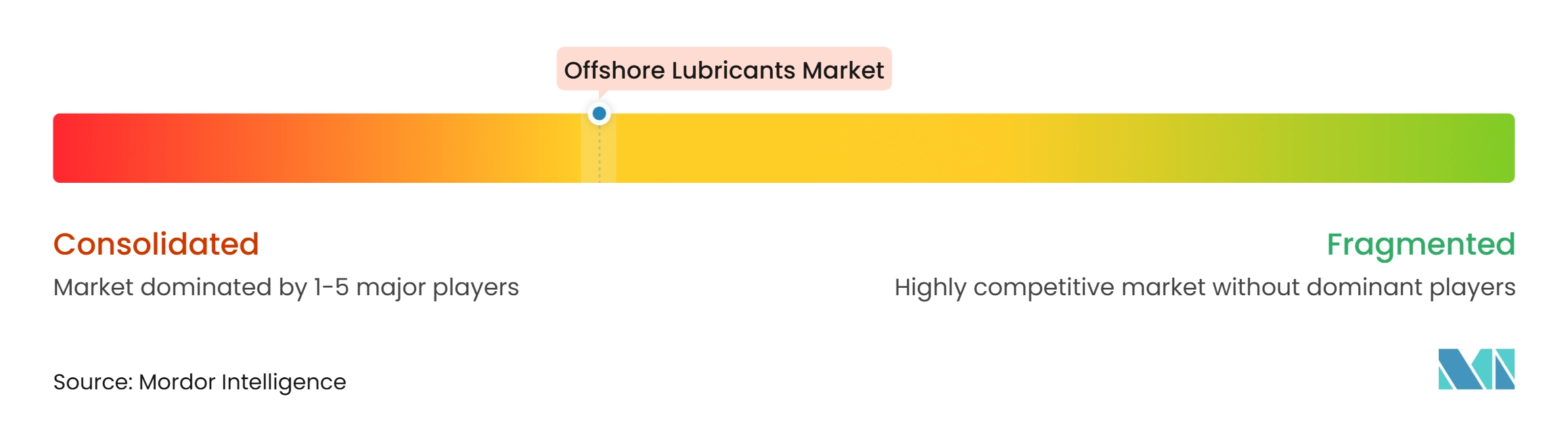
The global offshore lubricants market is moderately consolidated, with Shell, ExxonMobil, Chevron, TotalEnergies, and bp holding important positions through broad supply networks and established customer relationships. Their advantage comes from reliable supply across dispersed offshore locations as well as from product portfolios and equipment approvals. Offshore customers working under multi-year contracts place a high value on avoiding supply interruptions. FUCHS SE and Klüber Lubrication compete through specialty formulations, particularly in biodegradable and EAL-certified products. Their position is supported by the time and testing required to meet equipment and environmental approval standards.
FUCHS SE agreed in February 2026 to acquire OPET’s 50% share in the OPET FUCHS joint venture, taking full ownership of the business that was to be renamed FUCHS Lubricants Türkiye. The move gives FUCHS a wholly owned regional platform in a location important to offshore and industrial lubricant supply. In August 2025, Chevron Marine Lubricants and Closelink marked 1 year of integrated automated order handling across the marine lubricants procurement chain. This shows how procurement systems can strengthen supplier relationships beyond the lubricant product. TotalEnergies Lubmarine also expanded its service approach in November 2025 by using a hybrid lubricants bunkering barge at Fujairah, a major offshore supply corridor.
Technology is becoming more relevant to competition in the global offshore lubricants market because customers want to reduce downtime and manage maintenance remotely. ExxonMobil’s lubricant analysis services and Shell’s remote oil-condition monitoring support maintenance decisions based on equipment condition. Automated lubrication systems also support more accurate delivery in difficult areas of jack-up rigs and other offshore equipment. Asian suppliers including Idemitsu Kosan, ENEOS, PetroChina, and Sinopec Lubricant Company have a regional advantage through supply proximity and national oil company procurement relationships. Competition is therefore shaped by formulation quality, environmental compliance, digital service, and distribution coverage. The opportunity lies in combining certified EAL products with dependable condition monitoring in a single service offer.
Offshore Lubricants Industry Leaders
-
Shell plc
-
Exxon Mobil Corporation
-
Chevron Corporation
-
TotalEnergies SE
-
BP p.l.c.
- *Disclaimer: Major Players sorted in no particular order
Offshore Lubricants Market Companies Covered in this Report
- Afton Chemical Corporation
- bp p.l.c.
- Castrol Limited
- Chevron Corporation
- ENEOS Corporation
- Exxon Mobil Corporation
- FUCHS SE
- Gulf Oil International Ltd.
- Idemitsu Kosan Co., Ltd.
- Kl�ber Lubrication M�nchen GmbH & Co. KG
- Lubrizol Corporation
- LUKOIL
- PetroChina Company Limited
- Petronas Lubricants International Sdn. Bhd.
- Repsol S.A.
- Shell plc
- Sinopec Lubricant Company
- TotalEnergies SE
- Valvoline Inc
Recent Industry Developments in Offshore Lubricants Market
- September 2026: TotalEnergies Lubmarine launched Aurelia FE, a new trunk piston engine oil for 4-stroke medium-speed marine engines, claiming fuel savings of 1.5% on a standardized test cycle with no vessel modifications required. The launch targets offshore support vessel operators where fuel cost is a primary operating burden. It is directly relevant to operators that want to reduce fuel use without changing vessel hardware or maintenance routines.
- May 2026: SBM Offshore signed contracts with Petrobras for 2 FPSOs in Brazil’s Sergipe-Alagoas basin, SEAP-I (P-81) and SEAP-II (P-87). Each is designed for 120,000 barrels per day at 2,500 meters water depth, with deliveries in 2030 and 2031 respectively. The units add long-term requirements for lubricants used in power generation, compression, lifting, and deck systems.
- February 2026: FUCHS SE signed an agreement to acquire OPET’s 50% stake in their OPET FUCHS joint venture in Istanbul, taking full 100% ownership of the business to be renamed FUCHS Lubricants Türkiye. The transaction was expected to close by the end of April 2026 and strengthens FUCHS’s regional position.
- November 2025: TotalEnergies Marketing Middle East time-chartered a 750-cubic-meter hybrid lubricants bunkering barge at Fujairah from Tristar Group, combining electric and biofuel power to reduce emissions by up to 35%. The barge was positioned to serve vessels in a major offshore supply corridor.
Global Offshore Lubricants Market Report Scope
Offshore lubricants are specialized lubricating fluids and greases formulated to support the operation, maintenance, and protection of machinery and equipment used in offshore environments. These lubricants are designed to withstand demanding operating conditions, including high loads, moisture exposure, saltwater corrosion, temperature variations, and continuous equipment operation. They include hydraulic oils, gear oils, compressor oils, turbine oils, engine oils, greases, circulating and lubricating oils, and other specialty lubricants used in offshore drilling rigs, production platforms, floating production, storage and offloading (FPSO) units, offshore support vessels (OSVs), floating storage and offloading (FSO) units, and offshore wind installations. Offshore lubricants help reduce friction and equipment wear, maintain operational efficiency, protect machinery against corrosion, and support reliable performance in marine and offshore applications. Depending on the equipment and operating environment, these lubricants may incorporate properties such as water resistance, oxidation stability, anti-wear protection, and compatibility with marine operating conditions. Certain offshore applications also require biodegradable or environmentally acceptable lubricants to minimize the potential impact of accidental releases on marine ecosystems.
The Global Offshore Lubricants Market is segmented by product type and offshore asset. By product type, the market is segmented into hydraulic oils, gear oils, compressor oils, turbine oils, engine oils, greases, circulating and lubricating oils, and other specialty lubricants. By offshore asset, the market is segmented into offshore drilling rigs, offshore production platforms, floating production, storage and offloading (FPSO) units, offshore support vessels (OSVs), floating storage and offloading (FSO) units, offshore wind installations, and other offshore assets. The report also covers the market size and forecasts for the global offshore lubricants market across 26 countries in key regions. For each segment, market sizing and forecasts are provided on the basis of value (USD).
Segmentation Overview
| Hydraulic Oils |
| Gear Oils |
| Compressor Oils |
| Turbine Oils |
| Engine Oils |
| Greases |
| Circulating and Lubricating Oils |
| Other Specialty Lubricants |
| Offshore Drilling Rigs |
| Offshore Production Platforms |
| Floating Production, Storage and Offloading (FPSO) Units |
| Offshore Support Vessels (OSVs) |
| Floating Storage and Offloading (FSO) Units |
| Offshore Wind Installations |
| Other Offshore Assets |
| North America | United States |
| Canada | |
| Mexico | |
| Europe | Germany |
| France | |
| Italy | |
| Spain | |
| United Kingdom | |
| Norway | |
| Netherlands | |
| Russia | |
| Rest of Europe | |
| Asia-Pacific | China |
| India | |
| Japan | |
| South Korea | |
| Australia | |
| Indonesia | |
| Malaysia | |
| Rest of Asia-Pacific | |
| South America | Brazil |
| Argentina | |
| Colombia | |
| Ecuador | |
| Rest of South America | |
| Middle East and Africa | Saudi Arabia |
| United Arab Emirates | |
| Qatar | |
| Kuwait | |
| Oman | |
| Egypt | |
| Nigeria | |
| Rest of Middle East and Africa |
| By Product Type | Hydraulic Oils | |
| Gear Oils | ||
| Compressor Oils | ||
| Turbine Oils | ||
| Engine Oils | ||
| Greases | ||
| Circulating and Lubricating Oils | ||
| Other Specialty Lubricants | ||
| By Offshore Asset | Offshore Drilling Rigs | |
| Offshore Production Platforms | ||
| Floating Production, Storage and Offloading (FPSO) Units | ||
| Offshore Support Vessels (OSVs) | ||
| Floating Storage and Offloading (FSO) Units | ||
| Offshore Wind Installations | ||
| Other Offshore Assets | ||
| By Geography | North America | United States |
| Canada | ||
| Mexico | ||
| Europe | Germany | |
| France | ||
| Italy | ||
| Spain | ||
| United Kingdom | ||
| Norway | ||
| Netherlands | ||
| Russia | ||
| Rest of Europe | ||
| Asia-Pacific | China | |
| India | ||
| Japan | ||
| South Korea | ||
| Australia | ||
| Indonesia | ||
| Malaysia | ||
| Rest of Asia-Pacific | ||
| South America | Brazil | |
| Argentina | ||
| Colombia | ||
| Ecuador | ||
| Rest of South America | ||
| Middle East and Africa | Saudi Arabia | |
| United Arab Emirates | ||
| Qatar | ||
| Kuwait | ||
| Oman | ||
| Egypt | ||
| Nigeria | ||
| Rest of Middle East and Africa | ||
Key Questions Answered in the Report
What is the forecast growth rate for global offshore lubricants?
The global offshore lubricants market is projected to grow at a CAGR of 3.64% from 2027 to 2032, reaching USD 214.89 million by 2032.
Which product category has the largest offshore lubricant demand?
Engine oils lead demand in the global offshore lubricants market, and the global offshore lubricants market relies on vessel, rig, and platform diesel engines and generators. The segment held 69.6% in 2026.
Which offshore asset will drive the fastest demand growth?
FPSO units are projected to grow at a 4.9% CAGR through 2032 in the global offshore lubricants market. The global offshore lubricants market benefits when new units need several lubricant types.
Why are environmentally acceptable lubricants important for offshore operators?
United States discharge standards require EALs at oil-to-sea interfaces, including certain above-deck equipment, which increases the need for approved formulations.
Which region leads demand and which grows fastest?
Asia-Pacific holds the largest 2026 share at 26.3%, while North America is projected to grow fastest at a 4.1% CAGR through 2032. These patterns guide service planning, inventory placement, and procurement in the global offshore lubricants market.
How do longer drain intervals affect lubricant suppliers?
Condition monitoring can reduce replacement and top-up volumes per asset, even as it helps suppliers demonstrate product performance, limit downtime, and retain longer-term contracts.