
Off Highway Vehicles Market Size and Share
Market Overview
| Study Period | 2020 - 2032 |
|---|---|
| Market Size (2027) | USD 298.61 Billion |
| Market Size (2032) | USD 379.66 Billion |
| Growth Rate (2027 - 2032) | 4.92 % |
| Fastest Growing Market | Asia-Pacific |
| Largest Market | Asia-Pacific |
| Market Concentration | Low |
Major Players *Disclaimer: Major Players sorted in no particular order Image © Mordor Intelligence. Reuse requires attribution under CC BY 4.0. | |
Off Highway Vehicles Market Analysis by Mordor Intelligence
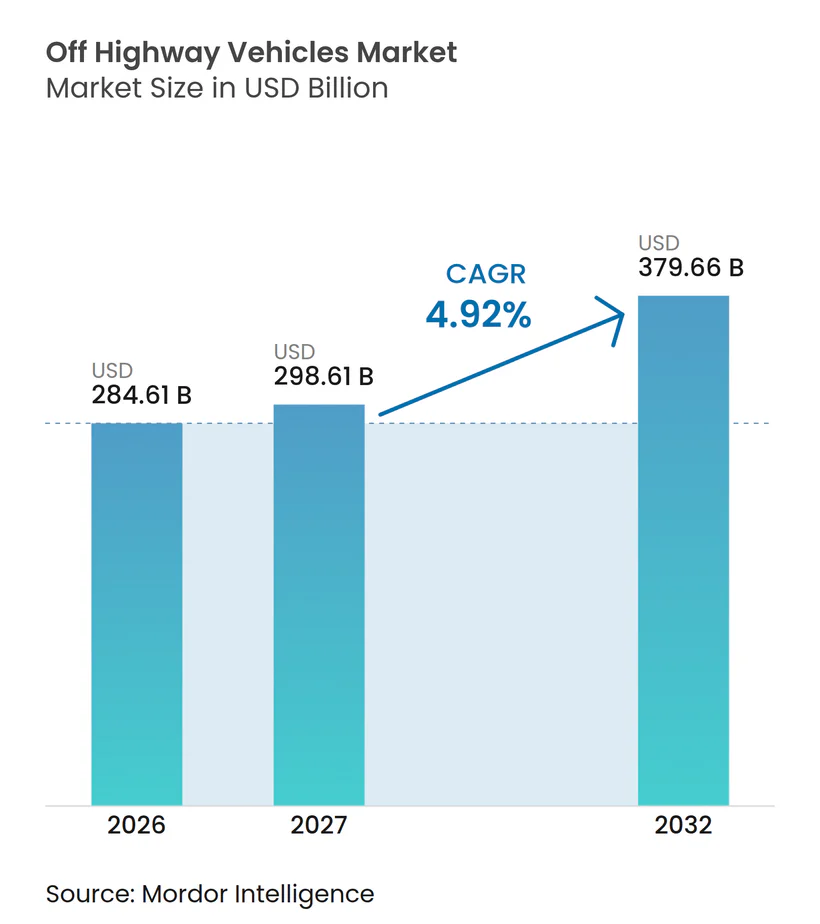
The off-highway vehicles market size was valued at USD 284.61 billion in 2026 and is expected to grow from USD 298.61 billion in 2027 to USD 379.66 billion by 2032, at a CAGR of 4.92% during 2027-2032. The off-highway vehicles market serves construction, agriculture, mining, material handling, and specialized applications, which gives demand more than one source of support. Public infrastructure programs, farm equipment upgrades, and critical-mineral projects are expected to sustain orders across equipment categories. This diversity also limits reliance on a single customer group or investment cycle. Manufacturers are increasingly competing through lifecycle costs, service coverage, digital tools, and machine availability rather than machine capacity alone. Rental providers and large fleet operators are becoming more influential buyers as high equipment prices change how smaller contractors and farmers access machinery.
Key Report Takeaways
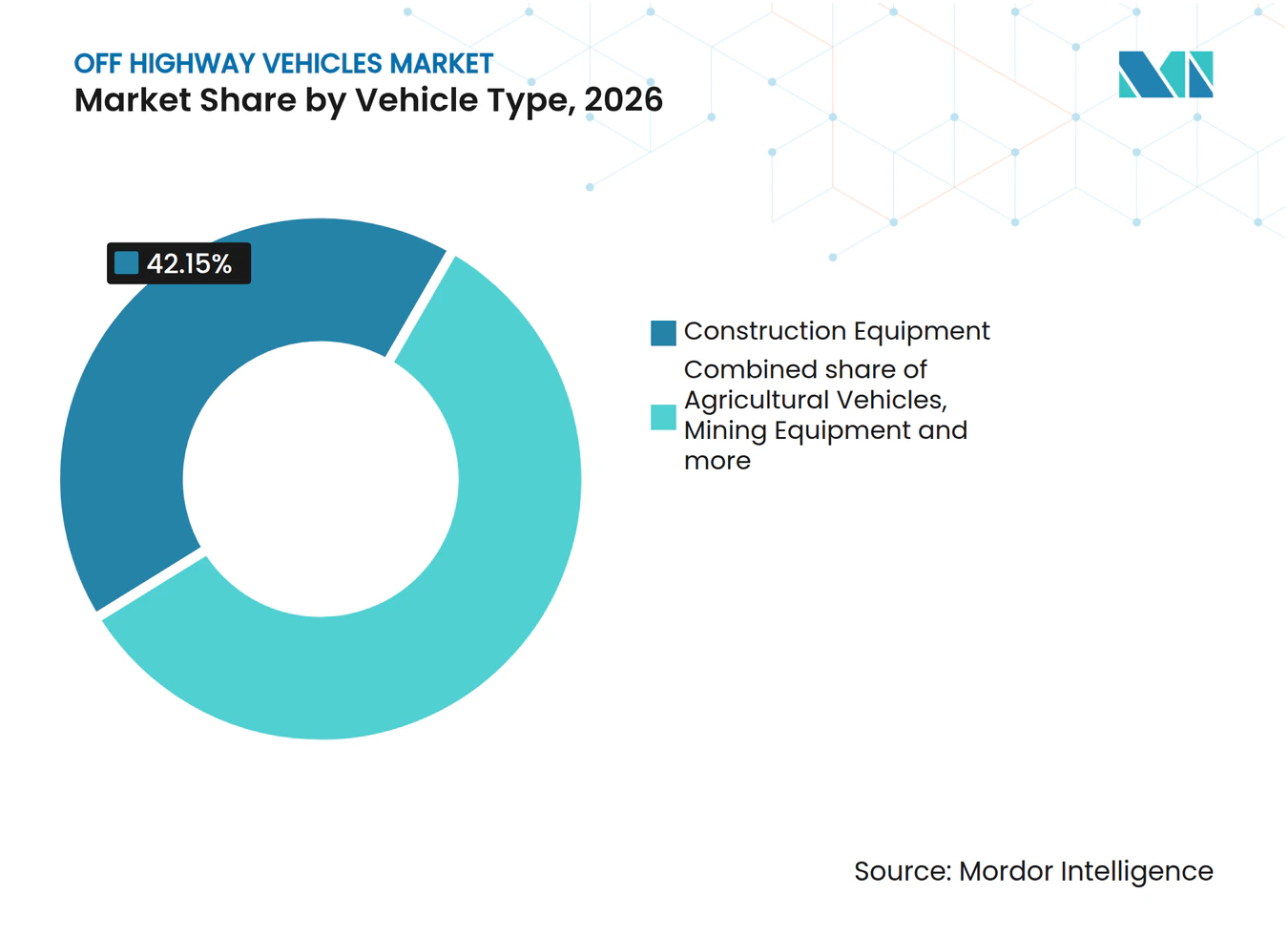
- By vehicle type, construction equipment held a 42.15% share in 2026, while agricultural vehicles are projected to grow at a 6.60% CAGR through 2032.
- By propulsion, internal combustion engine vehicles held a 69.02% share in 2026, while battery electric vehicles are projected to grow at a 15.22% CAGR through 2032.
- By power output, the 100–400 HP segment held a 39.16% share in 2026, while the above 400 HP segment is projected to grow at a 6.04% CAGR through 2032.
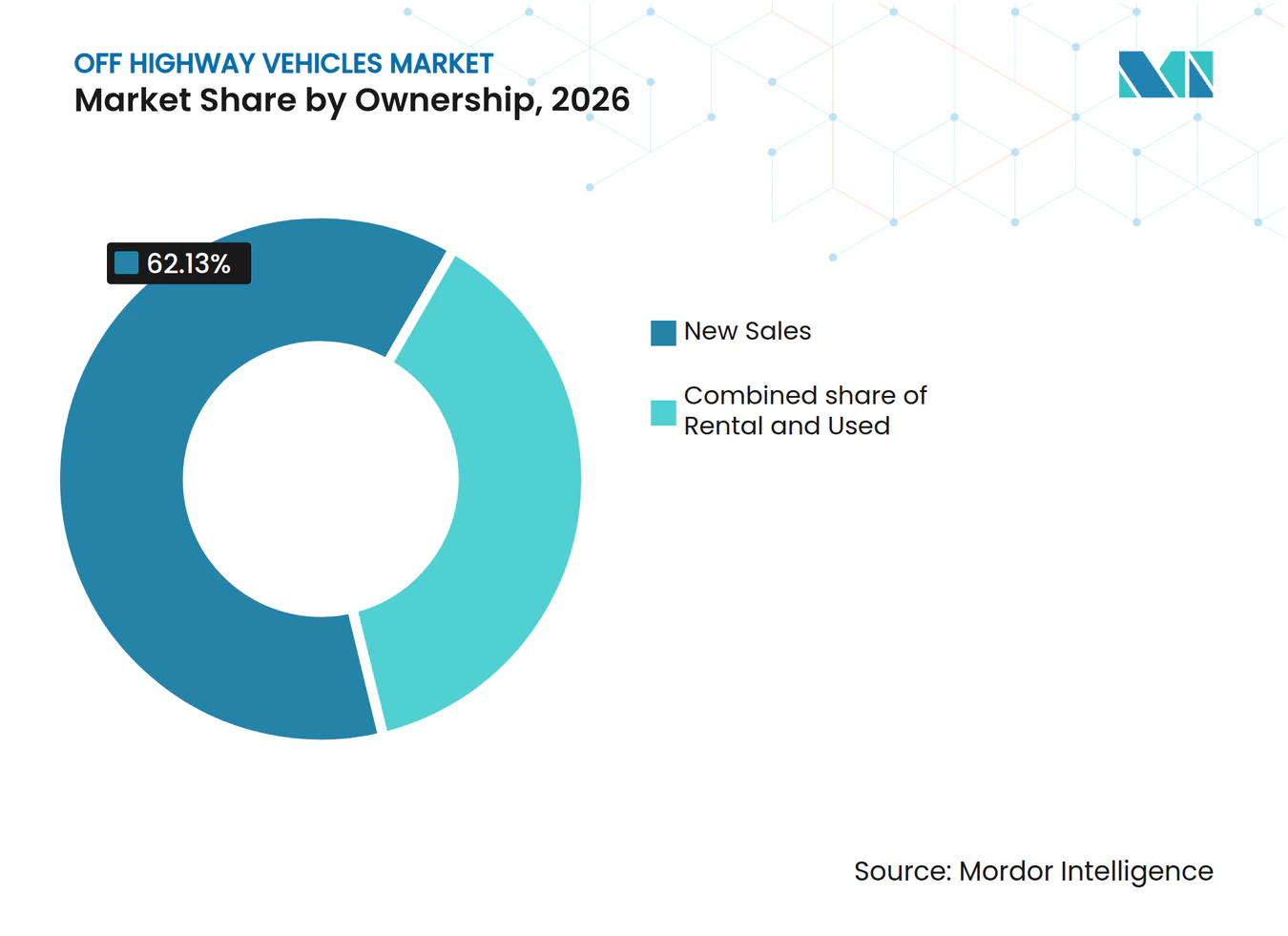
- By ownership, new sales held a 62.13% share in 2026, while rental is projected to grow at an 8.63% CAGR through 2032.
- By end user, construction held a 37.11% share in 2026, while agriculture is projected to grow at a 6.50% CAGR through 2032.
- By geography, Asia-Pacific held a 40.14% share in 2026 and is projected to grow at a 6.50% CAGR through 2032.
Note: Market numbers in this report are based on Mordor Intelligence's proprietary estimation framework, which combines nine months of actuals with Q4 projections for base year 2026.
Market Trends and Insights
Drivers Impact Analysis of Off Highway Vehicles Market*
| Driver | (~) % Impact on CAGR Forecast | Geographic Relevance | Impact Timeline |
|---|---|---|---|
| Infrastructure Investment and Large-Scale Construction Programs | +1.5% | Global, concentrated in Asia-Pacific and North America | Medium term (2–4 years) |
| Agricultural Mechanization and Farm Labor Substitution | +1.2% | Asia-Pacific core, South America, with spillover to Middle East and Africa | Long term (≥ 4 years) |
| Mining Expansion and Critical-Mineral Extraction | +0.8% | South America, Asia-Pacific, Middle East and Africa, and Canada | Long term (≥ 4 years) |
| Demand for Connected, Autonomous, and Productivity-Enhancing Machines | +0.6% | Global, with early penetration in North America and Australia | Medium term (2–4 years) |
| Electrification of Compact and Medium-Duty Equipment | +0.4% | North America and Europe, with early adoption in Asia-Pacific | Medium term (2–4 years) |
| Equipment Demand from Climate-Resilience and Disaster-Recovery Projects | +0.3% | Global, strongest in North America, Asia-Pacific, and Europe | Short term (≤ 2 years) |
| Source: Mordor Intelligence | |||
Infrastructure Investment and Large-Scale Construction Programs
Government-backed infrastructure work supports the off-highway vehicles market because road, bridge, industrial, and urban projects need equipment through several phases of delivery. These projects create demand for earthmoving, lifting, haulage, and material-handling machines over a period that extends beyond the initial commitment. Labor gaps reinforce the value of productive equipment, since the Associated Builders and Contractors projected a shortage of 439,000 construction workers in 2025 [1]. In Indonesia, capital relocation and Strategic Infrastructure Projects support equipment requirements, although demand timing depends on project approvals and implementation. Contractors require machines that can complete repeated work with fewer operators and avoid stoppages that delay project schedules. Equipment makers can respond by prioritizing fleets that reduce fuel use, downtime, and operator effort on long-duration projects.
Agricultural Mechanization and Farm Labor Substitution
Farm mechanization supports the off-highway vehicles market through labor replacement and through investment in more precise field operations. China reported that the comprehensive mechanization rate for crop cultivation, planting, and harvesting reached 76.82% in 2025 [2]. The remaining gap between mechanized farm processes and advanced production systems leaves room for tractors, implements, and harvesting machines. Equipment demand increasingly favors machines that can support guided operation, application control, and repeatable field performance. Kubota and Agtonomy expanded their collaboration in June 2025 to develop autonomous equipment for specialty-crop operations. This approach can raise the value of each machine sold because farmers may select equipment for precision and operating consistency, not only for horsepower.
Mining Expansion and Critical-Mineral Extraction
Mining investment supports demand for large haul trucks, loaders, drills, and support equipment in the off-highway vehicles market. Copper has a more resilient role because it is used across power systems, grids, and electrification projects. Chile imported USD 1.6 billion in U.S. mining equipment in 2025, up 24% from 2024, while copper projects continued to shape equipment requirements[3]. The same cycle can be uneven, as investment in minerals facing surplus supply can weaken rapidly. Suppliers therefore need flexible production plans and broad service networks rather than exposure to one mineral or one mining region.
Demand for Connected, Autonomous, and Productivity-Enhancing Machines
Connected and autonomous machines are moving from trials into operating fleets in selected mining and quarry applications. Epiroc and Hancock Iron Ore announced in October 2025 that Roy Hill had converted its 78 haul trucks to autonomous operation using the LinkOA system. The system is designed to work across mixed fleets, which can reduce the dependence on a single original equipment manufacturer. Komatsu, EARTHBRAIN, and TIER IV began a collaboration in September 2025 to advance autonomous construction equipment for civil engineering and quarry sites in Japan [4]. These deployments make data, remote operation, fleet integration, and local support part of the purchasing decision. The off-highway vehicles market is likely to reward suppliers that can connect machines to measurable improvements in safety, availability, and material movement.
Restraints Impact Analysis of Off Highway Vehicles Market*
| Restraint | (~) % Impact on CAGR Forecast | Geographic Relevance | Impact Timeline |
|---|---|---|---|
| High Acquisition, Financing, and Lifecycle Costs | -0.5% | Global, most acute for small and midsize contractors in Asia-Pacific and Middle East and Africa | Long term (≥ 4 years) |
| Emission-Control and After-Treatment Compliance Costs | -0.4% | Global, with near-term pressure in Europe, India, and China | Short term (≤ 2 years) |
| Charging, Grid-Capacity, and Site-Energy Constraints for Electric Machines | -0.3% | North America, Europe, and Asia-Pacific urban centers, with limited coverage in Middle East and Africa and rural Asia-Pacific | Medium term (2–4 years) |
| Low-Volume Customization and Fragmented Supplier Investment Capacity | -0.2% | Global, strongest in specialty mining and forestry segments | Long term (≥ 4 years) |
| Source: Mordor Intelligence | |||
High Acquisition, Financing, and Lifecycle Costs
High acquisition and financing costs can limit equipment purchases, especially for smaller contractors and farms with uneven project cash flows. This cost pressure favors rental, used equipment, and longer replacement cycles over direct purchases of new machines. Large mining groups, public agencies, and major rental fleets generally have greater access to financing than local contractors and individual farm operators. The resulting gap changes the customer mix of the off-highway vehicles market and increases the influence of fleet buyers. Rental growth therefore reflects a practical response to ownership costs as well as a preference for operating flexibility.
Emission-Control and After-Treatment Compliance Costs
Tighter emissions rules require manufacturers to redesign engines and require customers to absorb higher equipment costs. The International Council on Clean Transportation has estimated that EU Stage V compliance adds incremental engine costs that rise with power class, with the highest additions for machines above 130 kW. Higher-power machines face sizable cost additions, even though they are central to mining and major civil projects. The Association of Equipment Manufacturers has documented the growing complexity of nonroad engine requirements across different markets. Manufacturers must balance these compliance costs with spending on electric, autonomous, and digital platforms. This tension can slow product updates for smaller production runs and specialized machine classes.
*Our forecasts treat driver/restraint impacts as directional, not additive. The impact forecasts reflect baseline growth, mix effects, and variable interactions.
Off Highway Vehicles Market Segment Analysis
By Vehicle Type:
Construction Equipment Provides Scale While Agricultural Vehicles Grow FasterConstruction equipment accounted for 42.15% of the off-highway vehicles market share in 2026. The category includes high-value excavators, articulated dump trucks, graders, and other machines used in large civil works. Its revenue base is supported by the value of major projects as well as the number of units supplied. Construction equipment is required from early excavation through final site work, which gives it a broad role within each project. Caterpillar introduced its next-generation 725, 730, 730 EJ, and 735 articulated dump trucks for production from January 2026. The new models show why construction buyers are looking closely at operating cost, emissions performance, and uptime. Public works programs in the United States, India, Southeast Asia, and the Gulf continue to support this equipment group.
Agricultural vehicles are projected to record a 6.60% CAGR through 2032. Farm labor shortages and the need for more predictable field operations support tractor, harvester, and implement adoption. The segment also benefits when farms move from basic mechanization to guided and automated equipment. China’s 2025 mechanization data indicates that a substantial part of farm activity has already been mechanized, while further adoption potential remains. Kubota’s work with Agtonomy also points to growing interest in autonomous systems for specialty farms. Machinery that improves application accuracy or reduces dependence on seasonal labor can justify a higher purchase price. Mining equipment has a separate demand pattern linked to copper and other mineral projects, while material handling equipment benefits from warehouse and cold-chain activity.



By Propulsion:
Internal Combustion Engines Remain Central While Battery Electric Machines ExpandInternal combustion engine vehicles held 69.02% of the off-highway vehicles market share in 2026. Diesel power remains suited to remote, high-duty-cycle, and multi-shift applications where refueling speed and range are important. This is especially relevant for large mining trucks, heavy earthmoving machines, and equipment that operates far from reliable grid connections. The installed base of diesel machines also gives customers familiar servicing arrangements and established fuel supply practices. Hybrid systems provide a step between conventional engines and fully battery-electric operation in some machine classes. Caterpillar introduced the D8 XE electric-drive dozer in March 2026 and stated that it can use up to 10% less fuel while moving up to 6% more material per hour than the standard D8. This use of electric drive does not require full battery electrification.
Battery electric vehicles are projected to grow at a 15.22% CAGR through 2032. The strongest use cases are compact construction machines and material-handling equipment because those machines often work within controlled sites and predictable shifts. These operating environments allow charging to be planned around breaks, shift changes, or overnight periods. Volvo CE unveiled the A30 Electric and A40 Electric articulated haulers in 2025, with planned availability for selected European customers from 2026. Hydrogen fuel cell systems remain at an early commercial stage, which leaves diesel and electric machines as the main propulsion choices during the forecast period.
By Power Output:
The 100–400 HP Range Has the Broadest Base While High-Power Machines Add ValueThe 100–400 HP segment held 39.16% of the off-highway vehicles market share in 2026. This band covers a large share of excavators, tractors, loaders, and other machines that serve general construction, farming, and mid-scale mining. Its customer base spans municipal contractors, large farms, regional builders, and industrial operators. These uses keep the segment tied to both private investment and public project activity. Demand in this range is influenced by public investment, farm income, replacement cycles, and local financing conditions. Manufacturers must balance durable performance with manageable purchase and operating costs because buyers use these machines in many different settings.
The above 400 HP segment is forecast to expand at a 6.04% CAGR through 2032. Large mining trucks, high-capacity combines, and major earthmoving machines contribute fewer unit sales but high revenue per machine. Komatsu agreed to a USD 440 million equipment contract with Barrick Mining in June 2025 for the Reko Diq copper-gold project in Pakistan. This contract demonstrates the revenue impact of large mining fleets and long project lead times. Large equipment also requires specialist maintenance and operator training, which increases the value of after-sales support. Equipment below 100 HP has lower revenue per unit but is more favorable for early battery-electric adoption.
By Ownership:
New Sales Retain the Largest Base While Rental Gains ImportanceNew sales accounted for 62.13% of the off-highway vehicles market share in 2026. Outright ownership remains common among established fleet operators, mining companies, large farms, and businesses with long asset-use periods. These buyers can spread equipment costs over many years and may require machines with specialized configurations. New machines also give owners direct access to the latest emissions controls, connected features, and manufacturer support. Direct ownership can also make sense where utilization is high, and machines are central to a company’s daily operations.
Rental is projected to expand at an 8.63% CAGR through 2032. Contractors can align equipment expenses with project timing instead of committing capital to machines that may sit idle between jobs. This is relevant in India and Southeast Asia, where small and midsize builders often work on short project cycles. Rental fleets also act as a route to newer technology for customers that could not justify a direct purchase. Rental can also let customers test equipment types before making a long-term investment. Fleet operators consider maintenance, fuel use, operator familiarity, and resale value when selecting equipment. Their purchasing decisions can therefore speed the adoption of efficient or low-maintenance platforms across the off-highway vehicles market.

By End User:
Construction Leads Current Spending While Agriculture Gains MomentumConstruction held 37.11% of the off-highway vehicles market share in 2026. The segment covers public infrastructure, housing, industrial facilities, energy projects, and urban development. Its equipment demand is broad because most projects need site preparation, lifting, material movement, and finishing work. Project duration matters because machines may be required from the first groundworks through the final phase of building activity. Construction customers are also addressing labor shortages through telematics, machine control, and more productive equipment.
Agriculture is forecast to grow at a 6.50% CAGR through 2032. Farmers are adopting machinery not only to offset labor gaps but also to improve timing, precision, and consistency in seeding, cultivation, spraying, and harvesting. Mining demand remains important but varies with commodity prices, permitting, and operator capital budgets. Liebherr finalized a 17-machine supply plan for six Glencore sites in Australia in August 2025, indicating continued fleet renewal in surface mining. Industrial, forestry, defense, and recreation uses add smaller but specialized sources of equipment demand. These uses often require tailored attachments, safety features, or service arrangements. Their contribution broadens the end-user base even when construction and agriculture account for the largest revenue streams.
Geography Analysis
Asia-Pacific
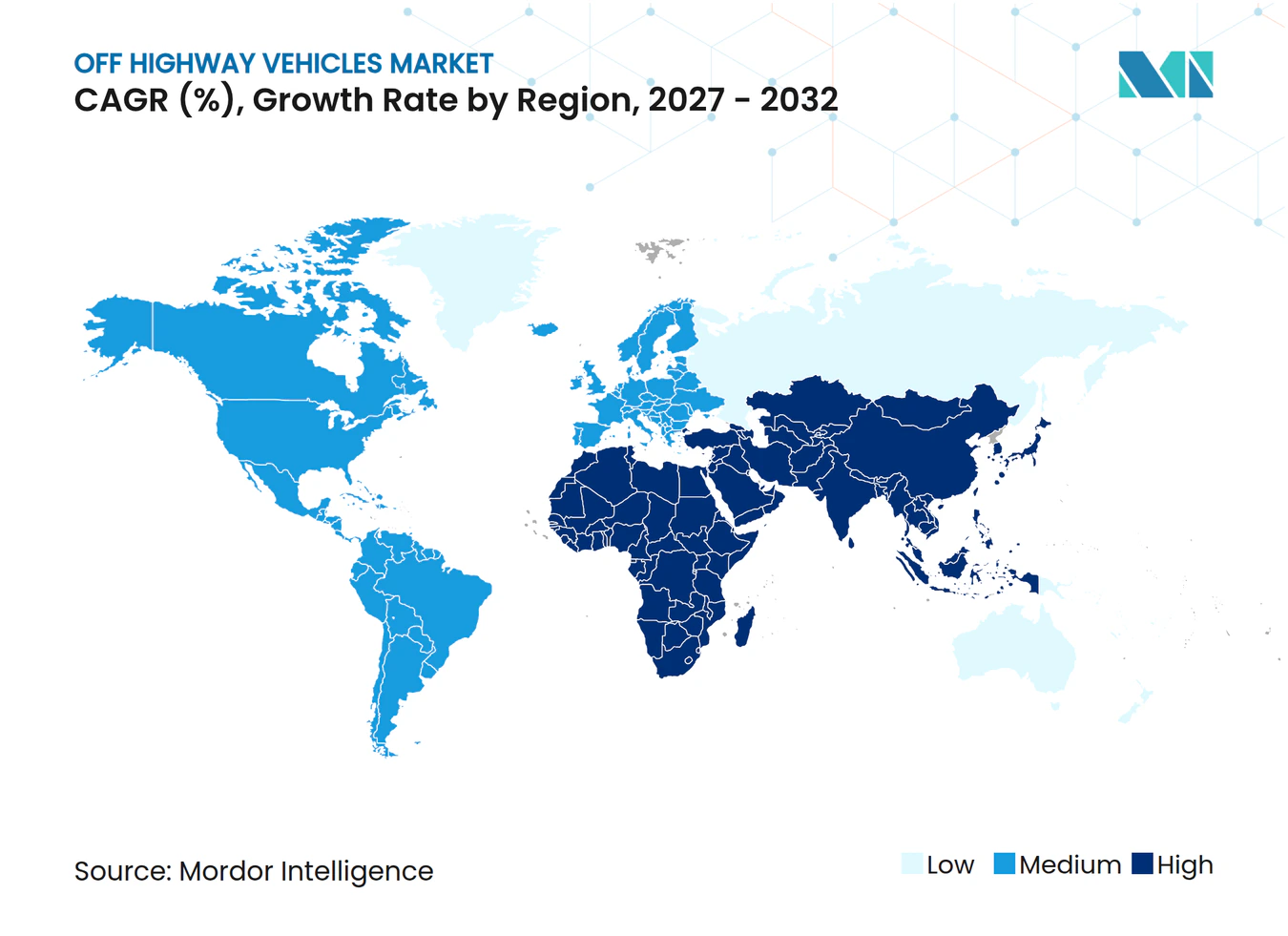
Asia-Pacific held 40.14% of the off-highway vehicles market share in 2026 and is projected to expand at a 6.50% CAGR through 2032. China remains a leading market by unit volume and is important for compact and medium equipment, including electric models. India supports demand through infrastructure development, mining activity, and a push toward higher mechanization in agriculture. Indonesia adds construction demand through strategic projects and capital relocation activity, though project implementation remains an important condition. Australia anchors demand for advanced mining fleets and autonomous technologies. China’s agricultural mechanization progress and India’s need for construction and mining equipment reinforce a broad regional demand base. The off-highway vehicles market in the region also benefits from a large base of local suppliers, dealers, contractors, and equipment users.
North America
North America benefits from infrastructure spending, industrial investment, mining activity, and replacement demand. Workforce limitations add an incentive to use connected and automated equipment. United States and Canadian mining projects also support demand for large loaders, trucks, and related service equipment. Manufacturers are investing in localized production and support capacity to shorten lead times and serve regional customers. Local assembly can also help manufacturers adapt machines to customer preferences and regional compliance needs. Adoption of electric equipment will depend on jobsite power, utilization rates, and total ownership cost rather than on regulation alone.
Europe, South America, and the Middle East and Africa
Europe, South America, and the Middle East and Africa have distinct demand patterns in the off-highway vehicles market. Europe is focused on emissions compliance, electric machinery, and local production resilience. Volvo Construction Equipment announced a USD 261 million investment in crawler excavator production in June 2025, covering its sites in Shippensburg (United States), Changwon (South Korea), and Sweden. South America is supported by farm equipment demand and copper-related mining investment, particularly in Chile. The Middle East and Africa offer selective construction and mining opportunities, with demand often linked to individual infrastructure and resource projects.
Competitive Landscape
Market Concentration
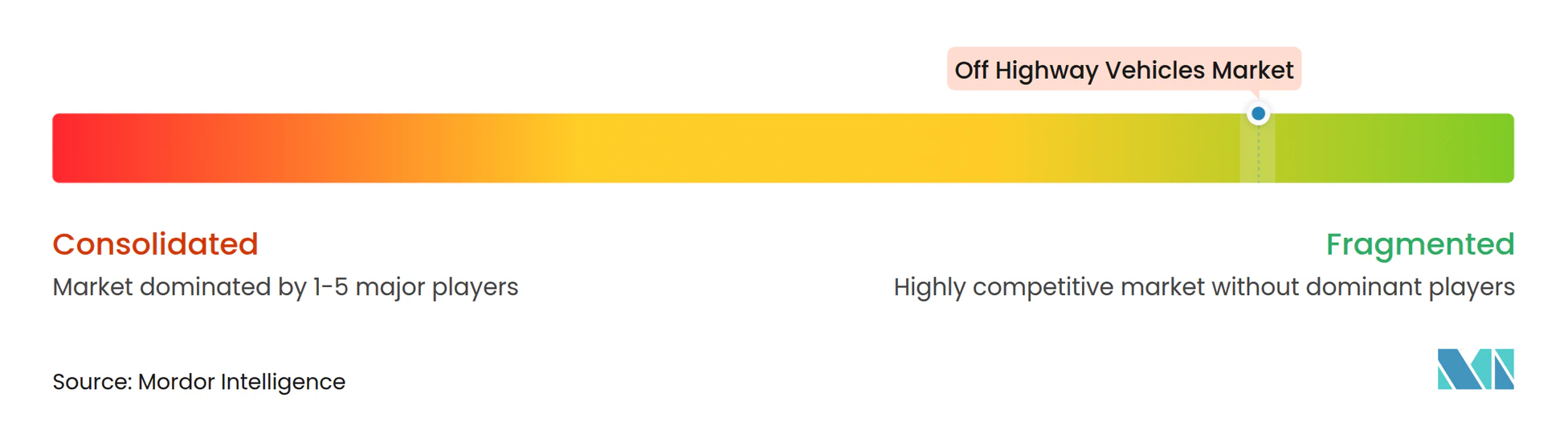
The off-highway vehicles market is fragmented at the global level, with competition becoming even more dispersed by equipment type and by country. Fragmentation is most pronounced in compact construction and agricultural equipment. Chinese manufacturers, including Sany, XCMG, and Zoomlion, are increasing their presence outside China. Large customers are diversifying supplier relationships when they buy major mining fleets. Liebherr announced in September 2024 that it would deliver 475 machines to Fortescue under its largest order to date. The order included a substantial number of battery-electric autonomous mining trucks and shows that large mining buyers are willing to commit to new technology at scale. The transaction also underlines the ability of long-term mining contracts to shape supplier positions.
Hardware capacity remains necessary, but it no longer determines major fleet contracts by itself. Customers also evaluate autonomy, charging systems, uptime commitments, remote support, and service coverage. In May 2026, Carmeuse selected Caterpillar’s MineStar Command for hauling for deployment at its Drummond Island operation in Michigan. These software and service layers can strengthen customer relationships through the useful life of equipment. Epiroc’s LinkOA platform is designed to enable autonomous operation across mixed fleets, which reduces the advantage of closed systems. The off-highway vehicles market is therefore moving toward competition between integrated operating solutions rather than stand-alone machines.
Volvo Group announced in October 2026 that it would create Volvo Mining, effective January 2027, to combine construction equipment, trucks, and autonomous solutions for mining customers. This move reflects the value of an integrated offering for mining customers that want productivity improvements across their operations. Opportunities remain in underground critical-mineral equipment, autonomous-ready compact machines, and retrofit systems for older diesel fleets. The installed base of internal combustion engine equipment is expected to remain significant in emerging markets through 2032.
Off Highway Vehicles Industry Leaders
-
Caterpillar Inc.
-
Komatsu Ltd.
-
Xuzhou Construction Machinery Group Co., Ltd.
-
Sany Heavy Industry Co., Ltd.
-
Volvo AB
- *Disclaimer: Major Players sorted in no particular order
Off Highway Vehicles Market Companies Covered in this Report
- Caterpillar Inc.
- Komatsu Ltd.
- Deere & Company
- CNH Industrial N.V.
- Volvo AB
- Hitachi Construction Machinery Co., Ltd.
- Liebherr-International AG
- AGCO Corporation
- Kubota Corporation
- Xuzhou Construction Machinery Group Co., Ltd.
- Sany Heavy Industry Co., Ltd.
- Zoomlion Heavy Industry Science & Technology Co., Ltd.
- Doosan Bobcat Inc.
- J.C. Bamford Excavators Limited
- Sandvik AB
- Epiroc AB
- Polaris Inc.
- Mahindra & Mahindra Limited
- CLAAS KGaA mbH
- Terex Corporation
Recent Industry Developments in Off Highway Vehicles Market
- October 2026: Volvo Group announced Volvo Mining, a dedicated entity from January 1, 2027, combining its construction equipment, trucks, and autonomous solutions for mining customers, starting in Sweden, Norway, and Finland.
- September 2026: Volvo CE launched the 65-ton EC650 mining excavator in India at bauma CONEXPO INDIA 2026 in Greater Noida.
- August 2026: Volvo CE rolled out its first U.S.-built excavators and large wheel loaders at its Shippensburg, Pennsylvania, plant.
- June 2026: BHP, Rio Tinto, and Caterpillar began trialing two Cat 793 XE Early Learner battery-electric haul trucks at BHP’s Jimblebar iron ore mine in the Pilbara, Western Australia.
Global Off Highway Vehicles Market Report Scope
The Off-Highway Vehicles Market Report is Segmented by Vehicle Type (Construction Equipment, Agricultural Vehicles, Mining Equipment, Material Handling Equipment, and Others), Propulsion (Internal Combustion Engine, Hybrid, Battery Electric, and Hydrogen Fuel Cell), Power Output (Below 100 HP, 100–400 HP, and Above 400 HP), Ownership (New Sales, Rental, and Used), End User (Construction, Agriculture, Mining, Industrial, and Others), and Geography (North America, Europe, Asia-Pacific, South America, and Middle East and Africa). The Market Forecasts are Provided in Terms of Value (USD) and Volume (Units).
Segmentation Overview
| Construction Equipment |
| Agricultural Vehicles |
| Mining Equipment |
| Material Handling Equipment |
| Others (Forestry Machines and ATVs/UTVs) |
| Internal Combustion Engine |
| Hybrid |
| Battery Electric |
| Hydrogen Fuel Cell |
| Below 100 HP |
| 100–400 HP |
| Above 400 HP |
| New Sales |
| Rental |
| Used |
| Construction |
| Agriculture |
| Mining |
| Industrial |
| Others (Defense, Recreation, Forestry) |
| North America | United States |
| Canada | |
| Rest of North America | |
| Europe | Germany |
| France | |
| United Kingdom | |
| Italy | |
| Spain | |
| Russia | |
| Sweden | |
| Netherlands | |
| Poland | |
| Rest of Europe | |
| Asia-Pacific | China |
| India | |
| Japan | |
| South Korea | |
| Australia | |
| Indonesia | |
| Rest of Asia-Pacific | |
| South America | Brazil |
| Argentina | |
| Chile | |
| Colombia | |
| Rest of South America | |
| Middle East and Africa | Saudi Arabia |
| United Arab Emirates | |
| Qatar | |
| Turkey | |
| Egypt | |
| South Africa | |
| Nigeria | |
| Rest of Middle East and Africa |
| By Vehicle Type | Construction Equipment | |
| Agricultural Vehicles | ||
| Mining Equipment | ||
| Material Handling Equipment | ||
| Others (Forestry Machines and ATVs/UTVs) | ||
| By Propulsion | Internal Combustion Engine | |
| Hybrid | ||
| Battery Electric | ||
| Hydrogen Fuel Cell | ||
| By Power Output | Below 100 HP | |
| 100–400 HP | ||
| Above 400 HP | ||
| By Ownership | New Sales | |
| Rental | ||
| Used | ||
| By End User | Construction | |
| Agriculture | ||
| Mining | ||
| Industrial | ||
| Others (Defense, Recreation, Forestry) | ||
| By Geography | North America | United States |
| Canada | ||
| Rest of North America | ||
| Europe | Germany | |
| France | ||
| United Kingdom | ||
| Italy | ||
| Spain | ||
| Russia | ||
| Sweden | ||
| Netherlands | ||
| Poland | ||
| Rest of Europe | ||
| Asia-Pacific | China | |
| India | ||
| Japan | ||
| South Korea | ||
| Australia | ||
| Indonesia | ||
| Rest of Asia-Pacific | ||
| South America | Brazil | |
| Argentina | ||
| Chile | ||
| Colombia | ||
| Rest of South America | ||
| Middle East and Africa | Saudi Arabia | |
| United Arab Emirates | ||
| Qatar | ||
| Turkey | ||
| Egypt | ||
| South Africa | ||
| Nigeria | ||
| Rest of Middle East and Africa | ||
Key Questions Answered in the Report
What is the projected growth rate for the off-highway vehicles market through 2032?
The off-highway vehicles market is projected to grow at a 4.92% CAGR from 2027 to 2032, reaching USD 379.66 billion by 2032.
Which vehicle type has the largest revenue position?
Construction equipment leads with a 42.15% share in 2026, supported by infrastructure, industrial, and urban projects. It includes machines used throughout a project, from earthmoving through site completion.
Which propulsion type is growing fastest?
Battery electric vehicles are projected to grow at a 15.22% CAGR through 2032, mainly in compact construction and material-handling uses.
Why is equipment rental growing faster than ownership?
Rental is forecast to grow at an 8.63% CAGR because it reduces upfront costs and aligns equipment spending with project duration.