
Off Highway Electric Vehicle Market Size and Share
Market Overview
| Study Period | 2020 - 2032 |
|---|---|
| Market Size (2027) | USD 17.12 Billion |
| Market Size (2032) | USD 35.40 Billion |
| Growth Rate (2027 - 2032) | 15.64 % |
| Fastest Growing Market | Asia-Pacific |
| Largest Market | Asia-Pacific |
| Market Concentration | Medium |
Major Players *Disclaimer: Major Players sorted in no particular order Image © Mordor Intelligence. Reuse requires attribution under CC BY 4.0. | |
Off Highway Electric Vehicle Market Analysis by Mordor Intelligence
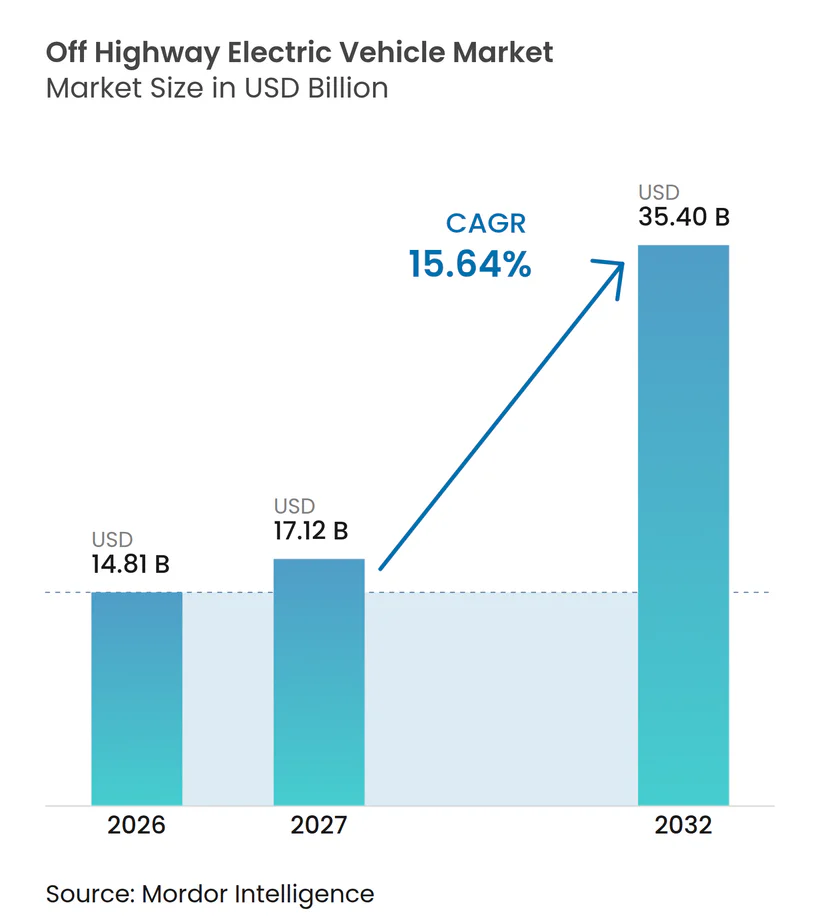
The off highway electric vehicle market size was valued at USD 14.81 billion in 2026 and is expected to grow from USD 17.12 billion in 2027 to USD 35.40 billion by 2032, at a CAGR of 15.64% during 2027-2032. The off highway electric vehicle market is moving from small pilots toward formal fleet procurement, especially where public contracts require lower-emission machinery. Construction, mining, agriculture, and material handling operators are weighing energy use, maintenance needs, worksite emissions, and charging access when they replace equipment. Europe benefits from established non-road emissions rules and local zero-emission site requirements, while China is increasing the availability and use of electric loaders. Large equipment is drawing more attention because higher battery capacity and charging capability are widening the range of work that electric machines can complete. The off highway electric vehicle market also faces practical limits from upfront cost, uncertain resale values, and restricted grid capacity at older worksites.
Key Report Takeaways
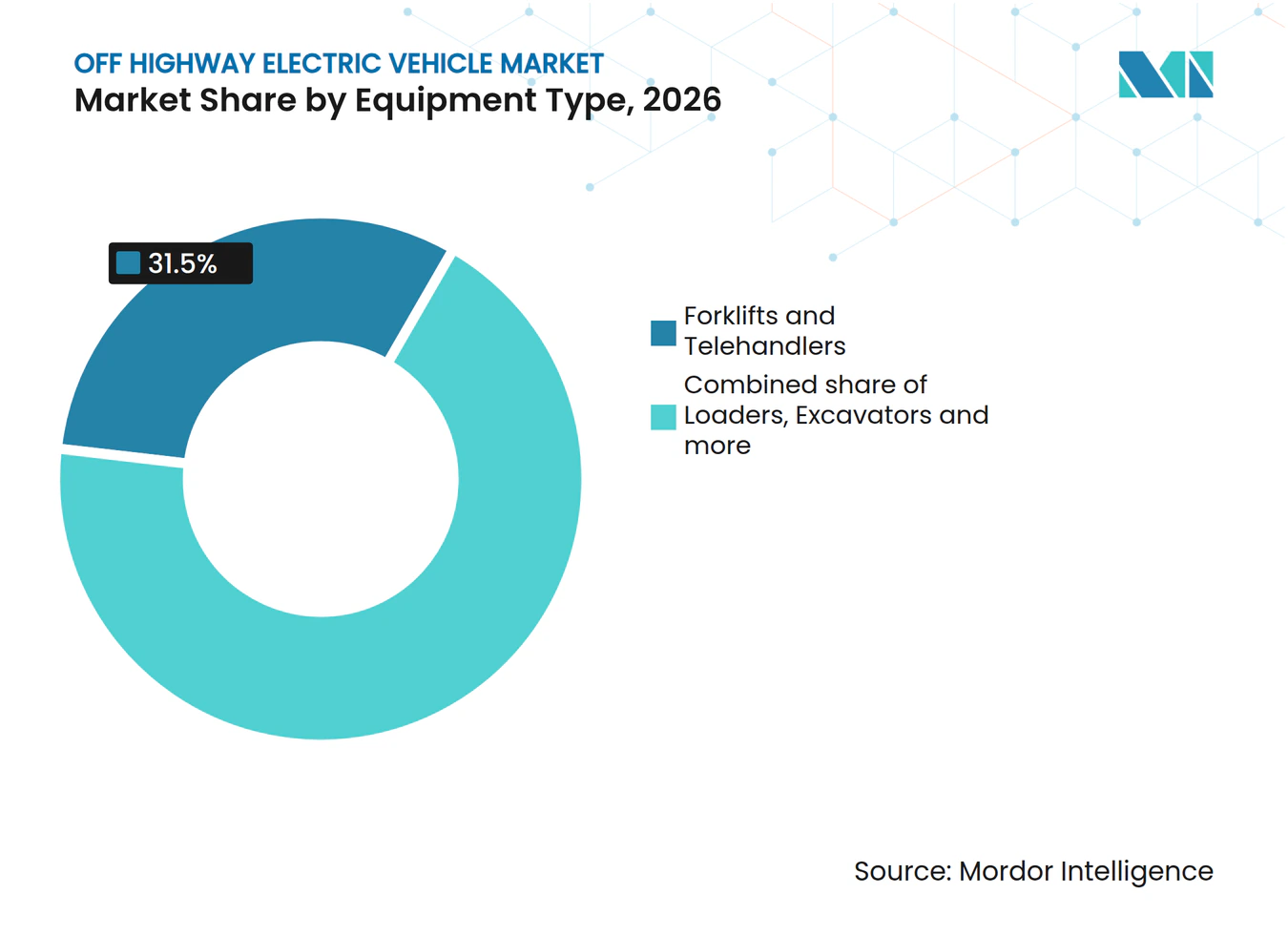
- By equipment type, forklifts and telehandlers held a 31.50% share in 2026, while dump/haul trucks are projected to grow at a 16.86% CAGR through 2032.
- By propulsion, battery electric held a 54.21% share in 2026, while hydrogen fuel cell is projected to grow at a 21.21% CAGR through 2032.
- By battery capacity, the 50–200 kWh band held a 42.87% share in 2026, while above 200 kWh systems are projected to grow at a 17.32% CAGR through 2032.
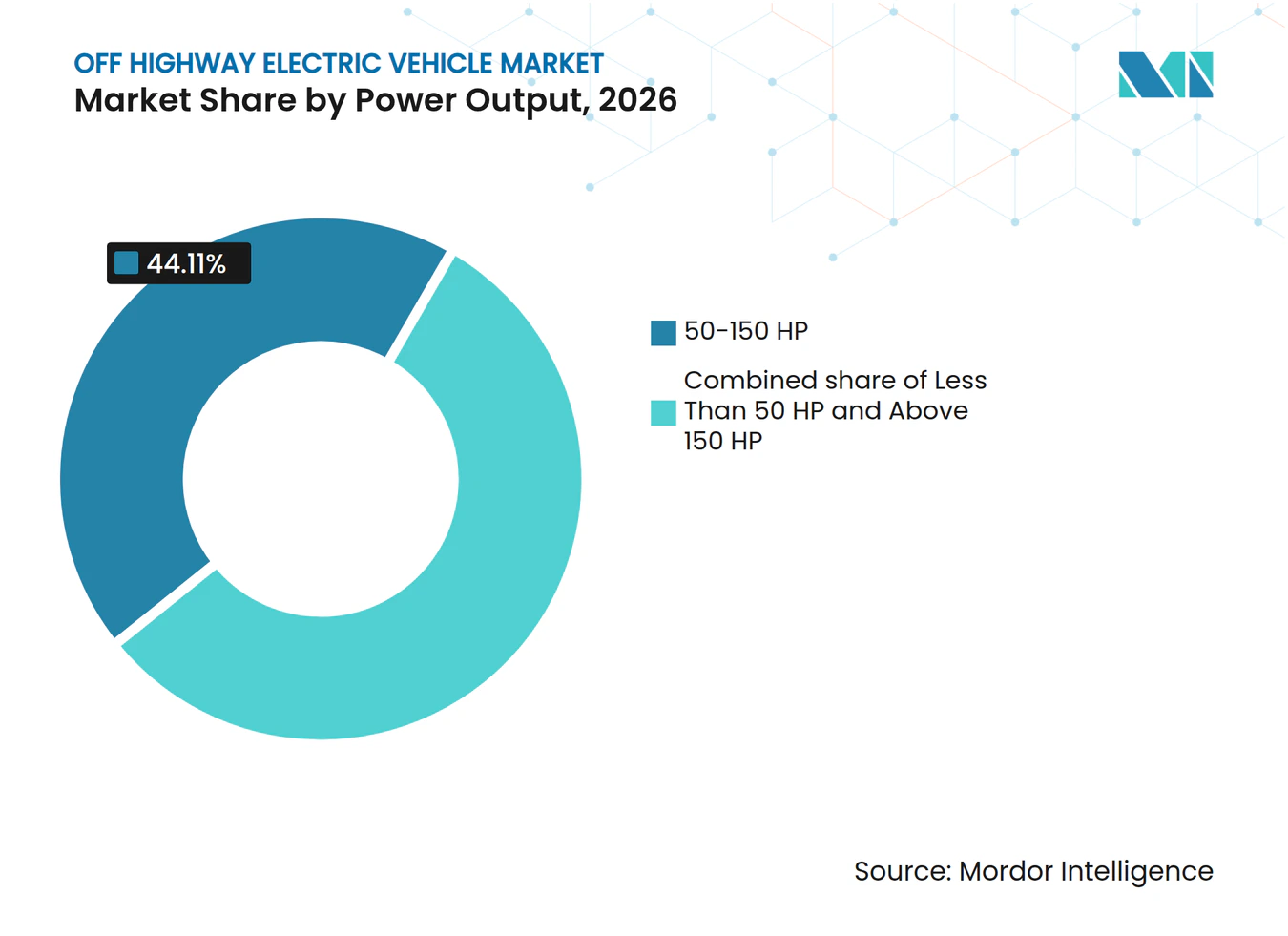
- By power output, the 50–150 HP band held a 44.11% share in 2026, while above 150 HP machines are projected to grow at a 17.65% CAGR through 2032.
- By application, construction held a 38.38% share in 2026, while mining is projected to grow at an 18.43% CAGR through 2032.
- By geography, Asia-Pacific held a 39.50% share in 2026 and is projected to grow at a 16.90% CAGR through 2032.
Note: Market numbers in this report are based on Mordor Intelligence's proprietary estimation framework, which combines nine months of actuals with Q4 projections for base year 2026.
Market Trends and Insights
Drivers Impact Analysis of Off Highway Electric Vehicle Market*
| Driver | (~) % Impact on CAGR Forecast | Geographic Relevance | Impact Timeline |
|---|---|---|---|
| Tightening Non-Road Emission Standards and Zero-Emission Procurement | +4.5% | Global, with near-term mandates concentrated in Europe and California | Short term (≤ 2 years) |
| Lower Total Cost of Ownership from Energy and Maintenance Savings | +3.0% | Global, strongest at high-use enclosed mines and logistics sites | Medium term (2–4 years) |
| Improving Battery Economics, Fast Charging, and Energy Density | +2.5% | Global, with Asia-Pacific OEMs leading LFP cost development | Medium term (2–4 years) |
| Broader OEM Commercialization of Electric Off-Highway Equipment | +2.0% | Global, with launches in Europe, the Americas, and Asia-Pacific | Short term (≤ 2 years) |
| Mine Ventilation and Heat Savings from Diesel Displacement | +1.2% | Asia-Pacific and South American mining regions, with spillover to the Middle East and Africa | Long term (≥ 4 years) |
| Low-Noise, Zero-Exhaust Operation Unlocking Urban, Indoor, and Night Work | +0.8% | Europe and North American urban infrastructure sites | Short term (≤ 2 years) |
| Source: Mordor Intelligence | |||
Tightening Non-Road Emission Standards and Zero-Emission Procurement
Zero-emission procurement is becoming a direct source of equipment demand rather than a general policy goal. CARB's California Clean Construction Program, a voluntary procurement framework with implementation proposed from 2027, maintains a list of zero-emission equipment types that participating awarding bodies can require on public projects[1]. Contract requirements can restrict the use of combustion alternatives when a qualifying electric model is available, shifting the decision to the procurement stage. In September 2025, France extended its ADEME-run E-TRANS program, funded through energy-savings certificates, to support purchases of at least 400 electric construction machines. These regulations give fleet managers stronger reasons to plan electric purchases before every machine class reaches broad technical maturity.
Lower Total Cost of Ownership from Energy and Maintenance Savings
Operating savings are highest when machines operate intensively at fixed sites with reliable charging access. Several cases reported substantial energy cost savings, while loaders at cement plants achieved relatively short payback periods. Mining excavators also recovered their price premiums quickly under similar high-utilization conditions. However, field tests found that higher operating hours did not eliminate the cost gap with diesel when grid access and charging logistics were constrained. Therefore, the off highway electric vehicle market offers the strongest cost proposition for enclosed mines, industrial plants, and logistics sites with planned charging infrastructure. Contractors that move equipment across older sites face a different cost structure, as they may need temporary power supplies, mobile energy storage, or additional downtime.
Improving Battery Economics, Fast Charging, and Energy Density
Charging equipment is improving the practical use of battery-electric machines. In March 2025, Danfoss introduced its 44 kW Editron ED3 onboard charger, which offers twice the charging power of a typical 22 kW unit[2]. The product can reduce the need for costly DC fast-charging equipment at some worksites. Volvo CE's A30 Electric has a 450 kWh battery and can charge from 20% to 80% in one hour using a 350 kW DC charger.
Broader OEM Commercialization of Electric Off-Highway Equipment
OEMs are expanding their electric model offerings beyond compact machinery to include heavier equipment for commercial use. At Bauma 2025, Volvo CE presented the A30 Electric and A40 Electric articulated haulers, with 29-ton and 39-ton payloads, respectively. Liebherr introduced the R 920 G8-E battery-electric crawler excavator with a high-capacity battery option at the same event. Komatsu has offered the PC138E-11, a 13-ton electric excavator, in Europe since late 2023. Greater product availability gives operators more choice across work types and allows service networks to build experience. As a result, the off highway electric vehicle market is expanding from isolated product lines toward fleets capable of covering routine loading, excavation, haulage, and underground tasks.
Restraints Impact Analysis of Off Highway Electric Vehicle Market*
| Restraint | (~) % Impact on CAGR Forecast | Geographic Relevance | Impact Timeline |
|---|---|---|---|
| High Upfront Capital Cost and Uncertain Residual Value | -2.5% | Global, most acute in South America, the Middle East and Africa, and among smaller contractors | Medium term (2–4 years) |
| Charging, Grid Capacity, and Downtime Constraints | -1.5% | Global, most limiting at remote mines and multi-project brownfield construction | Long term (≥ 4 years) |
| Duty-Cycle and Climate-Sensitive Battery Performance | -1.0% | Northern Canada, Scandinavia, and the Arabian Peninsula | Long term (≥ 4 years) |
| Fragmented Charging, Attachment, and Service Ecosystems | -0.5% | Global, most limiting in mixed-OEM fleets | Medium term (2–4 years) |
| Source: Mordor Intelligence | |||
High Upfront Capital Cost and Uncertain Residual Value
High upfront costs remain a major barrier to adoption, while uncertain resale values complicate financing for smaller contractors. Projected battery price reductions alone may not make electric loaders and excavators cost-competitive with diesel models without government incentives. The used-equipment market for electric heavy machinery remains in its early stages, limiting lenders’ ability to assess battery end-of-life risks reliably. This uncertainty can increase financing costs and restrict leasing options for operators without large balance sheets. Policy mechanisms can support the adoption of electric construction machinery. Similar policy support will be necessary in South America and the Middle East and Africa to prevent financing constraints from slowing adoption in these regions.
Charging, Grid Capacity, and Downtime Constraints
Charging creates interconnected equipment, logistics, and electricity-planning challenges for many operators. Site-level charging costs vary significantly, ranging from basic overnight grid connections to costly mobile energy storage and battery-swapping solutions. Older construction sites in dense urban areas often lack sufficient capacity to charge multiple large machines overnight. Battery swapping can enable continuous operations in mining and ports, but mixed fleets face limited interoperability standards. Long shifts and heavy-duty applications remain particularly challenging when equipment cannot pause for charging. These constraints indicate that the off highway electric vehicle market will evolve gradually rather than through the simultaneous replacement of diesel-powered equipment.
*Our forecasts treat driver/restraint impacts as directional, not additive. The impact forecasts reflect baseline growth, mix effects, and variable interactions.
Off Highway Electric Vehicle Market Segment Analysis
By Equipment Type:
Haul Trucks Accelerate as Forklifts LeadForklifts and telehandlers held a 31.50% share in 2026, as battery-electric operation is already well established in warehouse, logistics, and industrial material-handling fleets. Loaders followed with a 21.00% share, having entered commercial deployment earlier than larger equipment types because they often operate on predictable shifts at fixed sites. Electric loader penetration in China reached 17.1% in the first quarter of 2025, and the ten leading manufacturers accounted for more than 90% of available zero-emission loader models. This supply base indicates that the off highway electric vehicle market has moved more quickly from pilots to broader loader procurement.
Dump and haul trucks are forecast to grow at a CAGR of 16.86% through 2032. Their adoption requires operators to redesign charging infrastructure, energy management, and fleet planning rather than replacing a single machine. Modular platforms help mines retain flexibility across battery, trolley, and hydrogen power options. In November 2025, Sandvik introduced the DS422iE battery-powered cable bolter, featuring LFP batteries and Charging While Drilling capability. Excavators, tractors, dozers, graders, and rollers remain at varying stages of commercialization, though the range of available electric products in these categories is expanding.



By Propulsion:
Battery Electric Dominates, Hydrogen Fuel Cell Defines the Heavy-Duty FrontierBattery-electric equipment accounted for 54.21% of market value in 2026. This segment has the broadest current product base, as batteries are well-suited to compact and mid-sized equipment with established work patterns. LFP supply chains and field experience have supported adoption in applications with demanding thermal and safety requirements. Hybrid systems retain a role where long shifts and high energy demand make battery-only operation impractical. Cummins unveiled a hybrid-electric retrofit kit for the Komatsu 930E-4 haul truck at The Electric Mine 2025 in Chile, with pilots planned at two Chilean mines.
Hydrogen fuel cell equipment is forecast to grow at a 21.21% CAGR through 2032. This growth reflects its suitability for heavy trucks carrying large payloads over long shifts. In May 2025, Adani Group deployed India's first hydrogen fuel-cell mining truck, equipped with a Ballard 120 kW FCmove-XD fuel-cell engine. The vehicle had a 40-ton payload capacity and a 200 km range, illustrating a use case where battery weight and recharge time present operational constraints. Hydrogen fuel cell technology is not expected to replace battery-electric equipment in compact and mid-range machines.
By Battery Capacity:
Mid-Range Anchors Volume, High-Capacity Scales with Mining DemandThe 50–200 kWh segment accounted for 42.87% of market value in 2026. It covers compact excavators, mini loaders, and forklift-class equipment used in urban construction, warehouses, and enclosed industrial sites. Liebherr's R 920 G8-E has a 188 kWh standard battery option, placing it in the mid-range band. Machines in this range can generally support planned 6–8-hour shifts on a single charge, simplifying scheduling for operators.
Above-200-kWh systems are forecast to grow at a 17.32% CAGR through 2032, driven by larger construction and mining machines that require more stored energy for productive shifts. Volvo CE's A30 Electric uses a 450 kWh battery, while Liebherr's R 920 G8-E offers a 282 kWh high-capacity option. Systems below 50 kWh serve pallet jacks, pedestrian forklifts, and micro-excavators, where electric operation is already common. Higher-capacity systems are expanding the off highway electric vehicle market to more demanding work cycles.
By Power Output:
Mid-Power Machines Drive Volume, High-Output Scales with HaulThe 50–150 HP segment accounted for 44.11% of market value in 2026. This range provides sufficient power for many construction and mining-support tasks without exceeding current battery and charging limits. A growing number of electric construction and mining models are now listed by public programs, reflecting the commercial depth now available across relevant machine classes. Operators can often complete standard shifts with planned charging, giving suppliers a practical basis for service, parts, and charging investment.
The above-150 HP segment is forecast to grow at a 17.65% CAGR through 2032. This category is tied to larger construction equipment and surface mining fleets, where power and energy demand increase significantly. A 2025 fuel-cell retrofit study for the Komatsu 830E-5 found that the required fuel-cell, battery, and hydrogen-storage system exceeded the available space in current diesel truck layouts. This supports the case for purpose-built heavy equipment rather than simple retrofits. The under-50 HP class is more mature, while the off highway electric vehicle industry must still develop new high-output platforms.

By Application:
Construction Anchors Demand, Mining Redefines the Growth CeilingConstruction accounted for 38.38% of off highway electric vehicle market value in 2026. Zero-emission procurement in Europe and California is turning compliance requirements into machine orders. Dense urban worksites value reduced noise and no exhaust emissions at the point of use. Agriculture, forestry, and material handling expand the demand base with electric tractors, reach stackers, and port equipment, for which charging can be planned.
Mining is forecast to grow at an 18.43% CAGR through 2032. Underground applications can gain from lower ventilation demand, reduced heat, and improved worker conditions, not only lower machine energy use. Mining vehicles generate significant CO2-equivalent emissions and account for a substantial share of a typical mine’s operational emissions. Electric units have been deployed across mine sites, with repeat orders recorded. The adoption of electric off-highway equipment in mining involves energy supply, ventilation, haulage, and equipment availability.
Geography Analysis
Europe
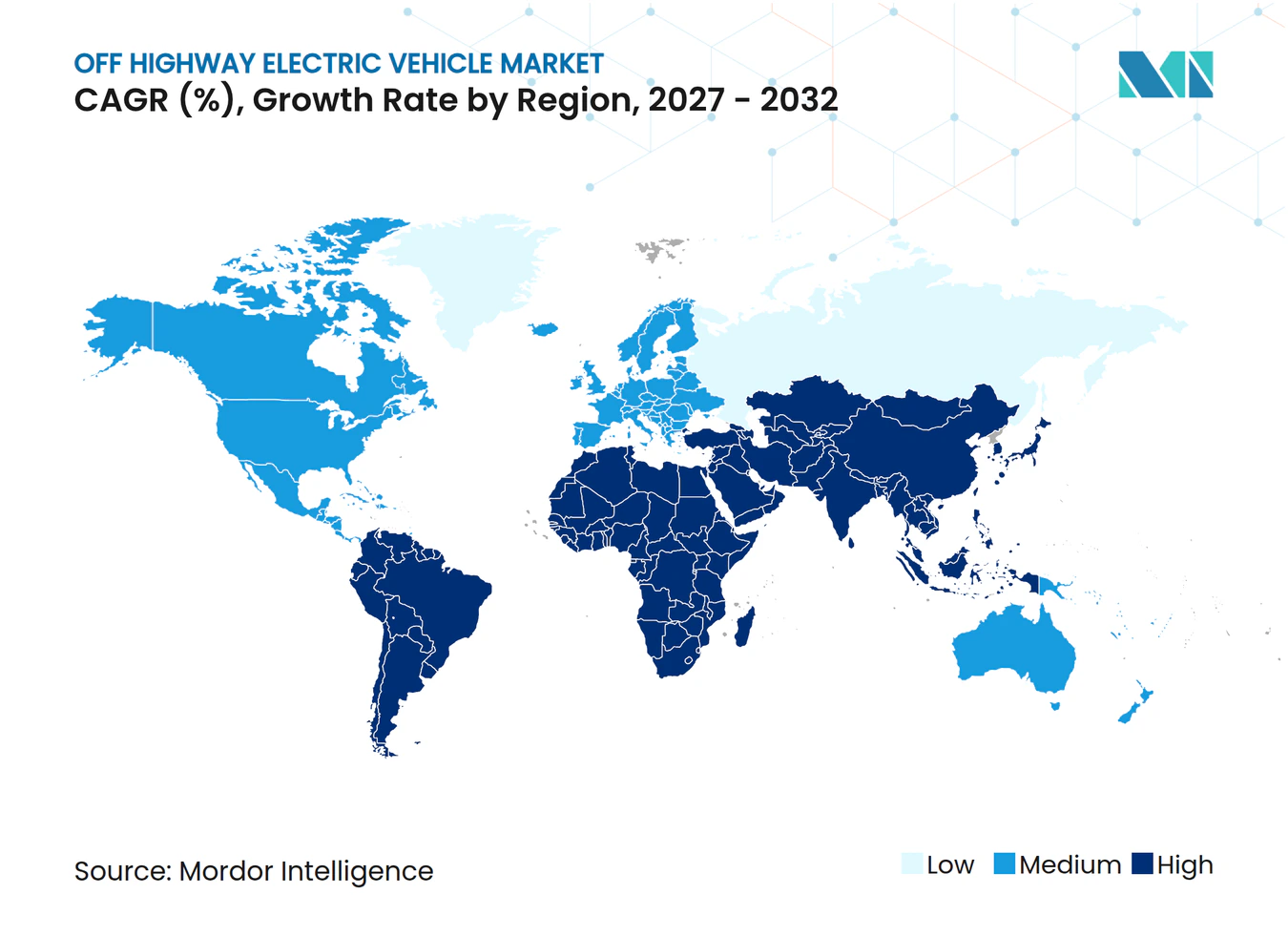
Europe held a 29.80% share in 2026, a position that reflects early adoption of emissions policy, active municipal procurement, and strong local OEM investment. France expanded E-TRANS support in 2025 for electric construction and agricultural machines through a program linked to energy-savings certificates. Bauma Munich 2025 showcased the region's product pipeline with launches from Volvo CE, Liebherr, Caterpillar, and Komatsu. At Sweden's Kristineberg mine, Epiroc's electrified ramp haulage with Boliden increased productivity by 23% compared with diesel-driven equipment, further strengthening the off highway electric vehicle market in Europe.
Asia-Pacific
Asia-Pacific held a 39.50% share in 2026, the largest of any region, and is forecast to grow at a 16.90% CAGR through 2032. China is central to this position, as electric loader penetration rose from 1.1% in Q1 2023 to 17.1% in Q1 2025 [3]. Australia is also emerging as a commercial testing location, following Fortescue’s contract with Epiroc for autonomous and electric surface-mining equipment in the Pilbara.
North America, South America, and the Middle East and Africa
North America is supported by California's equipment regulations and the Clean Off-Road Equipment Voucher Incentive Project. CARB's eligible-model list provides contractors and public buyers with a practical reference for zero-emission construction and mining equipment. In Canada, Epiroc received a large order for battery-electric equipment in March 2025 for Hudbay Minerals' Lalor underground mine in Manitoba. South America presents a strong mining opportunity, while the Middle East and Africa require greater charging infrastructure, service capacity, and financing support before adoption rates can match those in Europe or Asia-Pacific.
Competitive Landscape
Market Concentration
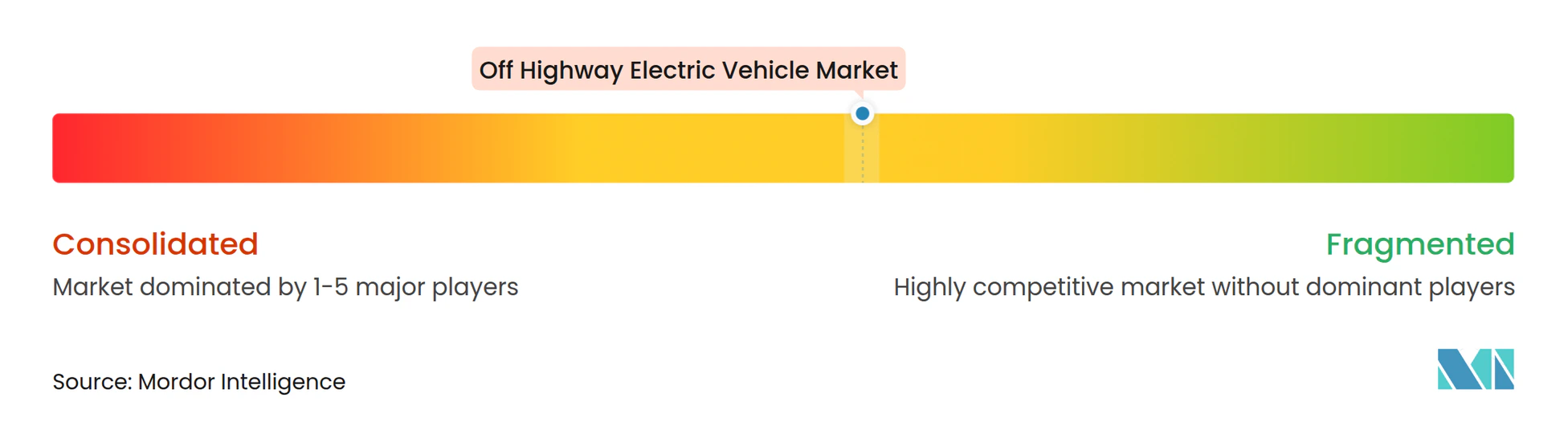
The off highway electric vehicle market is moderately concentrated, with established equipment manufacturers leading construction, mining, and material-handling programs. Caterpillar, Volvo CE, Komatsu, Liebherr, JCB, and Doosan Bobcat compete in construction through product range and service coverage. XCMG, SANY, LiuGong, and Zoomlion are expanding the number of electric models available in China. XCMG offered one of the broadest zero-emission ranges in China in 2025, including 11 electric loader and 17 zero-emission excavator models. Epiroc had more than 600 battery-electric units in operation at the end of 2025, with 40 mine sites having ordered its battery-electric equipment.
Competition depends on the broader equipment system, not only the vehicle itself. Sandvik's battery-swapping approach supports continuous underground operations and can increase switching costs once a mine adopts its operating system. Epiroc's April 2025 agreement with Fortescue combines autonomous and electric-powered mining equipment. Komatsu announced in July 2025 that it had commissioned its Power Agnostic 930E diesel trolley truck at Boliden's Aitik mine for a 12-month field trial. Volvo CE's A30 and A40 Electric launches extend electric options into larger articulated haulage classes.
Opportunities in the off highway electric vehicle market include charging systems compatible with mixed fleets, battery-swapping services outside China, and supply to remote sites with limited grid access. Caterpillar acquired the technology assets of electric and autonomous tractor developer Monarch Tractor in 2026, adding agricultural electrification capability. Smaller specialists require distribution, service, and financing capabilities to compete with established OEMs. A supplier's competitive position will increasingly depend on energy planning, charging infrastructure, maintenance, and fleet data support across a machine's operational life.
Off Highway Electric Vehicle Industry Leaders
-
Caterpillar Inc.
-
Volvo Group
-
Komatsu Ltd.
-
Deere & Company
-
Xuzhou Construction Machinery Group Co., Ltd. (XCMG)
- *Disclaimer: Major Players sorted in no particular order
Off Highway Electric Vehicle Market Companies Covered in this Report
- Caterpillar Inc.
- Komatsu Ltd.
- Volvo Group
- Hitachi Construction Machinery Co., Ltd.
- Liebherr-International AG
- Deere & Company
- CNH Industrial N.V.
- Doosan Bobcat Inc.
- J.C. Bamford Excavators Ltd.
- Sandvik AB
- Epiroc AB
- Xuzhou Construction Machinery Group Co., Ltd. (XCMG)
- SANY Heavy Industry Co., Ltd.
- Zoomlion Heavy Industry Science and Technology Co., Ltd.
- Kubota Corporation
- Wacker Neuson SE
- Kobelco Construction Machinery Co., Ltd.
- HD Hyundai Construction Equipment Co., Ltd.
- Takeuchi Mfg. Co., Ltd.
- LiuGong Machinery Co., Ltd.
Recent Industry Developments in Off Highway Electric Vehicle Market
- September 2026: Caterpillar introduced the Cat D11 XE, its first electric drive large dozer, using up to 25% less fuel per unit of material moved than the next-generation Cat D11.
- June 2026: Volvo Construction Equipment launched the EWR150 Electric, its first fully electric wheeled excavator, in Europe, with a 270 kWh battery and up to 150 kW DC fast charging.
- April 2026: Volvo Construction Equipment started series production of the A30 Electric and A40 Electric articulated haulers at its Braås plant in Sweden.
- April 2026: Caterpillar acquired the technology assets of electric and autonomous tractor developer Monarch Tractor.
Global Off Highway Electric Vehicle Market Report Scope
The Off Highway Electric Vehicle Market Report is Segmented by Equipment Type (Excavators, Loaders, Dump/Haul Trucks, Forklifts and Telehandlers, Tractors, and Other Equipment Types), Propulsion (Battery Electric, Hybrid Electric, and Hydrogen Fuel Cell), Battery Capacity (Below 50 kWh, 50–200 kWh, and Above 200 kWh), Power Output (Less Than 50 HP, 50–150 HP, and Above 150 HP), Application (Construction, Mining, Agriculture, Material Handling, and Other Applications), and Geography (North America, Europe, Asia-Pacific, South America, and Middle East and Africa). The Market Forecasts are Provided in Terms of Value (USD) and Volume (Units).
Segmentation Overview
| Excavators |
| Loaders (Wheel and Mining) |
| Dump/Haul Trucks |
| Forklifts and Telehandlers |
| Tractors |
| Other Equipment Types (Dozers, Graders, Sprayers, and Rollers) |
| Battery Electric |
| Hybrid Electric |
| Hydrogen Fuel Cell |
| Below 50 kWh |
| 50-200 kWh |
| Above 200 kWh |
| Less Than 50 HP |
| 50-150 HP |
| Above 150 HP |
| Construction |
| Mining |
| Agriculture |
| Material Handling |
| Other Applications (Forestry) |
| North America | United States |
| Canada | |
| Mexico | |
| Europe | Germany |
| United Kingdom | |
| France | |
| Italy | |
| Spain | |
| Netherlands | |
| Norway | |
| Sweden | |
| Poland | |
| Russia | |
| Rest of Europe | |
| Asia-Pacific | China |
| India | |
| Japan | |
| South Korea | |
| Australia | |
| Indonesia | |
| Thailand | |
| Rest of Asia-Pacific | |
| South America | Brazil |
| Chile | |
| Argentina | |
| Colombia | |
| Peru | |
| Rest of South America | |
| Middle East and Africa | Saudi Arabia |
| United Arab Emirates | |
| Qatar | |
| Turkey | |
| South Africa | |
| Egypt | |
| Morocco | |
| Nigeria | |
| Rest of Middle East and Africa |
| By Equipment Type | Excavators | |
| Loaders (Wheel and Mining) | ||
| Dump/Haul Trucks | ||
| Forklifts and Telehandlers | ||
| Tractors | ||
| Other Equipment Types (Dozers, Graders, Sprayers, and Rollers) | ||
| By Propulsion | Battery Electric | |
| Hybrid Electric | ||
| Hydrogen Fuel Cell | ||
| By Battery Capacity | Below 50 kWh | |
| 50-200 kWh | ||
| Above 200 kWh | ||
| By Power Output | Less Than 50 HP | |
| 50-150 HP | ||
| Above 150 HP | ||
| By Application | Construction | |
| Mining | ||
| Agriculture | ||
| Material Handling | ||
| Other Applications (Forestry) | ||
| By Geography | North America | United States |
| Canada | ||
| Mexico | ||
| Europe | Germany | |
| United Kingdom | ||
| France | ||
| Italy | ||
| Spain | ||
| Netherlands | ||
| Norway | ||
| Sweden | ||
| Poland | ||
| Russia | ||
| Rest of Europe | ||
| Asia-Pacific | China | |
| India | ||
| Japan | ||
| South Korea | ||
| Australia | ||
| Indonesia | ||
| Thailand | ||
| Rest of Asia-Pacific | ||
| South America | Brazil | |
| Chile | ||
| Argentina | ||
| Colombia | ||
| Peru | ||
| Rest of South America | ||
| Middle East and Africa | Saudi Arabia | |
| United Arab Emirates | ||
| Qatar | ||
| Turkey | ||
| South Africa | ||
| Egypt | ||
| Morocco | ||
| Nigeria | ||
| Rest of Middle East and Africa | ||
Key Questions Answered in the Report
What is the projected growth rate for the off highway electric vehicle market?
The off highway electric vehicle market is forecast to grow at a 15.64% CAGR from 2027 to 2032, reaching USD 35.40 billion by 2032.
Which equipment type is growing fastest?
Dump and haul trucks are forecast to expand at a 16.86% CAGR through 2032 as mines invest in new energy and haulage systems.
Why is mining a major demand area for electric machinery?
Mining is forecast to grow at an 18.43% CAGR because electric fleets can reduce ventilation and heat burdens alongside machine energy use.
Which propulsion type has the largest current position?
Battery-electric equipment accounted for 54.21% of market value in 2026 because it has the broadest current product range.
What limits adoption of electric heavy equipment?
The off highway electric vehicle market faces high upfront cost, uncertain resale value, charging access, grid capacity, and operational downtime.