
Nutraceutical Packaging Market Size and Share
Market Overview
| Study Period | 2022 - 2032 |
|---|---|
| Market Size (2027) | USD 4.98 Billion |
| Market Size (2032) | USD 6.29 Billion |
| Growth Rate (2027 - 2032) | 4.79 % |
| Fastest Growing Market | Asia-Pacific |
| Largest Market | North America |
| Market Concentration | Low |
Major Players *Disclaimer: Major Players sorted in no particular order Image © Mordor Intelligence. Reuse requires attribution under CC BY 4.0. | |
Nutraceutical Packaging Market Analysis by Mordor Intelligence
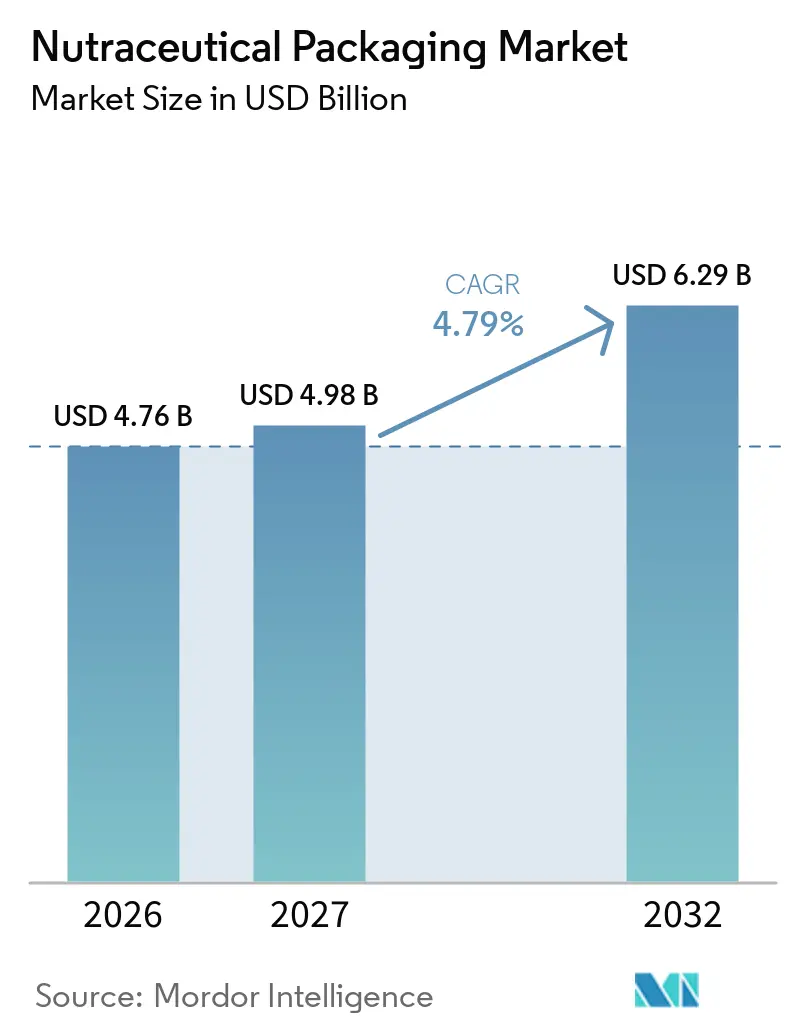
The Nutraceutical Packaging Market size was valued at USD 4.76 billion in 2026 and is estimated to grow from USD 4.98 billion in 2027 to reach USD 6.29 billion by 2032, at a CAGR of 4.79% during the forecast period (2027-2032). Preventive health spending is supporting demand for packaging that protects product quality and supports precise dosing. Consumers are using supplements, functional foods, and wellness products more routinely, which is broadening packaging needs beyond standard containers. The nutraceutical packaging market is also benefiting from direct-to-consumer fulfillment, which increases the need for moisture protection, tamper evidence, and durable packs. Global converters are expanding their format choices while specialist suppliers continue to serve high-barrier and child-resistant requirements. Resin costs, recycled-content availability, and qualification costs remain practical limits, but the nutraceutical packaging market continues to be supported by aging populations, health awareness, and format innovation, which keeps protective and usable packaging relevant as product portfolios and distribution models become more varied.
Key Report Takeaways
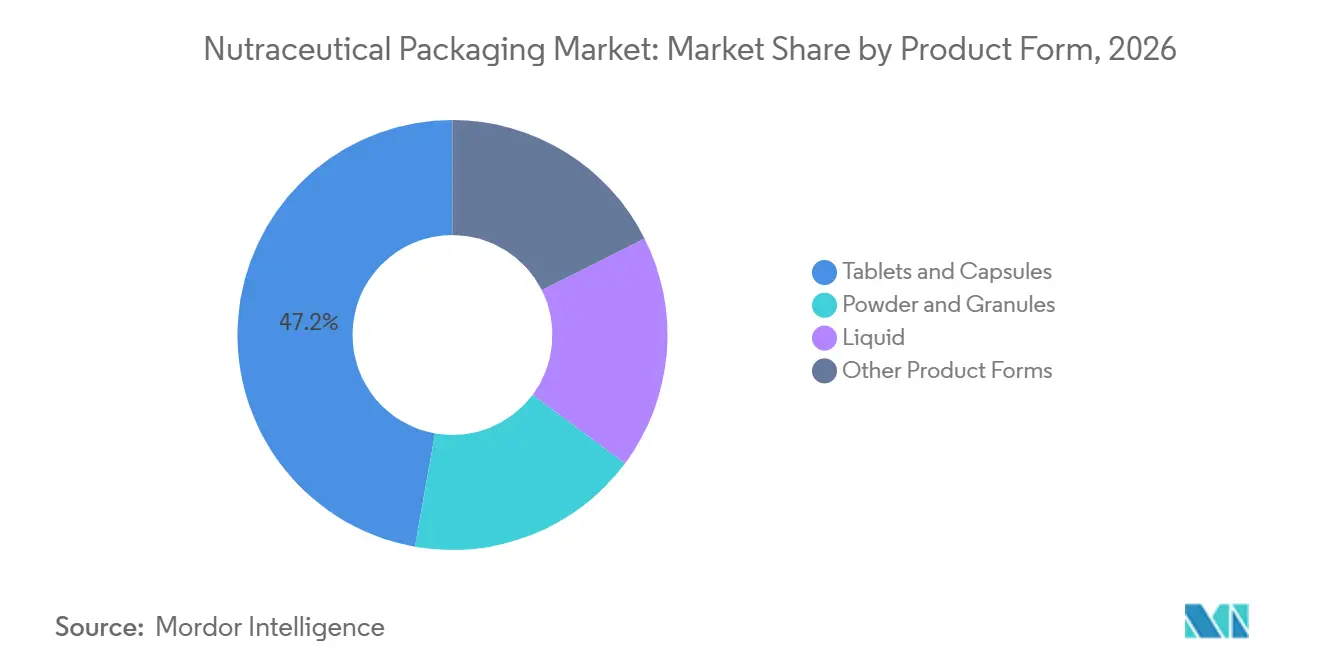
- By product form, tablets and capsules held 47.21% of the nutraceutical packaging market share in 2026 and are forecast to advance at a 5.16% CAGR through 2032.
- By product type, dietary supplements held 43.63% of the nutraceutical packaging market share in 2026, while functional foods are forecast to advance at a 5.45% CAGR through 2032.
- By packaging type, bottles held 38.47% of the nutraceutical packaging market share in 2026, while bags and pouches are forecast to advance at a 5.82% CAGR through 2032.
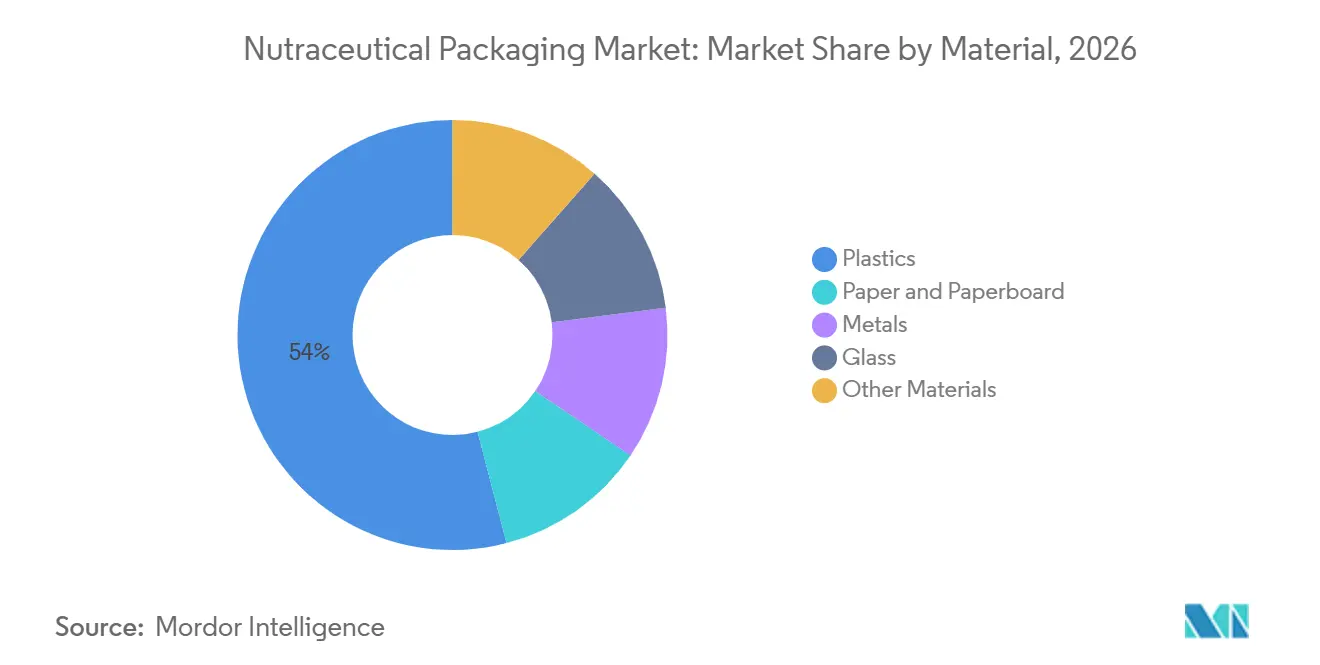
- By material, plastics held 54.04% of the nutraceutical packaging market share in 2026, while paper and paperboard are forecast to advance at a 5.91% CAGR through 2032.
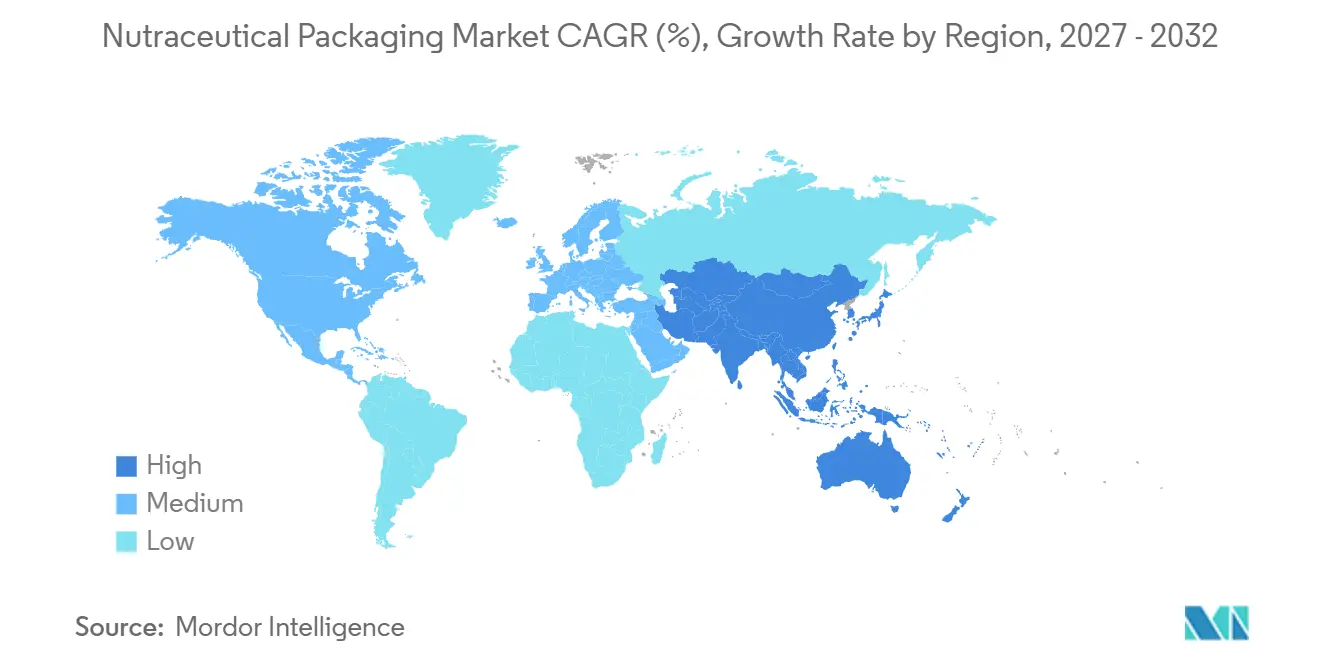
- By geography, North America held 34.82% of the nutraceutical packaging market share in 2026, while Asia-Pacific is forecast to advance at a 5.73% CAGR through 2032.
Note: Market numbers in this report are based on Mordor Intelligence's proprietary estimation framework, which combines nine months of actuals with Q4 projections for base year 2026.
Market Trends and Insights
Drivers Impact Analysis of Nutraceutical Packaging Market*
| Driver | (~) % Impact on CAGR Forecast | Geographic Relevance | Impact Timeline |
|---|---|---|---|
| Preventive Health and Wellness Consumption Growth | +1.4% | Global | Long term (≥ 4 years) |
| Expansion of Functional Foods, Beverages, and Dietary Supplements | +1.2% | Global, led by North America and Asia-Pacific | Medium term (2–4 years) |
| E-Commerce and Direct-to-Consumer Shipping Requirements | +0.9% | North America, Asia-Pacific, Europe | Medium term (2–4 years) |
| Packaging Sustainability Mandates and Recyclability Targets | +0.7% | Europe, North America, Asia-Pacific | Long term (≥ 4 years) |
| Micro-Batch SKU Proliferation and Faster Label Changeovers | +0.5% | North America, Europe | Medium term (2–4 years) |
| Source: Mordor Intelligence | |||
Preventive Health and Wellness Consumption Growth
Preventive nutrition is becoming a more established part of consumer health routines. This supports recurring demand for containers and flexible packs used for daily supplements and health-focused foods. The nutraceutical packaging market benefits when brand owners differentiate through amber glass, premium blisters, and individual-dose sachets instead of relying on basic commodity containers. Products such as nicotinamide mononucleotide, spermidine, and resveratrol are often sold in small quantities and require high-barrier amber vials. Their higher unit values can support the cost of more protective packaging. The World Health Organization stated in 2025 that cost-effective action on noncommunicable diseases and mental health could produce USD 1 trillion in economic benefits by 2030, which reinforces the broader policy focus on prevention[1].
Expansion of Functional Foods, Beverages, and Dietary Supplements
Functional foods expansion extends packaging demand from conventional supplement bottles into formats used in retail and cold-chain settings. Functional beverages and fortified foods require packs that can manage distribution, handling, and product protection under different conditions. Beverage-compatible pouches, aseptic cartons, and multi-serve rigid containers are therefore becoming more relevant. This broadening product mix increases the range of packaging formats used by nutraceutical brands.
E-Commerce and Direct-to-Consumer Shipping Requirements
Direct-to-consumer shipping exposes products to vibration, temperature cycles, and humidity during transit. The nutraceutical packaging market responds with stronger moisture barriers and closure systems that can protect product quality outside traditional retail distribution. Alu-alu cold-form blisters and desiccant-integrated high-density polyethylene bottles offer value where the formulation needs tighter protection. Secondary packaging alone cannot fully address risks that affect the primary package and the product it contains. Connected packaging also adds traceability and consumer information functions for brands that sell online. Japan's Foods with Health Claims framework is overseen by the Ministry of Health, Labour and Welfare and the Consumer Affairs Agency, which supports the use of traceability information as such channels develop.
Packaging Sustainability Mandates and Recyclability Targets
The European Union Packaging and Packaging Waste Regulation entered into force on February 11, 2025, and applies from August 12, 2026. The regulation requires recyclability performance grades for packaging placed on the European Union market by 2030, with recyclability-at-scale obligations becoming stricter from 2035. This makes the nutraceutical packaging market more receptive to mono-material alternatives that can meet both barrier and recycling requirements. Traditional polyvinyl chloride and polyvinylidene chloride blister structures face direct pressure where they do not meet the required grades. Amcor plc has registered its recycle-ready AmSky blister system for commercial orders, showing how compliance needs are influencing product development. The nutraceutical packaging market can therefore gain demand for new material systems as regulations change brand requirements.
Restraints Impact Analysis of Nutraceutical Packaging Market*
| Restraint | (~) % Impact on CAGR Forecast | Geographic Relevance | Impact Timeline |
|---|---|---|---|
| Complex Regulatory and Food-Contact Compliance Requirements | -0.9% | Global, particularly EU and North America | Long term (≥ 4 years) |
| Qualification Cost of High-Barrier and Child-Resistant Packaging | -0.6% | North America, Europe | Medium term (2–4 years) |
| Volatility in Resin, Aluminum, Glass, and Recycled-Content Supply | -0.5% | Global | Short term (≤ 2 years) |
| Source: Mordor Intelligence | |||
Complex Regulatory and Food-Contact Compliance Requirements
Nutraceutical packs must meet food-contact material requirements as well as dietary supplement labeling requirements. In the United States, the Food and Drug Administration states that dietary supplement manufacturers and distributors are responsible for ensuring their products are not adulterated or misbranded[2]. Packaging that contacts oral products must also meet applicable migration and material requirements. European Union requirements are becoming more demanding as the Packaging and Packaging Waste Regulation restricts certain substances and raises recyclability expectations. Brands entering both the United States and the European Union may face more testing, documentation, and longer launch processes. These costs can limit the number of products that mid-sized brands can introduce at one time.
Qualification Cost of High-Barrier and Child-Resistant Packaging
Child-resistant and high-barrier packs cost more than conventional packaging because they require specialized material engineering and validation. Testing must show that packs resist access by children while remaining accessible to seniors. Sanner Group noted that child-resistant packaging development requires a balance between safety and usability. Probiotics and moisture-sensitive botanical extracts may need alu-alu cold-form blisters, which raises qualification requirements and can extend development schedules. The cost burden is more difficult for direct-to-consumer start-ups and emerging-market brands to absorb. Mono-material conversion can create another qualification cycle where existing child-resistant solutions rely on multilayer composites.
*Our forecasts treat driver/restraint impacts as directional, not additive. The impact forecasts reflect baseline growth, mix effects, and variable interactions.
Nutraceutical Packaging Market Segment Analysis
By Product Form:
Tablets and Capsules Anchor Revenue and GrowthTablets and capsules are projected to account for 47.21% of the nutraceutical packaging market in 2026 and grow at a CAGR of 5.16% through 2032. This position reflects the continued importance of solid-dose formats in global supplement consumption and the packaging requirements established by brand owners. Moisture and oxygen sensitivity make high-density polyethylene bottles, aluminum-foil blisters, and alu-alu cold-form systems essential for these products, influencing material selection and filling-line planning. These requirements favor higher-value packaging specifications over basic containers and closely link packaging to product quality expectations. Powders and granules use jars, canisters, and resealable stand-up pouches, making supplier capabilities an important consideration during format selection. Protein and collagen powders continue to drive demand across sports nutrition and beauty-from-within applications, influencing cost, usability, and shelf presentation.
Liquid nutraceuticals use dropper bottles, amber glass vials, and spout pouches for functional shots, collagen drinks, and herbal tonics that require controlled dispensing and product protection throughout distribution. Other product formats include gummies, effervescent tablets, and lozenges, linking physical packaging design to product consumption. Gummies can increase demand for stand-up pouches with child-resistant zippers, influencing the selection between established and emerging packaging formats. In January 2025, Gerresheimer AG introduced its Connected Packaging platform at Paris Packaging Week, integrating Quick Response (QR) codes and Near Field Communication (NFC) tags into glass and plastic primary packaging. These features enable consumer engagement and anti-counterfeiting verification, further shaping brand owners’ packaging requirements. Therefore, the nutraceutical packaging market supports product formats that require both physical protection and consumer-facing information, influencing material selection and filling-line planning.

By Product Type:
Dietary Supplements Lead, While Functional Foods ExpandDietary supplements are projected to account for 43.63% of the nutraceutical packaging market in 2026, driven by repeat purchases of vitamins, minerals, and botanical products. Functional foods are expected to grow at a CAGR of 5.45% through 2032 as health-promoting ingredients expand into everyday food categories. This shift extends packaging demand beyond traditional dosage forms and keeps packaging closely tied to product quality expectations. Modified-atmosphere trays, high-barrier flexible films, and paper-based pouches serve applications that differ from standard supplement bottles, making supplier capabilities a key consideration during format selection. China’s Healthy China 2030 plan supports the development of health-promoting food products, increasing the relevance of these formats and influencing cost, usability, and shelf presentation. Consequently, the nutraceutical packaging market must address a broader range of retail and distribution requirements, with formats required to perform consistently throughout conventional distribution channels.
Functional beverages, including protein shakes, nootropic drinks, and probiotic shots, link physical packaging directly to consumer usage patterns. These products drive demand for aseptic packs, polyethylene terephthalate (PET) bottles with tamper-evident closures, and chilled pouches that support cold-chain distribution. These requirements can influence the selection between established and emerging packaging formats. Other product types, such as fortified confectionery, meal replacements, and nutritional products for clinical or elder-care settings, further shape packaging requirements specified by brand owners. In September 2025, Sonoco Products Company is expected to supply GreenCan paper-based composite cans for Laboratorios Best Medical’s Colagen Plus collagen supplement range. The project demonstrates the use of fiber-based packaging in a health-positioned product category, affecting both material selection and filling-line planning. The nutraceutical packaging industry can benefit as brands seek alternatives to traditional tin-and-plastic hybrid containers while maintaining packaging performance and product quality expectations.
By Packaging Type:
Bottles Lead While Bags and Pouches AccelerateBottles are expected to hold a 38.47% share of the nutraceutical packaging market in 2026. High-density polyethylene (HDPE) and polyethylene terephthalate (PET) bottles remain established primary packaging formats for tablets, capsules, and powders, making supplier capabilities a key consideration during format selection. Their widespread use reflects global tooling standards, supply chain familiarity, and established safety requirements, which collectively influence cost, usability, and shelf presentation. Push-and-turn child-resistant closures remain relevant for pharmacy-channel products, while shelf-footprint efficiency supports bottle use in mass retail environments, where packaging must perform consistently throughout standard distribution processes. Bottles also offer a familiar format for consumers who take supplements daily, aligning the physical package with product-use behavior. These attributes continue to sustain demand even as lightweight alternatives expand, influencing the choice between established and emerging packaging formats.
Bags and pouches are projected to grow at a CAGR of 5.82% through 2032 in the nutraceutical packaging market. Direct-to-consumer subscription brands value these formats for their lower weight, dimensional efficiency, and resealable designs, which influence packaging requirements set by brand owners. ProAmpac is expected to showcase its recycle-ready pouch portfolio and Fiberization of Packaging initiative at PACK EXPO 2025. Blisters and strips remain important for probiotics, effervescent tablets, and hygroscopic botanical products because they isolate each dose, affecting both material selection and filling-line planning. Jars and canisters remain relevant for protein and sports nutrition products, where packaging remains closely associated with product quality expectations. Composite paper cans, stick packs, and multi-use dispensing packs continue to gain attention in premium direct-to-consumer channels, making supplier capabilities an important consideration during format selection.
By Material:
Plastics Dominate, Paper and Paperboard Chart Fastest GrowthPlastics are projected to hold a 54.04% share of the nutraceutical packaging market in 2026. High-density polyethylene (HDPE) and polyethylene terephthalate (PET) are widely used in bottles, jars, and flexible packaging formats, influencing cost, usability, and shelf presentation. Food-contact recycled-content requirements are shifting procurement toward post-consumer recycled (PCR) grades, requiring packaging formats to perform consistently throughout standard distribution channels. However, the limited supply of food-contact-grade PCR resin remains a concern for packaging buyers and affects how physical packaging aligns with consumer usage requirements. Aluminum foil continues to play a critical role in blister packs and composite can components that require high barrier performance, influencing the selection between established and emerging packaging formats. Glass remains important for functional beverage shots and liquid supplements, where its inertness and premium presentation justify higher logistics costs and shape brand owners’ packaging requirements.
Paper and paperboard packaging are projected to grow at a CAGR of 5.91% through 2032 in the nutraceutical packaging market. Retailer scorecards, packaging regulations, and consumer interest in fiber-based packaging are supporting this growth, affecting both material selection and filling-line planning. In August 2025, Mondi scaled up FunctionalBarrier Paper Ultimate, an ultra-high-barrier paper solution designed for moisture-sensitive products, including vitamins, probiotics, and herbal extracts. The solution addresses product quality expectations by providing enhanced protection. Sonoco Products Company stated that its GreenCan contains at least 96% paper content, including 69% post-consumer recycled material. However, paper-based formats must still meet the protection requirements of sensitive active ingredients, making supplier capabilities a critical consideration during format selection. Material selection therefore remains closely tied to each product’s moisture, oxygen, safety, and recycling requirements, which collectively influence cost, usability, and shelf presentation.
Geography Analysis
North America Nutraceutical Packaging Market
North America held 34.82% of the nutraceutical packaging market share in 2026. The region benefits from a large dietary supplement retail channel and mature quality expectations. The Dietary Supplement Health and Education Act framework adds to the need for compliant packaging and labeling practices. Direct-to-consumer sales also require packs that protect products in transit. Growth through 2032 is expected from higher-barrier formats, connected packaging, and sustainable substitutions.
APAC Nutraceutical Packaging Market
Asia-Pacific is projected to advance at a 5.73% CAGR through 2032 in the nutraceutical packaging market. China, Japan, South Korea, India, and the Association of Southeast Asian Nations (ASEAN) countries have different regulatory systems, distribution methods, and consumer preferences. China is increasing the need for validated barrier and tamper-evident packaging, while India's Production Linked Incentive Scheme is attracting domestic packaging investment. Japan's aging population supports demand for individual-dose packs that protect efficacy. Online platforms in Japan and South Korea also support the supplement trade across Southeast Asia.
EMEA and South America Nutraceutical Packaging Market
Europe remains a key region because the Packaging and Packaging Waste Regulation applies from August 12, 2026. Germany, the United Kingdom, France, Italy, and the Nordic countries are core regional markets. Brands face strong pressure to convert blister and flexible packaging into recyclable mono-material alternatives. South America, the Middle East, and Africa offer room for growth as urbanization and health expenditure increase.
Competitive Landscape
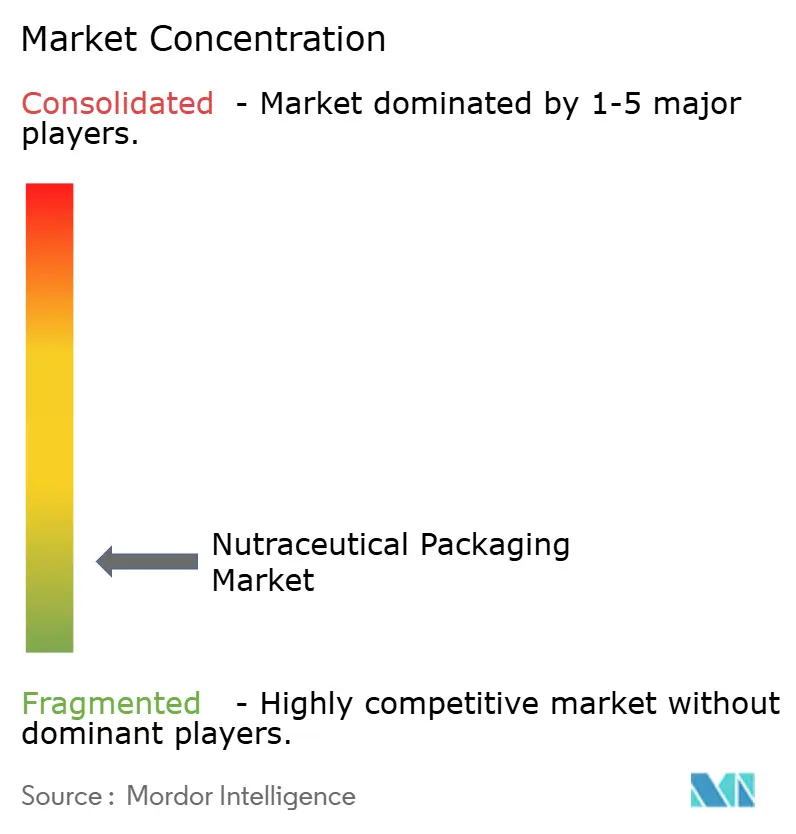
The nutraceutical packaging market is highly fragmented, with the top five players including Amcor plc, Sonoco Products Company, Smurfit Westrock, Mondi, and Huhtamäki Oyj. Suppliers compete on format coverage, sustainability credentials, product protection, and supply-chain reach. Rigid-packaging specialists compete where dispensing systems, glass, closures, and child resistance are central requirements. The nutraceutical packaging market rewards suppliers that can meet flexible, rigid, fiber-based, and connected-packaging needs.
Amcor plc completed its all-stock combination with Berry Global on April 30, 2025. The company targeted USD 650 million in pre-tax synergies by fiscal 2028, including USD 260 million in fiscal 2026. This combination broadens its flexible and rigid packaging platform across customer relationships. Constantia Flexibles strengthened its high-barrier flexible film position through a majority stake acquisition in Aluflexpack. Gerresheimer AG commercialized connected packaging through a platform that integrates Quick Response codes and Near Field Communication tags.
Paper-based platform suppliers are building positions in supplement-related applications. Sonoco Products Company is expanding GreenCan customer references in protein powder and collagen products. Smurfit Westrock opened its HORIZON facility near Dublin Airport in November 2025. Domestic converters in China and India are investing in high-barrier film capabilities, which can narrow the quality advantage global suppliers have historically held.
Nutraceutical Packaging Industry Leaders
-
Amcor plc
-
Sonoco Products Company
-
Smurfit Westrock
-
Mondi
-
Huhtamäki Oyj
- *Disclaimer: Major Players sorted in no particular order
Nutraceutical Packaging Market Companies Covered in this Report
- Amcor plc
- Aptar
- CCL Industries Inc.
- Comar, LLC
- Constantia Flexibles
- Gerresheimer AG
- Glenroy, Inc.
- Huhtamäki Oyj
- Mondi
- ProAmpac
- Sealed Air Corporation
- Silgan Holdings Inc.
- Smurfit Westrock
- Sonoco Products Company
- TricorBraun
Recent Industry Developments in Nutraceutical Packaging Market
- June 2026: Pure Form Solution launched a polyhydroxyalkanoate (PHA)-based biodegradable packer bottle designed as an alternative to conventional PET and HDPE bottles used for vitamins, supplements, and nutraceutical products. The launch supports the nutraceutical packaging market by introducing compostable packaging options that address demand for reduced reliance on conventional petroleum-based plastics.
- May 2026: KWK, part of Guala Closures Group, and Guala Closures presented integrated nutraceutical packaging solutions at Vitafoods Europe 2026, including child-resistant and tamper-evident closures, aluminum screw caps, and precision-dosing devices. The portfolio supports the nutraceutical packaging market by improving product protection, dosing accuracy, packaging functionality, and differentiation for liquid supplements.
Global Nutraceutical Packaging Market Report Scope
Nutraceutical packaging refers to packaging solutions designed to protect products containing nutrients and bioactive ingredients from moisture, oxygen, light, and contamination. These solutions help maintain product quality, shelf life, and safety during storage, transportation, and distribution.
The Nutraceutical Packaging Market is segmented by product form, product type, packaging type, material, and geography. By product form, the market is segmented into tablets and capsules, powder and granules, liquid, and other product forms. By product type, the market is segmented into dietary supplements, functional foods, functional beverages, and other product types. By packaging type, the market is segmented into blisters and strips, bottles, jars and canisters, bags and pouches, and other packaging types. By material, the market is segmented into plastics, paper and paperboard, metals, glass, and other materials. The report also covers the market size and forecasts for nutraceutical packaging across 15 countries. For each segment, the market sizing and forecasts have been done on the basis of value (USD).
Segmentation Overview
| Tablets and Capsules |
| Powder and Granules |
| Liquid |
| Other Product Forms |
| Dietary Supplements |
| Functional Foods |
| Functional Beverages |
| Other Product Types |
| Blisters and Strips |
| Bottles |
| Jars and Canisters |
| Bags and Pouches |
| Other Packaging Types |
| Plastics |
| Paper and Paperboard |
| Metals |
| Glass |
| Other Materials |
| Asia-Pacific | China |
| India | |
| Japan | |
| South Korea | |
| ASEAN Countries | |
| Rest of Asia-Pacific | |
| North America | United States |
| Canada | |
| Mexico | |
| Europe | Germany |
| United Kingdom | |
| France | |
| Italy | |
| NORDIC Countries | |
| Rest of Europe | |
| South America | Brazil |
| Argentina | |
| Rest of South America | |
| Middle East and Africa | Saudi Arabia |
| South Africa | |
| Rest of Middle East and Africa |
| By Product Form | Tablets and Capsules | |
| Powder and Granules | ||
| Liquid | ||
| Other Product Forms | ||
| By Product Type | Dietary Supplements | |
| Functional Foods | ||
| Functional Beverages | ||
| Other Product Types | ||
| By Packaging Type | Blisters and Strips | |
| Bottles | ||
| Jars and Canisters | ||
| Bags and Pouches | ||
| Other Packaging Types | ||
| By Material | Plastics | |
| Paper and Paperboard | ||
| Metals | ||
| Glass | ||
| Other Materials | ||
| By Geography | Asia-Pacific | China |
| India | ||
| Japan | ||
| South Korea | ||
| ASEAN Countries | ||
| Rest of Asia-Pacific | ||
| North America | United States | |
| Canada | ||
| Mexico | ||
| Europe | Germany | |
| United Kingdom | ||
| France | ||
| Italy | ||
| NORDIC Countries | ||
| Rest of Europe | ||
| South America | Brazil | |
| Argentina | ||
| Rest of South America | ||
| Middle East and Africa | Saudi Arabia | |
| South Africa | ||
| Rest of Middle East and Africa | ||
Key Questions Answered in the Report
What is the size of the nutraceutical packaging market?
The nutraceutical packaging market size was valued at USD 4.76 billion in 2026 and is estimated to grow from USD 4.98 billion in 2027 to reach USD 6.29 billion by 2032, at a CAGR of 4.79% during the forecast period (2027-2032).
What is driving demand for nutraceutical packaging?
Preventive health consumption, functional foods, direct-to-consumer distribution, and recyclable pack requirements are supporting demand.
Which product form leads the nutraceutical packaging demand?
Tablets and capsules held a 47.21% share in 2026 and are projected to advance at a 5.16% CAGR through 2032.
Which packaging type is projected to advance through 2032?
Bags and pouches are projected to advance at a 5.82% CAGR through 2032, supported by lightweight and resealable direct-to-consumer formats.