
Not From Concentrate Puree Market Size and Share
Market Overview
| Study Period | 2021 - 2031 |
|---|---|
| Market Size (2026) | USD 5.37 Billion |
| Market Size (2031) | USD 7.11 Billion |
| Growth Rate (2026 - 2031) | 5.78 % |
| Fastest Growing Market | Asia-Pacific |
| Largest Market | North America |
| Market Concentration | Low |
Major Players *Disclaimer: Major Players sorted in no particular order Image © Mordor Intelligence. Reuse requires attribution under CC BY 4.0. | |
Not From Concentrate Puree Market Analysis by Mordor Intelligence
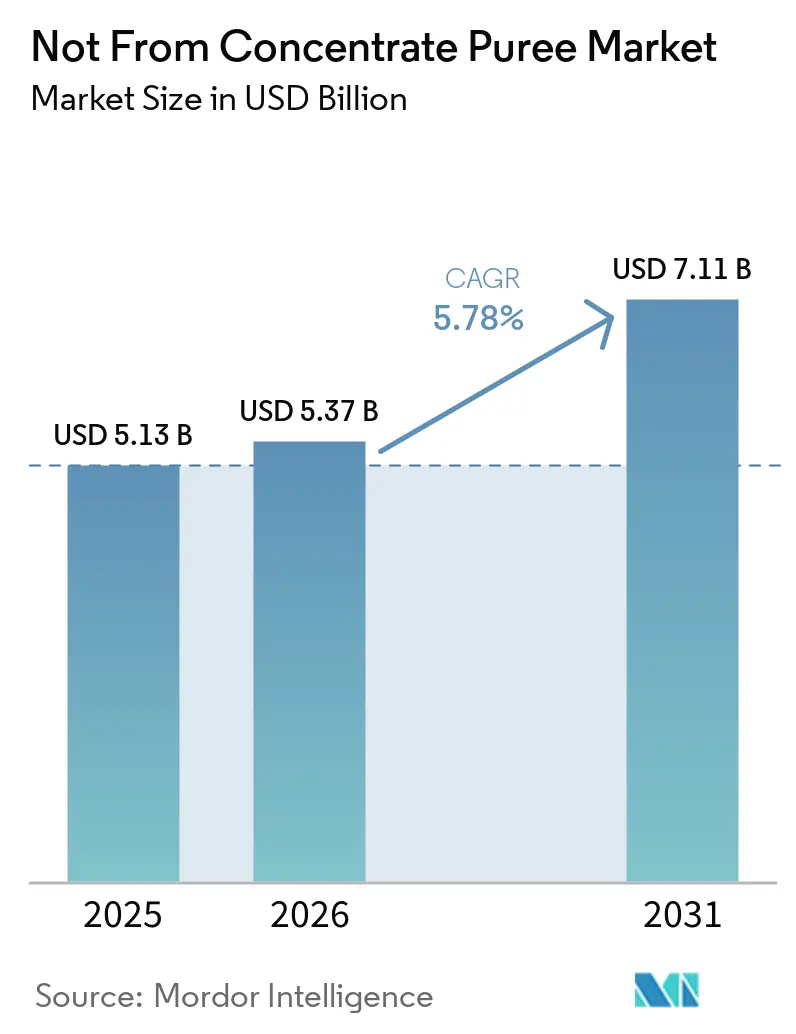
The not from concentrate puree market size is projected to expand from USD 5.13 billion in 2025 and USD 5.37 billion in 2026 to USD 7.11 billion by 2031, registering a CAGR of 5.78% between 2026 and 2031. The not from concentrate puree market is supported by food and beverage buyers moving from reconstituted concentrates toward single-strength ingredients. These ingredients retain fruit aroma, fiber, color, and bioactive compounds that can be lost during concentration. Clean-label reformulation is making this distinction more important for manufacturers in North America and Europe. Premium beverage, dairy, bakery, infant nutrition, and foodservice products all use the format to support simpler ingredient labels. Competition centers on quality validation, documented traceability, supply reliability, and sustainability credentials rather than price alone.
Key Report Takeaways
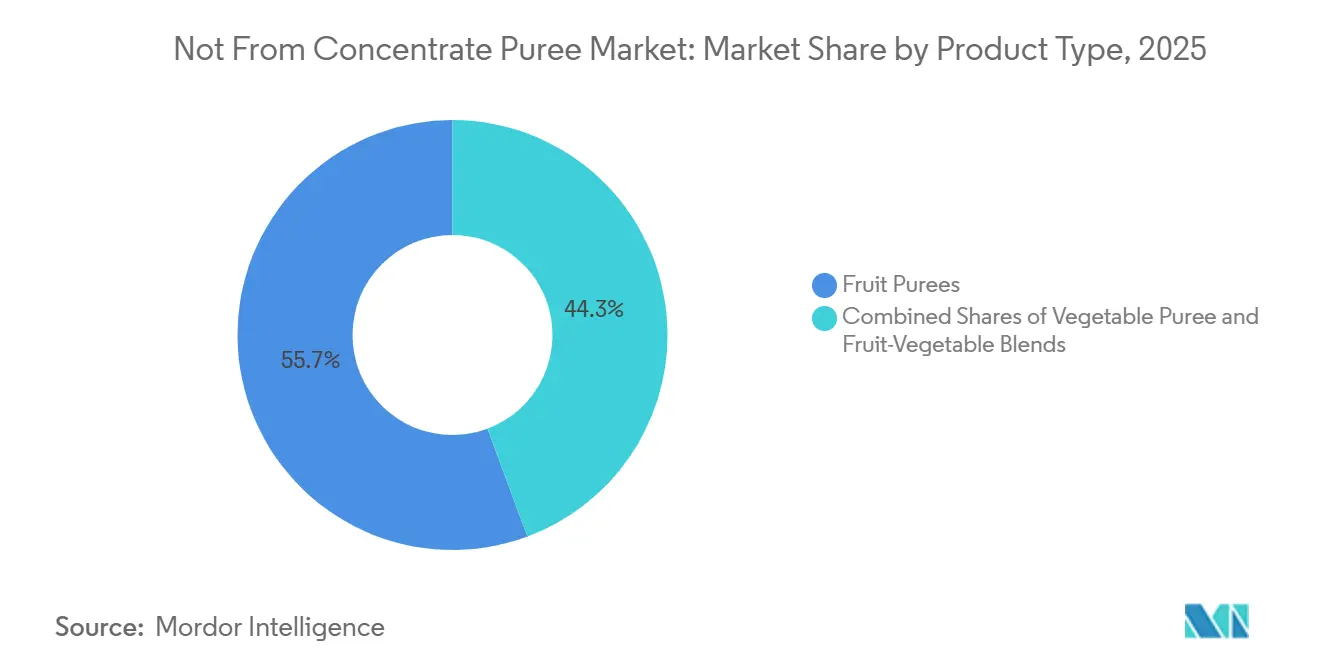
- By product type, fruit purees held 55.68% of the not from concentrate puree market share in 2025, while vegetable purees are forecast to grow at an 7.11% CAGR through 2031.
- By category, conventional products held 72.38% of the not from concentrate puree market share in 2025, while organic products are forecast to grow at a 6.56% CAGR through 2031.
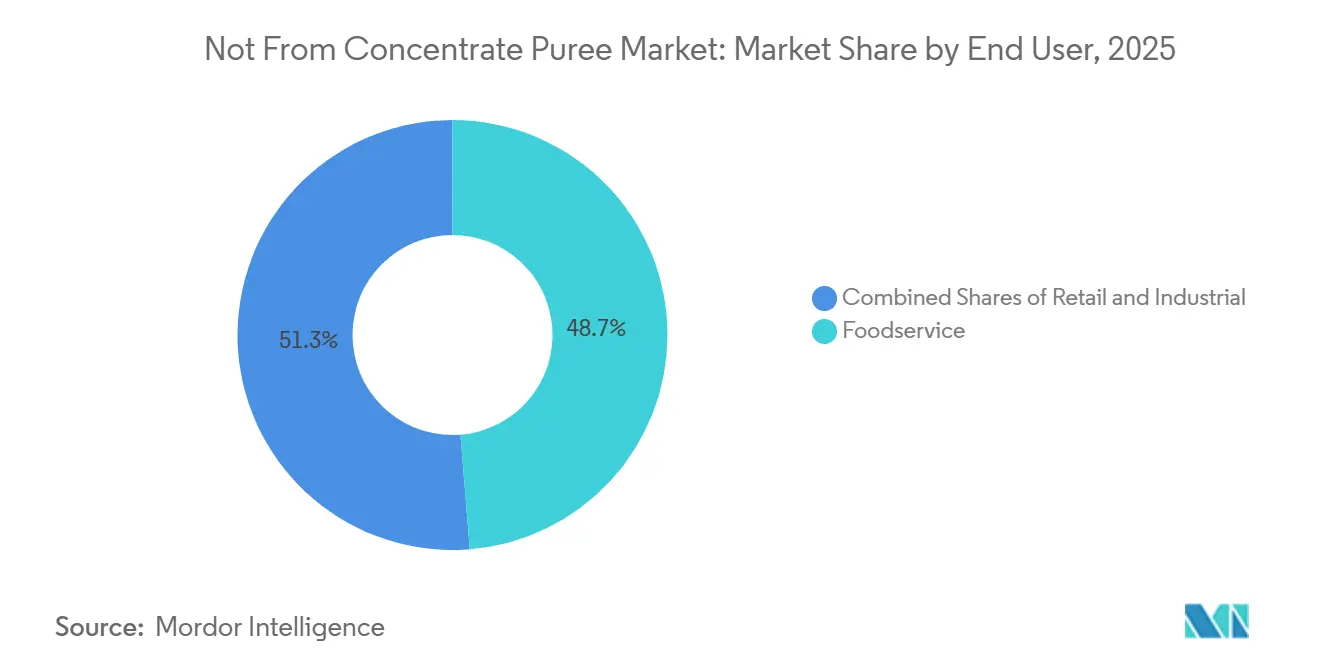
- By end user, foodservice held 48.72% of the not from concentrate puree market share in 2025, while industrial processing is forecast to grow at a 7.34% CAGR through 2031.
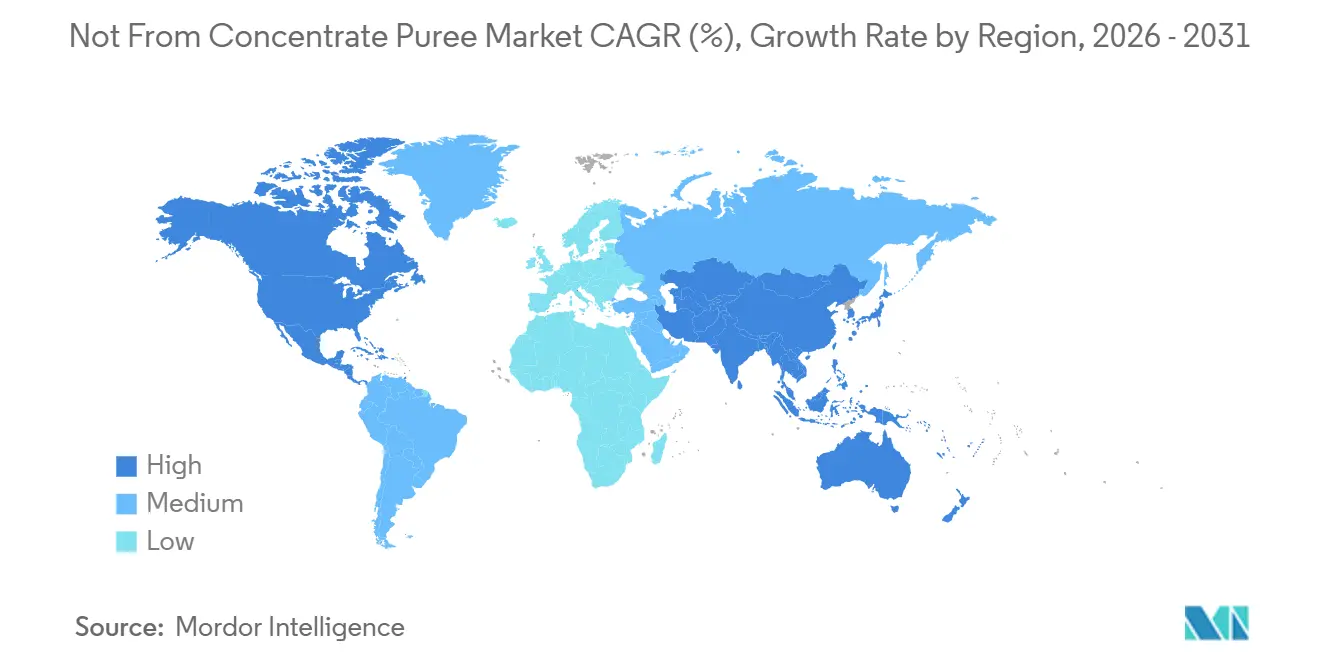
- By geography, North America held 45.82% of the not from concentrate puree market share in 2025, while Asia-Pacific is forecast to grow at a 6.69% CAGR through 2031.
Note: Market size and forecast figures in this report are generated using Mordor Intelligence’s proprietary estimation framework, updated with the latest available data and insights as of January 2026.
Global Not From Concentrate Puree Market Trends and Insights
Drivers Impact Analysis*
| Driver | (~) % Impact on CAGR Forecasts | Geographic Relevance | Impact Timeline |
|---|---|---|---|
| Growing Demand for Natural and Minimally Processed Ingredients | +1.4% | Global, led by North America and Western Europe | Short term (≤ 2 years) |
| Rising Clean-Label Product Development | +1.2% | North America and EU, extending to APAC urban cores | Medium term (2-4 years) |
| Increasing Demand for Premium Fruit-Based Beverages | +0.7% | North America, Europe, and APAC premium beverage hubs | Short term (≤ 2 years) |
| Expansion of Organic Food and Beverage Products | +0.6% | North America and EU, with early momentum in APAC | Medium term (2-4 years) |
| Expansion of Infant Nutrition, Smoothies, and Functional Beverages | +0.9% | Global, with highest demand pull in North America and APAC | Short term (≤ 2 years) |
| High Pressure Processing and Cold-Aseptic Processing Preserving Fresh-Like Quality | +0.5% | North America, EU, and APAC premium processing tier | Medium term (2-4 years) |
| Source: Mordor Intelligence | |||
Growing Demand for Natural and Minimally Processed Ingredients
Consumer demand for recognizable and traceable ingredients remains a central driver for the not from concentrate puree market. The 2025 IFIC Food and Health Survey found that 41% of U.S. consumers sought natural claims and 30% prioritized organic products[1]. Not from concentrate puree provides sweetness, color, fiber, and pH support in one ingredient, which can reduce listed additives. Food manufacturers use it in beverages, yogurt inclusions, baby food, condiments, frozen desserts, and bakery fillings. Buyers also require consistent Brix specifications, microbiological control, origin documentation, and dependable delivery. The format is most useful where product teams need simpler formulas while retaining an authentic fruit or vegetable profile.
Expansion of Infant Nutrition, Smoothies, and Functional Beverages
Infant nutrition is a tightly controlled application for NFC puree suppliers. The Baby Food Safety Act of 2026 was introduced in Congress with proposed limits for lead, cadmium, mercury, and arsenic in foods largely made from fruit or vegetable purees[2]. This proposal places greater attention on supplier records and testing documentation. Processors with established traceability systems can meet more demanding buyer review processes. Functional beverages also use NFC puree in vitamin-fortified smoothies, probiotic juice blends, and sports recovery drinks. These requirements make the not from concentrate puree market more dependent on documented quality systems. Quintus Technologies reports that high-pressure processing can support nutrient retention, food safety, and clean-label positioning for infant and toddler puree products.
High Pressure Processing and Cold-Aseptic Processing Preserving Fresh-Like Quality
High-pressure processing is extending the commercial use of premium puree beyond very short refrigerated shelf-life formats. Universal Pure states that processing at 6,000 bar can achieve more than a 5-log reduction of E. coli, Salmonella, and Listeria monocytogenes in juice applications. The company also reports refrigerated shelf life of 45 to 60 days, compared with 3 to 7 days without processing. A 2026 study found that HPP at 400 MPa preserved phenolic content and antioxidant capacity in pineapple puree better than conventional heating at 80°C. Cold-aseptic processing can provide ambient shelf life of 12 to 18 months, which improves distribution options for industrial and foodservice customers. These technologies require capital and increase processing costs, but they enable the not from concentrate puree market to support a fresh-like quality position for suppliers with secure customer volumes.
Expansion of Organic Food and Beverage Products
Organic demand is changing ingredient specifications for premium retail, infant food, and higher-value foodservice products. The USDA Strengthening Organic Enforcement rule has required organic certificates for imported ingredients in certified U.S. supply chains since March 2024. This raises documentation requirements for overseas puree suppliers serving certified customers. European buyers also apply organic-production and pesticide-residue requirements when qualifying suppliers[3]. The not from concentrate puree market has an opportunity where verified organic supply can meet both consumer expectations and retailer procurement rules. SVZ International notes that fresh, natural, and clean-label claims differentiate NFC juices and purees from concentrate alternatives.
Restraints Impact Analysis*
| Restraint | (~) % Impact on CAGR Forecasts | Geographic Relevance | Impact Timeline |
|---|---|---|---|
| High Raw Material Costs | -0.9% | Global, most acute in Southeast Asian and Eastern European sourcing zones | Short term (≤ 2 years) |
| Seasonal Availability of Fruits | -0.7% | Global, most acute for single-origin and tropical fruit processors | Short term (≤ 2 years) |
| Higher Production and Processing Costs | -0.5% | North America and the EU, with energy- and labor-intensive processing | Medium term (2-4 years) |
| Competition from Concentrates and Alternative Fruit Ingredients | -0.4% | Global, strongest in price-sensitive South American and Southeast Asian markets | Long term (≥ 4 years) |
| Source: Mordor Intelligence | |||
High Raw Material Costs and Seasonal Availability of Fruits
Agricultural inputs are the largest cost component in NFC puree production. Prices can change with weather conditions, currency movements, harvest yields, and commodity cycles. NFC processors have less flexibility than concentrate producers because they cannot use Brix adjustments and water addition to reduce the effect of higher input costs. Patulin risk in apples and variable mango yields can add trim losses and raw material rejection costs. Apple, mango, and tropical fruit harvests are concentrated within limited seasons and locations. This exposure can limit the not from concentrate puree market when processors cannot secure several qualified origins. AGRANA reported that frost damage to the 2026 Central European apple crop created idle costs and reduced beverage contribution margins.
Higher Production Costs and Competition from Concentrates
Aseptic and high-pressure processing use energy and require specialized equipment. These costs can place pressure on margins, especially in North American and Western European facilities with higher energy and labor costs. AGRANA expects significantly weaker earnings in its Beverages segment during FY 2026/27 because of lower contribution margins from the 2025 apple harvest. Fruit juice concentrates also remain a lower-cost option for buyers focused on shelf life and transport efficiency. They can be stored for 12 to 18 months at ambient conditions, which is valuable in South American and Southeast Asian locations with developing cold-chain capacity. The not from concentrate puree market must therefore demonstrate product quality, traceability, and sustainability value where it competes with concentrates.
*Our forecasts treat driver/restraint impacts as directional, not additive. The impact forecasts reflect baseline growth, mix effects, and variable interactions.
Segment Analysis
By Product Type: Fruit Purees Hold the Largest Position, While Vegetable Purees Grow Faster
Fruit purees accounted for 55.68% of demand in 2025. This position reflects established supply chains for mango, apple, strawberry, pineapple, passion fruit, and berry varieties. These varieties have familiar specifications and fit beverages, dairy products, infant food, and bakery fillings. Fruit formats give buyers a known option when they need consistent Brix values and broad application use. India’s favorable 2025 growing conditions and government support led to a bumper mango crop. This reduced Totapuri mango puree prices to multiyear lows and demonstrated the importance of India in tropical NFC supply. Fruit and vegetable blends occupy a developing middle position among buyers seeking flavor balance and nutrient density. Spinach-apple and beetroot-berry blends are used in children’s pouches, sports nutrition, and premium smoothie products. Such combinations allow brands to include vegetables without depending on a single strong vegetable flavor.
Vegetable purees are forecast to expand at a 7.11% CAGR through 2031. This growth exceeds the overall rate and reflects demand for plant-based foods and infant nutrition applications. The not from concentrate puree market size for vegetable purees also benefits from their use as natural colorants and sweetness modifiers. Carrot, butternut squash, pea, and beet formats extend the application base beyond traditional baby food. Foodservice operators use vegetable-inclusive purees in soups, sauces, and ready-to-use meal components. RSC Publishing found that HPP-treated pineapple puree retained higher antioxidant capacity and phenolic content than thermally processed material. The result supports quality claims for processors that serve functional food buyers. It also shows why processing capability can affect product positioning across fruit and vegetable applications.

By Category: Conventional Products Lead Volume, While Organic Supply Gains Importance
Conventional products accounted for 72.38% of demand in 2025. Their lead comes from cost competitiveness in industrial processing, mass foodservice, and price-sensitive retail. High-volume buyers often place greater weight on formulation cost than on organic positioning. Conventional supply remains suitable for applications where a final product label does not require certified organic ingredients. The category serves large dairy, bakery, beverage, and prepared-food production runs. It also provides a wider sourcing base for manufacturers managing costs across varied fruit types. This advantage helps the not from concentrate puree market serve bulk applications with stable demand and standardized specifications. Retail customers still compare organic and exotic-fruit premiums directly against their willingness to pay. This makes retail the most visible channel for assessing raw material cost pass-through.
Organic products are projected to grow at a 6.56% CAGR through 2031. The organic category is supported by premium retail, infant food, and upscale foodservice procurement. The 2024 USDA enforcement rule requires documented organic certificates for imported ingredients entering certified U.S. supply chains. European infant-food manufacturers also use organic certification and pesticide-residue compliance in supplier qualification. Organic raw materials for most fruit varieties cost 15% to 25% more than conventional equivalents. The 2025 IFIC survey showed that 30% of U.S. consumers actively sought organic products. This demand can support premiums in retail-facing categories. The biggest difference between organic and conventional demand appears in infant nutrition, where brand owners face close retailer and consumer scrutiny.
By End User: Foodservice Leads Demand, While Industrial Processing Expands Faster
Foodservice held 48.72% of demand in 2025. Smoothie operators, juice bars, restaurant chains, and quick-service restaurants use NFC puree in beverages, sauces, and desserts. The format supports crafted menus that need fruit-forward flavor and more transparent ingredient lists. Foodservice customers also need products that work efficiently in busy operating settings. Oregon Fruit Company launched shelf-stable Pourable Fruit in October 2024 with 10 SKUs across Smooth, Diced, and Unsweetened formats. The line was made available nationally through Dot Foods for quick-service restaurants, coffee shops, and bars. Its packaging addressed the need for operational convenience without moving to concentrate-based syrups. This supports the not from concentrate puree market where operators need both speed and recognizable fruit content. The refresher beverage category doubled its market penetration in the 4 years before 2025, supporting continuing demand from coffee shops, bars, and fast-casual chains.
Industrial processing is expected to grow at a 7.34% CAGR through 2031. Food manufacturers are replacing concentrates in dairy blends, bakery fillings, and functional food lines. They do so to meet clean-label retailer requirements and support premium product repositioning. Private-label premium ranges in North American and European grocery stores are contributing to this shift. Manufacturers supplying smoothies, yogurts, and health bars use NFC puree to support ingredient transparency on packs. The not from concentrate puree market is therefore becoming more relevant to B2B formulation supply. Industrial customers also require consistent specifications and dependable delivery across large production programs. Retail remains the third channel and covers pouches, jars, and bottles sold directly to consumers. Its price transparency makes it particularly sensitive to changes in raw material costs.
Geography Analysis
North America accounted for 45.82% of demand in 2025. The United States has a mature clean-label retail environment, active premium beverage development, and established cold-chain logistics. California and the Pacific Northwest are active procurement areas for NFC ingredients because of health-focused consumers and food safety requirements. Canada follows similar demand patterns in clean-label beverages and infant nutrition. Mexico serves both as a tropical puree origin and a growing buyer of premium NFC-format imports. AGRANA added a packaging plant in Jacona, Mexico, during FY 2025/26. Europe held the second-largest regional position, led by Germany and France in organic infant nutrition and premium dairy applications. Organic certification and residue requirements give the not from concentrate puree market a stable qualification threshold among Western European suppliers.
Asia-Pacific is forecast to grow at a 6.69% CAGR through 2031. Growing urban populations in China, India, Vietnam, South Korea, and Indonesia are increasing demand for health-oriented food and beverages. India combines a large export role for mango and guava puree with increasing domestic use in food and beverage manufacturing. Rising health awareness and beverage premiumization support this domestic demand. Vietnam and Indonesia are adding cold-chain processing capacity for NFC puree exports. Lower agricultural input costs and proximity to tropical fruit are advantages for these countries. Drought and saltwater intrusion in important growing areas can weaken supply reliability. Buyers are managing this risk through multiple origins and documented contingency sourcing. These investments broaden the not from concentrate puree market across the region. Japan and South Korea are premium import-dependent markets where NFC formats can command stronger price positioning in ready-to-drink beverages.
South America is becoming a more important sourcing and demand region for the not from concentrate puree market. Brazil, Argentina, Chile, Peru, and Colombia provide mango, passion fruit, guava, and citrus supply. These countries also have growing domestic use in premium beverages and functional foods. Brazil has one of the Southern Hemisphere’s more developed tropical fruit processing bases. Currency movements and logistics gaps still create uncertainty in landed costs for export buyers. The Middle East and Africa includes UAE and Saudi Arabia as premium import destinations. South Africa and Nigeria are emerging as domestic processing locations. AGRANA expanded fruit-preparation capacity in Akbou, Algeria, during FY 2025/26. The investment brings processing closer to agricultural origins and growing regional demand.
Competitive Landscape
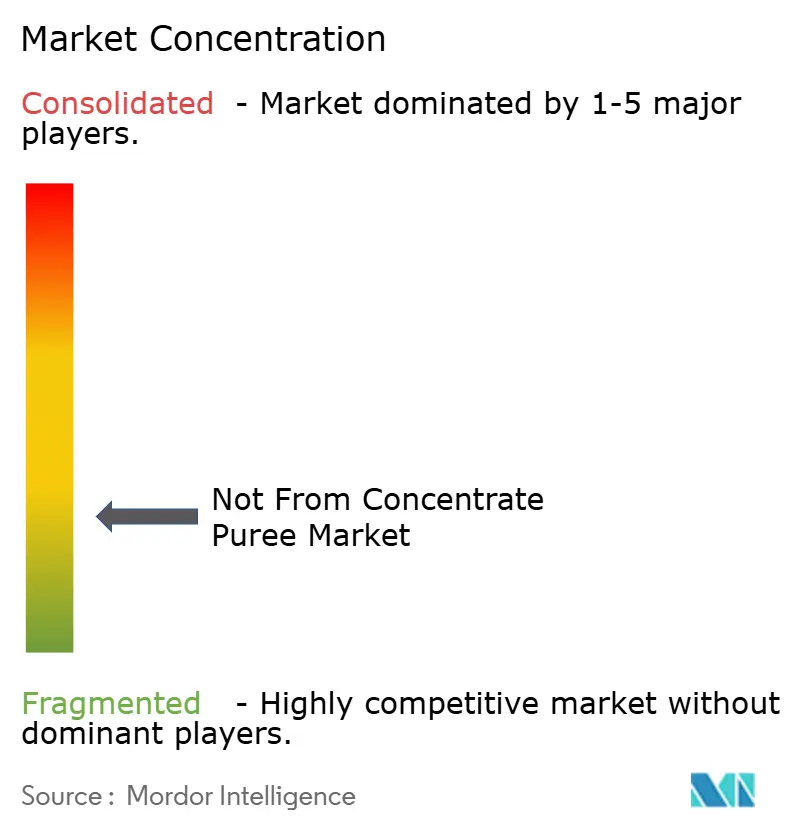
The not from concentrate puree market has a fragmented supplier structure. It includes global ingredient groups, specialist puree cooperatives, regional processors, and integrated fruit companies. No single supplier has enough scale to set pricing or supply conditions across every region and application. Large processors compete through capacity, sourcing access, quality systems, and customer relationships. Smaller suppliers can compete through specific fruit varieties, origin credentials, and flexible customer service. Regulatory requirements are increasing the value of documented traceability. Suppliers without these systems can struggle to qualify for premium and infant-nutrition tenders. This creates an advantage for companies that can combine fruit processing with technical and regulatory support. The competitive environment still leaves room for regional specialists in unique fruit varieties and customer-specific blends.
Refresco completed its acquisition of SunOpta for USD 6.50 per share in May 2026. The transaction brought SunOpta’s North American plant-based and organic ingredient capabilities into Refresco’s beverage platform across North America, Europe, and Australia. Ingredion announced a recommended all-cash acquisition of Tate & Lyle in June 2026. The proposed transaction carried an enterprise value of USD 5 billion and anticipated USD 130 million in run-rate net cost synergies by the end of 2030. These moves reflect the value of broader sourcing, formulation expertise, and compliance systems. They can strengthen the ability to serve food and beverage manufacturers that need coordinated ingredient support. Scale does not remove the importance of specialized NFC processing, but it improves access to customers and technical resources. The not from concentrate puree market remains open to processors that can meet customer specifications with consistent supply.
Opportunities remain in certified organic vegetable purees for infant nutrition. HPP-processed exotic and tropical varieties can address premium ready-to-drink beverage demand. Custom functional blends can serve sports nutrition and wellness applications. AGRANA invested EUR 64 million in Food and Beverage Solutions capital spending during FY 2025/26. The program included capacity additions in Algeria, Egypt, and Mexico. Kerry Group reported FY 2025 revenue of EUR 6,758 million and EBITDA of EUR 1,208 million. Kerry also expanded manufacturing in emerging markets and strengthened its customer innovation center network. These strategies position the company in the not from concentrate puree market to support more customized food and beverage development.
Not From Concentrate Puree Industry Leaders
-
Döhler GmbH
-
AGRANA Beteiligungs-AG
-
SunOpta Inc.
-
Kerry Group plc
-
The Kraft Heinz Company
- *Disclaimer: Major Players sorted in no particular order
Recent Industry Developments
- May 2026: Shanghai Gofun Machinery launched a new Mango NFC Juice Processing Line designed to produce premium not-from-concentrate mango juice while preserving the fruit’s natural flavor, aroma, color, and nutritional value. The automated, scalable system integrates enzymatic treatment, centrifugation, deaeration, homogenization, pasteurization, and aseptic filling, enabling processors to produce additive-free NFC juice and convert seasonal mangoes into higher-value beverages.
- January 2026: Oregon Fruit Company released a limited-season Sicilian Lemon aseptic puree from Femminello lemons grown in Sicily. The release used origin-specific sourcing and controlled availability for craft beverages, artisan food, and upscale bartending customers.
- March 2025: Odwalla launched a new line of natural juices and smoothies, featuring 100% juice blends and fruit-based smoothies made without added sugars, high-fructose corn syrup, artificial flavors, or preservatives. The portfolio includes a not-from-concentrate Valencia orange juice and a 100% mango-purée smoothie, highlighting the growing focus on premium, natural, and minimally processed fruit beverages.
Global Not From Concentrate Puree Market Report Scope
| Fruit Purees |
| Vegetable Purees |
| Fruit and Vegetable Blends |
| Conventional |
| Organic |
| Retail |
| Foodservice |
| Industrial Processing |
| North America | United States |
| Canada | |
| Mexico | |
| Rest of North America | |
| Europe | Germany |
| United Kingdom | |
| France | |
| Italy | |
| Spain | |
| Netherlands | |
| Sweden | |
| Poland | |
| Belgium | |
| Rest of Europe | |
| Asia-Pacific | China |
| India | |
| Japan | |
| Australia | |
| South Korea | |
| Vietnam | |
| Indonesia | |
| Rest of Asia-Pacific | |
| South America | Brazil |
| Argentina | |
| Chile | |
| Peru | |
| Colombia | |
| Rest of South America | |
| Middle East and Africa | United Arab Emirates |
| Saudi Arabia | |
| South Africa | |
| Nigeria | |
| Rest of Middle East and Africa |
| Product Type | Fruit Purees | |
| Vegetable Purees | ||
| Fruit and Vegetable Blends | ||
| Category | Conventional | |
| Organic | ||
| End User | Retail | |
| Foodservice | ||
| Industrial Processing | ||
| By Geography | North America | United States |
| Canada | ||
| Mexico | ||
| Rest of North America | ||
| Europe | Germany | |
| United Kingdom | ||
| France | ||
| Italy | ||
| Spain | ||
| Netherlands | ||
| Sweden | ||
| Poland | ||
| Belgium | ||
| Rest of Europe | ||
| Asia-Pacific | China | |
| India | ||
| Japan | ||
| Australia | ||
| South Korea | ||
| Vietnam | ||
| Indonesia | ||
| Rest of Asia-Pacific | ||
| South America | Brazil | |
| Argentina | ||
| Chile | ||
| Peru | ||
| Colombia | ||
| Rest of South America | ||
| Middle East and Africa | United Arab Emirates | |
| Saudi Arabia | ||
| South Africa | ||
| Nigeria | ||
| Rest of Middle East and Africa | ||
Key Questions Answered in the Report
How large is the not from concentrate puree market?
The category is estimated at USD 5.37 billion in 2026 and is forecast to reach USD 7.11 billion by 2031, with a 5.78% CAGR.
Which NFC puree type is growing fastest?
Vegetable purees are forecast to grow at an 7.11% CAGR through 2031, supported by plant-based products, infant nutrition, and natural color applications.
Why are organic NFC purees gaining attention?
Organic products are forecast to grow at a 6.56% CAGR through 2031, supported by certification requirements and premium retail and infant-food demand.
Which region has the strongest NFC puree demand?
North America held 45.82% of demand in 2025, while Asia-Pacific is expected to grow fastest at a 6.69% CAGR through 2031.