
Market Overview
| Study Period | 2021 - 2031 |
|---|---|
| Forecast Data Period | 2026 - 2031 |
| Historical Data Period | 2021 - 2024 |
| Growth Rate | 4.06 % |
| Market Concentration | Medium |
Major Players *Disclaimer: Major Players sorted in no particular order Image © Mordor Intelligence. Reuse requires attribution under CC BY 4.0. | |
North America Wireline Logging Services Market Analysis by Mordor Intelligence
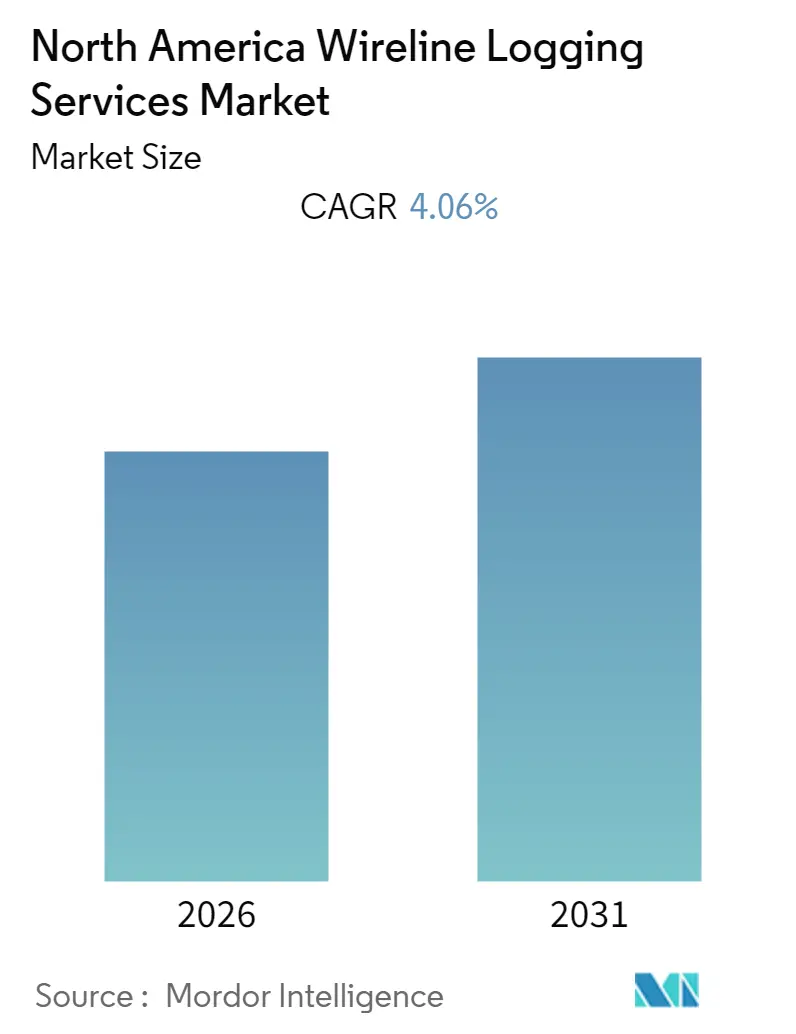
The North America Wireline Logging Services Market size is expected to register a CAGR of greater than 4.06% during the forecast period (2026-2031).
- Open-hole logging is likely to grow at a faster rate across the region during the forecast period due to its higher accuracy and reliability.
- The technological advancements in the field of well logging, such as the implementation of acoustic Logs and caliper Logs, pose a great opportunity for the growth of the wireline logging services market.
- The United States is expected to be the fastest-growing market across the region due to the upcoming upstream projects.
Note: Market size and forecast figures in this report are generated using Mordor Intelligence’s proprietary estimation framework, updated with the latest available data and insights as of 2026.
North America Wireline Logging Services Market Trends and Insights
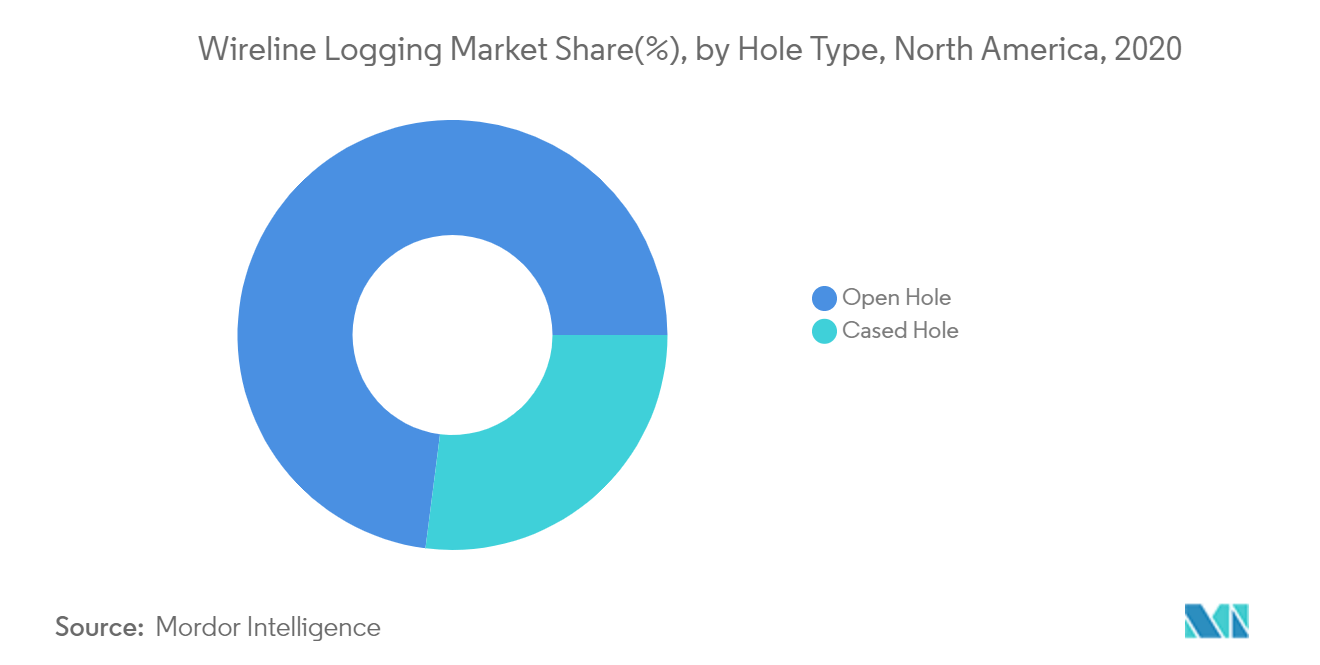
Open Hole Segment Expected to Dominate the Market
- Open hole logging refers to the logging operations that are performed before the wellbore has been cased. In this type, logging is performed through the bare rock sides of the downhole formation. Open hole logging is the most widely used technique at the global level as it renders no obstruction during the measurements.
- Open hole logging is the most mature logging technique. It is expected to continue its share in the near future, as the hunt for new oil and gas fields is still on in many countries for more production. The global oil production was recorded as 88,391 thousand barrels per day. The method will prove to be the most cost-effective way to produce oil and gas from the reserves, particularly at this time when the companies have to invest cautiously in the upstream sector.
- Significant proven crude and natural gas reserves across the region are likely to institute a favorable business scenario for the market players operating in the exploration and production activities. In 2020, Utah witnessed the largest 30% increase in proven crude reserves and condensates. This, in turn, may boost the wireline logging services market during the forecast timeline.
- Such developments in the oil and gas upstream sector are likely to have a positive impact on the wireline logging services market across North America during the forecast period.


United States to Dominate the Market
- The dominance is seen primarily due to continuous and significant increment in the exploration and production activities across the United States. The new unconventional hydrocarbon recovery and its growth are important reasons for the market's growth. The nation has the highest market share because of favorable supportive regulations.
- The rising crude oil prices are about to bring more revenue and more investments for the E&P companies, and subsequently, it will lead to more contracts for oilfield services players. The country has recently witnessed an upsurge in many upstream projects, both offshore and onshore.
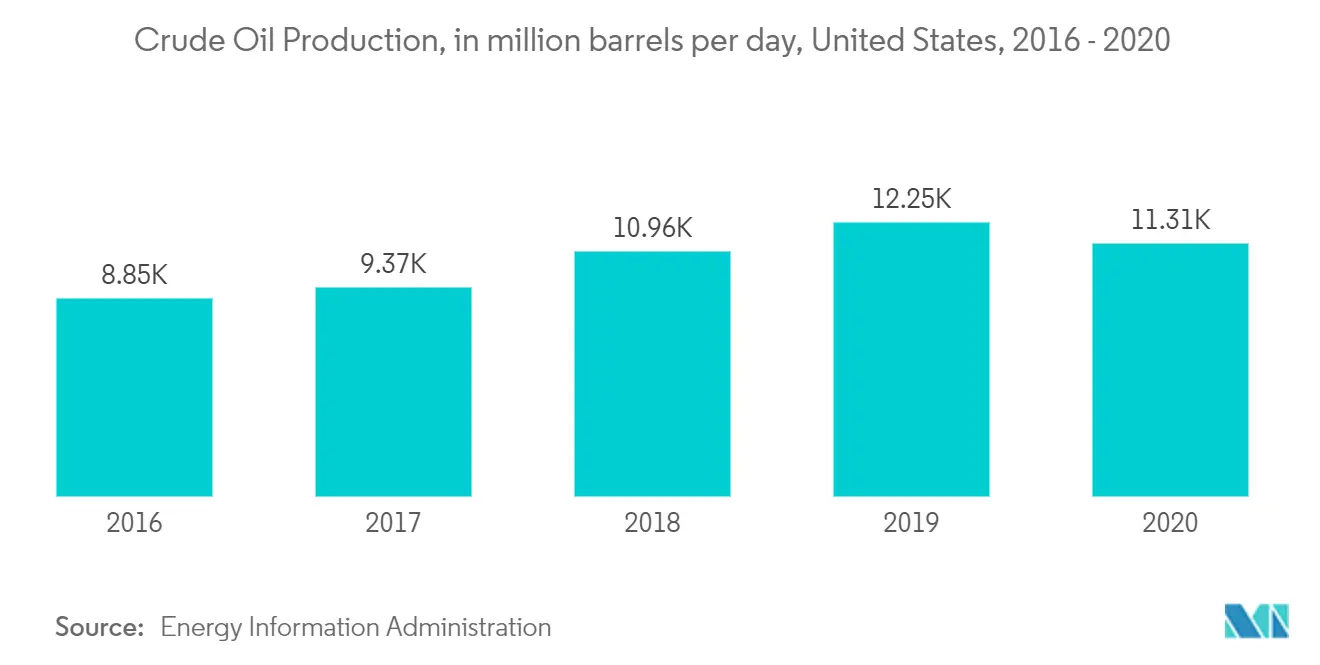
- The United States was among the top five crude oil producers, with a 15% share of world crude oil production in 2020. This, in turn, is further likely to institute a favorable business scenario for the players operating in the wireline logging services market in the near future.
- Moreover, in October 2021, Halliburton Company (HAL), a US-based wireline logging system provider, released the iStar Intelligent Drilling and Logging Platform, a comprehensive measurement platform comprising multiple services for greater control of drilling and logging operations within the country.
- Owing to such big investments planned in the upstream sector by the national and international companies, the country is expected to ace the market in the forecast period.
Regulatory Landscape
In the United States, offshore wireline operations sit within the Bureau of Safety and Environmental Enforcement (BSEE) framework, including 30 CFR 250.620 requirements on lubricator assembly use and pressure testing as part of well-intervention safety controls. In 2026, BSEE also published wireline operations research outputs, including a January 2026 technical report and an April 2026 final research report, which documented oversight practices and pointed to gaps such as the lack of a dedicated API standard for wireline operations.
Wireline logging that uses radioactive sources is governed by federal radiation safety rules (10 CFR Part 39), while state requirements can add more detailed operational obligations for logging service providers. Texas updated 25 TAC 289.253 (radiation safety requirements for well logging service operations and tracer studies) in 2025, tightening compliance expectations across licensing, handling, and operational controls. In Canada, federal and provincial requirements are implemented alongside industry guidance, and Energy Safety Canada sanctioned an updated IRP Volume 13 for wireline operations in May 2026 that emphasizes pressure control equipment practices used in land-based operations.
Value Chain Analysis
The wireline logging services value chain in North America begins with inputs such as high-tensile steel, copper conductors, and fiber-optic cores, followed by specialty cable manufacturing and wireline tool, sensor, and software development. These components feed into service companies that assemble and maintain toolstrings, surface acquisition systems, and pressure-control packages, including lubricators and related equipment, before trained crews deploy to deliver open-hole and cased-hole measurements at the wellsite. Integrated oilfield services providers such as Weatherford work alongside independents and regional specialists such as Renegade Services, GR Energy Services, Wireline Logging Solutions, Mustang Wireline Services, and Century Wireline Services.
Field execution is commonly organized through basin-based operations and district hubs that support rapid mobilization and higher utilization of crews and assets, a setup that matters for unconventional programs across major US basins. Bottlenecks tend to concentrate in premium cable and high-temperature system components, where sourcing and qualification can slow deployments on demanding wells. Commercially, the chain ends with delivery of logs, interpretations, and integrated datasets to E&P operators, with service delivery increasingly structured through Master Service Agreements while still accommodating job-specific equipment and crew scheduling.
Competitive Landscape
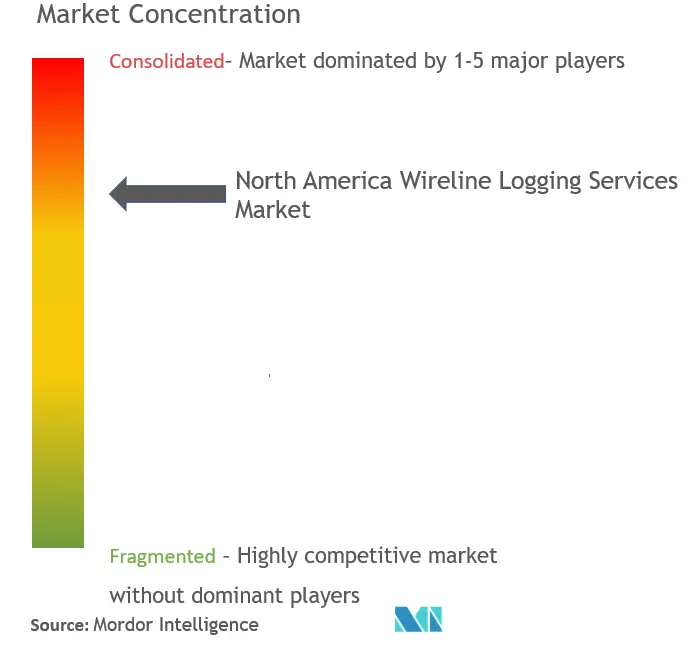
The North American wireline logging services market is moderately consolidated. The key players in this market include Schlumberger Limited, Halliburton Company, Expro Group, Weatherford PLC, and Baker Hughes Co.
North America Wireline Logging Services Industry Leaders
Schlumberger Limited
Baker Hughes Company
Halliburton Company
Expro Group
Weatherford International
- *Disclaimer: Major Players sorted in no particular order

Market Opportunities and Future Outlook
Technology-driven differentiation is strengthening in open-hole and advanced reservoir characterization workflows, as operators look for higher data quality with fewer trips. A clear datapoint is Halliburton's May 2026 launch of the Xaminer Deep Testing logging service, which combines near-wellbore and far-field insight in a single run and supports demand for consolidated toolstrings in complex reservoirs. At the same time, SLB's July 2025 introduction of the OnWave autonomous logging platform points to a competitive shift toward automation, safety, and a reduced footprint, particularly in use cases that can operate without conventional wireline units.
Data integration is also moving toward the center of commercial offerings for service companies and adjacent subsurface-data platforms, creating opportunities in digital delivery, log libraries, and interpretation workflows that connect wellsite measurements to decision systems. Enverus closed the July 2026 acquisition of TGS's North American well log library (A2D) for over USD 100 million, expanding access to historical log datasets and enabling tighter integration of subsurface data into analytics products used by North American operators and service providers. In parallel, tighter operational and emissions expectations in both onshore and offshore environments raise the premium on modern pressure-control practices and compliant equipment packages, which supports pull-through for upgraded wireline fleets and bundled services that combine acquisition, quality control, and interpretation under single contracts.
Recent Industry Developments
- July 2026: Enverus closed its acquisition of TGS's North American well data products business (A2D well log library), adding a large well-log dataset to its subsurface intelligence platform. The expanded access to historical and digital well logs strengthens integration between physical formation data and analytics workflows used by operators and service providers across North American basins.
- June 2026: Expro signed a contract extension of up to five years for subsea completion and intervention services in the Gulf of America, including deployment of its Solus Shear and Seal Valve. The multi-year extension supports continuity of subsea well-intervention activity and reinforces demand for safety-critical intervention hardware and services aligned with offshore compliance requirements.
- May 2026: Halliburton launched the Xaminer Deep Testing logging service as part of its Reservoir Xaminer formation testing service, designed to deliver deep-reading insight for producibility and boundary identification. The release expands advanced formation evaluation options and supports integrated, single-run characterization workflows that reduce operational steps on complex wells.


Research Methodology Framework and Report Scope
Market Definition and Coverage
This market is defined as revenues earned from wireline logging services used to evaluate formations and well conditions in oil and gas wells across North America, covering work done on open-hole and cased-hole wells using electric line and slickline.
Scope exclusions: Excludes wireline work that is not logging focused (such as perforation, fishing, or general intervention) and excludes logging-while-drilling and other measurement-while-drilling services.
Segmentation Overview
- Wireline Type
- E-line
- Slickline
- Hole Type
- Open Hole
- Cased Hole
- Geography
- United States
- Canada
- Rest of North America
Data Sources, Market Sizing, and Validation
Desk Research
Desk work started with building a clean picture of upstream activity that drives logging demand, then mapping where logging sits inside the well lifecycle. For this, we referenced public and official sources such as the US Energy Information Administration for drilling and production context, Bureau of Labor Statistics cost and wage series for service-intensity checks, and Statistics Canada for energy and industrial indicators relevant to Canadian activity.
To keep the model tied to field momentum, we also used sources such as state and provincial regulator publications for well counts and permitting direction, and industry and technical papers from societies and peer reviewed journals for tool usage trends and service mix shifts. Company filings, earnings decks, and credible press coverage were used to cross-check service exposure and pricing commentary, and we relied on selected paid subscriptions only for company financial intelligence and patent databases when public detail was thin. These examples are illustrative, and many other sources were also referenced for data collection, validation, and research clarification.
Primary Interviews and Surveys
Primary work was used to pressure test service mix, pricing behavior, and utilization assumptions that are hard to read from public data alone. We spoke with respondents across service providers, equipment-focused stakeholders, and operators, then used North America wide coverage to reflect differences between major US basins and Canadian activity. Insights from these conversations were used to clarify what should be counted as logging revenue, confirm recent pricing and job execution patterns, and fill gaps where public reporting was not granular enough.
Distribution of primary research fieldwork respondents
| Company type | Respondent position |
|---|---|
| Top tier: 33% | CXOs: 12% |
| Mid tier: 47% | Functional/Unit leaders: 31% |
| Smaller Players: 20% | Managers: 57% |
Market-Sizing & Forecasting
Sizing was built using a top-down approach where drilling and completion activity and the associated well count signals are converted into a logging service demand pool, then translated into revenues using service intensity and pricing assumptions. Because logging demand follows development cycles, the model uses indicators such as active rig counts, drilled but uncompleted trends, well completions, lateral length direction, and the share of work that requires open-hole versus cased-hole logging (all treated as inputs that can be updated).
Results were then checked with selective bottom-up approximations so totals stay realistic, including sampled job volumes by basin and an average price per job or run by wireline type, followed by a reasonableness check against service providers' reported upstream exposure and commentary on utilization. Where a clean bottom-up view was not possible for smaller and private participants, gaps were handled through share based allocations anchored on basin activity and the observed mix of e-line versus slickline work.
For forecasting, scenario analysis was used so the outlook reflects different upstream spending paths, then key variables were projected with guidance from primary inputs, including expected completion cadence, oil price sensitivity of activity, service utilization tightness, and how pricing escalates when crews and tools run near capacity. The final forecast is produced year by year, with assumptions stored as clear drivers so updates can be done quickly when new drilling and completion signals appear.
Data Validation & Update Cycle
Validation was done in steps so the output is not driven by a single assumption. Model totals were compared against independent signals like upstream activity direction, mix shifts between open-hole and cased-hole work, and whether implied pricing moves match what respondents reported for recent contracts.
When a variance looked unusual, the inputs were revisited, and follow up calls were triggered to recheck definitions and the service boundary. Before sign off, the work goes through an internal review where calculations, unit logic, and year to year movements are checked again, and the report is refreshed annually with interim updates when material events change activity, pricing, or service intensity. Right before delivery, a fresh pass is completed so clients receive the latest updated view.
Mordor Intelligence's North America Wireline Logging Services Market Market Size Compared With Other Published Estimates
Different published numbers for this market are common because the service boundary is easy to stretch, and the industry also swings with drilling and completion cycles. Differences usually come from what is counted as logging, how onshore versus offshore activity is weighted, and whether pricing is modeled as a steady average or adjusted for utilization changes.
The biggest gap drivers here are scope and service bundling, since some estimates fold well intervention and completion related wireline revenue into the same bucket as logging, which lifts the total. Another driver is how activity is reconstructed, where one model may lean on broad upstream spend assumptions while another uses well and completion indicators, and then applies different currency timing and inflation treatment for service rates.
Benchmark comparison
| Source | Market Size | Gaps in Research Methodology |
|---|---|---|
| Mordor Intelligence | USD 0.00 B (2024) | |
| Global Consultancy A | USD 5.55 B (2024) | This estimate is for the broader North America wireline services market and typically includes multiple service lines (logging, completion, and intervention related wireline), so the total is not directly comparable to a logging-only definition. |
| Regional Consultancy B | USD 6.70 B (2024) | This figure is presented as a full wireline services valuation and includes categories beyond logging, and the higher total can also reflect a more aggressive pricing and utilization path during tight service periods. |
The table shows that the spread is mostly explained by scope, and in Mordor Intelligence's model the value is counted only for logging focused wireline services, with non-logging wireline work kept outside the total to avoid double counting. With that service boundary kept consistent and checked through interviews against how jobs are priced and executed, the final number stays traceable to clear activity drivers and repeatable revenue logic.


Key Questions Answered in the Report
What is the current North America Wireline Logging Services Market size?
The North America Wireline Logging Services Market is projected to register a CAGR of 4.06% during the forecast period (2026-2031)
Who are the key players in North America Wireline Logging Services Market?
Schlumberger Limited, Baker Hughes Company, Halliburton Company, Expro Group and Weatherford International are the major companies operating in the North America Wireline Logging Services Market.
What years does this North America Wireline Logging Services Market cover?
The report covers the North America Wireline Logging Services Market historical market size for years: 2020, 2021, 2022, 2023 and 2024. The report also forecasts the North America Wireline Logging Services Market size for years: 2025, 2026, 2027, 2028, 2029 and 2030.
Page last updated on:





