
North America Transportation Technical Textile Market Size and Share
Market Overview
| Study Period | 2021 - 2032 |
|---|---|
| Forecast Data Period | 2027 - 2032 |
| Base Year Market Size (2026) | USD 15.43 Billion |
| Market Size (2027) | USD 16.05 Billion |
| Market Size (2032) | USD 18.82 Billion |
| Growth Rate (2027 - 2032) | 3.24 % |
| Market Concentration | Medium |
Major Players *Disclaimer: Major Players sorted in no particular order Image © Mordor Intelligence. Reuse requires attribution under CC BY 4.0. | |
North America Transportation Technical Textile Market Analysis by Mordor Intelligence
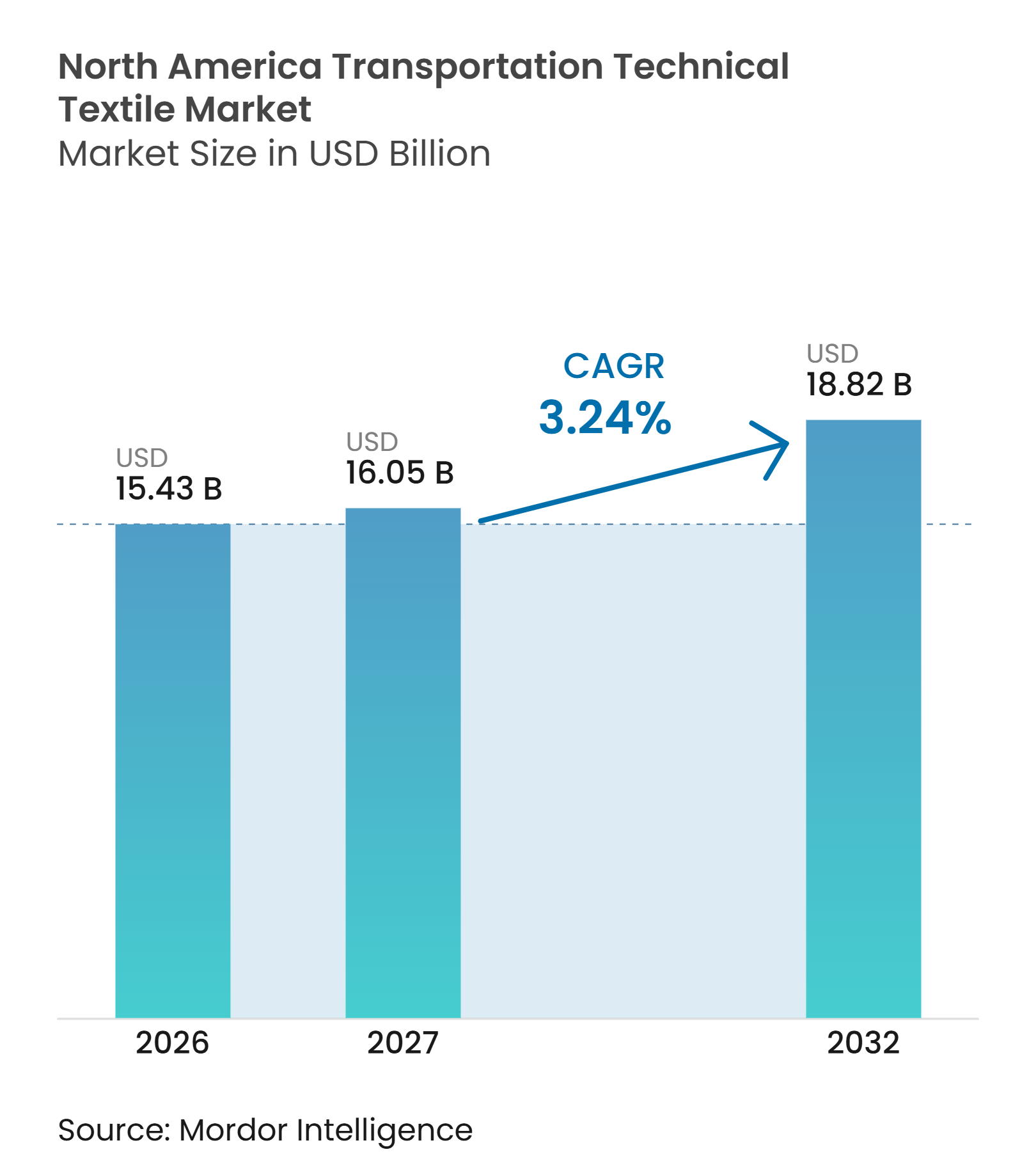
The North America Transportation Technical Textile Market size is projected to be USD 15.43 billion in 2026, USD 16.05 billion in 2027, and reach USD 18.82 billion by 2032, growing at a CAGR of 3.24% from 2027 to 2032.
The North America transportation technical textile market is moving toward engineered materials that serve a specific acoustic, structural, insulation, or safety purpose. Fuel-efficiency rules keep vehicle mass reduction central to material selection, while electric vehicles shift demand toward battery barriers and cabin noise control. Aerospace production recovery adds demand for composite reinforcements and high-temperature insulation. Suppliers that enter OEM design cycles early can secure a stronger position because materials must pass lengthy validation before production. Cost volatility, tariffs, and slower battery electric vehicle sales after the September 2025 tax-credit change may limit the pace of adoption.
Key Report Takeaways
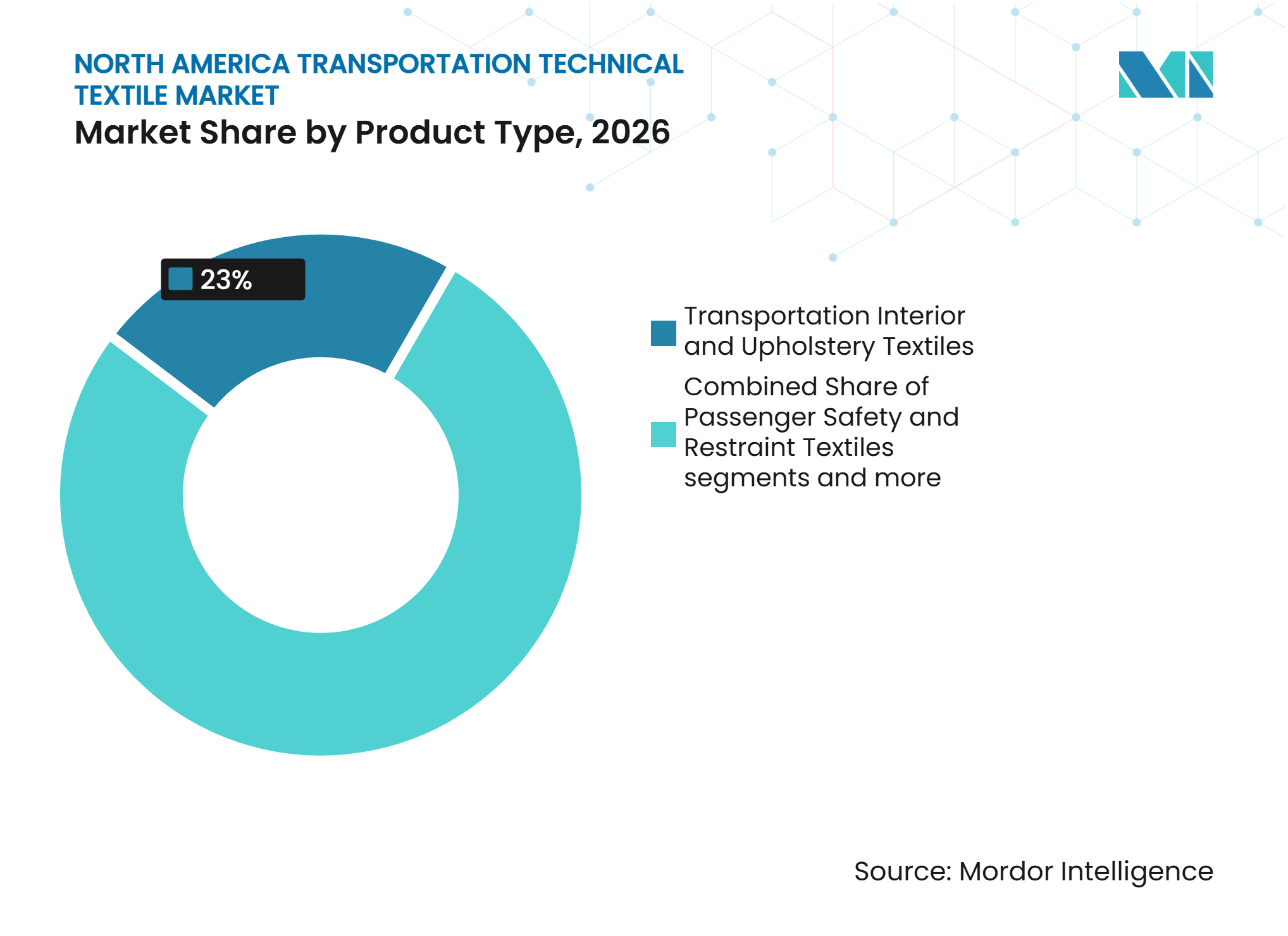
- By product type, transportation interior and upholstery textiles held 23% of the North America transportation technical textile market share in 2026, while structural and composite reinforcement textiles are forecast to grow at a 6.5% CAGR through 2032.
- By material type, polyester held 37% of the North America transportation technical textile market size in 2026, while carbon fibers are forecast to grow at a 7.0% CAGR through 2032.
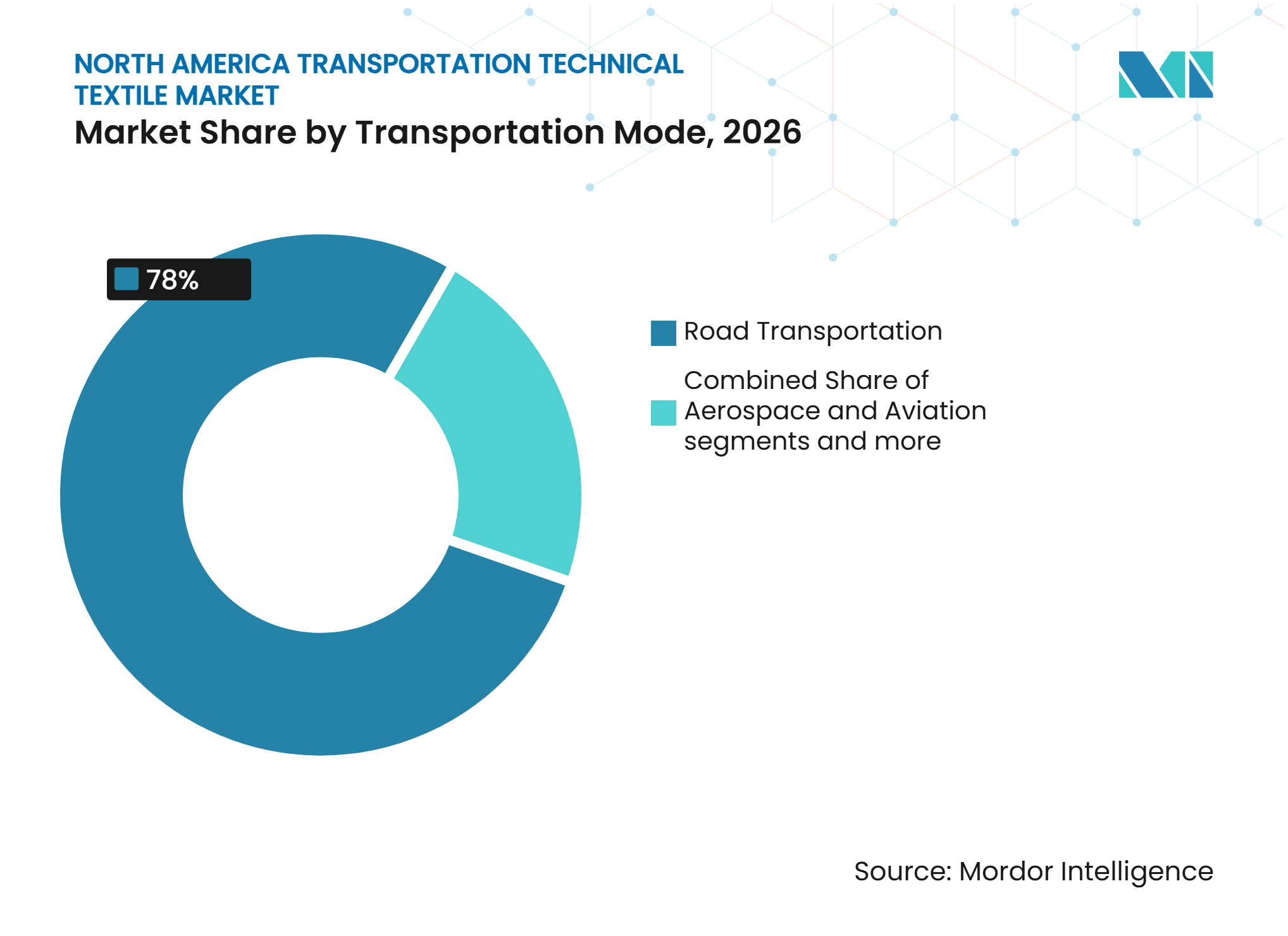
- By transportation mode, road transportation accounted for 78.0% of the North America transportation technical textile market share in 2026, while aerospace and aviation are forecast to grow at a 5.5% CAGR through 2032.
- By geography, the United States held 80.0% of the North America transportation technical textile market share in 2026, while Mexico is forecast to grow at a 4.8% CAGR through 2032.
Note: Market numbers in this report are based on Mordor Intelligence's proprietary estimation framework, which combines nine months of actuals with Q4 projections for base year 2026.
Market Trends and Insights
Drivers Impact Analysis of North America Transportation Technical Textile Market*
| Driver | (~) % Impact on CAGR Forecast | Geographic Relevance | Impact Timeline |
|---|---|---|---|
| Vehicle Lightweighting and Fuel-Efficiency Requirements | +1.0% | North America-wide, strongest on United States OEM platforms | Short term (≤ 2 years) |
| Electric Vehicle Acoustic and Thermal Management | +0.8% | United States and Canada, with spillover to Mexico EV assembly | Medium term (2-4 years) |
| North American Aerospace Production and Composite Adoption | +0.6% | United States aerospace hubs in Washington, South Carolina, Texas, and Alabama, with spillover to Canada | Long term (≥ 4 years) |
| Safety-Critical Textile Content in Airbags, Seat Belts and Tire Reinforcement | +0.4% | North America-wide, compliance-driven across all 3 countries | Short term (≤ 2 years) |
| Nearshoring of Vehicle and Component Production in Mexico | +0.3% | Mexico, with immediate effects on United States. tier-1 textile suppliers | Medium term (2-4 years) |
| Recycled and Bio-Based Content Requirements in OEM Sourcing | +0.2% | United States and Canada, with anticipatory compliance ahead of federal mandates | Long term (≥ 4 years) |
| Source: Mordor Intelligence | |||
Vehicle Lightweighting and Fuel-Efficiency Requirements
Fuel-economy regulation provides a direct source of demand for technical textiles used in North American road vehicles. The proposed SAFE Vehicles Rule III targets a fleet-wide average of 34.5 miles per gallon by model year 2031. The rule also removes electric vehicle credit trading from model year 2028 onward, increasing the importance of engineering gains on internal-combustion and hybrid platforms.[1] High-tenacity polyester, glass-fiber reinforced nonwovens, and multiaxial carbon-fiber fabrics compete with steel and molded plastics when designers assess performance per kilogram. The North America transportation technical textile market benefits because platform teams select materials years before vehicle production begins. Suppliers with qualification data aligned with CAFE-related lightweighting needs are better placed to win positions on future platforms.
Electric Vehicle Acoustic and Thermal Management
Electric vehicles require a different approach to cabin sound and heat management than internal-combustion vehicles. Without engine masking, road, tire, wind, and inverter noise become more noticeable in the cabin. The United States Energy Information Administration reported that hybrid, battery electric, and plug-in hybrid vehicles represented 22% of United States light-duty vehicle sales in 2025, while battery electric vehicle sales leveled near 1.2 million units.[2] Each new electric platform therefore creates a new sourcing opportunity for acoustic underlays, thermal barriers, and battery-housing textile parts. The Department of Energy supported research on unified thermal energy management for electric drive vehicles, showing that heat management is being addressed at the vehicle-system level.[3] Autoneum states that its Ultra-Silent textile battery undercover components can be up to 50% lighter than plastic alternatives and are fully recyclable.
North American Aerospace Production and Composite Adoption
Aerospace supports demand for high-value composite reinforcements, braided preforms, and high-temperature insulation fabrics, driven by aircraft production programs, lightweight structural requirements, and next-generation aerospace development. In October 2025, the FAA approved Boeing to raise 737 MAX production to 42 aircraft per month, restoring a volume base for woven and nonwoven composite reinforcement demand. Boeing, Collins Aerospace, Toray Industries, and Syensqo are among the program partners. NASA’s HiCAM project brings together 22 organizations to assess ways to reduce composite cycle times for full-scale wing and fuselage production. Toray’s T1100/3960 prepreg is NCAMP-qualified and was selected for the United States Army’s Future Long-Range Assault Aircraft primary airframe structures. In 2026, advancements in automated fiber placement, resin infusion, and next-generation prepreg systems further supported the adoption of advanced composite materials in aerospace manufacturing. These developments are strengthening demand for carbon fiber reinforcements and specialized technical fabrics by improving production efficiency, reducing component weight, and supporting the manufacture of complex aircraft structures.
Safety-Critical Textile Content in Airbags, Seat Belts and Tire Reinforcement
Safety requirements create a stable demand base for seat belt webbing, airbag fabrics, and tire cord materials. Federal Motor Vehicle Safety Standard No. 208 requires extended rear-seat belt warning systems by September 2027 and enhanced front-seat audio-visual warnings by September 2026 for covered vehicles. These requirements support continued procurement of high-tenacity polyester or nylon webbing that meets FMVSS 209 tensile requirements. NHTSA states that a fastened seat belt combined with a deployed airbag reduces the risk of death in frontal crashes by 61%. Tire reinforcement also relies on polyester, nylon, and aramid cord fabrics to meet FMVSS 109 performance specifications. The shared compliance environment across the United States, Canada, and Mexico keeps this part of the North America transportation technical textile market less exposed to cyclical changes in vehicle demand.
Restraints Impact Analysis of North America Transportation Technical Textile Market*
| Restraint | (~) % Impact on CAGR Forecast | Geographic Relevance | Impact Timeline |
|---|---|---|---|
| OEM Validation Cycles and Platform-Specific Qualification Costs | -0.5% | North America-wide, most acute for U.S. and Canada OEM platforms | Medium term (2-4 years) |
| Volatility in Synthetic Polymer and Specialty Fiber Costs | -0.4% | North America-wide, with highest tariff exposure in the United States | Medium term (2-4 years) |
| Recycling and End-of-Life Separation Constraints for Multilayer Textiles | -0.3% | United States and Canada, with emerging regulatory risk in all 3 markets | Long term (≥ 4 years) |
| Dependence on Imported Specialty Textile Inputs | -0.2% | United States and Mexico, partly mitigated by Canadian co-production | Long term (≥ 4 years) |
| Source: Mordor Intelligence | |||
OEM Validation Cycles and Platform-Specific Qualification Costs
New technical textile specifications must pass OEM-specific aging, flammability, chemical fogging, ultraviolet stability, and crash-performance tests before production approval. Approval for one vehicle line does not automatically transfer to a related model with a different architecture. This can extend the period from material submission to production launch to 24 to 36 months. Smaller suppliers are particularly exposed because they fund validation before receiving a volume commitment from an OEM. A canceled platform can leave years of material-development work without a commercial return. Incumbent materials can consequently retain approved positions longer, while tier-1 integrators hold much of the qualification cost and reduce the pricing power of upstream textile suppliers.
Volatility in Synthetic Polymer and Specialty Fiber Costs
Raw materials represent 55% to 70% of production costs for commodity synthetic fibers, leaving manufacturers exposed to petrochemical price movements. The Federal Reserve Bank of St. Louis recorded a Producer Price Index value of 175.0 for synthetic fibers in September 2026. United States polyester FDY prices fell from USD 1,314 per metric ton in the first quarter of 2025 to USD 1,150 per metric ton in the second quarter, a 12.5% decline after inventory normalization. The April 2025 Executive Order 14257 added a 10% tariff on imports from most nations alongside existing Section 301 China duties, disrupting procurement for buyers of Asian specialty fibers. Nylon 6,6 manufacturers also face caprolactam exposure because the United States lacks large-scale domestic caprolactam production. INDA requested a permanent exclusion for USMCA-qualifying Canadian and Mexican products from tariffs, reflecting the region’s integrated production chain.
*Our forecasts treat driver/restraint impacts as directional, not additive. The impact forecasts reflect baseline growth, mix effects, and variable interactions.
North America Transportation Technical Textile Market Segment Analysis
By Product Type:
Composite Reinforcement Outpaces Legacy Safety TextilesTransportation interior and upholstery textiles held 23% of the North America transportation technical textile market share in 2026. The segment includes seat upholstery, automotive carpets, and headliner systems across a regional vehicle production base exceeding 17 million units each year. OEMs are requesting lower-volatile-organic-compound fabrics with recycled material content. Autoneum introduced N-Join1 in July 2025 as a monomaterial polyester carpet that removes latex from production. The construction supports end-of-life recycling on internal-combustion and battery-electric vehicle platforms.
Structural and composite reinforcement textiles are forecast to grow at a 6.5% CAGR from 2027 to 2032, supported by aerospace production recovery, defense qualifications, and battery enclosures. This North America transportation technical textile market size opportunity requires flame-resistant and thermally stable substrates that conventional nonwovens cannot provide. Passenger Safety and Restraint Textiles remain stable in volume but add content through extended seat belt warnings and more airbag modules on electric platforms. Milliken and Company has expanded United States technical textile development programs for lighter coated fabrics used in next-generation airbag modules. Tire and Rubber Reinforcement Textiles remain important because electric vehicles require polyester, nylon, and aramid cord fabrics that can manage higher weight and altered torque.



By Material Type:
Carbon Fiber Leads a Premium ShiftPolyester held 37% of the North America transportation technical textile market share in 2026. It provides a cost-to-performance balance across interior carpets, filtration nonwovens, tire cord, and structural composites. Polyester offers an end-of-life advantage when a component uses a single-material construction. Autoneum’s Ultra-Silent Frunk is made from 100% polyester and has production orders from 3 major OEMs. The component supports end-of-life recycling and a lower vehicle carbon footprint.
Carbon fibers are forecast to grow at a 7.0% CAGR from 2027 to 2032. Toray’s T1100/3960 prepreg qualification supports primary aerospace structures and connects defense qualification with commercial deployment. Polyamide remains essential in airbag fabrics and seat belt webbing because its thermal stability is established in FMVSS-qualified applications. Polypropylene is used in interior liners, underbody shields, and acoustic systems. However, it faces flame-retardancy review near electric vehicle batteries. Glass fibers support automotive panels and aerospace secondary structures. At the same time, aramid and high-performance synthetics serve high-heat military aircraft and specialty marine uses.
By Transportation Mode:
Road Dominates, Aerospace AcceleratesRoad Transportation accounted for 78.0% of the North America transportation technical textile market share in 2026. Passenger vehicles are redesigning acoustic packages for electric drivetrain noise and adding battery thermal-management textiles and flame-resistant layers. Lear reported USD 17.3 billion in seating-segment sales in 2025, including USD 9.8 billion from North America. This result illustrates the scale of textile-intensive seating supply tied to United States vehicle assembly. Commercial vehicles and 2-wheelers add demand for filter media, interior fabrics, composites, and comfort-focused acoustic treatments.
Aerospace and Aviation is forecast to grow at a 5.5% CAGR from 2027 to 2032. Military aircraft, helicopters, and unmanned aerial systems qualify new composite materials before wider commercial use. Rail Transportation uses flame-resistant and low-smoke textiles subject to FAR and ASTM standards. Marine Transportation uses protective textiles, filtration systems, and structural composites across commercial vessels, cruise ships, and recreational craft.

Geography Analysis
United States: Scale and Specification Depth Define Market Leadership
The United States held 80.0% of the North America transportation technical textile market share in 2026. General Motors, Ford, Stellantis, Tesla, and foreign-brand domestic producers generate demand for safety textiles, acoustic nonwovens, structural composites, and interior fabrics. Lear’s North American seating operations produced USD 9.8 billion in revenue in 2025, illustrating the scale of textile-intensive United States vehicle assembly. NHTSA, the FAA, and the EPA provide safety, aerospace, and fuel-economy compliance factors that stabilize demand.
Mexico: Nearshoring Investment Accelerates Textile Demand Growth
Mexico is forecast to grow at a 4.8% CAGR from 2027 to 2032. Nearshoring is shifting automotive production toward the USMCA region and increasing demand for qualified textile inputs. Mexico produced 2.666 million light vehicles in the first 8 months of 2025, a record for that period. The country sent 83% of automotive exports, valued at USD 137 billion through June 2025, to United States customers. The USMCA regional-content requirement is expected to reach 70% by 2027, while electric and hybrid models account for more than 10% of Mexican vehicle production and are forecast to double within 5 years.
Canada
Canada serves as a co-production partner through specialty yarns, flame-resistant fabrics, and filtration materials used in multi-country manufacturing chains. Canadian textile representatives and United States textile officials sought tariff relief in 2025, citing cases where a specialty fiber crossed 2 borders before becoming a safety component. Canadian rail and marine uses support demand for flame-resistant interior textiles and filtration media subject to Transport Canada requirements. Recreational marine craft, snowmobiles, and off-highway vehicles create niche demand for abrasion-resistant and ultraviolet-stabilized textiles in Canada.
Competitive Landscape
Market Concentration
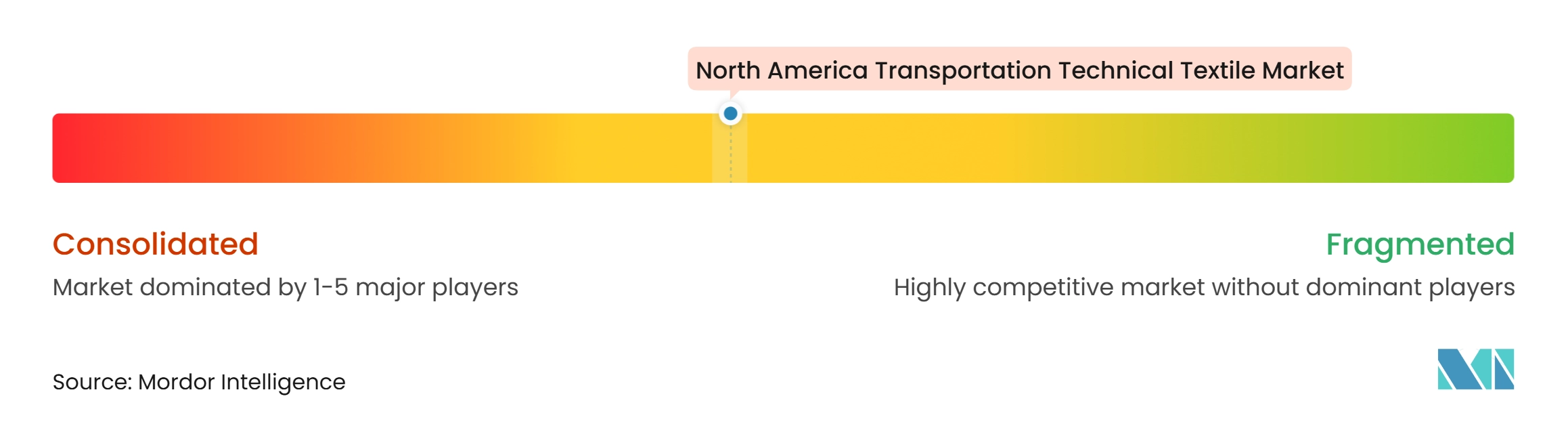
The North America transportation technical textile market exhibits a medium level of market concentration. Lear, Adient, and Autoneum supply textile-intensive seating and acoustic packages, while specialists lead in airbag fabrics and high-tenacity tire cord. Application-specific OEM qualifications provide an important barrier to entry. Freudenberg Performance Materials acquired the core Heytex business in January 2025, adding coated and laminated technical fabric capacity. In December 2025, Freudenberg acquired the remaining 25% stake in Japan Vilene Company from Toray Industries for approximately EUR 100 million (USD 117.6 million), becoming its sole owner and strengthening its technical textiles and filtration businesses.
Competition depends on recyclable construction, safety-system integration, and aerospace or defense qualifications. Autoneum uses in-house simulation tools in Ultra-Silent multilayer systems to develop acoustic and thermal performance together. Its N-Join1 carpet uses monomaterial polyester that eliminates latex and supports recycling. Toray achieved multi-site AS9100 aerospace quality-management certification with zero audit findings in 2025. Adient and Autoliv unveiled Z-Guard for zero-gravity seating positions in October 2025 and confirmed readiness for mass production.
Battery-safe barriers, recyclable monomaterial acoustic systems, and smart textile functions without extra wiring. Suppliers developing recycled monomaterial composites or bio-based high-performance fibers may use tier-1 partnerships to manage 24- to 36-month validation cycles. Freudenberg launched a fully recyclable polyester underbody system in September 2025, while Autoneum’s Polestar 5 partnership uses recyclable polyester components.
North America Transportation Technical Textile Industry Leaders
-
Lear Corporation
-
Sage Automotive Interiors, Inc.
-
Autoneum Holding AG
-
Freudenberg Performance Materials
-
Ahlstrom Oyj
- *Disclaimer: Major Players sorted in no particular order
North America Transportation Technical Textile Market Companies Covered in this Report
- Lear Corporation
- Sage Automotive Interiors, Inc.
- Autoneum Holding AG
- Freudenberg Performance Materials
- Ahlstrom Oyj
- Adient plc
- DuPont de Nemours, Inc.
- Johns Manville
- Asahi Kasei Corporation
- Toray Industries, Inc.
- Toyobo Co., Ltd.
- Mitsui Chemicals, Inc.
- Glatfelter Corporation
- TWE Group
- Sandler AG
- Fibertex Nonwovens A/S
- Tex Tech Industries
- UFP Technologies, Inc.
- Milliken and Company
- Magna International Inc.
- Seiren Co., Ltd.
Recent Industry Developments in North America Transportation Technical Textile Market
- February 2026: Adient introduced its Sculpted Soft Trim technology, a breathable, formed automotive seat-trim solution designed to create large upholstery panels and smaller components such as armrests, headrests, and child-seat anchor covers. The automated forming process reduces sewing requirements and provides greater design flexibility for automotive interior textiles.
- January 2026: Toyoda Gosei announced that its rear-side airbags were selected for Subaru's Impreza and Crosstrek passenger vehicle models. The compact airbag design is approximately one-third smaller than conventional front-side airbags, supporting improved passenger protection within limited rear-seat spaces and strengthening demand for automotive safety textiles.
- October 2025: Adient and Autoliv unveiled the Z-Guard dynamic seat safety solution for zero-gravity seating positions, combining Adient's new seating concept with Autoliv's restraint technologies. The system is confirmed ready for mass production. It targets the growing reclined-occupant segment in autonomous and premium EV platforms, requiring specialized textile webbing not addressed by conventional seatbelt geometry.
- October 2025: The FAA approved Boeing to increase 737 MAX production to 42 aircraft per month, restoring a significant volume of woven and nonwoven composite reinforcement demand across Boeing's tier-1 and tier-2 supply chain in North America.
North America Transportation Technical Textile Market Report Scope
The North America Transportation Technical Textile Market Report is Segmented by Product Type (Passenger Safety and Restraint Textiles, Transportation Interior and Upholstery Textiles, and More), by Material Type (Polyester (PET), Polyamide (Nylon), and More), by Transportation Mode (Road Transportation, Aerospace and Aviation, and More), and by Geography (Canada and More). The Market Forecasts are Provided in Terms of Value (USD).
Segmentation Overview
| Passenger Safety and Restraint Textiles | Automotive Airbag Fabrics and Textile Cushions |
| Seat Belt Webbing | |
| Other Transportation Safety and Restraint Textiles | |
| Transportation Interior and Upholstery Textiles | Seat Upholstery and Seating Fabrics |
| Automotive and Transportation Carpets | |
| Other Transportation Interior Textiles (Headliner, Window-Shading, etc.) | |
| Tire and Rubber Reinforcement Textiles | |
| Acoustic, Thermal and Protective Insulation Textiles | |
| Transportation Filtration and Air Management Textiles | |
| Structural and Composite Reinforcement Textiles (carbon fiber, glass fiber reinforcement fabric, etc.) | |
| Transportation Exterior and Protective Textiles | |
| Other Transportation Technical Textiles |
| Polyester (PET) |
| Polyamide (Nylon) |
| Polypropylene (PP) |
| Polyethylene (PE) |
| Glass Fibers |
| Carbon Fibers |
| Aramid and Other High-Performance Synthetic Fibers |
| Natural and Regenerated Fibers |
| Other Specialty Fibers and Materials |
| Road Transportation | Passenger Cars | Internal Combustion Engine and Hybrid Passenger Cars |
| Battery Electric Passenger Cars | ||
| Commercial Vehicles | ||
| Two-Wheelers, Three-Wheelers and Other Road Vehicles | ||
| Aerospace and Aviation | Commercial and Business Aircraft | |
| Military Aircraft and Helicopters | ||
| Spacecraft and Other Aerospace Platforms | ||
| Rail Transportation | ||
| Marine Transportation | Commercial and Cargo Vessels | |
| Passenger, Cruise Vessels, Recreational and Other Marine Vessels | ||
| Other Specialized Transportation Platforms |
| United States |
| Canada |
| Mexico |
| By Product Type | Passenger Safety and Restraint Textiles | Automotive Airbag Fabrics and Textile Cushions | |
| Seat Belt Webbing | |||
| Other Transportation Safety and Restraint Textiles | |||
| Transportation Interior and Upholstery Textiles | Seat Upholstery and Seating Fabrics | ||
| Automotive and Transportation Carpets | |||
| Other Transportation Interior Textiles (Headliner, Window-Shading, etc.) | |||
| Tire and Rubber Reinforcement Textiles | |||
| Acoustic, Thermal and Protective Insulation Textiles | |||
| Transportation Filtration and Air Management Textiles | |||
| Structural and Composite Reinforcement Textiles (carbon fiber, glass fiber reinforcement fabric, etc.) | |||
| Transportation Exterior and Protective Textiles | |||
| Other Transportation Technical Textiles | |||
| By Material Type | Polyester (PET) | ||
| Polyamide (Nylon) | |||
| Polypropylene (PP) | |||
| Polyethylene (PE) | |||
| Glass Fibers | |||
| Carbon Fibers | |||
| Aramid and Other High-Performance Synthetic Fibers | |||
| Natural and Regenerated Fibers | |||
| Other Specialty Fibers and Materials | |||
| By Transportation Mode | Road Transportation | Passenger Cars | Internal Combustion Engine and Hybrid Passenger Cars |
| Battery Electric Passenger Cars | |||
| Commercial Vehicles | |||
| Two-Wheelers, Three-Wheelers and Other Road Vehicles | |||
| Aerospace and Aviation | Commercial and Business Aircraft | ||
| Military Aircraft and Helicopters | |||
| Spacecraft and Other Aerospace Platforms | |||
| Rail Transportation | |||
| Marine Transportation | Commercial and Cargo Vessels | ||
| Passenger, Cruise Vessels, Recreational and Other Marine Vessels | |||
| Other Specialized Transportation Platforms | |||
| By Geography | United States | ||
| Canada | |||
| Mexico | |||
Key Questions Answered in the Report
What is the projected value of North America transportation technical textiles by 2032?
The North America transportation technical textile market is projected to reach USD 18.82 billion by 2032, growing at a 3.24% CAGR from 2027.
Which transportation mode has the largest share in 2026?
Road transportation accounted for 78.0% of the North America transportation technical textile market share in 2026.
Which material is expected to grow the fastest through 2032?
Carbon fibers are forecast to grow at a 7.0% CAGR through 2032, supported by aerospace, defense, and vehicle lightweighting requirements.
Why are electric vehicles relevant to technical textiles?
Electric vehicles need acoustic underlays, thermal barriers, battery-housing components, and flame-resistant materials that address different cabin-noise and heat-management needs.
Which country is expected to grow fastest in the region?
Mexico is forecast to grow at a 4.8% CAGR through 2032, supported by nearshoring and an export-oriented automotive production base.
What limits the adoption of new technical textiles in vehicles?
OEM validation can take 24 to 36 months, and suppliers also face polymer and specialty-fiber cost volatility.