
North America Renewable Diesel Market Size and Share
Market Overview
| Study Period | 2022 - 2032 |
|---|---|
| Forecast Data Period | 2027 - 2032 |
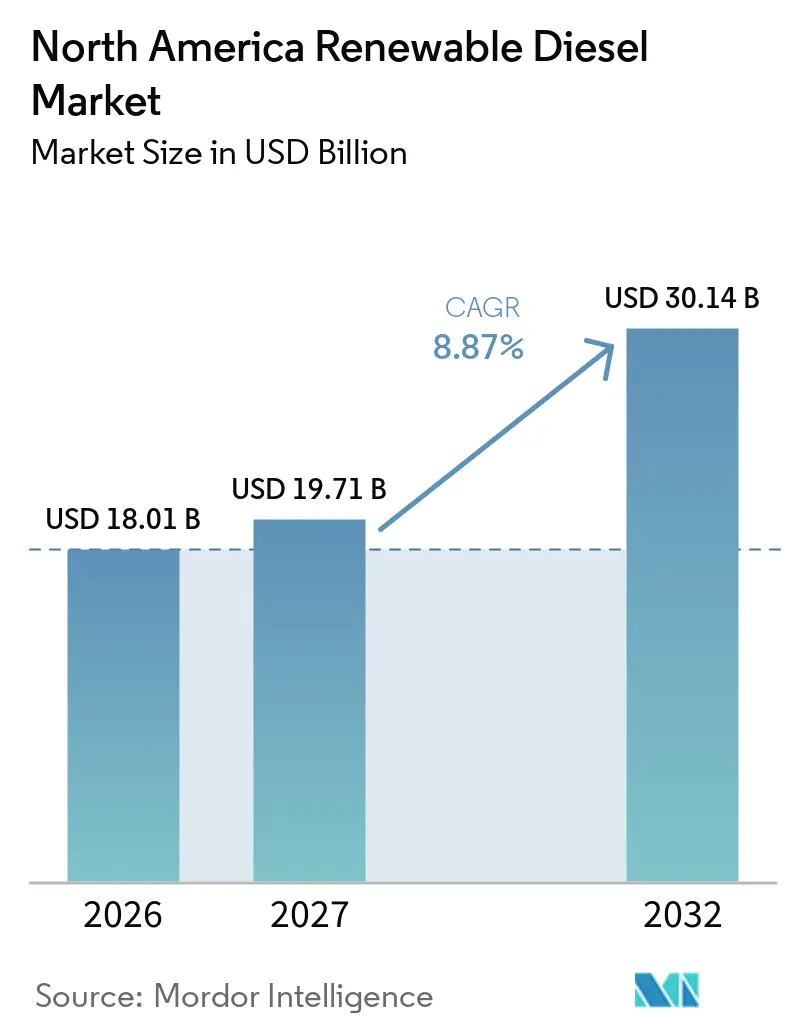
| Base Year Market Size (2026) | USD 18.01 Billion |
| Market Size (2027) | USD 19.71 Billion |
| Market Size (2032) | USD 30.14 Billion |
| Growth Rate (2027 - 2032) | 8.87 % |
| Market Concentration | High |
Major Players *Disclaimer: Major Players sorted in no particular order Image © Mordor Intelligence. Reuse requires attribution under CC BY 4.0. | |
North America Renewable Diesel Market Analysis by Mordor Intelligence
The North America renewable diesel market was valued at USD 18.01 billion in 2026 and is estimated to grow from USD 19.71 billion in 2027 to USD 30.14 billion by 2032, at a CAGR of 8.87% during the forecast period (2027-2032). Federal and state fuel programs form the core demand base by setting renewable fuel obligations and rewarding lower-carbon fuel pathways. California's revised Low Carbon Fuel Standard increases the importance of carbon intensity, favoring producers that can secure waste, residue, and other lower-carbon feedstocks. Higher credits for sustainable aviation fuel are also influencing production decisions at facilities capable of switching between renewable diesel and jet fuel. The strongest opportunities in the North America renewable diesel market are available to producers that combine feedstock flexibility, refinery integration, and reliable logistics.[1]
Key Report Takeaways
- By type, pure renewable diesel (HVO100) held 53.2% of the North America renewable diesel market share in 2026, while algae-derived and other novel feedstock variants are forecast to grow at a 12.3% CAGR through 2032.
- By feedstock, vegetable oils held 35.4% of the North America renewable diesel market share in 2026, while algae is forecast to grow at a 13.1% CAGR through 2032.
- By application, transportation fuel accounted for 71.6% of the North America renewable diesel market size in 2026, while aviation, or sustainable aviation fuel, is forecast to grow at a 13.5% CAGR through 2032.
- By end-user, oil refineries and blenders accounted for 52.9% of the North America renewable diesel market size in 2026, while airlines and aviation authorities are forecast to grow at a 12.9% CAGR through 2032.
- By geography, the United States held 83.2% of the North America renewable diesel market in 2026, while Mexico is forecast to grow at a 10.7% CAGR through 2032.
Note: Market numbers in this report are based on Mordor Intelligence's proprietary estimation framework, which combines nine months of actuals with Q4 projections for base year 2026.
Market Trends and Insights
Drivers Impact Analysis of North America Renewable Diesel Market*
| Driver | (~) % Impact on CAGR Forecast | Geographic Relevance | Impact Timeline |
|---|---|---|---|
| Federal and State Low-Carbon Fuel Incentives | +2.8% | United States, Canada | Short term (≤ 2 years) |
| Drop-In Compatibility With Existing Diesel Infrastructure | +1.9% | United States, Canada | Short term (≤ 2 years) |
| Heavy-Duty Fleet Decarbonization | +1.7% | United States, Canada, Mexico | Medium term (2-4 years) |
| Refinery Conversion and Co-Processing Economics | +1.4% | United States Gulf Coast, United States West Coast, Western Canada | Medium term (2-4 years) |
| SAF and Renewable Diesel Co-Production | +0.8% | United States, Canada | Long term (≥ 4 years) |
| Lower-Carbon Backup and Industrial Fuel Demand | +0.4% | United States, Canada, Mexico | Medium term (2-4 years) |
| Source: Mordor Intelligence | |||
Federal And State Low-Carbon Fuel Incentives
Federal and state programs provide the most direct demand support for the North America renewable diesel market. The U.S. Environmental Protection Agency set biomass-based diesel obligations at a minimum of 5.33 billion physical gallons for 2026 and 5.75 billion gallons for 2027 under the Renewable Fuel Standard Set 2 rule. These obligations help refiners assess revenue before committing capital to conversion projects. The Clean Fuel Production Credit provides higher support for sustainable aviation fuel than for non-SAF renewable fuels, making product flexibility more valuable at multi-product facilities. California's Low Carbon Fuel Standard tightens carbon-intensity benchmarks, increasing the value of lower-carbon pathways and verified feedstock supply chains.
Drop-In Compatibility with Existing Diesel Infrastructure
Renewable diesel can be used within existing fuel handling systems without modification, which supports its adoption. The U.S. Department of Energy states that renewable diesel is chemically similar to petroleum diesel and can be used in diesel engines without blending limitations.[2] This characteristic reduces operational changes for fleet managers, distributors, and terminal operators. Detroit Diesel's renewable diesel policy confirms that approved renewable diesel use does not require engine modifications across its covered engine range. This policy also gives procurement teams clearer assurance when changing fuel specifications. The North America renewable diesel market benefits because adoption does not depend on widespread replacement of trucks, tanks, or fueling equipment.
Heavy-Duty Fleet Decarbonization
Heavy-duty transport remains an important source of demand for the North America renewable diesel market. Long-haul trucks, rail operations, off-road equipment, and marine assets require fuels that retain diesel-like range and refueling practices. Renewable diesel allows fleet operators to reduce fuel-related lifecycle emissions while maintaining existing duty cycles. California's credit framework provides an additional incentive when low-carbon transportation fuels are used in the state. Port equipment illustrates this demand, as GCT Deltaport reported a 65% reduction in diesel-equipment emissions after switching to 100% renewable fuel in 2025. Such use cases enable public agencies and industrial operators to adopt renewable fuels without waiting for vehicle replacement cycles.
Refinery Conversion and Co-Processing Economics
Refinery conversion and co-processing continue to shape supply in the North America renewable diesel market. Chevron Corporation completed the expansion of its Geismar, Louisiana facility to 22,000 barrels per day in August 2025, after investing more than USD 950 million in the project. Refinery integration can provide shared hydrogen, established logistics, and access to existing feedstock networks. Co-processing also allows refiners to introduce renewable feedstocks into conventional units without completing a full site conversion. Parkland Corporation processed 44 million liters of bio-based feedstocks at its Burnaby refinery during the third quarter of 2025, a 47% increase from the same period in 2024. These approaches may reduce initial capital requirements, but their returns remain exposed to feedstock price and credit conditions.
Restraints Impact Analysis of North America Renewable Diesel Market*
| Restraint | (~) % Impact on CAGR Forecast | Geographic Relevance | Impact Timeline |
|---|---|---|---|
| Feedstock Availability and Price Volatility | -1.2% | United States, Canada, global feedstock suppliers | Short term (≤ 2 years) |
| Competition From Electrification and Hydrogen | -0.8% | Urban United States and Canada | Long term (≥ 4 years) |
| Carbon-Intensity Penalties for Crop-Based Feedstocks | -0.5% | California, Canada | Medium term (2-4 years) |
| Regional Feedstock Logistics and Pretreatment Bottlenecks | -0.3% | United States Midwest, Western Canada, Mexico | Medium term (2-4 years) |
| Source: Mordor Intelligence | |||
Feedstock Availability and Price Volatility
Feedstock availability and pricing remain the primary operating risks for renewable diesel producers. HF Sinclair Corporation reported a full-year 2025 adjusted renewables gross margin of negative USD -0.16 per gallon after operating expenses[3]. Soybean oil, canola oil, tallow, and used cooking oil are affected by food demand, weather, trade conditions, and collection systems that do not always align with fuel margins. California's 2025 Low Carbon Fuel Standard amendments add traceability and sustainability requirements for certain crop-based pathways. Producers with pretreatment assets can use a broader range of inputs and reduce reliance on spot vegetable oil purchases. The North America renewable diesel market remains vulnerable when feedstock costs rise faster than fuel, Renewable Identification Number, and low-carbon credit values.
Competition From Electrification and Hydrogen
Battery-electric and hydrogen technologies are expected to limit renewable diesel demand in selected applications over the longer term. The strongest pressure is anticipated on shorter urban and regional routes where medium-duty battery-electric vehicles can meet daily range requirements. California's Advanced Clean Trucks regulation supports a transition toward zero-emission vehicle sales in these segments. Renewable diesel retains a clearer role in long-haul trucking, refrigerated transport, rail, marine operations, and off-highway equipment, where payload, refueling, and operating requirements are more demanding. The competitive restraint from electrification and hydrogen is therefore concentrated in specific urban vehicle categories rather than across all diesel-consuming applications.
*Our forecasts treat driver/restraint impacts as directional, not additive. The impact forecasts reflect baseline growth, mix effects, and variable interactions.
North America Renewable Diesel Market Segment Analysis
By Type:
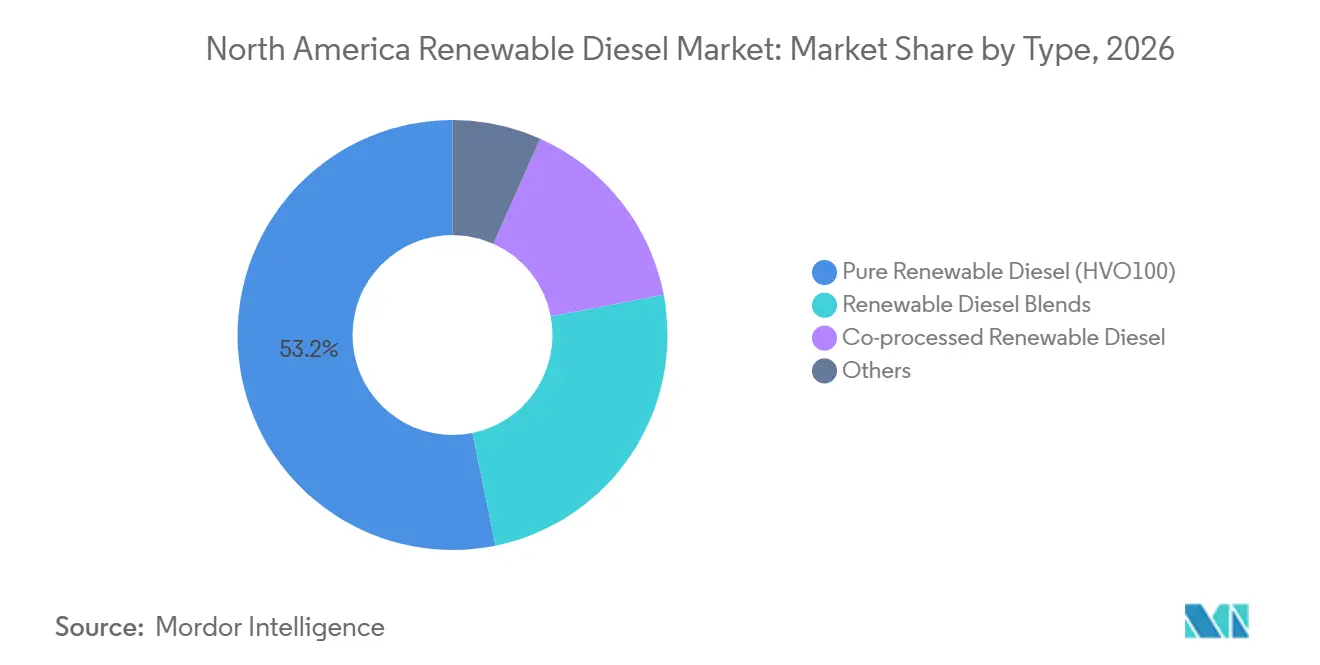
HVO100 Leads Through Broad Diesel CompatibilityPure Renewable Diesel (HVO100) held 53.2% of the North America renewable diesel market in 2026. Its position reflects the product's ability to function as a direct diesel substitute in existing engines and fuel systems. The U.S. Department of Energy identifies renewable diesel as a hydrocarbon fuel that is chemically similar to petroleum diesel. Fleet buyers value HVO100 because it avoids blend limits and can be supplied through conventional fuel channels. Its cold-weather suitability also supports use in Canadian operations when approved fuel specifications are met. HVO100's broad compatibility with transport, industrial, and backup-power applications gives suppliers a large potential customer base.
Renewable diesel blends remain relevant for customers that shift their fuel procurement gradually. Co-processed renewable diesel is also gaining attention because refiners can use existing infrastructure to introduce renewable feedstocks. Parkland Corporation's 47% year-over-year increase in bio-based feedstock processing during the third quarter of 2025 demonstrates the operational interest in this route. Algae-derived and other novel feedstock variants are forecast to record the highest CAGR of 12.3% through 2032. These pathways are of interest because they may avoid competition with food crops and support lower carbon-intensity outcomes. Their commercial progress depends on lower production costs and reliable scale-up. The North America renewable diesel market will continue to favor types that preserve engine compatibility while improving feedstock flexibility.

By Feedstock:
Vegetable Oils Remain Largest While Alternative Inputs Gain GroundVegetable oils held 35.4% of feedstock value in 2026 within the North America renewable diesel market. Soy, canola, and palm oils have established supply chains and are compatible with both hydroprocessing and transesterification routes. Canadian canola is particularly important to the country's supply chain. Imperial Oil Limited commissioned its Strathcona renewable diesel facility in Alberta in 2025 with a capacity of up to 20,000 barrels per day and planned use of Canadian bio-feedstocks.[4] British Columbia also introduced a requirement for Canadian-origin renewable content in diesel, which supports domestic sourcing.
Animal fats and used cooking oil are increasingly attractive because they can generate lower lifecycle emissions than virgin vegetable oils. These inputs can therefore earn stronger low-carbon credit values when their origin and treatment meet program rules. Algae is forecast to grow at a CAGR of 13.1% through 2032, the highest rate among the listed feedstocks. California's amended Low Carbon Fuel Standard places greater importance on sustainable feedstocks, traceability, and carbon-intensity performance. Tall oil and waste residues may also help producers reduce exposure to food-commodity price cycles. The relative value of feedstocks will increasingly depend on documented carbon performance, supply security, and pretreatment capability.
By Application:
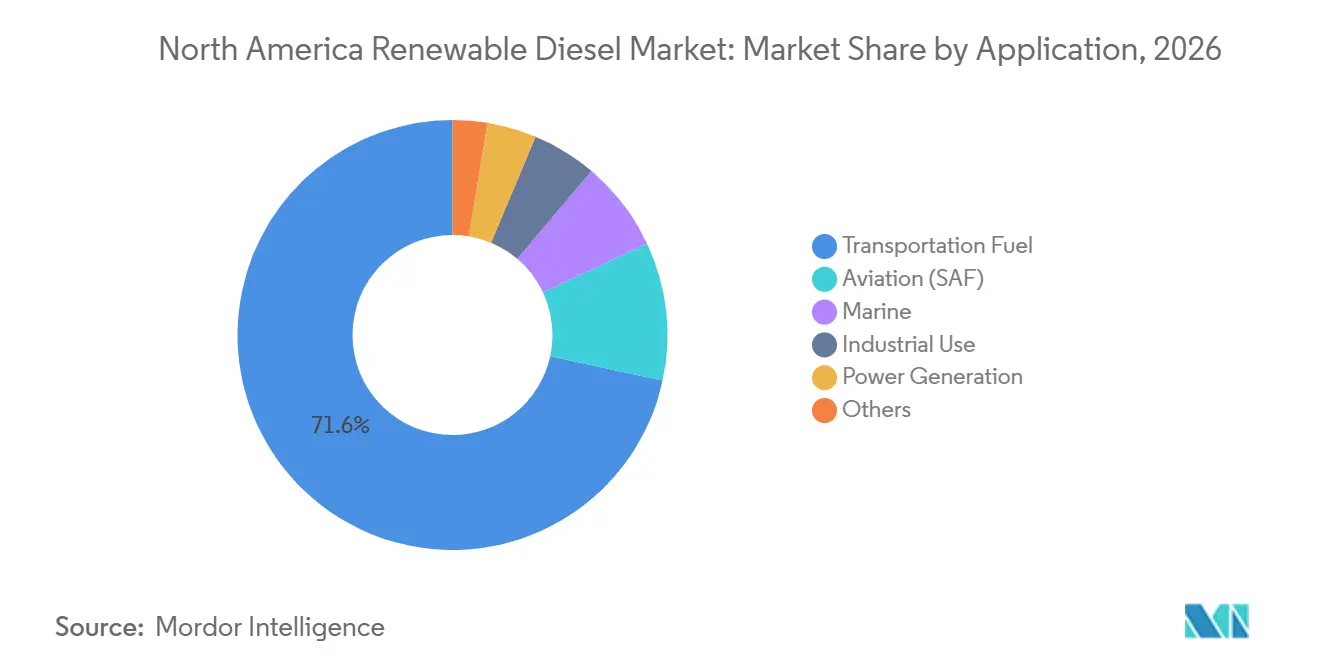
Transportation Fuel Holds Volume Leadership While SAF Grows FasterTransportation fuel accounted for 71.6% of regional demand in 2026. Truck fleets and off-highway equipment represent a large share of this demand because they can use renewable diesel without changing core operating practices. Renewable diesel can support lower-carbon operations where battery-electric equipment is not yet practical for the required duty cycle. Global Container Terminals Deltaport's 2025 transition to renewable fuel for diesel equipment illustrates the role of port operations in this segment. Marine, industrial, and power-generation uses remain smaller but are relevant for hard-to-electrify applications.
Aviation, represented by sustainable aviation fuel (SAF), is forecast to grow at a CAGR of 13.5% through 2032. The higher Clean Fuel Production Credit for qualifying SAF creates a financial incentive for adaptable plants to direct output toward jet fuel. The International Civil Aviation Organization reaffirmed the Carbon Offsetting and Reduction Scheme for International Aviation's environmental framework and endorsed a global SAF framework in October 2025. Diamond Green Diesel LLC's Port Arthur site can produce up to 235 million gallons of SAF from its 470-million-gallon annual renewable fuels capacity. This flexibility allows operators to respond to relative fuel prices and credit values, meaning renewable diesel supply growth may not translate directly into renewable diesel volumes when SAF economics are stronger.
By End-user:
Refineries and Blenders Lead While Airlines Expand FastestOil refineries and blenders accounted for 52.9% of regional demand in 2026. Integrated operators participate across feedstock purchasing, fuel processing, credit generation, blending, and distribution. This structure can give them more control over costs than stand-alone traders and allows them to use existing tanks, pipelines, terminals, and customer networks. Large refinery-linked facilities have become important sources of regional supply. U.S. renewable diesel capacity reached 4.97 billion gallons per year as of January 2026.
Commercial fleets are another important buyer group because their demand can be secured through multi-year supply contracts. Government and defense buyers offer smaller but steadier demand where fuel procurement includes sustainability requirements. Airlines and aviation authorities are forecast to grow at a CAGR of 12.9% through 2032. The Carbon Offsetting and Reduction Scheme for International Aviation's mandatory phase begins in 2027, which increases the relevance of long-term SAF procurement. Marine operators also need lower-carbon fuel options that work with existing diesel equipment. The North America renewable diesel market is therefore shifting from a primarily road-fuel customer base toward a broader mix that includes aviation and marine buyers.
Geography Analysis
The United States held 83.2% of the North America renewable diesel market in 2026. Its position rests on federal obligations, state low-carbon programs, established refinery assets, and large fleet demand. U.S. renewable diesel capacity totaled 4.97 billion gallons per year as of January 2026, representing a 5.3% increase from the previous year. Gulf Coast capacity reached 2.46 billion gallons per year, while West Coast facilities serve the California low-carbon fuel program. California remains a central demand center, but its sustainability requirements create a stronger need for low-carbon and traceable feedstocks.
Canada has a smaller production base but has introduced policies that encourage domestic renewable fuel supply. British Columbia raised diesel renewable-content requirements from 4% to 8% and included Canadian-origin sourcing provisions in 2025. Imperial Oil's Strathcona start-up added a major Canadian renewable diesel facility in 2025. Canada's domestic industry includes Braya, Tidewater, and Imperial Oil, and further processing and feedstock investment will be needed as policy-led demand grows. The Government of Newfoundland and Labrador provided Braya Renewable Fuels with a CAD 25 million repayable loan in September 2025 to support maintenance and feedstock diversification. This support reflects the importance of feedstock resilience for newer domestic facilities.
Mexico is forecast to grow at a 10.7% CAGR through 2032, the highest rate among the regional markets. October 2025 regulations for Mexico's secondary energy laws included a framework for biofuel production permitting. Tamaulipas also signed an agreement with the U.S. Grains Council in September 2025 to advance biofuel development. Mexico starts from a smaller base than the United States or Canada, and its growth will depend on permitting, project execution, feedstock access, and cross-border logistics. The North America renewable diesel market may gain a new source of demand and supply as these conditions develop.
Competitive Landscape
The North America renewable diesel market is moderately concentrated in production and more fragmented in distribution and blending. Diamond Green Diesel is the largest regional producer, with combined capacity of 1.595 billion gallons per year at Norco and Port Arthur, Louisiana. Phillips 66 operates the Rodeo Renewable Energy Complex in California with 800 million gallons per year of renewable fuels capacity. Marathon Petroleum, HF Sinclair, PBF Energy with Enilive, Chevron, and Calumet also hold notable positions through operating facilities, joint ventures, or expansion projects. Larger producers benefit from established logistics, commercial fuel relationships, and the ability to manage more than one feedstock type. These advantages are significant when credit values and vegetable oil costs move against producers.
Several companies have made targeted moves to improve flexibility or secure expansion funding. Calumet closed a U.S. Department of Energy loan guarantee in January 2025 for Montana Renewables, supporting a planned expansion in sustainable aviation fuel capacity. Chevron expanded Geismar to 22,000 barrels per day in August 2025, strengthening its renewable fuels position in Louisiana. Imperial Oil commissioned its Strathcona renewable diesel facility in 2025, providing Canadian production capacity of up to 20,000 barrels per day. These investments indicate that established refiners are adding lower-carbon fuel capacity while retaining access to their existing energy infrastructure. They also raise the competitive bar for smaller producers without comparable capital, supply, or logistics resources.
Competitive pressure is also visible in facility exits and restarts. CVR Energy returned the renewable diesel unit at its Wynnewood, Oklahoma refinery to conventional hydrocarbon processing in December 2025 after unfavorable renewable fuel economics. Braya resumed operations in 2025 after a five-month shutdown and government-backed financial support for maintenance and feedstock diversification. The competitive outlook favors producers that can procure used cooking oil, animal fats, corn oil, and other lower-carbon inputs. Feedstock pretreatment capacity has become a practical differentiator because it widens the usable input pool.
North America Renewable Diesel Industry Leaders
-
Diamond Green Diesel LLC
-
Chevron Corporation
-
Marathon Petroleum Corporation
-
HF Sinclair Corporation
-
Phillips 66 Company
- *Disclaimer: Major Players sorted in no particular order

North America Renewable Diesel Market Companies Covered in this Report
- BP p.l.c.
- Braya Renewable Fuels LP
- Calumet, Inc.
- Chevron Corporation
- CVR Energy, Inc.
- Diamond Green Diesel LLC
- East Kansas Agri-Energy, LLC
- Eni S.p.A.
- HF Sinclair Corporation
- Imperial Oil Limited
- Jaxon Energy, LLC
- Kern Oil & Refining Co.
- Marathon Petroleum Corporation
- Parkland Corporation
- PBF Energy Inc.
- Phillips 66 Company
- Seaboard Corporation
- Tidewater Renewables Ltd.
- Vertex Energy, Inc.
- World Energy, LLC
Recent Industry Developments in North America Renewable Diesel Market
- October 2026: XCF Global Inc. signed a definitive agreement to acquire an idle renewable fuels facility in Paramount, California from Air Products Manufacturing LLC for USD 10 million at closing and a USD 50 million deferred payment. The facility has approximately 50 million gallons per year of renewable fuel production capacity and is expected to restart within 9 to 12 months following transaction completion, expanding XCF Global Inc.'s renewable diesel and low-carbon fuels footprint.
- July 2026: The U.S. Environmental Protection Agency approved new Renewable Fuel Standard pathways for Chevron Renewable Energy Group's expanded renewable diesel facility in Geismar, Louisiana. The approval enables the plant to generate D4 and D5 Renewable Identification Numbers under the Renewable Fuel Standard program, improving the economics of the facility, which has a production capacity of approximately 340 million gallons per year.
- April 2026: The U.S. Environmental Protection Agency finalized its Renewable Fuel Standard requirements for 2026 and 2027, with the final rule published on April 1, 2026. The rule sets biomass-based diesel volume requirements of 8.86 billion RINs for 2026 and 8.95 billion RINs for 2027, rising to total applicable volumes of 9.07 billion and 9.20 billion RINs, respectively, after small-refinery-exemption reallocation. The requirements establish federal compliance obligations for renewable fuel producers and fuel suppliers.
- April 2025: St. Bernard Renewables LLC secured a USD 100 million senior secured term loan facility to support continued operations and production ramp-up at its 20,000-barrel-per-day renewable diesel plant in Chalmette, Louisiana. The financing strengthens the company's ability to increase utilization rates and optimize commercial production.
North America Renewable Diesel Market Report Scope
A renewable diesel is a low-carbon transportation fuel produced from renewable feedstocks such as vegetable oils, animal fats, used cooking oil, algae, and other waste-based materials through advanced refining processes. Unlike conventional biodiesel, renewable diesel is chemically similar to petroleum diesel and can be used as a drop-in fuel in existing diesel engines and infrastructure without modification. It offers reduced greenhouse gas emissions, improved fuel performance, and supports decarbonization efforts across transportation, aviation, marine, and industrial sectors.
The North America renewable diesel market is segmented by type, feedstock, application, end user, and geography. By type, the market is segmented into pure renewable diesel (HVO100), renewable diesel blends, co-processed renewable diesel, and other types, including algae-derived renewable diesel. By feedstock, the market is segmented into vegetable oils, including palm, soybean, and canola oils; animal fats; used cooking oil; algae; tall oil and waste residues; and other feedstocks, including municipal solid waste (MSW). By application, the market is segmented into transportation fuel, aviation and sustainable aviation fuel (SAF), marine, industrial use, power generation, and other applications, including military and agricultural equipment. By end user, the market is segmented into oil refineries and blenders, commercial fleet operators, airlines and aviation authorities, government and defense, marine transport operators, the industrial and utility sector, and other end users. The report also covers the market size and forecasts for the North American renewable diesel market across three countries: the United States, Canada, and Mexico. For each segment, the market sizing and forecasts are provided on the basis of value (USD).
Segmentation Overview
| Pure Renewable Diesel (HVO100) |
| Renewable Diesel Blends |
| Co-processed Renewable Diesel |
| Others (e.g., Algae-derived) |
| Vegetable Oils (Palm, Soy, Canola, etc.) |
| Animal Fats |
| Used Cooking Oil |
| Algae |
| Tall Oil & Waste Residues |
| Others (e.g., MSW) |
| Transportation Fuel |
| Aviation (SAF) |
| Marine |
| Industrial Use |
| Power Generation |
| Others (Military, Agri-equipment) |
| Oil Refineries and Blenders |
| Commercial Fleet Operators |
| Airlines and Aviation Authorities |
| Government and Defense |
| Marine Transport Operators |
| Industrial and Utility Sector |
| Others |
| North America | United States |
| Canada | |
| Mexico |
| By Type | Pure Renewable Diesel (HVO100) | |
| Renewable Diesel Blends | ||
| Co-processed Renewable Diesel | ||
| Others (e.g., Algae-derived) | ||
| By Feedstock | Vegetable Oils (Palm, Soy, Canola, etc.) | |
| Animal Fats | ||
| Used Cooking Oil | ||
| Algae | ||
| Tall Oil & Waste Residues | ||
| Others (e.g., MSW) | ||
| By Application | Transportation Fuel | |
| Aviation (SAF) | ||
| Marine | ||
| Industrial Use | ||
| Power Generation | ||
| Others (Military, Agri-equipment) | ||
| By End-user | Oil Refineries and Blenders | |
| Commercial Fleet Operators | ||
| Airlines and Aviation Authorities | ||
| Government and Defense | ||
| Marine Transport Operators | ||
| Industrial and Utility Sector | ||
| Others | ||
| By Geography | North America | United States |
| Canada | ||
| Mexico | ||
Key Questions Answered in the Report
What is driving renewable diesel demand in North America?
Federal renewable fuel obligations, state low-carbon fuel programs, and fleet decarbonization demand support growth through 2032.
How large is the North America renewable diesel market in 2026?
The market is valued at USD 18.01 billion in 2026 and is forecast to reach USD 30.14 billion by 2032.
Which renewable diesel product type leads regional demand?
Pure Renewable Diesel, or HVO100, leads with a 53.2% share in 2026 due to its suitability as a drop-in diesel fuel.
Which feedstock is growing fastest for renewable diesel production?
Algae is forecast to grow at a 13.1% CAGR through 2032, supported by interest in lower-carbon and non-land-competing pathways.
Why is sustainable aviation fuel important to renewable diesel producers?
Sustainable aviation fuel is projected to grow at a 13.5% CAGR and can offer higher Clean Fuel Production Credit support than non-SAF renewable fuels.
Which country is expected to grow fastest in regional renewable diesel demand?
Mexico is forecast to grow at a 10.7% CAGR through 2032 following the establishment of its 2025 biofuel permitting framework.