
North America Net-Zero Energy Buildings Market Size and Share
Market Overview
| Study Period | 2020 - 2031 |
|---|---|
| Forecast Data Period | 2026 - 2031 |
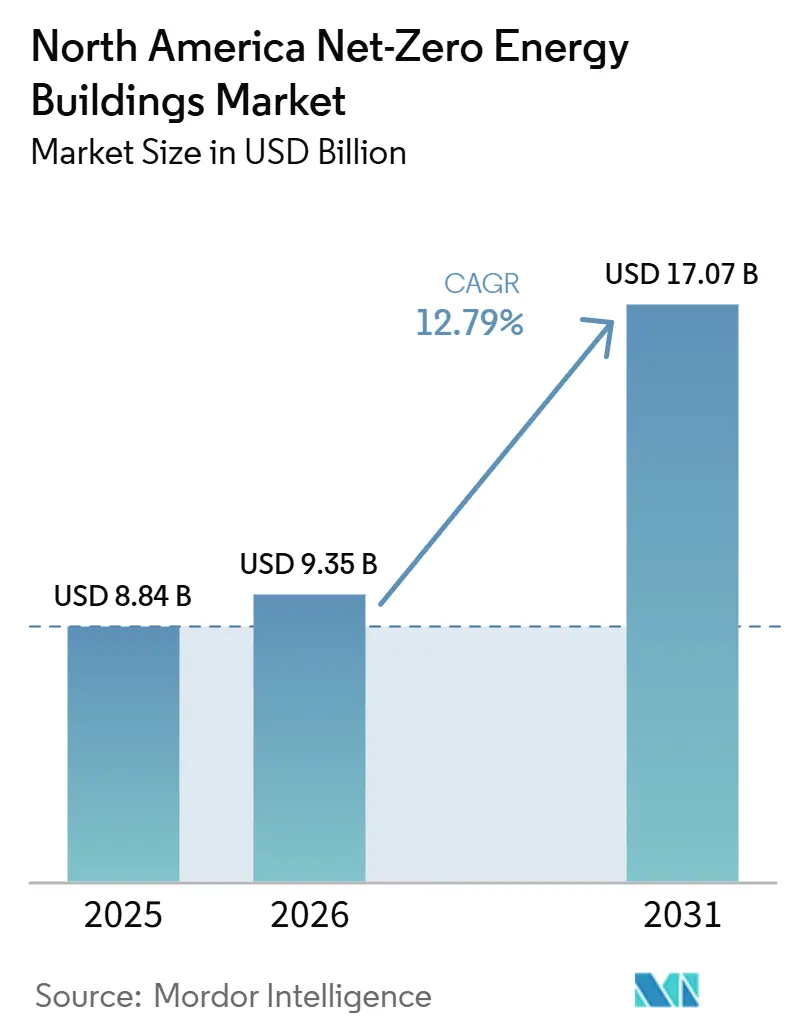
| Base Year Market Size (2025) | USD 8.84 Billion |
| Market Size (2026) | USD 9.35 Billion |
| Market Size (2031) | USD 17.07 Billion |
| Growth Rate (2026 - 2031) | 12.79 % |
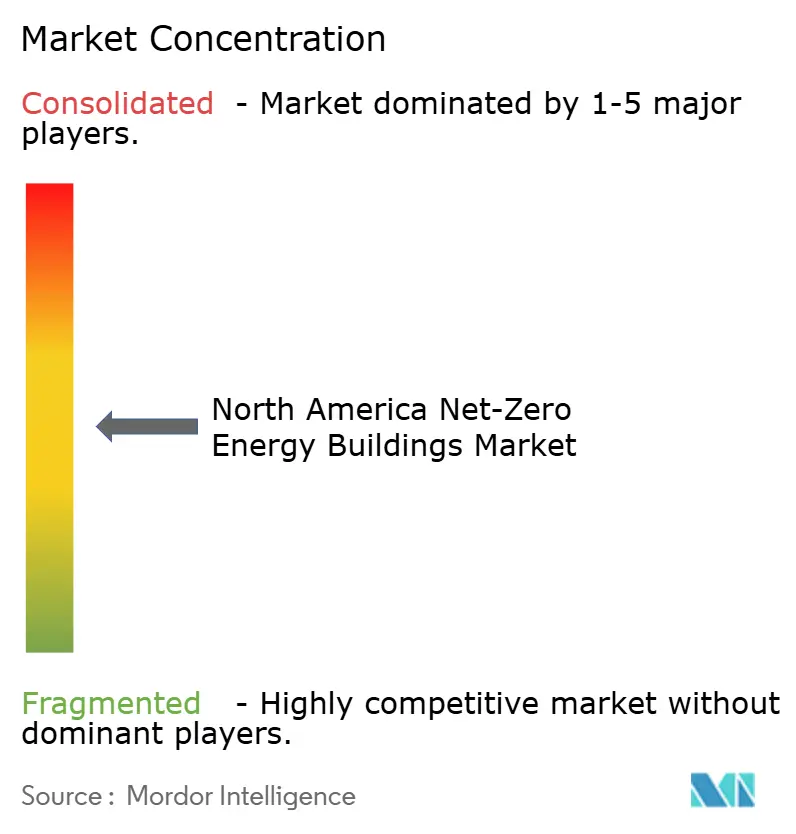
| Market Concentration | Medium |
Major Players *Disclaimer: Major Players sorted in no particular order Image © Mordor Intelligence. Reuse requires attribution under CC BY 4.0. | |
North America Net-Zero Energy Buildings Market Analysis by Mordor Intelligence
The North America Net-Zero Energy Buildings Market size is expected to grow from USD 8.84 billion in 2025 to USD 9.35 billion in 2026 and is forecast to reach USD 17.07 billion by 2031 at 12.79% CAGR over 2026-2031.
The North America net-zero energy buildings market is being shaped by stricter energy codes, corporate carbon requirements, and the broader adoption of electric heating, solar generation, and connected controls. U.S. and Canadian policies are moving building compliance beyond design-stage efficiency toward measured operational energy use and emissions. By July 2026, 16 active building performance standards (BPS) laws were in force across U.S. cities, counties, and states, with more than 40 cities expected to have some form of BPS in place by 2026. Unlike traditional prescriptive codes, which govern how a building is designed and built, a BPS sets a binding emissions cap or energy-use-intensity target for existing buildings and imposes financial penalties for non-compliance. For example, New York's Local Law 97 fines non-compliant buildings USD 268 per metric ton of CO2 equivalent above the annual cap.
This shift is changing procurement, as owners increasingly need systems that can document actual post-construction performance rather than only demonstrate design-stage compliance. Retrofit activity is gaining importance as older commercial and institutional properties face rising utility costs, tighter lease requirements, and growing carbon disclosure expectations. This pressure is expected to intensify as BPS emissions caps decline over successive compliance periods.
Key Report Takeaways
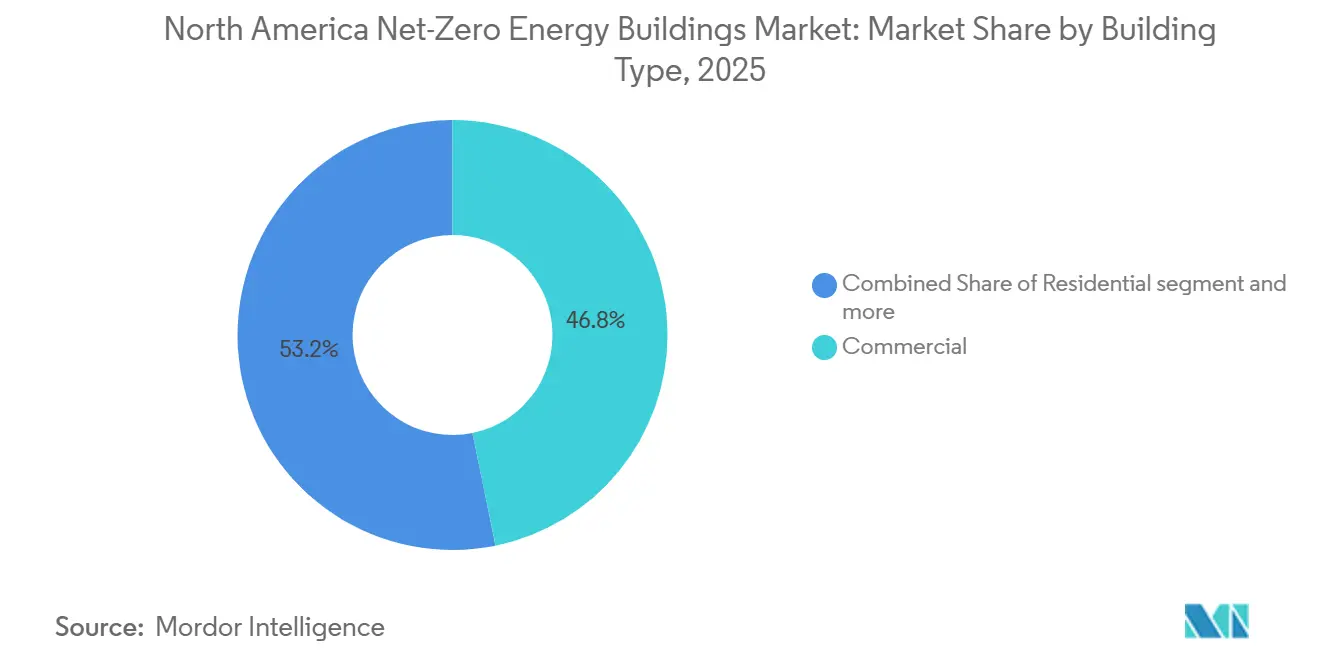
- By building type, commercial buildings held 46.8% of the North America net-zero energy buildings market share in 2025, while institutional buildings recorded the highest projected CAGR at 13.9% through 2031.
- By offerings, solutions accounted for 69.2% of the North America net-zero energy buildings market share in 2025, while services are forecast to grow at a 13.7% CAGR through 2031.
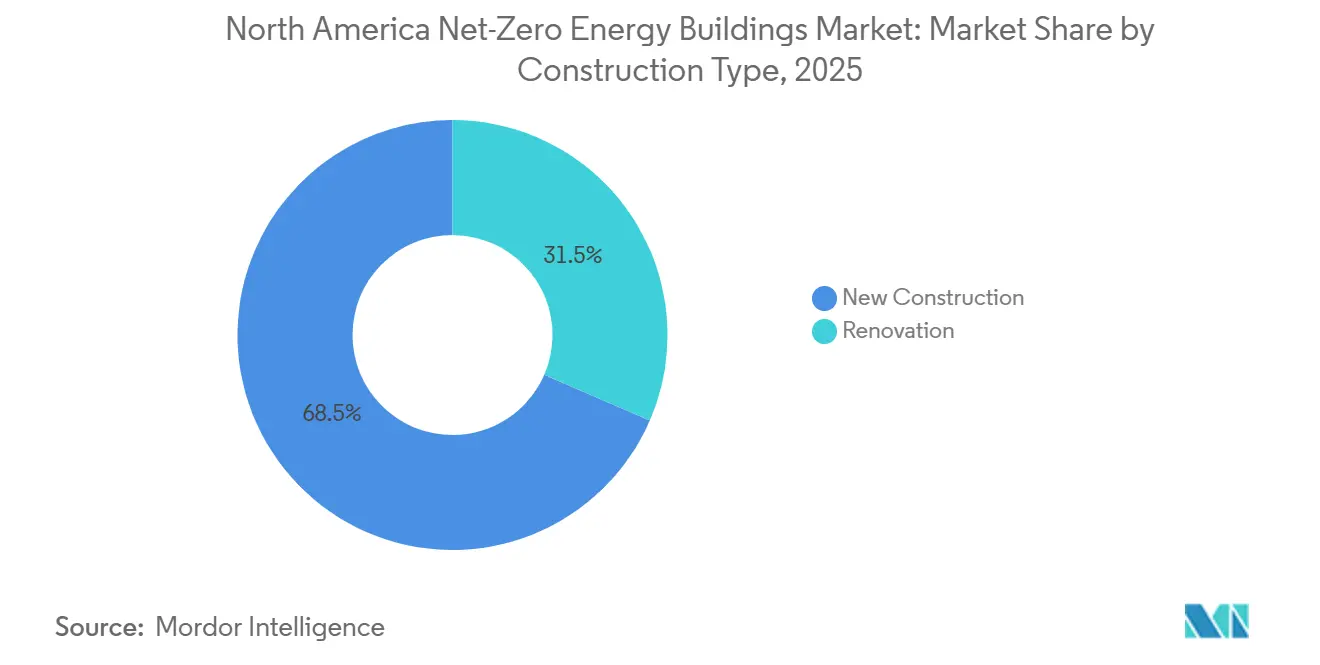
- By construction type, new construction held 68.5% of the North America net-zero energy buildings market size in 2025, while renovation is projected to expand at a 14.2% CAGR through 2031.
- By geography, the United States held 82.4% of the regional total in 2025, while Mexico is forecast to record the highest CAGR at 14.9% through 2031.
Note: Market size and forecast figures in this report are generated using Mordor Intelligence’s proprietary estimation framework, updated with the latest available data and insights as of January 2026.
Market Trends and Insights
Drivers Impact Analysis of North America Net-Zero Energy Buildings Market*
| Drivers | (~) % Impact on CAGR Forecast | Geographic Relevance | Impact Timeline |
|---|---|---|---|
| Stringent Energy Codes and Net-Zero Performance Targets | +3.0% | North America, with strongest relevance in the United States and Canada | Short term (≤ 2 years) |
| Deep Energy Retrofit Incentives | +2.2% | Primarily the United States, with secondary relevance in Canada | Short term (≤ 2 years) |
| Electrification of Space Heating and Cooling | +2.0% | North America, led by the U.S. Northeast, Pacific Coast, and Canada | Short term (≤ 2 years) |
| Corporate Portfolio Decarbonization | +1.8% | North America, concentrated in the United States and Canada | Medium term (2-4 years) |
| Grid-Interactive Building Demand Response | +1.3% | United States and Canada, with spillover to Mexico | Medium term (2-4 years) |
| Cold-Climate Envelope and Heat Pump Innovation | +0.8% | Canada and the northern United States | Medium term (2-4 years) |
| Source: Mordor Intelligence | |||
Stringent Energy Codes and Net-Zero Performance Targets
Energy codes are raising the level of building performance that owners must meet in the North American net-zero energy buildings market. Canada’s National Energy Code of Canada for Buildings 2025 introduced operational greenhouse gas performance tiers and energy-use pathways, giving provinces a common route toward lower-carbon construction. The code structure allows provinces to set their own adoption pace while preserving a common technical direction. In the United States, updated energy codes and state building performance rules are making high-efficiency mechanical systems, envelope upgrades, and measurement practices more central to project design. Developers that operate in several jurisdictions must plan for uneven adoption schedules and different documentation requirements. This favors firms with capabilities in code, engineering, and commissioning across multiple states and provinces.
Deep Energy Retrofit Incentives
Financial incentives have supported the retrofit pipeline in the North America net-zero energy buildings market, especially for large commercial and institutional properties. The U.S. federal framework has encouraged owners to assess energy upgrades alongside planned capital replacements, rather than treating efficiency work as a separate project. Incentive programs also increase demand for energy modeling and certification because owners need documentation to qualify for support. Public procurement has helped suppliers build experience with low-carbon materials, advanced controls, and performance verification. The scheduled change to some federal incentives after June 2026 may bring forward projects already under development. It also makes stable state, utility, and private financing programs more important for maintaining future renovation activity.
Electrification of Space Heating and Cooling
Electrification is expanding the addressable scope of the North America net-zero energy buildings market because heating and cooling remain major sources of building energy use. The Building Decarbonization Coalition reported that heat pumps accounted for 61% of new U.S. residential construction in 2024, while gas heating accounted for 38%. The same source reported that first-quarter 2026 heat pump shipments exceeded gas and fossil-fuel furnace sales by 32%[1]Building Decarbonization Coalition, “Record-Breaking Newly Built Home Market Share for Heat Pumps and Electric Heating,” Building Decarbonization Coalition, buildingdecarb.org. Advances in equipment are improving performance in cold climates, widening the range of locations where owners can replace fossil-fuel heating. Johnson Controls reports that advanced heat pump deployments can reduce emissions by up to 55% and operating costs by 35% compared with conventional heating systems. The result is a stronger demand for electrical upgrades, controls, training, and integrated mechanical design.
Corporate Portfolio Decarbonization
Corporate occupiers are increasing demand for buildings that provide verified energy and emissions information. In the North America net-zero energy buildings market, this changes leasing and acquisition decisions because owners need operational evidence, not only a design certification. Companies with public climate commitments are seeking data that can support portfolio reporting and internal capital planning. Johnson Controls states that its OpenBlue tools can help building portfolios reduce energy use by up to 30% and emissions by up to 68%. These expectations support demand for sensors, analytics, commissioning, and ongoing maintenance. They also raise the value of suppliers that can connect building systems with a customer’s wider reporting process.
Restraints Impact Analysis of North America Net-Zero Energy Buildings Market*
| Restraints | (~) % Impact on CAGR Forecast | Geographic Relevance | Impact Timeline |
|---|---|---|---|
| High Upfront Capital Costs and Long Payback Periods | -1.9% | North America, most acute in residential and small commercial buildings | Long term (≥ 4 years) |
| Skilled Labor and Commissioning Capacity Shortages | -1.6% | Primarily the United States, with secondary relevance in Canada | Short term (≤ 2 years) |
| Fragmented State, Provincial, and Municipal Regulations | -1.2% | Primarily the United States and Canada, with a federal-municipal split in Mexico | Medium term (2-4 years) |
| Interoperability, Cybersecurity, and Performance Verification Risks | -0.9% | North America, concentrated in institutional and commercial projects | Medium term (2-4 years) |
| Source: Mordor Intelligence | |||
High Upfront Capital Costs and Long Payback Periods
Whole-building retrofits can require envelope work, mechanical replacement, electrical upgrades, and controls at the same time. This creates a high initial cost for the North America net-zero energy buildings market, particularly where cold-climate upgrades require extensive insulation and air-sealing measures. Some owners have difficulty approving projects with payback periods longer than their usual capital planning cycle. Smaller commercial owners also may not have the staff to navigate complex incentive and financing programs. Property Assessed Clean Energy financing and utility financing can help, but their availability differs by jurisdiction. As a result, large institutions and corporate portfolios can move sooner than smaller owners with similar building needs.
Skilled Labor and Commissioning Capacity Shortages
Workforce availability is a practical constraint on the North America net-zero energy buildings market because projects need electricians, HVAC technicians, pipefitters, energy modelers, and commissioning specialists. Associated Builders and Contractors reported that the U.S. construction sector must attract 349,000 net new workers in 2026 and 456,000 in 2027. Net-zero projects require coordinated installation and system testing, so a shortage in one trade can delay the entire schedule. The International Energy Agency identifies workforce development as a major requirement for the buildings sector’s energy-efficiency transition. Contractors with trained staff and commissioning capacity can therefore become a limiting factor even when owners have funding and a clear regulatory reason to proceed. Training programs linked to electrification, controls, and verification will remain important to project delivery.
*Our forecasts treat driver/restraint impacts as directional, not additive. The impact forecasts reflect baseline growth, mix effects, and variable interactions.
North America Net-Zero Energy Buildings Market Segment Analysis
By Building Type:
Institutional Demand Strengthens in Healthcare and EducationCommercial buildings held 46.8% of the North America net-zero energy buildings market in 2025, supported by office, logistics, and retail retrofit activity. Corporate occupiers in these properties are increasingly asking for carbon data and energy performance evidence as part of leasing and procurement. Institutional buildings are forecast to expand at a 13.9% CAGR through 2031, the fastest rate among building types. Hospitals, universities, and government facilities often have long operating lives and public commitments that support major capital programs. UCI Health opened its all-electric acute care hospital in Irvine, California, in December 2025, using on-site solar and renewable grid electricity[2]UCI Health, “UCI Health Irvine Hospital Is Landmark in Healthcare Sustainability,” UCI Health, ucihealth.org. The project shows that a high-energy-use healthcare facility can adopt an all-electric design.
Residential buildings remain harder to address because ownership is fragmented and project-level technical support is limited. Industrial demand is growing in Mexico, where nearshoring-related construction must meet the requirements of multinational tenants. The North America net-zero energy buildings industry also benefits when institutional procurement creates repeatable specifications for suppliers and contractors. Cowichan District Hospital in British Columbia earned the Canada Green Building Council’s Zero Carbon Building Design Standard certification in 2025. Such projects provide reference points for healthcare owners assessing electrification and low-carbon design. Across building types, the most durable opportunity lies in projects that pair operational targets with long-term maintenance and verification.



By Offerings:
Solutions Lead While Services Gain From Verification NeedsSolutions accounted for 69.2% of the North American net-zero energy buildings market size in 2025 because equipment, construction, design, and digital platforms require substantial project spending. This category includes new building development, retrofit packages, integrated design and delivery, and smart building platforms. Building owners use these solutions to combine high-performance envelopes, electrified HVAC, renewable generation, storage, and controls. New development and integrated delivery retain a large role where institutional campuses and industrial facilities are planned from the start. Retrofit solutions are gaining momentum as older buildings need staged upgrades. The offering mix, therefore, increasingly favors suppliers that can coordinate physical systems and software.
Services are forecast to grow at a 13.7% CAGR through 2031, which reflects the importance of engineering, commissioning, certification, and consulting. The North American net-zero energy buildings market needs these services because design intent does not always align with measured operating performance. Owners require specialists to model energy use, configure controls, verify results, and manage evolving incentives. Schneider Electric launched EcoCare for Building Management Systems in June 2026, offering AI-supported monitoring and field support for commercial and institutional sites. The service model reflects a move toward continuing operational support rather than a single equipment sale. This supports recurring revenue while helping owners maintain performance after construction is complete.
By Construction Type:
Renovation Gains Ground as Existing Buildings Require UpgradesNew construction accounted for 68.5% of the North America net-zero energy buildings market size in 2025, supported by institutional campuses, industrial facilities, and new commercial projects. It is generally easier to include high-performance design requirements at the beginning of a project. Owners can coordinate the envelope, HVAC, and electrical systems, as well as solar capacity, before construction begins. Renovation is projected to grow at a 14.2% CAGR through 2031, which is faster than new construction. Older buildings are being reassessed as owners consider carbon disclosure, operating costs, lease expectations, and asset value. This gives retrofit projects a larger role in the regional pipeline.
Renovation is usually more complex because existing buildings can have limited electrical capacity, difficult envelopes, occupied spaces, and multiple legacy systems. These constraints raise coordination needs and can extend permitting and construction schedules. The North America net-zero energy buildings industry benefits from better energy modeling and building controls that help owners plan phased work. Canada Mortgage and Housing Corporation’s 2026 framework for Indigenous and remote communities identified net-zero energy-ready design and off-grid systems as relevant approaches for housing adaptation. In these settings, renovation can be especially relevant where resilience, energy security, and existing building conditions must be addressed together. Project outcomes will depend on whether local contractors and financing can support the required scope of work.
Geography Analysis
United States Net-Zero Energy Buildings Market
The United States held 82.4% of the regional total in 2025, supported by a large commercial building base, established professional services, and extensive incentive programs. State energy codes and building performance standards are pushing owners toward stronger efficiency and operational reporting practices. Institutional activity also supports demand. Utah State University’s Moab Academic Building received Zero Energy Certification in March 2026 after producing 40% more energy annually than it used through its on-site solar array. The United States also has a broad supplier base across HVAC, automation, electrical equipment, and energy services. This gives owners more options, but regulatory requirements still vary substantially between states and cities.
Canada Net-Zero Energy Buildings Market
Canada is the second-largest geography in the North America net-zero energy buildings market. The federal Canadian Green Buildings Strategy sets a long-term direction for net-zero-ready building stock by 2030. NECB 2025 provides provinces with operational emissions tiers and an energy-performance framework. Provincial adoption will occur at different speeds, creating continued demand for code interpretation and project support. The Canada Green Building Council certified 55 projects in May 2026 through its BCZ, LEED, and IREE programs[3]Canada Green Building Council, “Certified Projects May 2026,” Canada Green Building Council, cagbc.org. Cold-climate buildings and remote communities also create a need for solutions that address both energy performance and resilience.
Mexico Net-Zero Energy Buildings Market
Mexico is forecast to grow at a 14.9% CAGR through 2031, making it the fastest-growing geography in the North America net-zero energy buildings market. Nearshoring is increasing demand for industrial and manufacturing facilities that align with multinational tenant requirements. Those tenants often seek documented energy performance and recognized green building credentials. Mexico City’s environmental authority confirmed the rehabilitation of the Cuemanco public market as the country’s first public net-zero building in June 2026. The project provides a public reference for local developers and building owners. Growth in Mexico will depend on the ability of developers to translate occupier requirements into practical designs, local supply chains, and verified operating results.
Competitive Landscape
The North America net-zero energy buildings market has moderate concentration at the platform level because major integrators combine HVAC, building automation, energy management, and digital services. Johnson Controls, Schneider Electric, Siemens, Honeywell, Carrier, Trane Technologies, Daikin, and Mitsubishi Electric compete across major systems. Their installed base gives them access to existing buildings where owners are planning upgrades. At the same time, envelope providers, electrical equipment suppliers, lighting specialists, and software firms compete for a position in project specifications. The competitive focus is moving from equipment supply toward ongoing monitoring, analytics, and managed operations. This approach can raise customer switching costs because building data and workflows become more closely integrated with a supplier’s platform.
Johnson Controls reported in April 2026 that its technologies have helped customers avoid emissions equivalent to nearly 6 million U.S. homes and achieve USD 9.5 billion in cumulative energy cost savings. Schneider Electric launched EcoCare for Building Management Systems in June 2026 to combine AI-supported monitoring with on-site technical support. Kaiser Permanente is building 2 all-electric hospitals in Northern California, showing how large institutional customers are providing a practical deployment path for integrated electrification systems. These examples show that suppliers are increasingly competing on operational results, service capacity, and ability to coordinate several building systems. Mid-sized building owners remain an important opening because many lack internal teams to operate complex analytics platforms. Providers that add commissioning and managed support to their equipment can be better placed to serve this group.
Digital capabilities are becoming more important as owners connect building controls, energy systems, and reporting tools. Cybersecurity and interoperability are also relevant because buildings may include equipment and software from several vendors. Suppliers that can demonstrate reliable integration and operational support may gain an advantage in institutional and government contracts. High-performance envelope materials and building-integrated solar systems remain important because equipment alone cannot achieve whole-building targets. Competition will therefore continue across hardware, software, engineering, and field services. No combined market share for leading companies is available in the supplied material, so a concentration score cannot be assigned using the required share-based method without creating unsupported data.
North America Net-Zero Energy Buildings Industry Leaders
Johnson Controls International plc
Schneider Electric SE
Siemens AG
Honeywell International Inc.
Carrier Global Corporation
- *Disclaimer: Major Players sorted in no particular order
North America Net-Zero Energy Buildings Market Companies Covered in this Report
- Johnson Controls International plc
- Schneider Electric SE
- Siemens AG
- Honeywell International Inc.
- Carrier Global Corporation
- Trane Technologies plc
- Daikin Industries Ltd.
- Mitsubishi Electric Corporation
- ABB Ltd.
- Eaton Corporation plc
- Legrand SA
- Robert Bosch GmbH
- Saint-Gobain
- Kingspan Group plc
- ROCKWOOL A/S
- Owens Corning
- Lutron Electronics Co., Inc.
- Signify N.V.
- Canadian Solar Inc.
- Integrated Environmental Solutions Ltd.

Recent Industry Developments in North America Net-Zero Energy Buildings Market
- June 2026: Schneider Electric launched EcoCare for Building Management Systems in the United States at Realcomm IBcon 2026. The service provides 24/7 AI-driven monitoring, predictive analytics, and on-site technical support for commercial and institutional facilities.
- April 2026: Johnson Controls released its 2026 Sustainability Report. The company reported a 46% reduction in operational carbon emissions from its 2017 baseline and confirmed the completion of its Nantum AI acquisition.
- April 2026: Kaiser Permanente confirmed 2 all-electric acute care hospitals under construction in San Jose and Sacramento, California. The facilities eliminate the use of natural gas for heating and cooling.
- March 2026: Utah State University’s Moab Academic Building received Zero Energy Certification from the International Living Future Institute after generating 40% more energy annually than it consumed.


North America Net-Zero Energy Buildings Market Report Scope
| Residential |
| Commercial |
| Institutional |
| Industrial |
| Solutions (New Net-Zero Energy Building Development, Net-Zero Building Retrofit, Integrated Design & Delivery and Smart Net-Zero Building Solutions) |
| Services (Architectural & Engineering Design, Construction Services, Commissioning & Certification Services and Consulting Services) |
| New Construction |
| Renovation |
| United States |
| Canada |
| Mexico |
| By Building Type | Residential |
| Commercial | |
| Institutional | |
| Industrial | |
| By Offerings | Solutions (New Net-Zero Energy Building Development, Net-Zero Building Retrofit, Integrated Design & Delivery and Smart Net-Zero Building Solutions) |
| Services (Architectural & Engineering Design, Construction Services, Commissioning & Certification Services and Consulting Services) | |
| By Construction Type | New Construction |
| Renovation | |
| By Country | United States |
| Canada | |
| Mexico |


Key Questions Answered in the Report
What is the projected value of net-zero energy buildings in North America by 2031?
The North America net-zero energy buildings market is forecast to reach USD 17.1 billion by 2031, expanding at a 12.8% CAGR from 2026. The North America net-zero energy buildings market is supported by work on both new construction and existing buildings. Its expansion reflects policy changes, electrification investment, and growing demand for measurable operating results. Projects that combine envelope improvements, efficient equipment, renewable power, and commissioning are expected to account for a growing share of spending.
Which building type is growing fastest in North America?
Institutional buildings are forecast to grow at a 13.9% CAGR through 2031, supported by healthcare, education, and public-sector projects. The North America net-zero energy buildings market benefits from long project cycles and formal performance requirements in these facilities. Healthcare and university owners can also use standard project requirements across several sites, which gives suppliers a clearer route to repeat work.
Why are building retrofits increasing in the region?
Renovation is projected to grow at a 14.2% CAGR as owners upgrade older properties to address energy costs, performance requirements, and asset risk. This work broadens the North America net-zero energy buildings market beyond greenfield development. It also creates demand for planning that limits disruption for tenants and protects the building’s normal operations while work proceeds.
Which country has the largest regional share?
The United States held 82.4% of the regional total in 2025, supported by its commercial building base and extensive supplier ecosystem. The North America net-zero energy buildings market is concentrated in the United States because of its scale and established building services base. Its state-by-state rules can still increase planning needs for owners that operate a large multi-location portfolio.
Page last updated on:





