
North America Mobile Homes Market Size and Share
Market Overview
| Study Period | 2020 - 2031 |
|---|---|
| Forecast Data Period | 2026 - 2031 |
| Base Year Market Size (2025) | USD 5.33 Billion |
| Market Size (2026) | USD 5.63 Billion |
| Market Size (2031) | USD 7.48 Billion |
| Growth Rate (2026 - 2031) | 5.85 % |
| Market Concentration | Medium |
Major Players *Disclaimer: Major Players sorted in no particular order Image © Mordor Intelligence. Reuse requires attribution under CC BY 4.0. | |
North America Mobile Homes Market Analysis by Mordor Intelligence
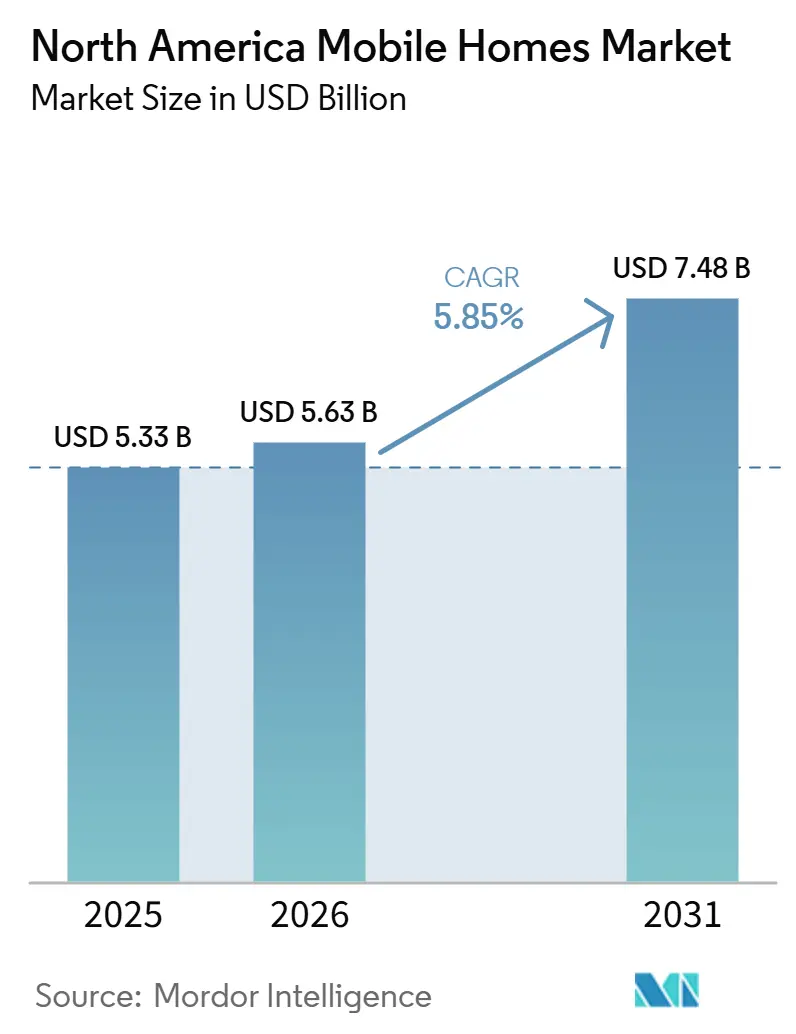
The North America Mobile Homes Market size is projected to be USD 5.33 billion in 2025, USD 5.63 billion in 2026, and reach USD 7.48 billion by 2031, growing at a CAGR of 5.85% from 2026 to 2031.
Housing affordability continues to support demand, as many households cannot afford newly built site-built homes. Factory production also enables builders to manage labor shortages more effectively and shorten delivery timelines.
Recent federal rule changes are expanding the range of designs permitted under the HUD Code. A 2024 final rule allows up to four-unit multi-dwelling manufactured homes and is expected to take effect in September 2025. HUD has also proposed eliminating the permanent chassis requirement on the upper floors of multistory manufactured homes. The agency estimates that this change could save buyers approximately USD 4,700-6,600 per multistory unit if finalized. The proposal remains open for public comment and is not yet in effect.
Community owners and institutional investors are expanding their roles in the supply chain, highlighting the importance of reliable production, installation, and service capabilities. However, financing costs and local zoning rules remain the main barriers to wider adoption in the North America mobile home market.
Key Report Takeaways
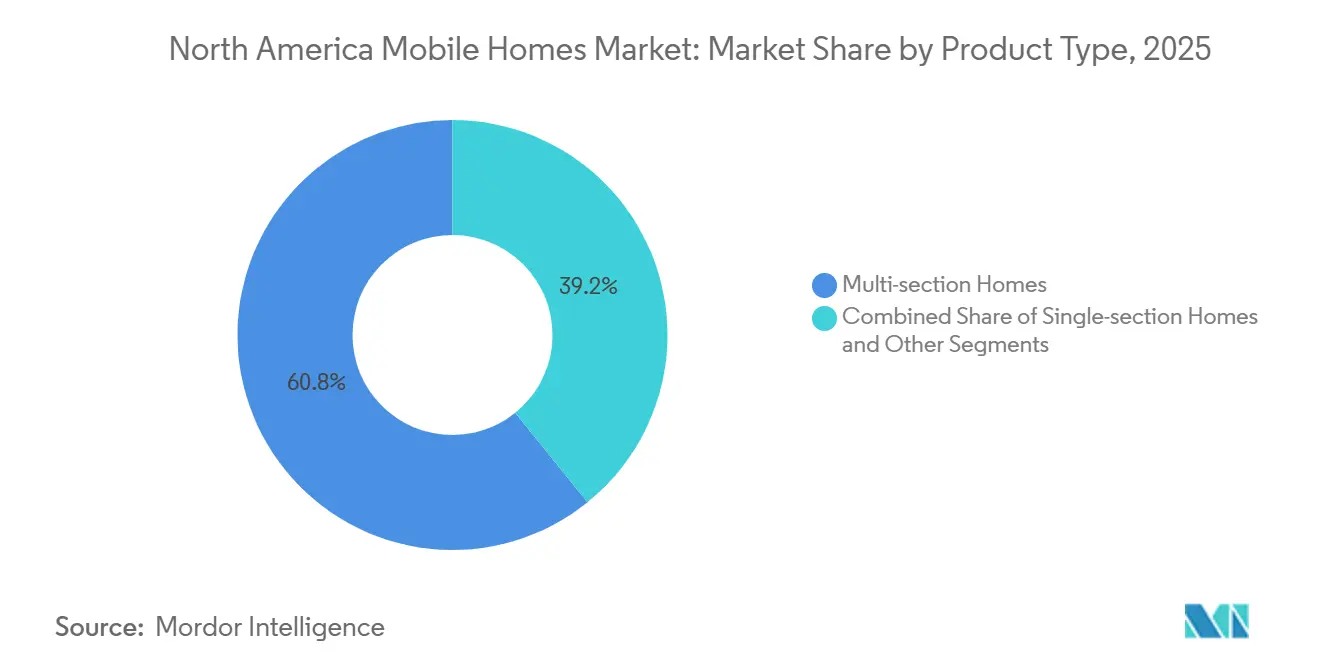
- By product type, multi-section homes held 60.8% of the North America mobile homes market share in 2025, while the Others category is forecast to grow at a 7.42% CAGR through 2031.
- By material, timber held 59.3% of the North America mobile homes market share in 2025, while composite and other materials are projected to advance at a 7.08% CAGR through 2031.
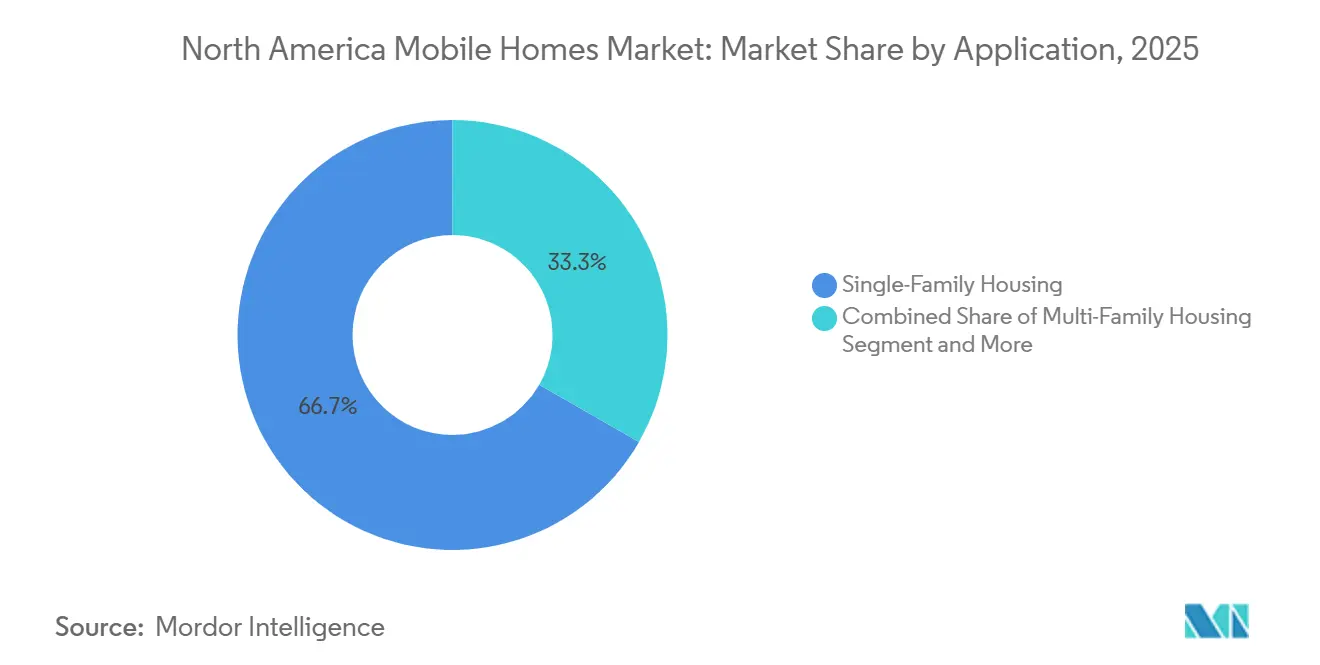
- By application, single-family housing accounted for 66.7% of the North America mobile homes market size in 2025, while the Others category is projected to expand at a 7.65% CAGR through 2031.
- By country, the United States accounted for 85.2% of the North America mobile homes market in 2025, while Mexico is forecast to expand at a 7.31% CAGR through 2031.
Note: Market size and forecast figures in this report are generated using Mordor Intelligence’s proprietary estimation framework, updated with the latest available data and insights as of January 2026.
Market Trends and Insights
Drivers Impact Analysis of North America Mobile Homes Market*
| Drivers | (~) % Impact on CAGR Forecast | Geographic Relevance | Impact Timeline |
|---|---|---|---|
| Housing affordability increases demand for mobile homes | +1.4% | United States, Canada, Mexico | Medium term (2-4 years) |
| Factory-built construction reduces time and labor needs | +1.1% | North America | Long term (≥ 4 years) |
| HUD Code modernization improves product quality | +0.9% | The United States primarily | Medium term (2-4 years) |
| Workforce housing and community expansion increase demand | +0.7% | U.S. Sun Belt, industrial corridors, Mexico | Medium term (2-4 years) |
| CrossMod homes improve design quality and acceptance | +0.5% | United States | Short term (≤ 2 years) |
| Institutional investment supports community expansion | +0.4% | United States, Canada | Short term (≤ 2 years) |
| Source: Mordor Intelligence | |||
Housing Affordability Challenges Increase Mobile Home Demand
The gap between site-built home prices and household incomes remains a central driver of demand for the North American mobile home market. The National Association of Home Builders reported that 75% of U.S. households, or 100.6 million households, could not afford a median-priced new home priced near USD 460,000 in 2025. This constraint favors manufactured homes because they offer a lower entry cost and can be produced on a larger scale. Demand in established communities also stays resilient because moving home is costly for residents who lease their sites. That condition supports occupancy, new-home placements, and continued investment in existing communities. The North America mobile homes market therefore benefits when conventional housing remains out of reach for a broad share of households.
Factory-Built Construction Reduces Build Time and Labor Dependence
Factory-built delivery helps producers limit exposure to on-site labor shortages and weather-related schedule delays. The World Economic Forum reported in 2025 that modular construction can reduce total delivery costs by up to 20% compared with conventional approaches[1]World Economic Forum, “How Modular Construction Drives Productivity and Circularity,” World Economic Forum analysis, January 2025, weforum.org. Clayton Homes stated that a single-section CrossMod home can be built in around one-third of the time required for a comparable site-built home. The Manufactured Housing Association for Regulatory Reform reported 102,738 HUD Code homes were produced in the United States during 2025[2]Manufactured Housing Association for Regulatory Reform, “Total 2025 U.S. Manufactured Home Production Data,” Manufactured Housing Association for Regulatory Reform, manufacturedhousingassociationregulatoryreform.org.. Stable factory output gives developers and community operators a more predictable supply option. This production advantage improves the North American mobile home market's ability to serve locations where conventional construction cannot keep pace.
HUD Code Modernization Improves Energy Efficiency and Product Quality
Federal updates are expanding the range of homes permitted under the HUD Code and improving product standards. HUD's 2024 final rule, effective March 17, 2025, allowed multi-unit single-family manufactured homes and updated appliance, accessibility, and installation provisions. The Department of Energy issued a final rule in July 2025 that delayed the Tier 2 energy-conservation compliance deadline by 180 days, effective upon publication of enforcement procedures[3]U.S. Department of Energy, “Energy Department Issues Final Rule Delaying Compliance Deadline for Manufactured Housing Standards,” U.S. Department of Energy, energy.gov.. HUD also proposed in June 2026 that upper-floor sections of multistory manufactured homes no longer require a permanent chassis. The proposed change is estimated to reduce production, transportation, and installation costs by USD 6,000 per home. These changes create more room for the North America mobile homes market to address denser sites and urban infill projects.
Workforce Housing and Manufactured Housing Communities Expand Market Demand
Workforce housing has become a recurring source of demand for factory-built homes, especially near employment centers with limited housing supply. In northern Mexico, industrial relocation has increased housing needs in Monterrey, Saltillo, and Ciudad Juárez. Canada and Quebec selected 11 highly prefabricated housing projects totaling 336 homes for delivery in summer 2026, supported by USD 69.3 million in federal funding. This program shows how public procurement can create a steadier pipeline of prefabricated construction projects. Community ownership is also becoming more institutional, which raises demand for standardized infrastructure and dependable supplier performance. These developments broaden the customer base of the North America mobile homes market beyond traditional individual homebuyers.
Restraints Impact Analysis of North America Mobile Homes Market*
| Restraints | (~) % Impact on CAGR Forecast | Geographic Relevance | Impact Timeline |
|---|---|---|---|
| Chattel financing and personal property titles increase ownership costs | -1.0% | The United States primarily | Long term (≥ 4 years) |
| Zoning, siting, and community approvals limit growth | -0.8% | United States and Canadian urban areas | Long term (≥ 4 years) |
| Transportation, crane, and last-mile costs increase project expenses | -0.6% | North America | Medium term (2-4 years) |
| Foundation certification and insurance requirements delay placement | -0.4% | United States | Short term (≤ 2 years) |
| Source: Mordor Intelligence | |||
Chattel Financing and Personal Property Titling Increase Ownership Costs
Financing remains a material obstacle even when a manufactured home has a lower purchase price than a site-built alternative. The supplied research indicated that chattel loans carry a material rate premium over traditional manufactured home mortgages. Chattel lending is often used when a buyer places a home on leased land and cannot obtain a conventional mortgage. The higher rate increases lifetime ownership costs and restricts access for households with limited savings. Expanded mortgage eligibility for certain CrossMod homes can improve options for eligible buyers, but it does not change the title structure for most community-placed homes. This financing gap continues to limit the addressable demand in the North American mobile home market.
Zoning, Siting, and Community Approval Restrictions Limit Market Growth
Local zoning and siting rules continue to restrict the placement of manufactured homes in many urban and suburban areas. The Bipartisan Policy Center found that 57% of 825 jurisdictions studied in 32 states required lots larger than half an acre for factory-built homes. Such rules raise land costs and exclude homes from locations where affordability needs are most acute. The Manufactured Housing Association for Regulatory Reform has called for stronger enforcement of federal preemption provisions in the Manufactured Housing Improvement Act. Community approval, foundation certification, insurance requirements, transportation, cranes, and last-mile delivery can add further time and cost to a project. These constraints limit how quickly the North American mobile home market can convert demand into completed home placements.
*Our forecasts treat driver/restraint impacts as directional, not additive. The impact forecasts reflect baseline growth, mix effects, and variable interactions.
North America Mobile Homes Market Segment Analysis
By Product Type:
Multi-Section Homes Lead Through Space and Financing OptionsMulti-section homes accounted for 60.8% of the North American mobile home market in 2025. Their position reflects larger floor plans, broader design choices, and a closer fit with buyer expectations for permanent housing. They also have an advantage when they qualify for real-property mortgage financing on owned land. The Manufactured Housing Institute noted that Freddie Mac expanded its CHOICEHome program to include single-section CrossMod homes in 2025, adding to the financing pathways already available for qualifying designs. Multi-section models remain well-suited to households that need more interior space but cannot afford a conventional new home.
Single-section homes continue to appeal to rural buyers and households that prioritize lower upfront costs and quick placement. Clayton Homes showcased a single-section CrossMod home at the 2025 Innovative Housing Showcase and stated that the home could be priced near USD 200,000, including land, in many U.S. locations. The Others category, which includes volumetric modular, panelized, and container-based homes, is projected to grow at a 7.42% CAGR through 2031. These formats are used where deployment speed is important, including disaster relief, workforce housing, and hospitality. HUD's rule allowing up to four-unit manufactured structures created a pathway for product concepts aimed at multifamily and hospitality projects.



By Material:
Timber Leads While Composites Gain Use in Demanding LocationsTimber held 59.3% of the regional mobile homes market in 2025. Its established supply base, predictable factory fabrication, and familiarity with HUD Code requirements support its continued use. Timber can also be processed under controlled factory conditions, which reduces material exposure during construction. Research published in Developments in the Built Environment in April 2026 found strong structural performance in thermally modified cross-laminated strand-veneer lumber panels. Steel remains useful in commercial, hospitality, and multi-unit applications that require structural durability.
Composite and other materials are forecast to grow at a 7.08% CAGR through 2031. Moisture resistance and durability make these materials a better choice for humid and coastal areas. This benefit can become more important where insurers require stronger building performance. The Lincoln Institute of Land Policy reported that voluntary resilience standards, including the Insurance Institute for Business and Home Safety Fortified program, are increasingly informing manufactured housing practices. These changes give producers in the North America mobile homes industry more options to differentiate higher-performance homes without displacing timber from its leading position.
By Application:
Single-Family Housing Remains the Primary UseSingle-family housing accounted for 66.7% of the North American mobile home market in 2025. It remains the core application because the product addresses households seeking a permanent home at a lower cost than site-built alternatives. The affordability gap supports this use case in both rural areas and communities near growing metropolitan areas. Manufactured homes also offer a viable option for buyers who value faster delivery and a defined purchase price. Mortgage program expansion for qualifying CrossMod designs can support the single-family market by enabling more buyers to access conventional financing.
The Others application category is forecast to grow at a 7.65% CAGR through 2031. It includes disaster relief and temporary housing, student and senior housing, workforce housing, and container-based applications. HUD's 2025 standards update included accessibility provisions that can support homes intended for older residents and people with disabilities. Multi-family housing also offers greater room to develop, as HUD Code rules now permit up to four-unit manufactured structures. Application diversification enables the North American mobile home market to serve public agencies, developers, and operators in addition to individual buyers.
Geography Analysis
United States Mobile Homes Market
The United States accounted for 85.2% of the North America mobile homes market in 2025. Its leading position is supported by the region's most established manufactured housing regulations, an active community investment base, and extensive retail and financing networks. Realtor.com reported that 20.6 million Americans lived in factory-built homes in 2026. U.S. HUD Code production reached 102,738 homes in 2025, with Florida, Texas, and Arizona among the largest demand centers. Population growth, housing costs, and selected local zoning conditions support demand in these states.
Canada Mobile Homes Market
Canada has a smaller base but is receiving increased public support for prefabricated housing. The Canadian and Quebec governments selected 11 highly prefabricated projects totaling 336 units for delivery in summer 2026. The federal support behind these projects totaled USD 69.3 million and strengthened the delivery pipeline. National and provincial building requirements can add certification work for producers operating across jurisdictions. Those requirements may slow delivery, but they do not remove the policy support for prefabricated projects.
Mexico Mobile Homes Market
Mexico is the fastest-growing country segment, with a projected CAGR of 7.31% from 2026 to 2031. Industrial relocation in northern manufacturing corridors is increasing the need for workforce housing near Monterrey, Saltillo, and Ciudad Juárez. INEGI reported that 58.5% of owner-occupied homes required repairs or expansion in its 2024 National Housing Survey. Factory-built homes can respond to persistent quality and capacity gaps through controlled production and faster site delivery. Mexico, therefore, offers the strongest growth opportunity in the North American mobile home market, though project success will depend on local infrastructure, buyer financing, and site readiness.
Competitive Landscape
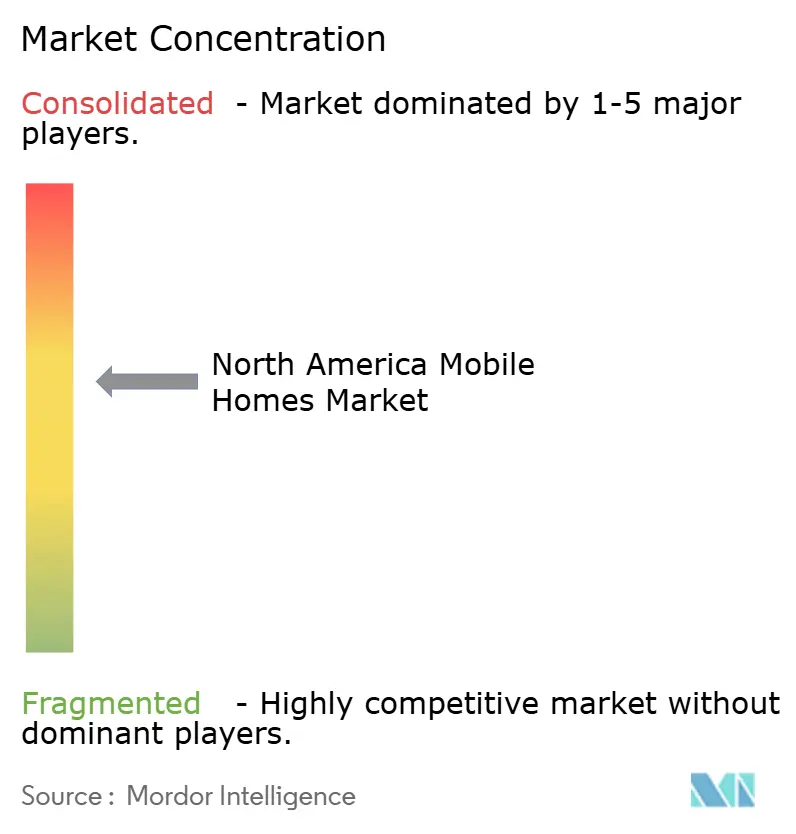
The North America mobile homes market has moderate-to-high manufacturing concentration. Clayton Homes, Champion Homes, and Cavco Industries together accounted for roughly half of annual HUD Code unit production, according to Berkshire Hathaway's 2024 annual report. Their scale supports wider dealer coverage, established purchasing relationships, and access to financing channels. Legacy Housing Corporation, Nobility Homes, Deer Valley Homebuilders, and ScotBilt Homes remain relevant where customized models or regional knowledge matter.
Vertical integration is a key competitive strategy. Champion Homes signed an agreement in May 2025 to acquire Iseman Homes and its 10 retail sales centers in the Dakotas, Minnesota, Montana, Nebraska, and Wyoming. In May 2026, Champion Homes also agreed to acquire 11 Homes Direct retail locations in Arizona, California, Colorado, New Mexico, and Oregon. Cavco Industries completed its acquisition of American Homestar Corporation in September 2025, adding 2 manufacturing facilities, 19 retail locations, and financing and insurance capabilities. These transactions bring production, sales, and buyer support closer together.
Community ownership is increasingly important to supplier selection and competitive positioning. Institutional owners look for homes that can be installed quickly, meet performance standards, and receive dependable post-placement service. Producers that meet these requirements can improve their chances of becoming preferred suppliers to large community portfolios. Age-qualified communities, workforce housing developments, and secondary markets remain areas where specialized floor plans may command better positioning. The competitive structure creates high entry barriers in national distribution while preserving opportunities for regional suppliers.
North America Mobile Homes Industry Leaders
Clayton Homes, Inc.
Champion Homes, Inc.
Cavco Industries, Inc.
Legacy Housing Corporation
Live Oak Homes
- *Disclaimer: Major Players sorted in no particular order
North America Mobile Homes Market Companies Covered in this Report
- Clayton Homes, Inc.
- Champion Homes, Inc.
- Cavco Industries, Inc.
- Legacy Housing Corporation
- Live Oak Homes
- Jessup Housing
- Adventure Homes
- American Home Star Corporation
- Sunshine Homes, Inc.
- Commodore Corporation
- Deer Valley Homebuilders, Inc.
- Nobility Homes, Inc.
- ScotBilt Homes
- Chariot Eagle
- Cappaert Manufactured Housing
- Friendship Homes
- Golden West Homes
- KIT HomeBuilders West
- Woodland Park
- Champion Retail Housing

Recent Industry Developments in North America Mobile Homes Market
- July 2026: Firm Capital Property Trust and SunPark Communities completed the acquisition of a 10-property manufactured housing community portfolio in Alberta and Saskatchewan for USD 157 million. The portfolio includes 1,649 sites and was financed partly through a 6-year mortgage at a 4.5% rate. Following the acquisition, SunPark Communities manages 2,572 sites across Ontario, Alberta, and Saskatchewan, strengthening its position among Canada’s larger manufactured housing community owners.
- June 2026: The U.S. Congress enacted the 21st Century Road to Housing Act, which updates the long-standing chassis requirement for manufactured homes and revises federal loan limits. The changes could reduce builder costs by USD 5,000 to USD 10,000 per unit by allowing chassis reuse.
- June 2026: HUD proposed removing the permanent chassis requirement for upper-floor sections of multistory manufactured homes. The proposal could reduce production, transportation, and installation costs by USD 6,000 per unit. It may also support manufactured housing projects in urban infill locations and multistory developments.
- May 2026: Cavco Industries began construction of a 616,000 sq ft manufacturing facility in El Mirage, Arizona. The plant will produce HUD Code manufactured homes and modular single-family homes for Arizona and nearby states. Cavco expects the facility to become operational by mid-2027 and has reserved space for a second production line.


North America Mobile Homes Market Report Scope
| Single-section Homes |
| Multi-section Homes |
| Others (Volumetric Modular Homes, Panelized Mobile Homes, and Container-based Mobile Homes) |
| Timber-Based Construction |
| Steel-Based Construction |
| Concrete-Based Construction |
| Composite and Other Materials |
| Single-Family Housing |
| Multi-Family Housing |
| Commercial, Hospitality, and Institutional Buildings |
| Others (Disaster Relief and Temporary Housing, Student and Senior Housing, Student and Senior Housing, Workforce Housing, and Container-based Mobile Homes) |
| United States |
| Canada |
| Mexico |
| By Product Type | Single-section Homes |
| Multi-section Homes | |
| Others (Volumetric Modular Homes, Panelized Mobile Homes, and Container-based Mobile Homes) | |
| By Material | Timber-Based Construction |
| Steel-Based Construction | |
| Concrete-Based Construction | |
| Composite and Other Materials | |
| By Application | Single-Family Housing |
| Multi-Family Housing | |
| Commercial, Hospitality, and Institutional Buildings | |
| Others (Disaster Relief and Temporary Housing, Student and Senior Housing, Student and Senior Housing, Workforce Housing, and Container-based Mobile Homes) | |
| By Country | United States |
| Canada | |
| Mexico |


Key Questions Answered in the Report
What is the value of the North America mobile homes market?
The North America mobile homes market was valued at USD 5.33 billion in 2025 and is estimated at USD 5.63 billion in 2026. It is forecast to reach USD 7.48 billion by 2031, with affordability pressures and community demand supporting expansion.
What growth rate is forecast for mobile homes in North America?
The sector is projected to grow at a 5.85% CAGR from 2026 to 2031. Factory production can shorten delivery schedules and reduce reliance on constrained on-site construction labor, especially for recurring community projects.
Which product type leads mobile home demand in North America?
Multi-section homes accounted for 60.8% of revenue in 2025 because they offer larger floor plans and can support real property mortgage financing in qualifying cases. They remain the preferred option for many permanent owner-occupied placements that need more living space.
Which country will grow fastest through 2031?
Mexico is forecast to grow at a 7.31% CAGR through 2031 as industrial relocation increases workforce housing demand in northern manufacturing corridors. Housing repair and expansion needs also point to a larger supply gap for dependable, quickly delivered housing.
What are the main barriers to wider manufactured housing adoption?
Higher chattel-loan costs, zoning limits, site approvals, transportation costs, and foundation and insurance requirements can delay or prevent home placements. These barriers can affect both project economics and the availability of suitable sites for new communities or infill homes.
Which companies shape competition in the North American mobile home market?
Clayton Homes, Champion Homes, and Cavco Industries are the leading manufacturers, accounting for roughly half of the annual HUD Code units. Champion and Cavco have expanded their retail reach through acquisitions, while regional producers focus on localized service and customization.
Page last updated on:





