
North America Data Center Disaster Recovery Infrastructure Market Size and Share
Market Overview
| Study Period | 2021 - 2032 |
|---|---|
| Forecast Data Period | 2027 - 2032 |
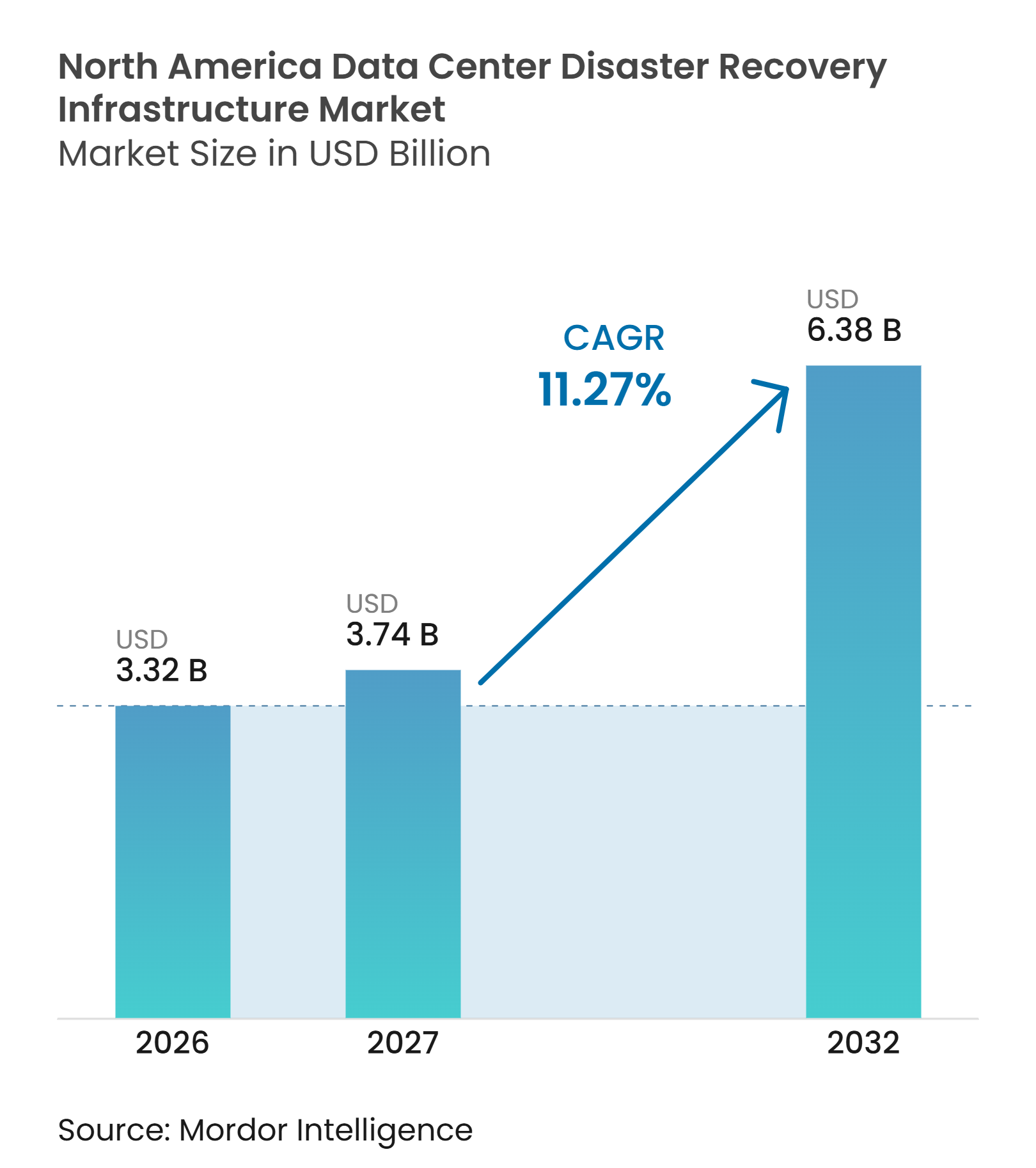
| Base Year Market Size (2026) | USD 3.32 Billion |
| Market Size (2027) | USD 3.74 Billion |
| Market Size (2032) | USD 6.38 Billion |
| Growth Rate (2027 - 2032) | 11.27 % |
| Market Concentration | Medium |
Major Players *Disclaimer: Major Players sorted in no particular order Image © Mordor Intelligence. Reuse requires attribution under CC BY 4.0. | |
North America Data Center Disaster Recovery Infrastructure Market Analysis by Mordor Intelligence
The North America data center disaster recovery infrastructure market size is projected to expand from USD 3.32 billion in 2026 and USD 3.74 billion in 2027 to USD 6.38 billion by 2032, registering a CAGR of 11.27% between 2027 to 2032. Ransomware risk is moving recovery planning from an operational concern to a board-level requirement, especially where backup environments can be compromised with production systems. Hybrid and multi-cloud estates are increasing the number of workloads, dependencies, and recovery paths that teams must manage. Buyers are favoring immutable storage, continuous replication, and automated failover because these tools can reduce recovery uncertainty during a cyber incident. Federal, sector-specific, and contractual requirements are also increasing demand for documented testing and audit-ready recovery procedures. The North America data center disaster recovery infrastructure market is therefore expanding across both dedicated facilities and managed cloud services, while implementation cost and scarce specialist talent continue to limit adoption.
Key Report Takeaways
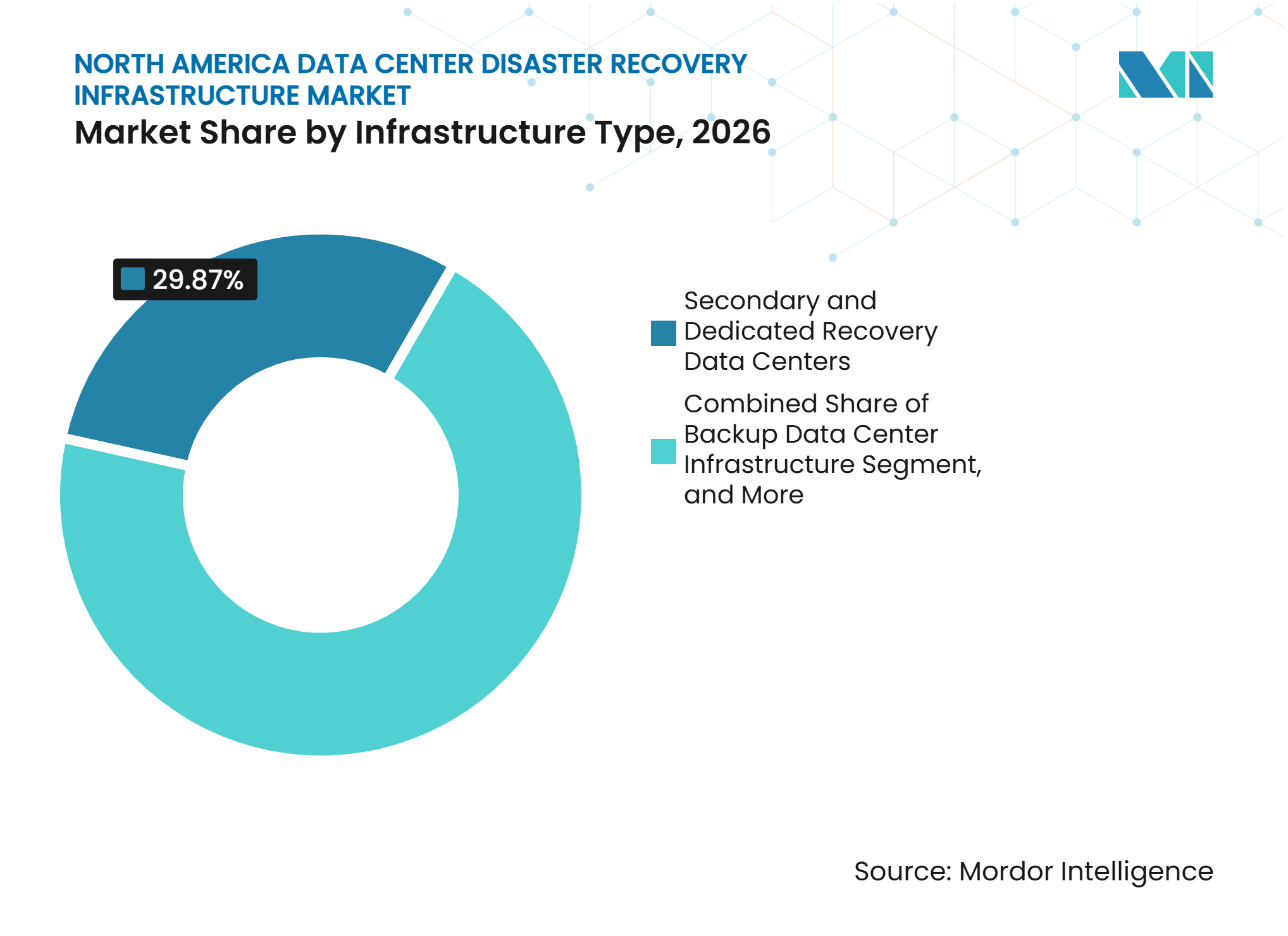
- By infrastructure type, Secondary and Dedicated Recovery Data Centers held a 29.87% share in 2026, while Cloud-Based Disaster Recovery Infrastructure is projected to expand at a 12.18% CAGR through 2032.
- By deployment model, On-Premises Disaster Recovery held a 31.42% share in 2026, while disaster recovery as a service is projected to expand at a 12.26% CAGR through 2032.
- By recovery architecture, Active-Passive held a 27.63% share in 2026, while Continuous Data Replication is projected to expand at a 12.14% CAGR through 2032.
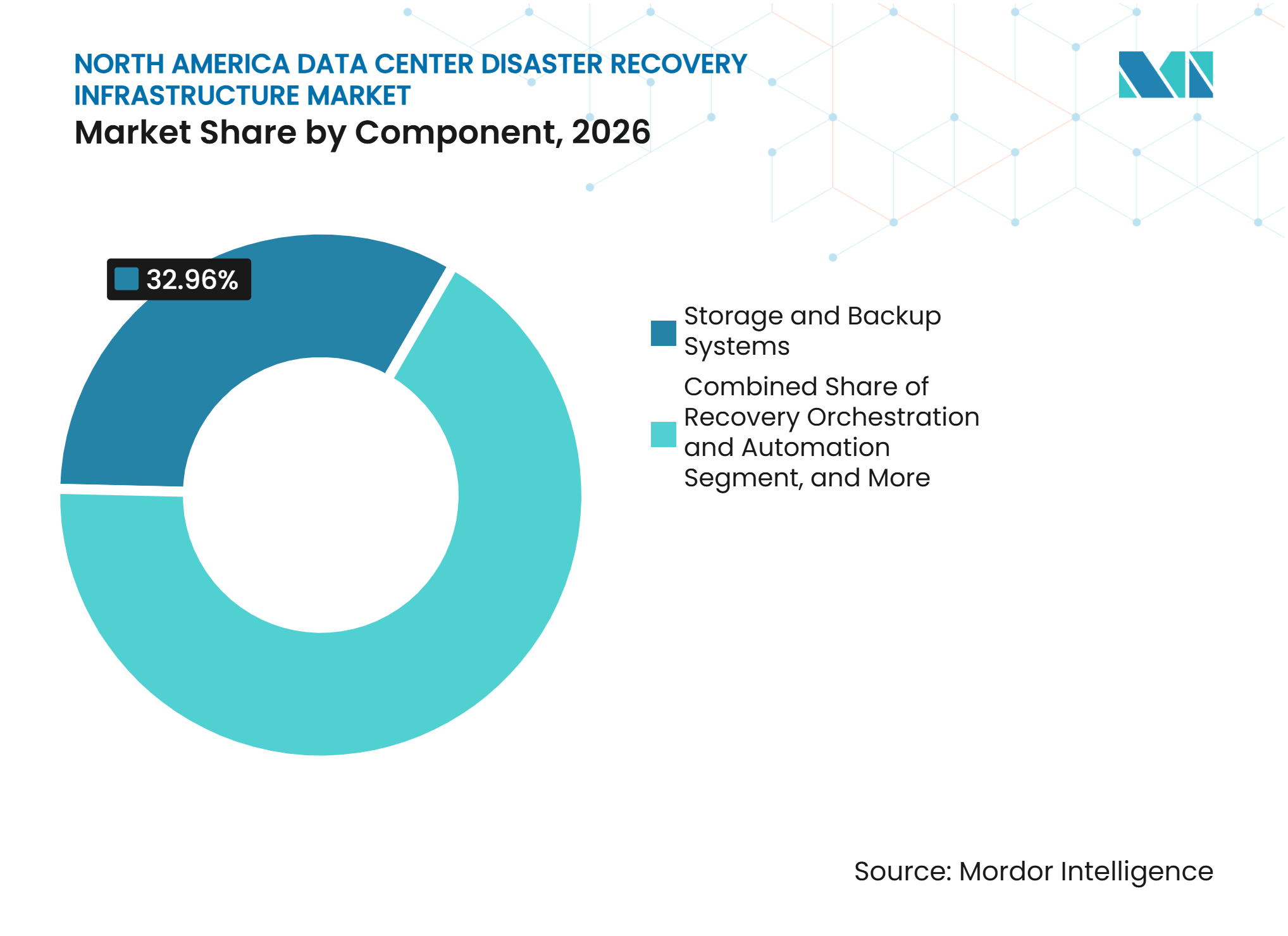
- By component, Storage and Backup Systems held a 32.96% share in 2026, while Recovery Orchestration and Automation is projected to expand at a 12.23% CAGR through 2032.
- By application, Critical Business Application Recovery held a 36.78% share in 2026, while Cloud-Native Application Recovery is projected to expand at a 12.28% CAGR through 2032.
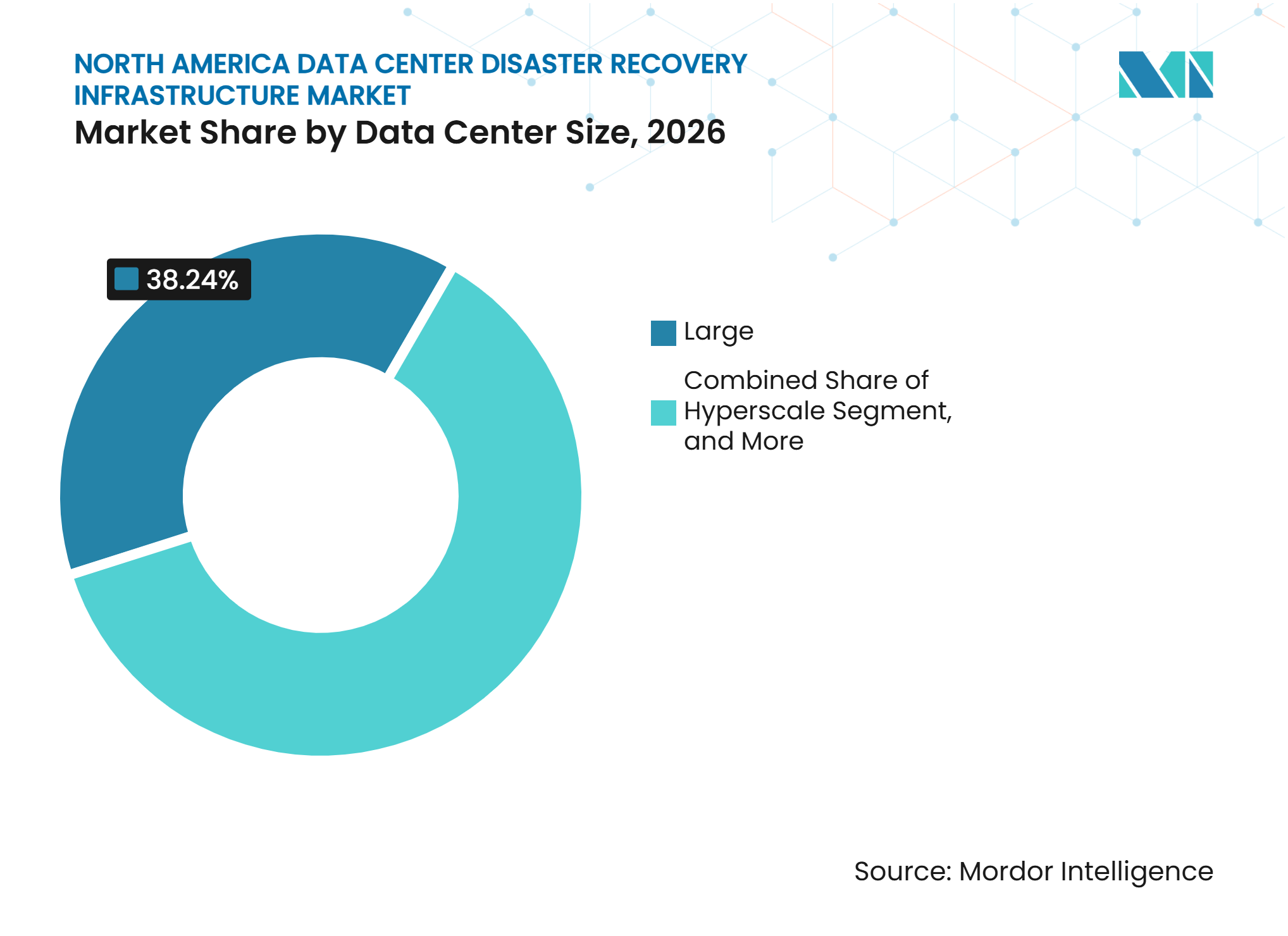
- By data center size, Large data centers held a 38.24% share in 2026, while Hyperscale data centers are projected to expand at a 12.16% CAGR through 2032.
- By data center type, Colocation data centers held a 43.19% share in 2026, while Cloud Service Providers are projected to expand at a 12.34% CAGR through 2032.
- By geography, the United States held 83.53% of the North America data center disaster recovery infrastructure market in 2026, while Mexico is projected to expand at a 12.32% CAGR through 2032.
Note: Market numbers in this report are based on Mordor Intelligence's proprietary estimation framework, which combines nine months of actuals with Q4 projections for base year 2026.
Market Trends and Insights
Drivers Impact Analysis of North America Data Center Disaster Recovery Infrastructure Market*
| Driver | (~) % Impact on CAGR Forecast | Geographic Relevance | Impact Timeline |
|---|---|---|---|
| Ransomware-Driven Demand for Immutable Recovery | +2.8% | Global, with United States accounting for 58% of disclosed attacks | Short term (≤ 2 years) |
| Hybrid and Multi-Cloud Workload Expansion | +2.3% | North America-wide, led by United States enterprise adoption | Medium term (2-4 years) |
| Regulatory and Contractual Recovery Accountability | +1.8% | United States federal and sector mandates, with spillover to Canada | Medium term (2-4 years) |
| Replacement of Idle Secondary Infrastructure With Consumption-Based Recovery | +1.4% | North America-wide, strongest in mid-market United States and Mexico | Medium term (2-4 years) |
| AI Workload Replication and High-Density Data Center Expansion | +1.1% | United States hyperscale corridors and Mexico's Querétaro region | Long term (≥ 4 years) |
| Grid-Event Exposure and Coordinated Utility-Node Resilience | +0.7% | ERCOT, PJM, and WECC regions in the United States | Short term (≤ 2 years) |
| Source: Mordor Intelligence | |||
Ransomware-Driven Demand for Immutable Recovery
Ransomware is changing recovery investment decisions because attackers increasingly target backup repositories as well as production data. Sophos reported that 56% of attacks encrypted data in 2026, making clean and isolated recovery copies essential for affected organizations. Organizations are responding by implementing immutable repositories that cannot be altered in a compromised production environment. This shifts immutable recovery from a specialist requirement to a broad procurement standard across the North America data center disaster recovery infrastructure market. It also increases demand for platforms that can validate clean data before a recovery workload is restored.
Hybrid and Multi-Cloud Workload Expansion
Enterprises are now running applications across on-premises systems, public clouds, and edge locations, which makes recovery design more difficult. The Disaster Recovery Journal identified the October 2025 AWS US-East outage as evidence that hidden service dependencies can limit intra-provider failover.[1] Cross-cloud replication can provide an additional recovery location when a wider provider disruption affects an application estate. This operating model requires vendor-neutral replication, consistent policy controls, and high-bandwidth connectivity between environments. The North America data center disaster recovery infrastructure market benefits because these requirements add software and network spending to conventional backup purchases. Buyers are also placing greater weight on recovery drills that test application dependencies rather than individual virtual machines.
Regulatory and Contractual Recovery Accountability
Recovery planning is becoming a documented obligation for organizations that manage regulated or public-sector workloads. Federal Data Center Enhancement Act implementation guidance requires agencies to improve data center operations and resiliency planning. NIST Cybersecurity Framework 2.0, FedRAMP 20x, HIPAA, PCI DSS, and Securities and Exchange Commission disclosure rules raise the cost of weak recovery documentation. These requirements make periodic testing, retained evidence, and clear accountability more important during procurement. Providers that combine recovery tools with compliance reporting have a clearer position in government, healthcare, and financial services accounts. The North America data center disaster recovery infrastructure market is gaining traction from this compliance-led demand, even as discretionary technology budgets are constrained.
Replacement of Idle Secondary Infrastructure With Consumption-Based Recovery
Traditional warm and cold sites require capital investment that remains underused until an incident occurs. Cloud-based continuous replication now enables organizations to achieve short recovery-point objectives without maintaining a dedicated secondary facility. This model is particularly relevant to mid-market firms that cannot justify separate facilities, specialized staff, and idle standby compute. Disaster recovery as a service also supports more frequent drills without disrupting production environments. Managed providers are consequently moving beyond capacity leasing toward packaged recovery operations and orchestration. This change broadens the addressable customer base for the North America data center disaster recovery infrastructure market while increasing pricing pressure on traditional secondary-site services.
Restraints Impact Analysis of North America Data Center Disaster Recovery Infrastructure Market*
| Restraint | (~) % Impact on CAGR Forecast | Geographic Relevance | Impact Timeline |
|---|---|---|---|
| High Implementation Costs and Competing Infrastructure Priorities | -1.4% | North America-wide, strongest in mid-market United States organizations | Medium term (2-4 years) |
| Legacy Application Integration Complexity | -0.9% | United States enterprise, particularly financial services and healthcare | Long term (≥ 4 years) |
| Recovery-Path Dependence on Cloud and Connectivity Providers | -0.6% | North America-wide | Medium term (2-4 years) |
| Shortage of Disaster Recovery and Data Center Resilience Specialists | -0.4% | North America-wide | Long term (≥ 4 years) |
| Source: Mordor Intelligence | |||
High Implementation Costs and Competing Infrastructure Priorities
Recovery investment is difficult to prioritize because its benefit is most visible only during an outage or cyber incident. A complete program can require continuous replication, standby compute, orchestration licenses, testing, and specialized services. These costs compete with AI infrastructure, cloud migration, security consolidation, and core application modernization. Organizations with the highest exposure may also lack the capital required to redesign their recovery architecture. The North America data center disaster recovery infrastructure market therefore faces slower adoption among budget-constrained mid-market buyers. Consumption-based services can reduce initial spending, but they do not eliminate the cost of configuration, testing, and governance.
Legacy Application Integration Complexity
Legacy applications can have undocumented dependencies that become visible only during a live failover. Mainframe systems, proprietary middleware, and closely linked databases often require more than a new recovery product. Teams must identify application relationships, sequence restarts, and verify data consistency before recovery objectives can be trusted. In regulated settings, an undocumented dependency can become a direct audit and operational risk. This complexity extends implementation schedules and can limit the use of standardized disaster recovery as a service offerings. It also favors providers with capabilities in discovery, dependency mapping, and recovery orchestration.
*Our forecasts treat driver/restraint impacts as directional, not additive. The impact forecasts reflect baseline growth, mix effects, and variable interactions.
North America Data Center Disaster Recovery Infrastructure Market Segment Analysis
By Infrastructure Type:
Cloud Migration Pressures Reshape Recovery ArchitectureSecondary and Dedicated Recovery Data Centers held 29.87% of the North America data center disaster recovery infrastructure market share in 2026. They remain important for latency-sensitive workloads that need clear physical separation from production systems. Backup Data Center Infrastructure and Replication and Data Protection Infrastructure continue to support layered recovery designs. These designs combine physical facilities with software-defined replication and isolated data copies. Cloud-Based Disaster Recovery Infrastructure is projected to grow at a 12.18% CAGR through 2032. Its growth reflects lower capital requirements and the ability to support automated regional failover. Rubrik launched Autonomous Business Recovery for Cloud Applications in June 2026, adding dependency mapping and sequenced recovery from validated clean points. This type of orchestration helps organizations restore connected applications rather than isolated technical resources. It also supports faster decision-making during an incident.
Cloud adoption does not remove demand for physical recovery infrastructure. Organizations are using tiered models where high-value applications receive continuous cloud replication. Cold workloads can remain on physical standby systems where data residency and sovereignty obligations apply. Failover and Recovery Orchestration Infrastructure is becoming more relevant as organizations manage these varied recovery tiers. Backup Storage Infrastructure is also important because immutable object storage limits the effect of ransomware-driven data corruption. The North America data center disaster recovery infrastructure market therefore supports several infrastructure types simultaneously. Spending is shifting toward coordinated architectures rather than a single standard recovery format. Providers that can manage mixed physical and cloud environments have a stronger route to enterprise accounts.



By Deployment Model:
Consumption Economics Displace the Dedicated Secondary SiteOn-Premises Disaster Recovery held a 31.42% share in 2026, supported by large enterprises with deterministic recovery requirements. Existing systems and application investments can make migration expensive and operationally difficult. Colocation-Based Recovery remains relevant where organizations need guaranteed bandwidth and controlled connectivity between sites. Hybrid Disaster Recovery offers another option for firms seeking physical control alongside cloud-based capacity. Disaster recovery as a service is projected to grow at a 12.26% CAGR through 2032. CBTS acquired Recovery Point Systems in September 2026 to add managed DRaaS, ransomware recovery, and colocation capabilities.[2] The transaction shows how providers are building integrated offerings for clients without specialist teams. These services also enable recurring testing and managed service-level commitments.
Cloud-Based Disaster Recovery is gaining traction because it lets teams stage recovery environments without permanently operating a second data center. AWS expanded Elastic Disaster Recovery to 36 global regions in July 2026, including Canada West and Mexico Central. The added coverage improves the choice of regional recovery locations for North American customers. AWS also introduced Recovery Plans in August 2026 for sequenced multi-server launches, approval gates, and recovery monitoring. These features can reduce manual errors during drills and live events. On-premises systems will continue to serve applications that require direct control or extensive redesign before migration. The North America data center disaster recovery infrastructure market will consequently retain a mix of dedicated, hybrid, colocation, and managed models. Vendor selection will increasingly depend on testing quality and application-specific recovery needs.
By Recovery Architecture:
Operational Continuity Demands Shift From Passive StandbyActive-Passive architecture held a 27.63% share in 2026 because it offers synchronized standby capacity without the cost of fully active duplicate systems. It remains suitable for organizations that can tolerate a short failover interval. Active-Active configurations are gaining traction in financial services and e-commerce environments where downtime immediately affects revenue. Continuous Data Replication is projected to expand at a 12.14% CAGR through 2032. The architecture limits data loss between conventional backup windows and supports stronger recovery-point objectives. Snowflake introduced RPO Assurance in 2026 with a service-level commitment for replica freshness. This signals that replication commitments are becoming standardized commercial offerings. Buyers are increasingly comparing recovery architectures based on recovery speed, data integrity, and test evidence.
Backup and Restore remains necessary for cold-tier data and long-term retention. Its limits are more apparent when attackers encrypt both production data and backup repositories. Sophos found that data was both encrypted and stolen in 16% of ransomware attacks during 2026. Organizations are responding with multi-tier designs that apply continuous replication to Tier-1 workloads. They use immutable backups and restore for less time-sensitive information. This structure creates greater demand for orchestration platforms that manage multiple recovery models through a single control plane. The North America data center disaster recovery infrastructure market benefits from this broader mix of architectures. It also raises the importance of clean-copy validation before workloads are returned to service.
By Component:
Automation Bridges the Gap Between Recovery Plans and ExecutionStorage and Backup Systems held a 32.96% share in 2026, reflecting broad investment in immutable storage and protected recovery repositories. Compute and Server Infrastructure remains necessary for standby capacity and recovery testing. Data Replication Software supports movement of application data across separate environments. Network and Connectivity Systems are also required to maintain low-latency replication between distributed locations. Recovery Orchestration and Automation is projected to grow at a 12.23% CAGR through 2032. Veeam Data Platform v13.1 added support for 14 hypervisor platforms and Active Directory Forest Recovery automation in July 2026. The release shows how suppliers are reducing manual steps that can delay a recovery. Automation is becoming a practical way to align documented plans with execution under pressure.
Identity recovery is particularly important because business applications cannot operate normally without secure directory services. Automated workflows can also establish validation steps before recovery systems reconnect to production networks. Security and recovery tools are becoming more connected as ransomware response requires both containment and restoration. Veeam also expanded malware scanning for NAS environments and cloud threat detection for Azure in its July 2026 release. These capabilities support recovery choices that account for the security state of the restored data. The North America data center disaster recovery infrastructure market is shifting toward platforms that unify backup, detection, and recovery operations. This shift can reduce handoffs between separate infrastructure and security teams. It also makes integration quality a more important competitive criterion.

By Application:
Mission-Critical Recovery Anchors Spending While Cloud-Native Demands AccelerateCritical Business Application Recovery held a 36.78% share in 2026, reflecting the priority given to ERP, core banking, and essential SaaS systems. Database and Data Platform Recovery supports the data layers beneath these applications. Virtual Machine and Workload Recovery remains essential across established enterprise technology estates. Cloud-Native Application Recovery is projected to grow at a 12.28% CAGR through 2032. Containerized applications and retrieval-augmented generation pipelines require recovery that understands application dependencies. The Disaster Recovery Journal found that fewer than one-third of respondents addressed Kubernetes and AI workload recovery in their current planning. This gap can create demand as these workloads become production-critical. The North America data center disaster recovery infrastructure market must therefore support more than virtual-machine-level failover.
Enterprise IT Recovery addresses broader continuity needs across complex, multi-site, and multi-cloud environments. High-Availability and Continuous Service Restoration also support organizations that cannot accept extended disruption. Cloud-native recovery requires teams to protect configuration data, identities, networking, and underlying platform services. Rubrik's Autonomous Business Recovery for Cloud Applications focuses on these linked components during restoration. This approach addresses a limitation of products that restore resources without rebuilding their full operating context. Providers are also extending malware scanning and cloud threat detection around unstructured data.
By Data Center Size:
Hyperscale Concentration Drives Recovery Infrastructure IntensityLarge data centers held a 38.24% share in 2026 because they concentrate enterprise and colocation capacity with redundant power, cooling, and connectivity. Medium and Small facilities remain relevant in regional deployments that address latency, resilience, or sovereignty requirements. Hyperscale data centers are projected to grow at a 12.16% CAGR through 2032 as AI infrastructure increases computing density. Larger facilities require more extensive planning because an outage can affect multiple customers and critical workloads. NERC identified large data center demand as a near-term challenge to bulk power system reliability in its 2025 assessment. The assessment noted events involving unexpected reductions of 1,000 MW or more during grid disturbances. These conditions increase the value of geographically separate recovery capacity. They also favor architectures that can shift workloads across regions.
Power availability is becoming a material recovery consideration for high-density facilities. NERC issued a 2025 alert on large-load interconnection, commissioning, and operating practices. Grid coordination requirements may lead operators to expand on-site resilience and remote failover options. Schneider Electric found that 7 of 13 major United States grid regions could operate below critical safety margins between 2025 and 2030. This makes active-active and continuous replication designs more relevant for concentrated computing estates. The North America data center disaster recovery infrastructure market is seeing increased demand from operators who must balance application continuity with grid-event exposure. Recovery strategy will increasingly include power, connectivity, and geographic diversity. This broadens the role of disaster recovery beyond data protection alone.
By Data Center Type:
Colocation Leads While Cloud Service Providers Redefine Recovery DeliveryColocation data centers held a 43.19% share in 2026 because they offer physical separation, carrier-neutral connectivity, and uptime commitments without a self-operated secondary site. Enterprise data centers continue to support low-latency workloads and controlled recovery environments. Edge sites also require localized continuity for workloads that cannot tolerate distant failover. Cloud Service Providers are projected to grow at a 12.34% CAGR through 2032. Their growth is supported by regional expansion, cross-region replication, and managed recovery tools. AWS added Canada West and Mexico Central to Elastic Disaster Recovery coverage in July 2026. This expands the recovery-destination options available to North American organizations. It also makes cloud services more practical for workloads that need regional recovery choices.
Colocation providers are adding managed DRaaS capabilities to move beyond infrastructure leasing. Cloud service providers are adding native orchestration and compliance tools to reduce implementation work for users. Google Cloud made cross-region backups generally available for its Backup and DR Service in June 2026. The service allows backup destinations to be separate from primary workload regions. This feature supports geographic control and data residency needs in multi-jurisdictional deployments. Competition will depend on how well each provider combines physical separation, cloud scale, and recovery management. The North America data center disaster recovery infrastructure market continues to support both colocation and cloud models because customer recovery requirements differ. Providers that offer clear portability between environments can better address these mixed requirements.
Geography Analysis
United States: Recovery Infrastructure as a Board-Level Investment
The United States held 83.53% of the North America data center disaster recovery infrastructure market share in 2026. Federal Data Center Enhancement Act guidance reinforces resilience planning across federal infrastructure. NIST Cybersecurity Framework 2.0 and FedRAMP 20x also increase the importance of documented recovery and testing. Reuters reported that a 2024 event prompted 60 Northern Virginia facilities to shift to on-site generation, prompting greater attention from PJM and Dominion Energy. The United States is integrating cyber resilience, compliance, and power resilience into its recovery strategies.
Mexico: Hyperscale Construction Creates a New Recovery Market
Mexico is projected to grow at a 12.32% CAGR through 2032, the fastest rate within the North America data center disaster recovery infrastructure market. MEXDC reported commitments totaling USD 82.5 billion for Mexican data center development through 2031. CloudHQ committed USD 4.8 billion for 6 data centers in Querétaro during 2025. AWS expanded Elastic Disaster Recovery to Mexico Central in July 2026, adding native regional support. Providers will need to align capacity planning with local connectivity and data residency requirements.
Canada and Regional Dynamics
Canada is seeing growing demand for recovery infrastructure as digital capacity and AI investment expand across several provinces. The City of Toronto continued its Enterprise IT Disaster Recovery Program with investments in Veritas NetBackup infrastructure during 2025.[3] AWS added Canada West to its Elastic Disaster Recovery coverage in 2026. Across North America, cloud coverage, hyperscale construction, and compliance requirements are encouraging more geographically distributed recovery plans.
Competitive Landscape
Market Concentration
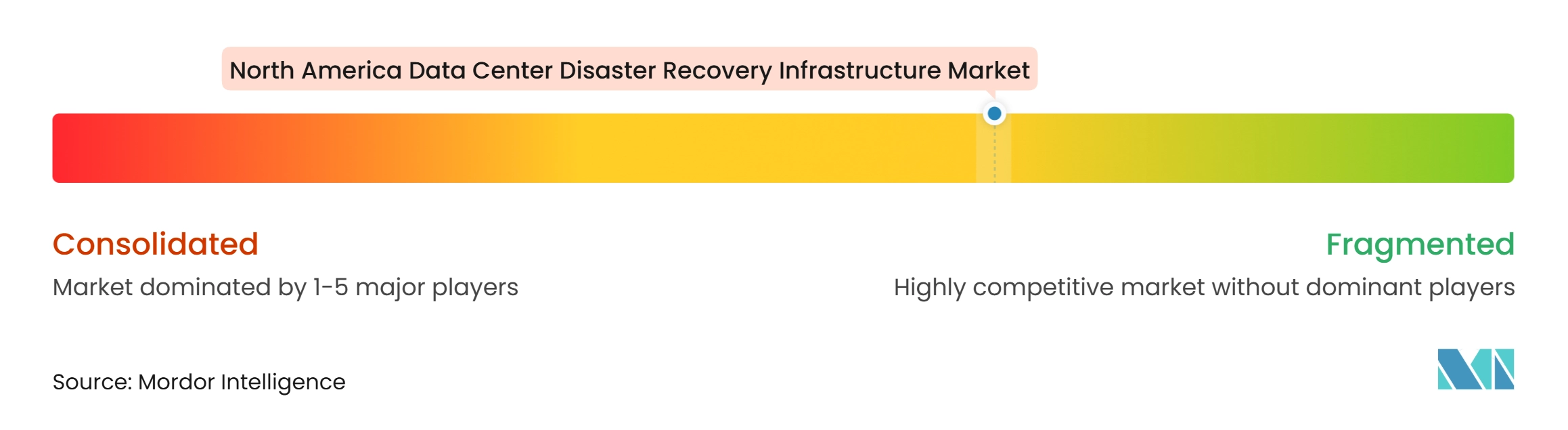
The North America data center disaster recovery infrastructure market is fragmented across cloud platforms, specialist data protection suppliers, managed service providers, and colocation operators. Amazon Web Services, Microsoft, and Google provide integrated cloud recovery infrastructure, while Veeam, Commvault, Rubrik, and Cohesity focus on software-led protection and orchestration. No provider dominates every recovery layer across on-premises, cloud, and managed environments. NetApp acquired JetStream Software in August 2026 to extend recovery for VMware environments on third-party storage and Azure NetApp Files.[4] The deal shows that acquisitions remain an important route to add cloud recovery capabilities.
Rubrik launched Autonomous Business Recovery for Cloud Applications in June 2026, using its Preemptive Recovery Engine to automate dependency-aware recovery. Veeam expanded its platform in July 2026 with recovery automation, broader hypervisor support, and malware scanning. These moves show a shift from backup management toward coordinated cyber recovery. Smaller providers such as Druva and Acronis target mid-market clients with SaaS models that reduce infrastructure management work. Simple deployment and audit-ready controls can support providers seeking customers outside the largest regulated accounts.
AI workload recovery remains an open product area because GPU clusters, vector databases, model checkpoints, and retrieval pipelines have specific continuity requirements. CBTS strengthened its managed portfolio through its September 2026 acquisition of Recovery Point Systems, adding DRaaS, ransomware recovery, and managed colocation. Competition is likely to center on orchestration depth, clean-data assurance, and management of hybrid workloads. The North America data center disaster recovery infrastructure market remains fragmented because no disclosed data shows a dominant combined share across these service layers.
North America Data Center Disaster Recovery Infrastructure Industry Leaders
-
Amazon Web Services, Inc.
-
Microsoft Corporation
-
International Business Machines Corporation
-
Hewlett Packard Enterprise Company
-
Broadcom Inc.
- *Disclaimer: Major Players sorted in no particular order
North America Data Center Disaster Recovery Infrastructure Market Companies Covered in this Report
- Amazon Web Services, Inc.
- Microsoft Corporation
- International Business Machines Corporation
- Hewlett Packard Enterprise Company
- Broadcom Inc.
- Google LLC
- Veeam Software Group GmbH
- Commvault Systems, Inc.
- Rubrik, Inc.
- Cohesity, Inc.
- Acronis International GmbH
- Druva Inc.
- Dell Technologies Inc.
- NetApp, Inc.
- Oracle Corporation
- Cisco Systems, Inc.
- TierPoint, LLC
- Evolve IP, LLC
- InterVision Systems, LLC
- Flexential Corp.
- Rackspace Technology, Inc.
- 11:11 Systems, Inc.
Recent Industry Developments in North America Data Center Disaster Recovery Infrastructure Market
- October 2026: Amazon Redshift launched automated cross-region snapshot copy, enabling provisioned clusters and serverless workgroups to continuously back up to user-specified destination regions without manual intervention, closing a previous operational gap by automatically copying the most recent snapshot during unplanned outages, independent of local snapshot schedules.
- September 2026: CBTS acquired Recovery Point Systems, a DRaaS and ransomware recovery specialist operating Tier III fiber-dense data centers. The transaction expands CBTS's enterprise recovery portfolio to include fully managed DRaaS with orchestrated SLAs, Ransomware Recovery as a Service with AI-powered backup validation, and managed colocation, positioning the combined entity as a single-vendor source for modernization, security, and recovery across North American enterprise and government clients.
- August 2026: NetApp acquired JetStream Software, a VMware disaster recovery and cloud migration specialist, to extend protection to VMware environments running on third-party storage and enable recovery to Azure NetApp Files, advancing NetApp's strategy of making hyperscaler cloud offerings the preferred destination for enterprise VMware workload recovery.
- August 2026: AWS Elastic Disaster Recovery introduced Recovery Plans, automating the sequential launch of multi-server applications during recovery events and drills with configurable wait times, approval gates, and real-time monitoring, eliminating a primary source of human error during high-pressure recovery scenarios.
North America Data Center Disaster Recovery Infrastructure Market Report Scope
The North America data center disaster recovery infrastructure market comprises solutions and services that enable organizations to restore data center operations, applications, and critical data following disruptions caused by natural disasters, cyberattacks, hardware failures, or other incidents. It includes backup and recovery systems, disaster recovery sites, replication solutions, cloud-based disaster recovery, and related services that support business continuity across North America data centers.
The North America Data Center Disaster Recovery Infrastructure Market Report is Segmented by Infrastructure Type (Secondary and Dedicated Recovery Data Centers, Backup Data Center Infrastructure, Replication and Data Protection Infrastructure, Failover and Recovery Orchestration Infrastructure, Backup Storage Infrastructure, Network and Connectivity Infrastructure for Recovery, and Cloud-Based Disaster Recovery Infrastructure), Deployment Model (On-Premises Disaster Recovery, Colocation-Based Recovery, Cloud-Based Disaster Recovery, Hybrid Disaster Recovery, and Disaster Recovery-as-a-Service [DRaaS]), Recovery Architecture (Active-Active, Active-Passive, Warm Standby, Cold Standby, Backup and Restore, and Continuous Data Replication), Component (Compute and Server Infrastructure, Storage and Backup Systems, Data Replication Software, Network and Connectivity Systems, Recovery Orchestration and Automation, and Monitoring, Testing, and Failover Management), Application (Critical Business Application Recovery, Database and Data Platform Recovery, Virtual Machine and Workload Recovery, Cloud-Native Application Recovery, Enterprise IT Recovery, and High-Availability and Continuous Service Restoration), Data Center Size (Small, Medium, Large, and Hyperscale), Data Center Type (Colocation, Cloud Service Providers [CSPs], and Enterprise and Edge), and Geography (United States, Canada, and Mexico). The Market Forecasts are Provided in Terms of Value (USD).
Segmentation Overview
| Secondary and Dedicated Recovery Data Centers |
| Backup Data Center Infrastructure |
| Replication and Data Protection Infrastructure |
| Failover and Recovery Orchestration Infrastructure |
| Backup Storage Infrastructure |
| Network and Connectivity Infrastructure for Recovery |
| Cloud-Based Disaster Recovery Infrastructure |
| On-Premises Disaster Recovery |
| Colocation-Based Recovery |
| Cloud-Based Disaster Recovery |
| Hybrid Disaster Recovery |
| Disaster Recovery-as-a-Service (DRaaS) |
| Active-Active |
| Active-Passive |
| Warm Standby |
| Cold Standby |
| Backup and Restore |
| Continuous Data Replication |
| Compute and Server Infrastructure |
| Storage and Backup Systems |
| Data Replication Software |
| Network and Connectivity Systems |
| Recovery Orchestration and Automation |
| Monitoring, Testing, and Failover Management |
| Critical Business Application Recovery |
| Database and Data Platform Recovery |
| Virtual Machine and Workload Recovery |
| Cloud-Native Application Recovery |
| Enterprise IT Recovery |
| High-Availability and Continuous Service Restoration |
| Small |
| Medium |
| Large |
| Hyperscale |
| Colocation |
| Cloud Service Providers (CSPs) |
| Enterprise and Edge |
| United States |
| Canada |
| Mexico |
| By Infrastructure Type | Secondary and Dedicated Recovery Data Centers |
| Backup Data Center Infrastructure | |
| Replication and Data Protection Infrastructure | |
| Failover and Recovery Orchestration Infrastructure | |
| Backup Storage Infrastructure | |
| Network and Connectivity Infrastructure for Recovery | |
| Cloud-Based Disaster Recovery Infrastructure | |
| By Deployment Model | On-Premises Disaster Recovery |
| Colocation-Based Recovery | |
| Cloud-Based Disaster Recovery | |
| Hybrid Disaster Recovery | |
| Disaster Recovery-as-a-Service (DRaaS) | |
| By Recovery Architecture | Active-Active |
| Active-Passive | |
| Warm Standby | |
| Cold Standby | |
| Backup and Restore | |
| Continuous Data Replication | |
| By Component | Compute and Server Infrastructure |
| Storage and Backup Systems | |
| Data Replication Software | |
| Network and Connectivity Systems | |
| Recovery Orchestration and Automation | |
| Monitoring, Testing, and Failover Management | |
| By Application | Critical Business Application Recovery |
| Database and Data Platform Recovery | |
| Virtual Machine and Workload Recovery | |
| Cloud-Native Application Recovery | |
| Enterprise IT Recovery | |
| High-Availability and Continuous Service Restoration | |
| By Data Center Size | Small |
| Medium | |
| Large | |
| Hyperscale | |
| By Data Center Type | Colocation |
| Cloud Service Providers (CSPs) | |
| Enterprise and Edge | |
| By Geography | United States |
| Canada | |
| Mexico |
Key Questions Answered in the Report
What is the size of the North America data center disaster recovery infrastructure market?
The market is projected to grow from USD 3.74 billion in 2027 to USD 6.38 billion by 2032, at an 11.27% CAGR.
What is driving demand for data center disaster recovery infrastructure in North America?
Ransomware exposure, hybrid and multi-cloud operations, compliance requirements, and consumption-based recovery services are key demand factors.
Which deployment model is growing fastest in the North America data center disaster recovery infrastructure sector?
Disaster recovery as a service is projected to expand at a 12.26% CAGR through 2032.
Which component has the largest share of spending?
Storage and Backup Systems held 32.96% share in 2026, supported by demand for immutable recovery repositories.
Which country is growing fastest for disaster recovery infrastructure in North America?
Mexico is projected to grow at a 12.32% CAGR through 2032 as data center development expands.
Why is recovery orchestration becoming more important?
Orchestration automates dependency-aware recovery steps, reduces manual errors, and supports faster testing during cyber incidents.